
Adapting to Challenges of the Business Environment Micro
Adapting to Challenges of the Business Environment
Micro Environment Business can adapt if it understands the impact on Management styles Vision Mission Rules and policies on the structure, culture and ethos Businesses must find a way to solve the problem ASAP in a sensible and sensitive manner
Market Environment Keys to adapting are information and relationships Management must research to get as much info as possible about: Large number of suppliers Customers and what they want and aspire to Intermediaries and how to use them effectively Unions involved, their membership and how they function Regulator and its rules, policies and power it has Competitors and what they offer
Macro Challenges If businesses adapt, it will have an edge over other businesses because: Be more prepared and flexible Will spend money on finding alternative resources/products if the supply becomes scarce Understand that within the global market, there is a huge diversity of needs, wants, values, priorities and take advantage of these Able to promote itself through being sensitive to people’s desire to buy from ethical, transparent, socially responsible and environmentally aware businesses
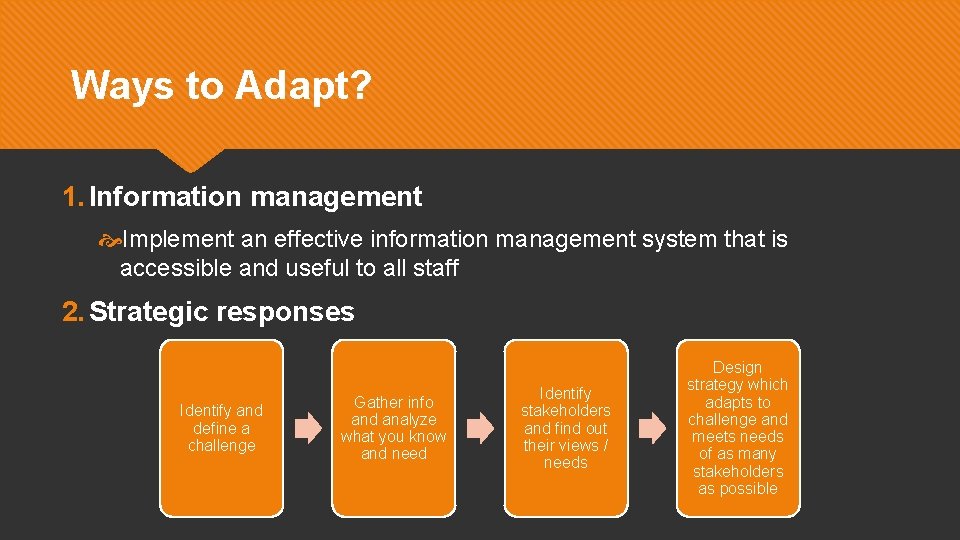
Ways to Adapt? 1. Information management Implement an effective information management system that is accessible and useful to all staff 2. Strategic responses Identify and define a challenge Gather info and analyze what you know and need Identify stakeholders and find out their views / needs Design strategy which adapts to challenge and meets needs of as many stakeholders as possible
Ways to Adapt? cont. . 3. Mergers, takeovers, acquisitions and alliances MERGER: an agreement that unites two existing companies into one new company. TAKEOVERS: the act of gaining control of a company by buying more of its shares than anyone else (hostile, without permission) ACQUISITION: they buy another company or part of a company (permission givens from Board) ALLIANCE: a relationship in which two countries, political parties, or organizations work together for some purpose. Engaging in any of the above allows great negotiating power and market share Two companies can combine different strengths
Ways to Adapt? cont. . 4. Organisational Design and Flexibility Integrate people. Information and technology to improve probability of business achieving its purpose 5. Direct influence of the environment Be sustainable, find substitute resources, follow laws Suppliers, customers and investors have become aware of the impact products have on the environment. 6. Social Responsibility towards the community Recipients benefit but so do employees Higher staff morale and job satisfactions being involved with helping others Marketing tool to impress customers/investors with their positive contribution
Lobbying, Networking and Power Relations Lobbying? trying to influence decisions made by officials in the government or members of regulatory agencies Hedging invest your money in such a way that its value grows at a faster rate than inflation Networking interacting with others to exchange ideas and information, to develop professional contacts and to give and get advice from other business people
Power Relationships Strategic Alliance Agreements Agreement between two or more firms to engage in an activity on a shared basis Persuasions of large investors Businesses with large, powerful investors can gain credit easier and better deals with suppliers Company Representative’s influence Acts on behalf of the company (represents companies beliefs, policies, products and services) and responsible for the image. Decisions about the business are sometimes based on the CRs attitude, intelligence and communication skills
- Slides: 9