
Adapting the Visualization Toolkit for Many Core Processors
- Slides: 43
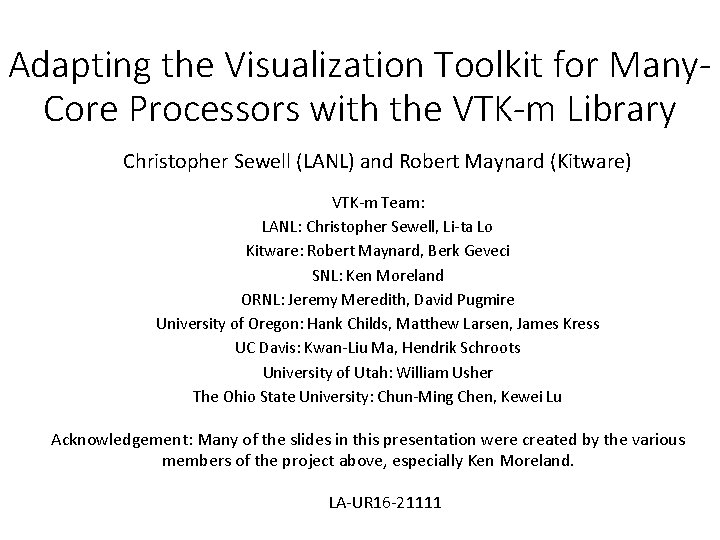
Adapting the Visualization Toolkit for Many. Core Processors with the VTK-m Library Christopher Sewell (LANL) and Robert Maynard (Kitware) VTK-m Team: LANL: Christopher Sewell, Li-ta Lo Kitware: Robert Maynard, Berk Geveci SNL: Ken Moreland ORNL: Jeremy Meredith, David Pugmire University of Oregon: Hank Childs, Matthew Larsen, James Kress UC Davis: Kwan-Liu Ma, Hendrik Schroots University of Utah: William Usher The Ohio State University: Chun-Ming Chen, Kewei Lu Acknowledgement: Many of the slides in this presentation were created by the various members of the project above, especially Ken Moreland. LA-UR 16 -21111
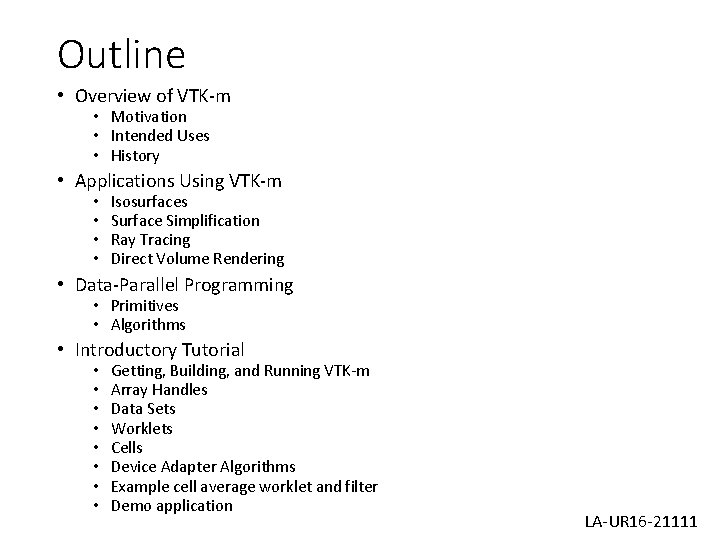
Outline • Overview of VTK-m • Motivation • Intended Uses • History • Applications Using VTK-m • • Isosurfaces Surface Simplification Ray Tracing Direct Volume Rendering • Data-Parallel Programming • Primitives • Algorithms • Introductory Tutorial • • Getting, Building, and Running VTK-m Array Handles Data Sets Worklets Cells Device Adapter Algorithms Example cell average worklet and filter Demo application LA-UR 16 -21111
Overview of VTK-m Motivation, Intended Uses, History LA-UR 16 -21111
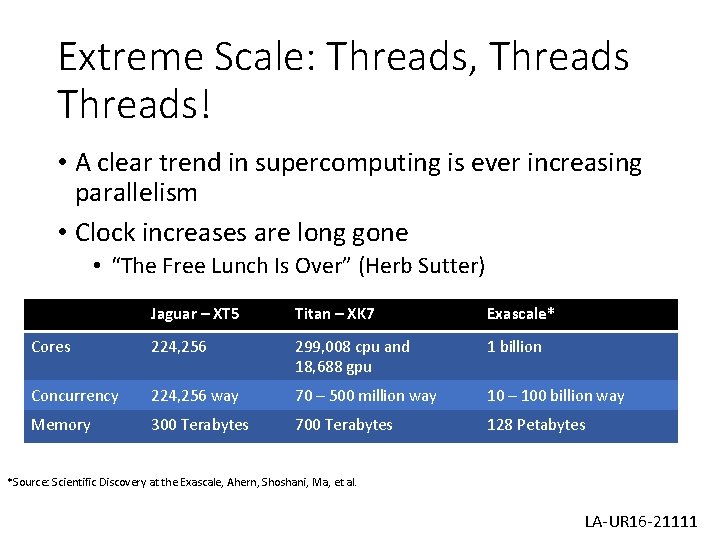
Extreme Scale: Threads, Threads! • A clear trend in supercomputing is ever increasing parallelism • Clock increases are long gone • “The Free Lunch Is Over” (Herb Sutter) Jaguar – XT 5 Titan – XK 7 Exascale* Cores 224, 256 299, 008 cpu and 18, 688 gpu 1 billion Concurrency 224, 256 way 70 – 500 million way 10 – 100 billion way Memory 300 Terabytes 700 Terabytes 128 Petabytes *Source: Scientific Discovery at the Exascale, Ahern, Shoshani, Ma, et al. LA-UR 16 -21111
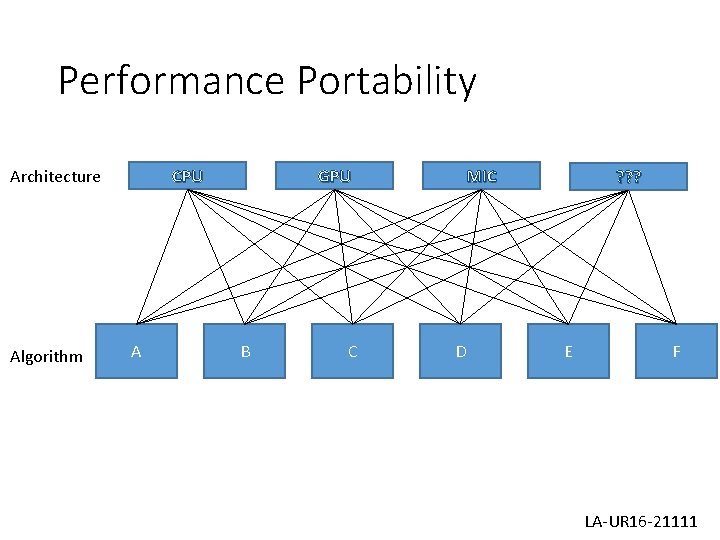
Performance Portability CPU Architecture Algorithm A GPU B C MIC D ? ? ? E F LA-UR 16 -21111
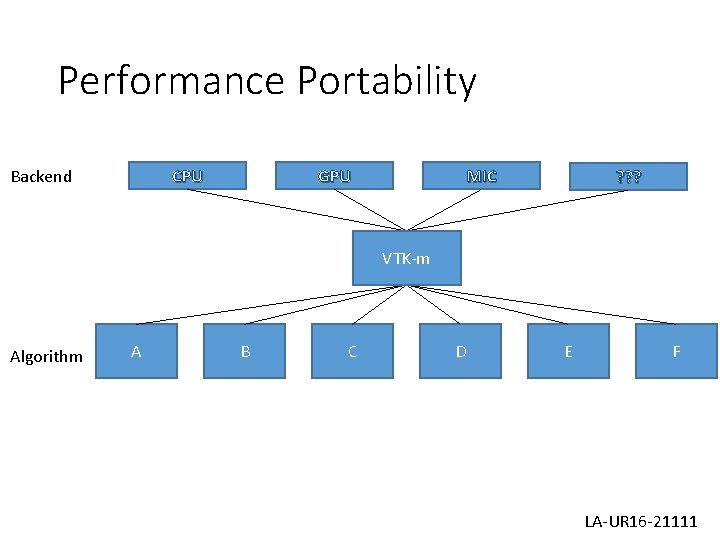
Performance Portability CPU Backend GPU MIC ? ? ? VTK-m Algorithm A B C D E F LA-UR 16 -21111
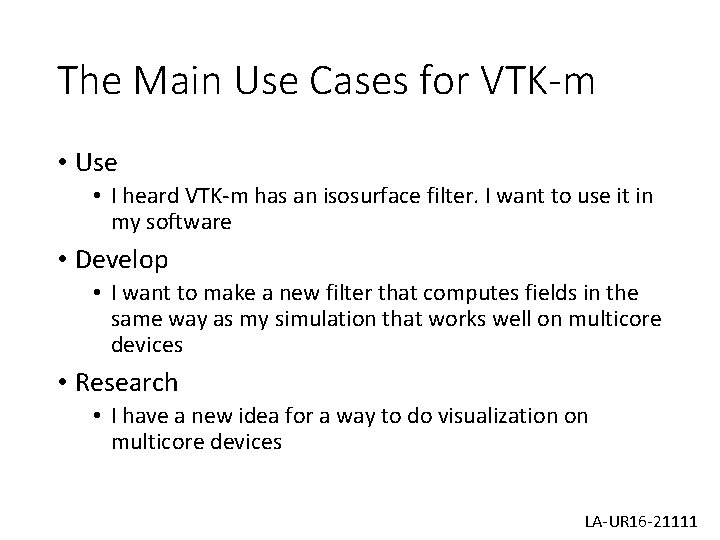
The Main Use Cases for VTK-m • Use • I heard VTK-m has an isosurface filter. I want to use it in my software • Develop • I want to make a new filter that computes fields in the same way as my simulation that works well on multicore devices • Research • I have a new idea for a way to do visualization on multicore devices LA-UR 16 -21111
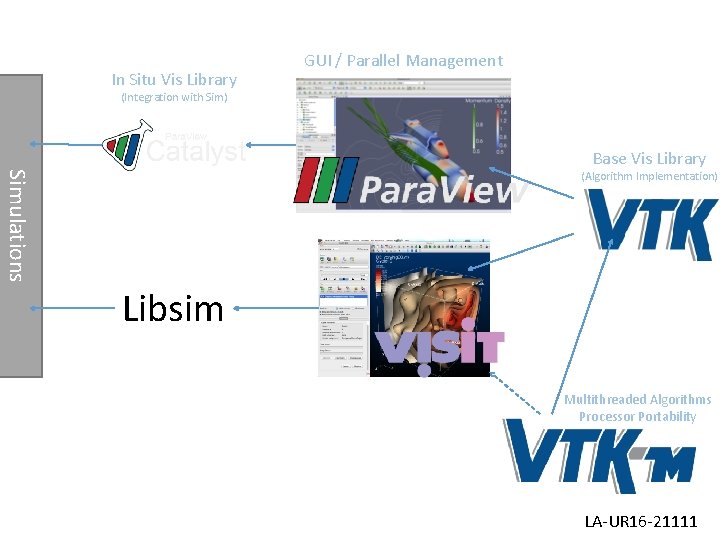
In Situ Vis Library GUI / Parallel Management (Integration with Sim) Base Vis Library Simulations (Algorithm Implementation) Libsim Multithreaded Algorithms Processor Portability LA-UR 16 -21111
Applications Using VTK-m Example Applications LA-UR 16 -21111
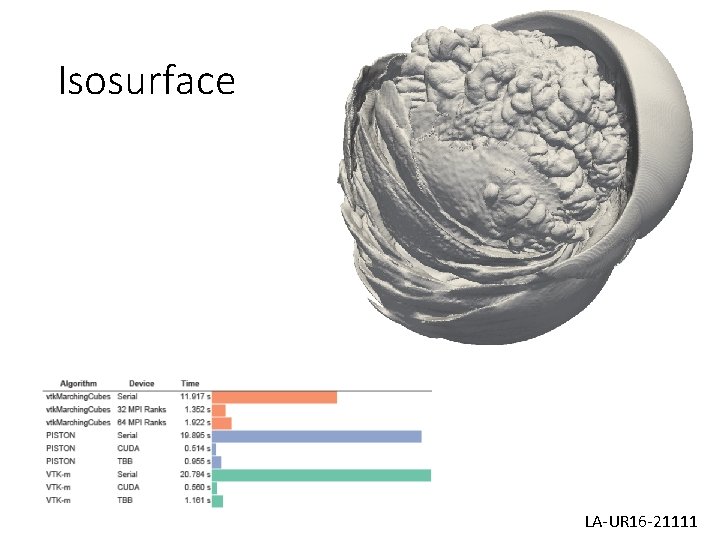
Isosurface LA-UR 16 -21111
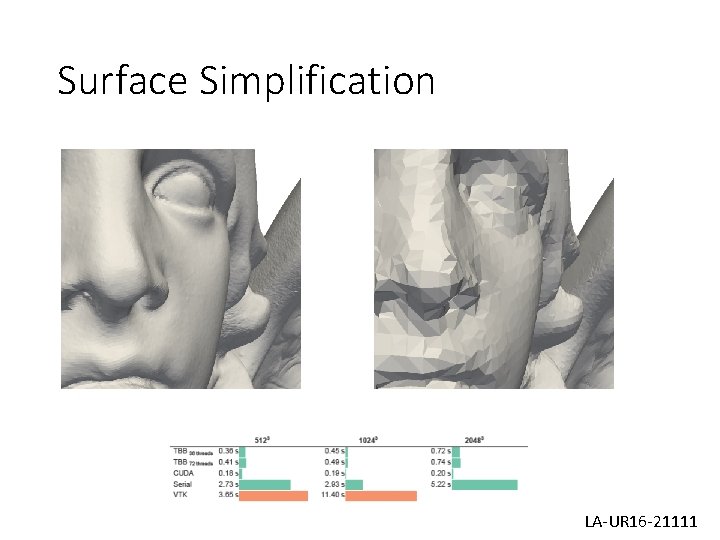
Surface Simplification LA-UR 16 -21111
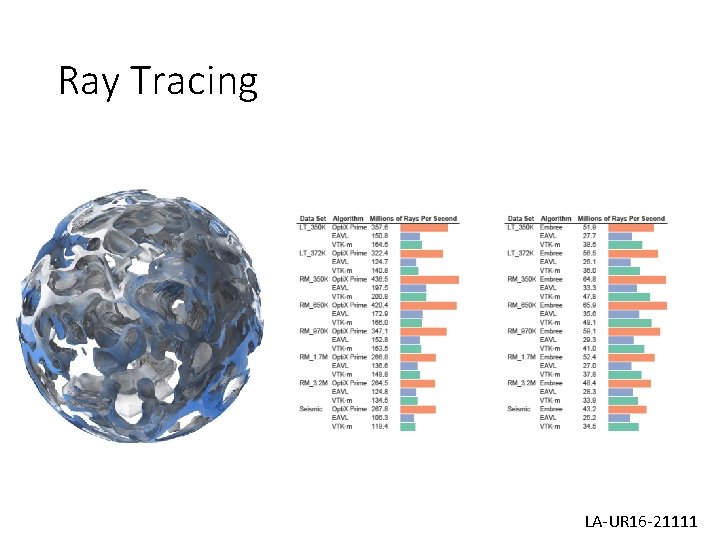
Ray Tracing LA-UR 16 -21111
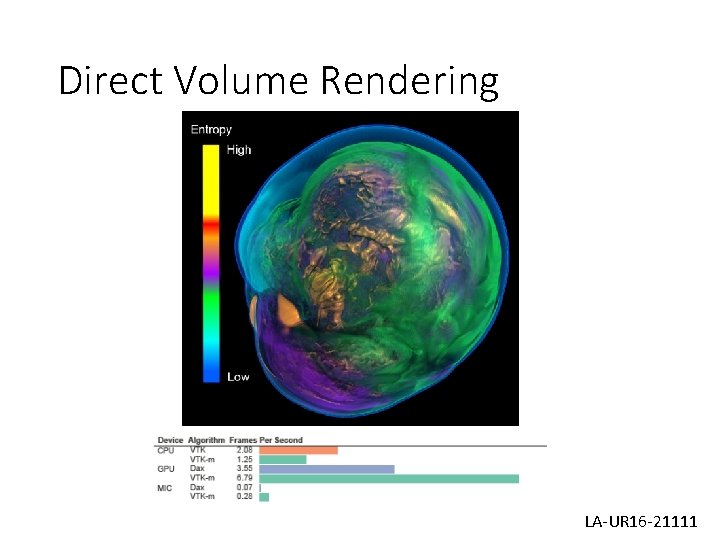
Direct Volume Rendering LA-UR 16 -21111
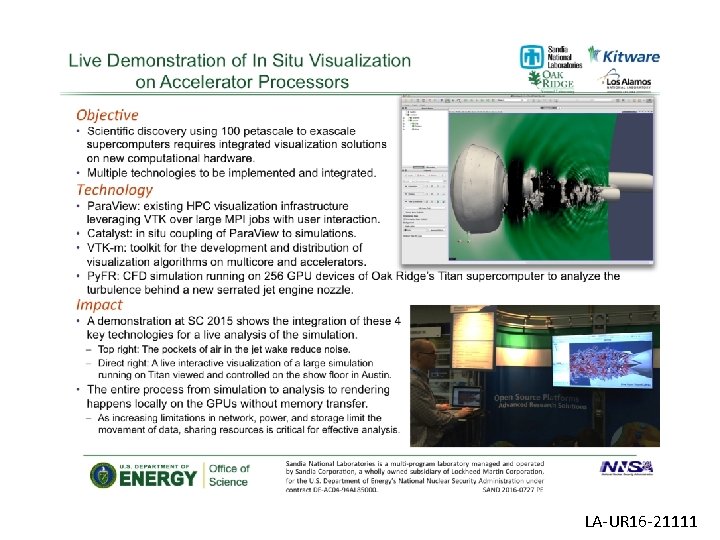
LA-UR 16 -21111
Data-Parallel Programming Primitives and Algorithms LA-UR 16 -21111
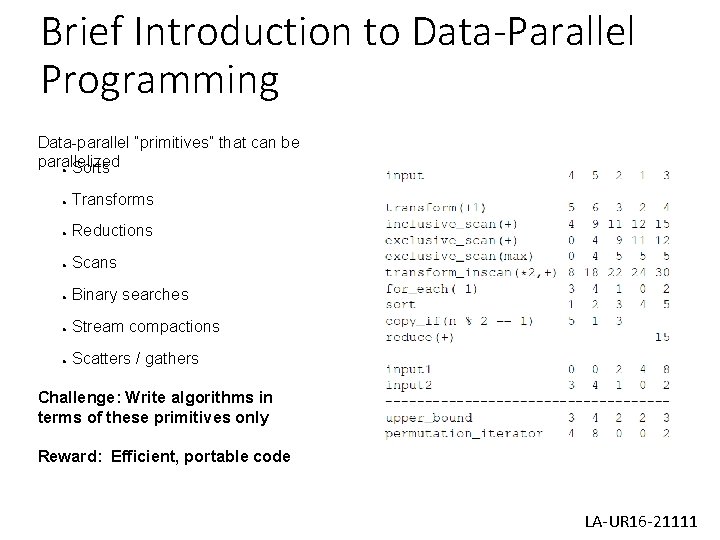
Brief Introduction to Data-Parallel Programming Data-parallel “primitives” that can be parallelized ● Sorts ● Transforms ● Reductions ● Scans ● Binary searches ● Stream compactions ● Scatters / gathers Challenge: Write algorithms in terms of these primitives only Reward: Efficient, portable code LA-UR 16 -21111 LA-UR-13 -23729
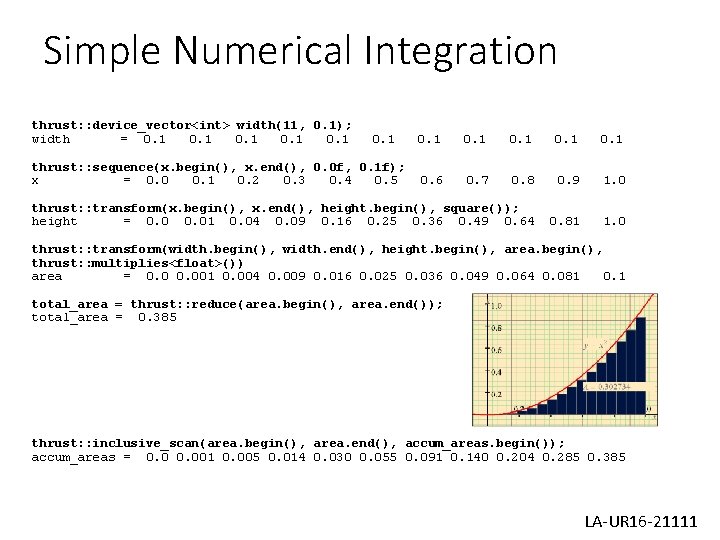
Simple Numerical Integration thrust: : device_vector<int> width(11, 0. 1); width = 0. 1 0. 6 0. 7 0. 8 0. 9 1. 0 thrust: : transform(x. begin(), x. end(), height. begin(), square()); height = 0. 01 0. 04 0. 09 0. 16 0. 25 0. 36 0. 49 0. 64 0. 81 1. 0 thrust: : sequence(x. begin(), x. end(), 0. 0 f, 0. 1 f); x = 0. 0 0. 1 0. 2 0. 3 0. 4 0. 5 thrust: : transform(width. begin(), width. end(), height. begin(), area. begin(), thrust: : multiplies<float>()) area = 0. 001 0. 004 0. 009 0. 016 0. 025 0. 036 0. 049 0. 064 0. 081 0. 1 total_area = thrust: : reduce(area. begin(), area. end()); total_area = 0. 385 thrust: : inclusive_scan(area. begin(), area. end(), accum_areas. begin()); accum_areas = 0. 001 0. 005 0. 014 0. 030 0. 055 0. 091 0. 140 0. 204 0. 285 0. 385 LA-UR 16 -21111
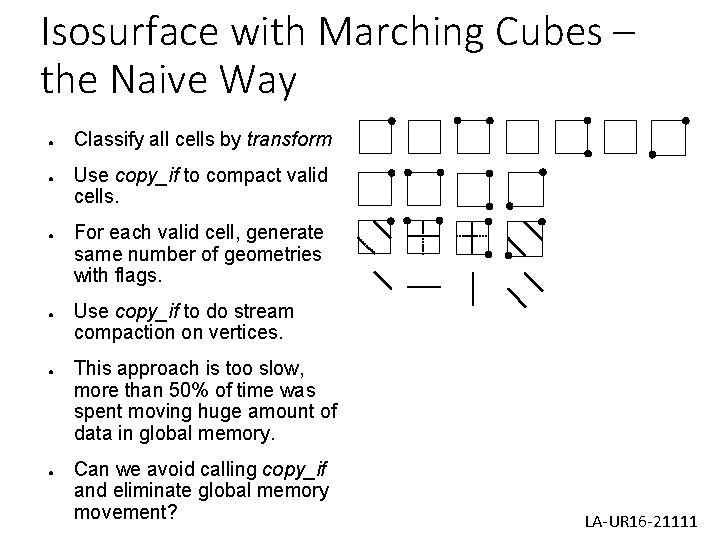
Isosurface with Marching Cubes – the Naive Way ● ● ● Classify all cells by transform Use copy_if to compact valid cells. For each valid cell, generate same number of geometries with flags. Use copy_if to do stream compaction on vertices. This approach is too slow, more than 50% of time was spent moving huge amount of data in global memory. Can we avoid calling copy_if and eliminate global memory movement? LA-UR 16 -21111 LA-UR-13 -23729
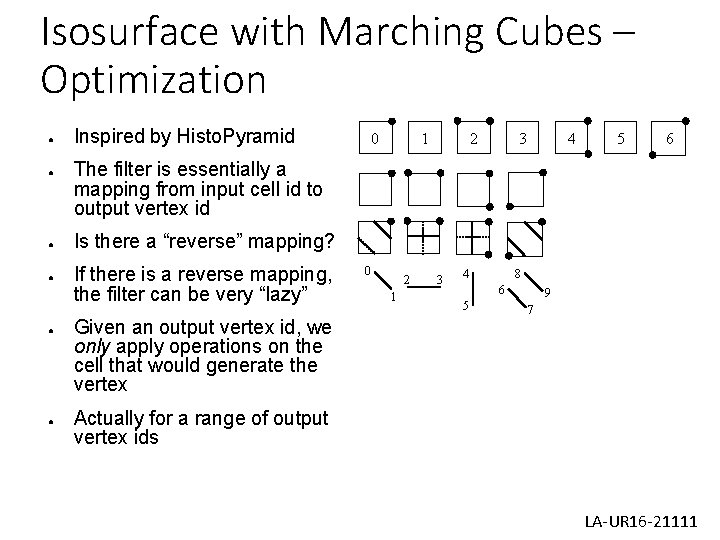
Isosurface with Marching Cubes – Optimization ● ● ● Inspired by Histo. Pyramid 0 1 2 3 4 5 6 The filter is essentially a mapping from input cell id to output vertex id Is there a “reverse” mapping? If there is a reverse mapping, the filter can be very “lazy” Given an output vertex id, we only apply operations on the cell that would generate the vertex 0 2 1 3 4 8 6 5 9 7 Actually for a range of output vertex ids LA-UR 16 -21111 LA-UR-13 -23729
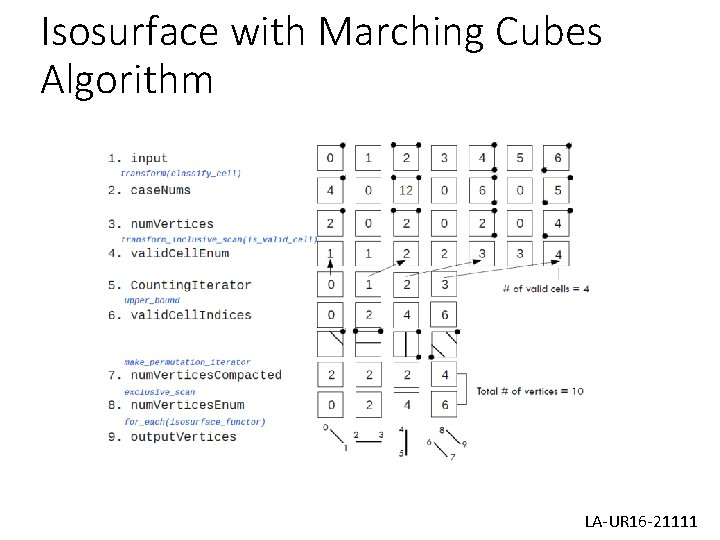
Isosurface with Marching Cubes Algorithm LA-UR 16 -21111 LA-UR-13 -23729
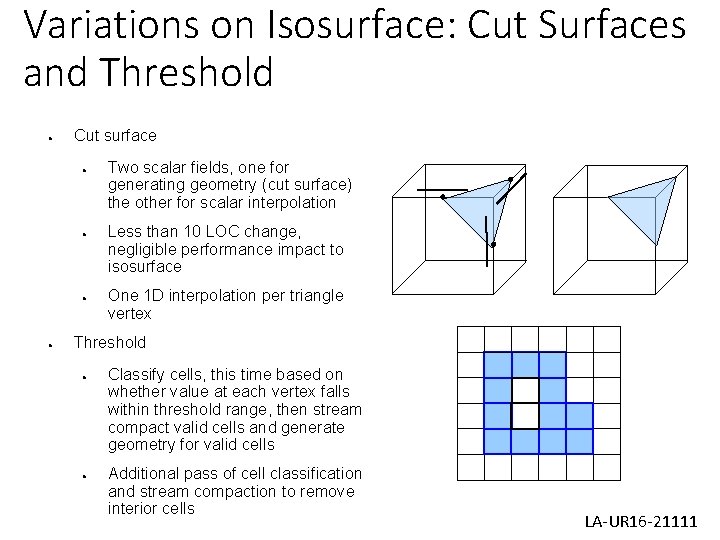
Variations on Isosurface: Cut Surfaces and Threshold ● Cut surface ● ● Two scalar fields, one for generating geometry (cut surface) the other for scalar interpolation Less than 10 LOC change, negligible performance impact to isosurface One 1 D interpolation per triangle vertex Threshold ● ● Classify cells, this time based on whether value at each vertex falls within threshold range, then stream compact valid cells and generate geometry for valid cells Additional pass of cell classification and stream compaction to remove interior cells LA-UR 16 -21111 LA-UR-13 -23729
Introductory Tutorial How to get started using VTK-m LA-UR 16 -21111
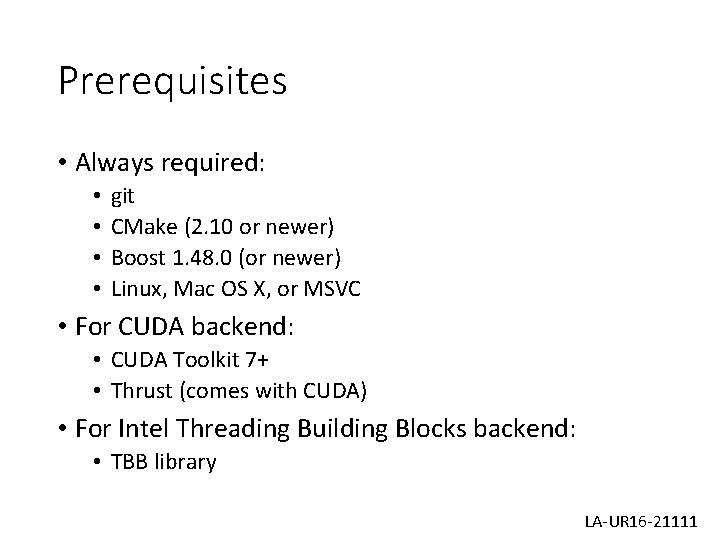
Prerequisites • Always required: • • git CMake (2. 10 or newer) Boost 1. 48. 0 (or newer) Linux, Mac OS X, or MSVC • For CUDA backend: • CUDA Toolkit 7+ • Thrust (comes with CUDA) • For Intel Threading Building Blocks backend: • TBB library LA-UR 16 -21111
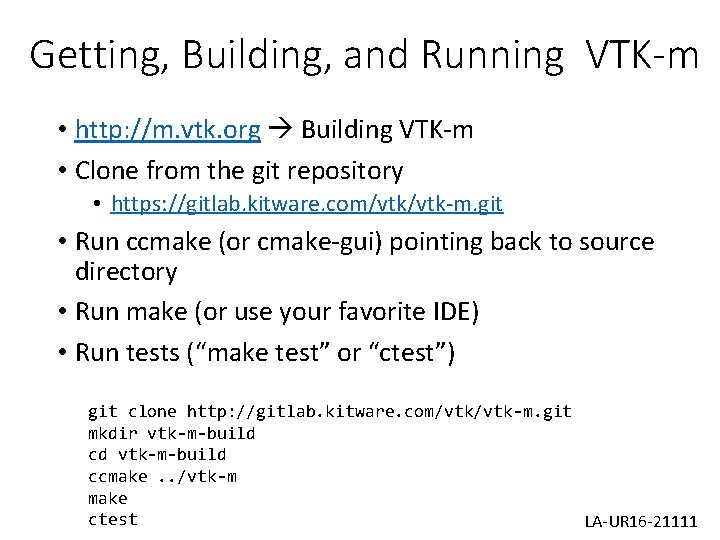
Getting, Building, and Running VTK-m • http: //m. vtk. org Building VTK-m • Clone from the git repository • https: //gitlab. kitware. com/vtk-m. git • Run ccmake (or cmake-gui) pointing back to source directory • Run make (or use your favorite IDE) • Run tests (“make test” or “ctest”) git clone http: //gitlab. kitware. com/vtk-m. git mkdir vtk-m-build cd vtk-m-build ccmake. . /vtk-m make ctest LA-UR 16 -21111
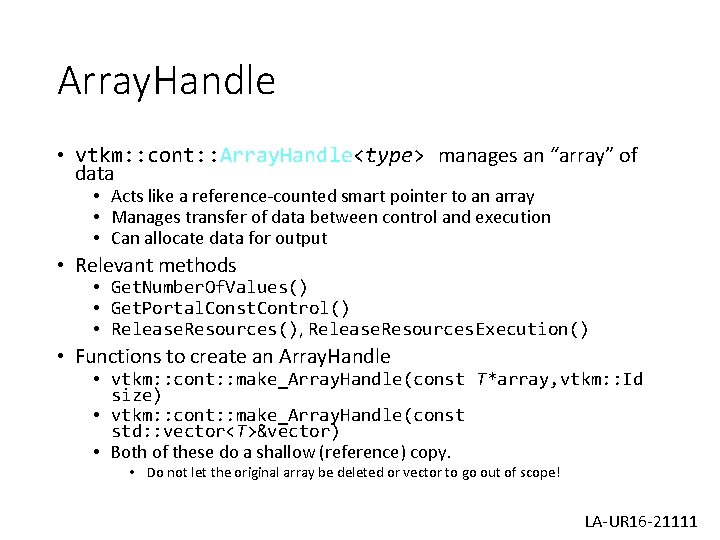
Array. Handle • vtkm: : cont: : Array. Handle<type> manages an “array” of data • Acts like a reference-counted smart pointer to an array • Manages transfer of data between control and execution • Can allocate data for output • Relevant methods • Get. Number. Of. Values() • Get. Portal. Const. Control() • Release. Resources(), Release. Resources. Execution() • Functions to create an Array. Handle • vtkm: : cont: : make_Array. Handle(const T*array, vtkm: : Id size) • vtkm: : cont: : make_Array. Handle(const std: : vector<T>&vector) • Both of these do a shallow (reference) copy. • Do not let the original array be deleted or vector to go out of scope! LA-UR 16 -21111
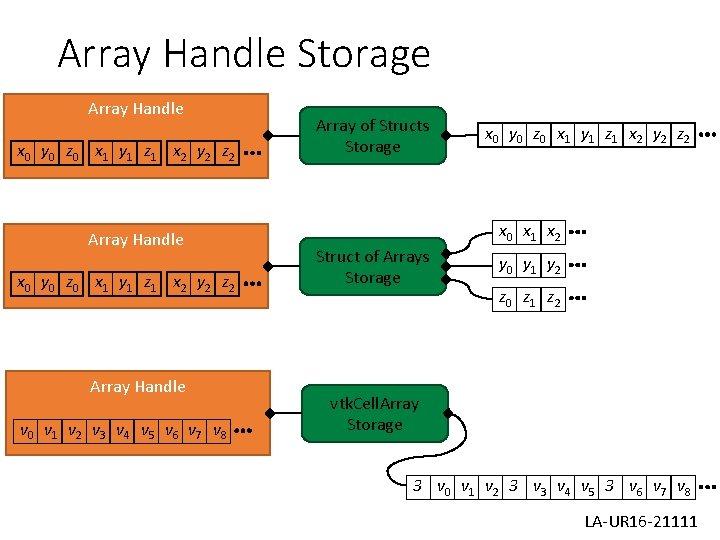
Array Handle Storage Array Handle x 0 y 0 z 0 x 1 y 1 z 1 x 2 y 2 z 2 Array Handle v 0 v 1 v 2 v 3 v 4 v 5 v 6 v 7 v 8 Array of Structs Storage x 0 y 0 z 0 x 1 y 1 z 1 x 2 y 2 z 2 x 0 x 1 x 2 Struct of Arrays Storage y 0 y 1 y 2 z 0 z 1 z 2 vtk. Cell. Array Storage 3 v 0 v 1 v 2 3 v 4 v 5 3 v 6 v 7 v 8 LA-UR 16 -21111
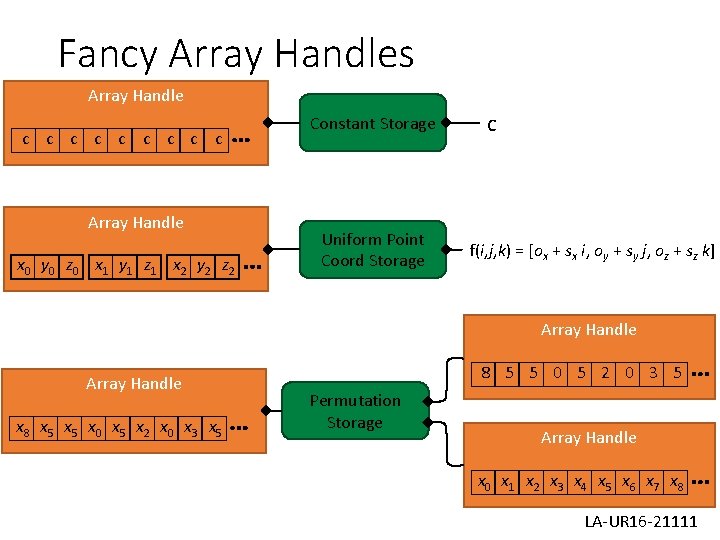
Fancy Array Handles Array Handle c c c c c Array Handle x 0 y 0 z 0 x 1 y 1 z 1 x 2 y 2 z 2 Constant Storage Uniform Point Coord Storage c f(i, j, k) = [ox + sx i, oy + sy j, oz + sz k] Array Handle x 8 x 5 x 0 x 5 x 2 x 0 x 3 x 5 8 5 5 0 5 2 0 3 5 Permutation Storage Array Handle x 0 x 1 x 2 x 3 x 4 x 5 x 6 x 7 x 8 LA-UR 16 -21111
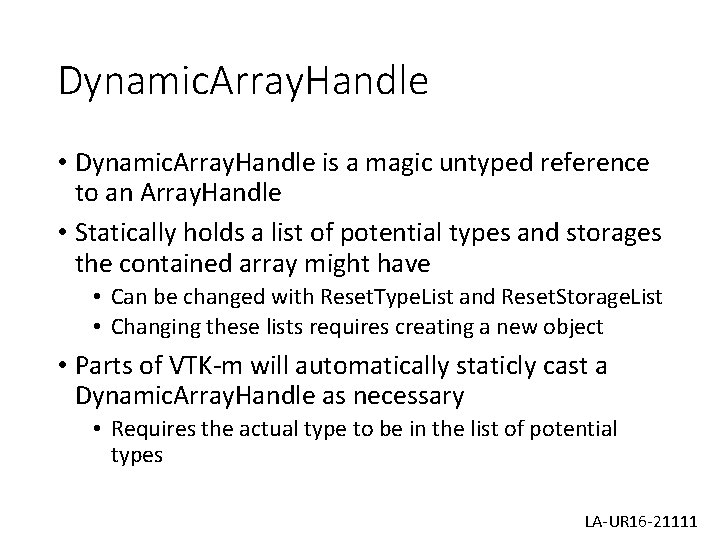
Dynamic. Array. Handle • Dynamic. Array. Handle is a magic untyped reference to an Array. Handle • Statically holds a list of potential types and storages the contained array might have • Can be changed with Reset. Type. List and Reset. Storage. List • Changing these lists requires creating a new object • Parts of VTK-m will automatically staticly cast a Dynamic. Array. Handle as necessary • Requires the actual type to be in the list of potential types LA-UR 16 -21111
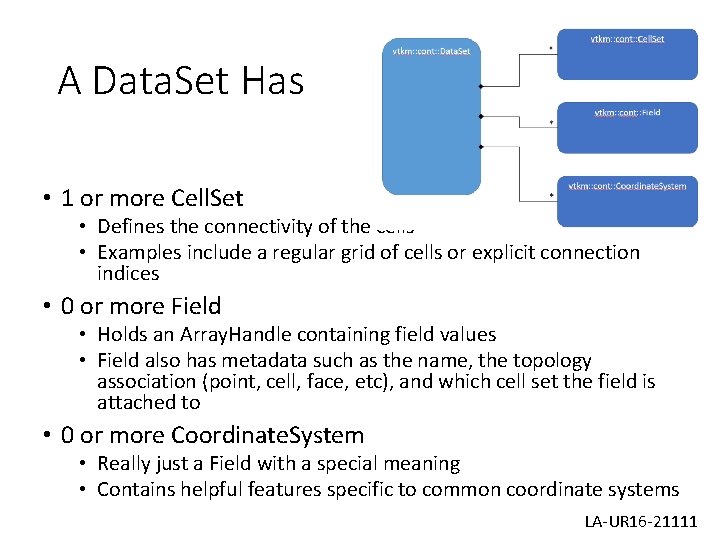
A Data. Set Has • 1 or more Cell. Set • Defines the connectivity of the cells • Examples include a regular grid of cells or explicit connection indices • 0 or more Field • Holds an Array. Handle containing field values • Field also has metadata such as the name, the topology association (point, cell, face, etc), and which cell set the field is attached to • 0 or more Coordinate. System • Really just a Field with a special meaning • Contains helpful features specific to common coordinate systems LA-UR 16 -21111
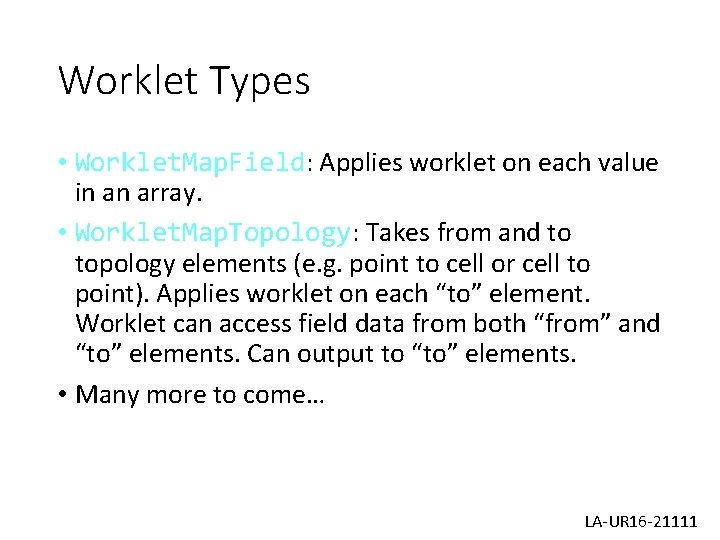
Worklet Types • Worklet. Map. Field: Applies worklet on each value in an array. • Worklet. Map. Topology: Takes from and to topology elements (e. g. point to cell or cell to point). Applies worklet on each “to” element. Worklet can access field data from both “from” and “to” elements. Can output to “to” elements. • Many more to come… LA-UR 16 -21111
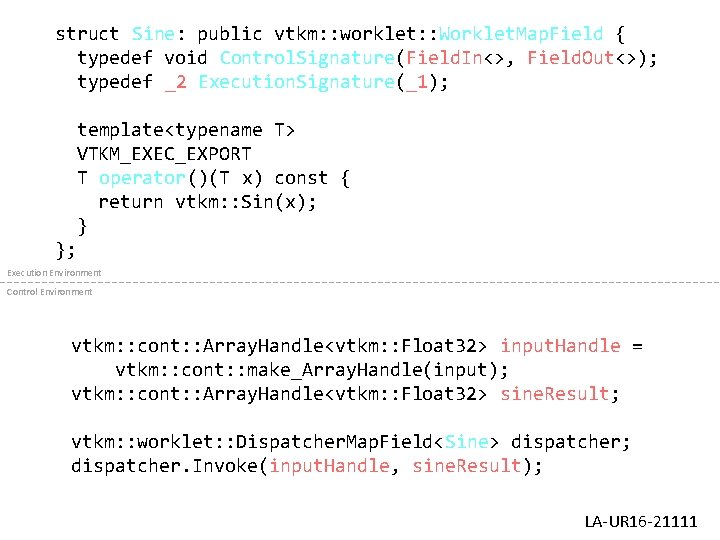
struct Sine: public vtkm: : worklet: : Worklet. Map. Field { typedef void Control. Signature(Field. In<>, Field. Out<>); typedef _2 Execution. Signature(_1); template<typename T> VTKM_EXEC_EXPORT T operator()(T x) const { return vtkm: : Sin(x); } }; Execution Environment Control Environment vtkm: : cont: : Array. Handle<vtkm: : Float 32> input. Handle = vtkm: : cont: : make_Array. Handle(input); vtkm: : cont: : Array. Handle<vtkm: : Float 32> sine. Result; vtkm: : worklet: : Dispatcher. Map. Field<Sine> dispatcher; dispatcher. Invoke(input. Handle, sine. Result); LA-UR 16 -21111
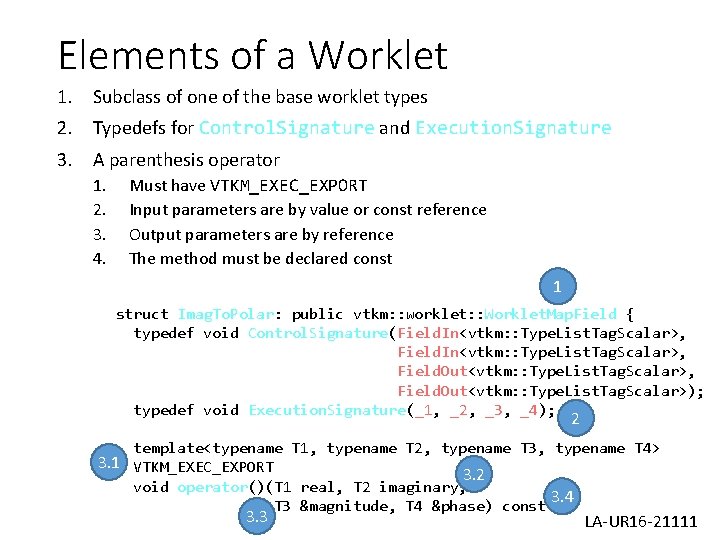
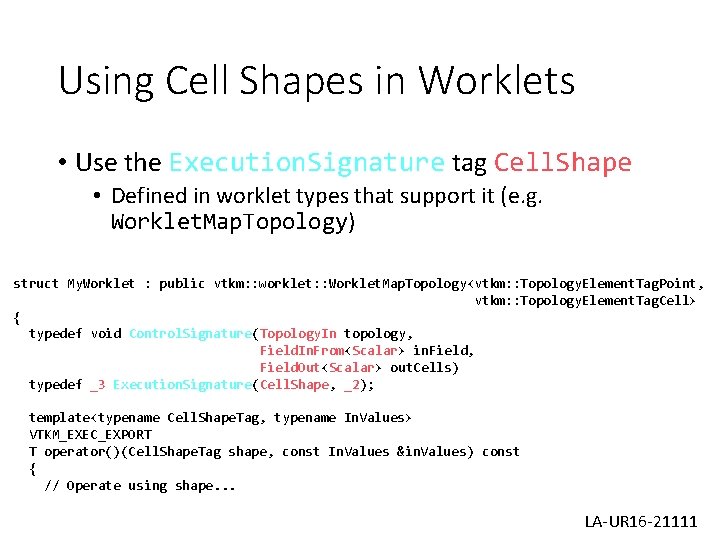
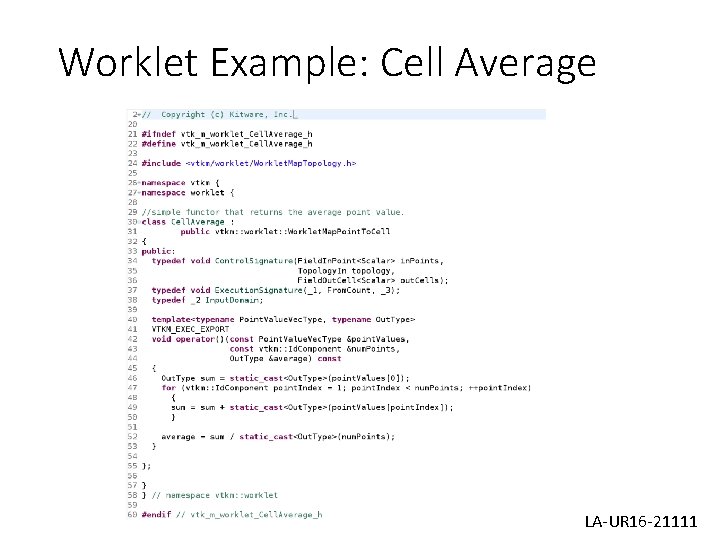
Elements of a Worklet 1. Subclass of one of the base worklet types 2. Typedefs for Control. Signature and Execution. Signature 3. A parenthesis operator 1. 2. 3. 4. Must have VTKM_EXEC_EXPORT Input parameters are by value or const reference Output parameters are by reference The method must be declared const 1 struct Imag. To. Polar: public vtkm: : worklet: : Worklet. Map. Field { typedef void Control. Signature(Field. In<vtkm: : Type. List. Tag. Scalar>, Field. Out<vtkm: : Type. List. Tag. Scalar>); typedef void Execution. Signature(_1, _2, _3, _4); 2 template<typename T 1, typename T 2, typename T 3, typename T 4> 3. 1 VTKM_EXEC_EXPORT 3. 2 void operator()(T 1 real, T 2 imaginary, 3. 4 T 3 &magnitude, T 4 &phase) const { 3. 3 LA-UR 16 -21111
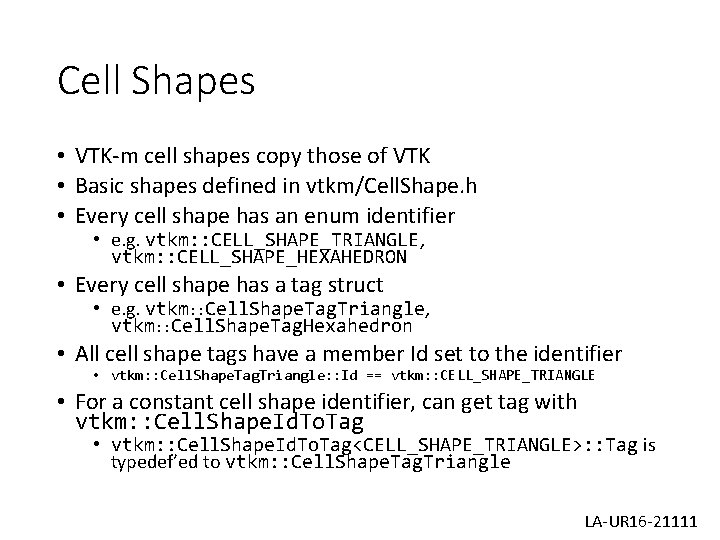
Cell Shapes • VTK-m cell shapes copy those of VTK • Basic shapes defined in vtkm/Cell. Shape. h • Every cell shape has an enum identifier • e. g. vtkm: : CELL_SHAPE_TRIANGLE, vtkm: : CELL_SHAPE_HEXAHEDRON • Every cell shape has a tag struct • e. g. vtkm: : Cell. Shape. Tag. Triangle, vtkm: : Cell. Shape. Tag. Hexahedron • All cell shape tags have a member Id set to the identifier • vtkm: : Cell. Shape. Tag. Triangle: : Id == vtkm: : CELL_SHAPE_TRIANGLE • For a constant cell shape identifier, can get tag with vtkm: : Cell. Shape. Id. To. Tag • vtkm: : Cell. Shape. Id. To. Tag<CELL_SHAPE_TRIANGLE>: : Tag is typedef’ed to vtkm: : Cell. Shape. Tag. Triangle LA-UR 16 -21111
Using Cell Shapes in Worklets • Use the Execution. Signature tag Cell. Shape • Defined in worklet types that support it (e. g. Worklet. Map. Topology) struct My. Worklet : public vtkm: : worklet: : Worklet. Map. Topology<vtkm: : Topology. Element. Tag. Point, vtkm: : Topology. Element. Tag. Cell> { typedef void Control. Signature(Topology. In topology, Field. In. From<Scalar> in. Field, Field. Out<Scalar> out. Cells) typedef _3 Execution. Signature(Cell. Shape, _2); template<typename Cell. Shape. Tag, typename In. Values> VTKM_EXEC_EXPORT T operator()(Cell. Shape. Tag shape, const In. Values &in. Values) const { // Operate using shape. . . LA-UR 16 -21111
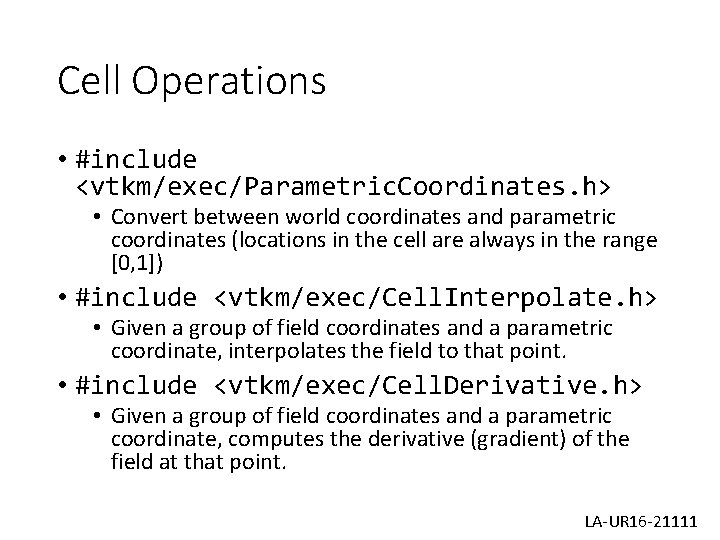
Cell Operations • #include <vtkm/exec/Parametric. Coordinates. h> • Convert between world coordinates and parametric coordinates (locations in the cell are always in the range [0, 1]) • #include <vtkm/exec/Cell. Interpolate. h> • Given a group of field coordinates and a parametric coordinate, interpolates the field to that point. • #include <vtkm/exec/Cell. Derivative. h> • Given a group of field coordinates and a parametric coordinate, computes the derivative (gradient) of the field at that point. LA-UR 16 -21111
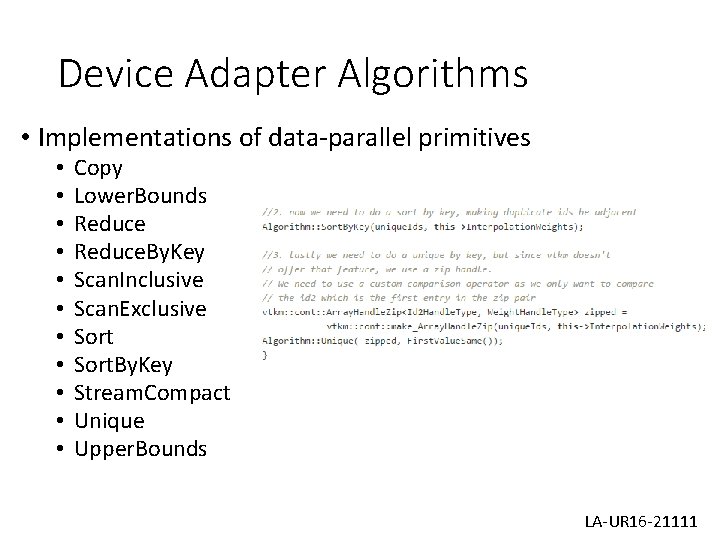
Device Adapter Algorithms • Implementations of data-parallel primitives • • • Copy Lower. Bounds Reduce. By. Key Scan. Inclusive Scan. Exclusive Sort. By. Key Stream. Compact Unique Upper. Bounds LA-UR 16 -21111
Worklet Example: Cell Average LA-UR 16 -21111
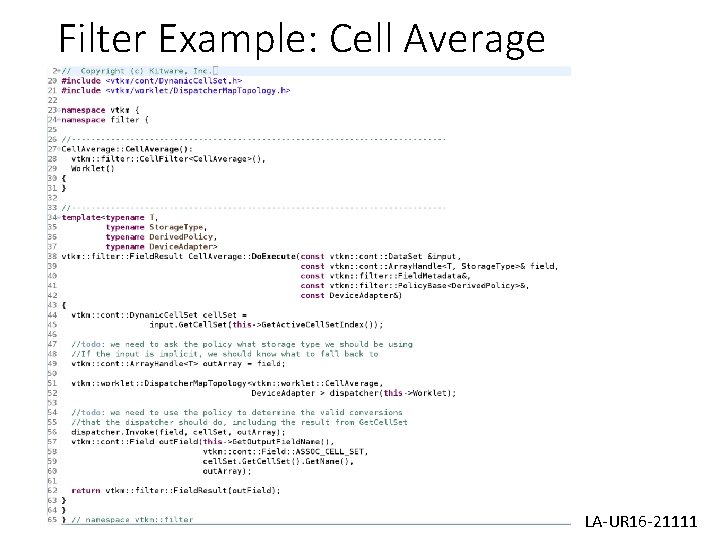
Filter Example: Cell Average LA-UR 16 -21111
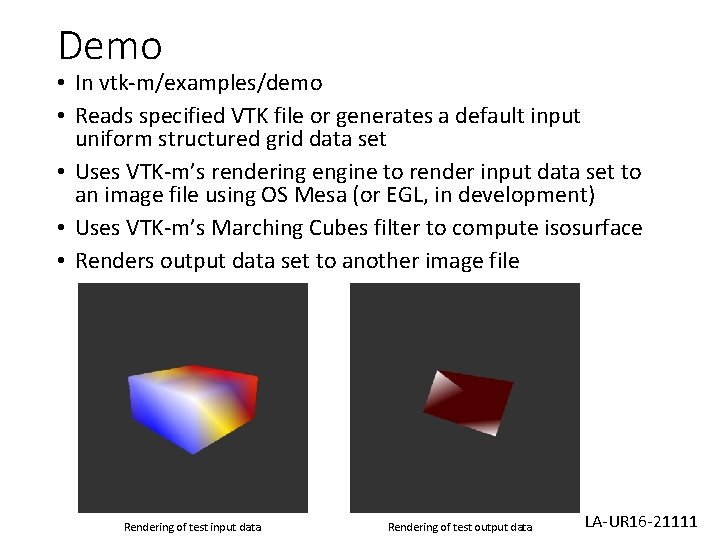
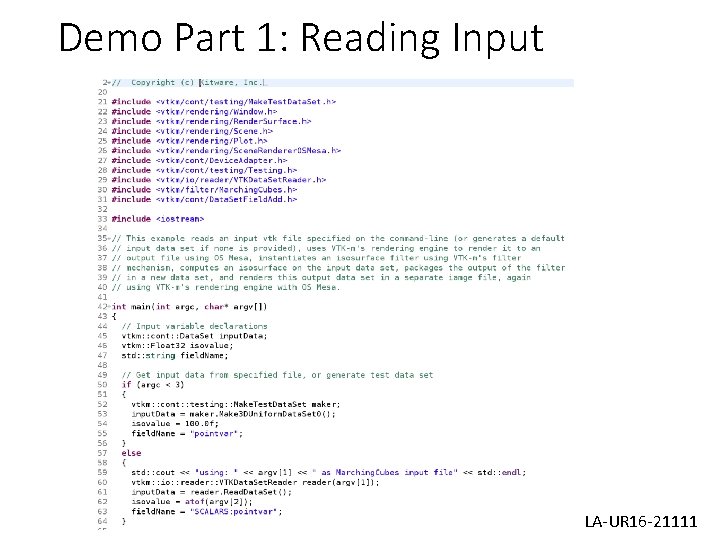
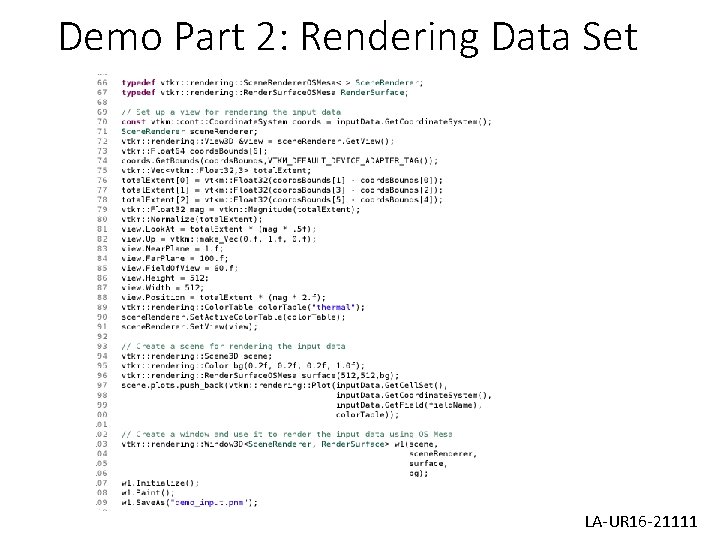
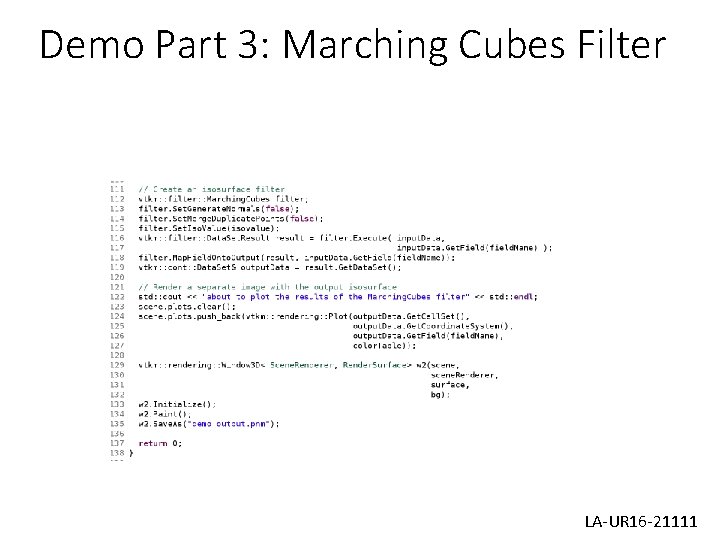
Demo • In vtk-m/examples/demo • Reads specified VTK file or generates a default input uniform structured grid data set • Uses VTK-m’s rendering engine to render input data set to an image file using OS Mesa (or EGL, in development) • Uses VTK-m’s Marching Cubes filter to compute isosurface • Renders output data set to another image file Rendering of test input data Rendering of test output data LA-UR 16 -21111
Demo Part 1: Reading Input LA-UR 16 -21111
Demo Part 2: Rendering Data Set LA-UR 16 -21111
Demo Part 3: Marching Cubes Filter LA-UR 16 -21111
Acknowledgements • This material is based upon work supported by the U. S. Department of Energy, Office of Science, Office of Advanced Scientic Computing Research, under Award Numbers 14 -017566 and 12 -015215. • SDAV: The Scalable Data Management, Analysis, and Visualization Sci. DAC Institute • XVis: Visualization for the Extreme-Scale Scientific. Computation Ecosystem LA-UR 16 -21111