
Adapting Organizations to Todays Markets CHAPTER 8 Nickels
- Slides: 56
* * * Adapting Organizations to Today’s Markets * * CHAPTER ** 8 * Nickels Mc. Hugh Mc. Graw-Hill/Irwin Understanding Business, 8 e 1 -1 8 -1 © 2008 The Mc. Graw-Hill Companies, Inc. , All Rights Reserved.
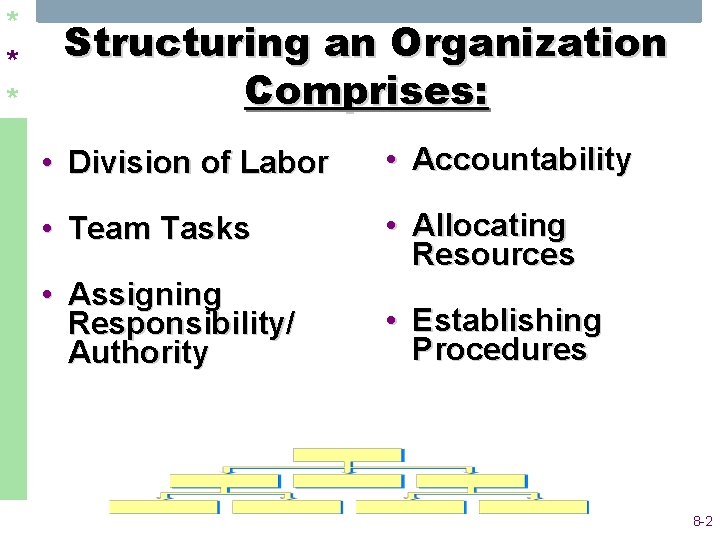
* * * Structuring an Organization Comprises: • Division of Labor • Accountability • Team Tasks • Allocating Resources • Assigning Responsibility/ Authority • Establishing Procedures 8 -2
* * * EVERYBODY IS DOING IT Building An Organization From The Bottom Up 8 -3
* * * II. THE CHANGING ORGANIZATION A. The Historical Development of Organizational Design Learning goal 1 Explain the organizational theories of Fayol and Weber Fayol’s Principles of Organization. Max Weber and Organizational Theory Turning Principles into Organizational Design 8 -4
* * * III. ISSUES INVOLVED IN STRUCTURING ORGANIZATIONS Learning goal 2 Explain the various issues involved in structuring organizations. Centralization versus Decentralization of Authority Choosing the Appropriate Span of Control Tall versus Flat Organization Structures Advantages and Disadvantages of Departmentalization Alternative Ways to Departmentalize 8 -5
* * * IV. ORGANIZATION MODELS Learning goal 3 Describe and differentiate the various organizational models. Line Organizations Line and Staff Organizations Matrix Style Organizations Cross Functional Self Managed Teams Going Beyond Organizational Boundaries 8 -6
* * * V. MANAGING THE INTERACTIONS AMONG FIRMS Learning goal 4 Discuss the concepts involved in inter firm cooperation and coordination. Benchmarking and Outsourcing 8 -7
* * * VI. ADAPTING TO CHANGE Learning goal 5 Explain how restructuring, organizational culture, and informal organizations can help businesses adapt to change. Restructuring for Empowerment Focusing on the Customer Creating a Change Oriented Organizational Culture The Informal Organization 8 -8
* * * 1. ORGANIZING THE BUSINESS Management begins with PLANNING. The next step is ORGANIZING (or STRUCTURING) deciding what work needs to be done and then dividing up tasks (called DIVISION OF LABOR. ) Dividing tasks into smaller jobs is called JOB SPECIALIZATION. As the business grows, the entrepreneur will hire more workers and will need to organize them into teams or departments. The process of setting up departments to do specialized tasks is called DEPARTMENTALIZATION. Finally, you need to ASSIGN AUTHORITY AND RESPONSIBILITY to people so you can control the process 8 -9
* * * An organization chart shows who is accountable for tasks and who is responsible to whom and involves: allocating resources assigning specific tasks establishing procedures An organization chart can be drawn up to show relationships among people. 8 -10
* * * ECONOMIES OF SCALE describes the situation in which companies can reduce their production costs if they can purchase raw materials in bulk; the average cost of goods goes down as production levels increase 8 -11
* * * HENRI FAYOL (Administration Industrielle et Generale in France in 1919. ) MAX WEBER (The Theory of Social and Economic Organizations in Germany about the same time. ) 8 -12
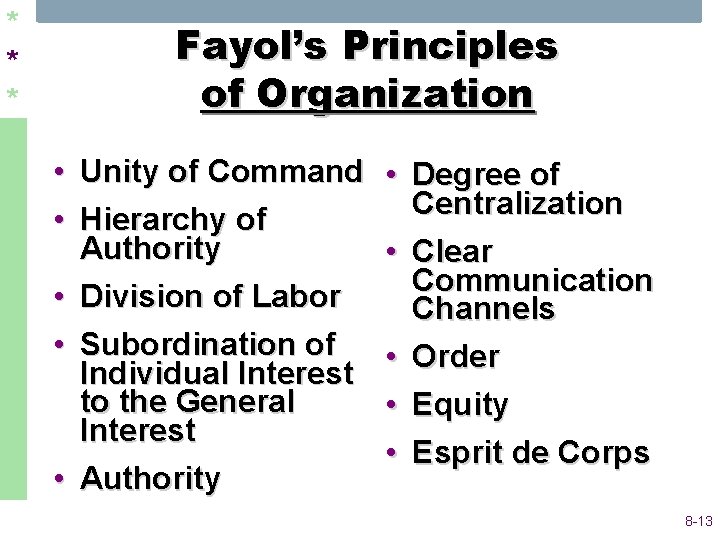
* * * Fayol’s Principles of Organization • Unity of Command • Degree of Centralization • Hierarchy of Authority • Clear Communication • Division of Labor Channels • Subordination of • Order Individual Interest to the General • Equity Interest • Esprit de Corps • Authority 8 -13
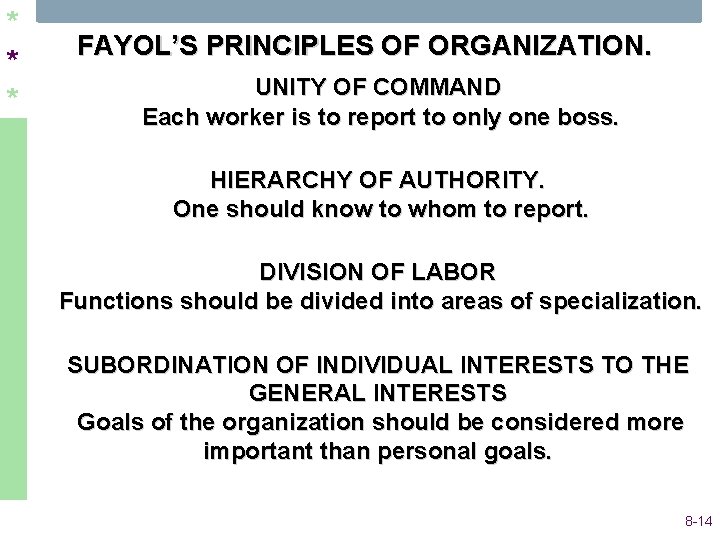
* * * FAYOL’S PRINCIPLES OF ORGANIZATION. UNITY OF COMMAND Each worker is to report to only one boss. HIERARCHY OF AUTHORITY. One should know to whom to report. DIVISION OF LABOR Functions should be divided into areas of specialization. SUBORDINATION OF INDIVIDUAL INTERESTS TO THE GENERAL INTERESTS Goals of the organization should be considered more important than personal goals. 8 -14
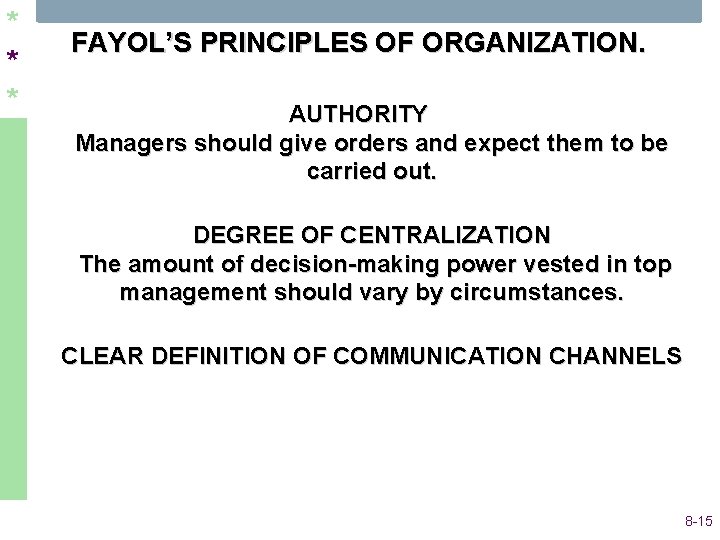
* * * FAYOL’S PRINCIPLES OF ORGANIZATION. AUTHORITY Managers should give orders and expect them to be carried out. DEGREE OF CENTRALIZATION The amount of decision making power vested in top management should vary by circumstances. CLEAR DEFINITION OF COMMUNICATION CHANNELS 8 -15
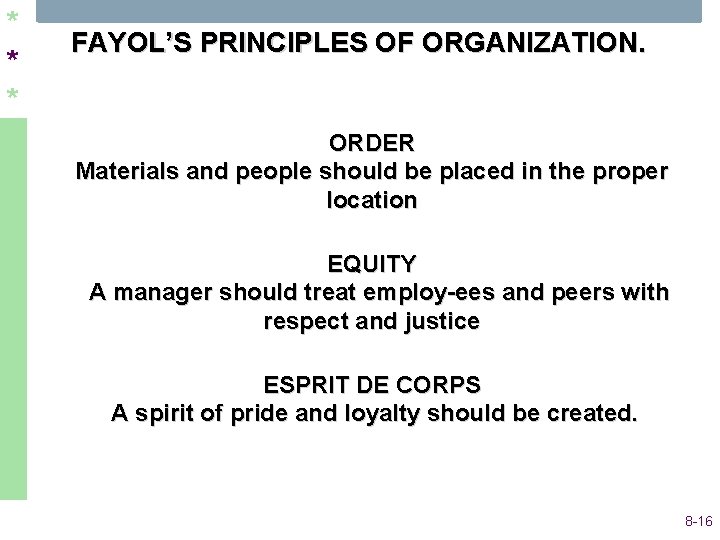
* * * FAYOL’S PRINCIPLES OF ORGANIZATION. ORDER Materials and people should be placed in the proper location EQUITY A manager should treat employ ees and peers with respect and justice ESPRIT DE CORPS A spirit of pride and loyalty should be created. 8 -16
* * * Weber’s Organizational Principles • Job Descriptions • Written Rules • Procedures, Regulations, Policies • Staffing/Promotions Based on Qualifications 8 -17
* * * Managers used the concepts of Fayol and Weber to design organizations so that managers could CONTROL WORKERS. A HIERARCHY is a system in which one person is at the top of the organization and there is a ranked or sequential ordering from the top down of managers who are responsible to that person 8 -18
* The CHAIN OF COMMAND * is the line of authority that moves from the * top of a hierarchy to the lowest level. Some organizations have a dozen LAYERS OF MANAGEMENT between the chief executive officer and the lowest level employee. 8 -19
* * * BUREAUCRACY is an organization with many layers of managers who set rules and regulations and oversee all decisions. In a bureaucracy, decision making may take too long to satisfy customers. To make customers happy, firms are reorganizing to give employees more power to make decisions on their own, known as EMPOWERMENT 8 -20
* * * DECENTRALIZED AUTHORITY is an organization structure in which decision making authority is delegated to lower level managers more familiar with local conditions than headquarters management could be (example: J. C. Penney). To thrive in today’s rapidly changing markets, more decentralization and more delegation of authority are needed. 8 -21
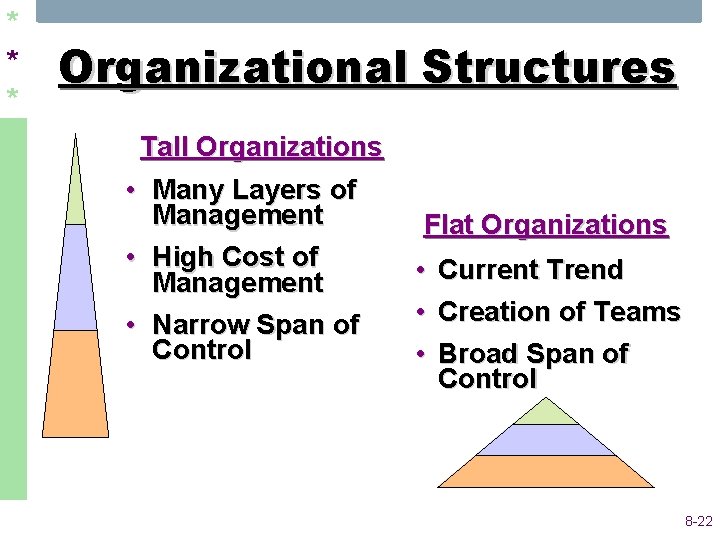
* * * Organizational Structures Tall Organizations • Many Layers of Management • High Cost of Management • Narrow Span of Control Flat Organizations • Current Trend • Creation of Teams • Broad Span of Control 8 -22
* * * A HIERARCHY is a system in which one person is at the top of the organization and there is a ranked or sequential ordering from the top down of managers who are responsible to that person. The CHAIN OF COMMAND is the line of authority that moves from the top of a hierarchy to the lowest level. Some organizations have a dozen LAYERS OF MANAGEMENT between the chief executive officer and the lowest level employee. 8 -23
* * * CENTRALIZED AUTHORITY is an organizing structure in which decision making authority is maintained at the top level of management at the company’s headquarters (example: Mc. Donalds. ) 8 -24
* * * Decentralization (Delegate Authority) Advantages • Better Adaptation to • Customer Wants • • More Empowerment of Workers • • Faster Decision Making • • Higher Morale Disadvantages Less Efficiency Complex Distribution System Less Top Management Control Weakened Corporate Image 8 -25
* * * DEPARTMENTALIZATION FUNCTIONAL STRUCTURE is the grouping of workers into departments based on similar skills, expertise, or resource use. ADVANTAGES of functional departmentalization: Skills can be developed in depth. Resources can be centralized to allow for economies of scale. There is good coordination within the function. . 8 -26
* * * DEPARTMENTALIZATION is dividing organizational functions into separate units. The traditional way to departmentalize is by function. FUNCTIONAL STRUCTURE is the grouping of workers into departments based on similar skills, expertise, or resource use. ADVANTAGES of functional departmentalization: Skills can be developed in depth. Resources can be centralized to allow 8 -27
* ALTERNATIVE WAYS TO DEPARTMENTALIZE * * By PROCESS (a firm that makes leather coats may have one department to cut the leather, another to dye it, and a third to sew the coat. ) Some firms use a COMBINATION of departmental techniques, called HYBRID FORMS. Companies must coordinate traditional departmental efforts with those of their Internet operations. 8 -28
* * * Weber promoted the PYRAMID SHAPED ORGANIZATION STRUCTURE Weber put great trust in managers and felt the less decision making employees had to do, the better. This approach is makes sense when dealing with uneducated an untrained workers. WEBER’S PRINCIPLES were similar to Fayol’s with the addition of: job descriptions written rules, decision guidelines, and policies consistent procedures, regulations, and policies staffing and promotions based on qualifications. 8 -29
* * * Centralization (No Delegation) Advantages • Greater Top Management Control • More Efficiency • Simpler Distribution System • Stronger Brand/Corporate Image Disadvantages • Less Responsiveness to Customers • Less Empowerment • Interorganizational Conflict • Lower Morale Away from Headquarters 8 -30
* * * SPAN OF CONTROL refers to the optimum number of subordinates a manager supervises or should supervise. At lower levels, a WIDE SPAN OF CONTROL is possible. 8 -31
* * * The span narrows at higher levels of the organization. The span of control VARIES WIDELY. The trend now is to expand the span of control as organizations get rid of middle managers. The span of control can be increased through empowerment and the use of technology. 8 -32
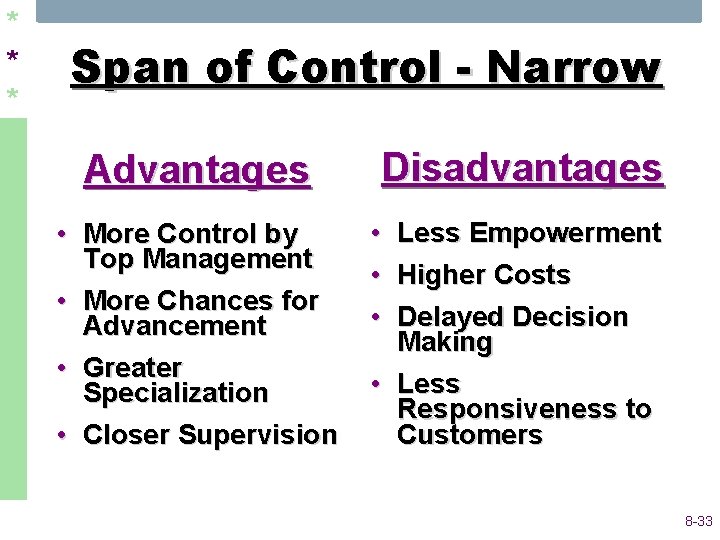
* * * Span of Control - Narrow Advantages Disadvantages • More Control by Top Management • More Chances for Advancement • Greater Specialization • Closer Supervision • Less Empowerment • Higher Costs • Delayed Decision Making • Less Responsiveness to Customers 8 -33
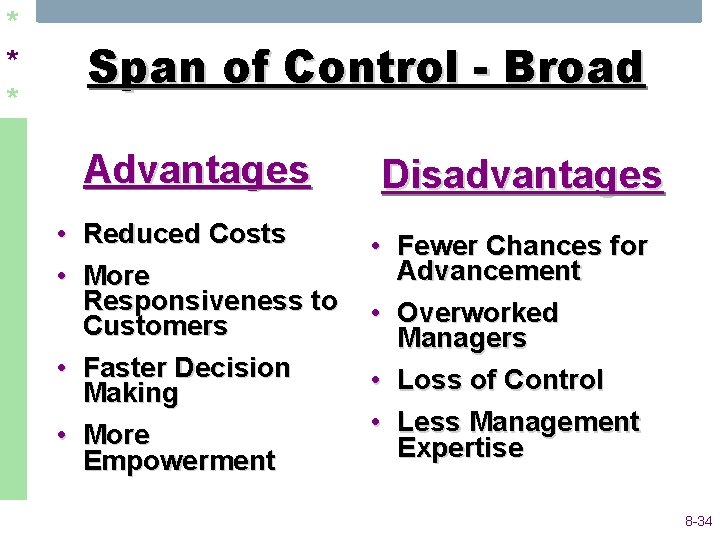
* * * Span of Control - Broad Advantages • Reduced Costs • More Responsiveness to Customers • Faster Decision Making • More Empowerment Disadvantages • Fewer Chances for Advancement • Overworked Managers • Loss of Control • Less Management Expertise 8 -34
* * * DECENTRALIZED AUTHORITY is an organi zation structure in which decision making authority is delegated to lower level managers more familiar with local conditions than headquarters management could be (example: J. C. Penney). To thrive in today’s rapidly changing markets, more decentralization and more delegation of authority are needed. 8 -35
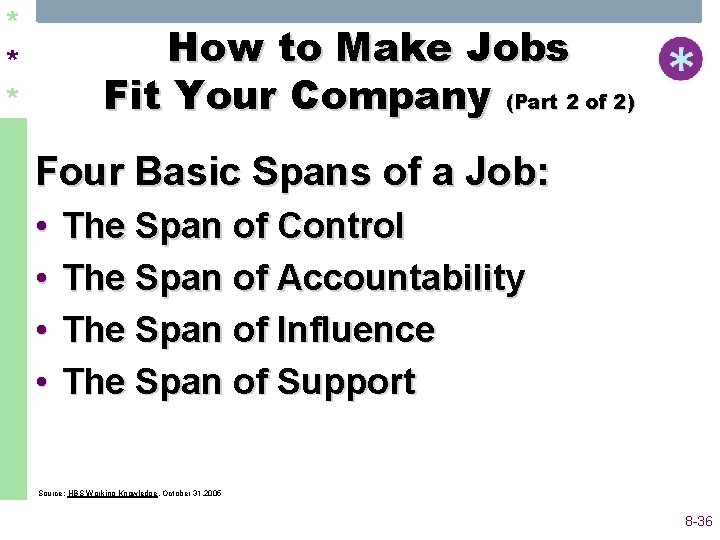
* * * How to Make Jobs Fit Your Company (Part 2 of 2) Four Basic Spans of a Job: • • The Span of Control The Span of Accountability The Span of Influence The Span of Support Source: HBS Working Knowledge, October 31, 2005 8 -36
* * * How to Make Jobs Fit Your Company (Part 1 of 2) Each manager must ask: • What resources do I control to accomplish my tasks? • What measures will be used to evaluate my performance? • Who do I need to interact with and influence to achieve my goals? • How much support can I expect when I reach out to others for help? Source: HBS Working Knowledge, October 31, 2005 8 -37
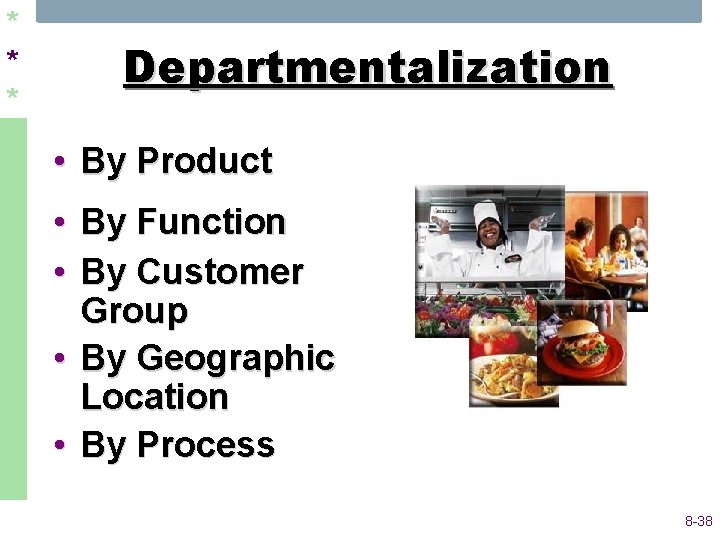
* * * Departmentalization • By Product • By Function • By Customer Group • By Geographic Location • By Process 8 -38
* * * Departmentalization by Function Advantages • • • Skill Development Economies of Scale Good Coordination Disadvantages • Lack of Communication • Employees Identify with Department • Slow Response to External Demands • Narrow Specialists • Groupthink 8 -39
* * * DEPARTMENTALIZATION DISADVANTAGES OF FUNCTIONAL Communication between departments is lacking. Employees identify with the department rather than the total organization. Response to external change is slow. Employees may not be trained in different management responsibilities and become narrow specialists. 8 -40
* ALTERNATIVE WAYS TO DEPARTMENTALIZE * * By PRODUCT (a book publisher might have departments for trade books, textbooks, and technical books. ) By CUSTOMER GROUP (a pharmaceutical company might have separate departments that focus on the consumer market, on hospitals, and on doctors. ) By GEOGRAPHIC LOCATIONS (operations in Japan, Europe, and Korea. ) 8 -41
* * * Line Organizations Advantages • Clear Authority & Responsibility • Easy to Understand • One Supervisor Per Employee Disadvantages • • Inflexible Few Specialists for Advice • Long Line of Communication • Difficult to Handle Complex Decisions 8 -42
* * * LINE ORGANIZATIONS. DISADVANTAGES: too inflexible few specialists to advise line employees lines of communication become too long unable to handle complex decisions Such organizations usually become line-and-staff organizations LINE AND STAFF ORGANIZATIONS LINE PERSONNEL are employees who are part of the chain of command that is responsible for achieving organizational goals. 8 -43
* * * LINE ORGANIZATIONS A LINE ORGANIZATION is an organization that has direct two-way lines of responsibility, authority, and communication running from the top to the bottom of the organization, with all people reporting to only one supervisor (i. e. the military and small businesses. ) The line organization has no specialists for management support. Line managers can issue orders and enforce discipline. 8 -44
* * * Line/Staff Organizations Line Personnel Staff Personnel • Formal Authority • Advise Line Personnel • Make Policy Decisions • Assist Line Personnel 8 -45
* * * Matrix Organizations Advantages Disadvantages • Flexibility • Costly/Complex • Cooperation & Teamwork • Confusion in Loyalty • Creativity • Requires Good Interpersonal Skills & Cooperation • More Efficient Use of Resources • Not Permanent 8 -46
* * * Important Conditions for Small Teams 1. 2. 3. 4. 5. Clear Purpose Clear Goals Correct Skills Mutual Accountability Shift Roles When Appropriate Source: CIO Dec 2003 8 -47
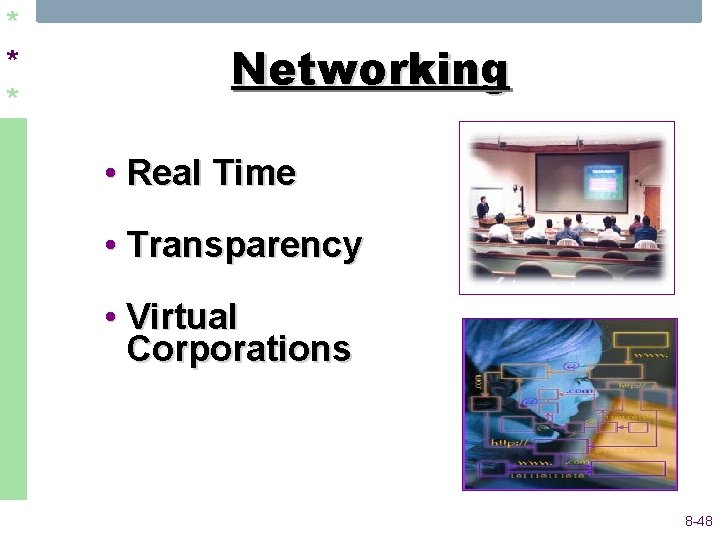
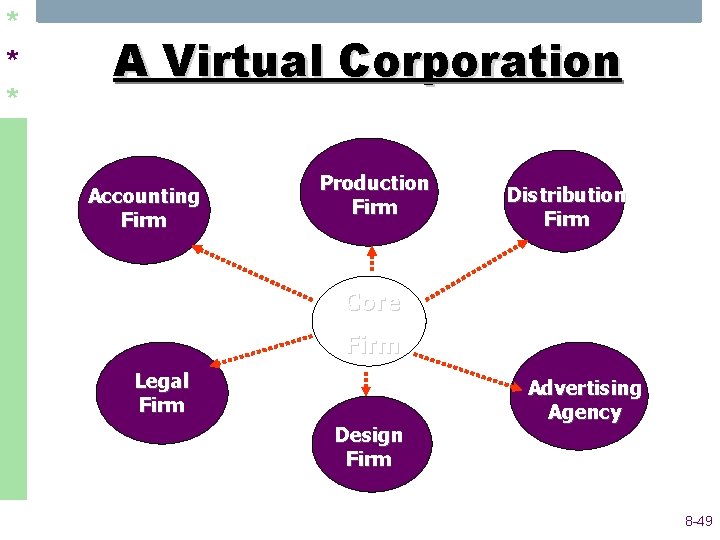
* * * Networking • Real Time • Transparency • Virtual Corporations 8 -48
* * * A Virtual Corporation Accounting Firm Production Firm Distribution Firm Core Firm Legal Firm Design Firm Advertising Agency 8 -49
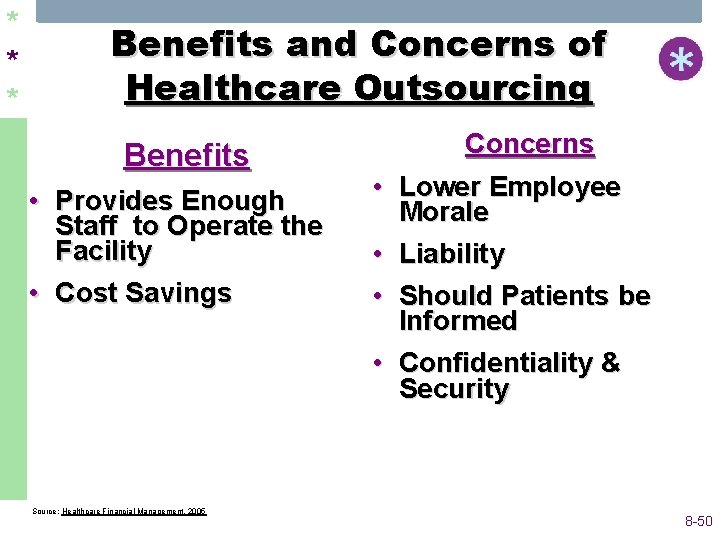
* * * Benefits and Concerns of Healthcare Outsourcing Benefits • Provides Enough Staff to Operate the Facility • Cost Savings Source: Healthcare Financial Management, 2005 • Concerns Lower Employee Morale Liability • • Should Patients be Informed • Confidentiality & Security 8 -50
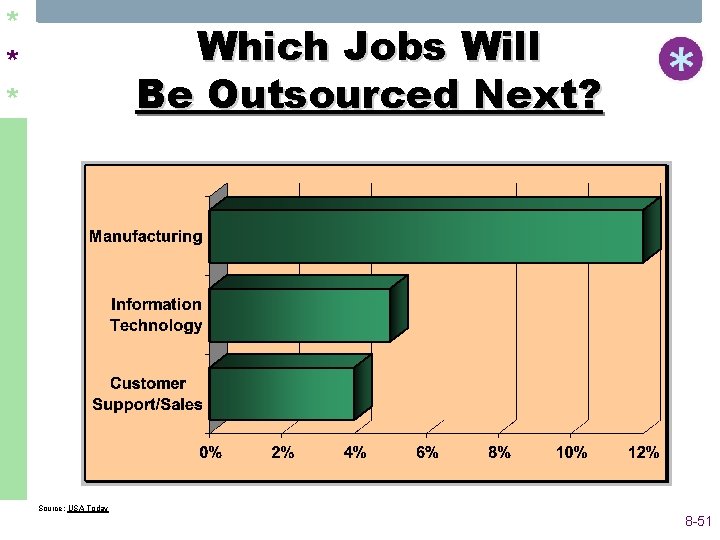
* * * Which Jobs Will Be Outsourced Next? Source: USA Today 8 -51
* * * Adapting to Change • Restructuring for Empowerment • Focusing on the Customer • Creating a Change Oriented Organizational Culture • The Informal Organization 8 -52
* * * Layers of Authority. Traditional • Top Managers Decision Makers • Middle Managers Develops Rules & Procedures • Workers and Supervisors 8 -53
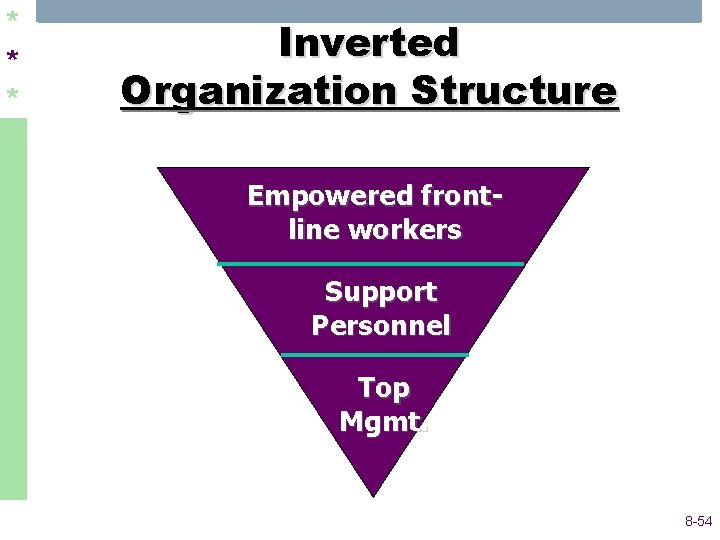
* * * Inverted Organization Structure Empowered frontline workers Support Personnel Top Mgmt. 8 -54
* * * Examples of Informal Group Norms • Do your job but don’t produce more than the rest of the group. • Don’t tell off color jokes or use profane language among group members. • Listen to the boss and use his/her expertise but don’t trust him/her. • Everyone is to be clean/organized at the workstation. 8 -55
* * * More Examples of Informal Group Norms • Never side with managers in a dispute involving group members. • Respect/help your fellow group members on the job. • Criticize the organization only among group members never among strangers. • Drinking is done off the job Never at work! 8 -56