
Adapting Curriculum Maps Intro to Module 1 and




- Slides: 84
Adapting Curriculum Maps & Intro to Module 1 and 5 Grades 6– 8 July 2018 1
ADAPTING CURRICULUM MAPS (GRADES 6– 8) Welcome Back! 2
ADAPTING CURRICULUM MAPS (GRADES 6– 8) Introduction: Who I Am Insert photo Name 1 • • Name 2 • • • 3
ADAPTING CURRICULUM MAPS (GRADES 6– 8) Introduction: Who You Are Raise your hand if… • You are a math teacher coach. • You hold a different role. • You teach in a district school. • You teach in a charter school. • You teach or work in a different type of school or organization. • You teach monolingual students. • You teach bilingual or multilingual students. 4
ADAPTING CURRICULUM MAPS (GRADES 6– 8) Thank You for Your Feedback! + 5
ADAPTING CURRICULUM MAPS (GRADES 6– 8) Norms That Support Our Learning • Take responsibility for yourself as a learner. • Honor timeframes (start, end, and activity). • Be an active and hands-on learner. • Use technology to enhance learning. • Strive for equity of voice. • Contribute to a learning environment in which it is “safe to not know. ” • Identify and reframe deficit thinking and speaking. 6
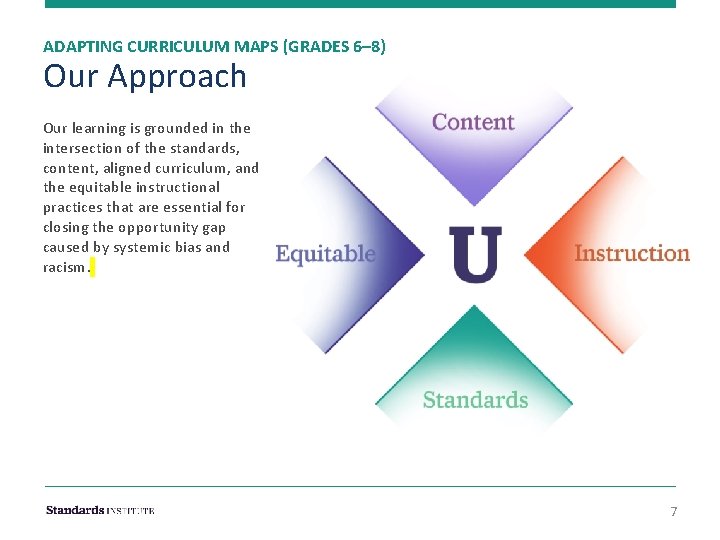
ADAPTING CURRICULUM MAPS (GRADES 6– 8) Our Approach Our learning is grounded in the intersection of the standards, content, aligned curriculum, and the equitable instructional practices that are essential for closing the opportunity gap caused by systemic bias and racism. 7
ADAPTING CURRICULUM MAPS (GRADES 6– 8) Unpacking Equity exists when the biases derived from dominant cultural norms and values no longer predict or influence how one fares in society. Equity systematically promotes fair and impartial access to rights and opportunities. Equity may look like adding supports and scaffolds that result in fair access to opportunities or creating opportunities for all voices to be heard. Educational Equity ensures that all children—regardless of circumstances—are receiving highquality, grade-level, and standards-aligned instruction with access to high-quality materials and resources. We become change agents for educational equity when we acknowledge that we are part of an educational system that holds policies and practices that are inherently racist and that we have participated in this system. We now commit to ensuring that all students, regardless of how we think they come to us, leave us having grown against grade-level standards and confident in their value and abilities. 8
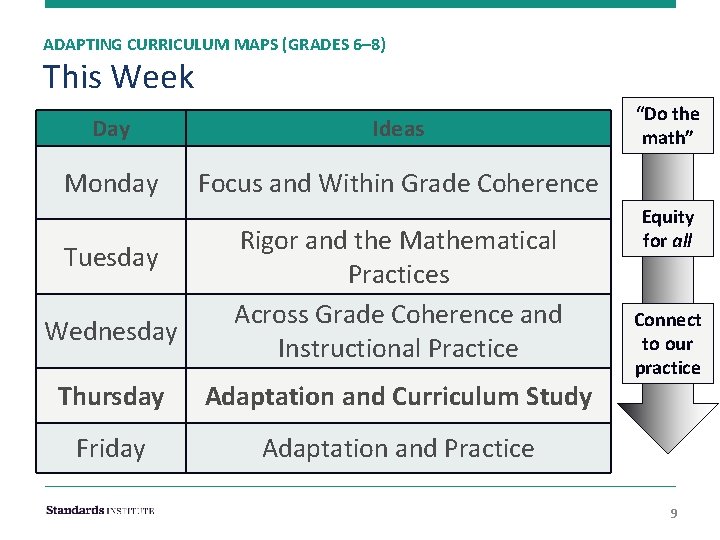
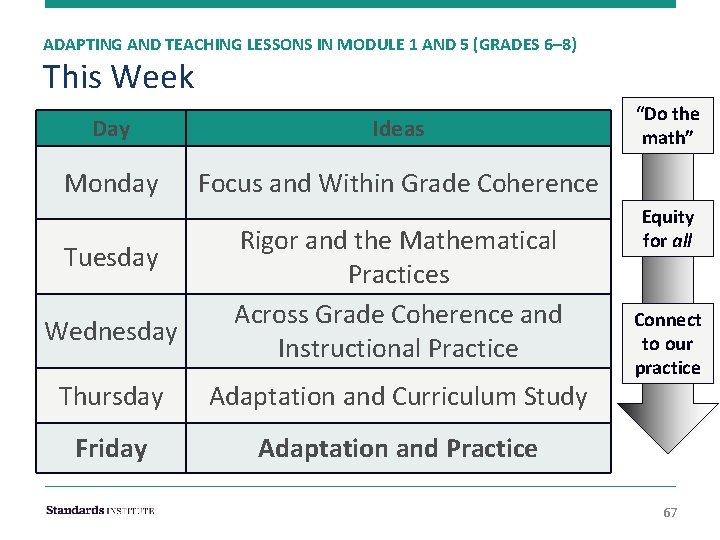
ADAPTING CURRICULUM MAPS (GRADES 6– 8) This Week Day Ideas Monday Focus and Within Grade Coherence Tuesday Wednesday Rigor and the Mathematical Practices Across Grade Coherence and Instructional Practice Thursday Adaptation and Curriculum Study Friday Adaptation and Practice “Do the math” Equity for all Connect to our practice 9
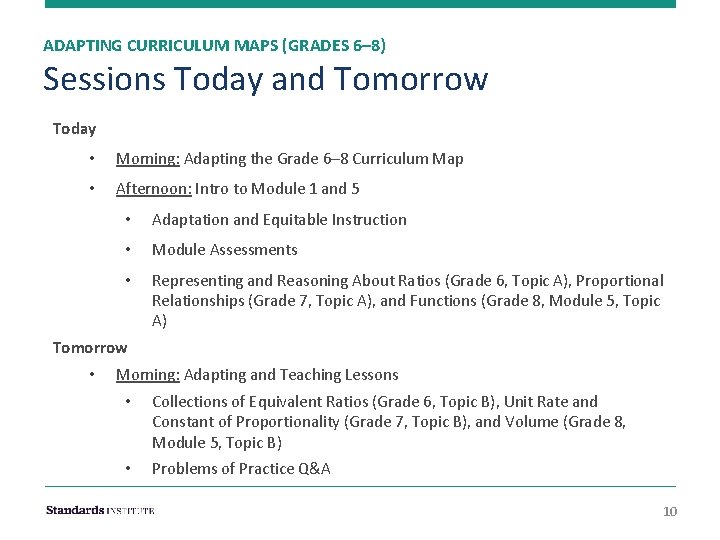
ADAPTING CURRICULUM MAPS (GRADES 6– 8) Sessions Today and Tomorrow Today • Morning: Adapting the Grade 6– 8 Curriculum Map • Afternoon: Intro to Module 1 and 5 • Adaptation and Equitable Instruction • Module Assessments • Representing and Reasoning About Ratios (Grade 6, Topic A), Proportional Relationships (Grade 7, Topic A), and Functions (Grade 8, Module 5, Topic A) Tomorrow • Morning: Adapting and Teaching Lessons • Collections of Equivalent Ratios (Grade 6, Topic B), Unit Rate and Constant of Proportionality (Grade 7, Topic B), and Volume (Grade 8, Module 5, Topic B) • Problems of Practice Q&A 10
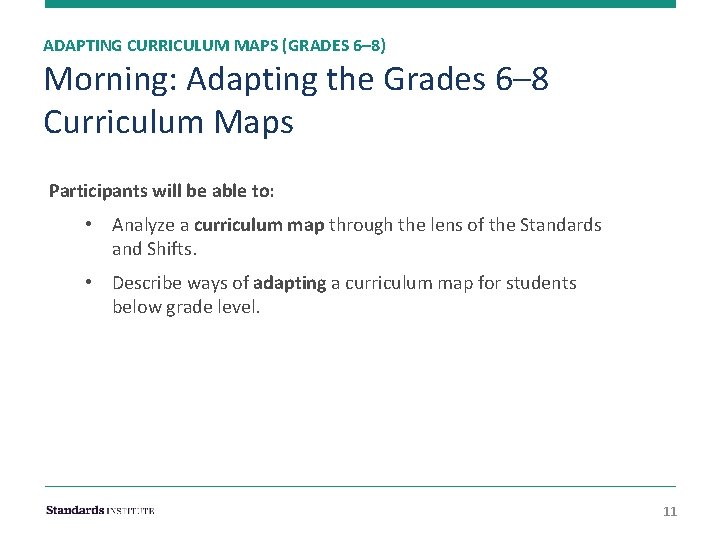
ADAPTING CURRICULUM MAPS (GRADES 6– 8) Morning: Adapting the Grades 6– 8 Curriculum Maps Participants will be able to: • Analyze a curriculum map through the lens of the Standards and Shifts. • Describe ways of adapting a curriculum map for students below grade level. 11
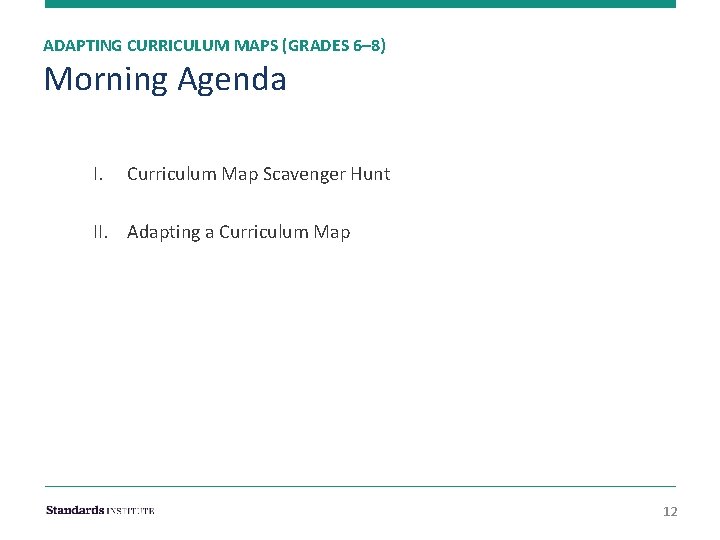
ADAPTING CURRICULUM MAPS (GRADES 6– 8) Morning Agenda I. Curriculum Map Scavenger Hunt II. Adapting a Curriculum Map 12
ADAPTING CURRICULUM MAPS (GRADES 6– 8) I. Curriculum Map Scavenger Hunt! You’ll look at: • The curriculum map for the year. • Titles of each module. • The standards associated with each module. • (If time) lessons and assessment items in Modules 1 and 2. 13
ADAPTING CURRICULUM MAPS (GRADES 6– 8) Scavenger Hunt! Scope and Sequence: 1. 2. 3. 4. How many modules focus on major work? How many days of instruction is this? What percent of the instructional year is this? Name all modules that include both major work and supporting content. Beyond! 1. Find a lesson that begins by engaging students in content from a previous grade. 2. Find an assessment item that connects a supporting cluster to a major one. 3. Find a lesson with a learning objective that uses language based on a cluster heading. 14
ADAPTING CURRICULUM MAPS (GRADES 6– 8) II. Adapting a Curriculum Map What should our approach be if we have students who are not ready to access grade-level content? 15
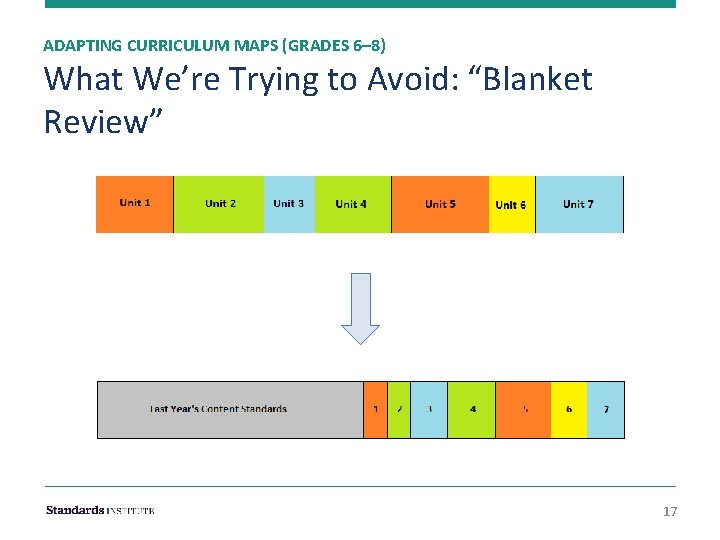
ADAPTING CURRICULUM MAPS (GRADES 6– 8) From the Appendix to Publisher’s Criteria “The natural distribution of prior knowledge in classrooms should not prompt abandoning instruction in grade level content, but should prompt explicit attention to connecting grade level content to content from prior learning. To do this, instruction should reflect the progressions on which the CCSSM are built…. Much unfinished learning from earlier grades can be managed best inside grade level work when the progressions are used to understand student thinking. ” 16
ADAPTING CURRICULUM MAPS (GRADES 6– 8) What We’re Trying to Avoid: “Blanket Review” 17
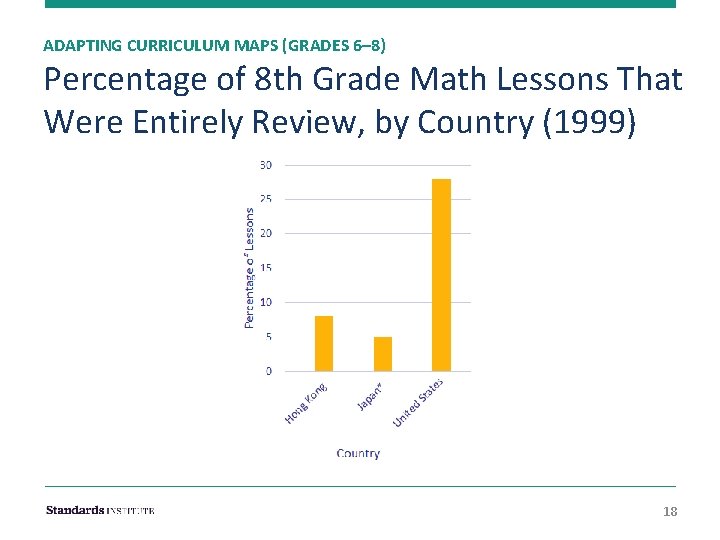
ADAPTING CURRICULUM MAPS (GRADES 6– 8) Percentage of 8 th Grade Math Lessons That Were Entirely Review, by Country (1999) 18
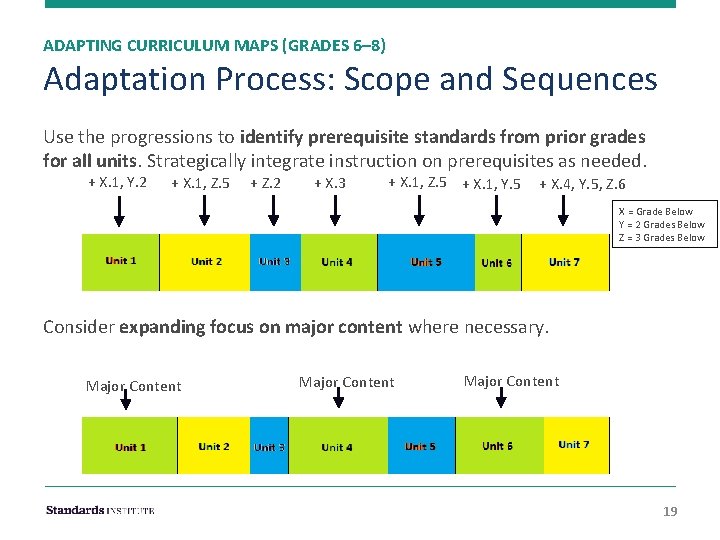
ADAPTING CURRICULUM MAPS (GRADES 6– 8) Adaptation Process: Scope and Sequences Use the progressions to identify prerequisite standards from prior grades for all units. Strategically integrate instruction on prerequisites as needed. + X. 1, Y. 2 + X. 1, Z. 5 + Z. 2 + X. 3 + X. 1, Z. 5 + X. 1, Y. 5 + X. 4, Y. 5, Z. 6 X = Grade Below Y = 2 Grades Below Z = 3 Grades Below Consider expanding focus on major content where necessary. Major Content 19
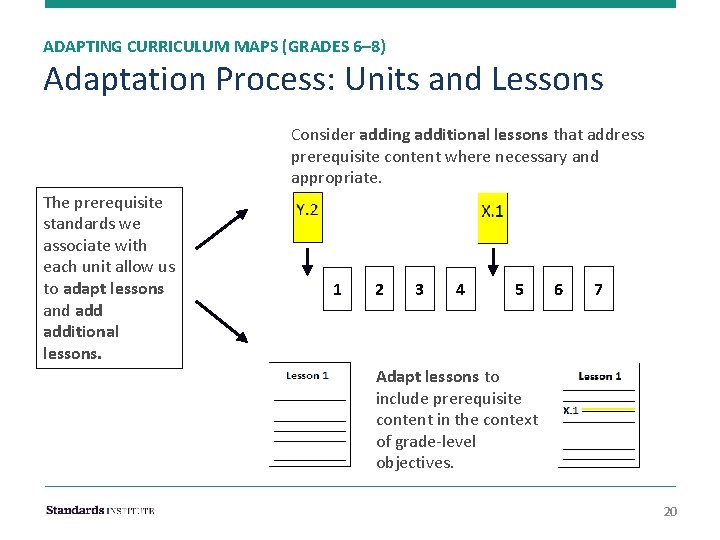
ADAPTING CURRICULUM MAPS (GRADES 6– 8) Adaptation Process: Units and Lessons Consider adding additional lessons that address prerequisite content where necessary and appropriate. The prerequisite standards we associate with each unit allow us to adapt lessons and additional lessons. 1 2 3 4 5 6 7 Adapt lessons to include prerequisite content in the context of grade-level objectives. 20
ADAPTING CURRICULUM MAPS (GRADES 6– 8) The Three C’s Coherent Content in Context 21
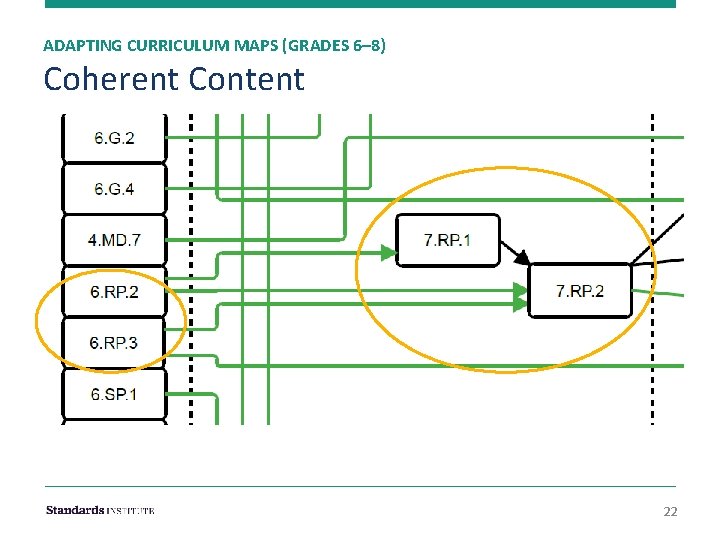
ADAPTING CURRICULUM MAPS (GRADES 6– 8) Coherent Content 22
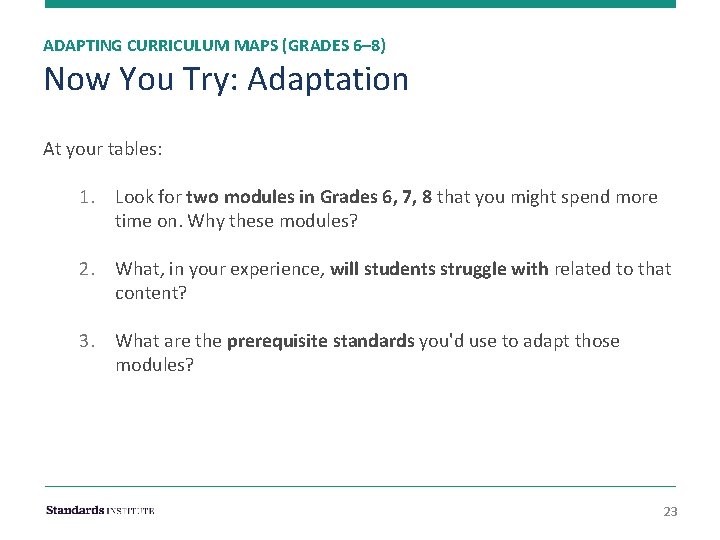
ADAPTING CURRICULUM MAPS (GRADES 6– 8) Now You Try: Adaptation At your tables: 1. Look for two modules in Grades 6, 7, 8 that you might spend more time on. Why these modules? 2. What, in your experience, will students struggle with related to that content? 3. What are the prerequisite standards you'd use to adapt those modules? 23
Share Out 24
SESSION 1 (111 M): Rigor– Calibrating Common Core (6 – 8) BREAK Lunch 12: 00 - 1: 00 25
INTRO TO MODULE 1 AND 5 (GRADES 6– 8) Sessions Today and Tomorrow Today • Morning: Adapting the Grades 6– 8 Curriculum Maps • Afternoon: Intro to Module 1 • Adaptation and Equitable Instruction • Module Assessments • Representing and Reasoning About Ratios (Grade 6, Topic A), Proportional Relationships (Grade 7, Topic A), and Functions (Grade 8, Module 5, Topic A) Tomorrow • Morning: Adapting and Teaching Lessons • Collections of Equivalent Ratios (Grade 6, Topic B), Unit Rate and Constant of Proportionality (Grade 7, Topic B), and Volume (Grade 8, Module 5, Topic B) • Problems of Practice Q&A 26
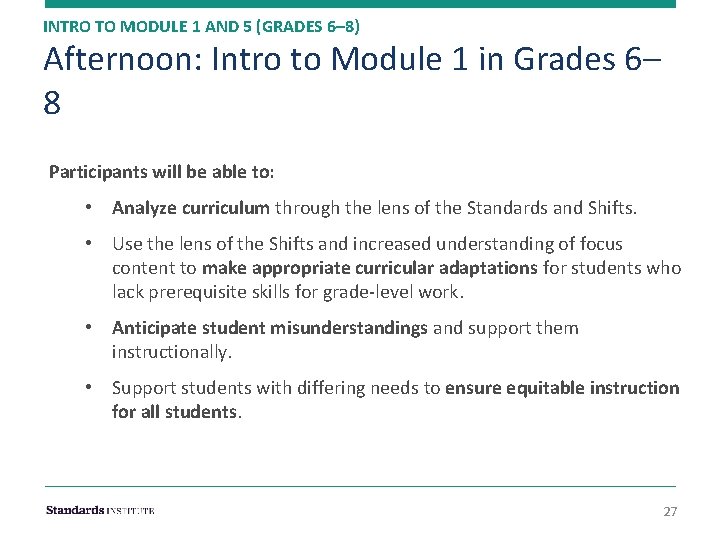
INTRO TO MODULE 1 AND 5 (GRADES 6– 8) Afternoon: Intro to Module 1 in Grades 6– 8 Participants will be able to: • Analyze curriculum through the lens of the Standards and Shifts. • Use the lens of the Shifts and increased understanding of focus content to make appropriate curricular adaptations for students who lack prerequisite skills for grade-level work. • Anticipate student misunderstandings and support them instructionally. • Support students with differing needs to ensure equitable instruction for all students. 27
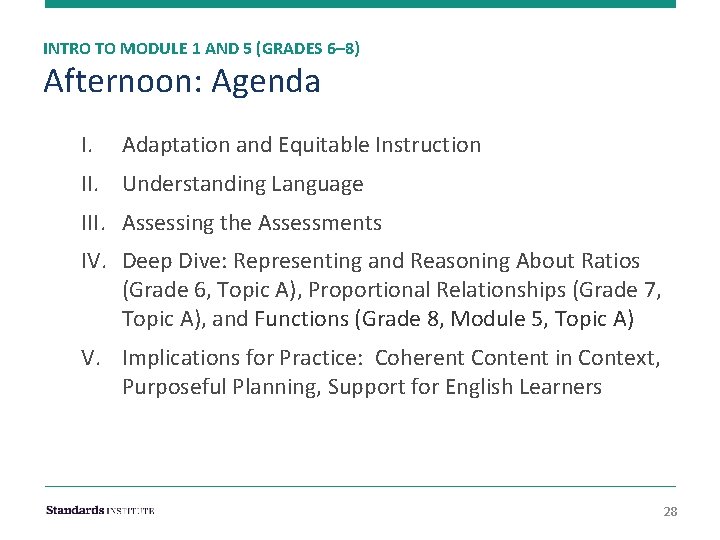
INTRO TO MODULE 1 AND 5 (GRADES 6– 8) Afternoon: Agenda I. Adaptation and Equitable Instruction II. Understanding Language III. Assessing the Assessments IV. Deep Dive: Representing and Reasoning About Ratios (Grade 6, Topic A), Proportional Relationships (Grade 7, Topic A), and Functions (Grade 8, Module 5, Topic A) V. Implications for Practice: Coherent Content in Context, Purposeful Planning, Support for English Learners 28
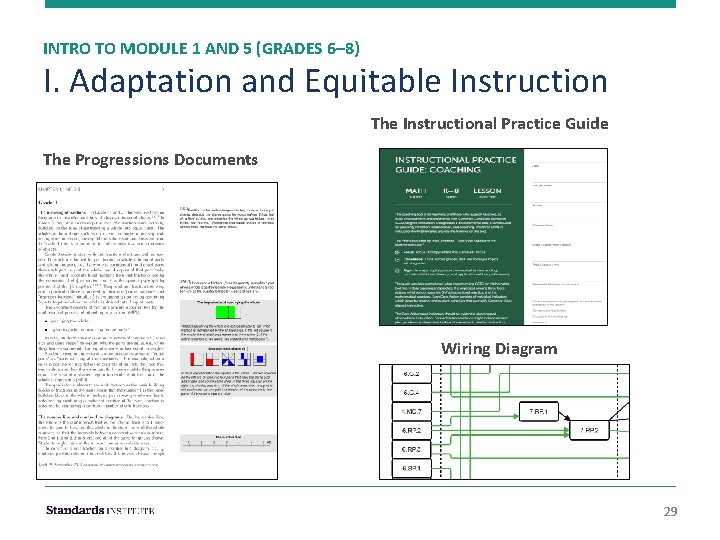
INTRO TO MODULE 1 AND 5 (GRADES 6– 8) I. Adaptation and Equitable Instruction The Instructional Practice Guide The Progressions Documents Wiring Diagram 29
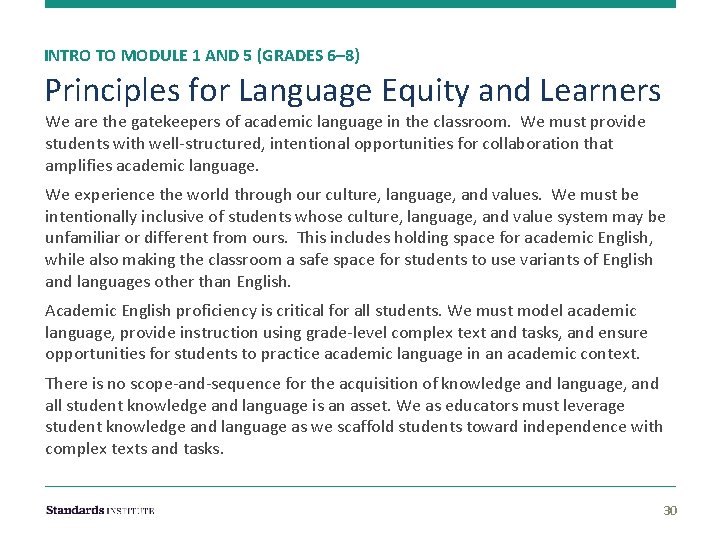
INTRO TO MODULE 1 AND 5 (GRADES 6– 8) Principles for Language Equity and Learners We are the gatekeepers of academic language in the classroom. We must provide students with well-structured, intentional opportunities for collaboration that amplifies academic language. We experience the world through our culture, language, and values. We must be intentionally inclusive of students whose culture, language, and value system may be unfamiliar or different from ours. This includes holding space for academic English, while also making the classroom a safe space for students to use variants of English and languages other than English. Academic English proficiency is critical for all students. We must model academic language, provide instruction using grade-level complex text and tasks, and ensure opportunities for students to practice academic language in an academic context. There is no scope-and-sequence for the acquisition of knowledge and language, and all student knowledge and language is an asset. We as educators must leverage student knowledge and language as we scaffold students toward independence with complex texts and tasks. 30
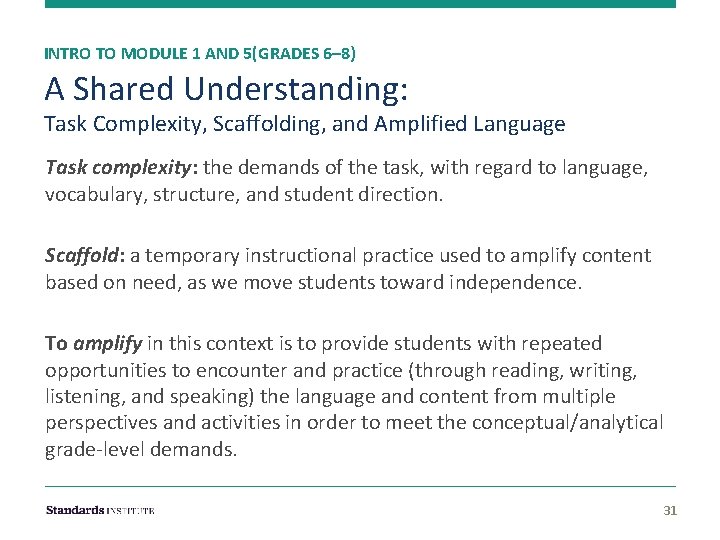
INTRO TO MODULE 1 AND 5(GRADES 6– 8) A Shared Understanding: Task Complexity, Scaffolding, and Amplified Language Task complexity: the demands of the task, with regard to language, vocabulary, structure, and student direction. Scaffold: a temporary instructional practice used to amplify content based on need, as we move students toward independence. To amplify in this context is to provide students with repeated opportunities to encounter and practice (through reading, writing, listening, and speaking) the language and content from multiple perspectives and activities in order to meet the conceptual/analytical grade-level demands. 31
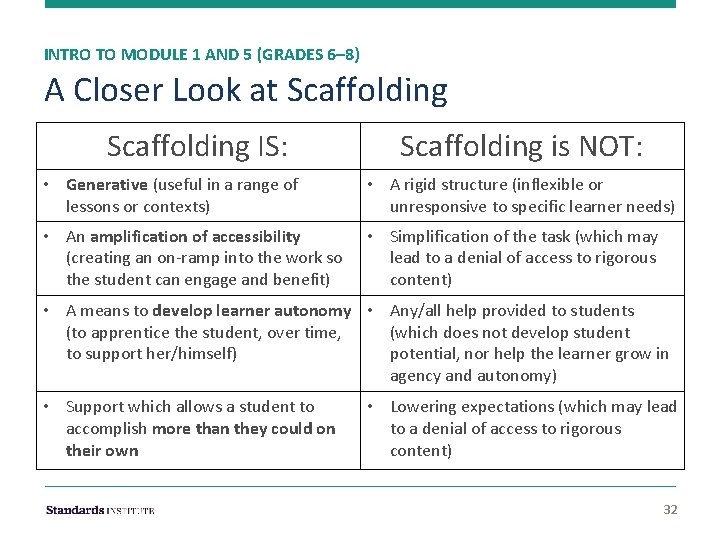
INTRO TO MODULE 1 AND 5 (GRADES 6– 8) A Closer Look at Scaffolding IS: Scaffolding is NOT: • Generative (useful in a range of lessons or contexts) • A rigid structure (inflexible or unresponsive to specific learner needs) • An amplification of accessibility (creating an on-ramp into the work so the student can engage and benefit) • Simplification of the task (which may lead to a denial of access to rigorous content) • A means to develop learner autonomy • Any/all help provided to students (to apprentice the student, over time, (which does not develop student to support her/himself) potential, nor help the learner grow in agency and autonomy) • Support which allows a student to accomplish more than they could on their own • Lowering expectations (which may lead to a denial of access to rigorous content) 32
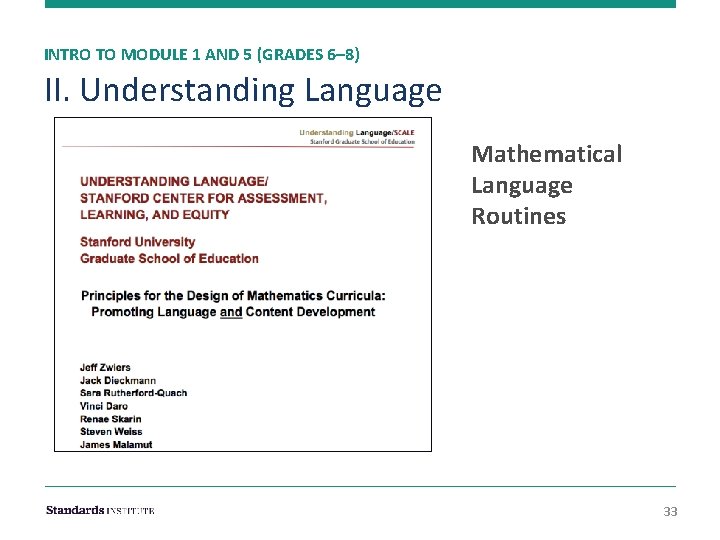
INTRO TO MODULE 1 AND 5 (GRADES 6– 8) II. Understanding Language Mathematical Language Routines 33
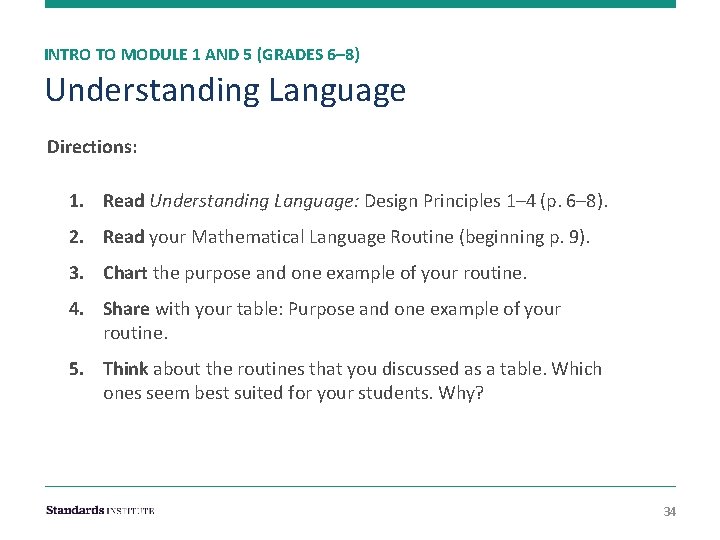
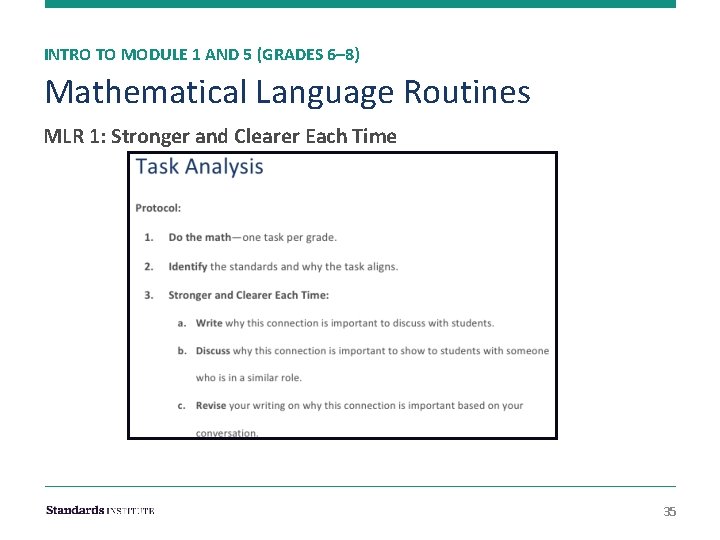
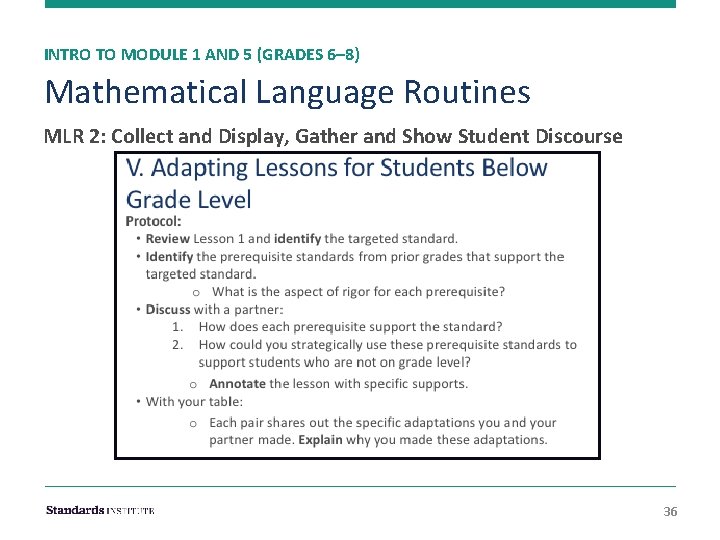
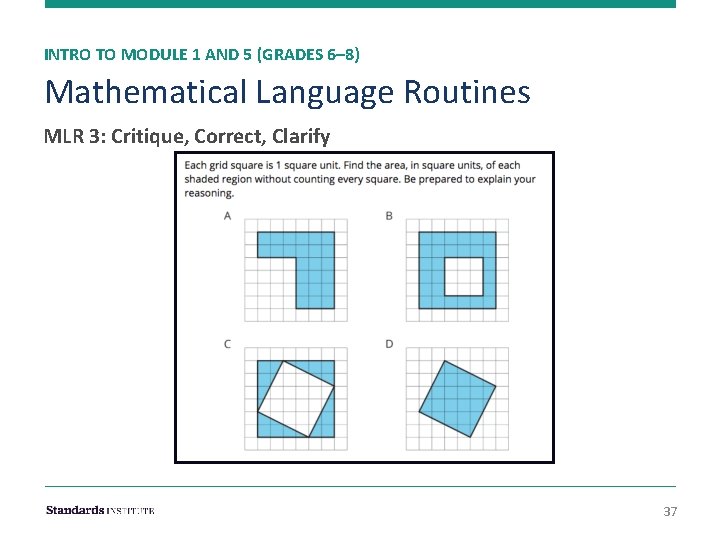
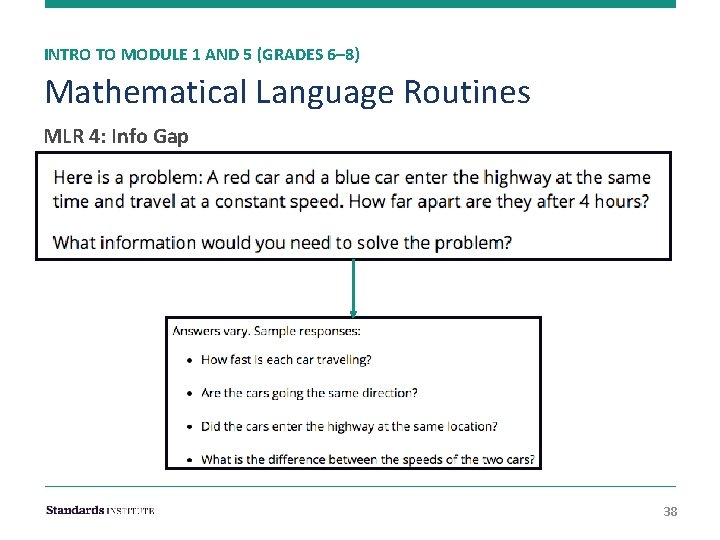
INTRO TO MODULE 1 AND 5 (GRADES 6– 8) Understanding Language Directions: 1. Read Understanding Language: Design Principles 1– 4 (p. 6– 8). 2. Read your Mathematical Language Routine (beginning p. 9). 3. Chart the purpose and one example of your routine. 4. Share with your table: Purpose and one example of your routine. 5. Think about the routines that you discussed as a table. Which ones seem best suited for your students. Why? 34
INTRO TO MODULE 1 AND 5 (GRADES 6– 8) Mathematical Language Routines MLR 1: Stronger and Clearer Each Time 35
INTRO TO MODULE 1 AND 5 (GRADES 6– 8) Mathematical Language Routines MLR 2: Collect and Display, Gather and Show Student Discourse 36
INTRO TO MODULE 1 AND 5 (GRADES 6– 8) Mathematical Language Routines MLR 3: Critique, Correct, Clarify 37
INTRO TO MODULE 1 AND 5 (GRADES 6– 8) Mathematical Language Routines MLR 4: Info Gap 38
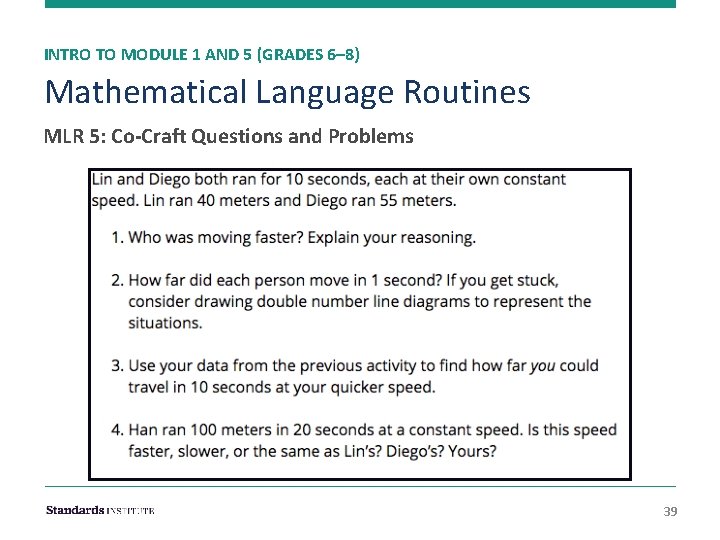
INTRO TO MODULE 1 AND 5 (GRADES 6– 8) Mathematical Language Routines MLR 5: Co-Craft Questions and Problems 39
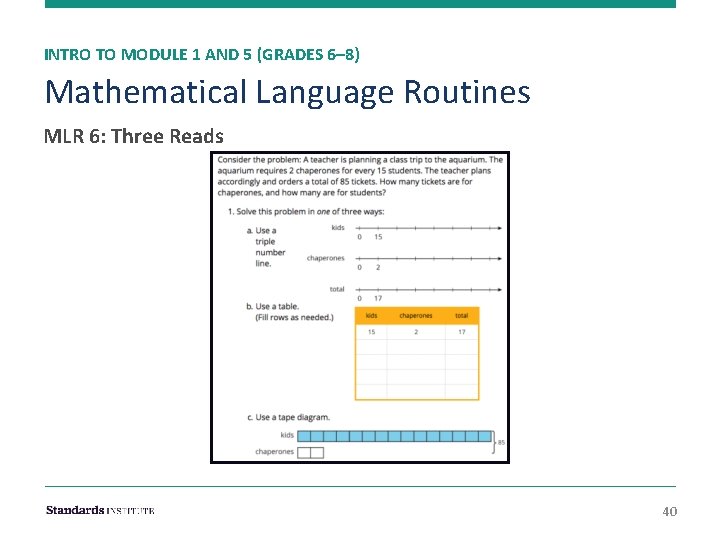
INTRO TO MODULE 1 AND 5 (GRADES 6– 8) Mathematical Language Routines MLR 6: Three Reads 40
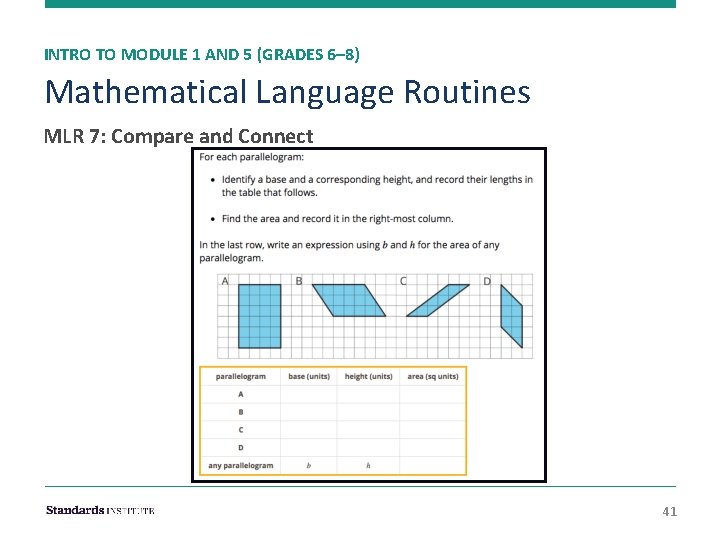
INTRO TO MODULE 1 AND 5 (GRADES 6– 8) Mathematical Language Routines MLR 7: Compare and Connect 41
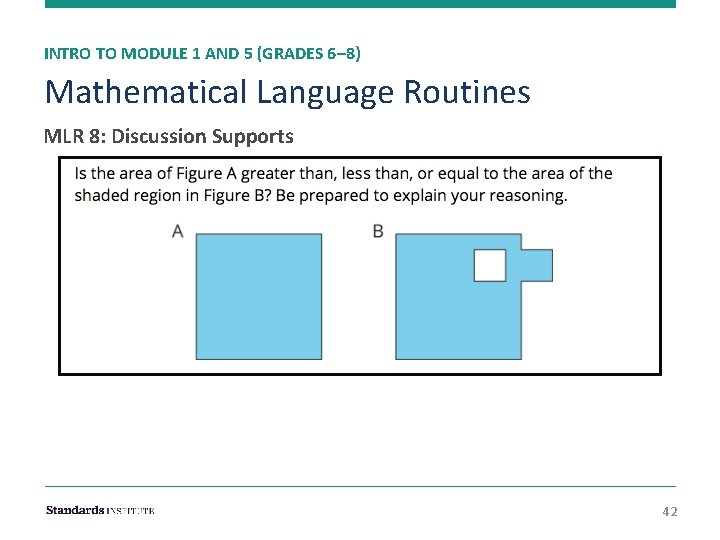
INTRO TO MODULE 1 AND 5 (GRADES 6– 8) Mathematical Language Routines MLR 8: Discussion Supports 42
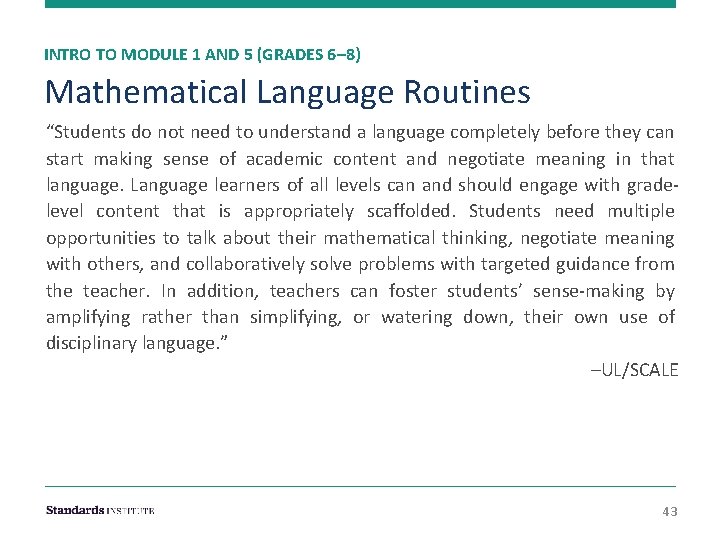
INTRO TO MODULE 1 AND 5 (GRADES 6– 8) Mathematical Language Routines “Students do not need to understand a language completely before they can start making sense of academic content and negotiate meaning in that language. Language learners of all levels can and should engage with gradelevel content that is appropriately scaffolded. Students need multiple opportunities to talk about their mathematical thinking, negotiate meaning with others, and collaboratively solve problems with targeted guidance from the teacher. In addition, teachers can foster students’ sense-making by amplifying rather than simplifying, or watering down, their own use of disciplinary language. ” –UL/SCALE 43
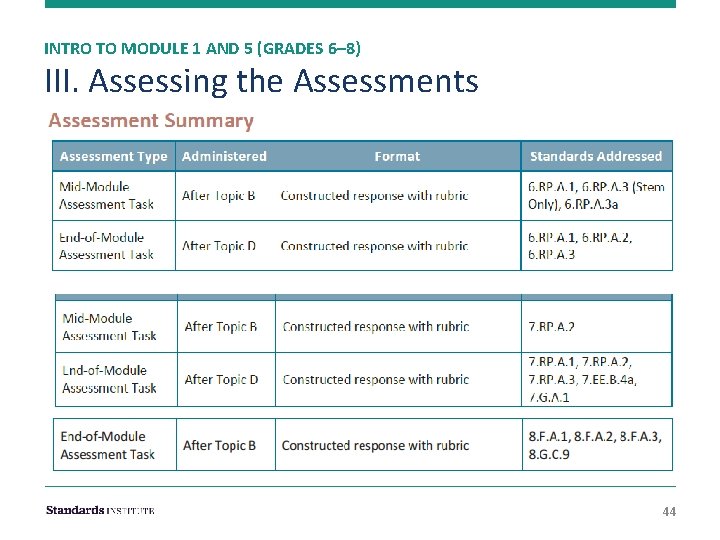
INTRO TO MODULE 1 AND 5 (GRADES 6– 8) III. Assessing the Assessments 44
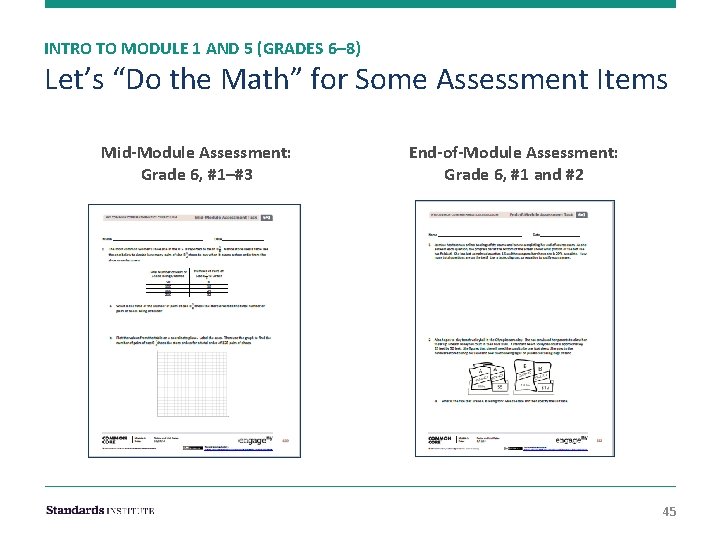
INTRO TO MODULE 1 AND 5 (GRADES 6– 8) Let’s “Do the Math” for Some Assessment Items Mid-Module Assessment: Grade 6, #1–#3 End-of-Module Assessment: Grade 6, #1 and #2 45
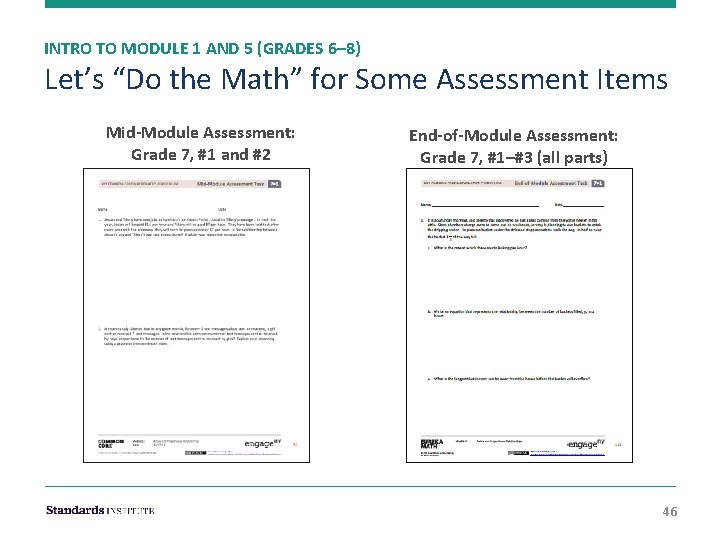
INTRO TO MODULE 1 AND 5 (GRADES 6– 8) Let’s “Do the Math” for Some Assessment Items Mid-Module Assessment: Grade 7, #1 and #2 End-of-Module Assessment: Grade 7, #1–#3 (all parts) 46
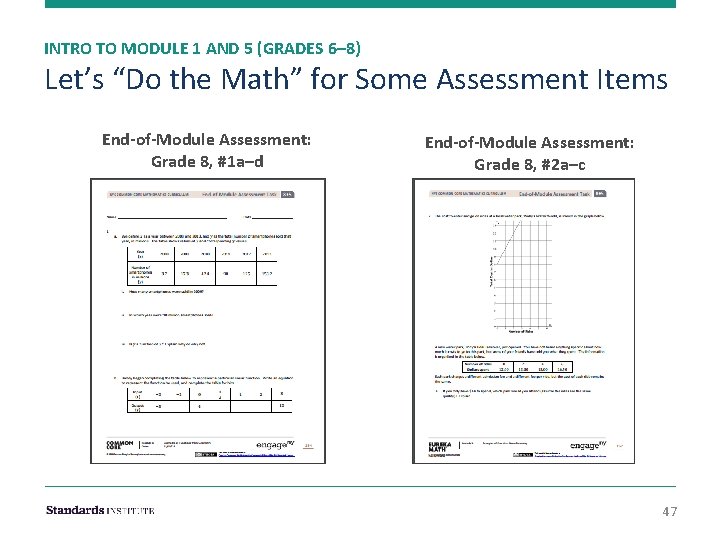
INTRO TO MODULE 1 AND 5 (GRADES 6– 8) Let’s “Do the Math” for Some Assessment Items End-of-Module Assessment: Grade 8, #1 a–d End-of-Module Assessment: Grade 8, #2 a–c 47
INTRO TO MODULE 1 AND 5 (GRADES 6– 8) At Your Table: Assessing the Assessments For each assessment item: 1. What standards are evident in this item and how do you know? 2. What aspects of rigor are highlighted in this item and how do you know? Also consider: 3. Compare the mid-module assessment to the end-of-module assessment. How does learning progress across the module? 48
INTRO TO MODULE 1 AND 5 (GRADES 6– 8) IV. Deep Dive: Topic A • Grade 6: Representing and Reasoning About Ratios • Grade 7: Proportional Relationships • Grade 8: Functions 49
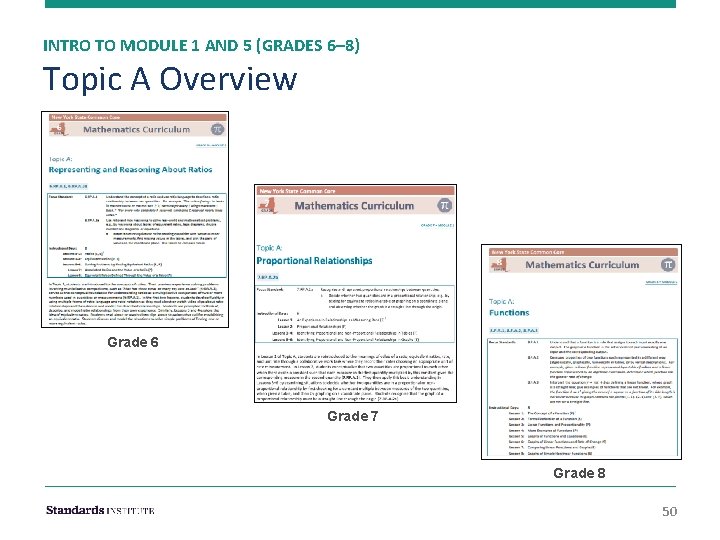
INTRO TO MODULE 1 AND 5 (GRADES 6– 8) Topic A Overview Grade 6 Grade 7 Grade 8 50
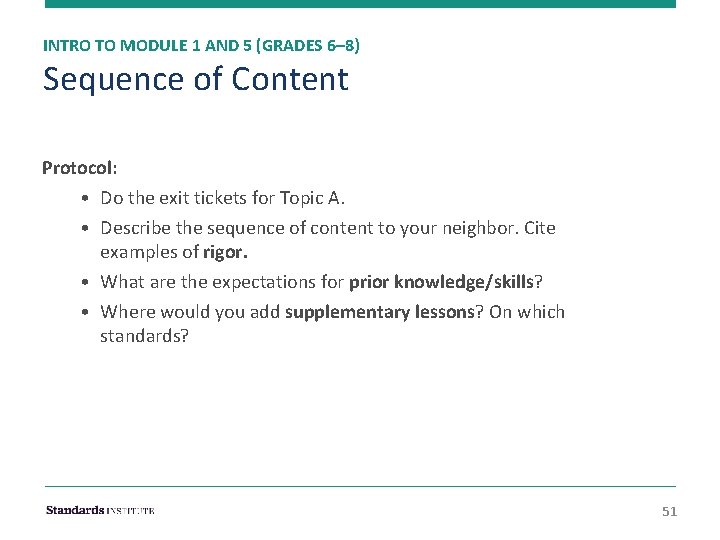
INTRO TO MODULE 1 AND 5 (GRADES 6– 8) Sequence of Content Protocol: • Do the exit tickets for Topic A. • Describe the sequence of content to your neighbor. Cite examples of rigor. • What are the expectations for prior knowledge/skills? • Where would you add supplementary lessons? On which standards? 51
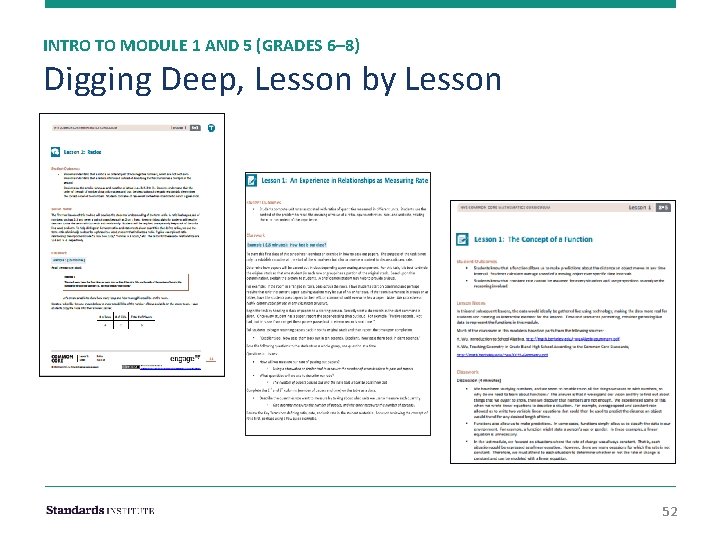
INTRO TO MODULE 1 AND 5 (GRADES 6– 8) Digging Deep, Lesson by Lesson 52
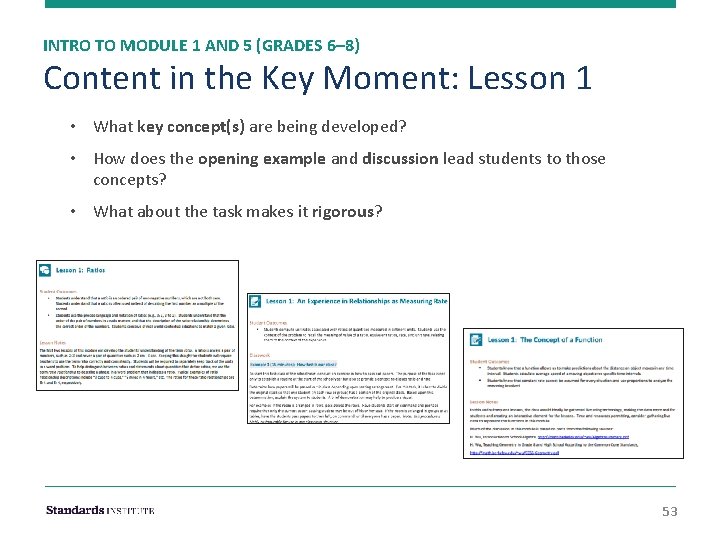
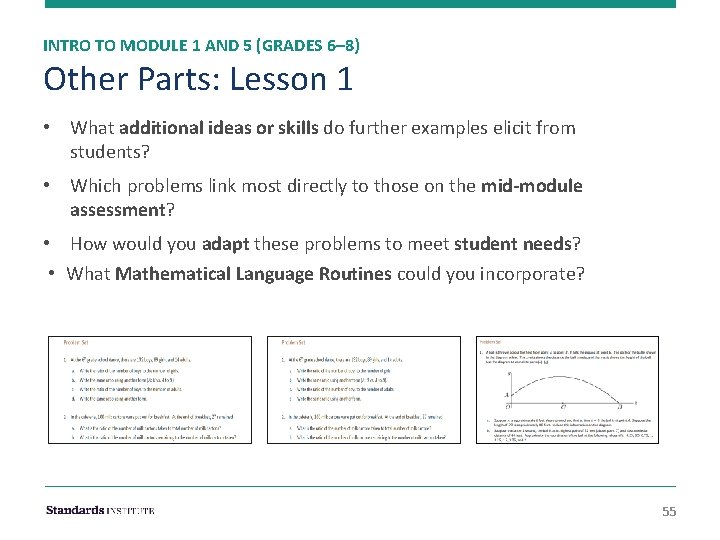
INTRO TO MODULE 1 AND 5 (GRADES 6– 8) Content in the Key Moment: Lesson 1 • What key concept(s) are being developed? • How does the opening example and discussion lead students to those concepts? • What about the task makes it rigorous? 53
INTRO TO MODULE 1 AND 5 (GRADES 6– 8) Implications for Practice: Lesson 1 • What are students doing? Are they engaging in mathematical practices? • What is the teacher doing to facilitate and engage them with the content? • What are the language demands of the tasks in relation to your students’ English language proficiency? • What Mathematical Language Routines could you incorporate? 54
INTRO TO MODULE 1 AND 5 (GRADES 6– 8) Other Parts: Lesson 1 • What additional ideas or skills do further examples elicit from students? • Which problems link most directly to those on the mid-module assessment? • How would you adapt these problems to meet student needs? • What Mathematical Language Routines could you incorporate? 55
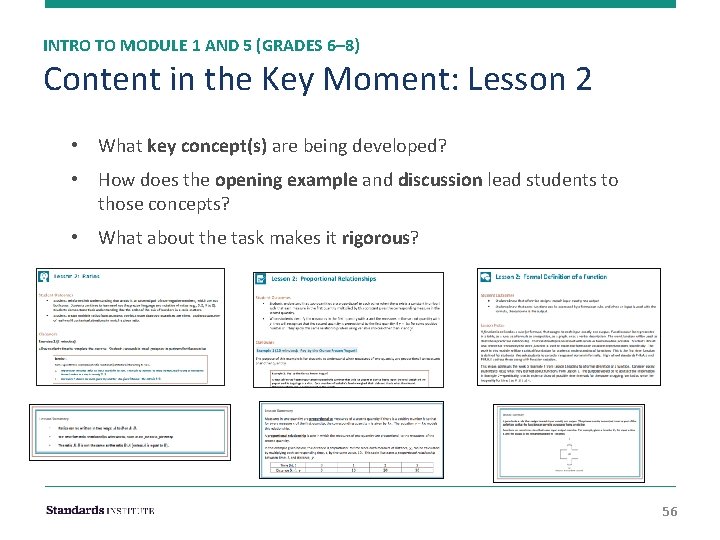
INTRO TO MODULE 1 AND 5 (GRADES 6– 8) Content in the Key Moment: Lesson 2 • What key concept(s) are being developed? • How does the opening example and discussion lead students to those concepts? • What about the task makes it rigorous? 56
INTRO TO MODULE 1 AND 5 (GRADES 6– 8) Implications for Practice: Lesson 2 • What are students doing? Are they engaging in mathematical practices? • What is the teacher doing to facilitate and engage them with the content? • How would you adapt this lesson to meet student needs? • What Mathematical Language Routines could you incorporate? 57
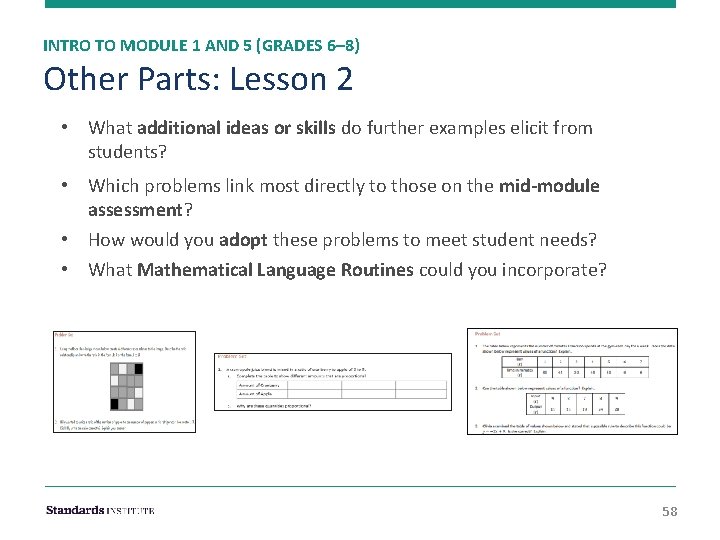
INTRO TO MODULE 1 AND 5 (GRADES 6– 8) Other Parts: Lesson 2 • What additional ideas or skills do further examples elicit from students? • Which problems link most directly to those on the mid-module assessment? • How would you adopt these problems to meet student needs? • What Mathematical Language Routines could you incorporate? 58
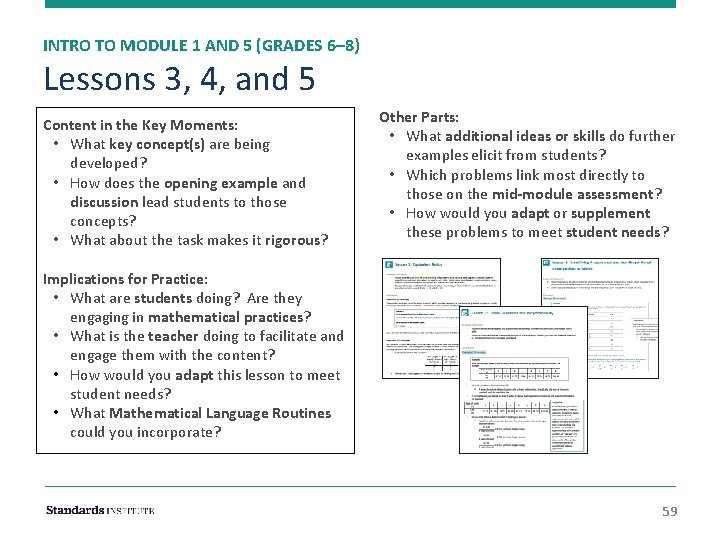
INTRO TO MODULE 1 AND 5 (GRADES 6– 8) Lessons 3, 4, and 5 Content in the Key Moments: • What key concept(s) are being developed? • How does the opening example and discussion lead students to those concepts? • What about the task makes it rigorous? Other Parts: • What additional ideas or skills do further examples elicit from students? • Which problems link most directly to those on the mid-module assessment? • How would you adapt or supplement these problems to meet student needs? Implications for Practice: • What are students doing? Are they engaging in mathematical practices? • What is the teacher doing to facilitate and engage them with the content? • How would you adapt this lesson to meet student needs? • What Mathematical Language Routines could you incorporate? 59
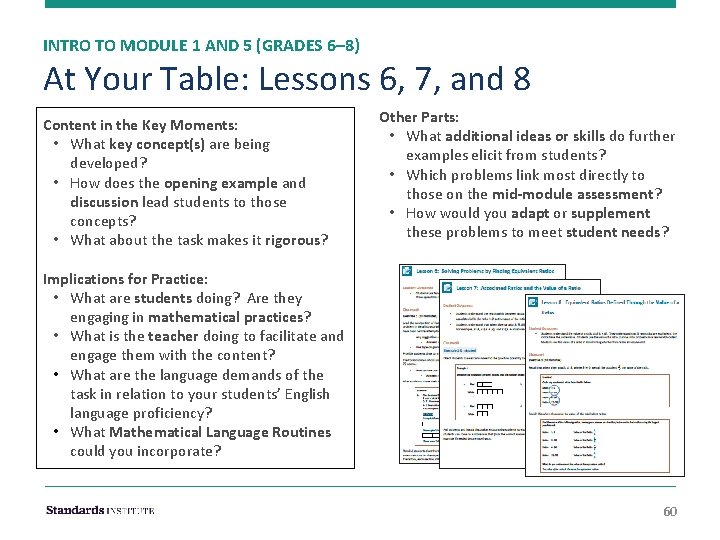
INTRO TO MODULE 1 AND 5 (GRADES 6– 8) At Your Table: Lessons 6, 7, and 8 Content in the Key Moments: • What key concept(s) are being developed? • How does the opening example and discussion lead students to those concepts? • What about the task makes it rigorous? Other Parts: • What additional ideas or skills do further examples elicit from students? • Which problems link most directly to those on the mid-module assessment? • How would you adapt or supplement these problems to meet student needs? Implications for Practice: • What are students doing? Are they engaging in mathematical practices? • What is the teacher doing to facilitate and engage them with the content? • What are the language demands of the task in relation to your students’ English language proficiency? • What Mathematical Language Routines could you incorporate? 60
V. Implications for Practice: Coherent Conten in Context, Purposeful Planning, Support for English Learners 61
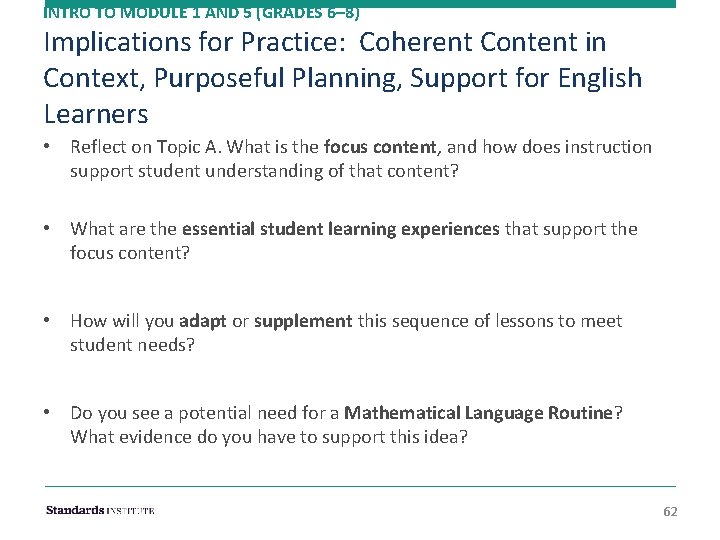
INTRO TO MODULE 1 AND 5 (GRADES 6– 8) Implications for Practice: Coherent Content in Context, Purposeful Planning, Support for English Learners • Reflect on Topic A. What is the focus content, and how does instruction support student understanding of that content? • What are the essential student learning experiences that support the focus content? • How will you adapt or supplement this sequence of lessons to meet student needs? • Do you see a potential need for a Mathematical Language Routine? What evidence do you have to support this idea? 62
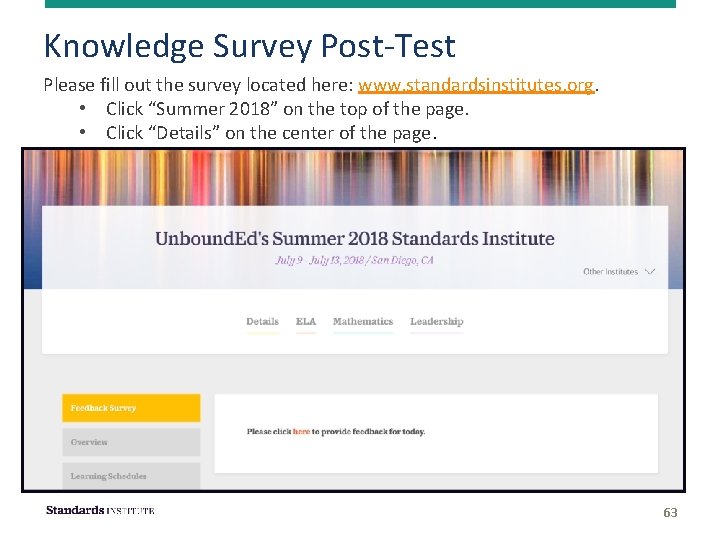
Knowledge Survey Post-Test Please fill out the survey located here: www. standardsinstitutes. org. • Click “Summer 2018” on the top of the page. • Click “Details” on the center of the page. 63
ADAPTING AND TEACHING LESSONS IN MODULE 1 (GRADES 6– 8) Welcome Back! 64
ADAPTING AND TEACHING LESSONS IN MODULE 1 AND 5 (GRADES 6– 8) Thank You for Your Feedback! + 65
ADAPTING AND TEACHING LESSONS IN MODULE 1 AND 5 (GRADES 6– 8) Norms That Support Our Learning • Take responsibility for yourself as a learner. • Honor timeframes (start, end, and activity). • Be an active and hands-on learner. • Use technology to enhance learning. • Strive for equity of voice. • Contribute to a learning environment in which it is “safe to not know. ” • Identify and reframe deficit thinking and speaking. 66
ADAPTING AND TEACHING LESSONS IN MODULE 1 AND 5 (GRADES 6– 8) This Week Day Ideas Monday Focus and Within Grade Coherence Tuesday Wednesday Rigor and the Mathematical Practices Across Grade Coherence and Instructional Practice Thursday Adaptation and Curriculum Study Friday Adaptation and Practice “Do the math” Equity for all Connect to our practice 67
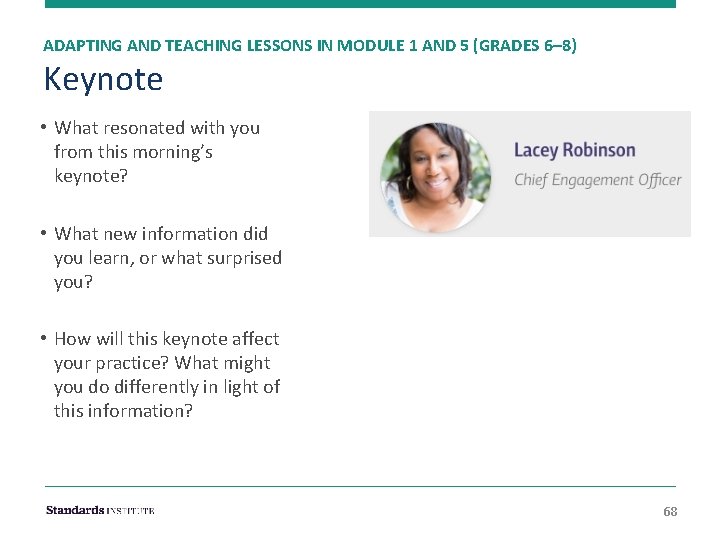
ADAPTING AND TEACHING LESSONS IN MODULE 1 AND 5 (GRADES 6– 8) Keynote • What resonated with you from this morning’s keynote? • What new information did you learn, or what surprised you? • How will this keynote affect your practice? What might you do differently in light of this information? 68
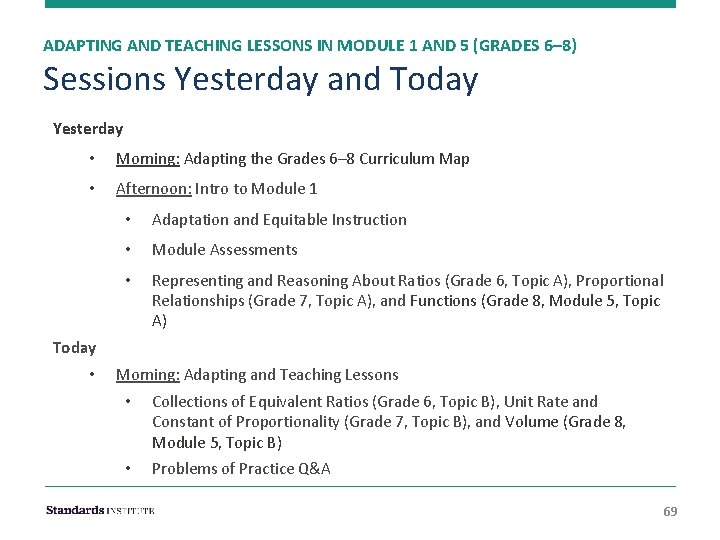
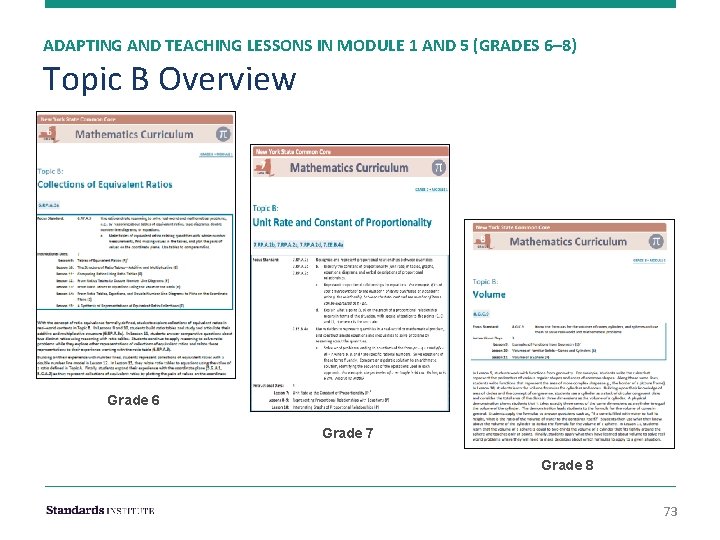
ADAPTING AND TEACHING LESSONS IN MODULE 1 AND 5 (GRADES 6– 8) Sessions Yesterday and Today Yesterday • Morning: Adapting the Grades 6– 8 Curriculum Map • Afternoon: Intro to Module 1 • Adaptation and Equitable Instruction • Module Assessments • Representing and Reasoning About Ratios (Grade 6, Topic A), Proportional Relationships (Grade 7, Topic A), and Functions (Grade 8, Module 5, Topic A) Today • Morning: Adapting and Teaching Lessons • Collections of Equivalent Ratios (Grade 6, Topic B), Unit Rate and Constant of Proportionality (Grade 7, Topic B), and Volume (Grade 8, Module 5, Topic B) • Problems of Practice Q&A 69
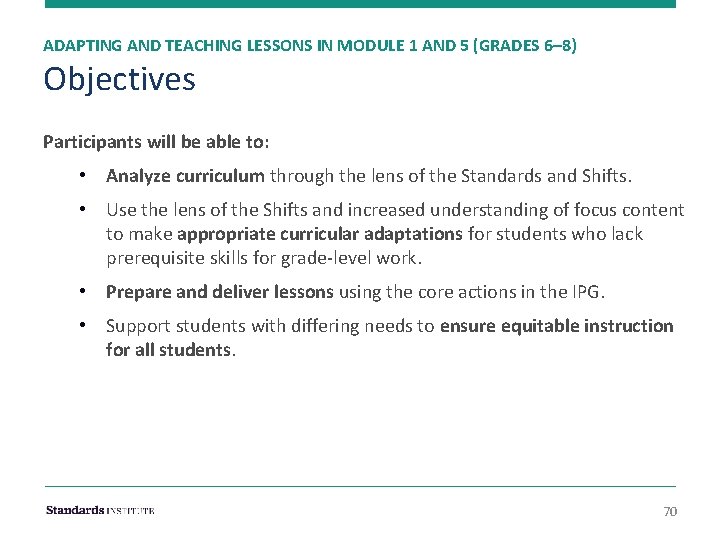
ADAPTING AND TEACHING LESSONS IN MODULE 1 AND 5 (GRADES 6– 8) Objectives Participants will be able to: • Analyze curriculum through the lens of the Standards and Shifts. • Use the lens of the Shifts and increased understanding of focus content to make appropriate curricular adaptations for students who lack prerequisite skills for grade-level work. • Prepare and deliver lessons using the core actions in the IPG. • Support students with differing needs to ensure equitable instruction for all students. 70
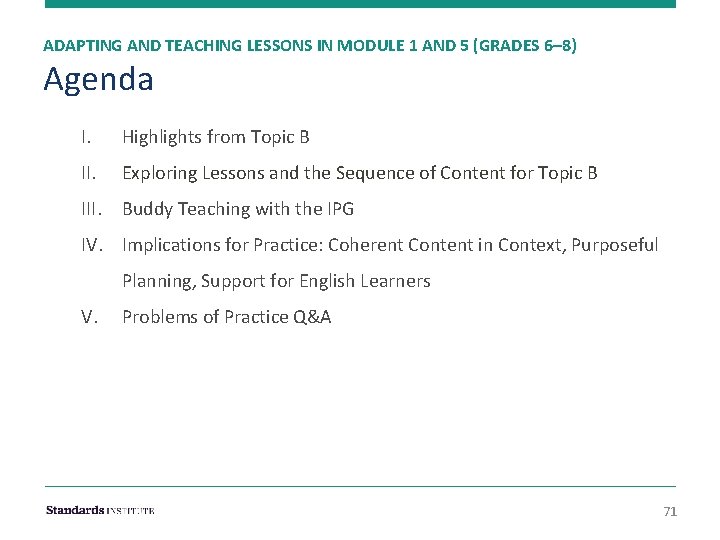
ADAPTING AND TEACHING LESSONS IN MODULE 1 AND 5 (GRADES 6– 8) Agenda I. Highlights from Topic B II. Exploring Lessons and the Sequence of Content for Topic B III. Buddy Teaching with the IPG IV. Implications for Practice: Coherent Content in Context, Purposeful Planning, Support for English Learners V. Problems of Practice Q&A 71
I. Highlights from Topic B 72
ADAPTING AND TEACHING LESSONS IN MODULE 1 AND 5 (GRADES 6– 8) Topic B Overview Grade 6 Grade 7 Grade 8 73
II. Exploring Lessons and the Sequence of Content for Topic B 74
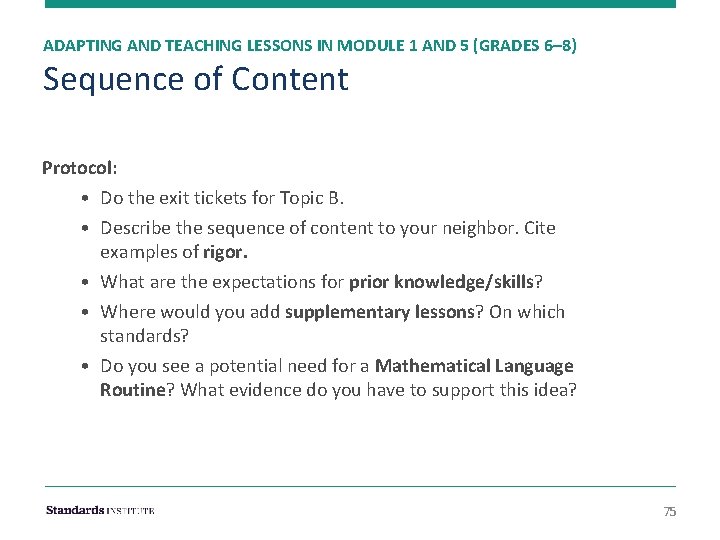
ADAPTING AND TEACHING LESSONS IN MODULE 1 AND 5 (GRADES 6– 8) Sequence of Content Protocol: • Do the exit tickets for Topic B. • Describe the sequence of content to your neighbor. Cite examples of rigor. • What are the expectations for prior knowledge/skills? • Where would you add supplementary lessons? On which standards? • Do you see a potential need for a Mathematical Language Routine? What evidence do you have to support this idea? 75
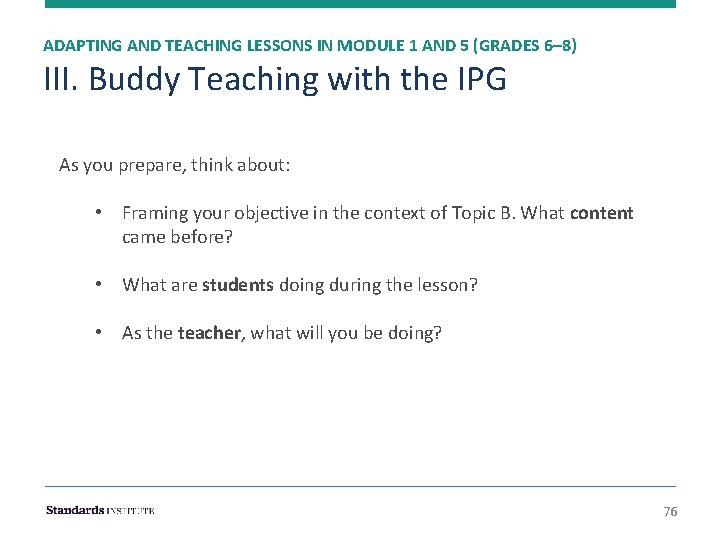
ADAPTING AND TEACHING LESSONS IN MODULE 1 AND 5 (GRADES 6– 8) III. Buddy Teaching with the IPG As you prepare, think about: • Framing your objective in the context of Topic B. What content came before? • What are students doing during the lesson? • As the teacher, what will you be doing? 76
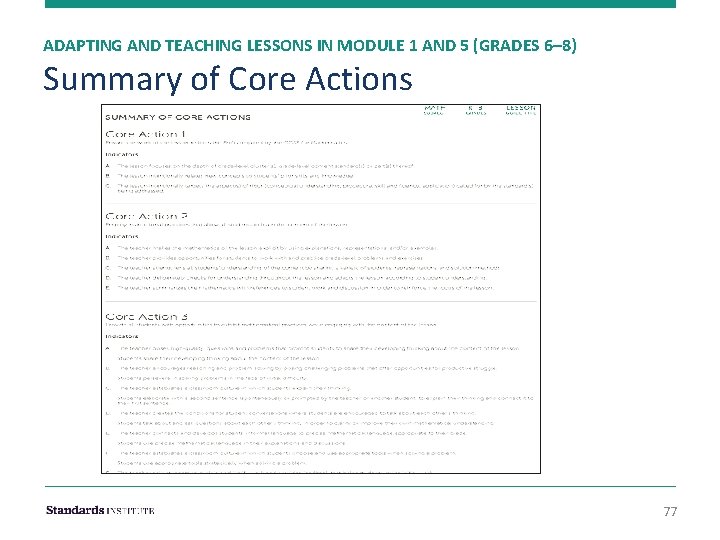
ADAPTING AND TEACHING LESSONS IN MODULE 1 AND 5 (GRADES 6– 8) Summary of Core Actions 77
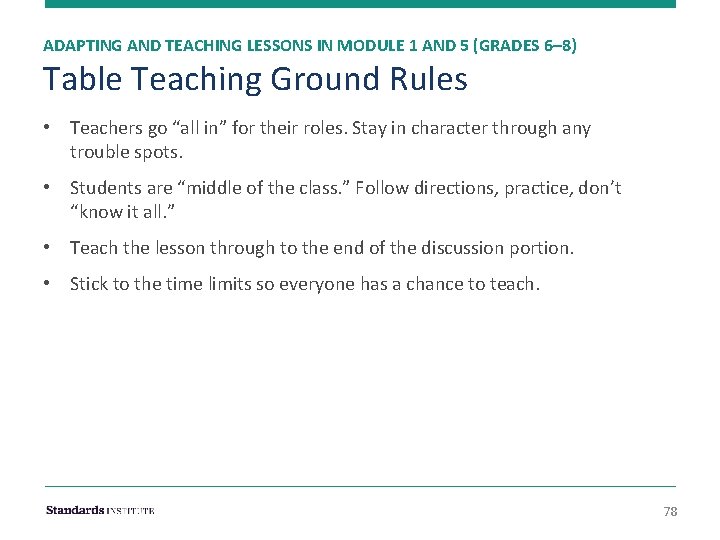
ADAPTING AND TEACHING LESSONS IN MODULE 1 AND 5 (GRADES 6– 8) Table Teaching Ground Rules • Teachers go “all in” for their roles. Stay in character through any trouble spots. • Students are “middle of the class. ” Follow directions, practice, don’t “know it all. ” • Teach the lesson through to the end of the discussion portion. • Stick to the time limits so everyone has a chance to teach. 78
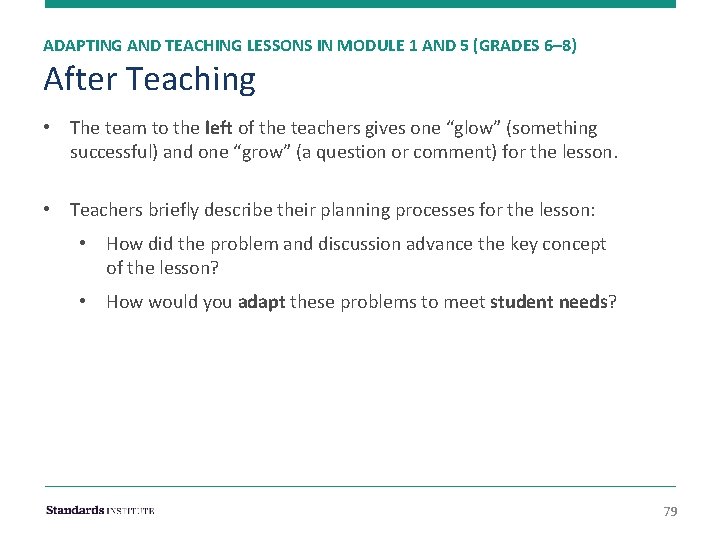
ADAPTING AND TEACHING LESSONS IN MODULE 1 AND 5 (GRADES 6– 8) After Teaching • The team to the left of the teachers gives one “glow” (something successful) and one “grow” (a question or comment) for the lesson. • Teachers briefly describe their planning processes for the lesson: • How did the problem and discussion advance the key concept of the lesson? • How would you adapt these problems to meet student needs? 79
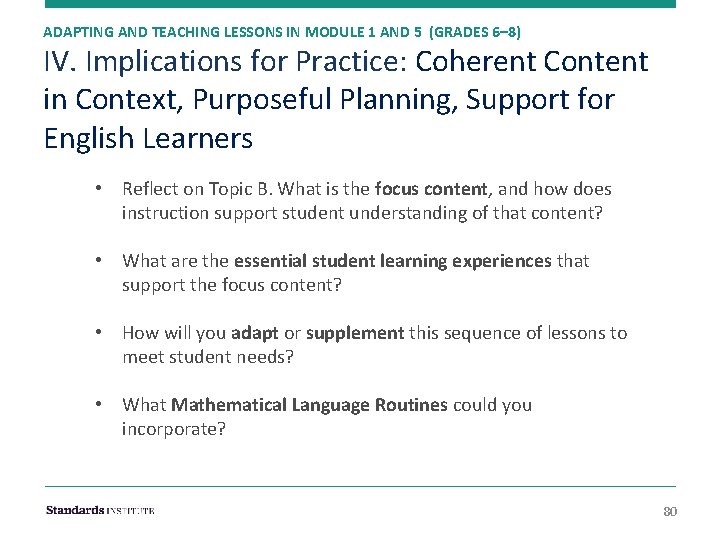
ADAPTING AND TEACHING LESSONS IN MODULE 1 AND 5 (GRADES 6– 8) IV. Implications for Practice: Coherent Content in Context, Purposeful Planning, Support for English Learners • Reflect on Topic B. What is the focus content, and how does instruction support student understanding of that content? • What are the essential student learning experiences that support the focus content? • How will you adapt or supplement this sequence of lessons to meet student needs? • What Mathematical Language Routines could you incorporate? 80
ADAPTING AND TEACHING LESSONS IN MODULE 1 AND 5 (GRADES 6– 8) V. Problems of Practice Q&A Protocol: 1. Prepare a question related to content learned throughout the week. a. Take 10 min to prepare a problem of practice that affects you in your role. Be specific! b. Do you have evidence that provides context to your problem? c. Identify how this problem connects to content learned throughout the week. 2. Each participant will receive a 15 minute Q&A session. 3. I will rotate to you to begin your round of Problems of Practice Q&A. 81
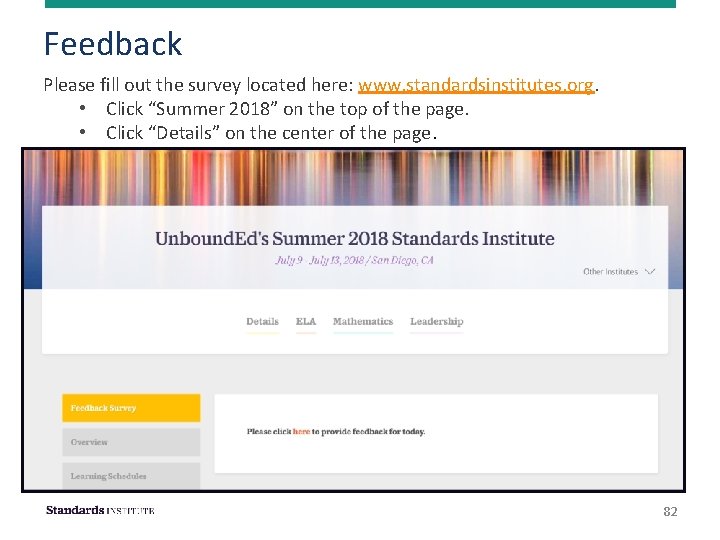
Feedback Please fill out the survey located here: www. standardsinstitutes. org. • Click “Summer 2018” on the top of the page. • Click “Details” on the center of the page. 82
About This Deck • Copyright © 2018 Unbound. Ed Learning, Inc. • This work is licensed under a Creative Commons Attribution Non. Commercial Share. Alike 4. 0 International License. • Unbound. Ed Learning, Inc. is the copyright holder of the images and content, except where otherwise indicated in the slide notes. • More information on Creative Commons’ licenses can be found here: https: //creativecommons. org/licenses/. 83
How You Can Use This Deck The materials that we create, unless otherwise cited in the slide notes, are licensed under the Creative Commons Attribution-Non. Commercial-Share. Alike 4. 0 International license (CC BYNC-SA 4. 0). This means you may: • Share—copy and redistribute the material in any medium or format • Adapt—remix, transform, and build upon the material As long as you follow the license terms: • Provide Attribution—You must give appropriate credit, provide a link to the license, and indicate if changes were made. You may do so in any reasonable manner, but not in any way that suggests that Unbound. Ed or any third party creator endorses you or your use. • No Commercial Use—You may not use the material for commercial purposes. • Share. Alike—If you remix, transform, or build upon the material, you must distribute your contributions under the same license as the original. • No Additional Restrictions—You may not apply legal terms or technological measures that legally restrict others from doing anything the license permits. 84