
Adapting Curriculum Maps Intro to Module 1 Algebra
Adapting Curriculum Maps & Intro to Module 1 Algebra II June 2017 1
ADAPTING CURRICULUM MAPS (ALGEBRA II) Welcome Back! 2
ADAPTING CURRICULUM MAPS (ALGEBRA II) Introduction: Who I Am Insert photo Name 1 • • Name 2 • • • 3
ADAPTING CURRICULUM MAPS (ALGEBRA II) Introduction: Who You Are Raise your hand if… • you are a math teacher coach • you hold a different role • you teach in a district school • you teach in a charter school • you teach or work in a different type of school or organization 4
ADAPTING CURRICULUM MAPS (ALGEBRA II) Thank You for Your Feedback! + 5
ADAPTING CURRICULUM MAPS (ALGEBRA II) Norms That Support Our Learning • Take responsibility for yourself as a learner • Honor timeframes (start, end, activity) • Be an active and hands-on learner • Use technology to enhance learning • Strive for equity of voice • Contribute to a learning environment in which it is “safe to not know” 6
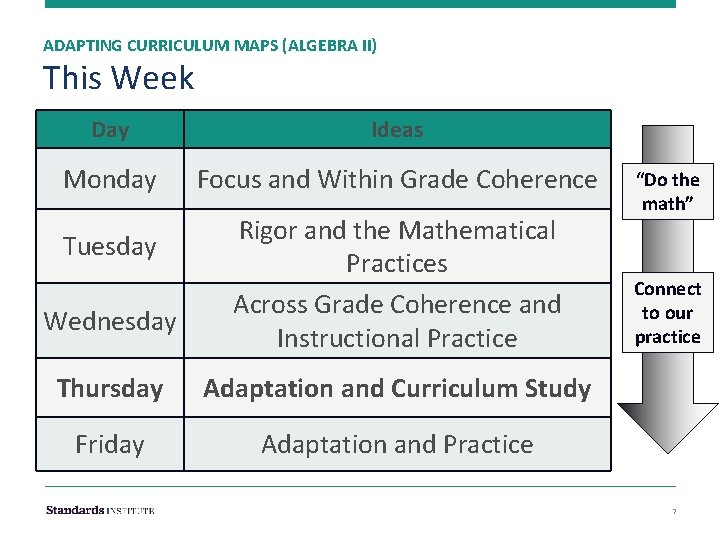
ADAPTING CURRICULUM MAPS (ALGEBRA II) This Week Day Ideas Monday Focus and Within Grade Coherence Tuesday Wednesday Rigor and the Mathematical Practices Across Grade Coherence and Instructional Practice Thursday Adaptation and Curriculum Study Friday Adaptation and Practice “Do the math” Connect to our practice 7
ADAPTING CURRICULUM MAPS (ALGEBRA II) Sessions Today and Tomorrow Today • Morning: Adapting the Algebra II Curriculum Map • Afternoon: Intro to Module 1 • Module Assessments • Polynomials—From Base Ten to Base X (Topic A) Tomorrow • Morning: Adapting and Teaching Lessons • Factoring—Its Use and Its Obstacles (Topic B) • Solving and Applying Equations—Polynomial, Rational, and Radical (Topic C) 8
ADAPTING CURRICULUM MAPS (ALGEBRA II) Morning: Adapting the Algebra II Curriculum Map Participants will be able to • analyze a curriculum map through the lens of the standards and shifts. • describe ways of adapting a curriculum map for students below grade level. 9
ADAPTING CURRICULUM MAPS (ALGEBRA II) Morning Agenda I. Curriculum Map Scavenger Hunt II. Adapting a Curriculum Map 10
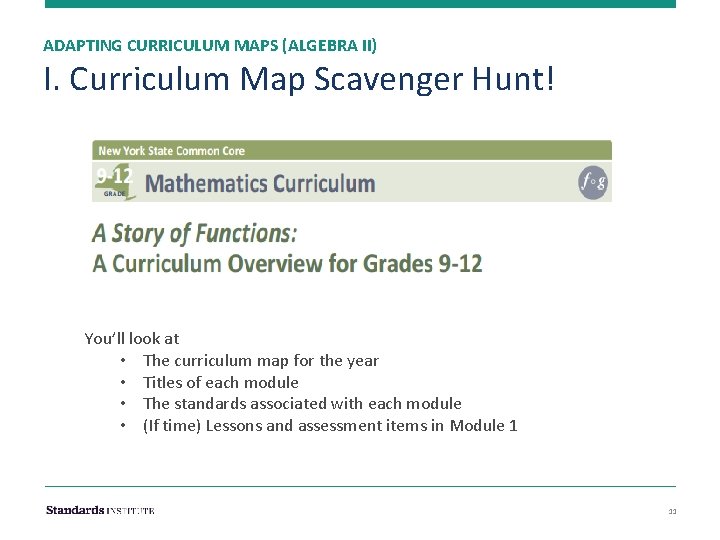
ADAPTING CURRICULUM MAPS (ALGEBRA II) I. Curriculum Map Scavenger Hunt! You’ll look at • The curriculum map for the year • Titles of each module • The standards associated with each module • (If time) Lessons and assessment items in Module 1 11
ADAPTING CURRICULUM MAPS (ALGEBRA II) Scavenger Hunt! 1. Scope and Sequence (Module Titles and Overview Pages): a. How many modules focus on major work? b. How many days of instruction is this? c. What percent of the instructional year is this? 2. Name all modules that include major and supporting content together. 3. Name all modules that emphasize additional content. 12
ADAPTING CURRICULUM MAPS (ALGEBRA II) II. Adapting a Curriculum Map What should our approach be if we have students who are not ready to access grade-level content? 13
ADAPTING CURRICULUM MAPS (ALGEBRA II) From the Appendix to Publisher’s Criteria “The natural distribution of prior knowledge in classrooms should not prompt abandoning instruction in grade level content, but should prompt explicit attention to connecting grade level content to content from prior learning. To do this, instruction should reflect the progressions on which the CCSSM are built…. Much unfinished learning from earlier grades can be managed best inside grade level work when the progressions are used to understand student thinking. ” 14
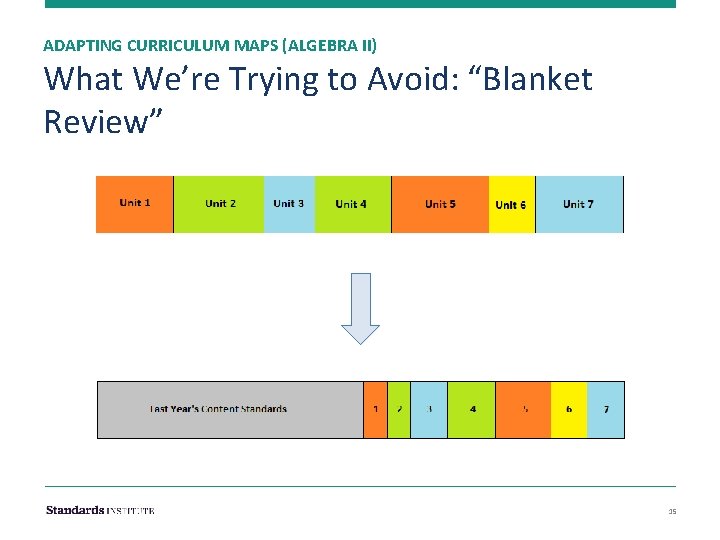
ADAPTING CURRICULUM MAPS (ALGEBRA II) What We’re Trying to Avoid: “Blanket Review” 15
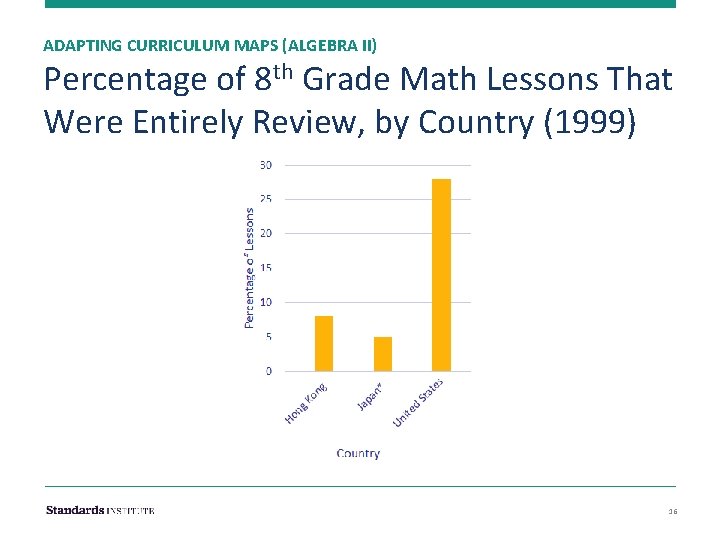
ADAPTING CURRICULUM MAPS (ALGEBRA II) Percentage of 8 th Grade Math Lessons That Were Entirely Review, by Country (1999) 16
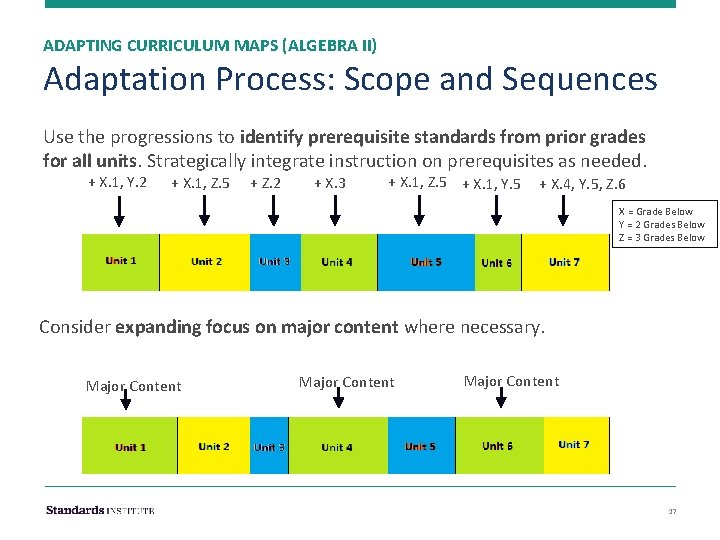
ADAPTING CURRICULUM MAPS (ALGEBRA II) Adaptation Process: Scope and Sequences Use the progressions to identify prerequisite standards from prior grades for all units. Strategically integrate instruction on prerequisites as needed. + X. 1, Y. 2 + X. 1, Z. 5 + Z. 2 + X. 3 + X. 1, Z. 5 + X. 1, Y. 5 + X. 4, Y. 5, Z. 6 X = Grade Below Y = 2 Grades Below Z = 3 Grades Below Consider expanding focus on major content where necessary. Major Content 17
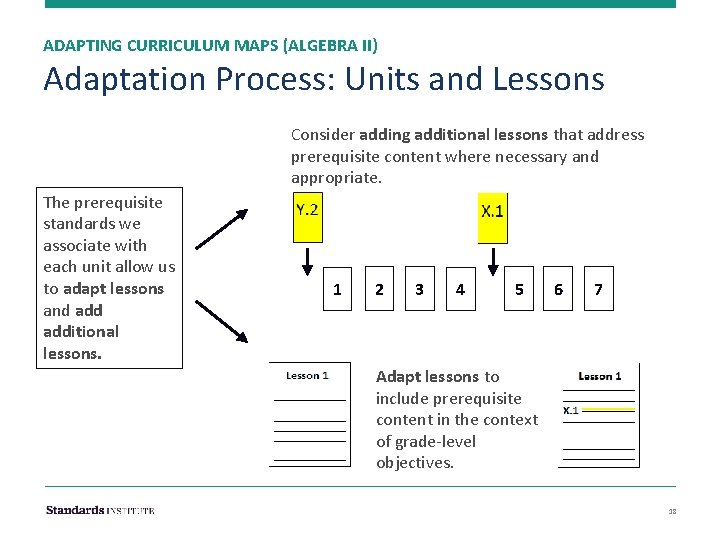
ADAPTING CURRICULUM MAPS (ALGEBRA II) Adaptation Process: Units and Lessons Consider adding additional lessons that address prerequisite content where necessary and appropriate. The prerequisite standards we associate with each unit allow us to adapt lessons and additional lessons. 1 2 3 4 5 6 7 Adapt lessons to include prerequisite content in the context of grade-level objectives. 18
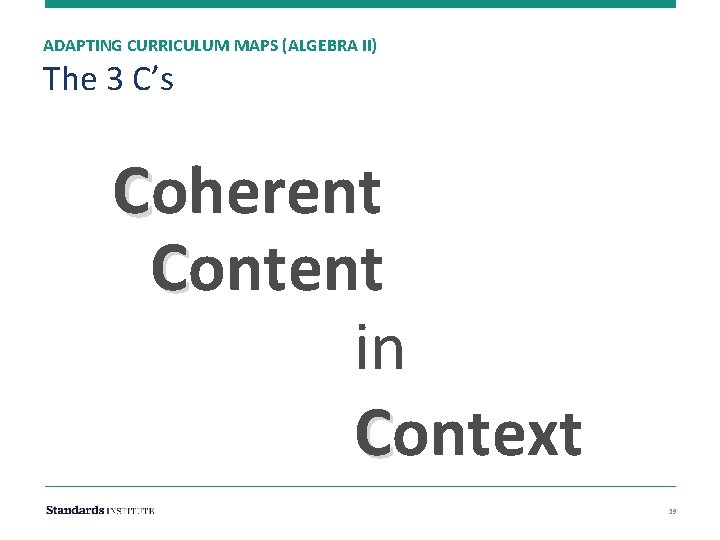
ADAPTING CURRICULUM MAPS (ALGEBRA II) The 3 C’s Coherent Content in Context 19
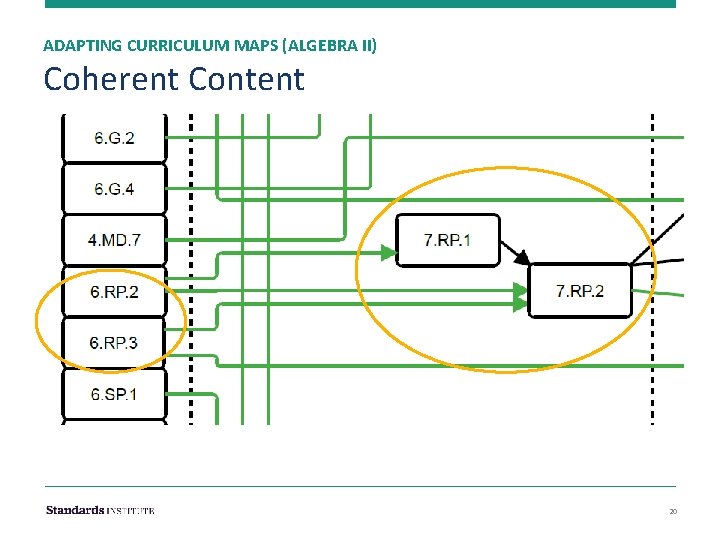
ADAPTING CURRICULUM MAPS (ALGEBRA II) Coherent Content 20
ADAPTING CURRICULUM MAPS (ALGEBRA II) Now You Try: Adaptation At your tables: 1. Look for two modules in Algebra II that you might spend more time on. Why these modules? 2. What, in your experience, will students struggle with related to that content? 3. What are the prerequisite standards you'd use to adapt those modules? 21

Share Out 22

SESSION 1 (111 M): Rigor– Calibrating Common Core (6 – 8) BREAK Lunch 23
INTRO TO MODULE 1 (ALGEBRA II) Sessions Today and Tomorrow Today • Morning: Adapting the Algebra II Curriculum Map • Afternoon: Intro to Module 1 • Module Assessments • Polynomials—From Base Ten to Base X (Topic A) • Tomorrow • Morning: Adapting and Teaching Lessons • Factoring—Its Use and Its Obstacles (Topic B) • Solving and Applying Equations—Polynomial, Rational, and Radical (Topic C) 24
INTRO TO MODULE 1 (ALGEBRA II) Afternoon: Intro to Module 1 in Algebra II Participants will be able to • analyze curriculum through the lens of the standards and shifts. • use the lens of the Shifts and increased understanding of focus content to make appropriate curricular adaptations for students who lack prerequisite skills for grade-level work. • anticipate student misunderstandings and support them instructionally. 25
INTRO TO MODULE 1 (ALGEBRA II) Afternoon: Agenda I. Assessing the Assessments II. Highlights from Topic A III. Exploring Lessons and the Sequence of Content for Topic A IV. Implications for Practice 26
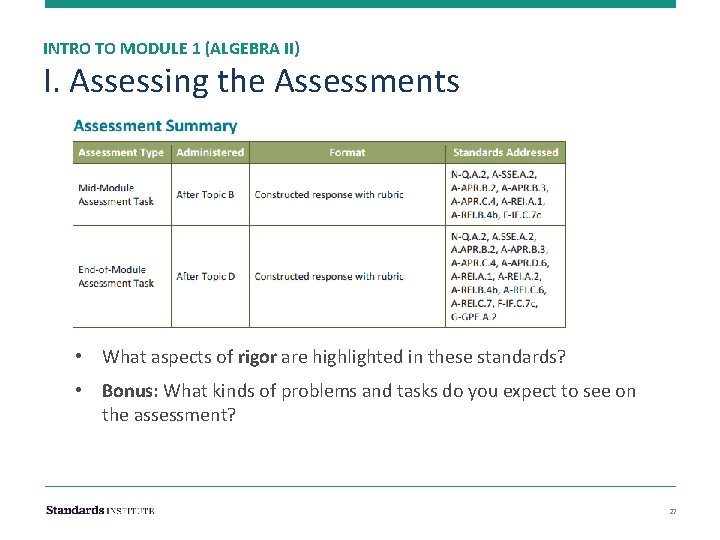
INTRO TO MODULE 1 (ALGEBRA II) I. Assessing the Assessments • What aspects of rigor are highlighted in these standards? • Bonus: What kinds of problems and tasks do you expect to see on the assessment? 27
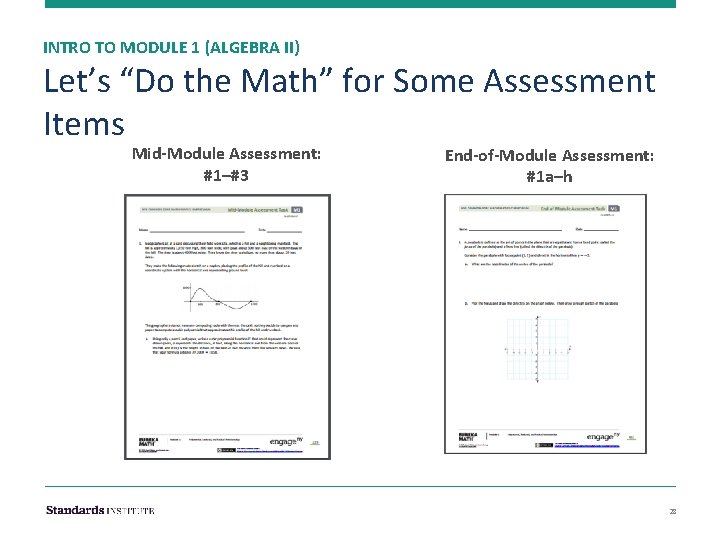
INTRO TO MODULE 1 (ALGEBRA II) Let’s “Do the Math” for Some Assessment Items Mid-Module Assessment: #1–#3 End-of-Module Assessment: #1 a–h 28
INTRO TO MODULE 1 (ALGEBRA II) At Your Table: Assessing the Assessments For each assessment item: 1. What standards are evident in this item and how do you know? 2. What aspects of rigor are highlighted in this item and how do you know? Also consider: 3. Compare the mid-module assessment to the end-of-module assessment. How does learning progress across the module? 29

II. Highlights from Topic A 30
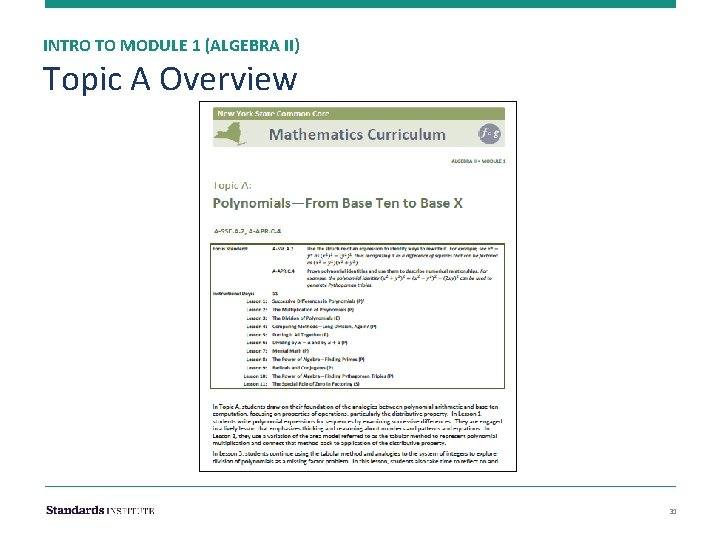
INTRO TO MODULE 1 (ALGEBRA II) Topic A Overview 31
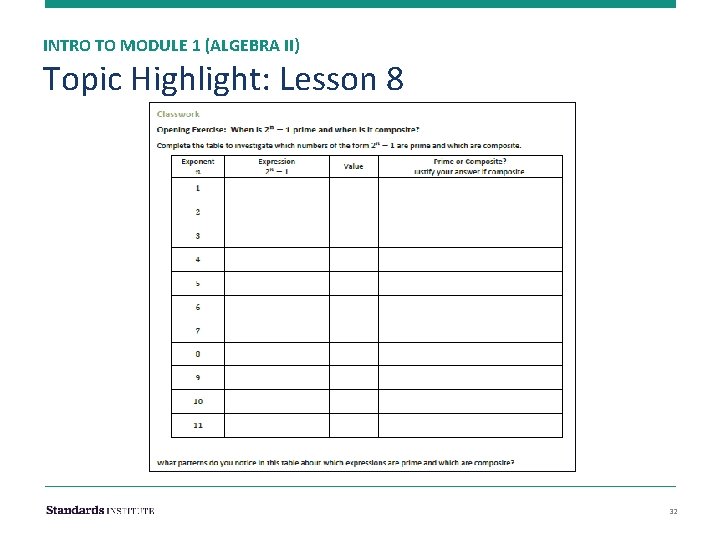
INTRO TO MODULE 1 (ALGEBRA II) Topic Highlight: Lesson 8 32

III. Exploring Lessons and the Sequence of Content for Topic A 33
INTRO TO MODULE 1 (ALGEBRA II) Sequence of Content • Do the exit tickets for Topic A. • Describe the sequence of content to your neighbor. Cite examples of rigor. • What are the expectations for prior knowledge/skills? • Where would you add supplementary lessons? On which standards? 34
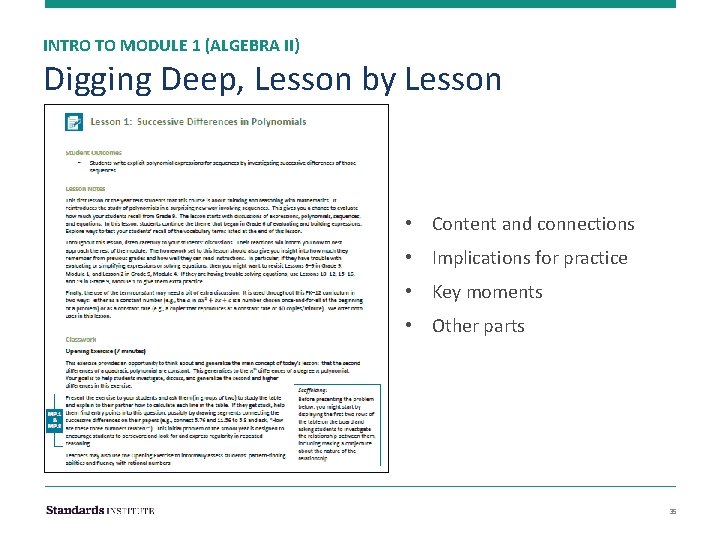
INTRO TO MODULE 1 (ALGEBRA II) Digging Deep, Lesson by Lesson • Content and connections • Implications for practice • Key moments • Other parts 35
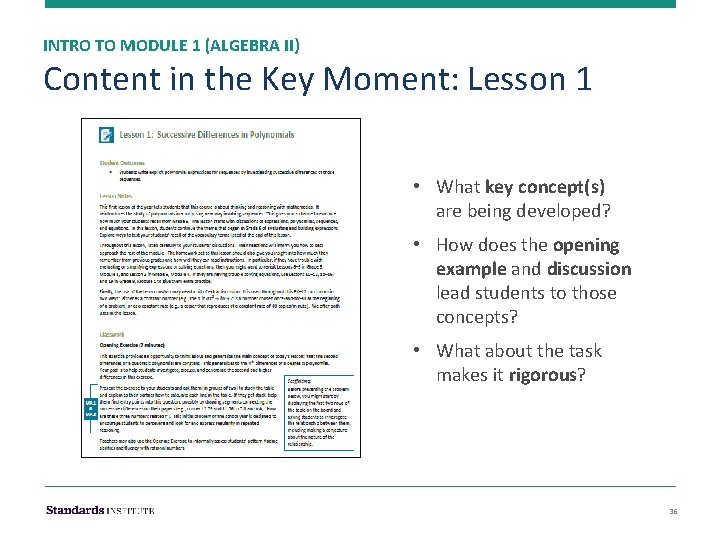
INTRO TO MODULE 1 (ALGEBRA II) Content in the Key Moment: Lesson 1 • What key concept(s) are being developed? • How does the opening example and discussion lead students to those concepts? • What about the task makes it rigorous? 36
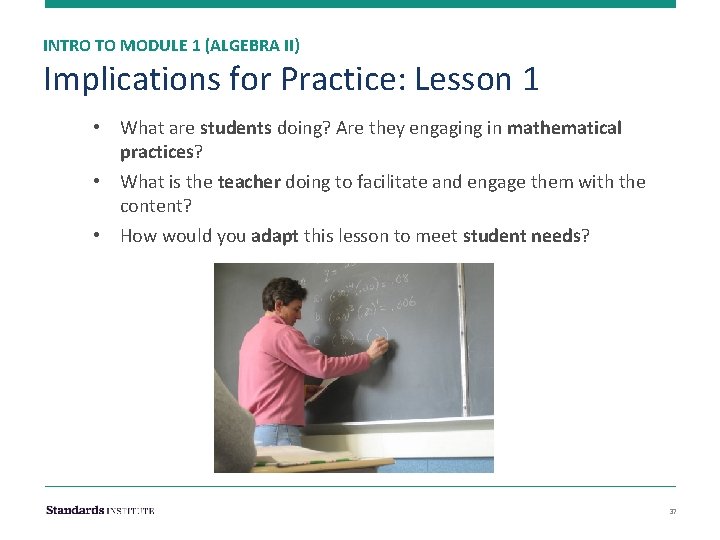
INTRO TO MODULE 1 (ALGEBRA II) Implications for Practice: Lesson 1 • What are students doing? Are they engaging in mathematical practices? • What is the teacher doing to facilitate and engage them with the content? • How would you adapt this lesson to meet student needs? 37
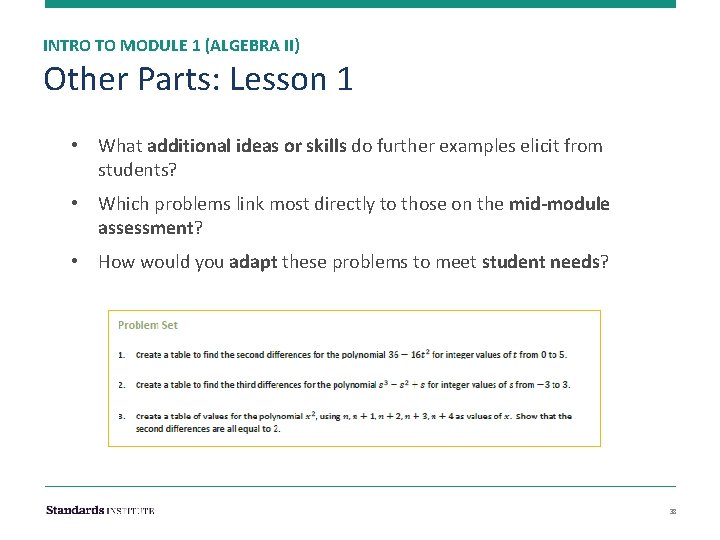
INTRO TO MODULE 1 (ALGEBRA II) Other Parts: Lesson 1 • What additional ideas or skills do further examples elicit from students? • Which problems link most directly to those on the mid-module assessment? • How would you adapt these problems to meet student needs? 38
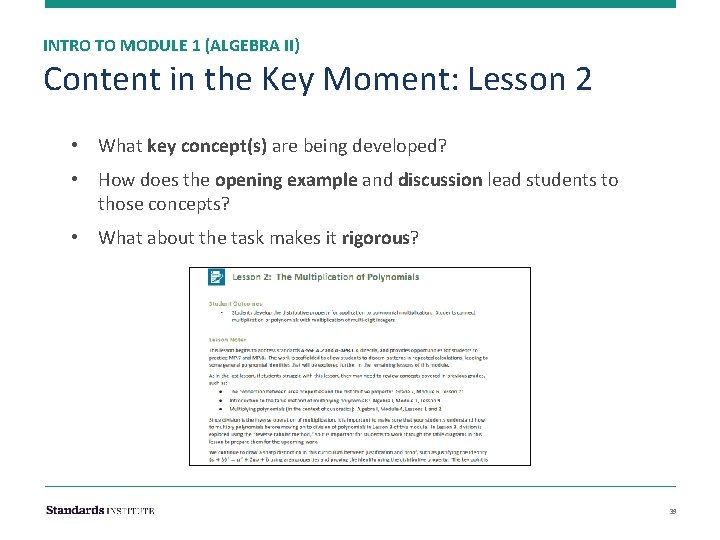
INTRO TO MODULE 1 (ALGEBRA II) Content in the Key Moment: Lesson 2 • What key concept(s) are being developed? • How does the opening example and discussion lead students to those concepts? • What about the task makes it rigorous? 39
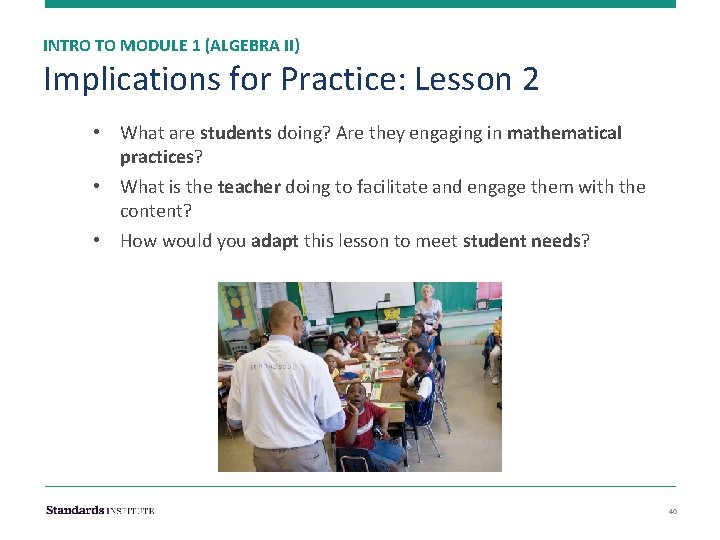
INTRO TO MODULE 1 (ALGEBRA II) Implications for Practice: Lesson 2 • What are students doing? Are they engaging in mathematical practices? • What is the teacher doing to facilitate and engage them with the content? • How would you adapt this lesson to meet student needs? 40
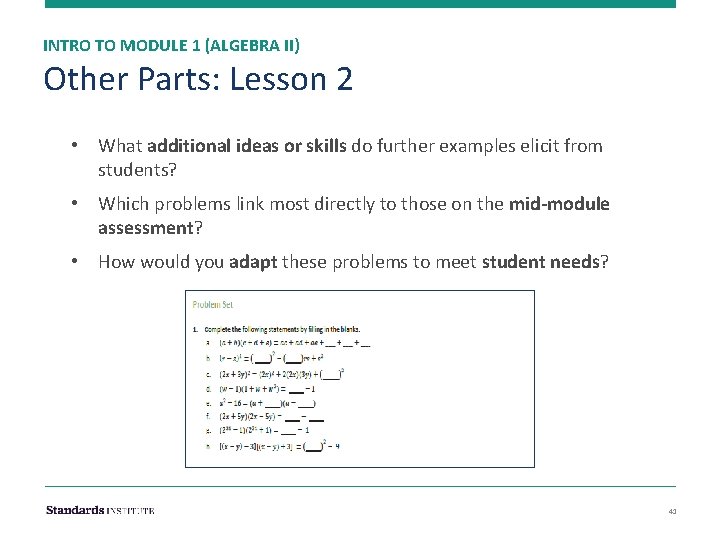
INTRO TO MODULE 1 (ALGEBRA II) Other Parts: Lesson 2 • What additional ideas or skills do further examples elicit from students? • Which problems link most directly to those on the mid-module assessment? • How would you adapt these problems to meet student needs? 41
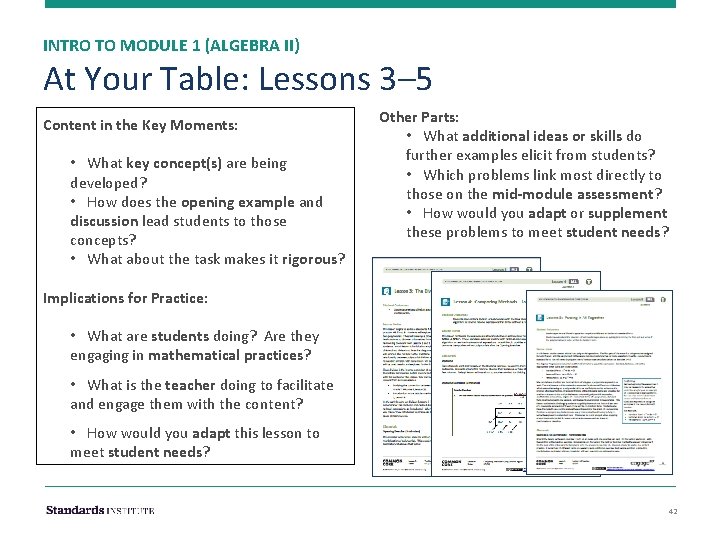
INTRO TO MODULE 1 (ALGEBRA II) At Your Table: Lessons 3– 5 Content in the Key Moments: • What key concept(s) are being developed? • How does the opening example and discussion lead students to those concepts? • What about the task makes it rigorous? Other Parts: • What additional ideas or skills do further examples elicit from students? • Which problems link most directly to those on the mid-module assessment? • How would you adapt or supplement these problems to meet student needs? Implications for Practice: • What are students doing? Are they engaging in mathematical practices? • What is the teacher doing to facilitate and engage them with the content? • How would you adapt this lesson to meet student needs? 42
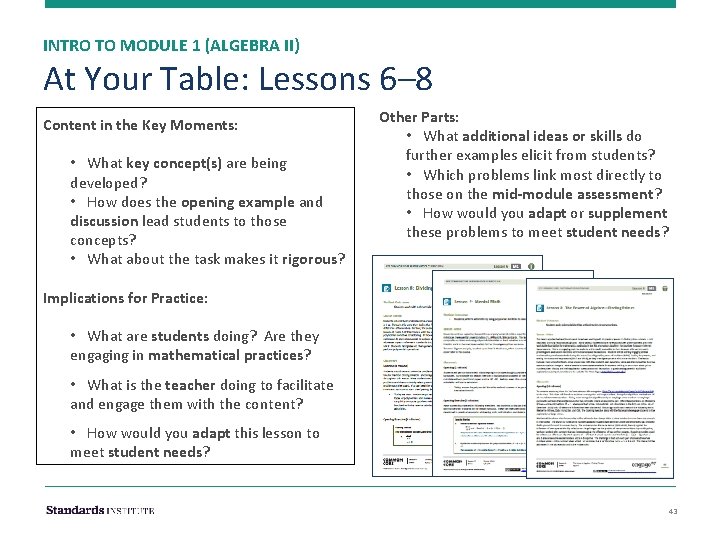
INTRO TO MODULE 1 (ALGEBRA II) At Your Table: Lessons 6– 8 Content in the Key Moments: • What key concept(s) are being developed? • How does the opening example and discussion lead students to those concepts? • What about the task makes it rigorous? Other Parts: • What additional ideas or skills do further examples elicit from students? • Which problems link most directly to those on the mid-module assessment? • How would you adapt or supplement these problems to meet student needs? Implications for Practice: • What are students doing? Are they engaging in mathematical practices? • What is the teacher doing to facilitate and engage them with the content? • How would you adapt this lesson to meet student needs? 43
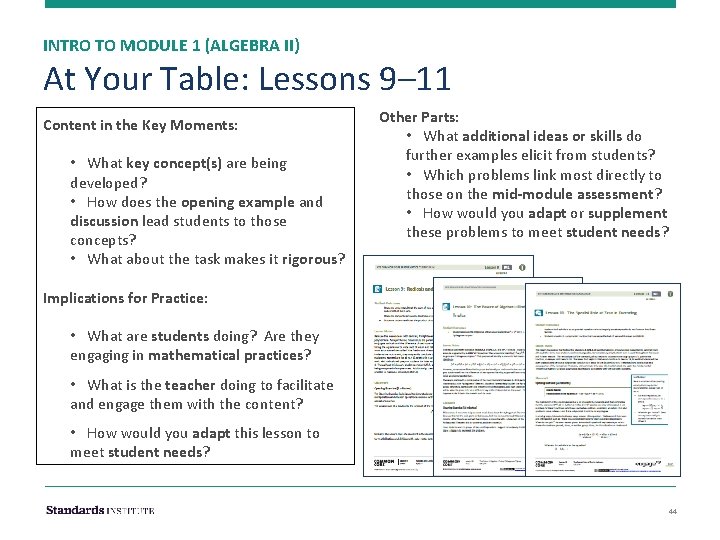
INTRO TO MODULE 1 (ALGEBRA II) At Your Table: Lessons 9– 11 Content in the Key Moments: • What key concept(s) are being developed? • How does the opening example and discussion lead students to those concepts? • What about the task makes it rigorous? Other Parts: • What additional ideas or skills do further examples elicit from students? • Which problems link most directly to those on the mid-module assessment? • How would you adapt or supplement these problems to meet student needs? Implications for Practice: • What are students doing? Are they engaging in mathematical practices? • What is the teacher doing to facilitate and engage them with the content? • How would you adapt this lesson to meet student needs? 44
IV. Implications for Practice 45
INTRO TO MODULE 1 (ALGEBRA II) IV. Implications for Practice • Reflect on Topic A. What is the focus content, and how does instruction support student understanding of that content? • What are the essential student learning experiences that support the focus content? • How will you adapt or supplement this sequence of lessons to meet student needs? 46
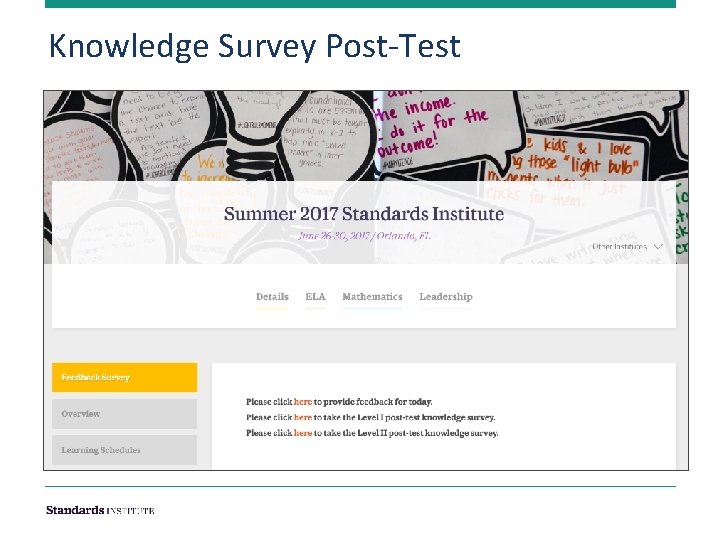
Knowledge Survey Post-Test
ADAPTING AND TEACHING LESSONS IN MODULE 1 (ALGEBRA II) Welcome Back! 48
ADAPTING AND TEACHING LESSONS IN MODULE 1 (ALGEBRA II) Thank You for Your Feedback! + 49
ADAPTING AND TEACHING LESSONS IN MODULE 1 (ALGEBRA II) Norms That Support Our Learning • Take responsibility for yourself as a learner • Honor timeframes (start, end, activity) • Be an active and hands-on learner • Use technology to enhance learning • Strive for equity of voice • Contribute to a learning environment in which it is “safe to not know” 50
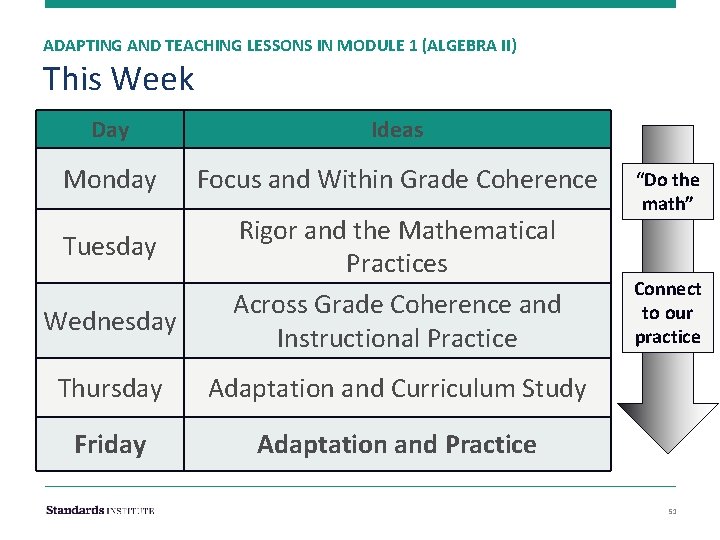
ADAPTING AND TEACHING LESSONS IN MODULE 1 (ALGEBRA II) This Week Day Ideas Monday Focus and Within Grade Coherence Tuesday Wednesday Rigor and the Mathematical Practices Across Grade Coherence and Instructional Practice Thursday Adaptation and Curriculum Study Friday Adaptation and Practice “Do the math” Connect to our practice 51
ADAPTING AND TEACHING LESSONS IN MODULE 1 (ALGEBRA II) Sessions Yesterday and Today Yesterday • Morning: Adapting the Algebra II Curriculum Map • Afternoon: Intro to Module 1 • Module Assessments • Polynomials—From Base Ten to Base X (Topic A) Today • Morning: Adapting and Teaching Lessons • Factoring—Its Use and Its Obstacles (Topic B) • Solving and Applying Equations—Polynomial, Rational, and Radical (Topic C) 52
ADAPTING AND TEACHING LESSONS IN MODULE 1 (ALGEBRA II) Objectives Participants will be able to • analyze curriculum through the lens of the standards and shifts. • use the lens of the shifts and increased understanding of focus content to make appropriate curricular adaptations for students who lack prerequisite skills for grade-level work. • prepare and deliver lessons using the core actions in the IPG. 53
ADAPTING AND TEACHING LESSONS IN MODULE 1 (ALGEBRA II) Agenda I. Highlights from Topic B II. Exploring Lessons and the Sequence of Content for Topic B III. Buddy Teaching with the IPG IV. Implications for Practice V. Highlights from Topic C VI. Exploring Lessons and the Sequence of Content for Topic C VII. Buddy Teaching an Adapted Lesson VIII. Implications for Practice 54

I. Highlights from Topic B 55
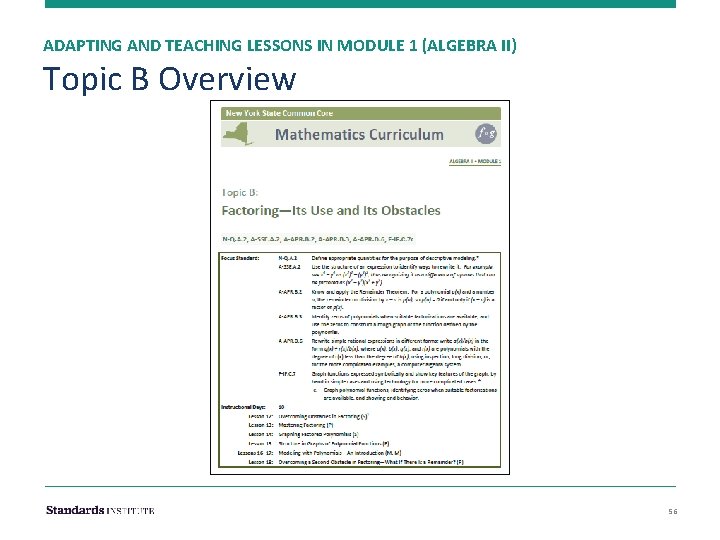
ADAPTING AND TEACHING LESSONS IN MODULE 1 (ALGEBRA II) Topic B Overview 56
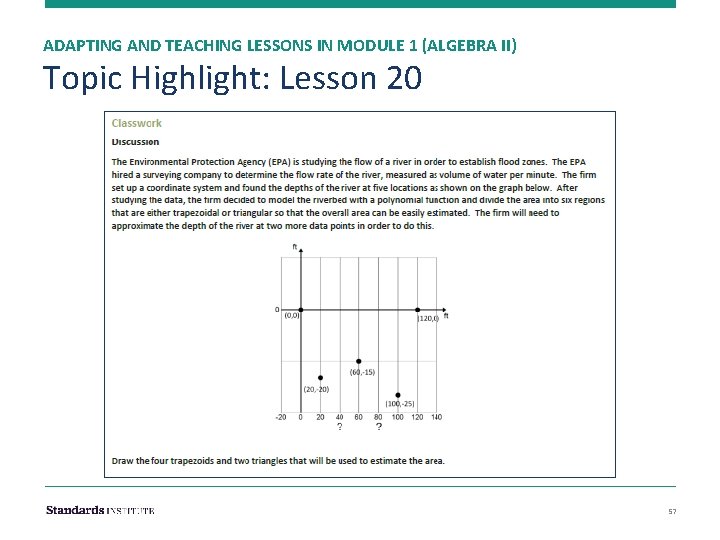
ADAPTING AND TEACHING LESSONS IN MODULE 1 (ALGEBRA II) Topic Highlight: Lesson 20 57

II. Exploring Lessons and the Sequence of Content for Topic B 58
ADAPTING AND TEACHING LESSONS IN MODULE 1 (ALGEBRA II) Sequence of Content • Do the exit tickets for Topic B. • Describe the sequence of content to your neighbor. Cite examples of rigor. • What are the expectations for prior knowledge/skills? • Where would you add supplementary lessons? On which standards? 59
ADAPTING AND TEACHING LESSONS IN MODULE 1 (ALGEBRA II) III. Buddy Teaching with the IPG As you prepare, think about: • Framing your objective in the context of Topic B. What content came before? • What are students doing during the lesson? • As the teacher, what will you be doing? 60
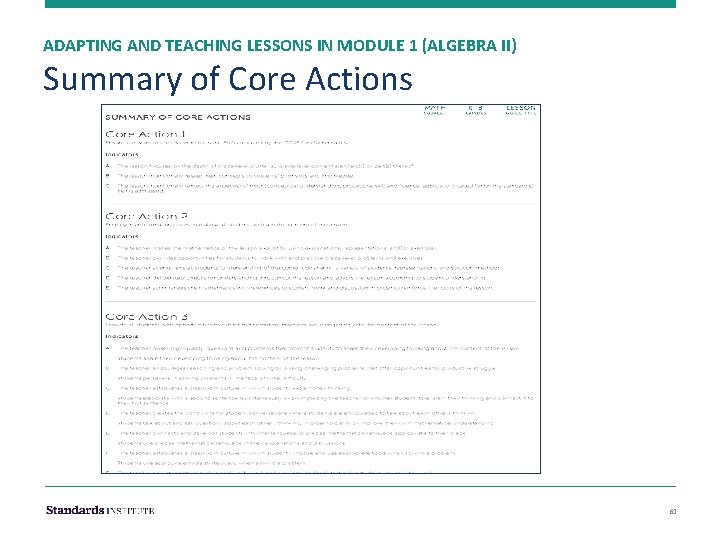
ADAPTING AND TEACHING LESSONS IN MODULE 1 (ALGEBRA II) Summary of Core Actions 61
ADAPTING AND TEACHING LESSONS IN MODULE 1 (ALGEBRA II) Table Teaching Ground Rules • Teachers go “all in” for their roles. Stay in character through any trouble spots. • Students are “middle of the class. ” Follow directions, practice, don’t “know it all. ” • Teach the lesson through to the end of the discussion portion. • Stick to the time limits so everyone has a chance to teach. 62
ADAPTING AND TEACHING LESSONS IN MODULE 1 (ALGEBRA II) After Teaching • The team to the left of the teachers gives one “glow” (something successful) and one “grow” (a question or comment) for the lesson. • Teachers briefly describe their planning processes for the lesson: • How did the problem and discussion advance the key concept of the lesson? • How would you adapt these problems to meet student needs? 63
ADAPTING AND TEACHING LESSONS IN MODULE 1 (ALGEBRA II) IV. Implications for Practice • Reflect on Topic B. What is the focus content, and how does instruction support student understanding of that content? • What are the essential student learning experiences that support the focus content? • How will you adapt or supplement this sequence of lessons to meet student needs? 64

V. Highlights from Topic C
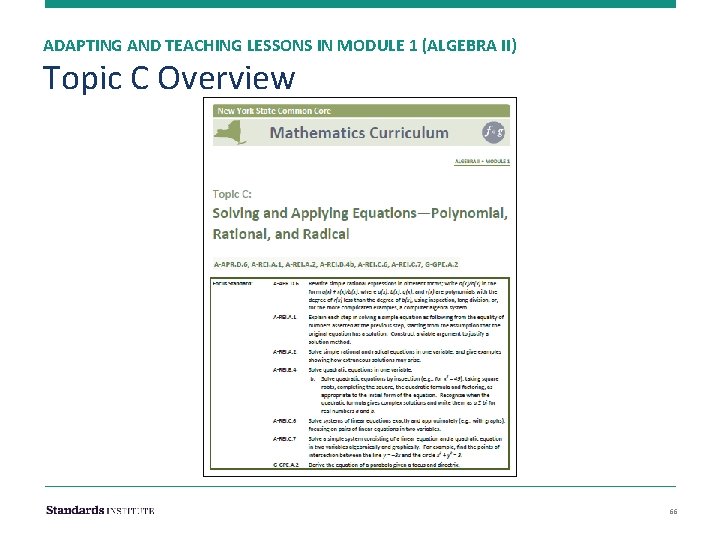
ADAPTING AND TEACHING LESSONS IN MODULE 1 (ALGEBRA II) Topic C Overview 66
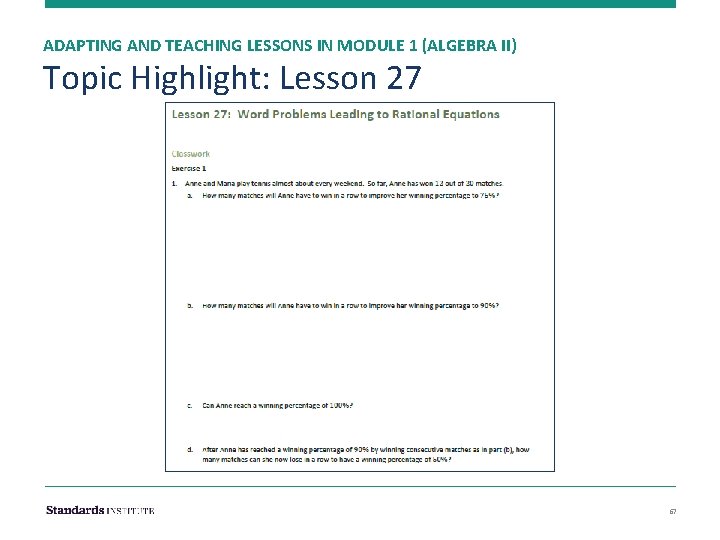
ADAPTING AND TEACHING LESSONS IN MODULE 1 (ALGEBRA II) Topic Highlight: Lesson 27 67
ADAPTING AND TEACHING LESSONS IN MODULE 1 (ALGEBRA II) VI. Exploring Lessons and the Sequence of Content for Topic C 68
ADAPTING AND TEACHING LESSONS IN MODULE 1 (ALGEBRA II) Sequence of Content • Do the exit tickets for Topic C Lessons 22– 27. • Describe the sequence of content to your neighbor. Cite examples of rigor. • What are the expectations for prior knowledge/skills? • Where would you add supplementary lessons? On which standards? 69
ADAPTING AND TEACHING LESSONS IN MODULE 1 (ALGEBRA II) Digging Deep: Jigsaw With your group, consider: • The content in the key moment (opening example and discussion) of your lesson. • Implications for teaching practice in the key moment. • The significance of the other parts (further examples, problem set). 70
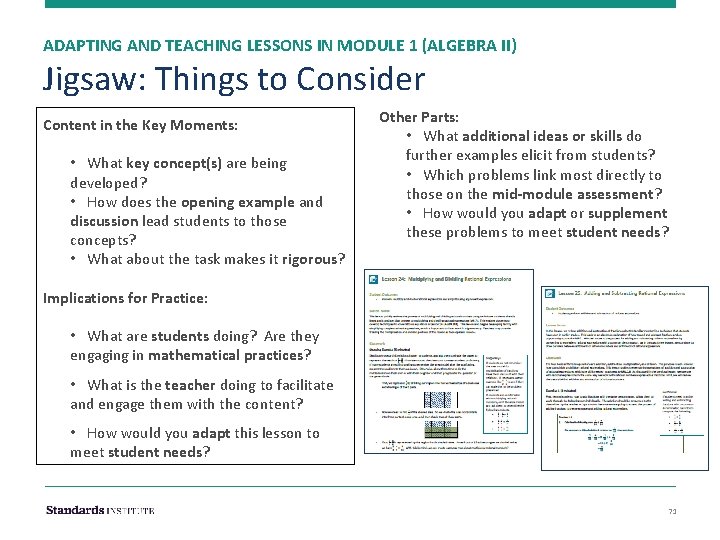
ADAPTING AND TEACHING LESSONS IN MODULE 1 (ALGEBRA II) Jigsaw: Things to Consider Content in the Key Moments: • What key concept(s) are being developed? • How does the opening example and discussion lead students to those concepts? • What about the task makes it rigorous? Other Parts: • What additional ideas or skills do further examples elicit from students? • Which problems link most directly to those on the mid-module assessment? • How would you adapt or supplement these problems to meet student needs? Implications for Practice: • What are students doing? Are they engaging in mathematical practices? • What is the teacher doing to facilitate and engage them with the content? • How would you adapt this lesson to meet student needs? 71
ADAPTING AND TEACHING LESSONS IN MODULE 1 (ALGEBRA II) VII. Buddy Teaching an Adapted Lesson Protocol: • Adapt a lesson in Topic C using coherent content in context. • Explain the adaptation to your partner. • Teach the adapted section to your partner. 72
ADAPTING AND TEACHING LESSONS IN MODULE 1 (ALGEBRA II) VIII. Implications for Practice • Reflect on Topic C. What is the focus content, and how does instruction support student understanding of that content? • What are the essential student learning experiences that support the focus content? • How will you adapt or supplement this sequence of lessons to meet student needs? 73
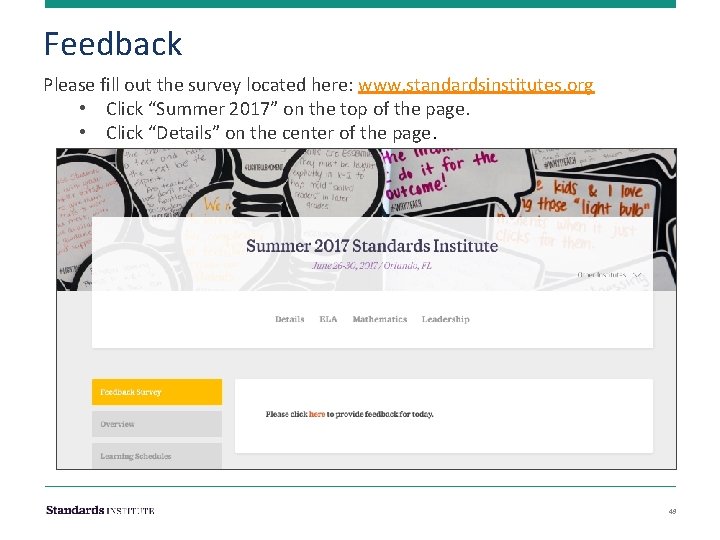
Feedback Please fill out the survey located here: www. standardsinstitutes. org • Click “Summer 2017” on the top of the page. • Click “Details” on the center of the page. 49
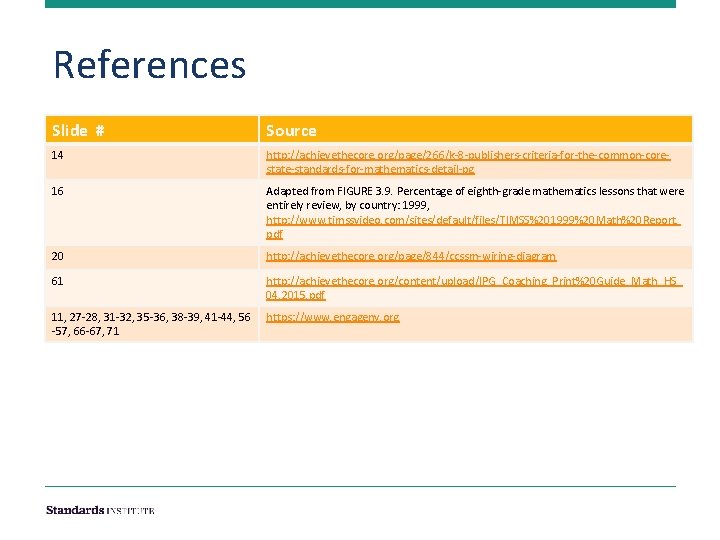
References Slide # Source 14 http: //achievethecore. org/page/266/k-8 -publishers-criteria-for-the-common-corestate-standards-for-mathematics-detail-pg 16 Adapted from FIGURE 3. 9. Percentage of eighth-grade mathematics lessons that were entirely review, by country: 1999, http: //www. timssvideo. com/sites/default/files/TIMSS%201999%20 Math%20 Report. pdf 20 http: //achievethecore. org/page/844/ccssm-wiring-diagram 61 http: //achievethecore. org/content/upload/IPG_Coaching_Print%20 Guide_Math_HS_ 04. 2015. pdf 11, 27 -28, 31 -32, 35 -36, 38 -39, 41 -44, 56 -57, 66 -67, 71 https: //www. engageny. org
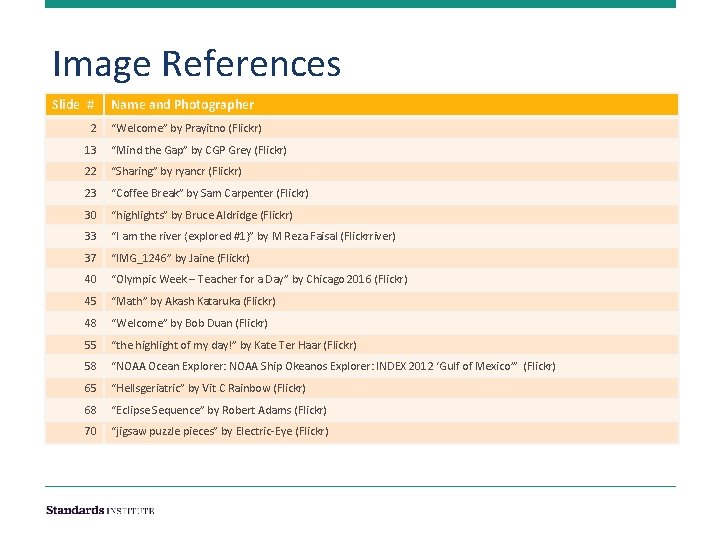
Image References Slide # 2 Name and Photographer “Welcome” by Prayitno (Flickr) 13 “Mind the Gap” by CGP Grey (Flickr) 22 “Sharing” by ryancr (Flickr) 23 “Coffee Break” by Sam Carpenter (Flickr) 30 “highlights” by Bruce Aldridge (Flickr) 33 “I am the river {explored #1}” by M Reza Faisal (Flickrriver) 37 “IMG_1246” by Jaine (Flickr) 40 “Olympic Week – Teacher for a Day” by Chicago 2016 (Flickr) 45 “Math” by Akash Kataruka (Flickr) 48 “Welcome” by Bob Duan (Flickr) 55 “the highlight of my day!” by Kate Ter Haar (Flickr) 58 “NOAA Ocean Explorer: NOAA Ship Okeanos Explorer: INDEX 2012 ‘Gulf of Mexico’” (Flickr) 65 “Hellsgeriatric” by Vit C Rainbow (Flickr) 68 “Eclipse Sequence” by Robert Adams (Flickr) 70 “jigsaw puzzle pieces” by Electric-Eye (Flickr)
- Slides: 76