
Adapting a MetaAnalysis Methodology at the Undergraduate Level
- Slides: 1
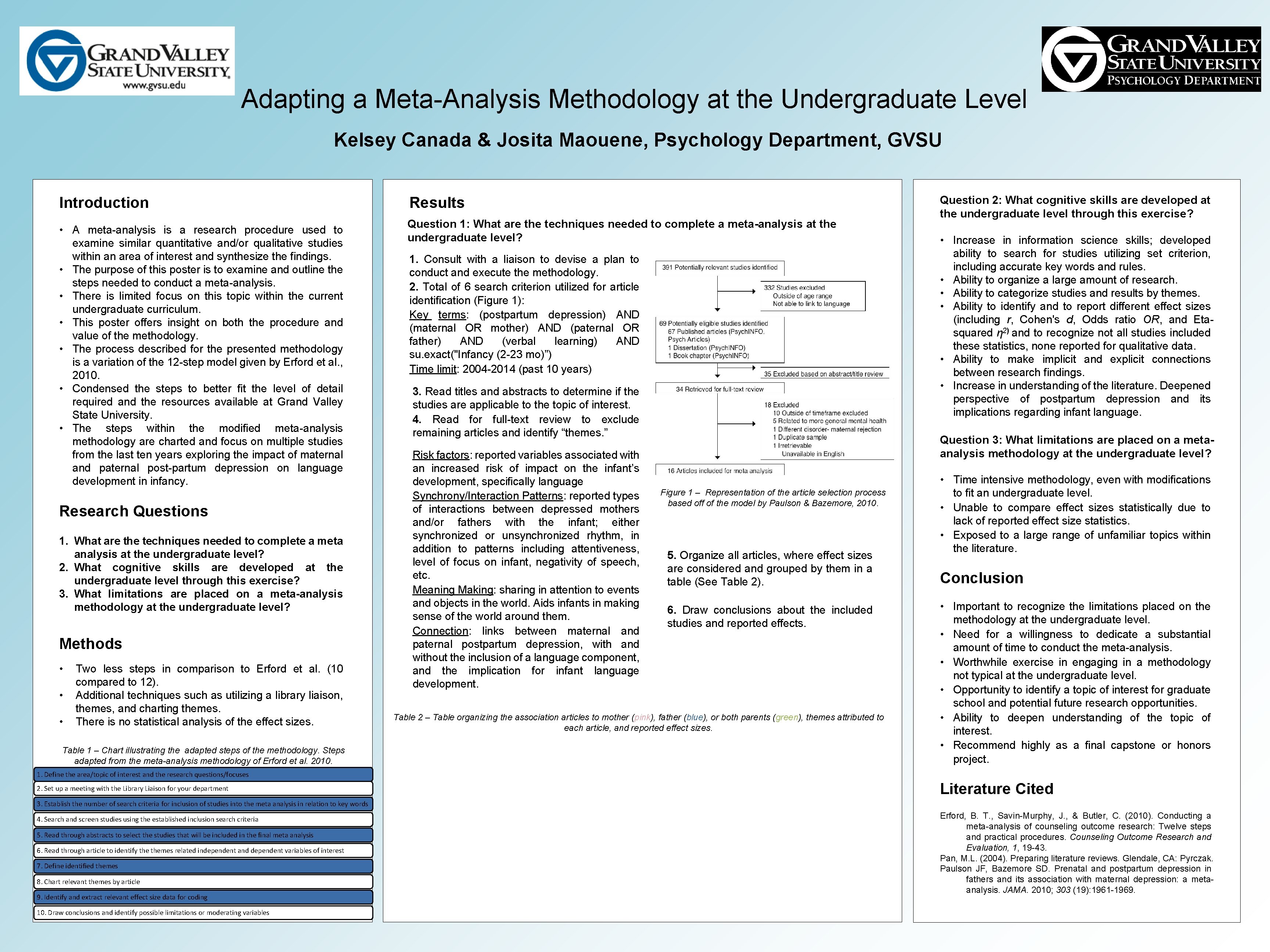
Adapting a Meta-Analysis Methodology at the Undergraduate Level Kelsey Canada & Josita Maouene, Psychology Department, GVSU Introduction • A meta-analysis is a research procedure used to examine similar quantitative and/or qualitative studies within an area of interest and synthesize the findings. • The purpose of this poster is to examine and outline the steps needed to conduct a meta-analysis. • There is limited focus on this topic within the current undergraduate curriculum. • This poster offers insight on both the procedure and value of the methodology. • The process described for the presented methodology is a variation of the 12 -step model given by Erford et al. , 2010. • Condensed the steps to better fit the level of detail required and the resources available at Grand Valley State University. • The steps within the modified meta-analysis methodology are charted and focus on multiple studies from the last ten years exploring the impact of maternal and paternal post-partum depression on language development in infancy. Research Questions 1. What are the techniques needed to complete a meta analysis at the undergraduate level? 2. What cognitive skills are developed at the undergraduate level through this exercise? 3. What limitations are placed on a meta-analysis methodology at the undergraduate level? Methods • • • Two less steps in comparison to Erford et al. (10 compared to 12). Additional techniques such as utilizing a library liaison, themes, and charting themes. There is no statistical analysis of the effect sizes. Table 1 – Chart illustrating the adapted steps of the methodology. Steps adapted from the meta-analysis methodology of Erford et al. 2010. Results Question 1: What are the techniques needed to complete a meta-analysis at the undergraduate level? 1. Consult with a liaison to devise a plan to conduct and execute the methodology. 2. Total of 6 search criterion utilized for article identification (Figure 1): Key terms: (postpartum depression) AND (maternal OR mother) AND (paternal OR father) AND (verbal learning) AND su. exact("Infancy (2 -23 mo)”) Time limit: 2004 -2014 (past 10 years) 3. Read titles and abstracts to determine if the studies are applicable to the topic of interest. 4. Read for full-text review to exclude remaining articles and identify “themes. ” Risk factors: reported variables associated with an increased risk of impact on the infant’s development, specifically language Synchrony/Interaction Patterns: reported types of interactions between depressed mothers and/or fathers with the infant; either synchronized or unsynchronized rhythm, in addition to patterns including attentiveness, level of focus on infant, negativity of speech, etc. Meaning Making: sharing in attention to events and objects in the world. Aids infants in making sense of the world around them. Connection: links between maternal and paternal postpartum depression, with and without the inclusion of a language component, and the implication for infant language development. Question 2: What cognitive skills are developed at the undergraduate level through this exercise? • Increase in information science skills; developed ability to search for studies utilizing set criterion, including accurate key words and rules. • Ability to organize a large amount of research. • Ability to categorize studies and results by themes. • Ability to identify and to report different effect sizes (including r, Cohen's d, Odds ratio OR, and Etasquared η 2) and to recognize not all studies included these statistics, none reported for qualitative data. • Ability to make implicit and explicit connections between research findings. • Increase in understanding of the literature. Deepened perspective of postpartum depression and its implications regarding infant language. Question 3: What limitations are placed on a metaanalysis methodology at the undergraduate level? Figure 1 – Representation of the article selection process based off of the model by Paulson & Bazemore, 2010. 5. Organize all articles, where effect sizes are considered and grouped by them in a table (See Table 2). 6. Draw conclusions about the included studies and reported effects. Table 2 – Table organizing the association articles to mother (pink), father (blue), or both parents (green), themes attributed to each article, and reported effect sizes. • Time intensive methodology, even with modifications to fit an undergraduate level. • Unable to compare effect sizes statistically due to lack of reported effect size statistics. • Exposed to a large range of unfamiliar topics within the literature. Conclusion • Important to recognize the limitations placed on the methodology at the undergraduate level. • Need for a willingness to dedicate a substantial amount of time to conduct the meta-analysis. • Worthwhile exercise in engaging in a methodology not typical at the undergraduate level. • Opportunity to identify a topic of interest for graduate school and potential future research opportunities. • Ability to deepen understanding of the topic of interest. • Recommend highly as a final capstone or honors project. 1. Define the area/topic of interest and the research questions/focuses 2. Set up a meeting with the Library Liaison for your department Literature Cited 3. Establish the number of search criteria for inclusion of studies into the meta analysis in relation to key words 4. Search and screen studies using the established inclusion search criteria 5. Read through abstracts to select the studies that will be included in the final meta analysis 6. Read through article to identify themes related independent and dependent variables of interest 7. Define identified themes 8. Chart relevant themes by article 9. Identify and extract relevant effect size data for coding 10. Draw conclusions and identify possible limitations or moderating variables Erford, B. T. , Savin-Murphy, J. , & Butler, C. (2010). Conducting a meta-analysis of counseling outcome research: Twelve steps and practical procedures. Counseling Outcome Research and Evaluation, 1, 19 -43. Pan, M. L. (2004). Preparing literature reviews. Glendale, CA: Pyrczak. Paulson JF, Bazemore SD. Prenatal and postpartum depression in fathers and its association with maternal depression: a metaanalysis. JAMA. 2010; 303 (19): 1961 -1969.