
Adapted Mindfulness Dr Ceri Woodrow What is mindfulness
- Slides: 48
Adapted Mindfulness Dr Ceri Woodrow
What is mindfulness? • Staying in the moment – Being aware of what your mind is doing – Refocusing your mind – Present in the moment (non-judgementally, curiously) – Observe ourselves
Mindfulness • Breathing exercise
Mindfulness Therapies • Developed therapeutically by Dr Jon Kabat -Zinn and used in the West to promote wellbeing • Mindfulness-Based Stress Reduction improves mental health (Fjorback et al. , 2011) • Mindfulness-Based Cognitive Therapy prevents depressive relapse (Fjorback et al. , 2011)
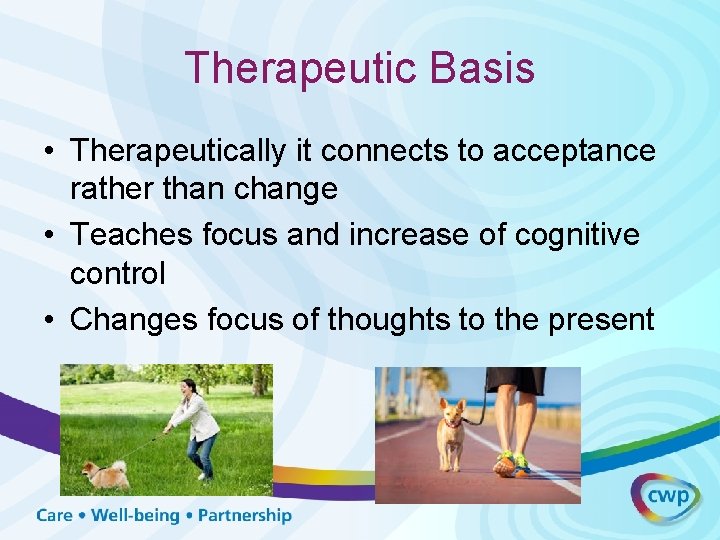
Therapeutic Basis • Therapeutically it connects to acceptance rather than change • Teaches focus and increase of cognitive control • Changes focus of thoughts to the present
Therapies • Increase in mindfulness based therapies and ‘ 3 rd wave’ therapies • Mindfulness-Based Stress Reduction (MBSR) • Mindfulness-Based Cognitive Therapy (MBCT)
Culturally Acceptable • Use in – Schools – Institutions – Organisations – Healthcare
Mindfulness-Based Stress Reduction (MBSR) • Jon Kabat-Zinn (1994) • Developed for stress reduction of varied patient groups from chronic pain to anxiety and heart problems but is now widespread for all forms of stress • Aims to reduce prolonged stress to aid mental well-being using meditation, body scan exercises and gentle yoga
MBSR • Structured group programme • Eight weekly 2 -2. 5 hour sessions plus full day retreat between week 6 & 7 • Expectation that people incorporate these skills into everyday life • Well documented beneficial effects on stress reduction and well-being (Hofmann, 2010)
MBSR evidence • It has been shown to reduce anxiety levels by 58% and stress by 40%. • Individuals with “problematic” levels of stress found a significant improvement in perceived levels of stress with MBSR (Krusche et al, 2013). • Changes in mindfulness “precede changes in perceived stress” (Baer et al, 2012).
Mindfulness-Based Cognitive Therapy (MBCT) • Adapted from MBSR • Developed by Segal, Williams and Teasdale in the 1990 s (book: 2002) • Used for people with recurrent major depression while in remission (NICE recommended) • Aims to prevent relapse (not treat)
MBCT • It uses techniques such as meditation, breathing exercises and stretching, alongside elements of cognitive therapy to help break the negative thought patterns often seen in recurrent depression. • Focus is on the ‘here and now’ rather than worrying about the past or future
MBCT • 85% MBSR with elements of Cognitive Behaviour Therapy (CBT) • Eight weekly 2 hour sessions • Increased focus on thoughts • Identification of physiological responses • Learn to notice rumination
MBCT evidence • MBCT halved the rate of depressive relapse in patients with three or more past episodes (Teasdale, Segal & Williams, 2000) • Reduced risk of relapse of recurrent depression by 43% on average (Mark et al, 2014).
Exercise • Mindful body scan
Mindfulness as a therapy component • Mindfulness is expanding • Increasing research base into various areas inc ID (Chapman et al, 2013) • Also used as a part of otherapies • Acceptance and Commitment Therapy (ACT), Dialectic Behaviour Therapy (DBT), Compassion Focused Therapy (CFT)
DBT • Dialectical Behaviour Therapy (DBT) is a psychotherapy which balances therapeutic validation and acceptance of the person along with cognitive and behaviour change strategies (Linehan, 1993) • Core skills: mindfulness, distress tolerance, emotional regulation and interpersonal effectiveness
Mindful exercises • • Listening Breathing Colouring Eating Walking Body scan Touch
Adaptations • • • Soles of the feet Adapted component of otherapies Within coping skills groups Adapted individual therapy Staff teams
Mindfulness within ID • Soles of the feet (Singh, 2003) • Singh and colleagues in the USA have adapted and extensively applied the ‘Meditation on the Soles of the Feet’ (So. F) technique
Soles of the Feet – Aims to assist Pw. ID to divert their attention away from various affect producing thoughts, events or situations to an emotionally neutral part of the body; the soles of their feet – This enables people to calm down, and then make a choice about how to react to the thought, event or situation that triggered the affect
Soles of the Feet
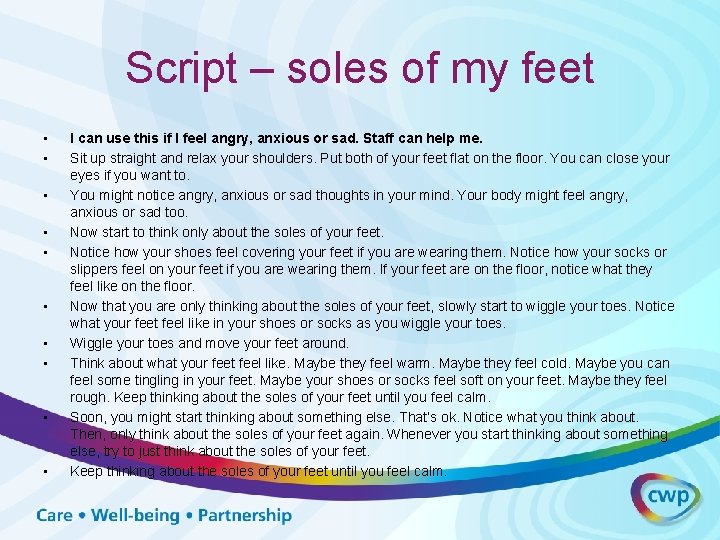
Script – soles of my feet • • • I can use this if I feel angry, anxious or sad. Staff can help me. Sit up straight and relax your shoulders. Put both of your feet flat on the floor. You can close your eyes if you want to. You might notice angry, anxious or sad thoughts in your mind. Your body might feel angry, anxious or sad too. Now start to think only about the soles of your feet. Notice how your shoes feel covering your feet if you are wearing them. Notice how your socks or slippers feel on your feet if you are wearing them. If your feet are on the floor, notice what they feel like on the floor. Now that you are only thinking about the soles of your feet, slowly start to wiggle your toes. Notice what your feet feel like in your shoes or socks as you wiggle your toes. Wiggle your toes and move your feet around. Think about what your feet feel like. Maybe they feel warm. Maybe they feel cold. Maybe you can feel some tingling in your feet. Maybe your shoes or socks feel soft on your feet. Maybe they feel rough. Keep thinking about the soles of your feet until you feel calm. Soon, you might start thinking about something else. That’s ok. Notice what you think about. Then, only think about the soles of your feet again. Whenever you start thinking about something else, try to just think about the soles of your feet. Keep thinking about the soles of your feet until you feel calm.
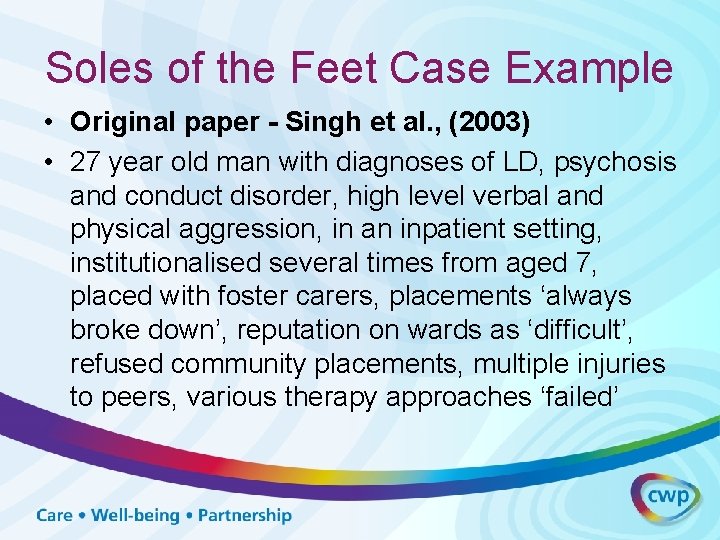
Soles of the Feet Case Example • Original paper - Singh et al. , (2003) • 27 year old man with diagnoses of LD, psychosis and conduct disorder, high level verbal and physical aggression, in an inpatient setting, institutionalised several times from aged 7, placed with foster carers, placements ‘always broke down’, reputation on wards as ‘difficult’, refused community placements, multiple injuries to peers, various therapy approaches ‘failed’
Soles of the Feet Case Example • Intervention • Taught So. F technique to increase his mindfulness of external and internal environments (exactly same as just experienced) • 30 minute role play and practice sessions twice a day for 5 days
Soles of the Feet Case Example • Results • Significant reduction of incidents, aggression, PRN, injuries to self and others • Significant increase in community activities
Case Example 2 • Singh et al. , (2011) • So. F approach was also used to enable three adolescents diagnosed with Asperger’s Syndrome self-control their aggression • Outcomes • Physical aggression decreased progressively whilst they were mastering the technique • no aggressive behaviour during a long term follow up of 4 years.
Further Evidence So. F • Further case examples given by Singh – see reference section (Singh, 2003, 3006, 32008, 2011 a, 2011 b, 2011 c)
Adapted in an A&T Unit • • Group based on So. F Some people unable to utilise group Mindful exercises – focusing the mind Therapeutic opportunities for all inpatients
Adaptations for Inpatients • To encourage self-regulation of emotions and self-soothing • Aims: 1) To develop a mindfulness group for service users on the unit. 2) To implement a pilot group and use service user feedback from this group to provide recommendations for future groups
Adaptations for Inpatients Method • Scoping interviews with MDT to gain views • Pilot mindfulness group – 20 sessions • Feedback gained from MDT and service users on impact of the pilot group • Recommendations given
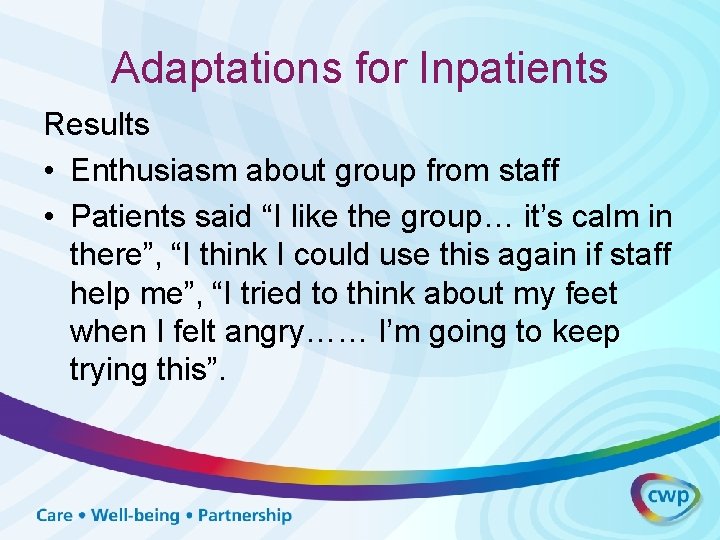
Adaptations for Inpatients Results • Enthusiasm about group from staff • Patients said “I like the group… it’s calm in there”, “I think I could use this again if staff help me”, “I tried to think about my feet when I felt angry…… I’m going to keep trying this”.
Adaptations for Inpatients Results • Patients requested a larger variety of sensory activities, and additional support from staff to practice between sessions • They wanted the group to be held more often • Two people requested an adaptation to the script (hands not feet)
For Inpatient Staff • • Limited time Changing shift patterns 5 minutes exercises Days vary
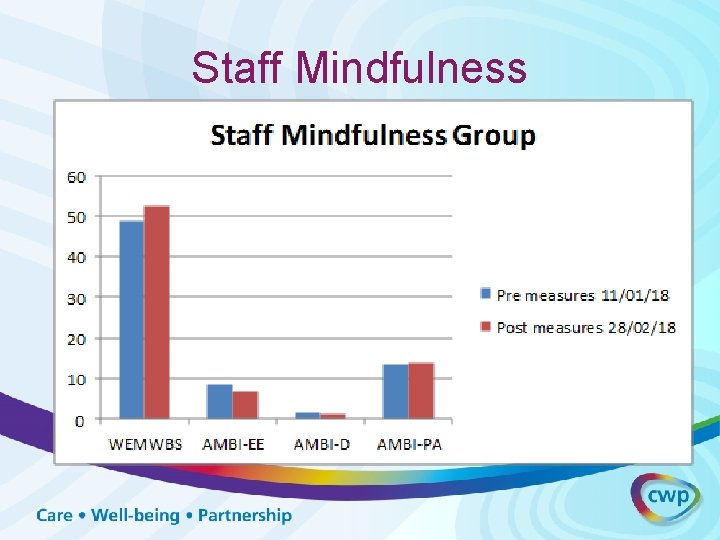
Staff Mindfulness Measures • WEBWBS - Warwick-Edinburgh Mental Well-Being Scale (Tennent et al, 2007) – Higher scores indicate an increase in wellbeing
Staff Mindfulness • AMBI – Abbreviated Maslach Burnout Inventory (Mc. Clafferty, H. 2014) Three subscales: – emotional exhaustion (lower scores indicate a decrease in emotional exhaustion and burnout) – Depersonalisation (lower scores indicate a decrease in depersonalisation and burnout) – Personal Accomplishment (higher scores indicate a decrease in burnout and an increase in personal accomplishment)
Staff Mindfulness
Staff Mindfulness • All staff completed the pre-measures • 18 mindfulness sessions • Staff who attended one or more of these sessions then completed post-measures. • Anonymous (honest but pre- post- can’t be matched)
Staff Mindfulness • Trends are all in the expected direction • Significant difference in pre and post WEMWBS means at p<. 10 (1 tailed) using an independent t-test • Sessions continue • In 18 sessions, will request measures
Staff Mindfulness • • • ‘Helpful’ ‘I use it when I’m stressed’ ‘It gets easier when you do it more’ ‘Positive way to start the day’ ‘I was using it to calm down in the car yesterday’
Adapted DBT • 6 sessions split up as two sessions between each module
Adapted DBT • Mindfulness: introduction to mindfulness; focusing the mind and wise mind • Stop and Think: based on observing. Introduce idea of slowing things down and noticing what is happening • One thing at a time: Based on participation 1 • Describe: based on describing events and being non -judgemental • Goals: taken from the mindfulness skill of being effective • Review of all strategies
References • Baer, R. A. , Carmody, J. , Hunsinger, M. (2012) Weekly Change in Mindfulness and Perceived Stress in a Mindfulness-Based Stress Reduction Programme. Journal of Clinical Psychology, 68(7), 755765. • Bull, S. & Cullingham, N. (2017) Introducing Mindfulness to an Inpatient Unit. University of Manchester Poster. • Chapman, M. , Hare, D. , Caton, S. , Donalds, D. , Mc. Innis, E. & Mitchell, D. (2013) The use of mindfulness with people with intellectual disabilities: a systematic review and narrative analysis, Mindfulness, 1 -12. doi: 10. 1007/s 12671 -013 -0197 -7 • Fjorback, L. O. , Arendt, E. , Fink, P. & Walach, H. (2011) Acta Psychiatrica Scandinavica. 124: 102 -119
References • Harris, R. (2006) Embracing you demons: an overview of Acceptance and Commitment Therapy. Psychotherapy in Australia 12 (4): 2– 8. • Hofmann, S. G. , Sawyer, A. T. , Witt, A. A. , & Oh, D. (2010). The Effect of Mindfulness-Based Therapy on Anxiety and Depression: A Meta-Analytic Review. Journal of Consulting and Clinical Psychology, 78(2), 169– 183. http: //doi. org/10. 1037/a 0018555 • Kabat-Zinn, J. (1994) Wherever you go there you are. US: Hyperion • Krusche, A. , Cyhlarova E. , Williams J. M. G. (2013) Mindfulness Online: An Evaluation of The Feasibility of a Web-Based Mindfulness Course For, Stress, Anxiety and Depression. British Medical Journal, October 2013(3), BMJ Open
References • Linehan, M. M. (1993). Cognitive-behavioural treatment of borderline personality disorder. New York: Guildford Press • Linehan, M. . (1993). Skills training manual for treating borderline personality disorder. New York: Guildford Press • Mark, J. , et al (2014) Mindfulness-Based Cognitive Therapy for Preventing Relapse in Recurrent Depression: A Randomized Dismantling Trial. Journal of Consulting and Clinical Psychology: 82(2): 275– 286 • Mc. Clafferty, H. (2014). Abbreviated Maslach Burnout Inventory. Physician Health and Well Being: The Art and Science of Self-Care in Medicine, Oct 2014
References • Segal, Z. V. , Williams, J. M. G. , & Teasdale, J. D. (2002). Mindfulnessbased cognitive therapy for depression: a new approach to preventing relapse. New York: Guildford Press • Singh, N. N. , Wahler, W. , Adkins, A. D. & Myers, R. E. (2003). Soles of the Feet: a mindfulness-based self-control intervention for aggression by an individual with mild mental retardation and mental illness. Research in Developmental Disabilities. 24, 158 -169. • Singh, N. , Lancioni, G. , Winton, A. , Curtis, W. , Wahler, R. , Sabaawi, M. , Singh, J. , Mc. Aleavey, K. (2006). Mindful staff increase learning and reduce aggression in adults with developmental disabilities. Research in Developmental Disabilities. 27 , 545– 558.
References • Singh, N. , Lancioni, G. , Winton, A. , Singh, A. , Adkins, A. & Singh, J. (2008). Clinical and benefit–cost outcomes of teaching a mindfulness-based procedure to adult offenders with intellectual disabilities. Behaviour Modification, 32, 622 -637. • Singh, N. N. , Lancioni, G. E. , Singh, A. D. A. , Winton, A. S. W. , Singh, A. N. A. , & Singh, J. (2011). Adolescents with Asperger syndrome can use a mindfulness-based strategy to control their aggressive behaviour. Research in Autism Spectrum Disorders. 5, 1103– 1109. • Singh, N. N. , Lancioni, G. E. , Winton, A. S. W. , Singh, J. , Singh, A. N. A. & Singh, D. A. (2011). Peer with intellectual disabilities as a mindfulness-based anger and aggression management therapist. Research in Developmental Disabilities. 32, 2690 -2696.
References • Singh, N. , Singh, G. , Lancioni, G. , Winton, A. , Singh, A. , Adkins, A. & Singh, J. (2011). Canadult offenders with intellectual disabilities use mindfulness-based procedures to control their deviant sexual arousal? Psychology, Crime & Law, 17, 165 -179. • Tennant, R. , Hiller, L. , Fishwick, R. , Platt, S. , Joseph, S. , Weich, S. , … Stewart-Brown, S. (2007). The Warwick-Edinburgh Mental Wellbeing Scale (WEMWBS): development and UK validation. Health and Quality of Life Outcomes, 5, 63. http: //doi. org/10. 1186/14777525 -5 -63 • Welford, M. (2016). Compassion Focused Therapy for Dummies. Wiley