
Adapted from material by Jamison Fargo Ph D
Adapted from material by Jamison Fargo, Ph. D Cohen Chapter 15 Repeated Measures ANOVA

“The biggest job we have is to teach a newly hired employee how to fail intelligently. We have to train him to experiment over and to keep on trying and failing until he learns what will work. ” Charles Kettering, American engineer, 1876 - 1958
One-Way Repeated Measures ANOVA

Dr. Pearson is interested in determining whether the average man wants to express his worries to his wife more (or less) the longer they are married. The Desire to Express Worry (DEW) scale is administered to men when they initially get married and then at their 5 th, 10 th, and 15 th wedding anniversaries. What is the repeated-measures factor and what are its levels? What is the outcome variable? Dr. Fairchild wishes to compare reaction time differences for the three subtests of the Stroop Test in patients with Parkinson’s Disease: Color, Word, and Color Word. What is the repeated-measures factor and what are its levels? What is the outcome variable? 4

5

Design Types 1. Same outcome, same cases, different occasions Time points are levels of factor § Experimental § Quasi-experimental § Field/Naturalistic studies § Longitudinal/Developmental studies 2. Different outcomes (all on same metric) on same cases Different outcomes are levels of factor 3. Same outcome, different condition/exposure, on cases that are matched into sets prior to random assignment Different conditions are levels of factor 6

More powerful: • Each case serves as their own control, less between-subject variation • Error term (denominator) of F-test for RM ANOVA is often less than in Independent Groups ANOVA More economical: • Fewer cases required • Independent Groups ANOVA: • 3 conditions, • 10 cases per condition • = 30 cases Repeated-Measures (RM) factor often referred to as: ‘Within-Subjects’ factor § Time 1, Time 2, Time 3, etc… § Condition 1, Condition 2, Condition 3, etc… May have… § Multiple RM factors Factorial RM ANOVA § A combination of RM and independent groups factors Mixed Design ANOVA § Lack of independence of observations must be accounted for in analysis • RM ANOVA: • 3 conditions, • same 10 cases used in all conditions • = 10 cases 7

Time as a RM Factor Can answer questions such as: Do measurements on outcome change over time or conditions? Is change linear? Quadratic? Is change positive or negative? Does change 1 st increase, then decrease (or vice versa)? How long does change last? Is change permanent over duration of study? Is outcome same at beginning and end of study? • Researcher chooses when and how frequently to observe outcome, time is not traditionally considered experimental variable • Not a manipulated factor, cannot counterbalance time, or randomize participants to have different times or orders of observation • Although many experiments are longitudinal, they include an additional treatment variable that is experimentally manipulated • Time intervals must be equally spaced • If spacing is unequal, ANOVA with random-effects must be used instead 8
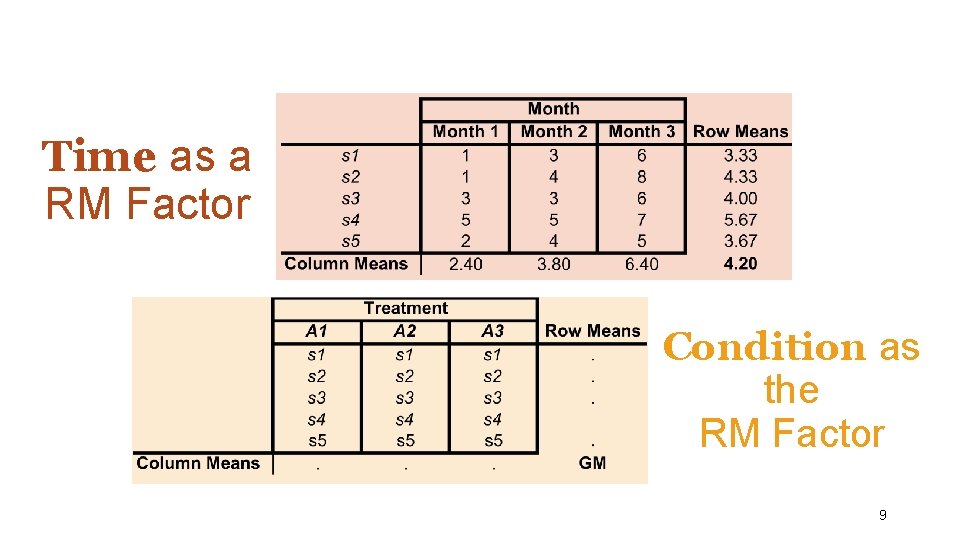
Time as a RM Factor Condition as the RM Factor 9
Simultaneous RM Factors • Sometimes levels of RM factors are administered: simultaneously or inter-mixed within one experimental or observational study For example… • Levels of RM factor might be verbs, nouns, and adjectives, which appear randomly within a passage to be memorized • # of words of each type recalled by participants are recorded 10
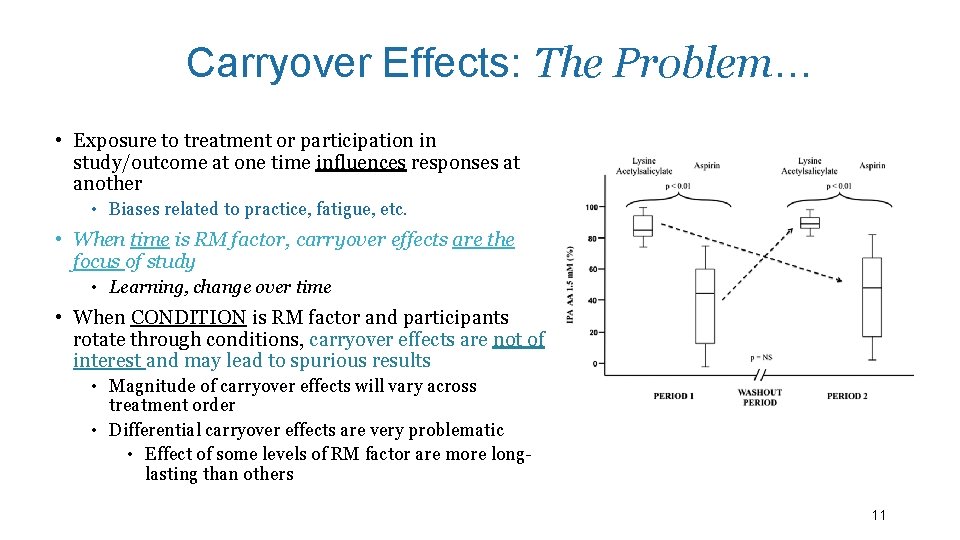
Carryover Effects: The Problem… • Exposure to treatment or participation in study/outcome at one time influences responses at another • Biases related to practice, fatigue, etc. • When time is RM factor, carryover effects are the focus of study • Learning, change over time • When CONDITION is RM factor and participants rotate through conditions, carryover effects are not of interest and may lead to spurious results • Magnitude of carryover effects will vary across treatment order • Differential carryover effects are very problematic • Effect of some levels of RM factor are more longlasting than others 11

Carryover Effects: Possible Solutions • Counterbalancing: Varying RM condition order across subjects • 3 -level RM factor: ABC, ACB, BCA, BAC, CAB, CBA • Partial counterbalancing (Latin Squares): Too many possible orders of RM conditions so a representative set is used • Each subject receives a random order of RM conditions • Each subject receives a ‘run-in’ period (a series of practice trials) at beginning of study to ‘stabilize’ performance • Intervening (distractor, neutral) trials between conditions • Larger time interval, washout period, between conditions • Note: Effects may not be eliminated by any of these methods 12
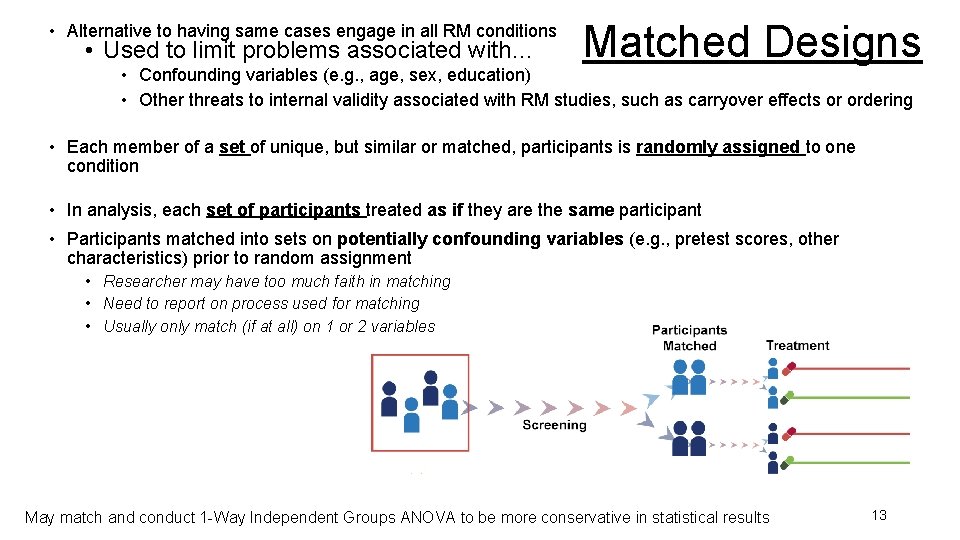
• Alternative to having same cases engage in all RM conditions • Used to limit problems associated with… Matched Designs • Confounding variables (e. g. , age, sex, education) • Other threats to internal validity associated with RM studies, such as carryover effects or ordering • Each member of a set of unique, but similar or matched, participants is randomly assigned to one condition • In analysis, each set of participants treated as if they are the same participant • Participants matched into sets on potentially confounding variables (e. g. , pretest scores, other characteristics) prior to random assignment • Researcher may have too much faith in matching • Need to report on process used for matching • Usually only match (if at all) on 1 or 2 variables May match and conduct 1 -Way Independent Groups ANOVA to be more conservative in statistical results 13
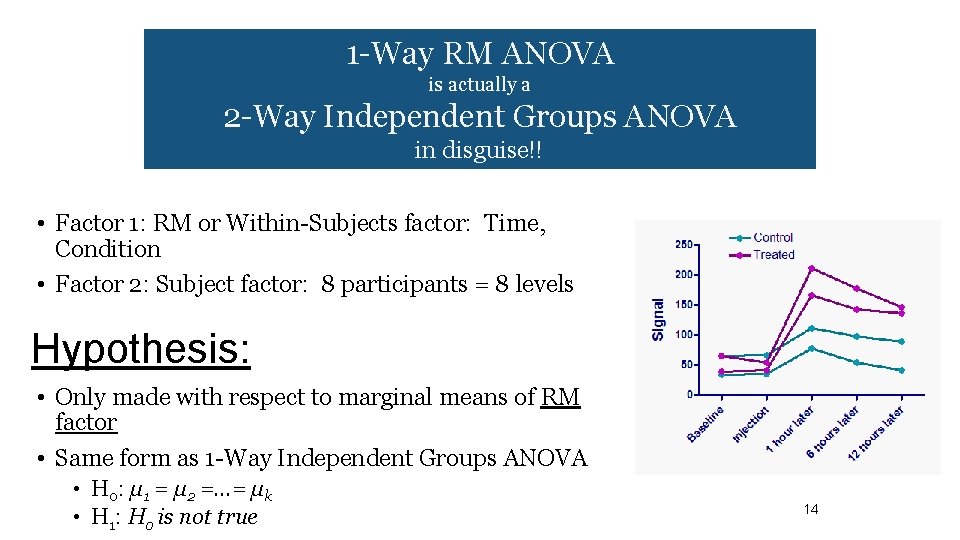
1 -Way RM ANOVA is actually a 2 -Way Independent Groups ANOVA in disguise!! • Factor 1: RM or Within-Subjects factor: Time, Condition • Factor 2: Subject factor: 8 participants = 8 levels Hypothesis: • Only made with respect to marginal means of RM factor • Same form as 1 -Way Independent Groups ANOVA • H 0: μ 1 = μ 2 =…= μk • H 1: H 0 is not true 14
Partitioning Variance • RM factor: Same or similar outcome is measured more than once (each level) by multiple participants • Subject factor: Same or similar outcome is measured more than once (each level) by same participants or sets of matched participants • RM x Subject factor interaction Total variation partitioned into 3 parts…but no SSW or error term! SSTotal = SSRM + SSSubj + SSRMx. Subj Note: only 1 score per cell (n = 1) in previous 1 -Way RM ANOVA cross-classification, thus, no variability within cells; SSW = 0 • SSRMx. Subj is used as error term and represents variation in outcome explained by… 1. Interaction of participants with levels of RM factor 2. Random (i. e. , left-over) variation (error) 15
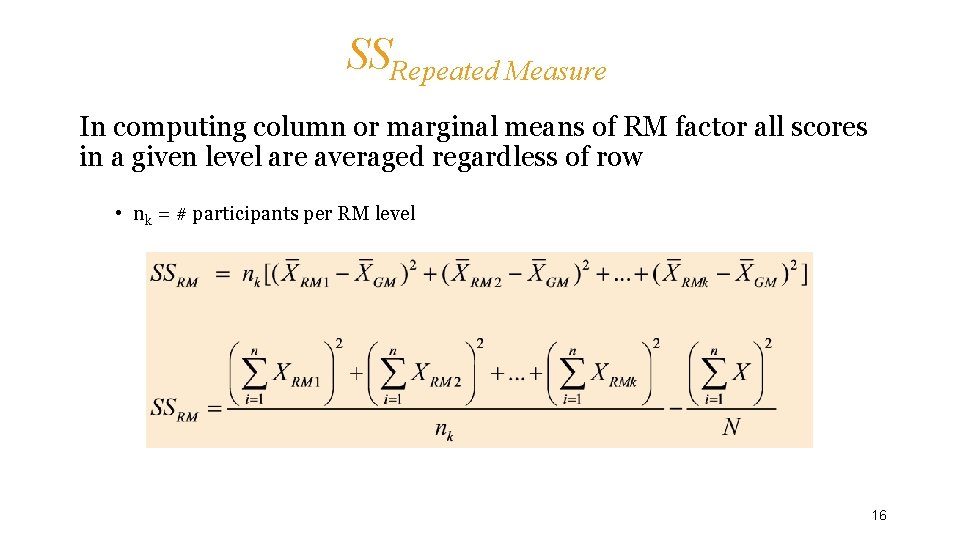
SSRepeated Measure In computing column or marginal means of RM factor all scores in a given level are averaged regardless of row • nk = # participants per RM level 16
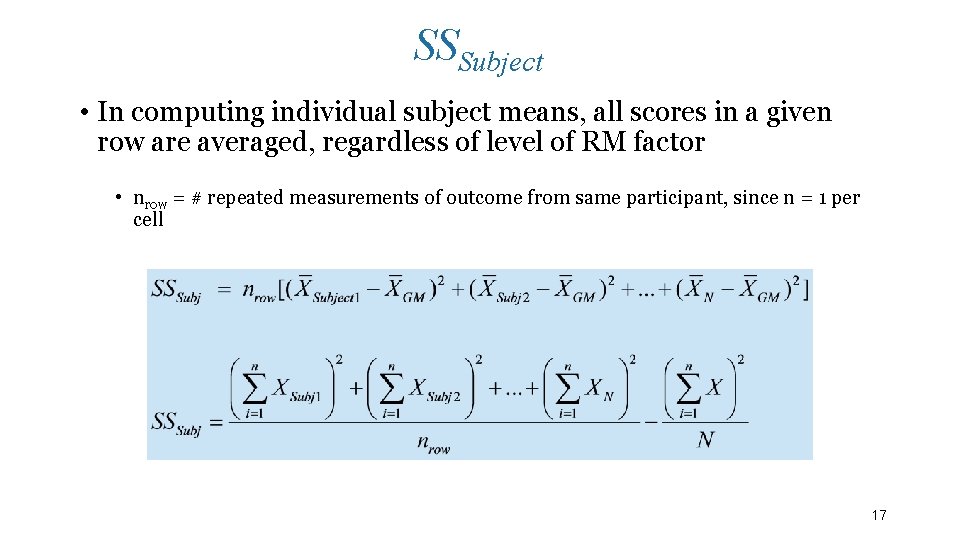
SSSubject • In computing individual subject means, all scores in a given row are averaged, regardless of level of RM factor • nrow = # repeated measurements of outcome from same participant, since n = 1 per cell 17
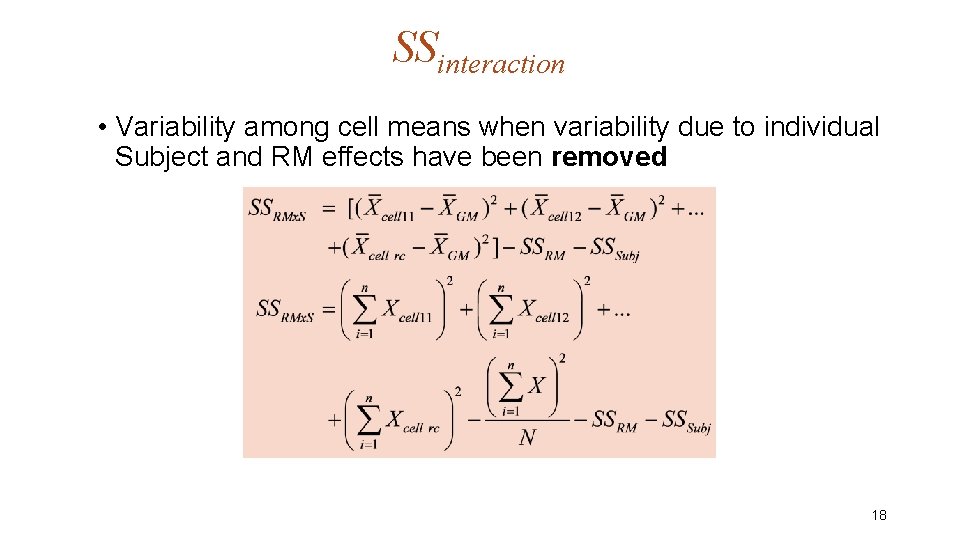
SSinteraction • Variability among cell means when variability due to individual Subject and RM effects have been removed 18
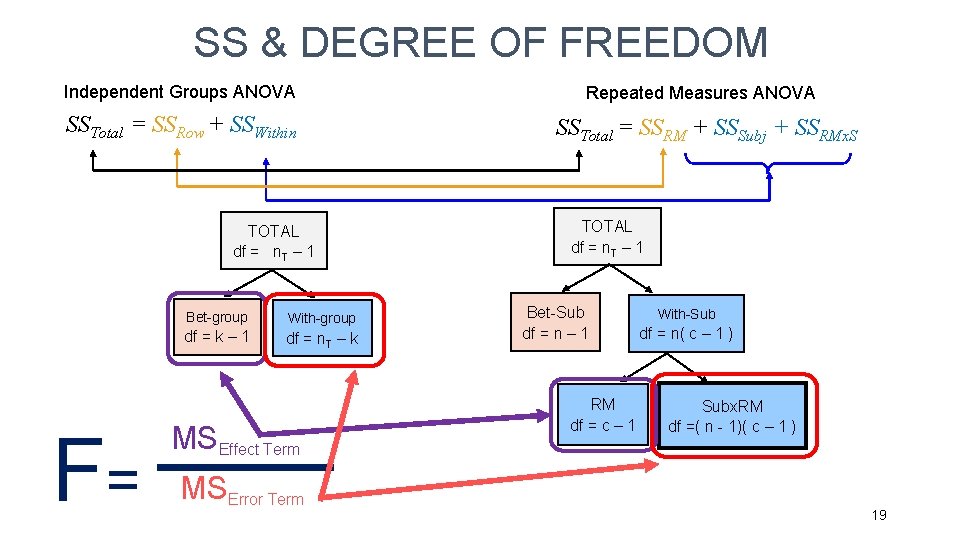
SS & DEGREE OF FREEDOM Independent Groups ANOVA Repeated Measures ANOVA SSTotal = SSRow + SSWithin SSTotal = SSRM + SSSubj + SSRMx. S TOTAL df = n. T – 1 F= Bet-group With-group df = k – 1 df = n. T – k MSEffect Term MSError Term TOTAL df = n. T – 1 Bet-Sub df = n – 1 RM df = c – 1 With-Sub df = n( c – 1 ) Subx. RM df =( n - 1)( c – 1 ) 19
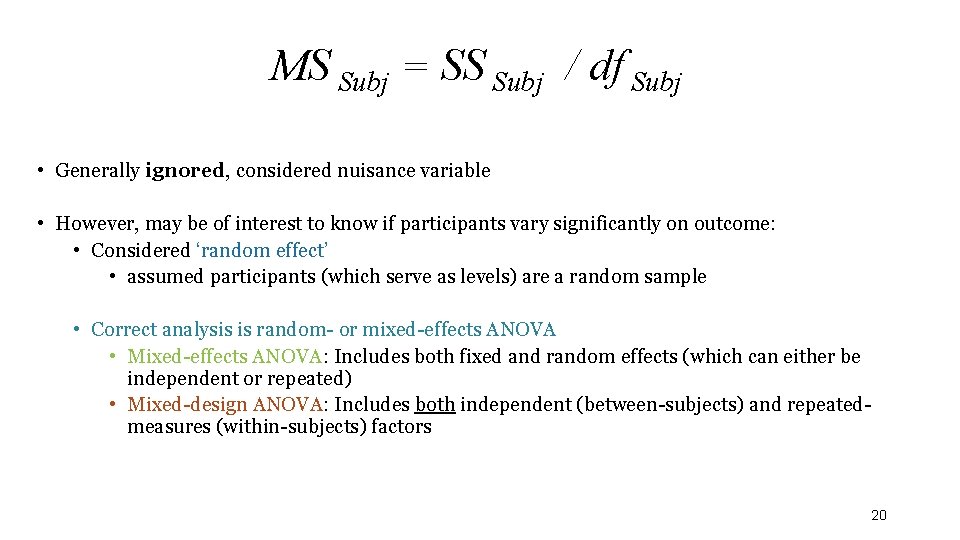
MS Subj = SS Subj / df Subj • Generally ignored, considered nuisance variable • However, may be of interest to know if participants vary significantly on outcome: • Considered ‘random effect’ • assumed participants (which serve as levels) are a random sample • Correct analysis is random- or mixed-effects ANOVA • Mixed-effects ANOVA: Includes both fixed and random effects (which can either be independent or repeated) • Mixed-design ANOVA: Includes both independent (between-subjects) and repeatedmeasures (within-subjects) factors 20
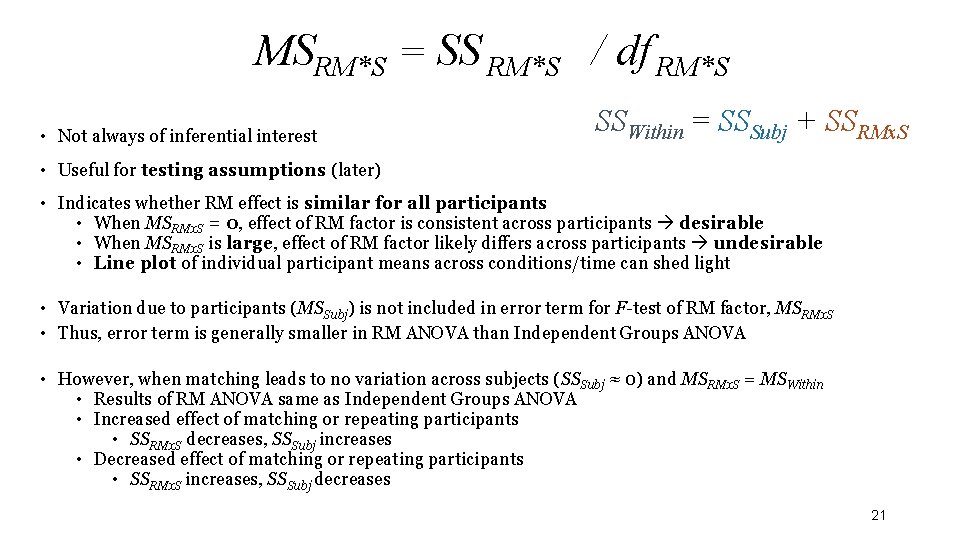
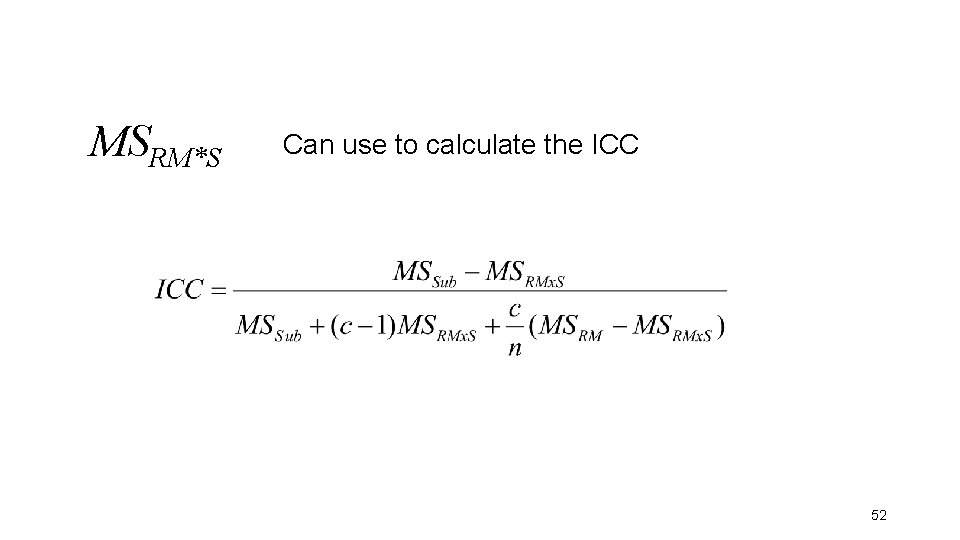
MSRM*S = SS RM*S / df RM*S • Not always of inferential interest SSWithin = SSSubj + SSRMx. S • Useful for testing assumptions (later) • Indicates whether RM effect is similar for all participants • When MSRMx. S = 0, effect of RM factor is consistent across participants desirable • When MSRMx. S is large, effect of RM factor likely differs across participants undesirable • Line plot of individual participant means across conditions/time can shed light • Variation due to participants (MSSubj) is not included in error term for F-test of RM factor, MSRMx. S • Thus, error term is generally smaller in RM ANOVA than Independent Groups ANOVA • However, when matching leads to no variation across subjects (SSSubj ≈ 0) and MSRMx. S = MSWithin • Results of RM ANOVA same as Independent Groups ANOVA • Increased effect of matching or repeating participants • SSRMx. S decreases, SSSubj increases • Decreased effect of matching or repeating participants • SSRMx. S increases, SSSubj decreases 21
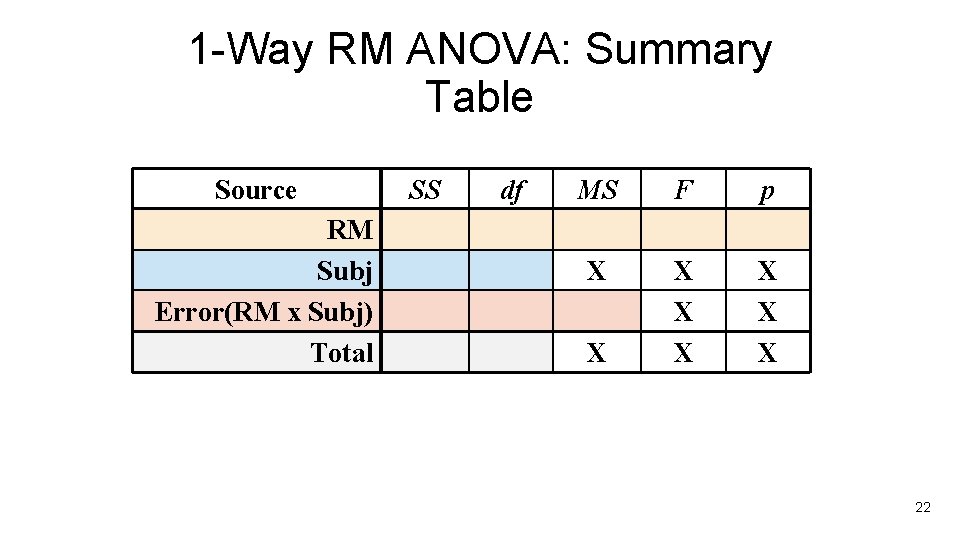
1 -Way RM ANOVA: Summary Table Source RM Subj Error(RM x Subj) Total SS df MS F p X X X X 22
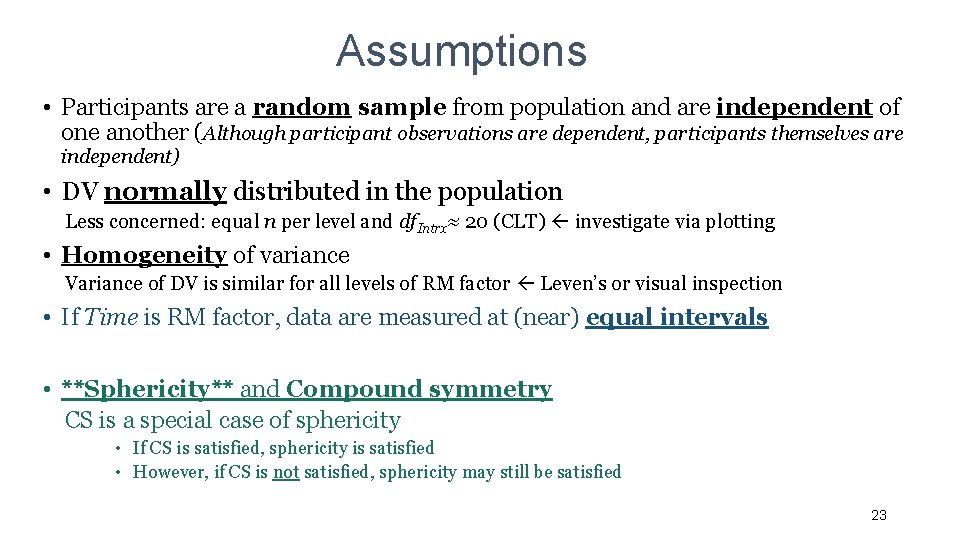
Assumptions • Participants are a random sample from population and are independent of one another (Although participant observations are dependent, participants themselves are independent) • DV normally distributed in the population Less concerned: equal n per level and df. Intrx≈ 20 (CLT) investigate via plotting • Homogeneity of variance Variance of DV is similar for all levels of RM factor Leven’s or visual inspection • If Time is RM factor, data are measured at (near) equal intervals • **Sphericity** and Compound symmetry CS is a special case of sphericity • If CS is satisfied, sphericity is satisfied • However, if CS is not satisfied, sphericity may still be satisfied 23
Sphericity • Informally, it is the degree of violation of independence same for all levels of RM factor? • Taking DV, difference scores can be calculated for each participant between all possible pairs of levels of RM factor • A variance can be calculated for each set of difference scores • When assumption of sphericity is met, difference score variances will be equal • Mauchly’s test of sphericity • Based on χ2 distribution • H 0: Variances of difference scores between all pairs of levels of RM factor are equal (sphericity) • Test not extremely useful as most “tests of other tests” tend to be…misleading* • Small N = ↑ Type II error • Large N, non-normality, +heterogeneity of covariances = ↑ Type I error • When using this test, assess all RM main effect(s) • Rule of thumb: cause for concern may exist when the largest variance is 4 x greater than smallest *Kesselman, Rogan, Mendoza, & Breen, 1980 24
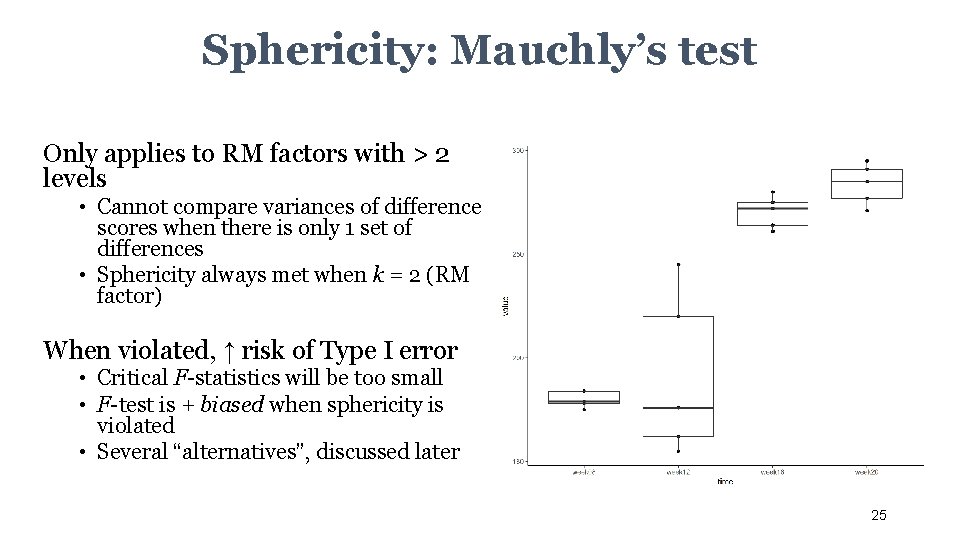
Sphericity: Mauchly’s test Only applies to RM factors with > 2 levels • Cannot compare variances of difference scores when there is only 1 set of differences • Sphericity always met when k = 2 (RM factor) When violated, ↑ risk of Type I error • Critical F-statistics will be too small • F-test is + biased when sphericity is violated • Several “alternatives”, discussed later 25
Compound Symmetry A bit stricter than sphericity, which is a special case, and is subsumed by CS q Homogeneity of variances of difference scores • • Variance of difference scores assumed to be equal Same as previously mentioned for sphericity q Homogeneity of covariances of difference scores • • Covariances of difference scores (between all possible pairs of levels of the RM factor) assumed to be equal Most software does not assess this assumption q Additivity (discussed in later slides) 26
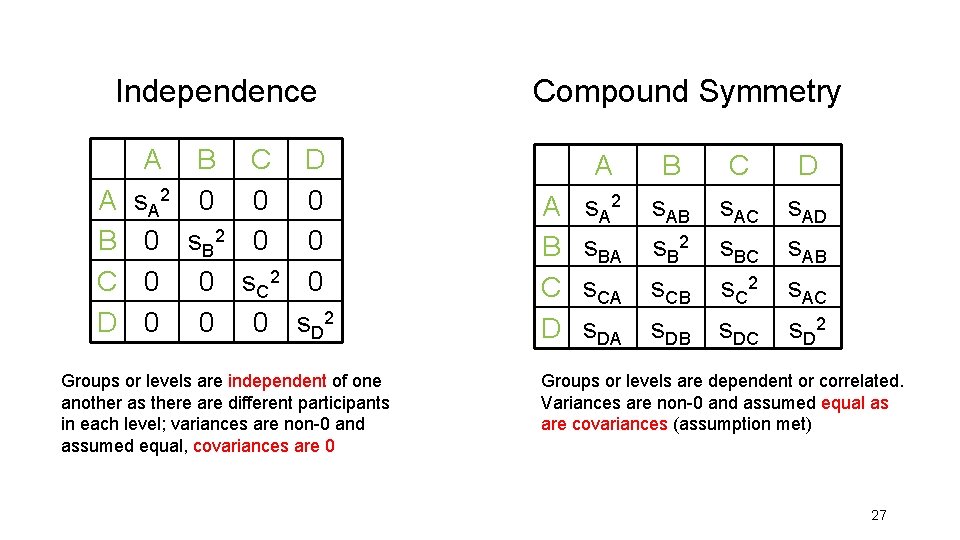
Independence A B C D A B C s. A 2 0 0 0 s. B 2 0 0 0 s. C 2 0 0 0 D 0 0 0 s. D 2 Groups or levels are independent of one another as there are different participants in each level; variances are non-0 and assumed equal, covariances are 0 Compound Symmetry A B C D A s. A 2 s. BA s. CA s. DA B s. AB s. B 2 s. CB s. DB C s. AC s. BC s. C 2 s. DC D s. AB s. AC s. D 2 Groups or levels are dependent or correlated. Variances are non-0 and assumed equal as are covariances (assumption met) 27
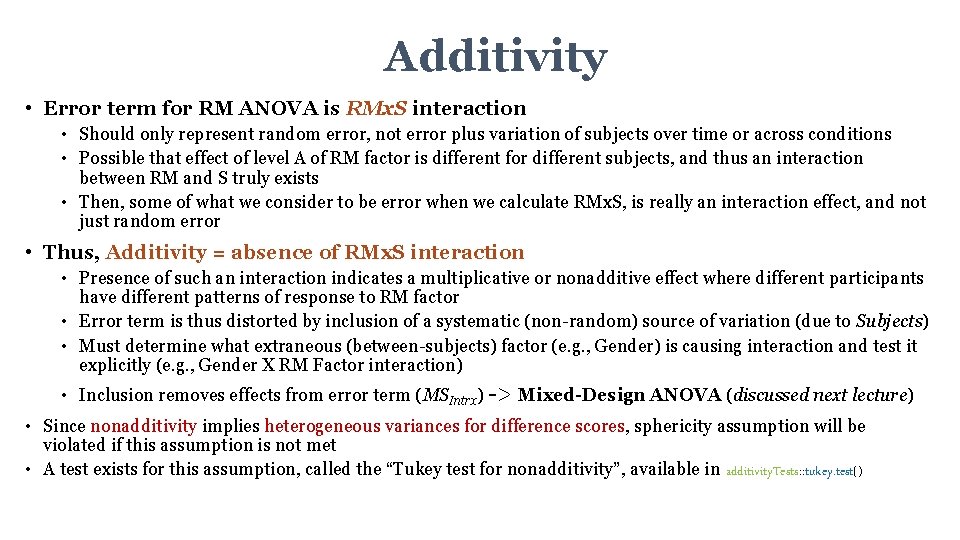
Additivity • Error term for RM ANOVA is RMx. S interaction • Should only represent random error, not error plus variation of subjects over time or across conditions • Possible that effect of level A of RM factor is different for different subjects, and thus an interaction between RM and S truly exists • Then, some of what we consider to be error when we calculate RMx. S, is really an interaction effect, and not just random error • Thus, Additivity = absence of RMx. S interaction • Presence of such an interaction indicates a multiplicative or nonadditive effect where different participants have different patterns of response to RM factor • Error term is thus distorted by inclusion of a systematic (non-random) source of variation (due to Subjects) • Must determine what extraneous (between-subjects) factor (e. g. , Gender) is causing interaction and test it explicitly (e. g. , Gender X RM Factor interaction) • Inclusion removes effects from error term (MSIntrx) -> Mixed-Design ANOVA (discussed next lecture) • Since nonadditivity implies heterogeneous variances for difference scores, sphericity assumption will be violated if this assumption is not met • A test exists for this assumption, called the “Tukey test for nonadditivity”, available in additivity. Tests: : tukey. test()
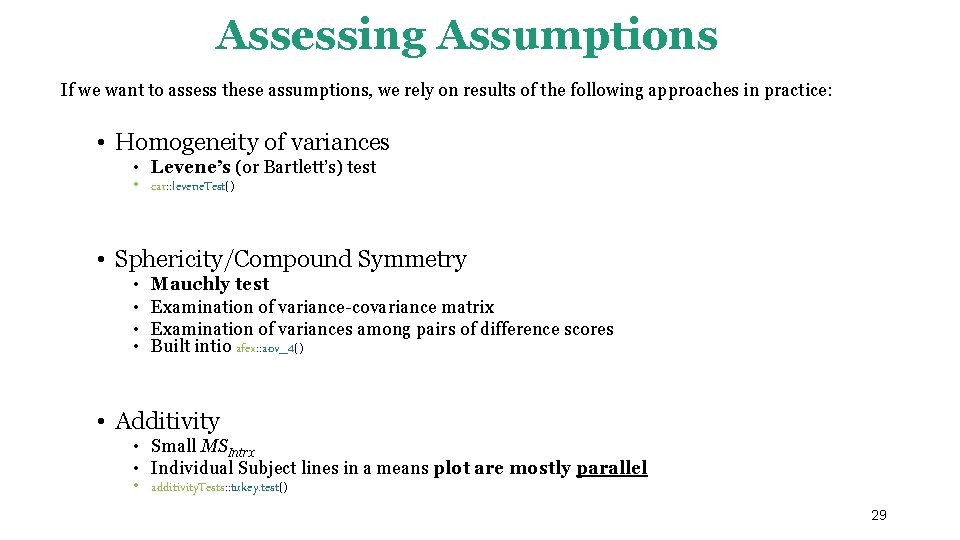
Assessing Assumptions If we want to assess these assumptions, we rely on results of the following approaches in practice: • Homogeneity of variances • Levene’s (or Bartlett’s) test • car: : levene. Test() • Sphericity/Compound Symmetry • • Mauchly test Examination of variance-covariance matrix Examination of variances among pairs of difference scores Built intio afex: : aov_4() • Additivity • Small MSIntrx • Individual Subject lines in a means plot are mostly parallel • additivity. Tests: : tukey. test() 29
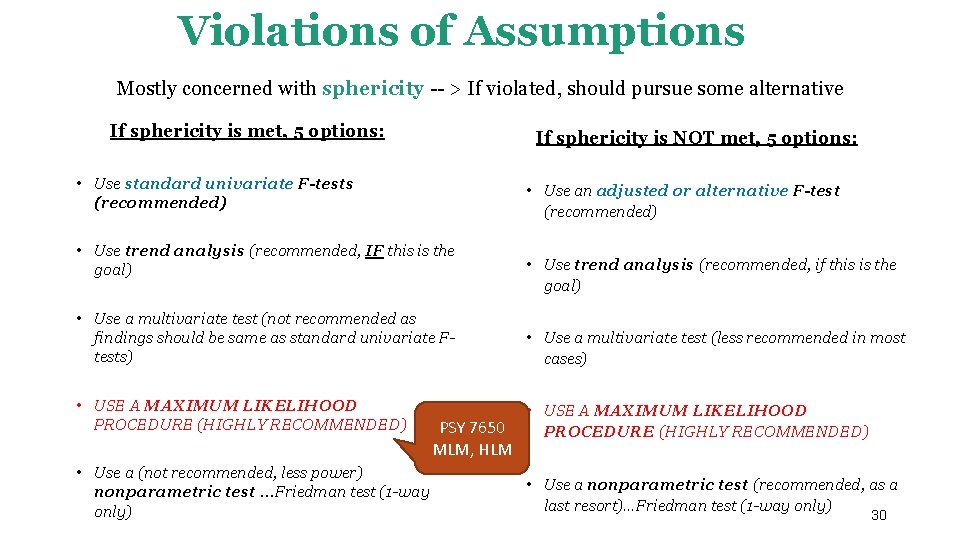
Violations of Assumptions Mostly concerned with sphericity -- > If violated, should pursue some alternative If sphericity is met, 5 options: If sphericity is NOT met, 5 options: • Use standard univariate F-tests (recommended) • Use an adjusted or alternative F-test (recommended) • Use trend analysis (recommended, IF this is the goal) • Use trend analysis (recommended, if this is the goal) • Use a multivariate test (not recommended as findings should be same as standard univariate Ftests) • Use a multivariate test (less recommended in most cases) • USE A MAXIMUM LIKELIHOOD PROCEDURE (HIGHLY RECOMMENDED) • Use a (not recommended, less power) nonparametric test …Friedman test (1 -way only) PSY 7650 MLM, HLM • Use a nonparametric test (recommended, as a last resort)…Friedman test (1 -way only) 30
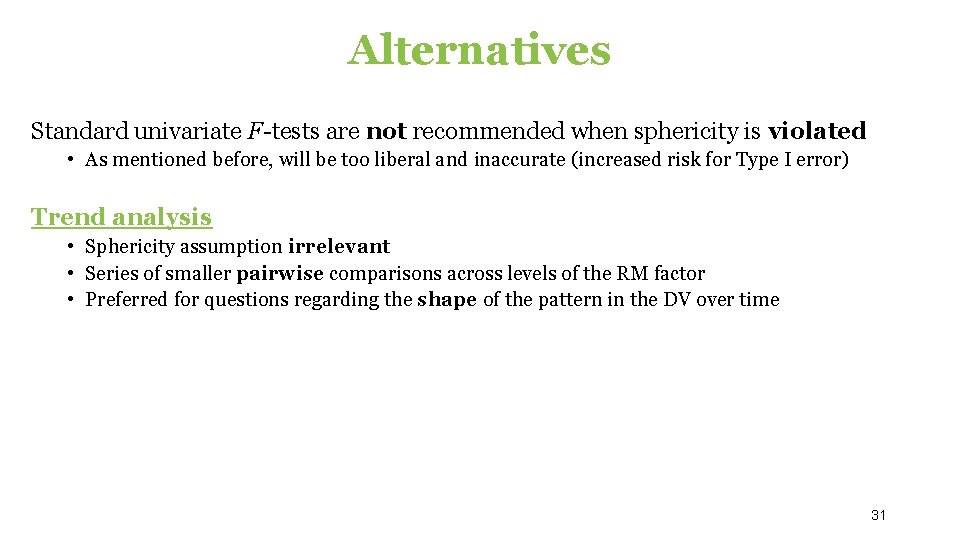
Alternatives Standard univariate F-tests are not recommended when sphericity is violated • As mentioned before, will be too liberal and inaccurate (increased risk for Type I error) Trend analysis • Sphericity assumption irrelevant • Series of smaller pairwise comparisons across levels of the RM factor • Preferred for questions regarding the shape of the pattern in the DV over time 31
Adjusted or alternative univariate F-tests (Useful for “smaller” N) • DEGREES OF FREEDOM (numerator and denominator) are REDUCED by multiplying by EPSILON • Epsilon = an adjustment factor describing the magnitude of the departure from sphericity • If sphericity assumption is perfectly met, epsilon = 1 • Epsilon < 1 indicates departure from sphericity • Lower-bound depends on k levels of RM factor • 1 / (k – 1), thus when k = 3, epsilon can be as small as. 50 • MORE conservative F-critical value • df correction approaches have been criticized as too conservative, • increasing risk of Type II error, as they assume maximal heterogeneity among cells Several approaches (most-to-least conservative) • Lower-bound: Uses the lower bound estimate of epsilon in the df correction • Greenhouse-Geisser: Considered conservative and tends to underestimate epsilon when epsilon is close to 1 (danger for over-correction) • Huynh-Feldt: Considered less conservative when true value of epsilon is ≥. 75; but also overestimates sphericity 32
Multivariate F-tests • DV is treated as a set of variables, ignores (does not assume) sphericity; • Assumes general covariance structure • Cost: Less powerful than RM ANOVA and should be avoided UNLESS… • k is low (< 5) and N is > (15 + k) (or k is high (5 to 8) and N is > (30 + k)) , epsilon is low (<. 70), and correlations among levels of RM factor are high • Computed on differences among means • Most often used in context of non-experimental research • Different forms exist: • Pillai’s trace, +Wilk’s λ, Hotelling’s trace, Roy’s largest root • +Preferred and most commonly used • All yield same result for 1 -Way RM ANOVA • Additional assumptions for multivariate F-tests • Difference scores are multivariately normally distributed in population • Difference scores on outcome for each pair of levels are normally distributed at every combination of the values of other factors • Difference scores from any one participant are independent from those of any other participant • Use multivariate η 2 for main effect or interaction when using multivariate F-tests • Multivariate η 2 = 1 – Wilk’s Lambda (Λ) 33
Maximum likelihood procedures • Mixed-effects, multilevel, or hierarchical linear models • Wave of the (present and) future • Structure of variance-covariance matrix is modeled explicitly • not assumed to follow compound symmetry (can be tested empirically) • Autoregressive, exchangeable, or unstructured correlational structures are but a few examples Effect of N on results of the Mauchly test of sphericity § Could have large N, reject H 0, apply corrections, which are only minimal and unlikely to affect outcome of results § Could have small N, fail to reject H 0, not apply corrections and obtain spurious results § If epsilon is near 1, a correction is probably not necessary; however, if epsilon is near the lower bound, a correction is likely necessary § Could run both RM ANOVA (with corrections for sphericity) and Multivariate analyses and report analysis that is statistically significant as that analysis has the greater power given the circumstances 34
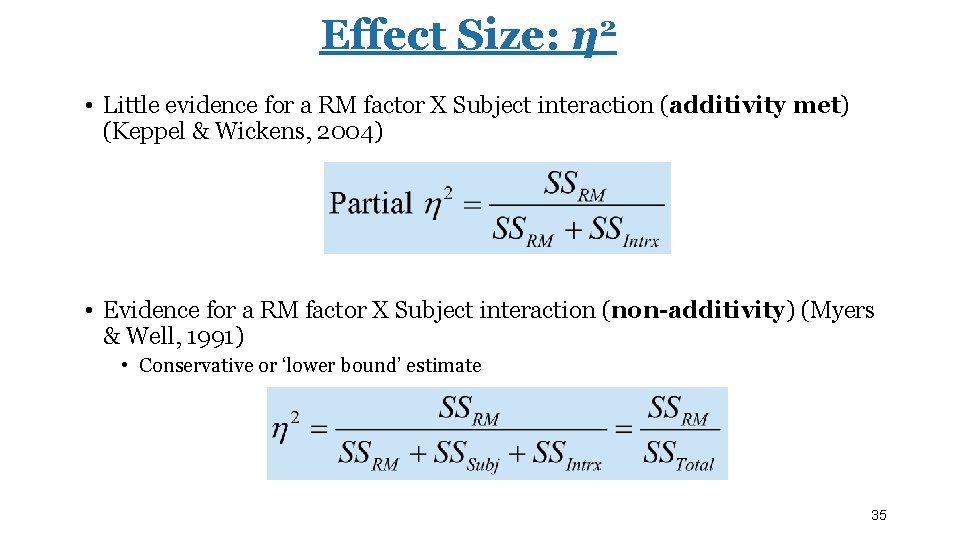
Effect Size: 2 η • Little evidence for a RM factor X Subject interaction (additivity met) (Keppel & Wickens, 2004) • Evidence for a RM factor X Subject interaction (non-additivity) (Myers & Well, 1991) • Conservative or ‘lower bound’ estimate 35
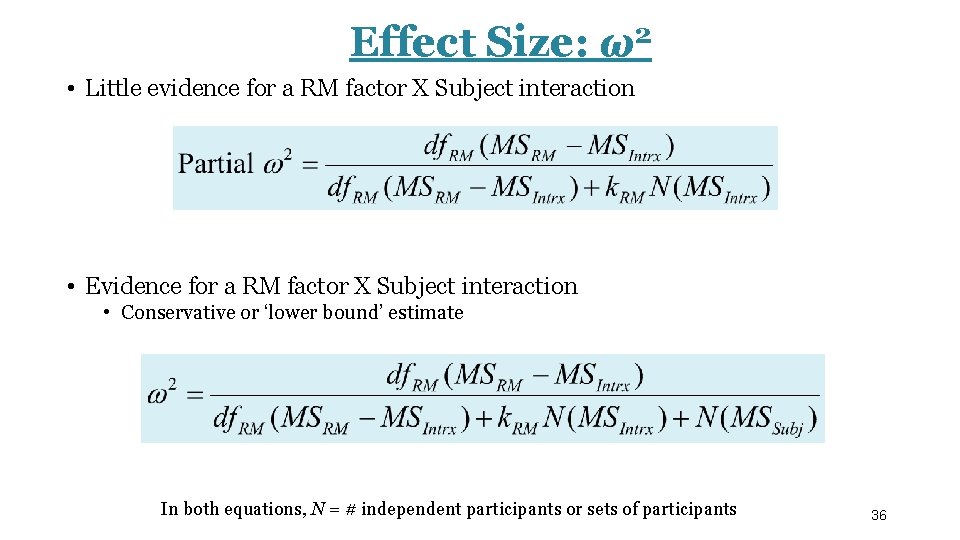
Effect Size: ω2 • Little evidence for a RM factor X Subject interaction • Evidence for a RM factor X Subject interaction • Conservative or ‘lower bound’ estimate In both equations, N = # independent participants or sets of participants 36
FACTORIAL REPEATED MEASURES ANOVA
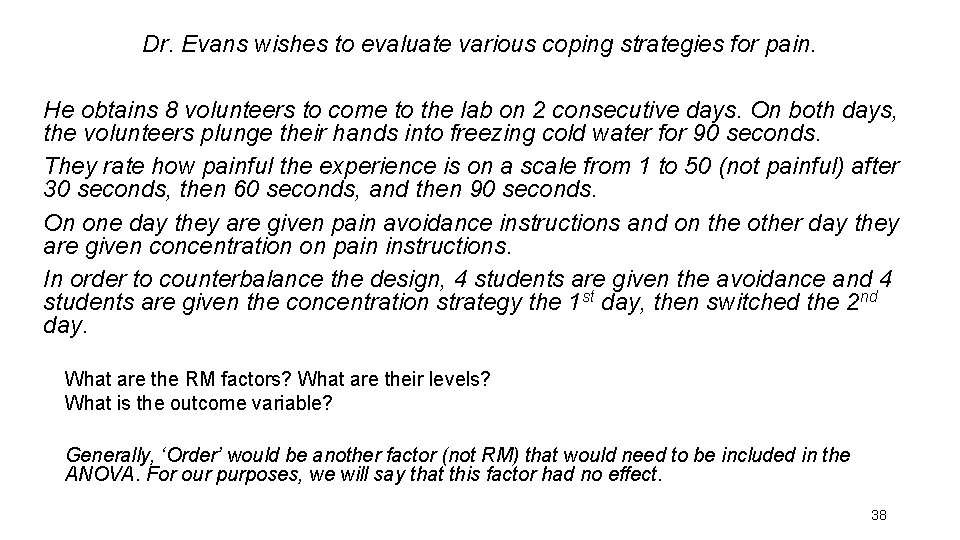
Dr. Evans wishes to evaluate various coping strategies for pain. He obtains 8 volunteers to come to the lab on 2 consecutive days. On both days, the volunteers plunge their hands into freezing cold water for 90 seconds. They rate how painful the experience is on a scale from 1 to 50 (not painful) after 30 seconds, then 60 seconds, and then 90 seconds. On one day they are given pain avoidance instructions and on the other day they are given concentration on pain instructions. In order to counterbalance the design, 4 students are given the avoidance and 4 students are given the concentration strategy the 1 st day, then switched the 2 nd day. What are the RM factors? What are their levels? What is the outcome variable? Generally, ‘Order’ would be another factor (not RM) that would need to be included in the ANOVA. For our purposes, we will say that this factor had no effect. 38
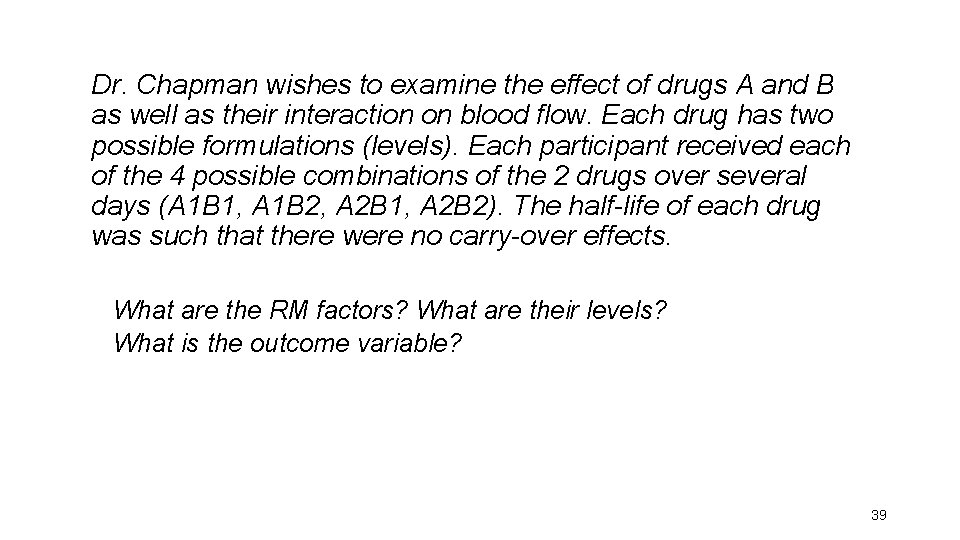
Dr. Chapman wishes to examine the effect of drugs A and B as well as their interaction on blood flow. Each drug has two possible formulations (levels). Each participant received each of the 4 possible combinations of the 2 drugs over several days (A 1 B 1, A 1 B 2, A 2 B 1, A 2 B 2). The half-life of each drug was such that there were no carry-over effects. What are the RM factors? What are their levels? What is the outcome variable? 39
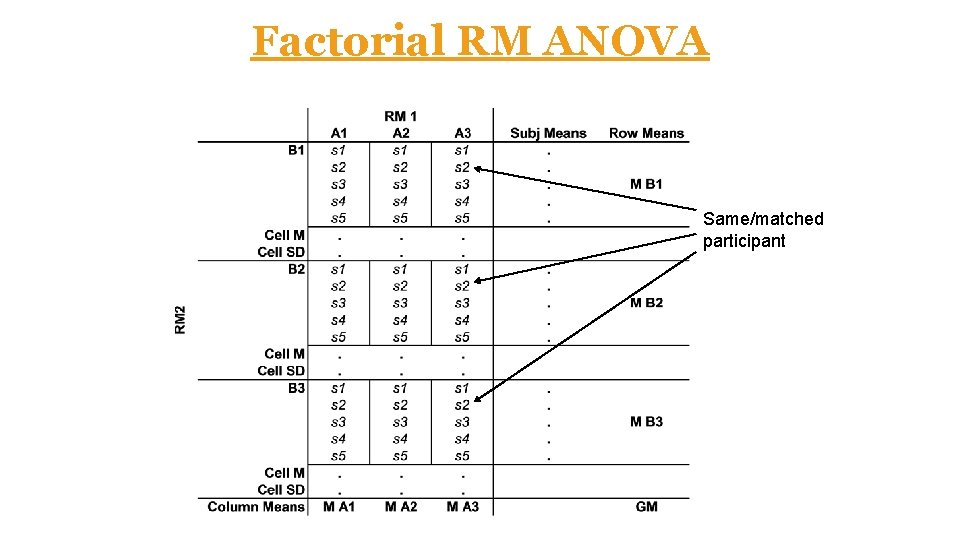
Factorial RM ANOVA Same/matched participant
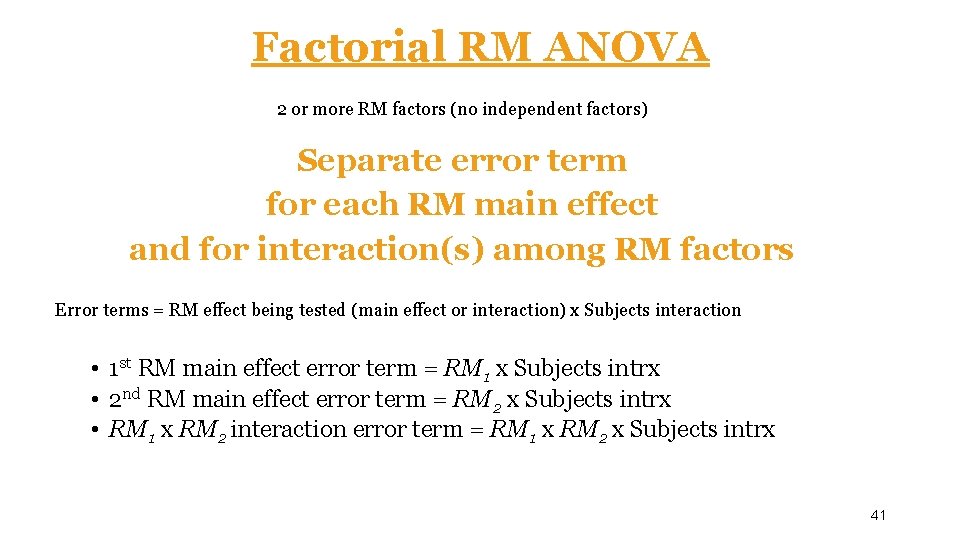
Factorial RM ANOVA 2 or more RM factors (no independent factors) Separate error term for each RM main effect and for interaction(s) among RM factors Error terms = RM effect being tested (main effect or interaction) x Subjects interaction • 1 st RM main effect error term = RM 1 x Subjects intrx • 2 nd RM main effect error term = RM 2 x Subjects intrx • RM 1 x RM 2 interaction error term = RM 1 x RM 2 x Subjects intrx 41
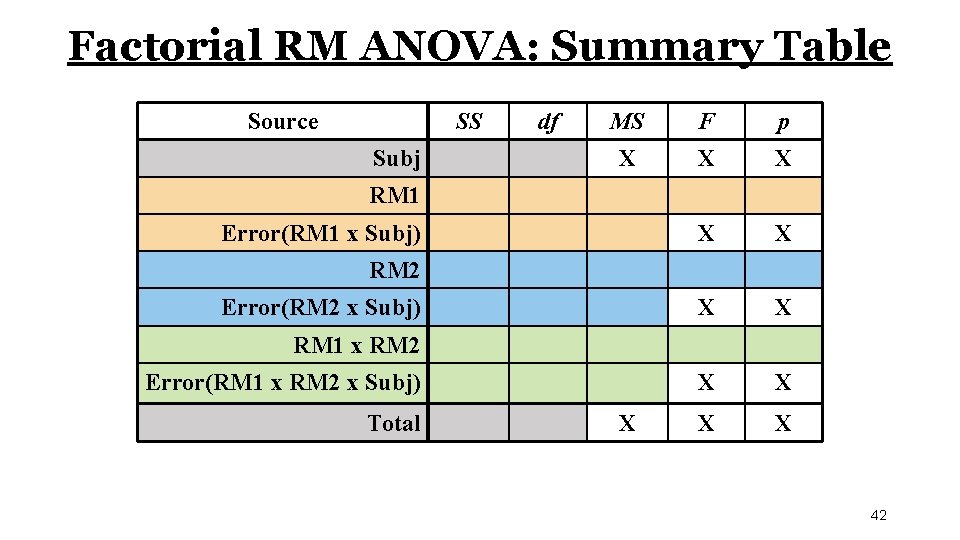
Factorial RM ANOVA: Summary Table Source SS Subj df MS F p X X X RM 1 Error(RM 1 x Subj) RM 2 Error(RM 2 x Subj) RM 1 x RM 2 Error(RM 1 x RM 2 x Subj) Total X 42
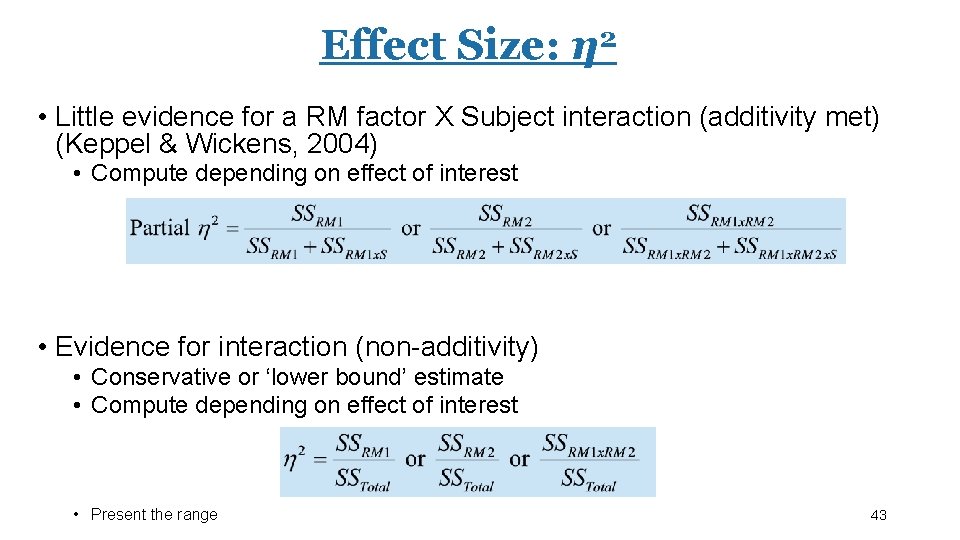
Effect Size: η 2 • Little evidence for a RM factor X Subject interaction (additivity met) (Keppel & Wickens, 2004) • Compute depending on effect of interest • Evidence for interaction (non-additivity) • Conservative or ‘lower bound’ estimate • Compute depending on effect of interest • Present the range 43
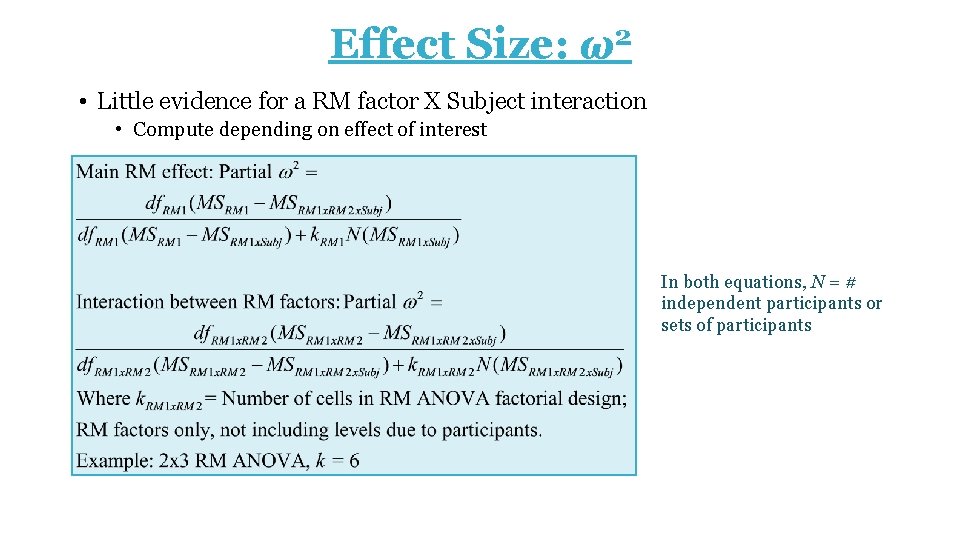
Effect Size: ω2 • Little evidence for a RM factor X Subject interaction • Compute depending on effect of interest In both equations, N = # independent participants or sets of participants
Multiple Comparisons Similar procedures as other ANOVA designs Different error term technically required for each RM comparison • Error represents differences among participants across levels of RM factor + random error • When a contrast omits one or more levels of the RM factor, how do we know whether omnibus error term represented by RM x Subjects factors still applies to remaining levels? Hard to say… However, use of MSIntrx as error term in omnibus multiple comparisons is usually justified • i. e. , Follow-up 1 -Way RM ANOVAs for simple main effects following interaction • Similar to follow-up 1 -Way Independent Groups ANOVAs following significant Factorial ANOVA Simple or pairwise comparisons avoid this problem by use of paired-samples t-tests or trend analysis procedures (recommended) 45
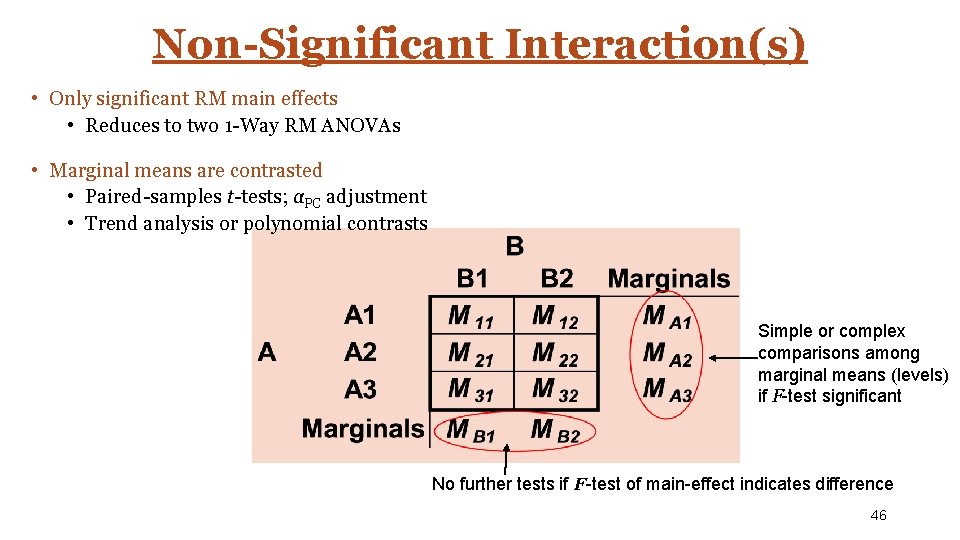
Non-Significant Interaction(s) • Only significant RM main effects • Reduces to two 1 -Way RM ANOVAs • Marginal means are contrasted • Paired-samples t-tests; αPC adjustment • Trend analysis or polynomial contrasts Simple or complex comparisons among marginal means (levels) if F-test significant No further tests if F-test of main-effect indicates difference 46
Significant Interaction(s) • Visualize: Plot means • Tests of simple (main) effects • Contrast means from levels of one RM factor within levels of another RM factor using 1 -way RM ANOVA, paired-samples t-tests, or polynomial contrasts • Avoid interpretation of main effects • Alternative: Tests of interaction contrasts • Create difference scores between levels of one factor within each level of another factor and compare with paired-samples t-tests • Order dictates valence of difference scores • Results will indicate whether mean differences across one condition vary across levels of other condition 47
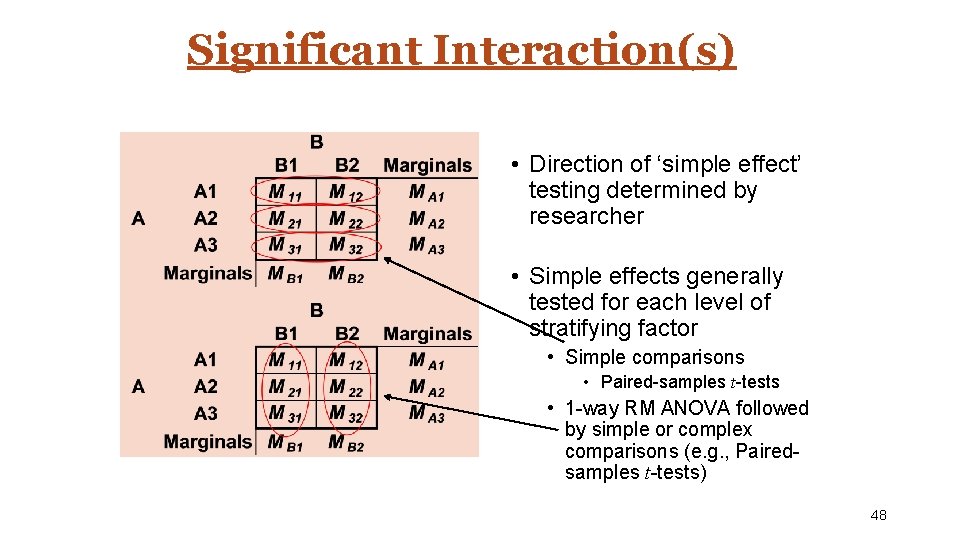
Significant Interaction(s) • Direction of ‘simple effect’ testing determined by researcher • Simple effects generally tested for each level of stratifying factor • Simple comparisons • Paired-samples t-tests • 1 -way RM ANOVA followed by simple or complex comparisons (e. g. , Pairedsamples t-tests) 48
Reporting Results • Summary information: sample means and either SDs, SEs, CIs • Effect size measures for main effects or interactions (even if non-significant) • Results of post hoc comparisons • Mean differences and interactions can be graphically depicted 49
• Extraneous factors (internal validity) Problems • Passage of time in longitudinal studies • Do conditions, equipment, experimenters, participants change (interest, practice, skills) over the course of the study in ways that may invalidate results? • Need methodological control • Generalizability (external validity) • Using fewer participants, so sample is less representative of population • Poor matching, small n, violated assumptions may lead to deflated power in RM ANOVA so that its power is same as Independent Groups ANOVA • If a participant is missing data on outcome from any level of any RM factor, all data from that participant is removed from analysis • Decreased N less power • However, easier to impute missing data in RM ANOVA than in randomized- or independentgroups designs • Other outcome scores are available from participants with missing values • Imputation results in several data sets on which the same analysis is conducted and results are compared 50
Supplemental
MSRM*S Can use to calculate the ICC 52
- Slides: 52