
Adaptations of plants Sing along http www mbgnet
Adaptations of plants. .

Sing along! http: //www. mbgnet. net/bioplants/adapt. html
What is an adaptation? Adaptations are special features that allow a plant or animal to live in a particular place or habitat. Plants have adaptations to help them survive (live and grow) in different areas. These adaptations might make it very difficult for the plant to survive in a different place. This explains why certain plants are found in one area, but not in another. For example, you wouldn't see a cactus living in the Arctic. Nor would you see lots of really tall trees living in grasslands. Helpful term biome—a place characterized by its climate and the plants and animals that live there.
Desert It’s very dry and hot. Annual rainfall averages less than 10 inches per year There is a lot of direct sunlight shining on the plants. The soil is often sandy or rocky and unable to hold much water. Winds are often strong, and dry out plants. Plants are exposed to extreme temperatures and drought conditions and must cope with extensive water loss.

Desert It has spines rather than leaves and it stores water in its stem. This cactus displays lightcolored hair that helps shade the plant. This plant has a waxy coating on its leaves.
Grassland Also called prairie, feature hot summers and cold winters. Rainfall is uncertain and drought is common. The temperate grasslands usually receive about 10 to 30 inches of precipitation per year. The soil is extremely rich in organic material due to the fact that the above-ground portions of grasses die off annually, enriching the soil. The area is well-suited to agriculture, and few original prairies survive today.
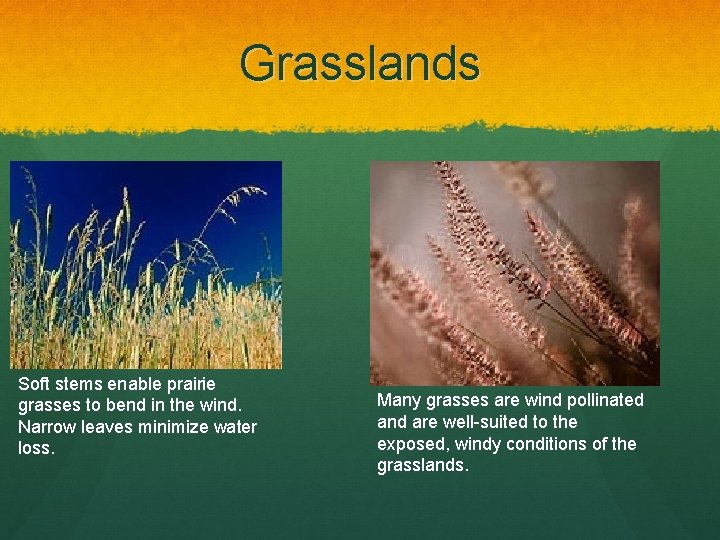
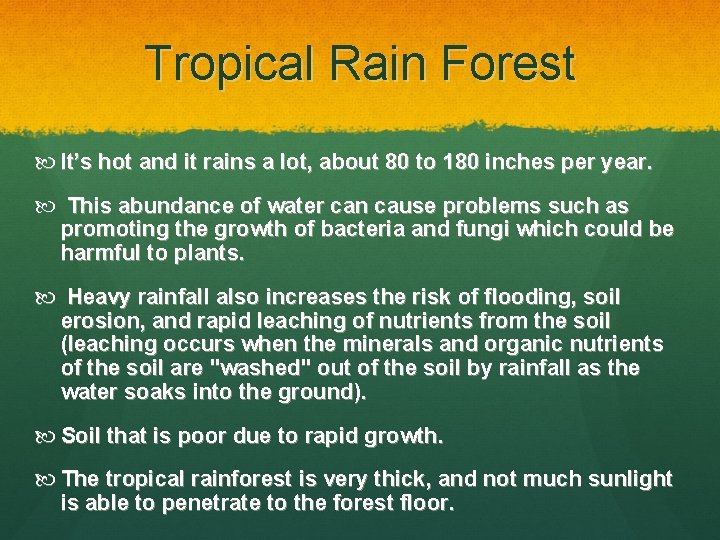
Grasslands Soft stems enable prairie grasses to bend in the wind. Narrow leaves minimize water loss. Many grasses are wind pollinated and are well-suited to the exposed, windy conditions of the grasslands.
Tropical Rain Forest It’s hot and it rains a lot, about 80 to 180 inches per year. This abundance of water can cause problems such as promoting the growth of bacteria and fungi which could be harmful to plants. Heavy rainfall also increases the risk of flooding, soil erosion, and rapid leaching of nutrients from the soil (leaching occurs when the minerals and organic nutrients of the soil are "washed" out of the soil by rainfall as the water soaks into the ground). Soil that is poor due to rapid growth. The tropical rainforest is very thick, and not much sunlight is able to penetrate to the forest floor.
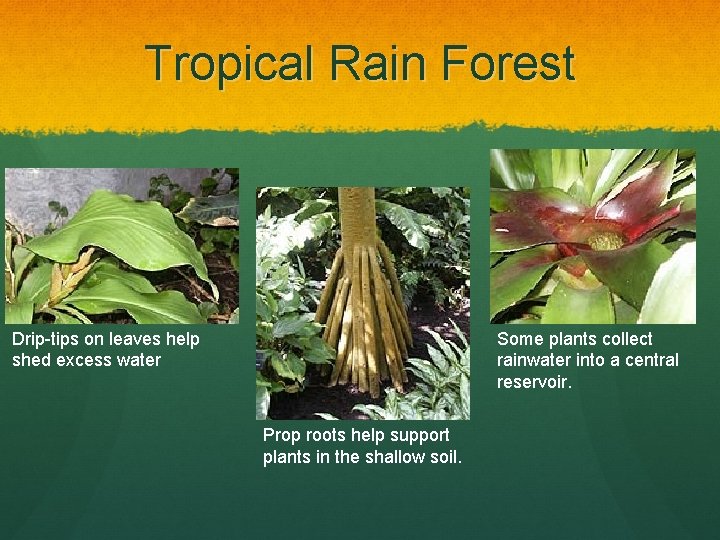
Tropical Rain Forest Drip-tips on leaves help shed excess water Some plants collect rainwater into a central reservoir. Prop roots help support plants in the shallow soil.
Deciduous Forest There are four distinct seasons t: spring, summer, autumn, and winter. The temperature varies from hot in the summer to below freezing in the winter. Rain is plentiful, about 30 to 50 inches per year. The temperate deciduous forest is made up of layers of plants; the number of layers depends upon factors such as climate, soil, and the age of the forest. The tallest trees make up the forest canopy which can be 100 feet or more above the ground. Beneath the canopy, the understory contains smaller trees and young trees. These understory trees are more shade tolerant than canopy trees. Below the understory is a shrub layer. Carpeting the forest floor is the herb layer made up of wildflowers, mosses, and ferns. Fallen leaves, twigs, and dried plants cover the ground, decompose, and help add nutrients to
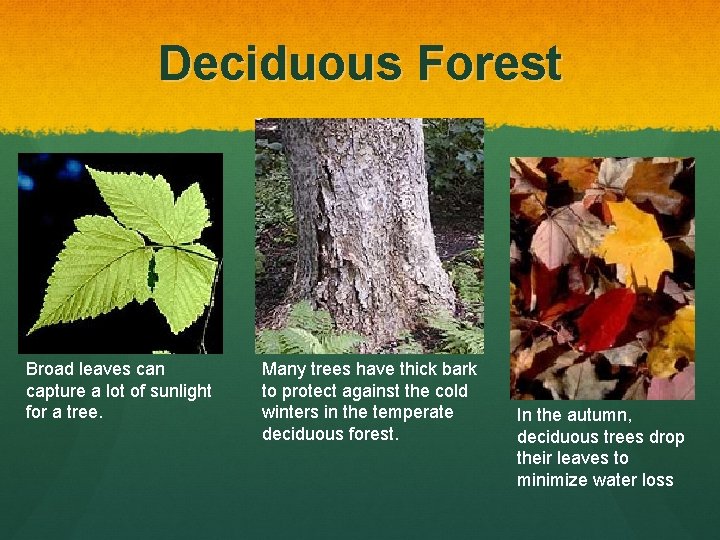
Deciduous Forest Broad leaves can capture a lot of sunlight for a tree. Many trees have thick bark to protect against the cold winters in the temperate deciduous forest. In the autumn, deciduous trees drop their leaves to minimize water loss
Taiga The taiga has cold winters and warm summers. Some parts of the taiga have a permanently frozen sublayer of soil called permafrost. Drainage is poor due to the permafrost or due to layers of rock just below the soil surface, and together with the ground carved out by receding glaciers, lead to the development of lakes, swamps, and bogs. The soil is acidic and mineral-poor. It is covered by a deep layer of partially-decomposed conifer needles.
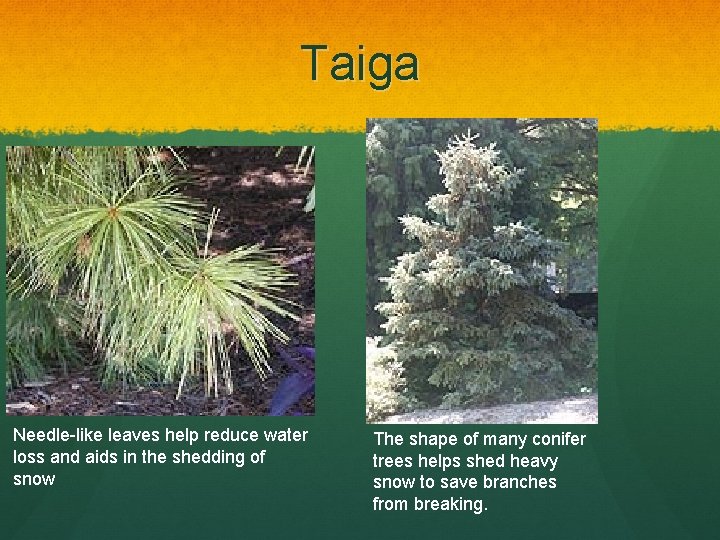
Taiga Needle-like leaves help reduce water loss and aids in the shedding of snow The shape of many conifer trees helps shed heavy snow to save branches from breaking.
Tundra Is cold year-round—it has short cool summers and long, severe winters. The tundra has a permanently frozen sublayer of soil called permafrost. Drainage is poor due to the permafrost and because of the cold, evaporation is slow. The tundra receives little precipitation, about 4 to 10 inches per year, and what it does receive is usually in the form of snow or ice. Plant life is dominated by mosses, grasses, and sedges.
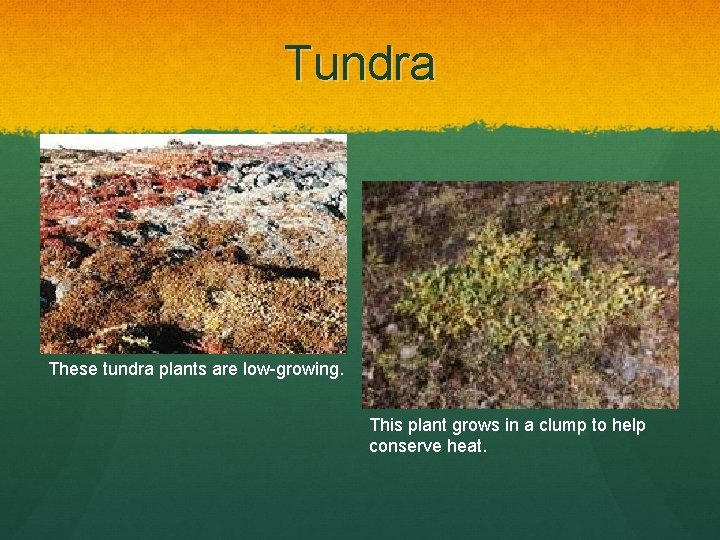
Tundra These tundra plants are low-growing. This plant grows in a clump to help conserve heat.
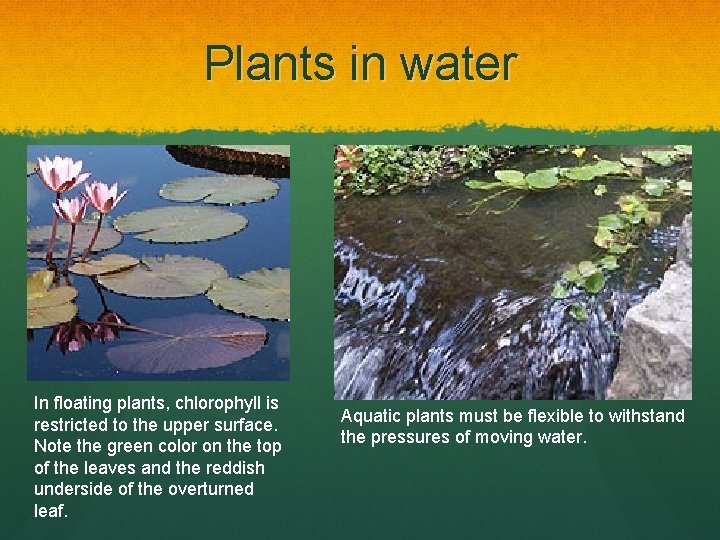
Plants in water In floating plants, chlorophyll is restricted to the upper surface. Note the green color on the top of the leaves and the reddish underside of the overturned leaf. Aquatic plants must be flexible to withstand the pressures of moving water.
ACTIVITY

Adaptations Game http: //www. mbgnet. net/bioplants/adapt. html
- Slides: 18