
Adaptations Objectives n Analyze structural behavioral and physiological
Adaptations
Objectives n Analyze structural, behavioral, and physiological adaptations to predict which populations are likely to survive in a particular environment I can: n Identify an adaptation as structural and behavioral n I can xplain how an adaptation helps an organism survive in a particular environment.
Types of Adaptation n n An adaptation is anything that helps an organism survive in its environment Adaptations are inherited from their parents It also refers to the ability of living things to adjust to different conditions within their environments. There are 3 kinds of adaptations: n n n Structural adaptation Behavioural adaptations Physiological adaptations (we will only be exploring the first two) I can identify an adaptation as structural, behavioral, or physiological.
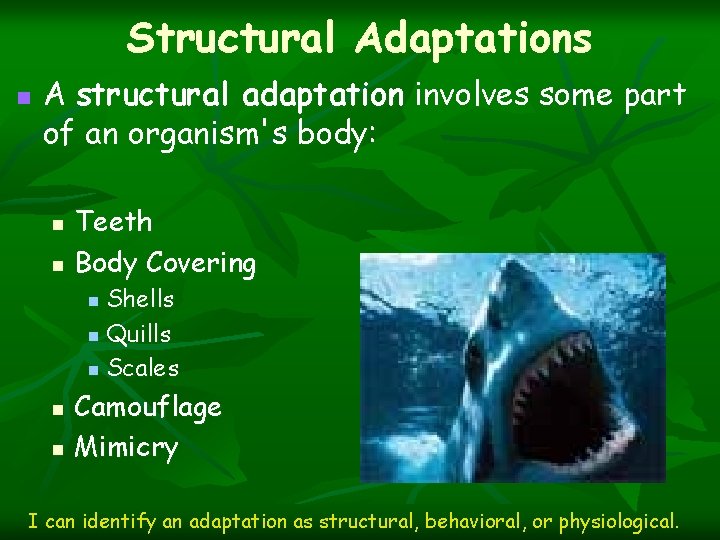
Structural Adaptations n A structural adaptation involves some part of an organism's body: n n Teeth Body Covering Shells n Quills n Scales n n n Camouflage Mimicry I can identify an adaptation as structural, behavioral, or physiological.
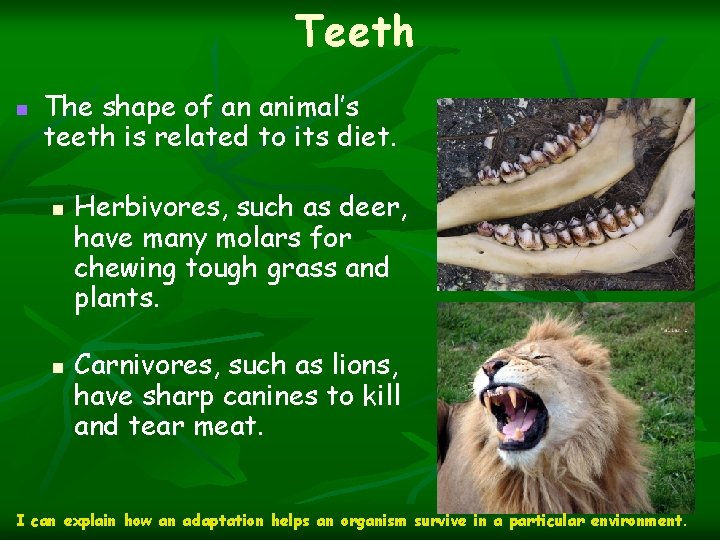
Teeth n The shape of an animal’s teeth is related to its diet. n n Herbivores, such as deer, have many molars for chewing tough grass and plants. Carnivores, such as lions, have sharp canines to kill and tear meat. I can explain how an adaptation helps an organism survive in a particular environment.
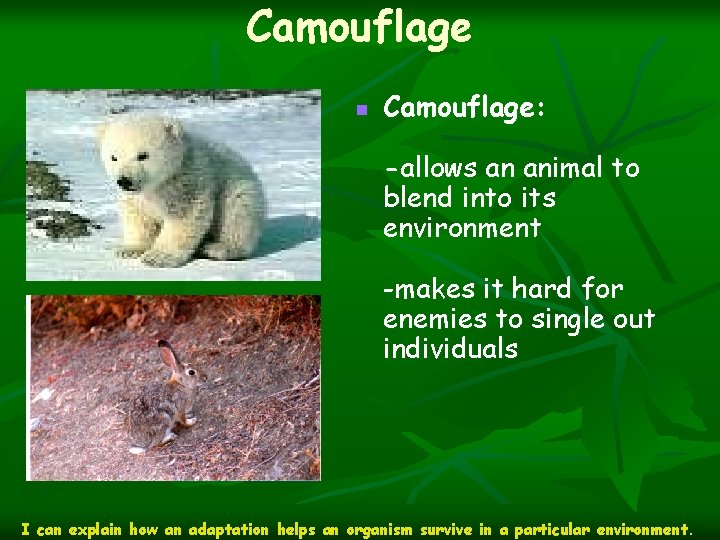
Camouflage n Camouflage: -allows an animal to blend into its environment -makes it hard for enemies to single out individuals I can explain how an adaptation helps an organism survive in a particular environment.
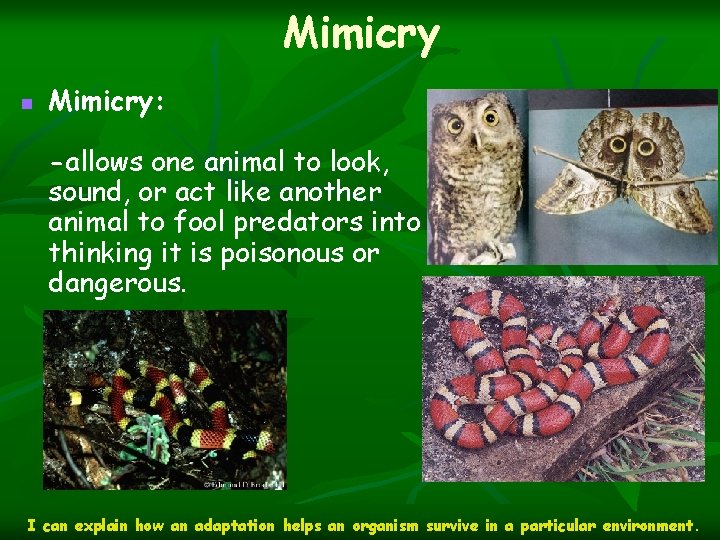
Mimicry n Mimicry: -allows one animal to look, sound, or act like another animal to fool predators into thinking it is poisonous or dangerous. I can explain how an adaptation helps an organism survive in a particular environment.
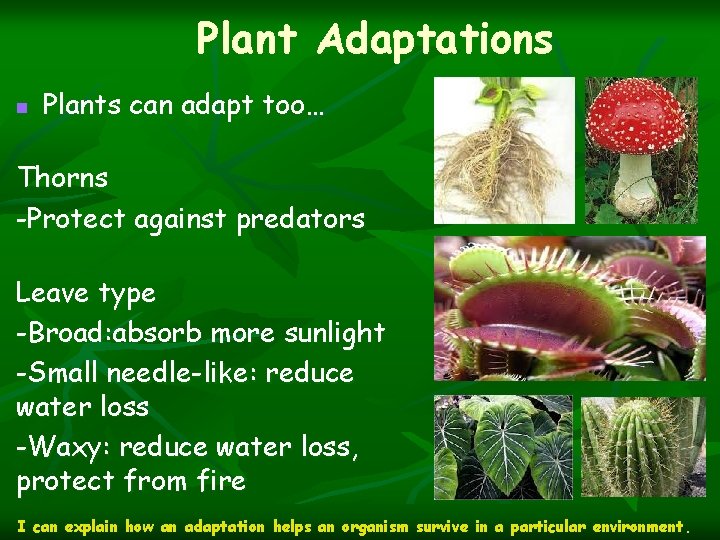
Plant Adaptations n Plants can adapt too… Thorns -Protect against predators Leave type -Broad: absorb more sunlight -Small needle-like: reduce water loss -Waxy: reduce water loss, protect from fire I can explain how an adaptation helps an organism survive in a particular environment.

Behavioral Adaptations n A Behavioural adaptation includes activities or behaviours that help a living thing survive. 1. 2. 3. 4. Innate vs Learned Survival Defence Seasonal I can identify an adaptation as structural, behavioral, or physiological.
Innate vs. Learned Innate n n Inherited through the genes Examples n Flying for bees, birds n Swimming for fish n Walking for humans n Speaking for humans Learned n Learned from experience or from observing other animals n Type of language spoken for humans n Riding a bicycle I can explain how an adaptation helps an organism survive in a particular environment.
Survival Behaviour Predator-Prey Adaptations certain animals eat certain animals –the one that is eating the other we call the predator -the one that gets eaten we call the prey n Marking Territory Adaptations n animals inform other animals that an area is occupied by them I can explain how an adaptation helps an organism survive in a particular environment.
Survival Behaviour Defensive Action Adaptations n animals defend to protect resources, themselves, food, mates, offspring Courtship n Animals show certain behaviors to find a mate Parenting n young animals depend on parents for survival I can explain how an adaptation helps an organism survive in a particular environment.
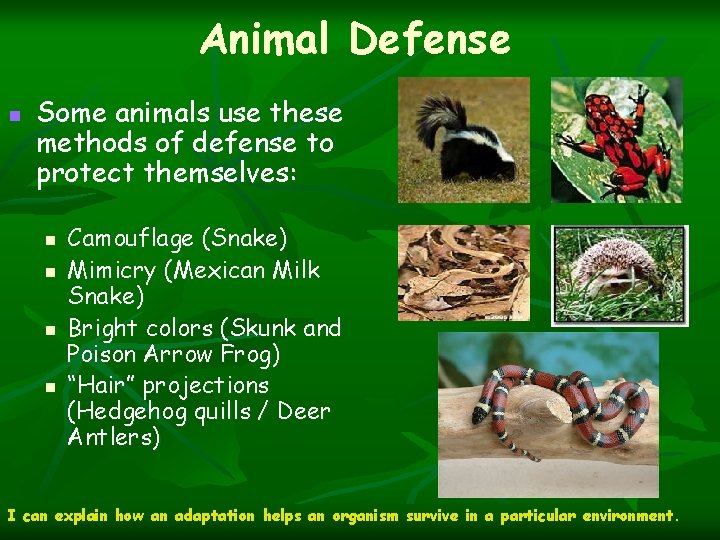
Animal Defense n Some animals use these methods of defense to protect themselves: n n Camouflage (Snake) Mimicry (Mexican Milk Snake) Bright colors (Skunk and Poison Arrow Frog) “Hair” projections (Hedgehog quills / Deer Antlers) I can explain how an adaptation helps an organism survive in a particular environment.
Seasonal Behavior n Behaviours that occur during specific seasons help organisms adapt to the environment -Migration -Hibernation -Estivation I can explain how an adaptation helps an organism survive in a particular environment.
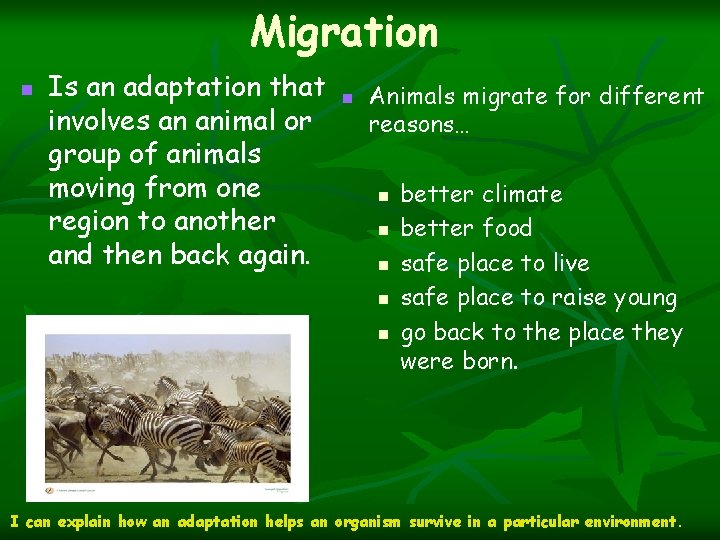
Migration n Is an adaptation that involves an animal or group of animals moving from one region to another and then back again. n Animals migrate for different reasons… n n n better climate better food safe place to live safe place to raise young go back to the place they were born. I can explain how an adaptation helps an organism survive in a particular environment.
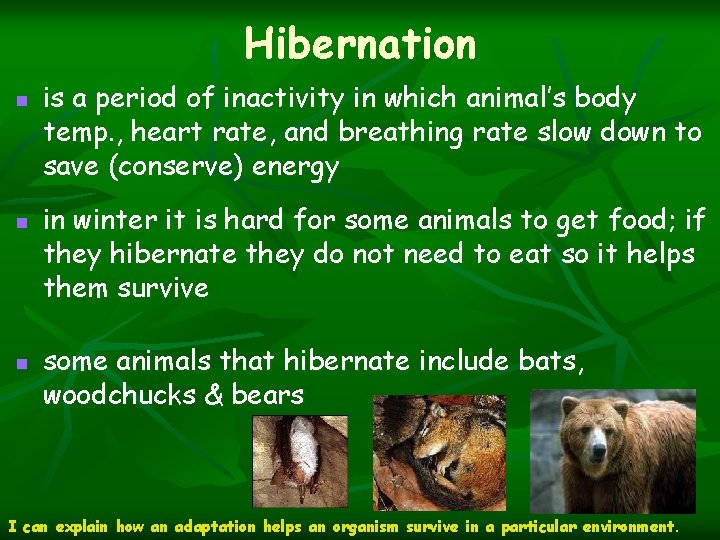
Hibernation n is a period of inactivity in which animal’s body temp. , heart rate, and breathing rate slow down to save (conserve) energy in winter it is hard for some animals to get food; if they hibernate they do not need to eat so it helps them survive some animals that hibernate include bats, woodchucks & bears I can explain how an adaptation helps an organism survive in a particular environment.
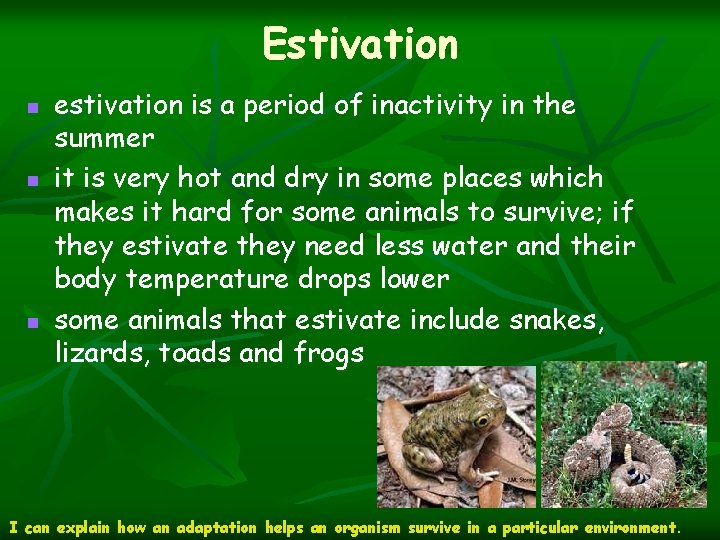
Estivation n estivation is a period of inactivity in the summer it is very hot and dry in some places which makes it hard for some animals to survive; if they estivate they need less water and their body temperature drops lower some animals that estivate include snakes, lizards, toads and frogs I can explain how an adaptation helps an organism survive in a particular environment.
All living things must have these adaptations in order to survive… I can explain how an adaptation helps an organism survive in a particular environment.
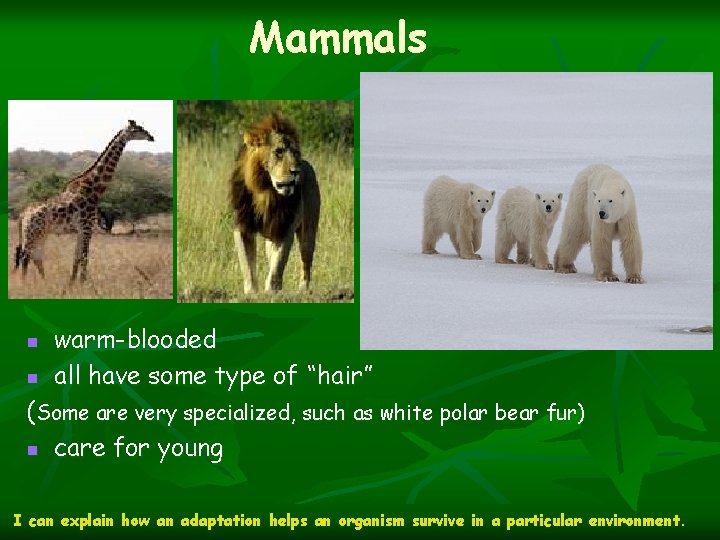
Mammals n n warm-blooded all have some type of “hair” (Some are very specialized, such as white polar bear fur) n care for young I can explain how an adaptation helps an organism survive in a particular environment.
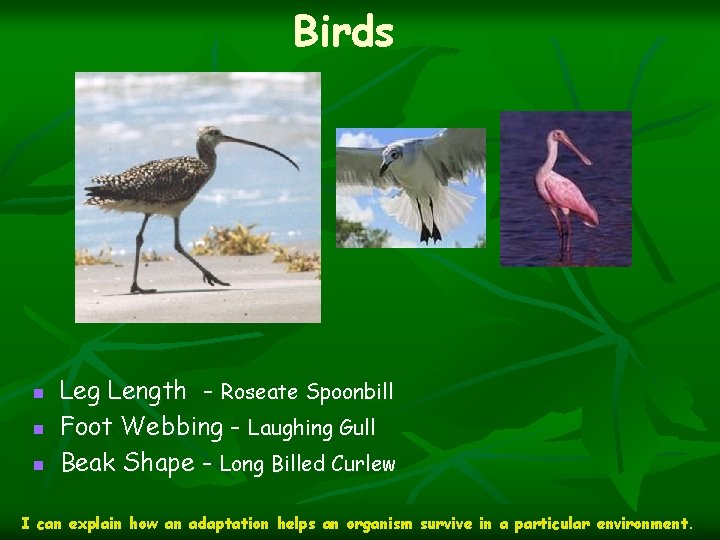
Birds n n n Leg Length - Roseate Spoonbill Foot Webbing - Laughing Gull Beak Shape - Long Billed Curlew I can explain how an adaptation helps an organism survive in a particular environment.
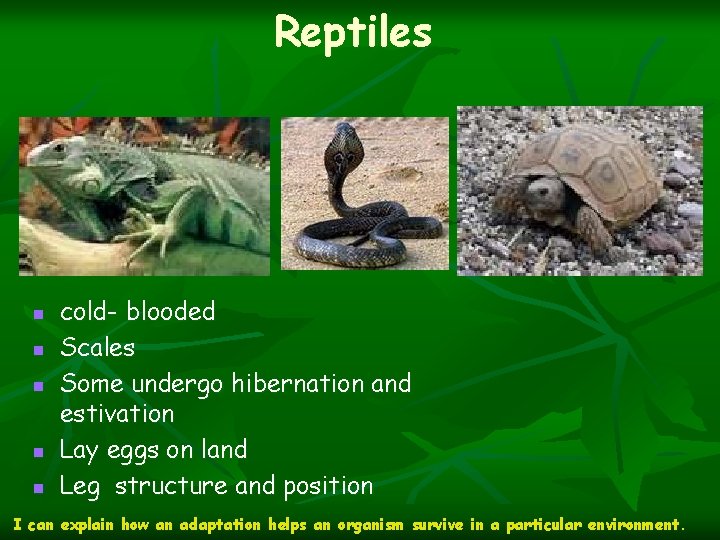
Reptiles n n n cold- blooded Scales Some undergo hibernation and estivation Lay eggs on land Leg structure and position I can explain how an adaptation helps an organism survive in a particular environment.
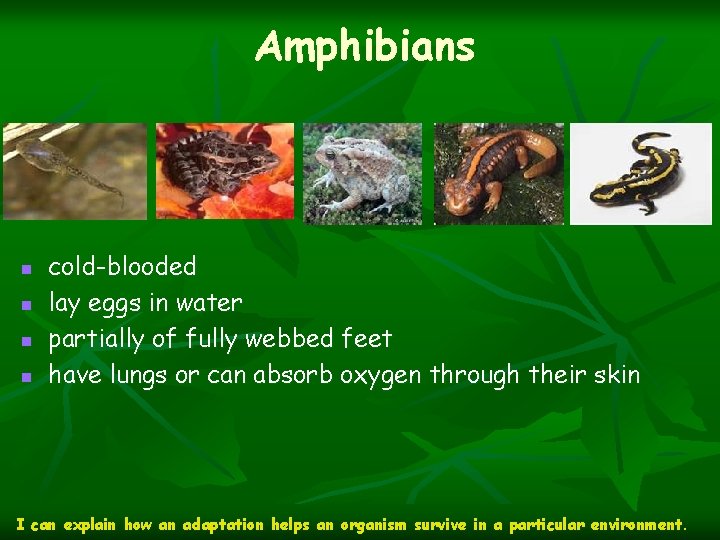
Amphibians n n cold-blooded lay eggs in water partially of fully webbed feet have lungs or can absorb oxygen through their skin I can explain how an adaptation helps an organism survive in a particular environment.

This powerpoint was kindly donated to www. worldofteaching. com Modified by Lane Clark http: //www. worldofteaching. com is home to over a thousand powerpoints submitted by teachers. This is a completely free site and requires no registration. Please visit and I hope it will help in your teaching.
Natural Selection and Population Changes Over Time
Objectives n n SPI 0807. 5. 2 Analyze structural, behavioral, and physiological adaptations to predict which populations are likely to survive in a particular environment SPI 0807. 5. 3 Analyze data on levels of variation within a population to make predictions about survival under particular environmental conditions. I can: n Explain how genetic variations within a population help an organism survive longer.
Natural Selection n n The process by which individuals are better adapted to their environment “Survival of the Fittest” The fittest survive to pass on their traits to the next generation. http: //www. vtaide. com/png/bird. Examples: adaptations 3. htm n n n Insecticide resistance Speciation Galapagos finches I can explain how genetic variations within a population help an organism survive longer.
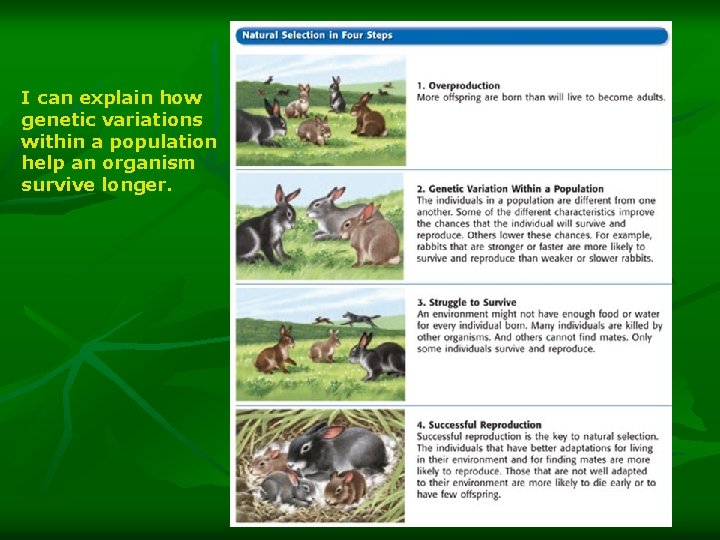
I can explain how genetic variations within a population help an organism survive longer.
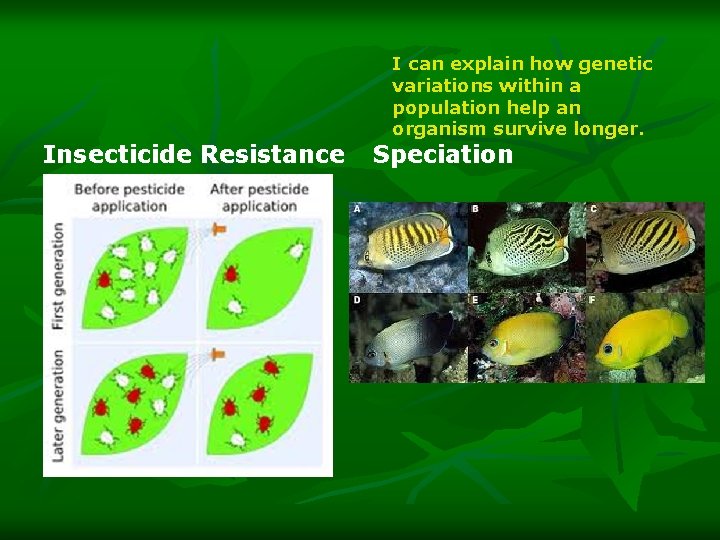
Insecticide Resistance I can explain how genetic variations within a population help an organism survive longer. Speciation
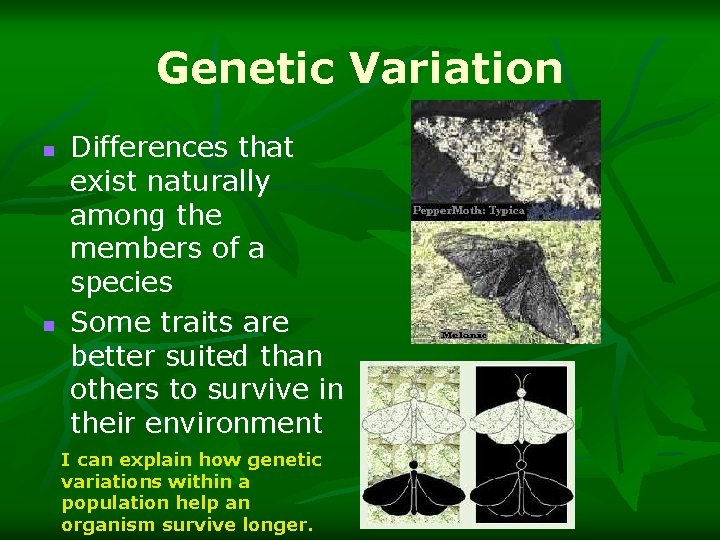
Genetic Variation n n Differences that exist naturally among the members of a species Some traits are better suited than others to survive in their environment I can explain how genetic variations within a population help an organism survive longer.
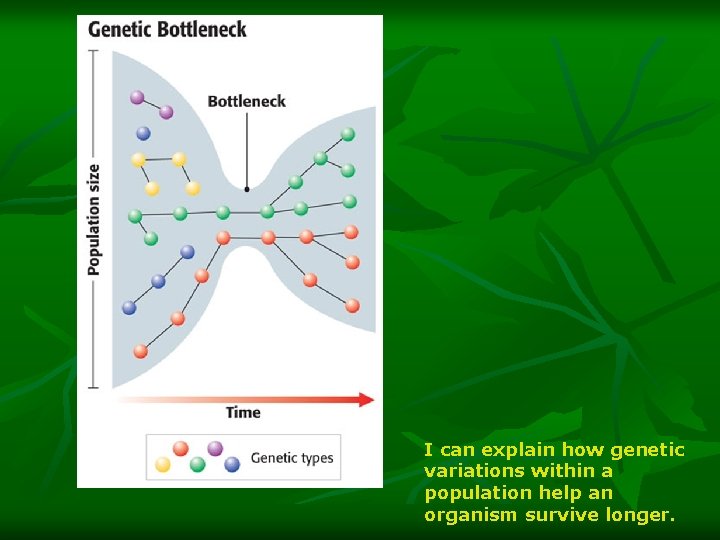
I can explain how genetic variations within a population help an organism survive longer.
- Slides: 30