
Adaptations Learning Objectives To understand the how living
Adaptations
Learning Objectives To understand the how living organisms are adapted to their environment Success criteria Learners should be able to demonstrate and apply their knowledge and understanding of: (g) the different types of adaptations of organisms to their environment Anatomical, physiological and behavioural adaptations AND why organisms from different taxonomic groups may show similar anatomical features, including the marsupial mole and placental mole.
Adaptation Key Term: Adaptation A feature that enhances survival and long term reproductive success Adaptations help organisms to cope with environmental stresses and obtain the things they need to survive What will a well adapted organism be able to do?

Adaptation What will a well adapted organism be able to do? Find enough food, photosynthesise well Find enough water Gather enough nutrients Defend itself from predators and disease Survive the physical conditions of it’s environment eg temperature and light Still have enough energy to reproduce
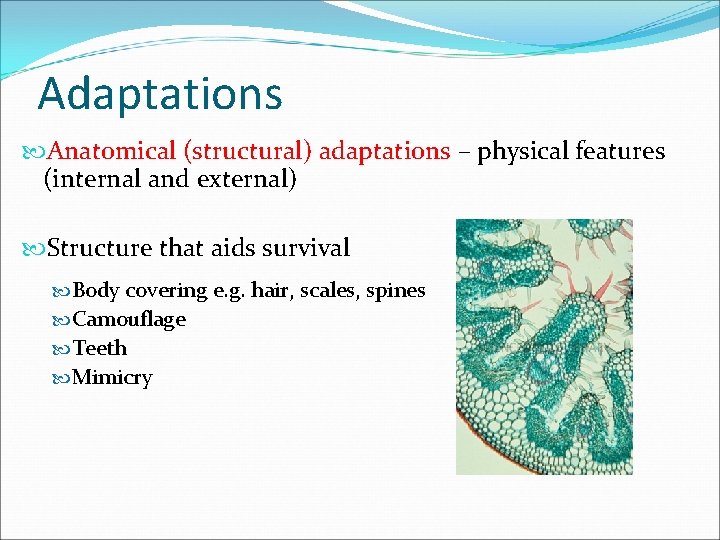
Adaptations Anatomical (structural) adaptations – physical features (internal and external) Structure that aids survival Body covering e. g. hair, scales, spines Camouflage Teeth Mimicry

Adaptations Physiological / Biochemical Adaptations – processes that take place inside an organism Ensure correct functioning cell processes e. g. Yeast making correct enzymes to respire Poison production Antibiotic production Water holding

Adaptations Behavioural Adaptations – the way an organism acts (innate (instinctive) or learnt behaviours) Aspect of behaviour that helps organism survive e. g. earthworm withdraws into burrow when touched Survival behaviours Courtship Seasonal behaviours Migration & hibernation
Task - homework Prepare a factfile on the different types of adaptations (anatomical, physiological and behavioural). You must include 3 organism either plants or animals for each type of adaptation. The following website may help http: //www. bbc. co. uk/nature/adaptations It’s not meant to be an epic, one side per adaptation type
Divergent evolution Speciation involves a process of divergence where initially similar organisms become different. Move to a new territory population spreads out become exposed to different selection pressures become adapted to different ecological niches. If species in a group diverge rapidly in this way it is called adaptive radiation.
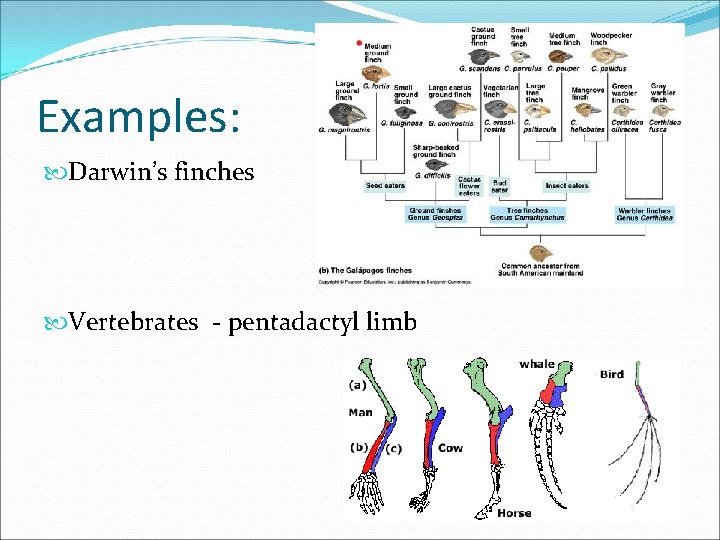
Examples: Darwin’s finches Vertebrates - pentadactyl limb

Convergent evolution This is the process whereby organisms not closely related, independently evolve similar traits as a result of having to adapt to similar environments or ecological niches. Example : cactus (USA) : euphorbia (Madagascar)
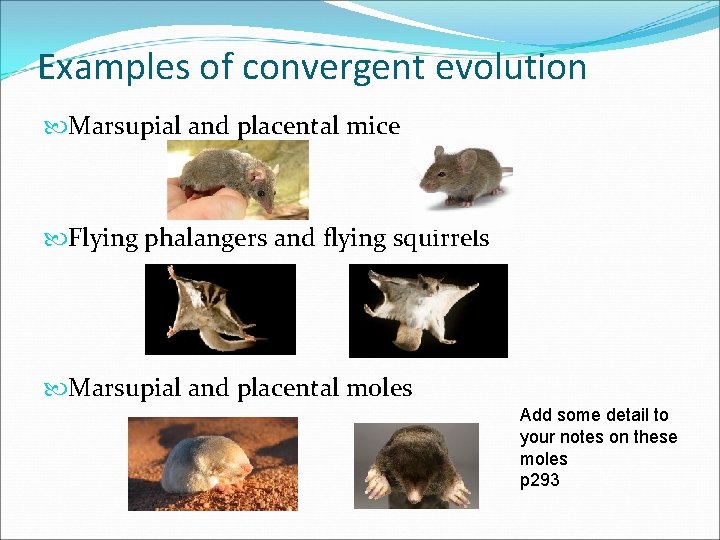
Examples of convergent evolution Marsupial and placental mice Flying phalangers and flying squirrels Marsupial and placental moles Add some detail to your notes on these moles p 293
Learning Objectives To understand the how living organisms are adapted to their environment Success criteria Learners should be able to demonstrate and apply their knowledge and understanding of: (g) the different types of adaptations of organisms to their environment Anatomical, physiological and behavioural adaptations AND why organisms from different taxonomic groups may show similar anatomical features, including the marsupial mole and placental mole.
- Slides: 13