
Adaptations for Parasitism BY 2 6 Definition examples
Adaptations for Parasitism BY 2. 6 • Definition & examples. • Taenia solium – pork tapeworm.
Parasites • Parasites are organisms that live on or in another organism, which is called the host. • The parasite obtains nourishment at the expense of the host. • Parasites benefit greatly from the relationship, the host is normally harmed. • The relationship between the host and the parasite is called parasitism.
Parasites • Parasites are normally much smaller then their hosts • Parasites normally show a high degree of specialization for their mode of life. • They normally reproduce quickly, producing a great number of offspring. • Vertebrates suffer parasitism from parasites such as tapeworms, flukes, fleas and species of Plasmodium – an organism that causes malaria.
Parasites • There are two types of parasite: • Endoparasites – which live inside the body of the host, e. g. tapeworm. • Ectoparasites – which live on the outside of the host, e. g. fleas
Parasites • • • Parasites may show some of the following: Agents for penetration of the host. A means of attachment to the host. Protection against the host’s immune response. Show degeneration of unnecessary organ systems. • Have a vector or intermediate host. • Produce resistant stages to overcome the period spent away from the host.
Taenia solium • The pork tapeworm – Taenia solium, is an endoparasite that lives in the small intestine of humans (primary host). The secondary /intermediate host is a pig. • It has adapted to survive this hostile environment.
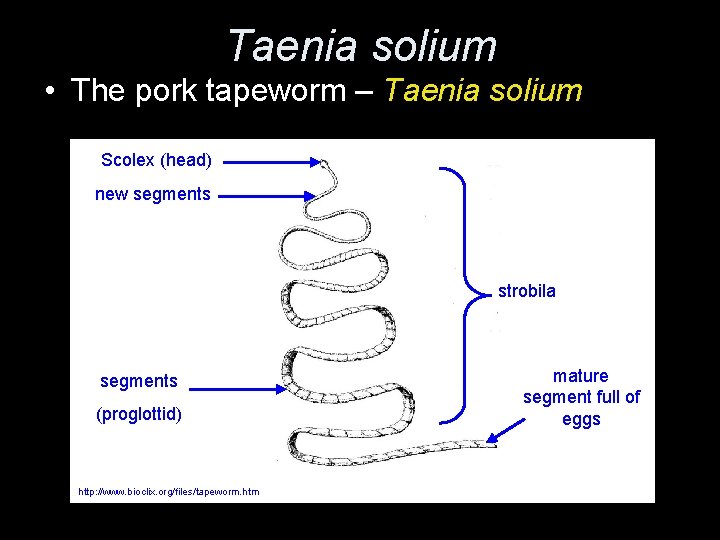
Taenia solium • The pork tapeworm – Taenia solium Scolex (head) new segments strobila segments (proglottid) http: //www. bioclix. org/files/tapeworm. htm mature segment full of eggs
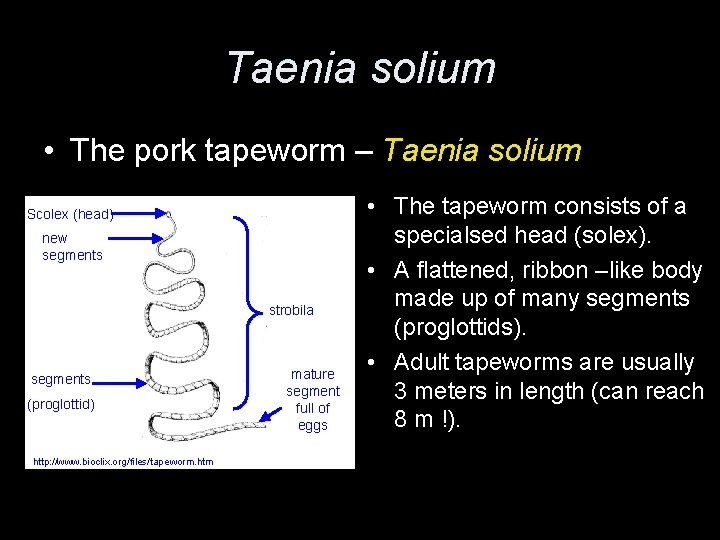
Taenia solium • The pork tapeworm – Taenia solium Scolex (head) new segments strobila segments (proglottid) http: //www. bioclix. org/files/tapeworm. htm mature segment full of eggs • The tapeworm consists of a specialsed head (solex). • A flattened, ribbon –like body made up of many segments (proglottids). • Adult tapeworms are usually 3 meters in length (can reach 8 m !).
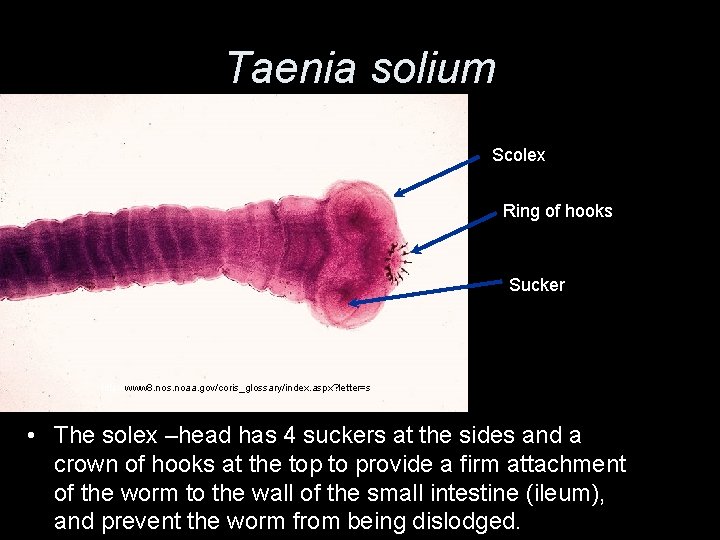
Taenia solium Scolex Ring of hooks Sucker http: //www 8. nos. noaa. gov/coris_glossary/index. aspx? letter=s • The solex –head has 4 suckers at the sides and a crown of hooks at the top to provide a firm attachment of the worm to the wall of the small intestine (ileum), and prevent the worm from being dislodged.
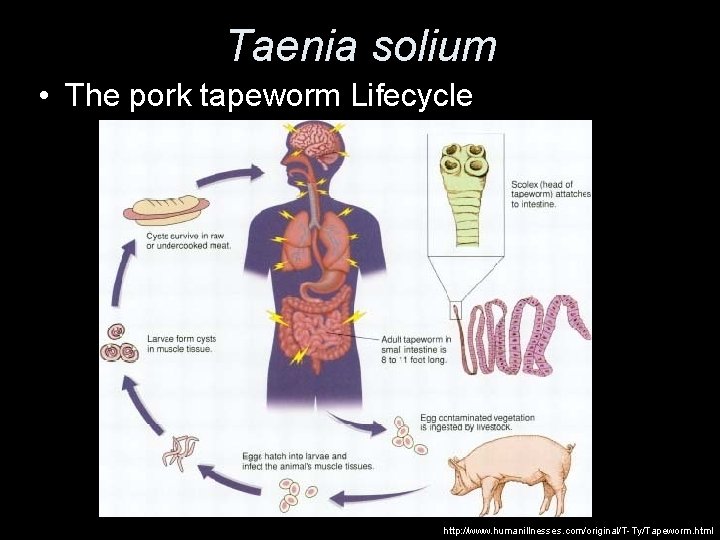
Taenia solium • The pork tapeworm Lifecycle http: //www. humanillnesses. com/original/T-Ty/Tapeworm. html
Taenia solium • The tapeworm has no mouth or alimentary canal. • Instead it absorbs predigested food from the host’s ileum by diffusion and active transport over the entire body surface. • The tapeworm has a very large surface area to volume ratio to aid absorption. • They have a thick cuticle and produce inhibitory substances to prevent their digestion by the host’s enzymes.
Taenia solium • The narrow region behind the scolex gives rise to new proglottids (segments) by a continuous process of budding. • As the individual segments grow, they are pushed back from the solex. • Mature proglottids (near the end) contain both male and female reproductive organs.
Taenia solium • Following fertilisation within the mature proglottids, eggs develop and fill the segments. • At intervals, sections called gravid proglottids, break off the chain and pass out of the host with the faeces. • Each segment may contain up to 40 000 eggs! • The eggs have resistant shells which help protect them outside of the host.
Taenia solium • Further development of the eggs only occurs if eaten by a pig (secondary host). • There embryos emerge which move into the animal’s muscles where they remain dormant until the “meat” is eaten by humans. • Humans usually contract pork tapeworms by eating undercooked meat.
Taenia solium • The pork tapeworm normally causes little discomfort in human. • However, if humans consume tapeworm eggs then the tapeworm develops in the same way as it does in the pig. • This causes cysticercosis where embryos encyst (form cysts) in various organs and damage surrounding tissue.
Taenia solium • Adult worms can be eradicated from humans by use of drugs. • Careful inspection of meat is required to prevent human infection (through tapeworm cysts). • This goes hand in hand with appropriate public health measures. • Adequate sewage treatment and prohibition of discharging raw sewage into waterways and/or the sea can help prevent infection of pigs/humans.
- Slides: 16