
Adaptation processes in individuals with post stroke visual
- Slides: 1
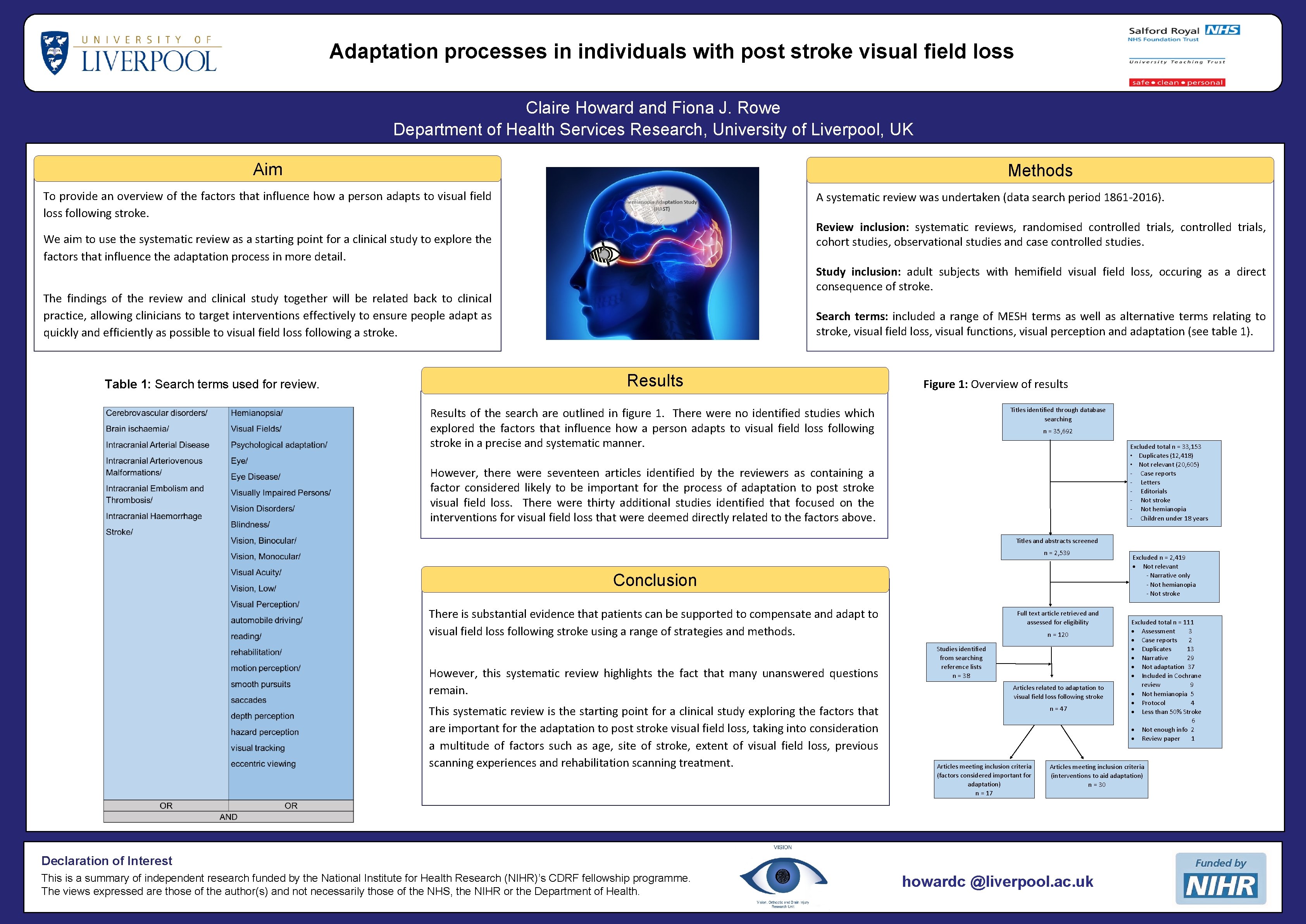
Adaptation processes in individuals with post stroke visual field loss Claire Howard and Fiona J. Rowe Department of Health Services Research, University of Liverpool, UK Aim Methods To provide an overview of the factors that influence how a person adapts to visual field loss following stroke. A systematic review was undertaken (data search period 1861 -2016). Review inclusion: systematic reviews, randomised controlled trials, cohort studies, observational studies and case controlled studies. We aim to use the systematic review as a starting point for a clinical study to explore the factors that influence the adaptation process in more detail. Study inclusion: adult subjects with hemifield visual field loss, occuring as a direct consequence of stroke. The findings of the review and clinical study together will be related back to clinical practice, allowing clinicians to target interventions effectively to ensure people adapt as quickly and efficiently as possible to visual field loss following a stroke. Table 1: Search terms used for review. Search terms: included a range of MESH terms as well as alternative terms relating to stroke, visual field loss, visual functions, visual perception and adaptation (see table 1). Results Figure 1: Overview of results Results of the search are outlined in figure 1. There were no identified studies which explored the factors that influence how a person adapts to visual field loss following stroke in a precise and systematic manner. Titles identified through database searching n = 35, 692 Excluded total n = 33, 153 • Duplicates (12, 418) • Not relevant (20, 605) - Case reports - Letters - Editorials - Not stroke - Not hemianopia - Children under 18 years Articles relating to intervention However, there were seventeen articles identified by the reviewers as containing a n= 45 factor considered likely to be important for the process of adaptation to post stroke visual field loss. There were thirty additional studies identified that focused on the interventions for visual field loss that were deemed directly related to the factors above. Titles and abstracts screened n = 2, 539 Conclusion There is substantial evidence that patients can be supported to compensate and adapt to visual field loss following stroke using a range of strategies and methods. However, this systematic review highlights the fact that many unanswered questions remain. This systematic review is the starting point for a clinical study exploring the factors that are important for the adaptation to post stroke visual field loss, taking into consideration a multitude of factors such as age, site of stroke, extent of visual field loss, previous scanning experiences and rehabilitation scanning treatment. Full text article retrieved and assessed for eligibility n = 120 Studies identified from searching reference lists n = 38 Articles related to adaptation to visual field loss following stroke n = 47 Articles meeting inclusion criteria (factors considered important for adaptation) n = 17 Excluded total n = 111 Assessment 3 Case reports 2 Duplicates 13 Narrative 29 Not adaptation 37 Included in Cochrane review 9 Not hemianopia 5 Protocol 4 Less than 50% Stroke 6 Not enough info 2 Review paper 1 Articles meeting inclusion criteria (interventions to aid adaptation) n = 30 Declaration of Interest This is a summary of independent research funded by the National Institute for Health Research (NIHR)’s CDRF fellowship programme. The views expressed are those of the author(s) and not necessarily those of the NHS, the NIHR or the Department of Health. Excluded n = 2, 419 Not relevant - Narrative only - Not hemianopia - Not stroke howardc @liverpool. ac. uk