
ADAMTS13 Activity Assay for Research Use Only in
- Slides: 12
ADAMTS-13 Activity Assay for Research Use Only in US & Canada Tips for Training & Validation ML-00 -00292 Rev 02_ADAMTS-13 Activity. Assay. Technical. Tips
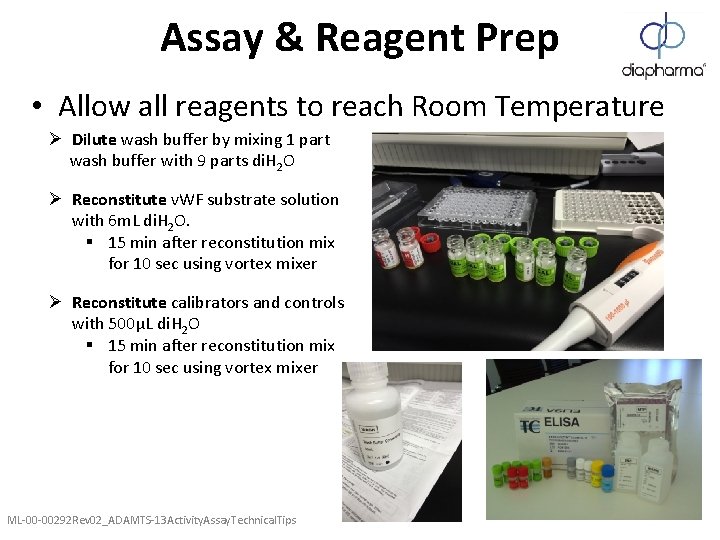
Assay & Reagent Prep • Allow all reagents to reach Room Temperature Ø Dilute wash buffer by mixing 1 part wash buffer with 9 parts di. H 2 O Ø Reconstitute v. WF substrate solution with 6 m. L di. H 2 O. § 15 min after reconstitution mix for 10 sec using vortex mixer Ø Reconstitute calibrators and controls with 500µL di. H 2 O § 15 min after reconstitution mix for 10 sec using vortex mixer ML-00 -00292 Rev 02_ADAMTS-13 Activity. Assay. Technical. Tips
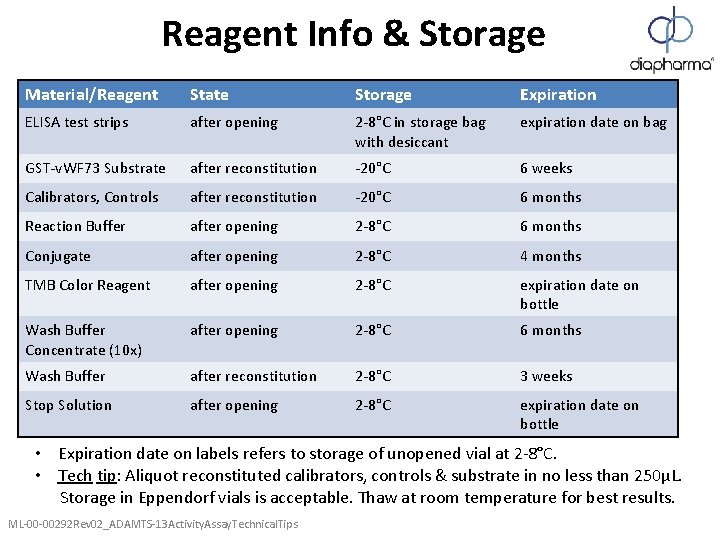
Reagent Info & Storage Material/Reagent State Storage Expiration ELISA test strips after opening 2 -8°C in storage bag with desiccant expiration date on bag GST-v. WF 73 Substrate after reconstitution -20°C 6 weeks Calibrators, Controls after reconstitution -20°C 6 months Reaction Buffer after opening 2 -8°C 6 months Conjugate after opening 2 -8°C 4 months TMB Color Reagent after opening 2 -8°C expiration date on bottle Wash Buffer Concentrate (10 x) after opening 2 -8°C 6 months Wash Buffer after reconstitution 2 -8°C 3 weeks Stop Solution after opening 2 -8°C expiration date on bottle • Expiration date on labels refers to storage of unopened vial at 2 -8°C. • Tech tip: Aliquot reconstituted calibrators, controls & substrate in no less than 250µL. Storage in Eppendorf vials is acceptable. Thaw at room temperature for best results. ML-00 -00292 Rev 02_ADAMTS-13 Activity. Assay. Technical. Tips
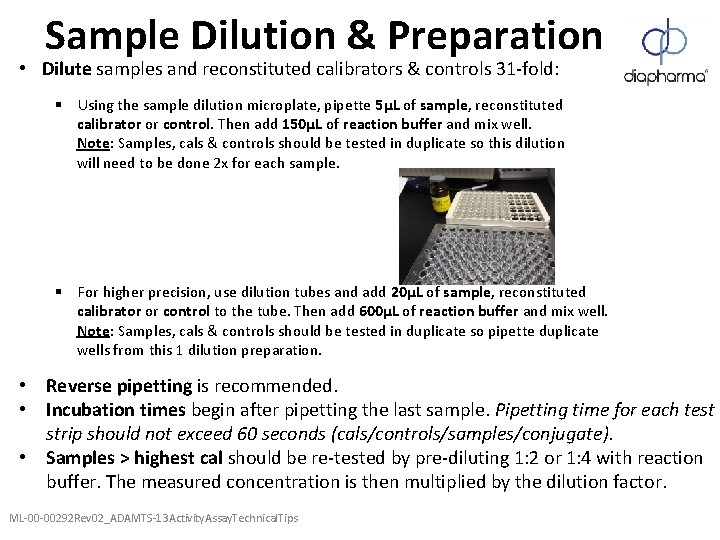
Sample Dilution & Preparation • Dilute samples and reconstituted calibrators & controls 31 -fold: § Using the sample dilution microplate, pipette 5µL of sample, reconstituted calibrator or control. Then add 150µL of reaction buffer and mix well. Note: Samples, cals & controls should be tested in duplicate so this dilution will need to be done 2 x for each sample. § For higher precision, use dilution tubes and add 20µL of sample, reconstituted calibrator or control to the tube. Then add 600µL of reaction buffer and mix well. Note: Samples, cals & controls should be tested in duplicate so pipette duplicate wells from this 1 dilution preparation. • Reverse pipetting is recommended. • Incubation times begin after pipetting the last sample. Pipetting time for each test strip should not exceed 60 seconds (cals/controls/samples/conjugate). • Samples > highest cal should be re-tested by pre-diluting 1: 2 or 1: 4 with reaction buffer. The measured concentration is then multiplied by the dilution factor. ML-00 -00292 Rev 02_ADAMTS-13 Activity. Assay. Technical. Tips
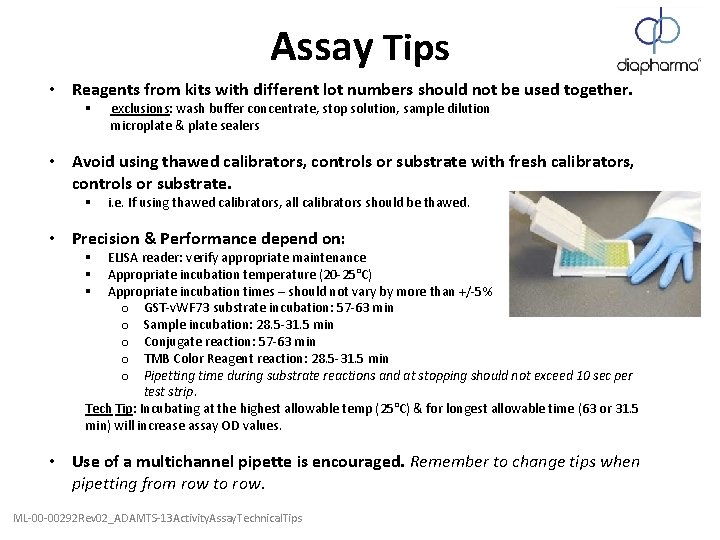
Assay Tips • Reagents from kits with different lot numbers should not be used together. § exclusions: wash buffer concentrate, stop solution, sample dilution microplate & plate sealers • Avoid using thawed calibrators, controls or substrate with fresh calibrators, controls or substrate. § i. e. If using thawed calibrators, all calibrators should be thawed. • Precision & Performance depend on: ELISA reader: verify appropriate maintenance Appropriate incubation temperature (20 -25°C) Appropriate incubation times – should not vary by more than +/-5% o GST-v. WF 73 substrate incubation: 57 -63 min o Sample incubation: 28. 5 -31. 5 min o Conjugate reaction: 57 -63 min o TMB Color Reagent reaction: 28. 5 -31. 5 min o Pipetting time during substrate reactions and at stopping should not exceed 10 sec per test strip. Tech Tip: Incubating at the highest allowable temp (25°C) & for longest allowable time (63 or 31. 5 min) will increase assay OD values. § § § • Use of a multichannel pipette is encouraged. Remember to change tips when pipetting from row to row. ML-00 -00292 Rev 02_ADAMTS-13 Activity. Assay. Technical. Tips
Limitations & Interferences • EDTA is a strong inhibitor of ADAMTS-13 function. Do not use samples with EDTA. • Hemolysis: No interference is observed with samples containing up to 200 mg/d. L hemoglobin, which corresponds with a moderate haemolysis /d. L. • Lipemia: No interference is observed with samples containing up to 300 mg/d. L Intralipid, which corresponds with a moderate to severe concentration. • Icterus: No interference was observed with samples containing up to 15 mg/d. L bilirubin (conjugated as well as unconjugated), which corresponds with a moderate to severe concentration. • Rheumatoid factor: No interference was observed up to 30 U/m. L RF, with corresponds with a 2 -fold concentration of normal. • Anti CD 20 antibodies: No interference was observed up to a level of 200µg/m. L, which corresponds to the upper level of serum concentrations found after Rituximab administration. ML-00 -00292 Rev 02_ADAMTS-13 Activity. Assay. Technical. Tips
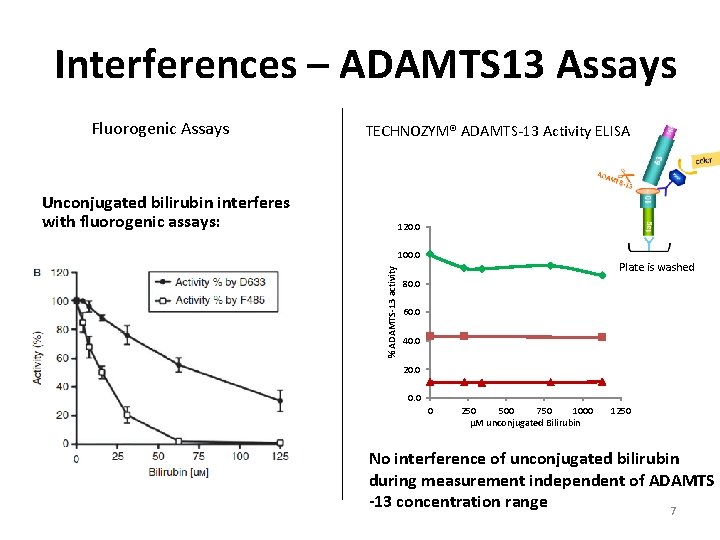
Interferences – ADAMTS 13 Assays Unconjugated bilirubin interferes with fluorogenic assays: TECHNOZYM® ADAMTS-13 Activity ELISA 120. 0 100. 0 % ADAMTS-13 activity Fluorogenic Assays Plate is washed 80. 0 60. 0 40. 0 20. 0 0 250 500 750 1000 µM unconjugated Bilirubin 1250 No interference of unconjugated bilirubin during measurement independent of ADAMTS -13 concentration range 7
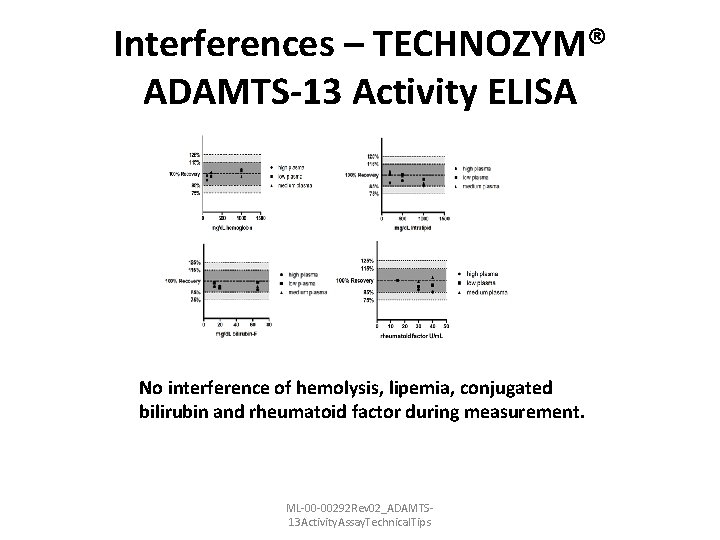
Interferences – TECHNOZYM® ADAMTS-13 Activity ELISA No interference of hemolysis, lipemia, conjugated bilirubin and rheumatoid factor during measurement. ML-00 -00292 Rev 02_ADAMTS 13 Activity. Assay. Technical. Tips
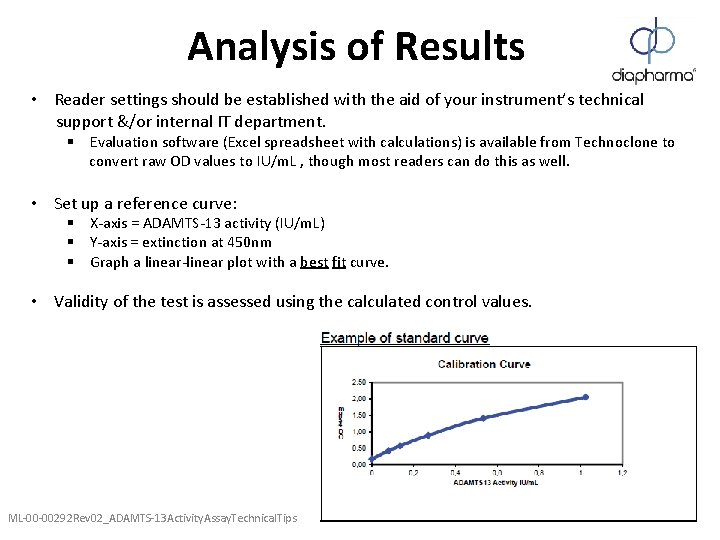
Analysis of Results • Reader settings should be established with the aid of your instrument’s technical support &/or internal IT department. § Evaluation software (Excel spreadsheet with calculations) is available from Technoclone to convert raw OD values to IU/m. L , though most readers can do this as well. • Set up a reference curve: § X-axis = ADAMTS-13 activity (IU/m. L) § Y-axis = extinction at 450 nm § Graph a linear-linear plot with a best fit curve. • Validity of the test is assessed using the calculated control values. ML-00 -00292 Rev 02_ADAMTS-13 Activity. Assay. Technical. Tips
Lot-to-Lot Qualification Suggestions Lot to lot qualification procedures should always be established in conjunction with each institution’s QA policies & procedures. 1) Perform 20 assay runs of each control to establish your laboratory control range. § Test using a previously qualified lot; and § Use control range on the Certificate of Analysis from the new lot of control to accept/ reject the “test” control. 2) Take the mean of these 20 values to establish the mean for your laboratory. § Use Westgard rules & a Levey-Jennings chart to accept/reject runs based on control values with the new lot. 3) Test previously assayed samples using the new lot. Verify sample interpretation is the same between lots. ML-00 -00292 Rev 02_ADAMTS-13 Activity. Assay. Technical. Tips
Method to Prepare Low-Activity Samples • Heat-treat normal human plasma at 56°C for 30 minutes (inactivated plasma) § This inactivates endogenous ADAMTS 13 protease activity. • Heat-treated plasma can then be diluted in different concentrations (1: 1, 1: 2, 1: 4, 1: 8, 1: 16) with normal plasma (pooled 5 -10 individuals). • Run the normal plasma straight to calculate expected values of diluted heat-inactivated samples & then run those as low-activity samples. ML-00 -00292 Rev 02_ADAMTS-13 Activity. Assay. Technical. Tips
Training Video • www. diapharma. com/a 13 ML-00 -00292 Rev 02_ADAMTS-13 Activity. Assay. Technical. Tips