
ADAAA Will the Final Regulations Change How Employers
- Slides: 28
ADAAA: Will the Final Regulations Change How Employers Handle Disability Issues in the Workplace? Presented By: C. Matthew Keen
EMPLOYERS & LAWYERS, WORKING TOGETHER Background n n n ADA passed in 1990 Called “a mandate for the elimination of discrimination against individuals with disabilities” 1992 -2008: The courts spent a great deal of time focusing on who is considered covered under the ADA as an “individual with a disability” FIRST CLASS SERVICE, COAST TO COAST
EMPLOYERS & LAWYERS, WORKING TOGETHER Background n n The United States Supreme Court, in two landmark cases, interpreted the coverage provisions of the ADA narrowly Congress concluded that the ADA needed to be amended to more clearly state Congress’ intention for broad coverage FIRST CLASS SERVICE, COAST TO COAST
ADA Amendments Act of 2008 EMPLOYERS & LAWYERS, WORKING TOGETHER n n n Passed by Congress on September 25, 2008 Expressed Congress’ clear intention that the ADA be interpreted broadly and that the EEOC’s current regulations were inconsistent with that intent Legislatively overturned the Supreme Court in two (2) cases where Congress felt the results conflicted with Congressional intent of broad protection FIRST CLASS SERVICE, COAST TO COAST
EMPLOYERS & LAWYERS, WORKING TOGETHER ADA Amendments Act of 2008 Bottom line – makes it easier for individuals with disabilities to obtain protection under the ADA n Directed the EEOC to promulgate new regulations to implement this intent n FIRST CLASS SERVICE, COAST TO COAST
EMPLOYERS & LAWYERS, WORKING TOGETHER EEOC Charge Activity Increased Dramatically While Awaiting the Final Regulations n n ADA charge filing with the EEOC increased to over 25, 000 ADA-related charges in fiscal year 2010 That is up nearly 3, 500 charges from fiscal year 2009 and up 7000 charges from 2008 FIRST CLASS SERVICE, COAST TO COAST
EMPLOYERS & LAWYERS, WORKING TOGETHER Final Regulations and Revised Interpretive Guidance Issued on March 25, 2011 n n n Provide for broad coverage under the ADA Focus on the issue of whether discrimination occurred rather than coverage issues Make “reasonable accommodation” a regular part of doing business FIRST CLASS SERVICE, COAST TO COAST
EMPLOYERS & LAWYERS, WORKING TOGETHER Broad Coverage for Definition of “Disability” n n n Determination of disability status should not require extensive analysis Make it easier for an individual seeking protection under the ADA to fall within the definition for coverage purposes Focus on whether discrimination occurred FIRST CLASS SERVICE, COAST TO COAST
EMPLOYERS & LAWYERS, WORKING TOGETHER The Definition of “Disability” Has Not Changed, Just the Interpretation and Application n Still three prongs to the definition l l l n Actual disability prong Record of disability prong Regarded as having a disability prong The interpretation and application of the definition is changing in “fundamental ways” FIRST CLASS SERVICE, COAST TO COAST
EMPLOYERS & LAWYERS, WORKING TOGETHER The Definition of “Disability” Has Not Changed, Just the Interpretation and Application n n First and second prong of the definition, requiring a showing of substantial limitation of a major life activity, applies only to situations where individual is seeking or has been denied reasonable accommodation “Regarded as” prong for all other claims of discrimination FIRST CLASS SERVICE, COAST TO COAST
Physical or Mental Impairment EMPLOYERS & LAWYERS, WORKING TOGETHER n n Any physiological disorder or condition, cosmetic disfigurement, or anatomical loss affecting one or more body systems, such as neurological, musculoskeletal, special sense organs, respiratory (including speech organs), cardiovascular, reproductive, digestive, genitourinary, immune, circulatory, hemic, lymphatic, skin, and endocrine; or Any mental psychological disorder, such as an intellectual disability (formerly termed “mental retardation”), organic brain syndrome, emotional or mental illness, and specific learning disabilities FIRST CLASS SERVICE, COAST TO COAST
“Major Life Activities” EMPLOYERS & LAWYERS, WORKING TOGETHER n n n Caring for oneself Performing manual tasks Seeing Hearing Eating Sleeping Walking Standing Sitting Reaching Lifting FIRST CLASS SERVICE, COAST TO COAST n n n n n Bending Speaking Breathing Learning Reading Concentrating Thinking Communicating Interacting with others Working
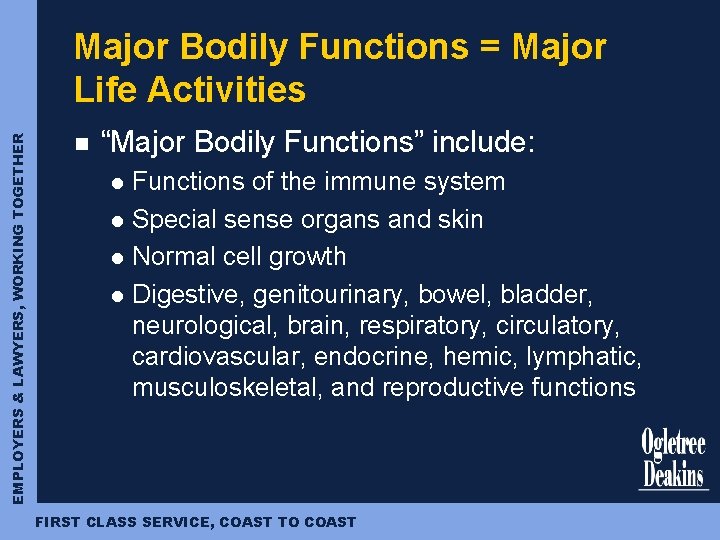
EMPLOYERS & LAWYERS, WORKING TOGETHER Major Bodily Functions = Major Life Activities n “Major Bodily Functions” include: l l Functions of the immune system Special sense organs and skin Normal cell growth Digestive, genitourinary, bowel, bladder, neurological, brain, respiratory, circulatory, cardiovascular, endocrine, hemic, lymphatic, musculoskeletal, and reproductive functions FIRST CLASS SERVICE, COAST TO COAST
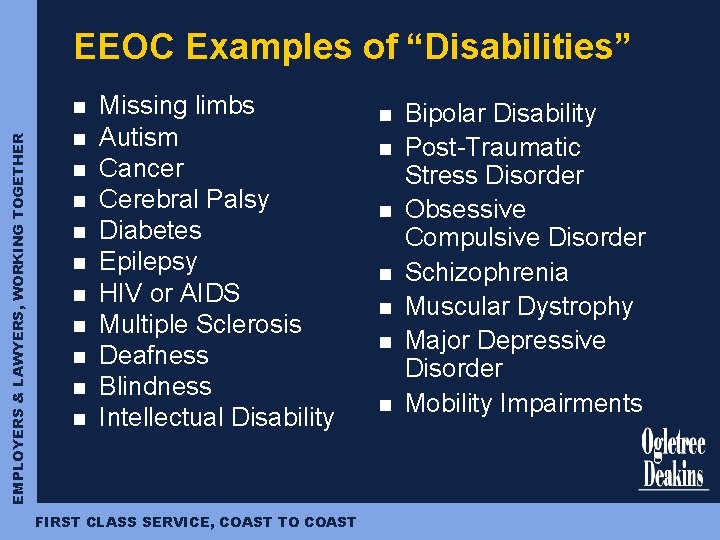
EEOC Examples of “Disabilities” EMPLOYERS & LAWYERS, WORKING TOGETHER n n n Missing limbs Autism Cancer Cerebral Palsy Diabetes Epilepsy HIV or AIDS Multiple Sclerosis Deafness Blindness Intellectual Disability FIRST CLASS SERVICE, COAST TO COAST n n n n Bipolar Disability Post-Traumatic Stress Disorder Obsessive Compulsive Disorder Schizophrenia Muscular Dystrophy Major Depressive Disorder Mobility Impairments
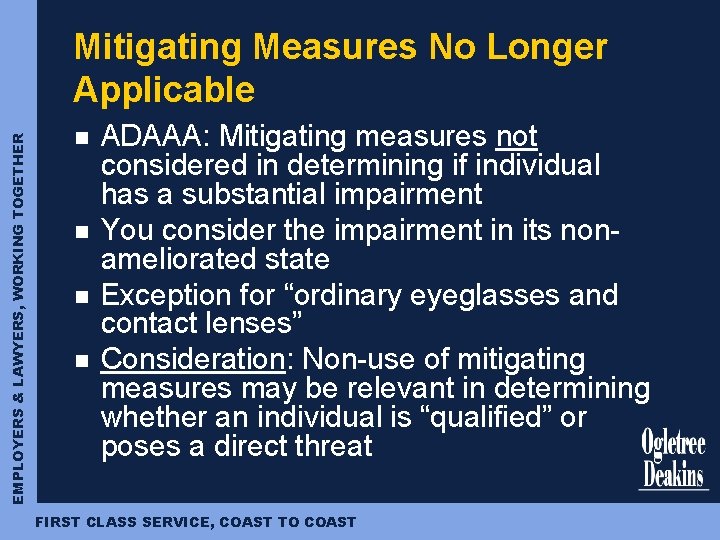
EMPLOYERS & LAWYERS, WORKING TOGETHER Mitigating Measures No Longer Applicable n n ADAAA: Mitigating measures not considered in determining if individual has a substantial impairment You consider the impairment in its nonameliorated state Exception for “ordinary eyeglasses and contact lenses” Consideration: Non-use of mitigating measures may be relevant in determining whether an individual is “qualified” or poses a direct threat FIRST CLASS SERVICE, COAST TO COAST
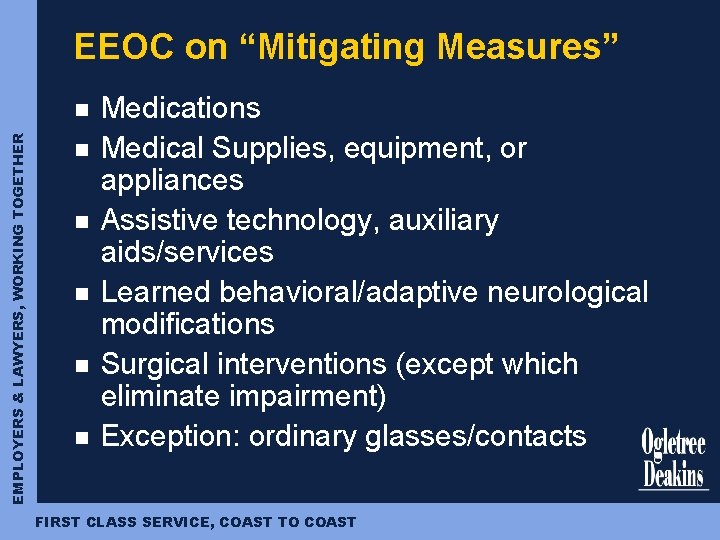
EEOC on “Mitigating Measures” EMPLOYERS & LAWYERS, WORKING TOGETHER n n n Medications Medical Supplies, equipment, or appliances Assistive technology, auxiliary aids/services Learned behavioral/adaptive neurological modifications Surgical interventions (except which eliminate impairment) Exception: ordinary glasses/contacts FIRST CLASS SERVICE, COAST TO COAST
EMPLOYERS & LAWYERS, WORKING TOGETHER Reverse the Restrictive Definition of “Substantially Limits” Applied by the Courts n n The objective of ADA cases should be to ferret out discriminatory conduct and facilitate reasonable accommodation, not to ratchet-up the definition of “substantially limits” so as to create an impediment to coverage No definition of “substantiality limits” FIRST CLASS SERVICE, COAST TO COAST
Changes to “Regarded As” EMPLOYERS & LAWYERS, WORKING TOGETHER n Previous Standard: Employer must regard the employee as “disabled” before an employee may invoke the “regarded as” protection of ADA l n i. e. the employer must view the employee as “substantially limited” in a “major life activity” ADAAA: Individual may invoke “regarded as” protection if he/she has actual or perceived impairment l It does not matter whether the impairment is perceived to “substantially limit” a “major life activity” of the employee FIRST CLASS SERVICE, COAST TO COAST
EMPLOYERS & LAWYERS, WORKING TOGETHER “Regarded As” Prong of Disability Definition n n “Transitory” or minor impairments (i. e. those with an actual or expected duration of six months or less) are not covered under the “regarded as“ prong Employer has no duty to provide a “reasonable accommodation” to individuals under the “regarded as” prong FIRST CLASS SERVICE, COAST TO COAST
EMPLOYERS & LAWYERS, WORKING TOGETHER “Regarded As” Prong of Disability Excludes Impairments that are Both Transitory and Minor n n “Transitory” means lasting or expected to last for six months or less No definition of “minor”, although the Revised Interpretive Guidance makes reference to common ailments such as a cold or the flu FIRST CLASS SERVICE, COAST TO COAST
EMPLOYERS & LAWYERS, WORKING TOGETHER What Has Not Changed? n n n Employers can still require that employees have the ability to perform the essential functions of a job, with or without reasonable accommodation Direct threat defense – substantial likelihood of significant harm Reasonable accommodation standard FIRST CLASS SERVICE, COAST TO COAST
EMPLOYERS & LAWYERS, WORKING TOGETHER Duty to Reasonably Accommodate n A reasonable accommodation is something done or something avoided which allows a qualified individual with a disability to perform the essential functions of a job FIRST CLASS SERVICE, COAST TO COAST
EMPLOYERS & LAWYERS, WORKING TOGETHER When Duty to Accommodate Arises n When an employee informs employer that accommodation is needed or when employer has knowledge of the disability l l Request can be made in any form No “magic words” required No need to request specific accommodations Not required to disclose particular disability or medical condition FIRST CLASS SERVICE, COAST TO COAST
EMPLOYERS & LAWYERS, WORKING TOGETHER Employer’s Duty to Accommodate n Engage in good faith interactive discussion l l l Review current job description and physical job analysis Identify essential and non-essential functions Receive input from the employee Review medical documentation Identify potential accommodations Document everything FIRST CLASS SERVICE, COAST TO COAST
EMPLOYERS & LAWYERS, WORKING TOGETHER Potential Accommodations n n n Making facilities accessible and useable Job restructuring Allowing part-time or modified work schedules Reassignment to vacant positions Acquisition or modification of equipment or devices Unpaid leave FIRST CLASS SERVICE, COAST TO COAST
EMPLOYERS & LAWYERS, WORKING TOGETHER Potential Accommodations n n Providing qualified readers or interpreters Protected leaves of absence Other similar accommodations Accommodations may become permanent FIRST CLASS SERVICE, COAST TO COAST
EMPLOYERS & LAWYERS, WORKING TOGETHER Exceptions to Accommodation n n When accommodation would cause “undue hardship” When accommodation constitutes a “direct threat” to the health and safety of co-workers or to the employee FIRST CLASS SERVICE, COAST TO COAST
EMPLOYERS & LAWYERS, WORKING TOGETHER Result of ADA Amendments n n n More employees considered “disabled” Emphasis on reasonable accommodation and “interactive process” Essential job functions critical Harder to prevail on summary judgment More jury trials FIRST CLASS SERVICE, COAST TO COAST