
ADA Compliance During Construction Module 10 Why is

- Slides: 57
ADA Compliance During Construction Module - 10
Why is Accessibility Important? • Nationwide issue • Often overlooked or underestimated during Design & Construction • Potential Liability • Civil Penalties
Abbreviations • Temporary Traffic Control (TTC) • Americans with Disabilities Act of 1990 (ADA) • Americans with Disabilities Act Accessibility Guidelines (ADAAG) • 28 CFR part 35. 151 + 2004 ADAAG = 2010 Standards for Accessible Design • Manual on Uniform Traffic Control Devices (MUTCD) • as amended for use in California
Discussion • Authorities • State Level • Caltrans • California MUTCD, Part 6 • Local Governments • Federal Level • Department of Justice • FHWA
Temporary Facilities …including reasonably safe pedestrian routes around work sites, are also covered by the accessibility requirements of the Americans with Disabilities Act of 1990 (ADA) rev on September 15, 2010. -- for newly designed and constructed or altered State and local government facilities, public accommodations, and commercial facilities to be readily accessible to and usable by individuals with disabilities.
Path of Travel An alteration that affects or could affect the usability of or access to an area of a facility that contains a primary function shall be made so as to ensure that, to the maximum extent feasible, the path of travel to the altered area and the restrooms, telephones, and drinking fountains serving the altered area are readily accessible to and usable by individuals with disabilities, including individuals who use wheelchairs, unless the cost and scope of such alterations is disproportionate to the cost of the overall alteration.
Path of Travel A "path of travel" includes a continuous, unobstructed way of pedestrian passage by means of which the altered area may be approached, entered, and exited, and which connects the altered area with an exterior approach (including sidewalks, streets, and parking areas), an entrance to the facility, and other parts of the facility.
Alterations …made to provide an accessible path of travel to the altered area will be deemed disproportionate to the overall alteration when the cost exceeds 20% of the cost of the alteration to the primary function area.
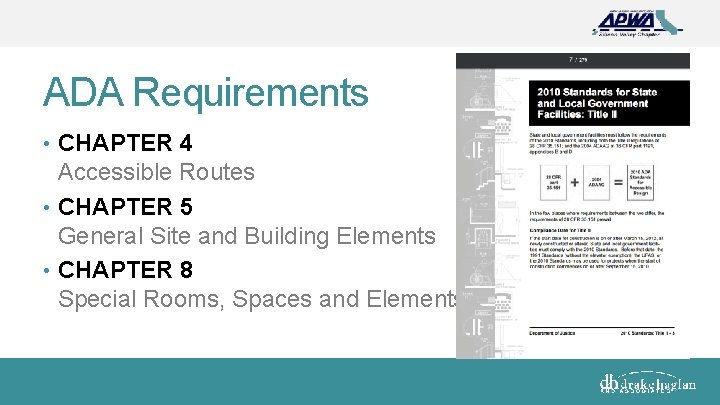
ADA Requirements • CHAPTER 4 Accessible Routes • CHAPTER 5 General Site and Building Elements • CHAPTER 8 Special Rooms, Spaces and Elements
ADA Requirements Road, sidewalk, and building designers should coordinate their efforts to ensure that accessible sidewalks are developed in new construction and alterations. Good review processes, including a variety of interest groups, can ensure that construction plans for accessible sidewalks are implemented. Transportation agencies differ greatly in the degree to which they address pedestrian facilities. . . (CH 4 Accessible Routes)
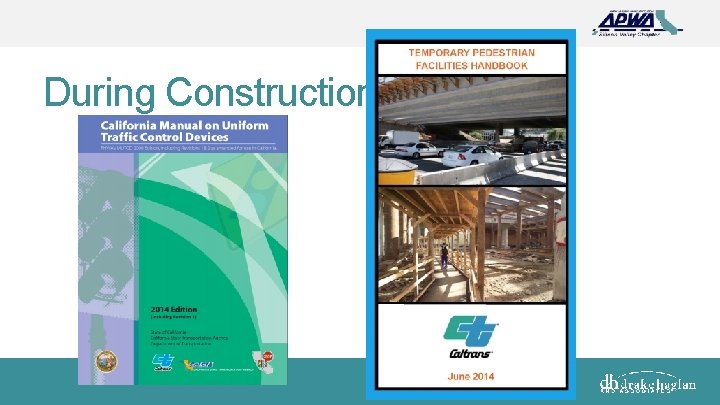
During Construction
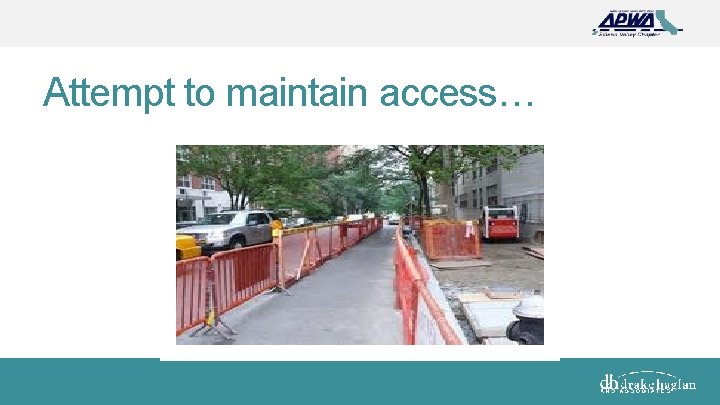
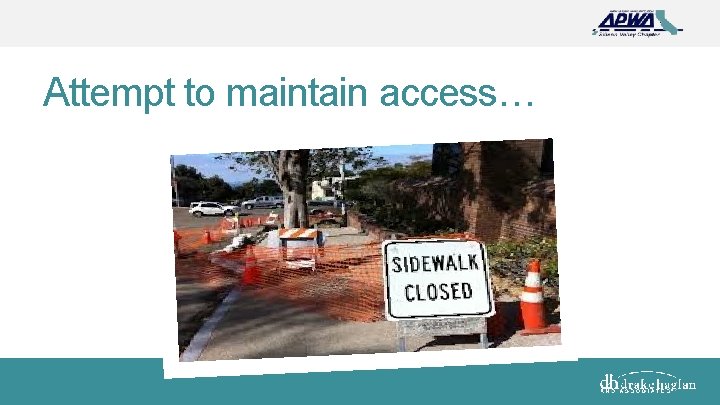
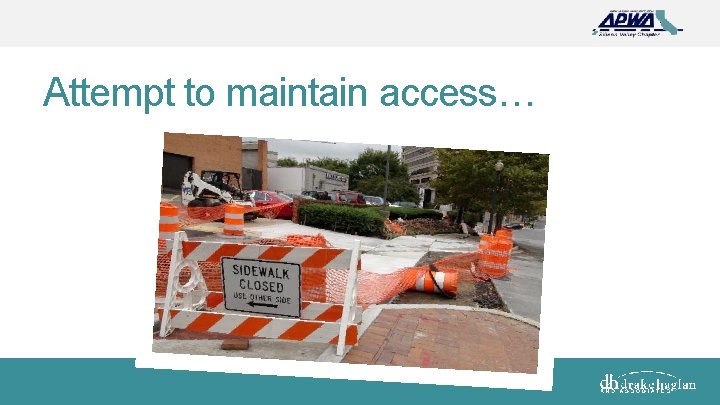
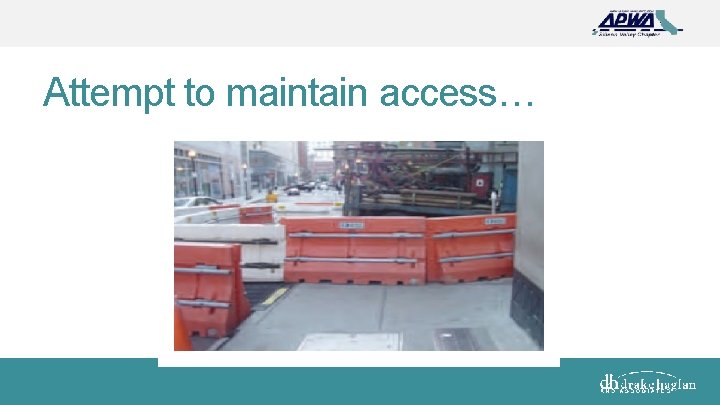
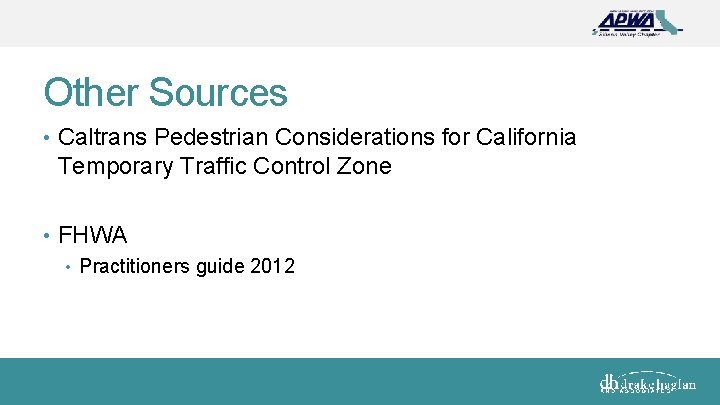
Sidewalk Work When an existing continuous sidewalk or street crossing route cannot be maintained for pedestrians because of construction, either temporary walkways with curb ramps are to be provided, or the construction shall be phased to maintain access to the affected addresses. Contractors shall be allowed flexibility as long as the requirements are met.
Pedestrian Accommodation A continuous route for all pedestrians, including the disabled and bicyclists, shall be maintained at all times. When existing pedestrian facilities are disrupted, closed, or relocated in a TTC zone, the temporary facilities shall be detectable and include accessibility features consistent with the features present in the existing pedestrian facility.
Temporary Traffic Control Considerations • The TTC pedestrian accommodation that utilizes a temporary route does the following: • • Defines detoured routes clearly. Provides advance signage at intersections rather than mid-block locations. Separates pedestrians from vehicle traffic. Avoids mid-block crossings. Ensures that temporary routes are not much longer than the original route. Provides clear and positive guidance to delineate a temporary route. Provides continuous access to transit stops and/or relocates transit stops.
Temporary Traffic Control Considerations • Provide pedestrian information throughout the TTC zone. • Maintain a continuous accessible path of travel either around or through the construction site throughout all construction phases. • Ensure compliance with Americans with Disabilities Act (ADA) requirements. • Maintain pedestrian access to businesses, residences, transit stops, etc. • Provide temporary nighttime lighting for pedestrian walkways throughout the TTC zone.
Where must curb ramps be provided? • Generally, curb ramps are needed wherever a sidewalk or other pedestrian walkway crosses a curb. • The ADA does not require installation of ramps or curb ramps in the absence of a pedestrian walkway with a prepared surface for pedestrian use. • Nor are curb ramps required in the absence of a curb, elevation, or other barrier between the street and the walkway.
Pedestrian Considerations While in the Field • Promote adequate pedestrian safety via physical separation from work space and vehicular traffic, overhead protection, etc. • Provide adequate and safe detour(s) whenever sidewalks are closed or blocked. • Clear the path of debris and other items that may obstruct pedestrians’ paths.
Pedestrian Considerations While in the Field • Consider carefully the placement of intersection crosswalks, implement additional signing/marking, add and/or relocate transit stops, and modify traffic signals (traffic signal timing, pedestrian signals, push buttons) as necessary.
Pedestrian Considerations While in the Field • Inspect pedestrian accommodations during construction to ensure that the TTC plan is followed. • Ensure traffic control devices are in good and safe condition. • Make pedestrian routes ADA compliant and available to pedestrians during all phases of construction.
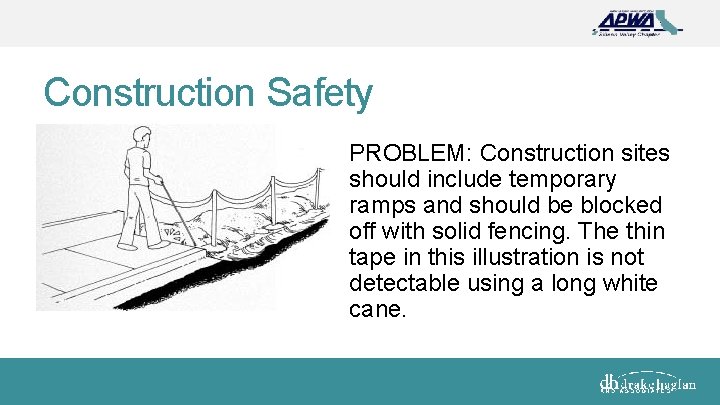
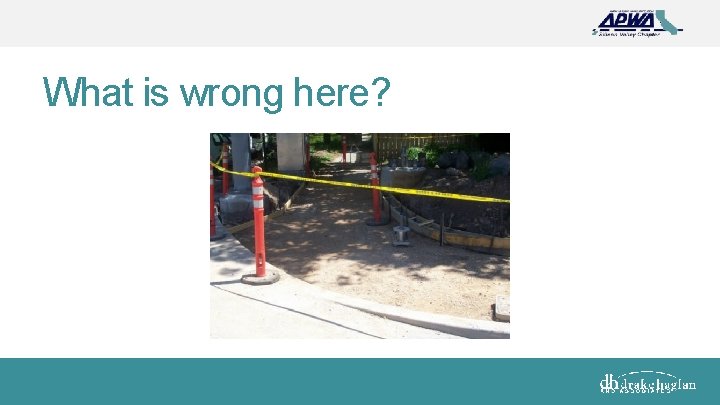
Construction Safety PROBLEM: Construction sites should include temporary ramps and should be blocked off with solid fencing. The thin tape in this illustration is not detectable using a long white cane.
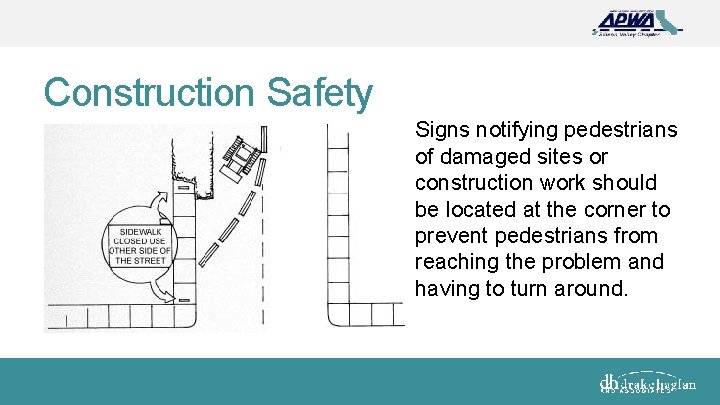
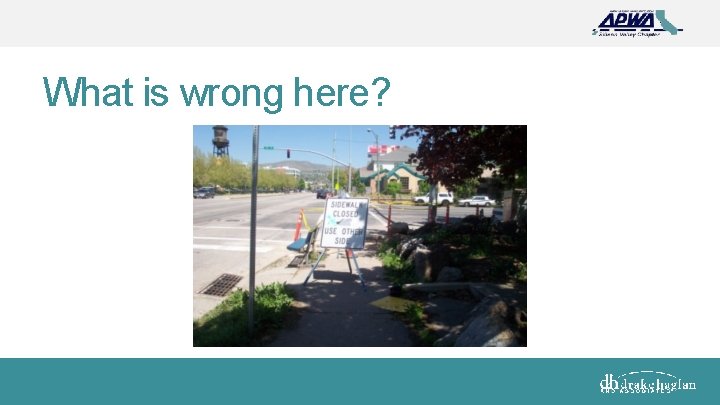
Construction Safety Signs notifying pedestrians of damaged sites or construction work should be located at the corner to prevent pedestrians from reaching the problem and having to turn around.
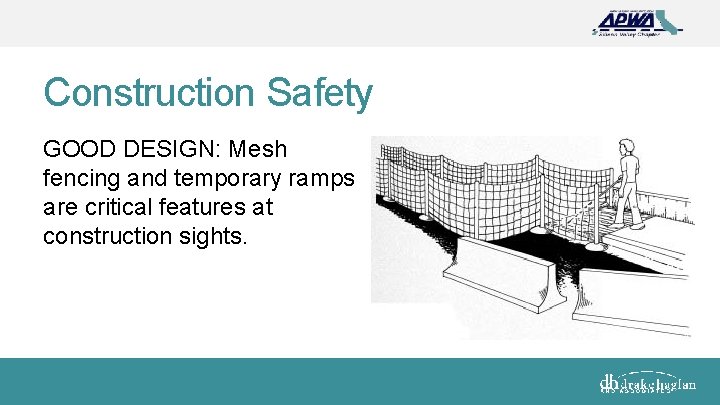
Construction Safety GOOD DESIGN: Mesh fencing and temporary ramps are critical features at construction sights.
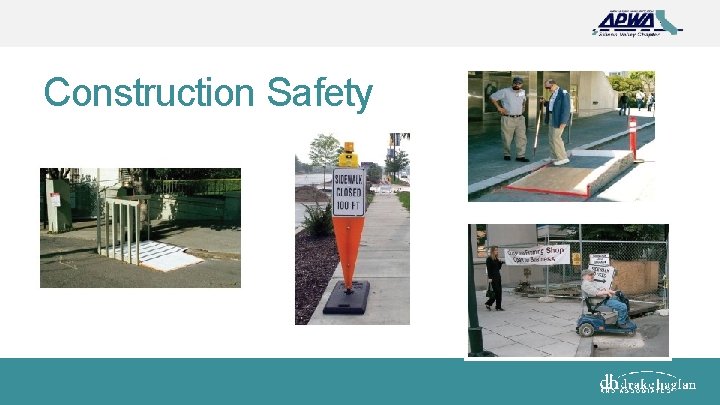
Construction Safety
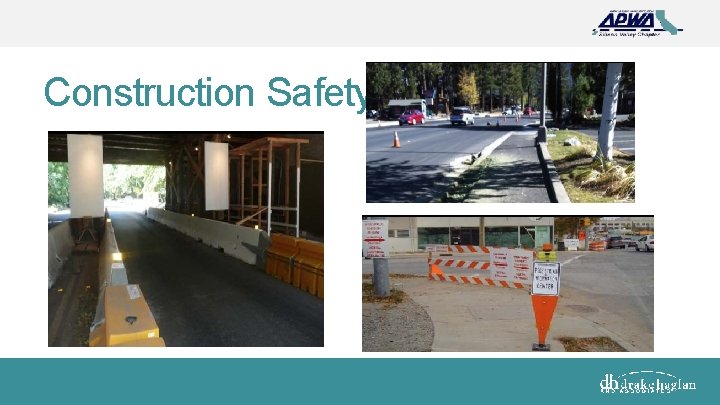
Construction Safety
What is wrong here?
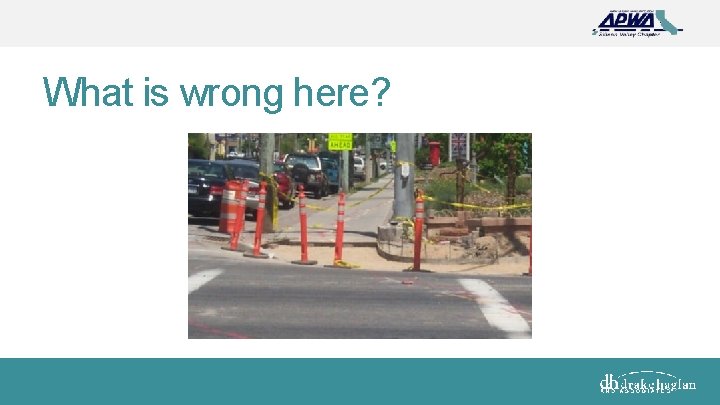
What is wrong here?
What is wrong here?
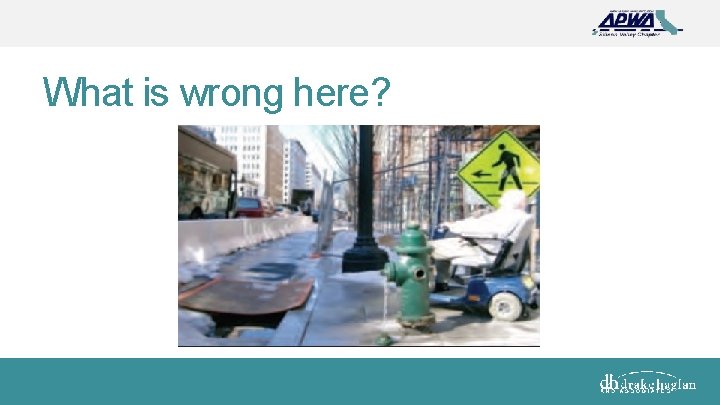
What is wrong here?
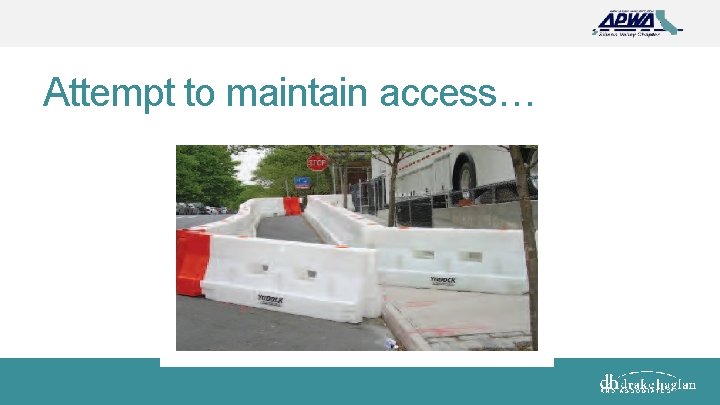
Attempt to maintain access…
Attempt to maintain access…
Attempt to maintain access…
Attempt to maintain access…
Attempt to maintain access…
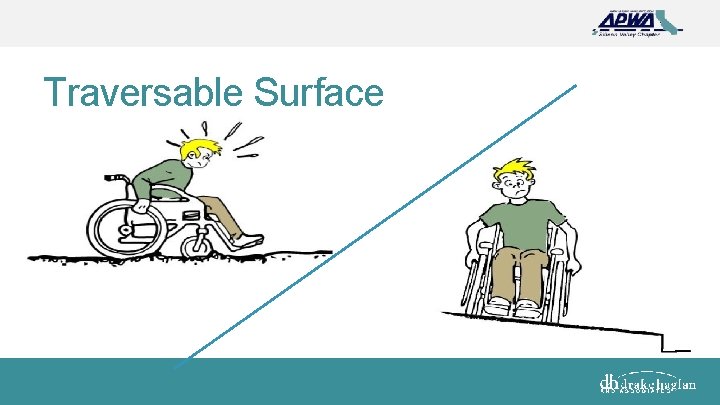
Traversable Surface
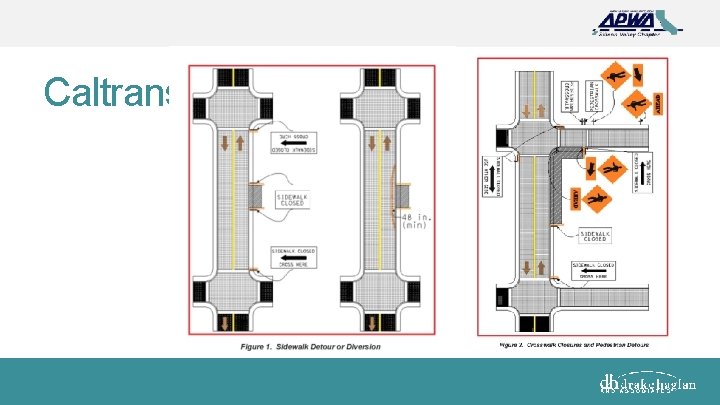
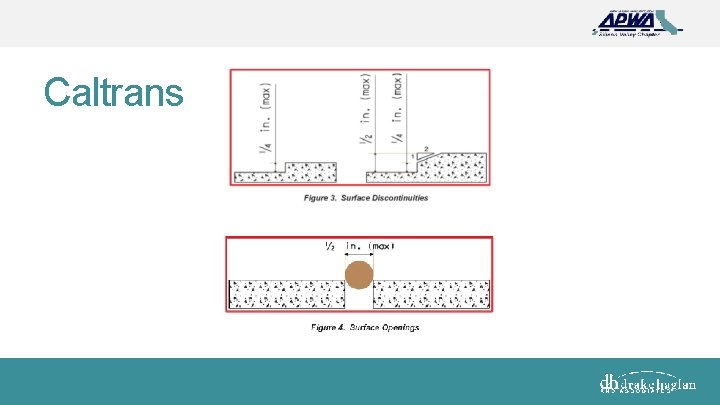
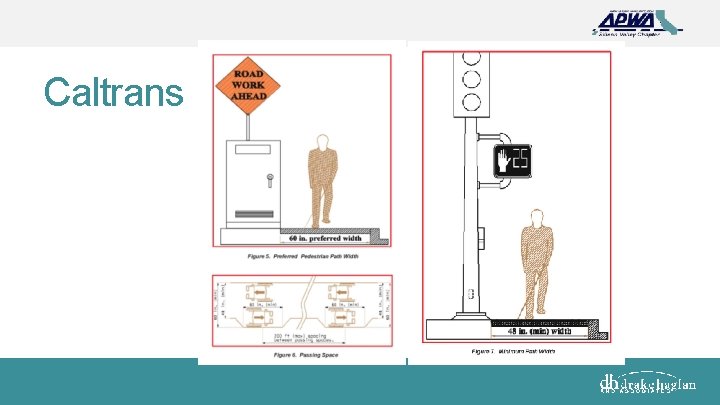
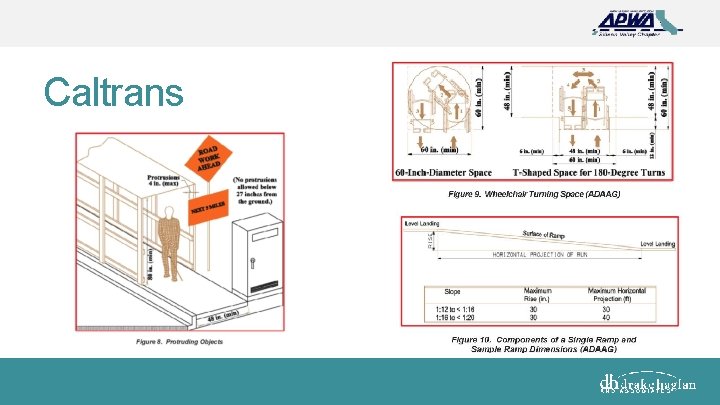
Clear Passage Temporary Sidewalks—The width of the temporary sidewalk and ramp should be a minimum continuous clear width of 4 feet Wider sidewalks (6 feet in effective width) should be considered where there are high pedestrian volumes and in the CBD. For temporary sidewalks with clear widths less than 5 feet, a passable area (5 feet x 5 feet) shall be provided every 200 feet, unless otherwise directed… The surface of temporary sidewalks must be firm, stable and slip resistant. Temporary facilities, including pedestrian routes around worksites, are also covered by the accessibility requirements of the Americans with Disabilities Act (ADA)
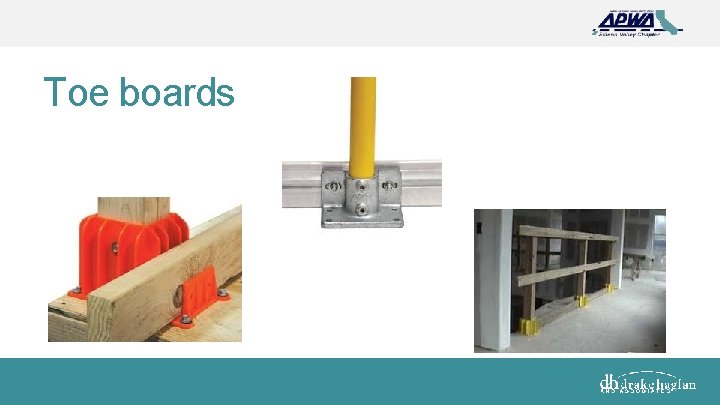
Toe boards
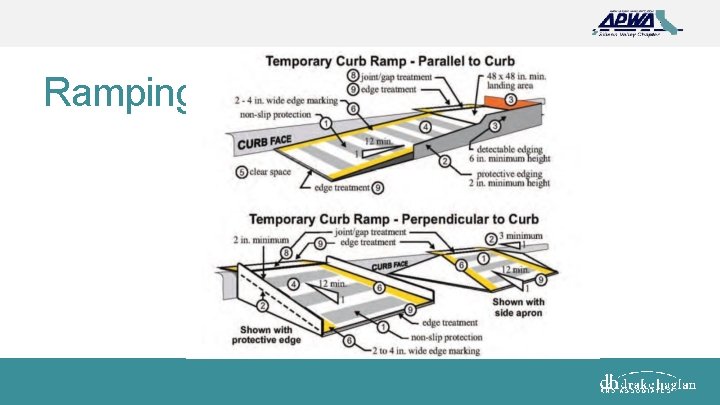
Ramping
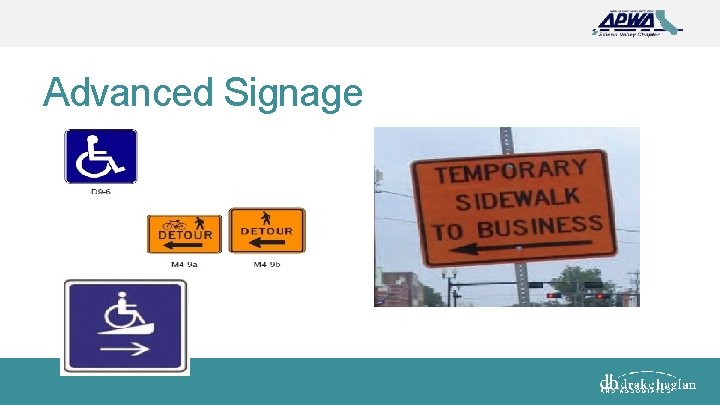
Advanced Signage
Temporary Pedestrian Facilities …. should provide safe, accessible routes that replicate as nearly as practical the most desirable characteristics of the existing facility, and parallel the disrupted route whenever possible. A smooth, continuous hard surface should be provided throughout the entire length of the temporary pedestrian facility. See MUTCD 6 D. 01 and 6 D. 02
Other Accommodations • Advance information placed at appropriate distances before the work zone allowing pedestrians to make timely decisions about routes through or around the work zone. See MUTCD 6 F. 13 • Transition information allowing pedestrians to find a safe path through and around work zones, which is critical when the pathway is restricted, diverted or detoured. See MUTCD 6 F. 13
Other Sources • Caltrans Pedestrian Considerations for California Temporary Traffic Control Zone • FHWA • Practitioners guide 2012
Caltrans
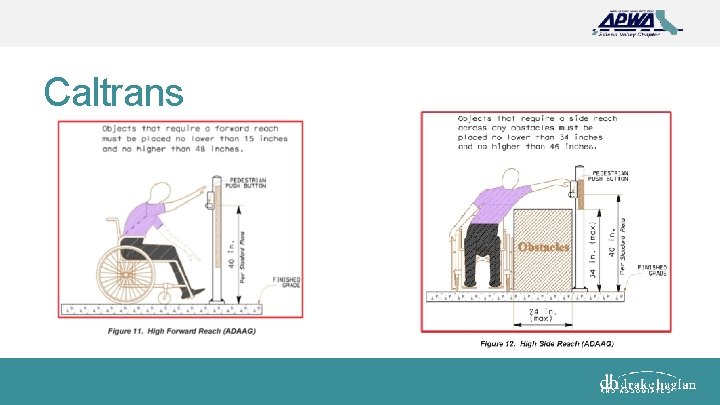
Caltrans
Caltrans
Caltrans
Caltrans
FHWA
Other Accommodations • Exit information directing pedestrians back to the original route. See MUTCD 6 F. 13 • Crosswalk placement at intersections may need additional signage, temporary striping, traffic signal modification, pedestrian signals with audible alarms if justified, proper push button height, and ramps. See MUTCD 6 H. 29, 6 F. 80, and 4 E. 06
Enforcement (Typical City Spec) 7 -1. 03 A Maintaining Traffic: Attention is directed to Sections 7 -1. 04 of the Standard Specifications and to the following modifications thereof. If construction is within City owned right-of-way, provisions shall be made for the safe passage of public traffic through the work site at all times consistent with the requirements of Santa Rosa City Code Chapter 13 -04.
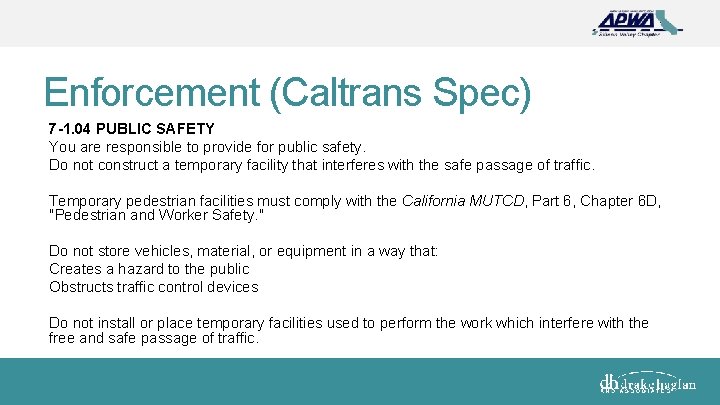
Enforcement (Caltrans Spec) 7 -1. 04 PUBLIC SAFETY You are responsible to provide for public safety. Do not construct a temporary facility that interferes with the safe passage of traffic. Temporary pedestrian facilities must comply with the California MUTCD, Part 6, Chapter 6 D, "Pedestrian and Worker Safety. " Do not store vehicles, material, or equipment in a way that: Creates a hazard to the public Obstructs traffic control devices Do not install or place temporary facilities used to perform the work which interfere with the free and safe passage of traffic.
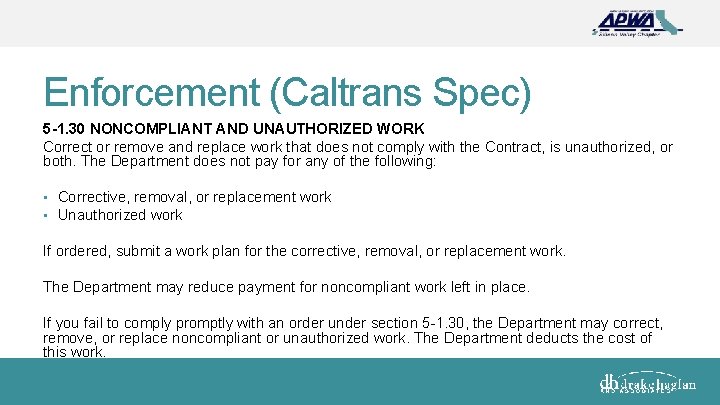
Enforcement (Caltrans Spec) 5 -1. 30 NONCOMPLIANT AND UNAUTHORIZED WORK Correct or remove and replace work that does not comply with the Contract, is unauthorized, or both. The Department does not pay for any of the following: • Corrective, removal, or replacement work • Unauthorized work If ordered, submit a work plan for the corrective, removal, or replacement work. The Department may reduce payment for noncompliant work left in place. If you fail to comply promptly with an order under section 5 -1. 30, the Department may correct, remove, or replace noncompliant or unauthorized work. The Department deducts the cost of this work.
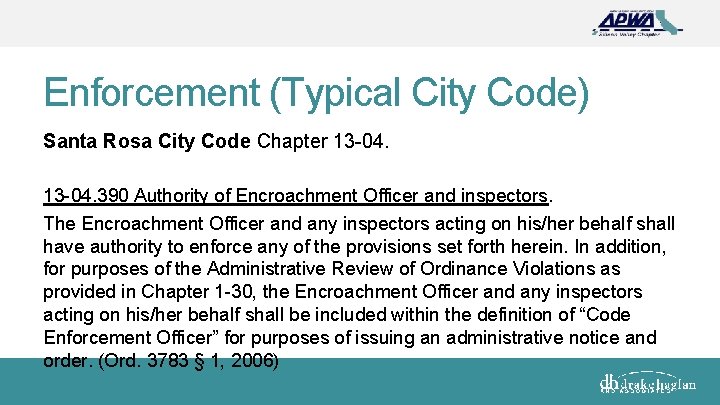
Enforcement (Typical City Code) Santa Rosa City Code Chapter 13 -04. 390 Authority of Encroachment Officer and inspectors. The Encroachment Officer and any inspectors acting on his/her behalf shall have authority to enforce any of the provisions set forth herein. In addition, for purposes of the Administrative Review of Ordinance Violations as provided in Chapter 1 -30, the Encroachment Officer and any inspectors acting on his/her behalf shall be included within the definition of “Code Enforcement Officer” for purposes of issuing an administrative notice and order. (Ord. 3783 § 1, 2006)
Summary • Requirements of the ADAAG and MUTCD are adhered to. • Make sure accommodations are made for transit • Access is maintained to the affected businesses and residences. • Frequent checks of the pedestrian and bicycle accommodations are made during construction to ensure that the temporary traffic control plan • Check for clear and advance signage to guide disabled users
Best Practices Design Guide http: //www. fhwa. dot. gov/environment/bicycle_pedestrian/publications/sidewalk 2/sidewalks 210. cfm http: //www. fhwa. dot. gov/indiv/docs/atssa_pedestrian_checklist. pdf http: //www. dot. ca. gov/hq/construc/safety/Temporary_Pedestrian_Facilities_Handbook. pdf http: //www. ada. gov/ta-pubs-pg 2. htm http: //www. ada. gov/regs 2010/title. II_2010/title_ii_primer. html