
Ad S CFT aka Anti de Sitter space


- Slides: 44
Ad. S / CFT aka Anti de Sitter (space) / Conformal Field Theory W. A. Zajc Columbia University 12 -Mar-07 Journal Club
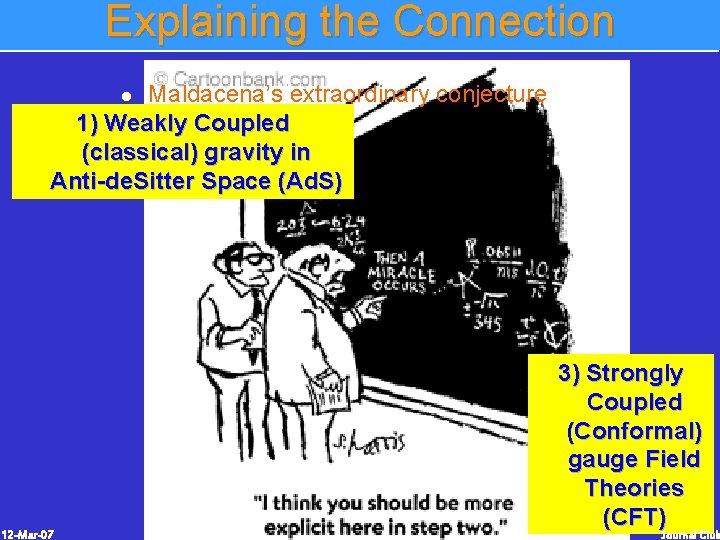
Explaining the Connection Maldacena’s extraordinary conjecture 1) Weakly Coupled (classical) gravity in Anti-de. Sitter Space (Ad. S) l 12 -Mar-07 3) Strongly Coupled (Conformal) gauge Field Theories (CFT) Journal Club
All You Need To Know About Strings 12 -Mar-07 Journal Club
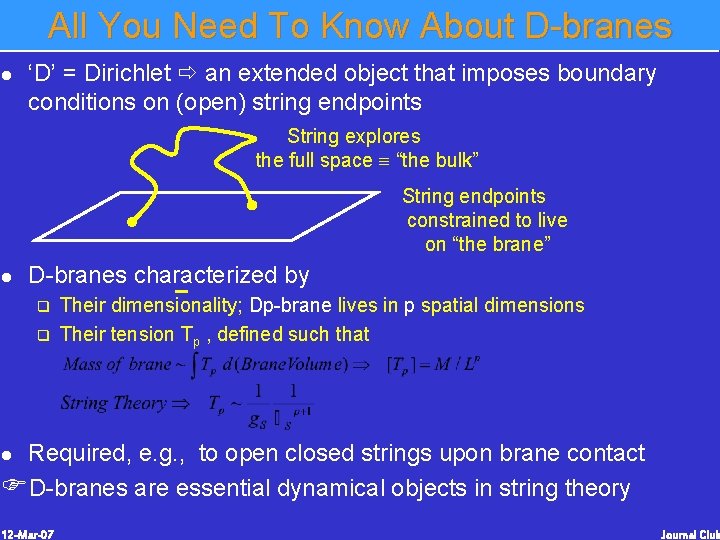
All You Need To Know About D-branes l ‘D’ = Dirichlet an extended object that imposes boundary conditions on (open) string endpoints String explores the full space “the bulk” l String endpoints constrained to live on “the brane” D-branes characterized by q q Their dimensionality; Dp-brane lives in p spatial dimensions Their tension Tp , defined such that Required, e. g. , to open closed strings upon brane contact FD-branes are essential dynamical objects in string theory l 12 -Mar-07 Journal Club
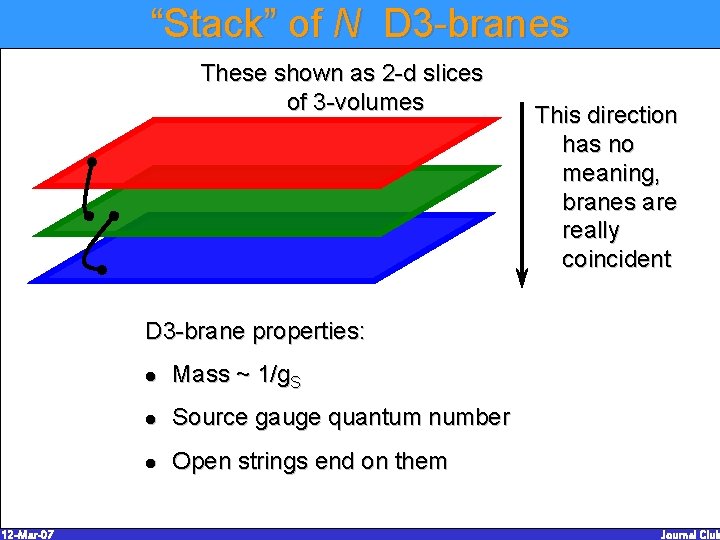
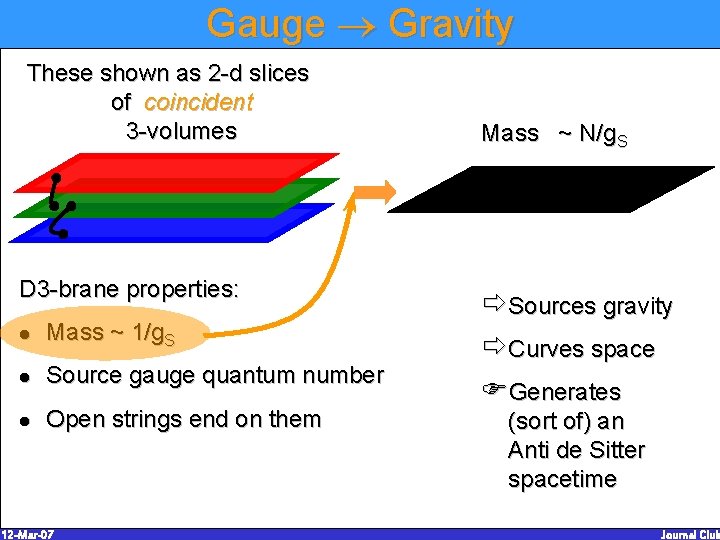
“Stack” of N D 3 -branes These shown as 2 -d slices of 3 -volumes This direction has no meaning, branes are really coincident D 3 -brane properties: 12 -Mar-07 l Mass ~ 1/g. S l Source gauge quantum number l Open strings end on them Journal Club
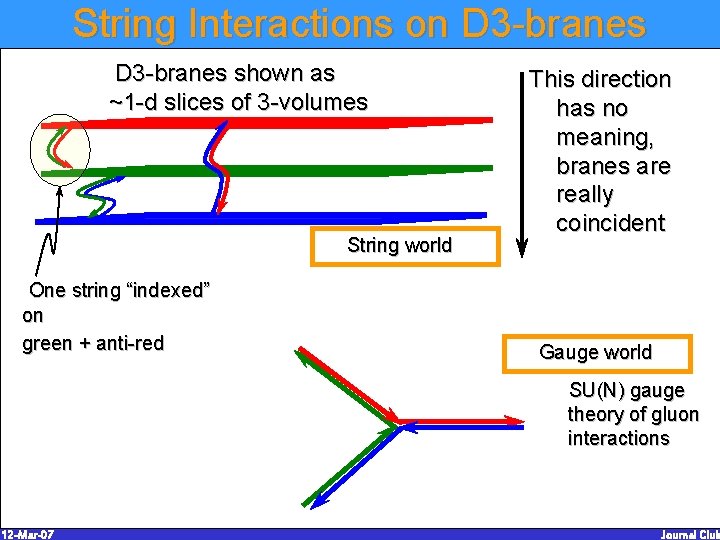
String Interactions on D 3 -branes shown as ~1 -d slices of 3 -volumes One string “indexed” on green + anti-red String world This direction has no meaning, branes are really coincident Gauge world SU(N) gauge theory of gluon interactions 12 -Mar-07 Journal Club
Gauge Gravity These shown as 2 -d slices of coincident 3 -volumes D 3 -brane properties: l Mass ~ 1/g. S l Source gauge quantum number l Open strings end on them 12 -Mar-07 Mass ~ N/g. S Sources gravity Curves space FGenerates (sort of) an Anti de Sitter spacetime Journal Club
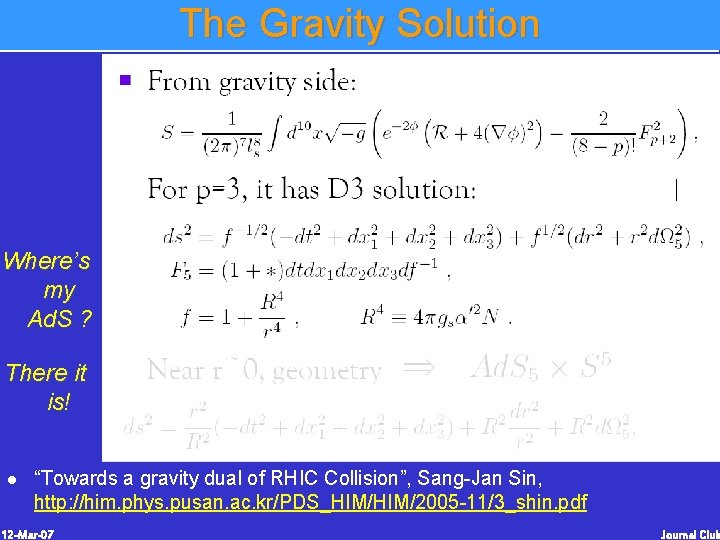
The Gravity Solution Where’s my Ad. S ? There it is! l “Towards a gravity dual of RHIC Collision”, Sang-Jan Sin, http: //him. phys. pusan. ac. kr/PDS_HIM/2005 -11/3_shin. pdf 12 -Mar-07 Journal Club
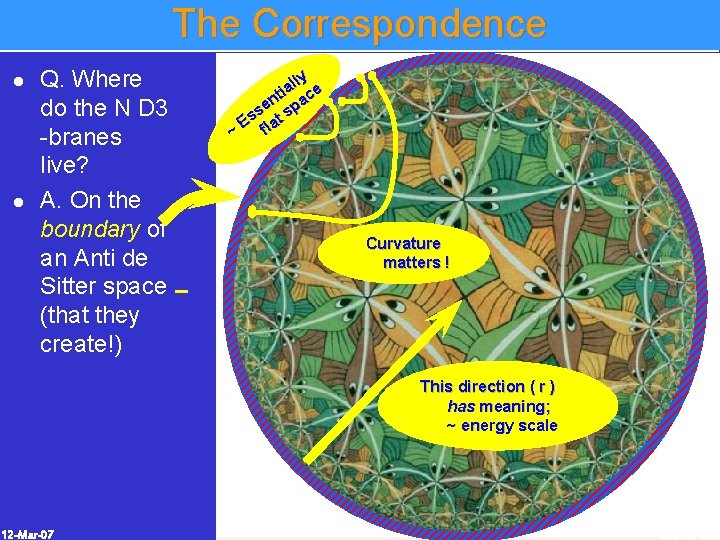
The Correspondence l l Q. Where lly e a i nt pac e do the N D 3 s s Es flat ~ -branes live? A. On the boundary of an Anti de Sitter space (that they create!) Curvature matters ! This direction ( r ) has meaning; ~ energy scale 12 -Mar-07 Journal Club
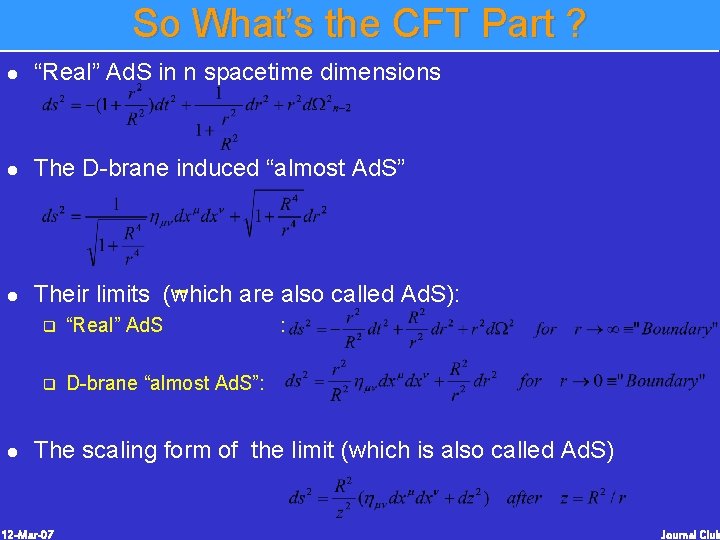
So What’s the CFT Part ? l “Real” Ad. S in n spacetime dimensions l The D-brane induced “almost Ad. S” l Their limits (which are also called Ad. S): l q “Real” Ad. S q D-brane “almost Ad. S”: : The scaling form of the limit (which is also called Ad. S) 12 -Mar-07 Journal Club
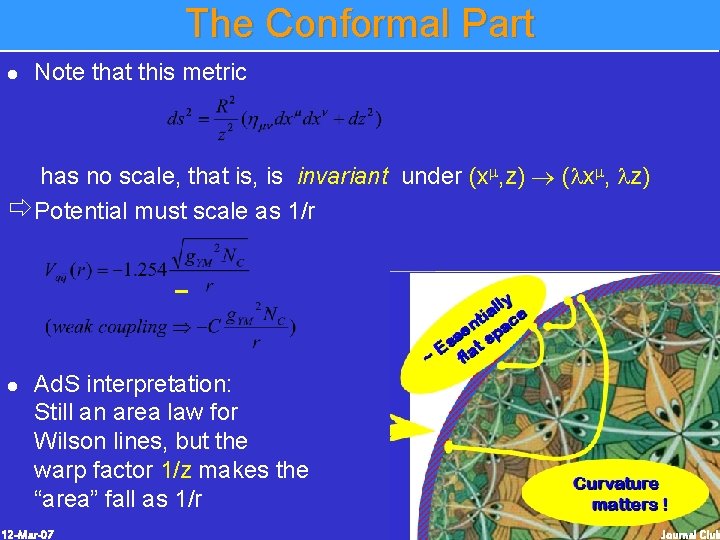
The Conformal Part l Note that this metric has no scale, that is, is invariant under (xm, z) (lxm, lz) Potential must scale as 1/r l Ad. S interpretation: Still an area law for Wilson lines, but the warp factor 1/z makes the “area” fall as 1/r 12 -Mar-07 Journal Club
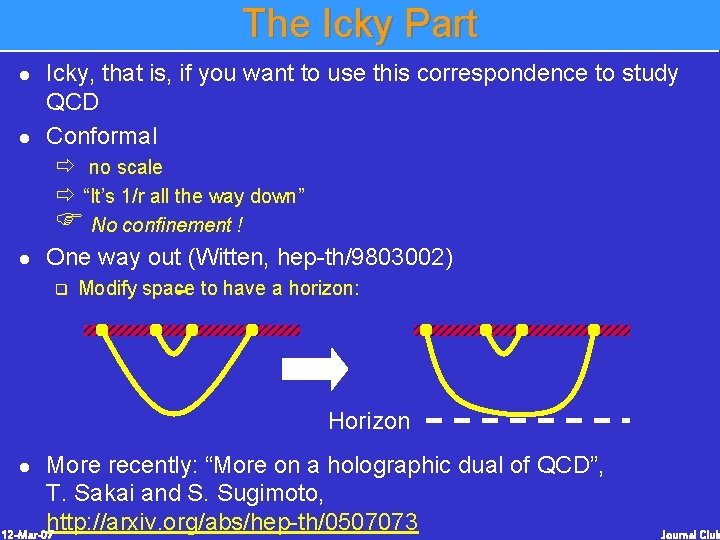
The Icky Part l l Icky, that is, if you want to use this correspondence to study QCD Conformal no scale “It’s 1/r all the way down” F No confinement ! l One way out (Witten, hep-th/9803002) q Modify space to have a horizon: Horizon More recently: “More on a holographic dual of QCD”, T. Sakai and S. Sugimoto, http: //arxiv. org/abs/hep-th/0507073 12 -Mar-07 l Journal Club
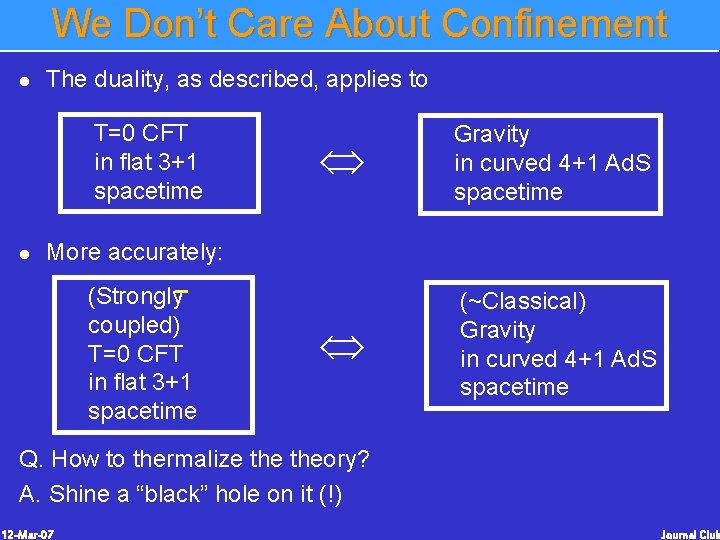
We Don’t Care About Confinement l The duality, as described, applies to T=0 CFT in flat 3+1 spacetime l More accurately: (Strongly coupled) T=0 CFT in flat 3+1 spacetime Gravity in curved 4+1 Ad. S spacetime (~Classical) Gravity in curved 4+1 Ad. S spacetime Q. How to thermalize theory? A. Shine a “black” hole on it (!) 12 -Mar-07 Journal Club
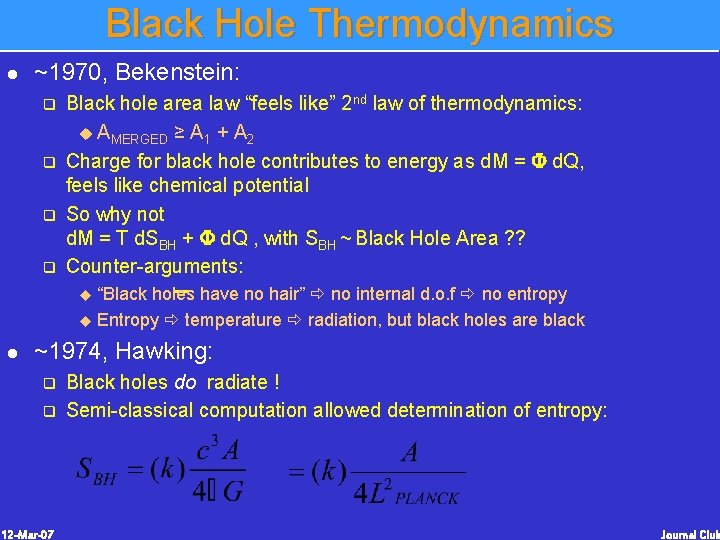
Black Hole Thermodynamics l ~1970, Bekenstein: q q Black hole area law “feels like” 2 nd law of thermodynamics: u AMERGED ≥ A 1 + A 2 Charge for black hole contributes to energy as d. M = F d. Q, feels like chemical potential So why not d. M = T d. SBH + F d. Q , with SBH ~ Black Hole Area ? ? Counter-arguments: u “Black holes have no hair” no internal d. o. f no entropy u Entropy temperature radiation, but black holes are black l ~1974, Hawking: q q 12 -Mar-07 Black holes do radiate ! Semi-classical computation allowed determination of entropy: Journal Club
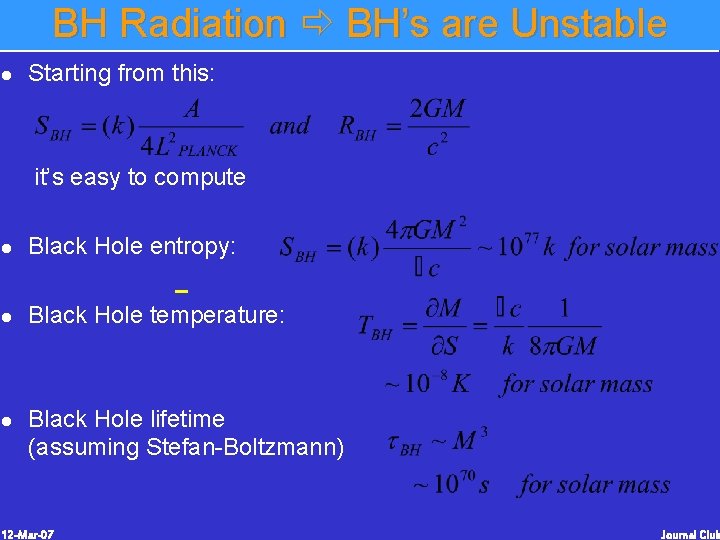
BH Radiation BH’s are Unstable l Starting from this: it’s easy to compute l l l Black Hole entropy: Black Hole temperature: Black Hole lifetime (assuming Stefan-Boltzmann) 12 -Mar-07 Journal Club
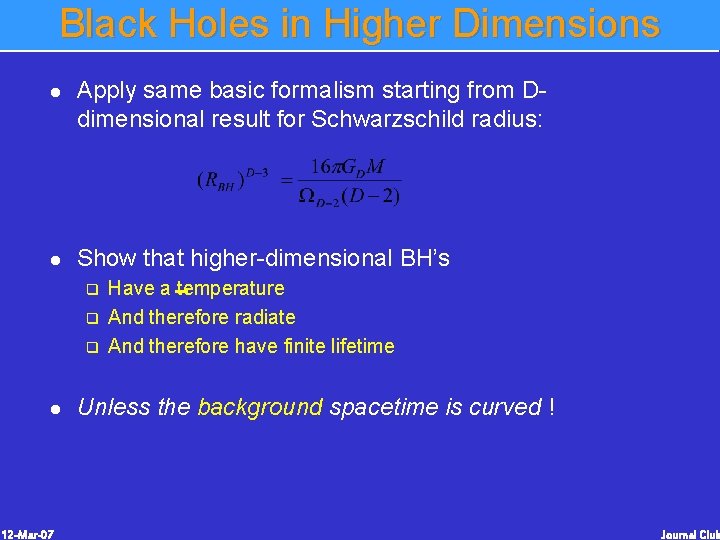
Black Holes in Higher Dimensions l l Apply same basic formalism starting from Ddimensional result for Schwarzschild radius: Show that higher-dimensional BH’s q Have a temperature q q l 12 -Mar-07 And therefore radiate And therefore have finite lifetime Unless the background spacetime is curved ! Journal Club
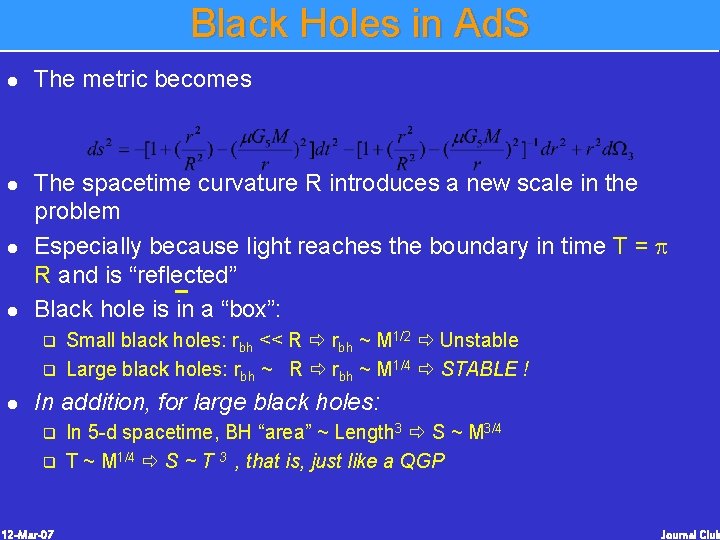
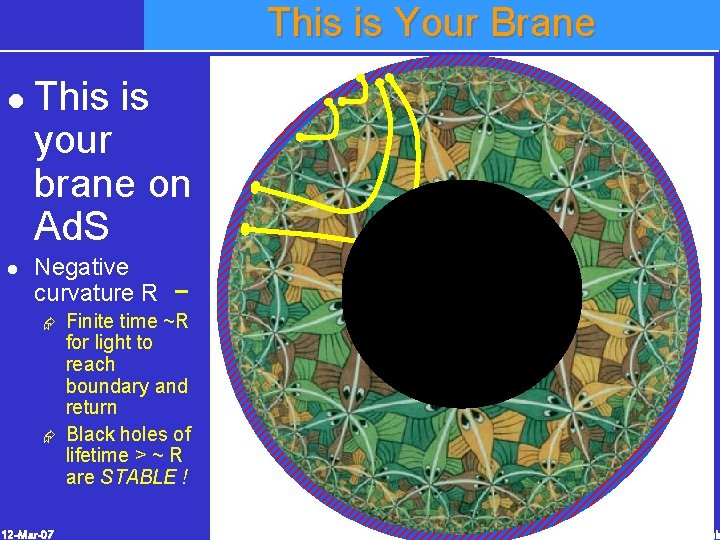
Black Holes in Ad. S l l The metric becomes The spacetime curvature R introduces a new scale in the problem Especially because light reaches the boundary in time T = p R and is “reflected” Black hole is in a “box”: q q l Small black holes: rbh << R rbh ~ M 1/2 Unstable Large black holes: rbh ~ R rbh ~ M 1/4 STABLE ! In addition, for large black holes: q q 12 -Mar-07 In 5 -d spacetime, BH “area” ~ Length 3 S ~ M 3/4 T ~ M 1/4 S ~ T 3 , that is, just like a QGP Journal Club
This is Your Brane l l This is your brane on Ad. S Negative curvature R 12 -Mar-07 Finite time ~R for light to reach boundary and return Black holes of lifetime > ~ R are STABLE ! Journal Club
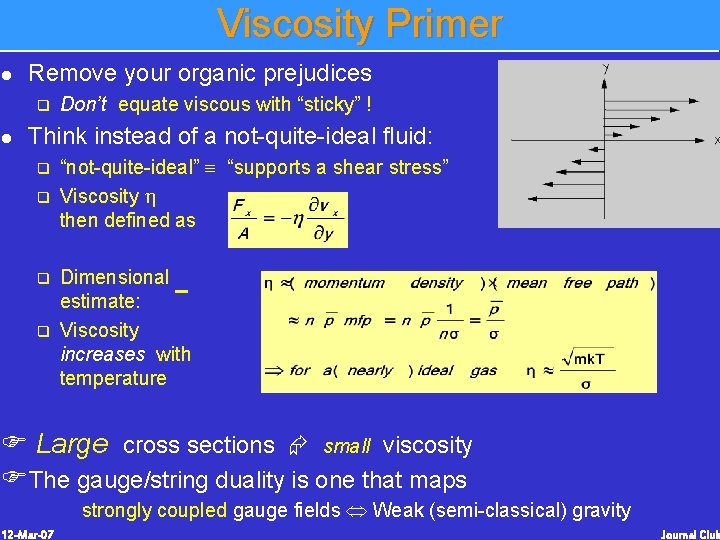
Viscosity Primer l Remove your organic prejudices q l Don’t equate viscous with “sticky” ! Think instead of a not-quite-ideal fluid: q q “not-quite-ideal” “supports a shear stress” Viscosity h then defined as Dimensional estimate: Viscosity increases with temperature F Large cross sections small viscosity FThe gauge/string duality is one that maps strongly coupled gauge fields Weak (semi-classical) gravity 12 -Mar-07 Journal Club
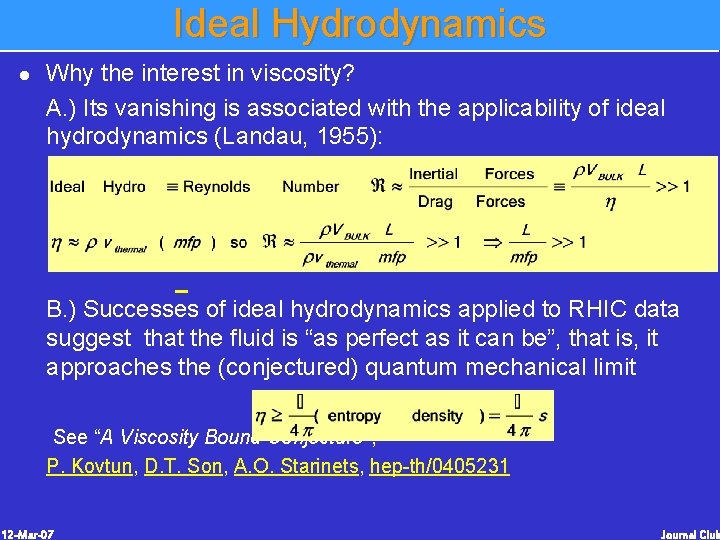
Ideal Hydrodynamics l Why the interest in viscosity? A. ) Its vanishing is associated with the applicability of ideal hydrodynamics (Landau, 1955): B. ) Successes of ideal hydrodynamics applied to RHIC data suggest that the fluid is “as perfect as it can be”, that is, it approaches the (conjectured) quantum mechanical limit See “A Viscosity Bound Conjecture”, P. Kovtun, D. T. Son, A. O. Starinets, hep-th/0405231 12 -Mar-07 Journal Club
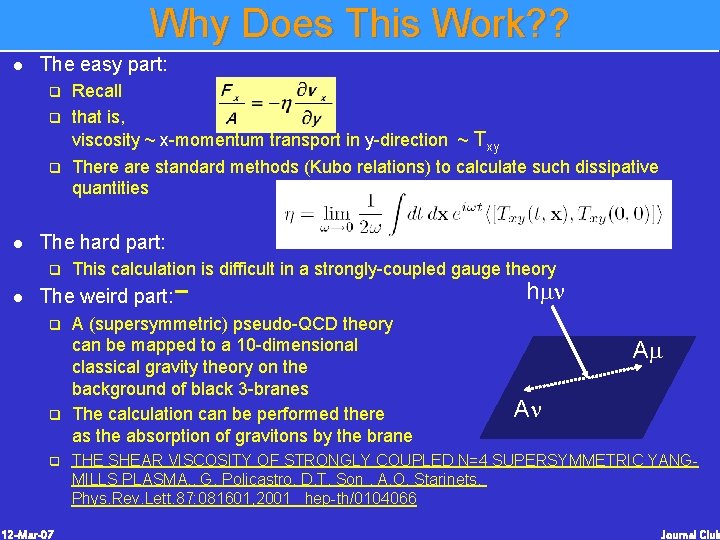
Why Does This Work? ? l The easy part: q q q l The hard part: q l Recall that is, viscosity ~ x-momentum transport in y-direction ~ Txy There are standard methods (Kubo relations) to calculate such dissipative quantities The weird part: q q q 12 -Mar-07 This calculation is difficult in a strongly-coupled gauge theory A (supersymmetric) pseudo-QCD theory can be mapped to a 10 -dimensional classical gravity theory on the background of black 3 -branes The calculation can be performed there as the absorption of gravitons by the brane hmn Am An THE SHEAR VISCOSITY OF STRONGLY COUPLED N=4 SUPERSYMMETRIC YANGMILLS PLASMA. , G. Policastro, D. T. Son , A. O. Starinets, Phys. Rev. Lett. 87: 081601, 2001 hep-th/0104066 Journal Club
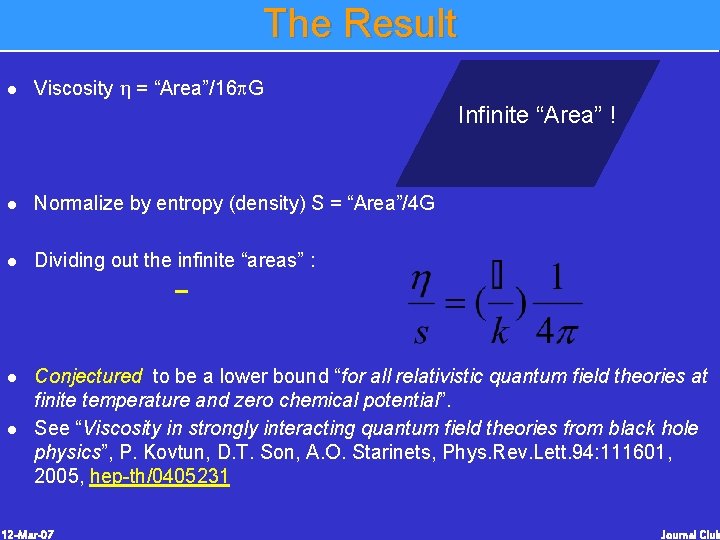
The Result l Viscosity h = “Area”/16 p. G Infinite “Area” ! l Normalize by entropy (density) S = “Area”/4 G l Dividing out the infinite “areas” : l l Conjectured to be a lower bound “for all relativistic quantum field theories at finite temperature and zero chemical potential”. See “Viscosity in strongly interacting quantum field theories from black hole physics”, P. Kovtun, D. T. Son, A. O. Starinets, Phys. Rev. Lett. 94: 111601, 2005, hep-th/0405231 12 -Mar-07 Journal Club
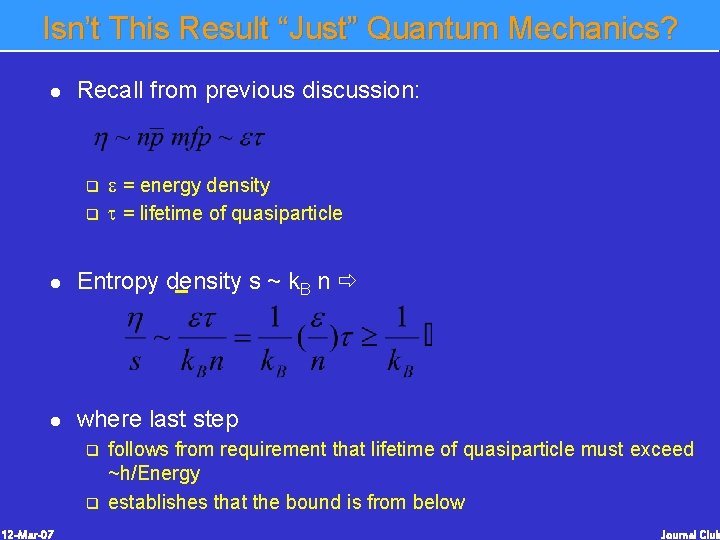
Isn’t This Result “Just” Quantum Mechanics? l Recall from previous discussion: q q e = energy density t = lifetime of quasiparticle l Entropy density s ~ k. B n l where last step q q 12 -Mar-07 follows from requirement that lifetime of quasiparticle must exceed ~h/Energy establishes that the bound is from below Journal Club
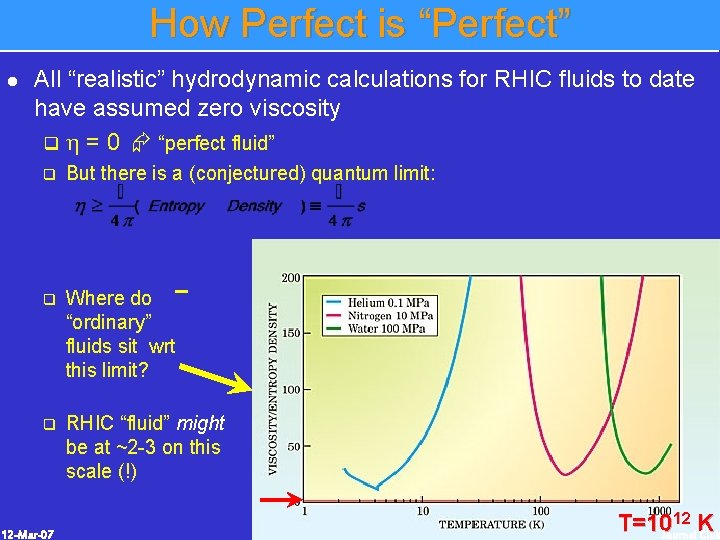
How Perfect is “Perfect” l All “realistic” hydrodynamic calculations for RHIC fluids to date have assumed zero viscosity q h = 0 “perfect fluid” q But there is a (conjectured) quantum limit: q Where do “ordinary” fluids sit wrt this limit? q RHIC “fluid” might be at ~2 -3 on this scale (!) 12 -Mar-07 12 K T=10 Journal Club
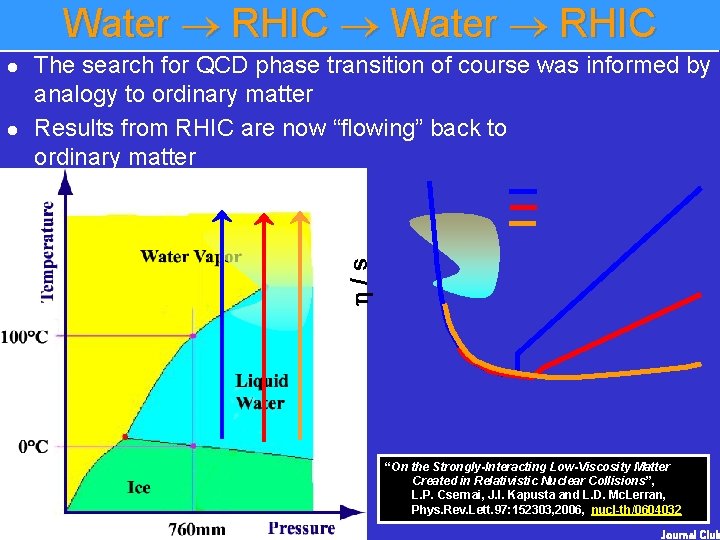
Water RHIC l The search for QCD phase transition of course was informed by analogy to ordinary matter Results from RHIC are now “flowing” back to ordinary matter h/s l “On the Strongly-Interacting Low-Viscosity Matter Created in Relativistic Nuclear Collisions”, L. P. Csernai, J. I. Kapusta and L. D. Mc. Lerran, Phys. Rev. Lett. 97: 152303, 2006, nucl-th/0604032 12 -Mar-07 Journal Club
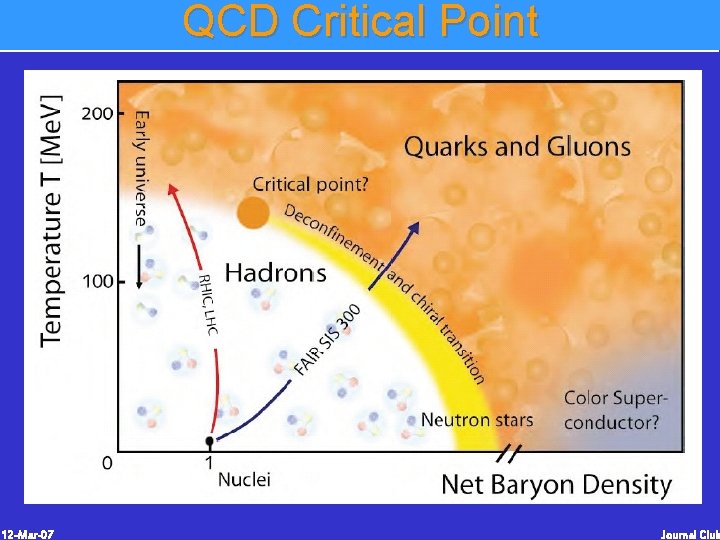
QCD Critical Point 12 -Mar-07 Journal Club
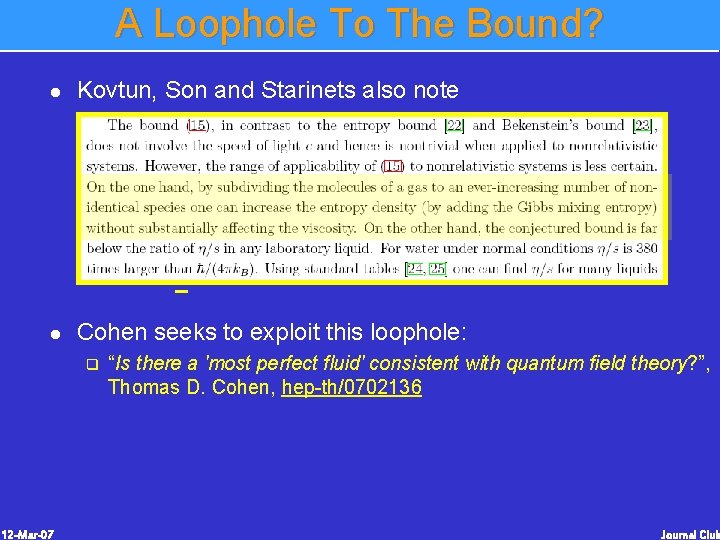
A Loophole To The Bound? l Kovtun, Son and Starinets also note l Cohen seeks to exploit this loophole: q 12 -Mar-07 “Is there a 'most perfect fluid' consistent with quantum field theory? ”, Thomas D. Cohen, hep-th/0702136 Journal Club
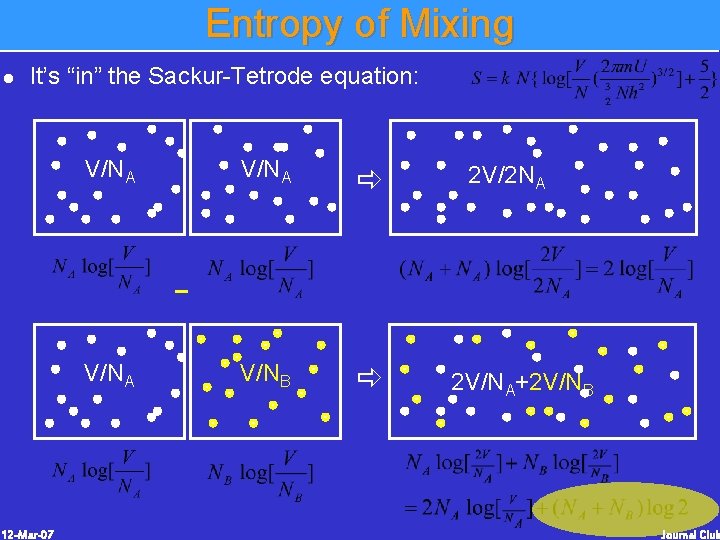
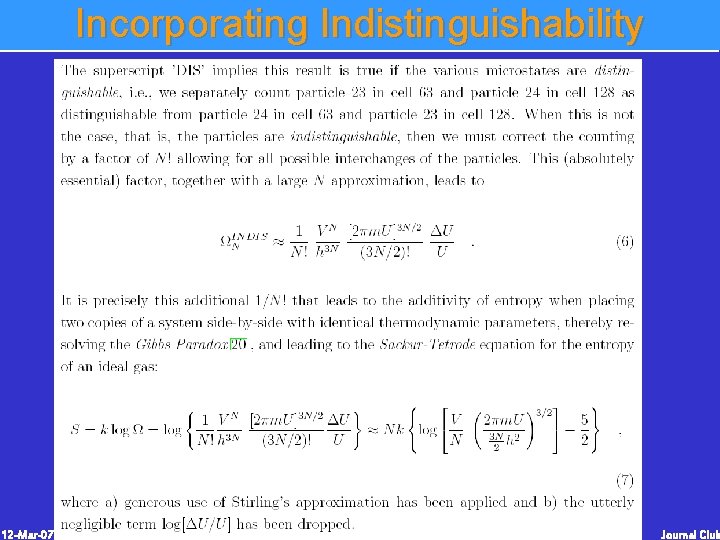
Entropy of Mixing l It’s “in” the Sackur-Tetrode equation: V/NA 2 V/2 NA V/NA 12 -Mar-07 V/NB 2 V/NA+2 V/NB Journal Club
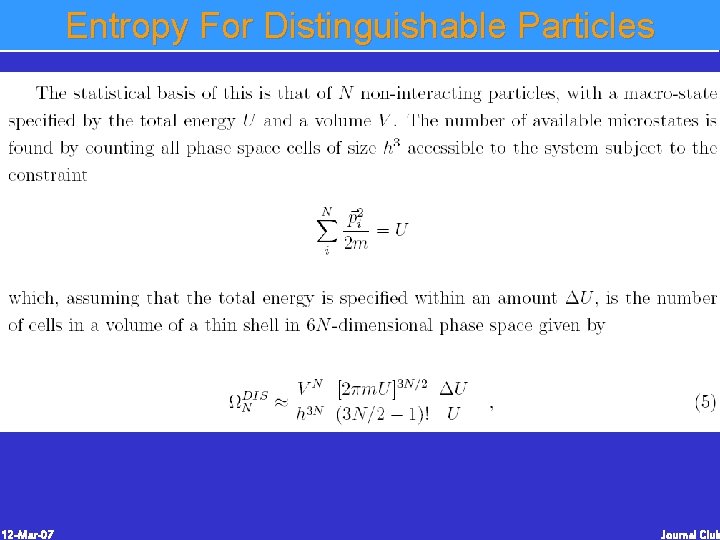
Entropy For Distinguishable Particles 12 -Mar-07 Journal Club
Incorporating Indistinguishability 12 -Mar-07 Journal Club
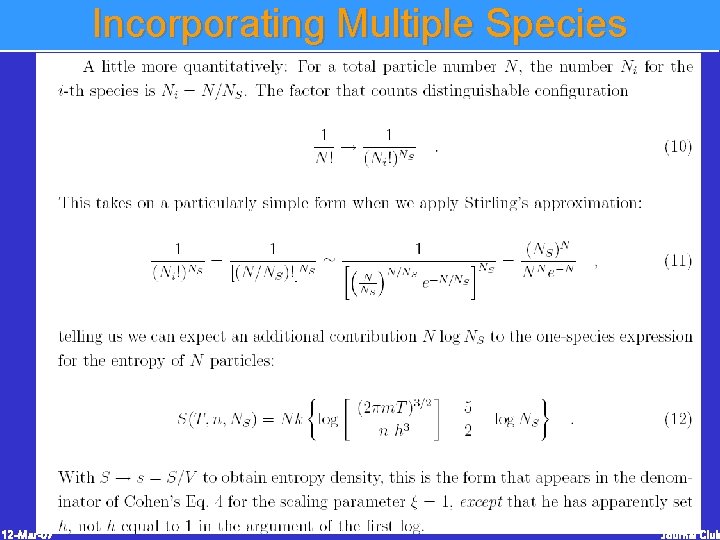
Incorporating Multiple Species 12 -Mar-07 Journal Club
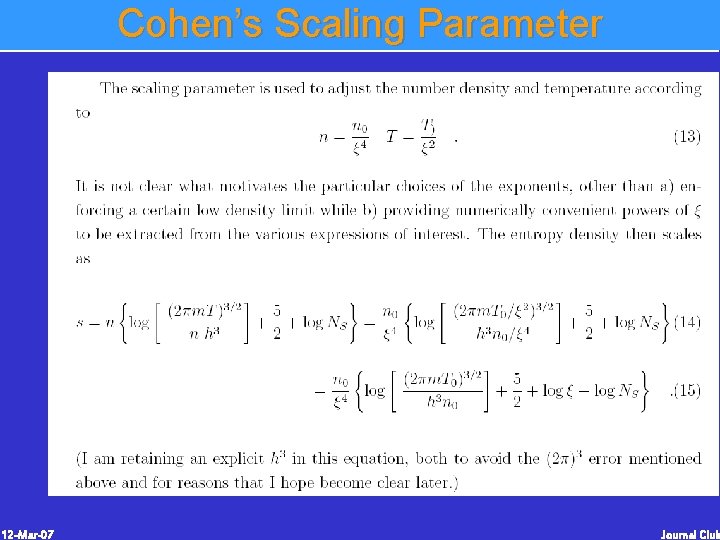
Cohen’s Scaling Parameter 12 -Mar-07 Journal Club
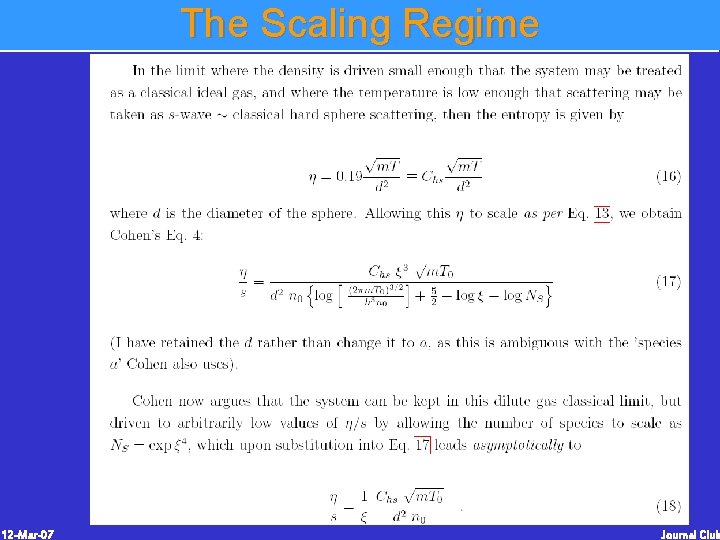
The Scaling Regime 12 -Mar-07 Journal Club
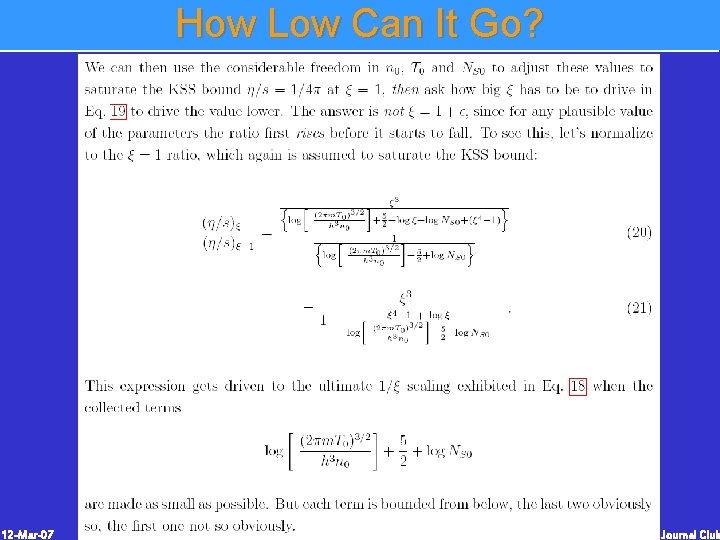
How Low Can It Go? 12 -Mar-07 Journal Club
Not Discussed l Counter-counter arguments: q l Bousso’s entropy bound on spacetime regions? Counter-counter arguments: q Residual entropy ? 12 -Mar-07 Journal Club
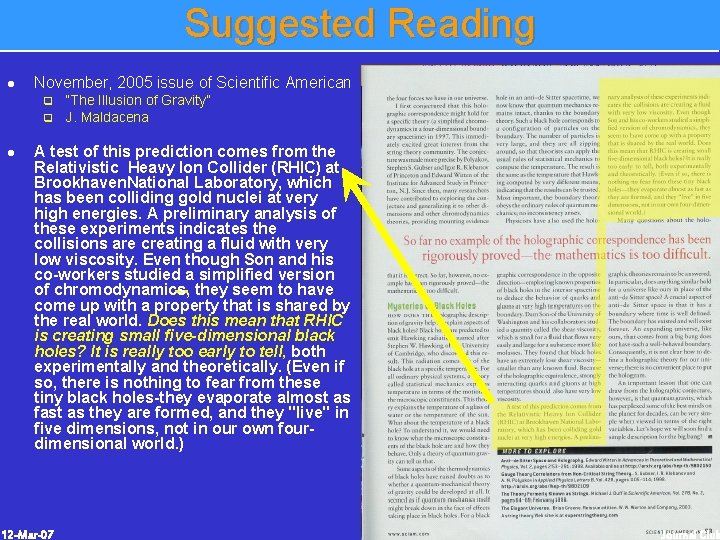
Suggested Reading l November, 2005 issue of Scientific American q q l “The Illusion of Gravity” J. Maldacena A test of this prediction comes from the Relativistic Heavy Ion Collider (RHIC) at Brookhaven. National Laboratory, which has been colliding gold nuclei at very high energies. A preliminary analysis of these experiments indicates the collisions are creating a fluid with very low viscosity. Even though Son and his co-workers studied a simplified version they of chromodynamics, seem to have come up with a property that is shared by the real world. Does this mean that RHIC is creating small five-dimensional black holes? It is really too early to tell, both experimentally and theoretically. (Even if so, there is nothing to fear from these tiny black holes-they evaporate almost as fast as they are formed, and they "live" in five dimensions, not in our own fourdimensional world. ) 12 -Mar-07 Journal Club
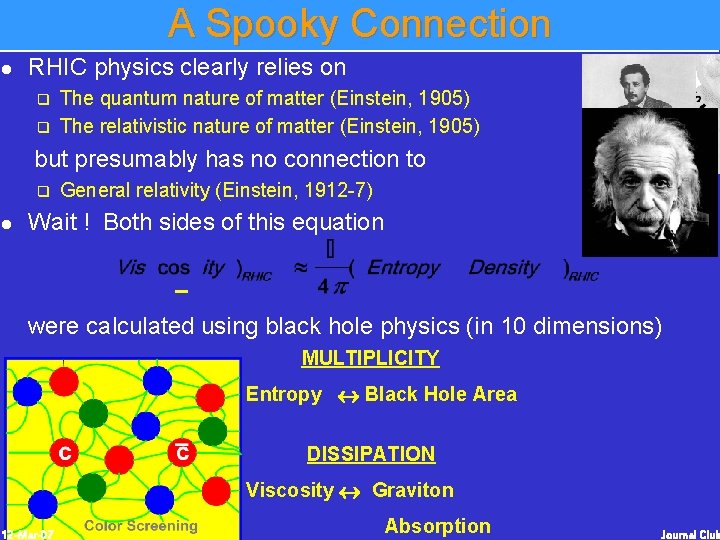
A Spooky Connection l RHIC physics clearly relies on q q The quantum nature of matter (Einstein, 1905) The relativistic nature of matter (Einstein, 1905) but presumably has no connection to q l General relativity (Einstein, 1912 -7) Wait ! Both sides of this equation were calculated using black hole physics (in 10 dimensions) MULTIPLICITY Entropy Black Hole Area DISSIPATION Viscosity Graviton 12 -Mar-07 Absorption Journal Club
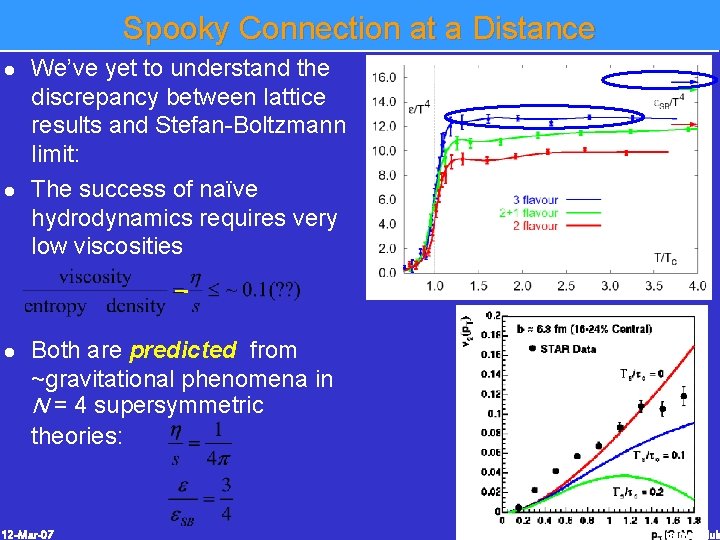
Spooky Connection at a Distance l l We’ve yet to understand the discrepancy between lattice results and Stefan-Boltzmann limit: The success of naïve hydrodynamics requires very low viscosities l Both are predicted from ~gravitational phenomena in N = 4 supersymmetric theories: 12 -Mar-07 Journal Club
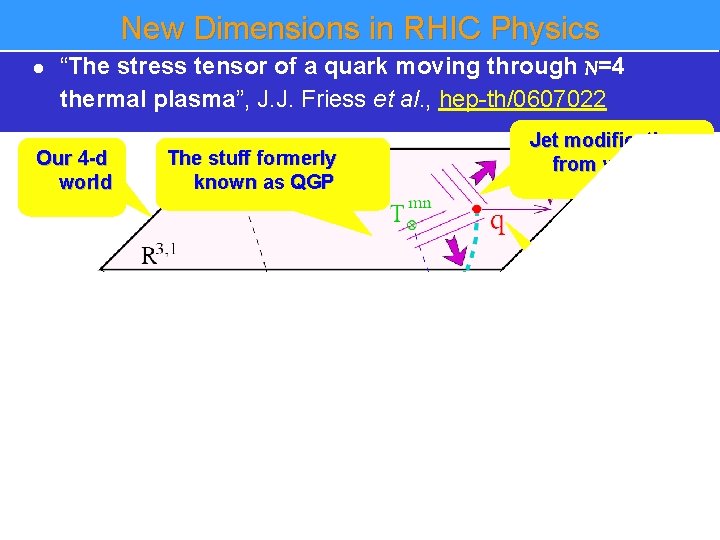
New Dimensions in RHIC Physics l “The stress tensor of a quark moving through N=4 thermal plasma”, J. J. Friess et al. , hep-th/0607022 Our 4 -d world The stuff formerly known as QGP String theorist’s 5 -d world 12 -Mar-07 Jet modifications from wake field Heavy quark moving through the Energy loss medium from string drag Journal Club
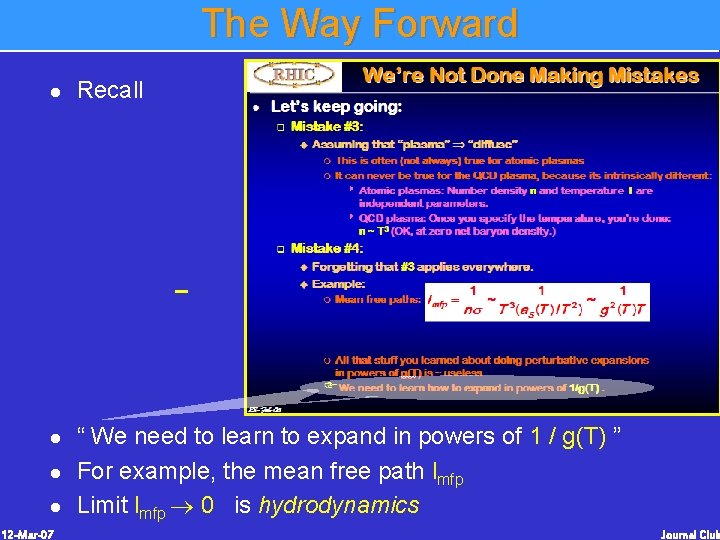
The Way Forward l Recall l l l 12 -Mar-07 “ We need to learn to expand in powers of 1 / g(T) ” For example, the mean free path lmfp Limit lmfp 0 is hydrodynamics Journal Club
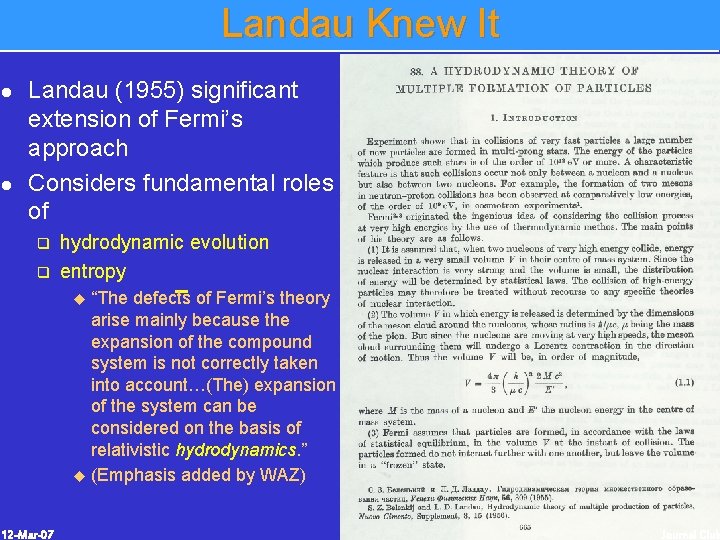
Landau Knew It l l Landau (1955) significant extension of Fermi’s approach Considers fundamental roles of q q hydrodynamic evolution entropy u “The defects of Fermi’s theory arise mainly because the expansion of the compound system is not correctly taken into account…(The) expansion of the system can be considered on the basis of relativistic hydrodynamics. ” u (Emphasis added by WAZ) 12 -Mar-07 Journal Club
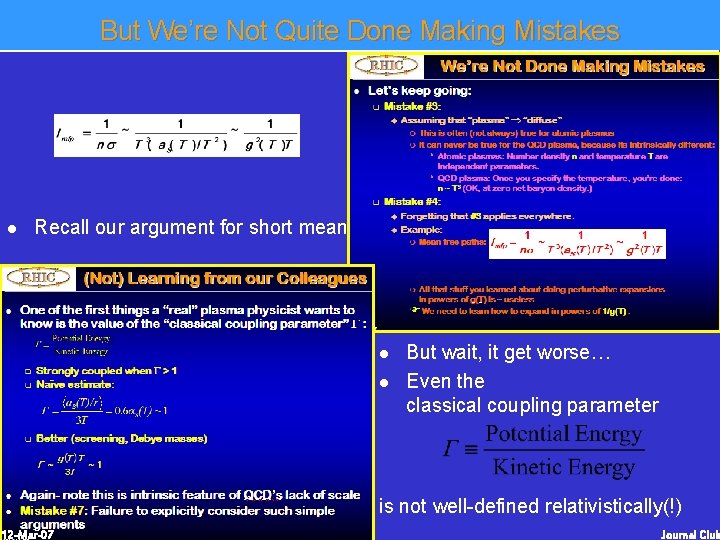
But We’re Not Quite Done Making Mistakes l Recall our argument for short mean free paths: l But this relies on the number density n , which is not well-defined for a relativis l l But wait, it get worse… Even the classical coupling parameter is not well-defined relativistically(!) 12 -Mar-07 Journal Club
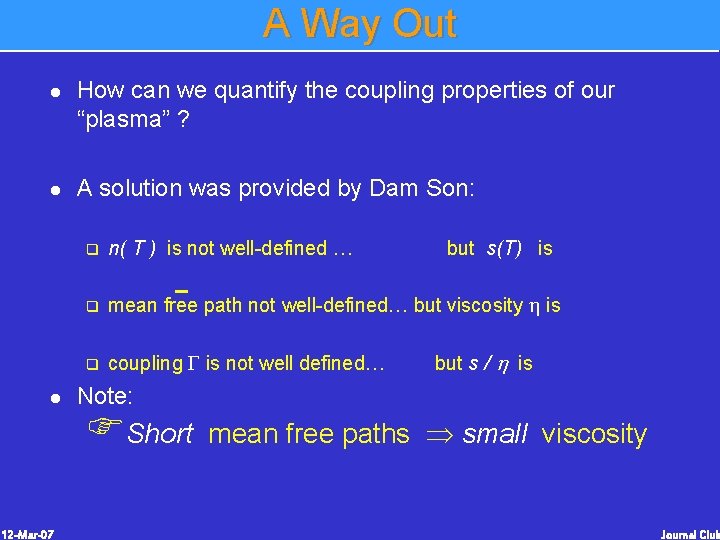
A Way Out l l How can we quantify the coupling properties of our “plasma” ? A solution was provided by Dam Son: q n( T ) is not well-defined … but s(T) is l 12 -Mar-07 q mean free path not well-defined… but viscosity h is q coupling G is not well defined… but s / h is Note: FShort mean free paths small viscosity Journal Club
This is Your Brane l l l This is your brane on Ad. S More seriously: Negative curvature R 12 -Mar-07 Finite time ~R for light to reach boundary and return Black holes of lifetime > ~ R are STABLE ! Journal Club