
Ad hoc and Sensor Networks Chapter 1 Motivation
- Slides: 32
Ad hoc and Sensor Networks Chapter 1: Motivation & Applications Holger Karl Computer Networks Group Universität Paderborn
Goals of this chapter · Give an understanding what ad hoc & sensor networks are good for, what their intended application areas are · Commonalities and differences · Differences to related network types · Limitations of these concepts SS 05 Ad hoc & sensor networs - Ch 1: Motivation & Applications 2
Outline · · Infrastructure for wireless? (Mobile) ad hoc networks Wireless sensor networks Comparison SS 05 Ad hoc & sensor networs - Ch 1: Motivation & Applications 3
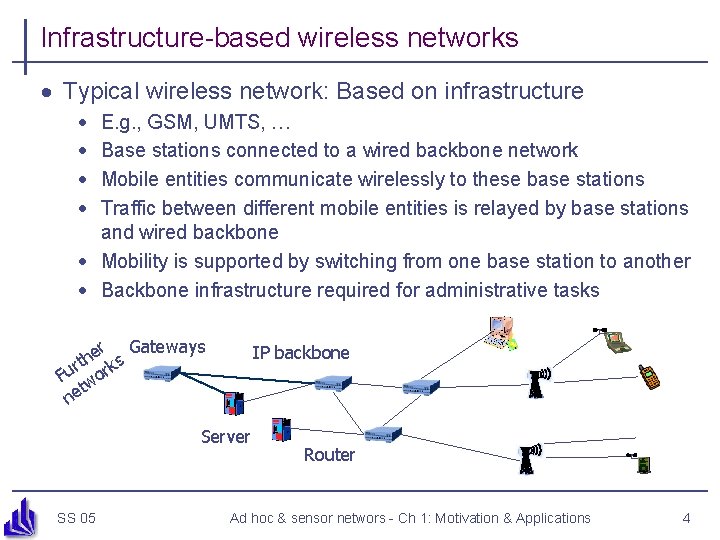
Infrastructure-based wireless networks · Typical wireless network: Based on infrastructure · · E. g. , GSM, UMTS, … Base stations connected to a wired backbone network Mobile entities communicate wirelessly to these base stations Traffic between different mobile entities is relayed by base stations and wired backbone · Mobility is supported by switching from one base station to another · Backbone infrastructure required for administrative tasks er s Gateways h rt k Fu wor t ne IP backbone Server SS 05 Router Ad hoc & sensor networs - Ch 1: Motivation & Applications 4
Infrastructure-based wireless networks – Limits? · What if … · No infrastructure is available? – E. g. , in disaster areas · It is too expensive/inconvenient to set up? – E. g. , in remote, large construction sites · There is no time to set it up? – E. g. , in military operations SS 05 Ad hoc & sensor networs - Ch 1: Motivation & Applications 5
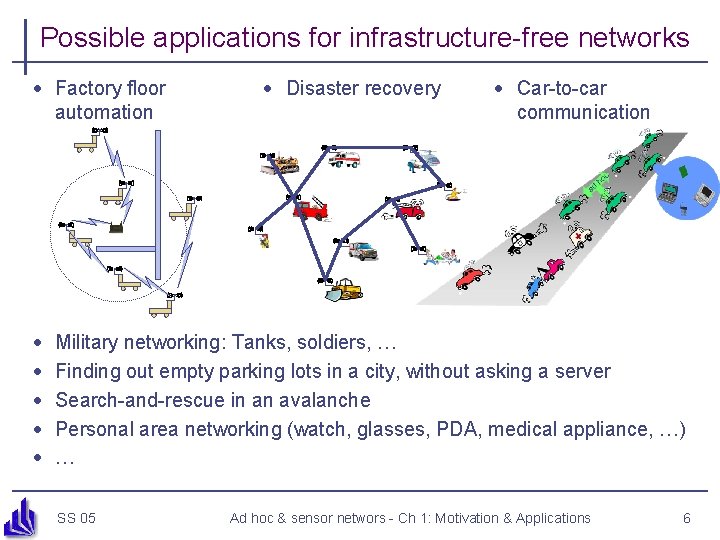
Possible applications for infrastructure-free networks · Factory floor automation · · · Disaster recovery · Car-to-car communication Military networking: Tanks, soldiers, … Finding out empty parking lots in a city, without asking a server Search-and-rescue in an avalanche Personal area networking (watch, glasses, PDA, medical appliance, …) … SS 05 Ad hoc & sensor networs - Ch 1: Motivation & Applications 6
Outline · · Infrastructure for wireless? (Mobile) ad hoc networks Wireless sensor networks Comparison SS 05 Ad hoc & sensor networs - Ch 1: Motivation & Applications 7
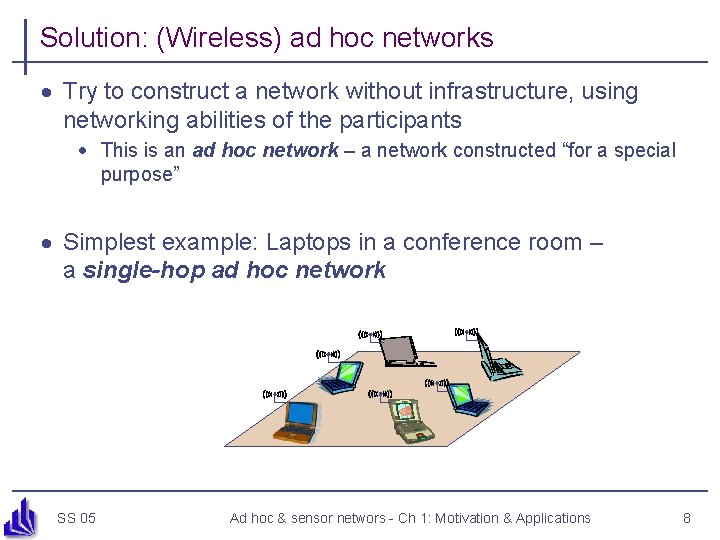
Solution: (Wireless) ad hoc networks · Try to construct a network without infrastructure, using networking abilities of the participants · This is an ad hoc network – a network constructed “for a special purpose” · Simplest example: Laptops in a conference room – a single-hop ad hoc network SS 05 Ad hoc & sensor networs - Ch 1: Motivation & Applications 8
Problems/challenges for ad hoc networks · Without a central infrastructure, things become much more difficult · Problems are due to · · SS 05 Lack of central entity for organization available Limited range of wireless communication Mobility of participants Battery-operated entities Ad hoc & sensor networs - Ch 1: Motivation & Applications 9
No central entity ! self-organization · Without a central entity (like a base station), participants must organize themselves into a network (selforganization) · Pertains to (among others): · Medium access control – no base station can assign transmission resources, must be decided in a distributed fashion · Finding a route from one participant to another SS 05 Ad hoc & sensor networs - Ch 1: Motivation & Applications 10
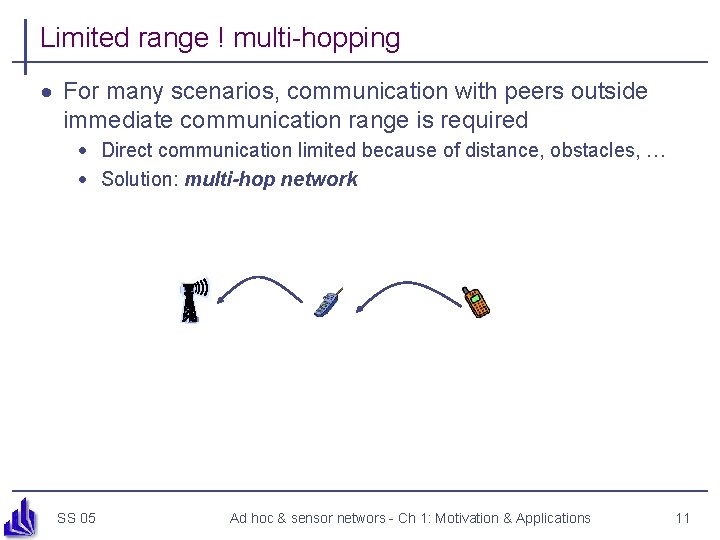
Limited range ! multi-hopping · For many scenarios, communication with peers outside immediate communication range is required · Direct communication limited because of distance, obstacles, … · Solution: multi-hop network ? SS 05 Ad hoc & sensor networs - Ch 1: Motivation & Applications 11
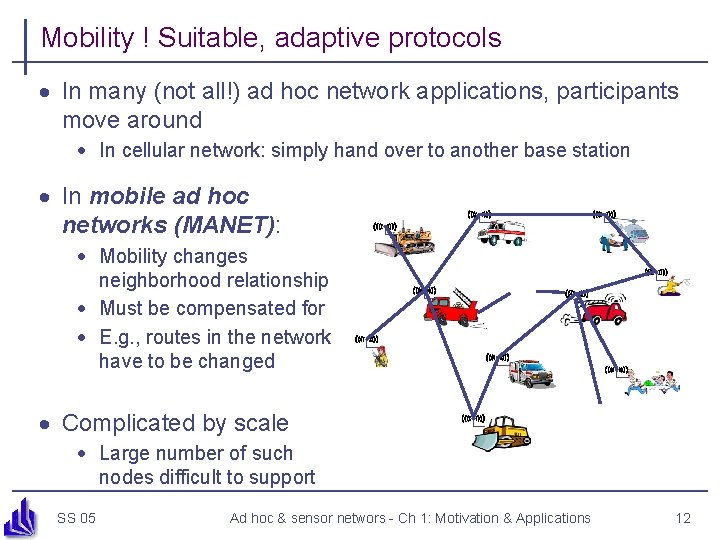
Mobility ! Suitable, adaptive protocols · In many (not all!) ad hoc network applications, participants move around · In cellular network: simply hand over to another base station · In mobile ad hoc networks (MANET): · Mobility changes neighborhood relationship · Must be compensated for · E. g. , routes in the network have to be changed · Complicated by scale · Large number of such nodes difficult to support SS 05 Ad hoc & sensor networs - Ch 1: Motivation & Applications 12
Battery-operated devices ! energy-efficient operation · Often (not always!), participants in an ad hoc network draw energy from batteries · Desirable: long run time for · Individual devices · Network as a whole ! Energy-efficient networking protocols · E. g. , use multi-hop routes with low energy consumption (energy/bit) · E. g. , take available battery capacity of devices into account · How to resolve conflicts between different optimizations? SS 05 Ad hoc & sensor networs - Ch 1: Motivation & Applications 13
Outline · Infrastructure for wireless? · (Mobile) ad hoc networks · Wireless sensor networks · Applications · Requirements & mechanisms · Comparison SS 05 Ad hoc & sensor networs - Ch 1: Motivation & Applications 14
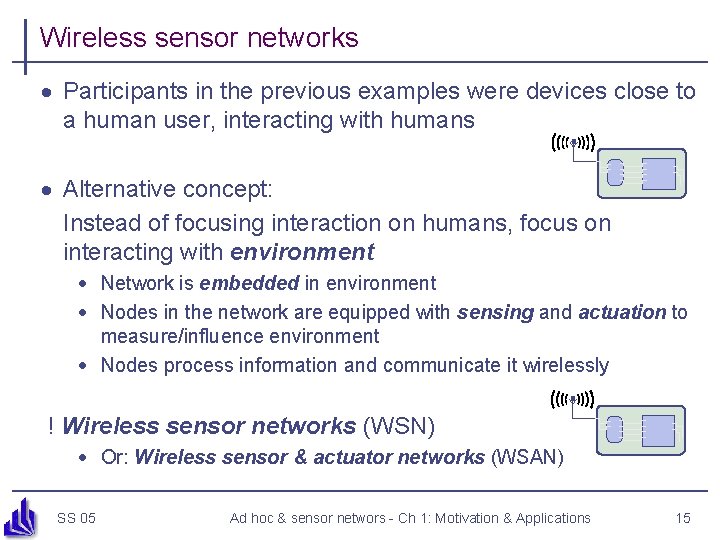
Wireless sensor networks · Participants in the previous examples were devices close to a human user, interacting with humans · Alternative concept: Instead of focusing interaction on humans, focus on interacting with environment · Network is embedded in environment · Nodes in the network are equipped with sensing and actuation to measure/influence environment · Nodes process information and communicate it wirelessly ! Wireless sensor networks (WSN) · Or: Wireless sensor & actuator networks (WSAN) SS 05 Ad hoc & sensor networs - Ch 1: Motivation & Applications 15
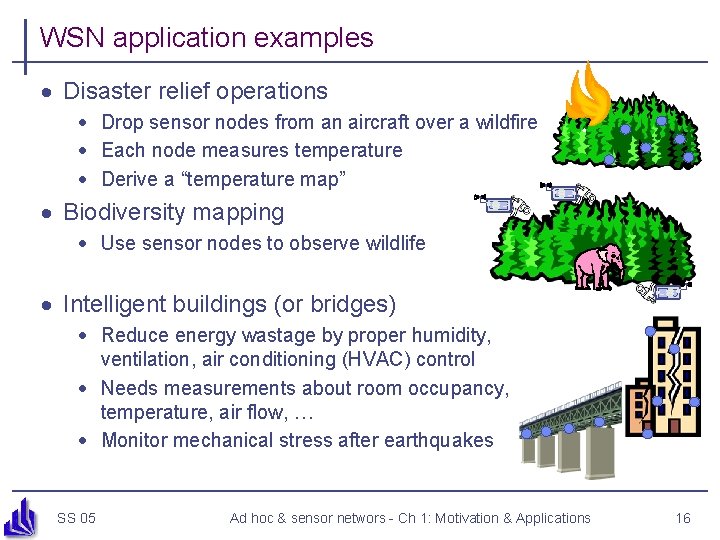
WSN application examples · Disaster relief operations · Drop sensor nodes from an aircraft over a wildfire · Each node measures temperature · Derive a “temperature map” · Biodiversity mapping · Use sensor nodes to observe wildlife · Intelligent buildings (or bridges) · Reduce energy wastage by proper humidity, ventilation, air conditioning (HVAC) control · Needs measurements about room occupancy, temperature, air flow, … · Monitor mechanical stress after earthquakes SS 05 Ad hoc & sensor networs - Ch 1: Motivation & Applications 16
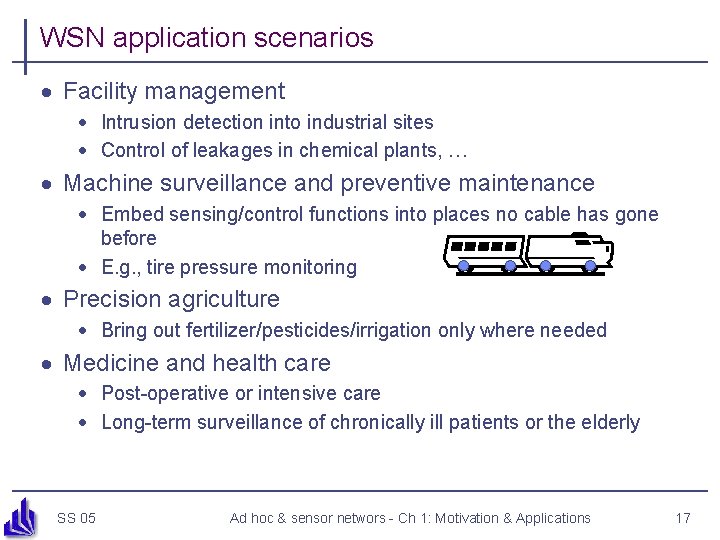
WSN application scenarios · Facility management · Intrusion detection into industrial sites · Control of leakages in chemical plants, … · Machine surveillance and preventive maintenance · Embed sensing/control functions into places no cable has gone before · E. g. , tire pressure monitoring · Precision agriculture · Bring out fertilizer/pesticides/irrigation only where needed · Medicine and health care · Post-operative or intensive care · Long-term surveillance of chronically ill patients or the elderly SS 05 Ad hoc & sensor networs - Ch 1: Motivation & Applications 17
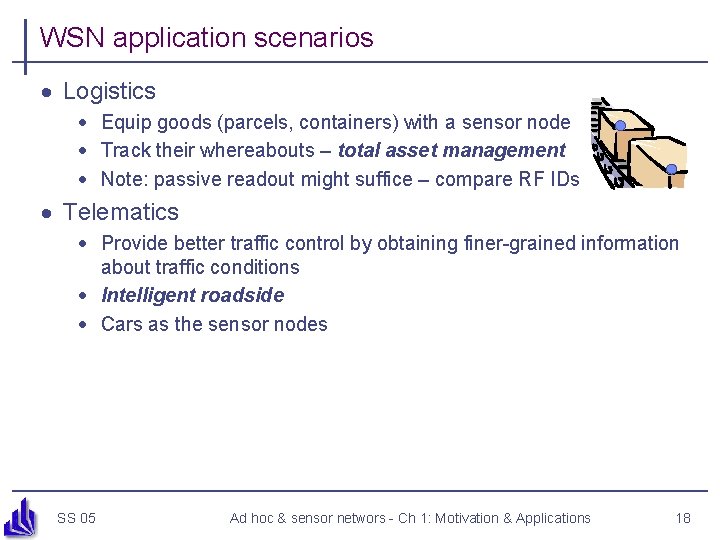
WSN application scenarios · Logistics · Equip goods (parcels, containers) with a sensor node · Track their whereabouts – total asset management · Note: passive readout might suffice – compare RF IDs · Telematics · Provide better traffic control by obtaining finer-grained information about traffic conditions · Intelligent roadside · Cars as the sensor nodes SS 05 Ad hoc & sensor networs - Ch 1: Motivation & Applications 18
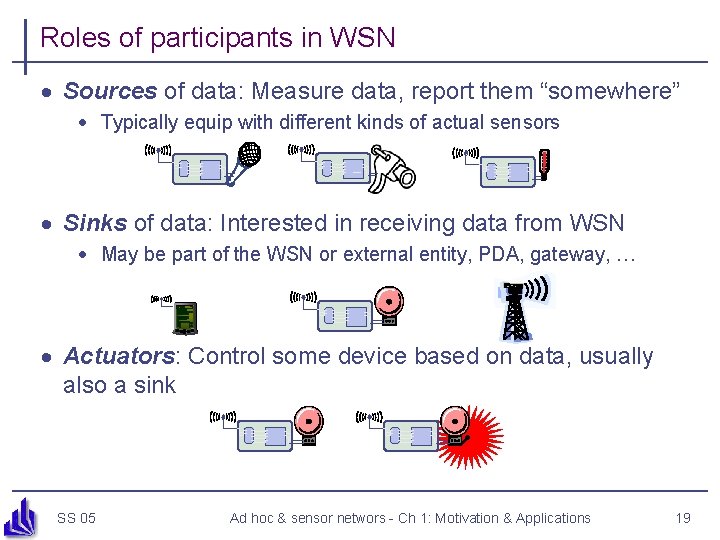
Roles of participants in WSN · Sources of data: Measure data, report them “somewhere” · Typically equip with different kinds of actual sensors · Sinks of data: Interested in receiving data from WSN · May be part of the WSN or external entity, PDA, gateway, … · Actuators: Control some device based on data, usually also a sink SS 05 Ad hoc & sensor networs - Ch 1: Motivation & Applications 19
Structuring WSN application types · Interaction patterns between sources and sinks classify application types · Event detection: Nodes locally detect events (maybe jointly with nearby neighbors), report these events to interested sinks · Event classification additional option · Periodic measurement · Function approximation: Use sensor network to approximate a function of space and/or time (e. g. , temperature map) · Edge detection: Find edges (or other structures) in such a function (e. g. , where is the zero degree border line? ) · Tracking: Report (or at least, know) position of an observed intruder (“pink elephant”) SS 05 Ad hoc & sensor networs - Ch 1: Motivation & Applications 20
Deployment options for WSN · How are sensor nodes deployed in their environment? · Dropped from aircraft ! Random deployment · Usually uniform random distribution for nodes over finite area is assumed · Is that a likely proposition? · Well planned, fixed ! Regular deployment · E. g. , in preventive maintenance or similar · Not necessarily geometric structure, but that is often a convenient assumption · Mobile sensor nodes · Can move to compensate for deployment shortcomings · Can be passively moved around by some external force (wind, water) · Can actively seek out “interesting” areas SS 05 Ad hoc & sensor networs - Ch 1: Motivation & Applications 21
Maintenance options · Feasible and/or practical to maintain sensor nodes? · E. g. , to replace batteries? · Or: unattended operation? · Impossible but not relevant? Mission lifetime might be very small · Energy supply? · Limited from point of deployment? · Some form of recharging, energy scavenging from environment? · E. g. , solar cells SS 05 Ad hoc & sensor networs - Ch 1: Motivation & Applications 22
Outline · Infrastructure for wireless? · (Mobile) ad hoc networks · Wireless sensor networks · Applications · Requirements & mechanisms · Comparison SS 05 Ad hoc & sensor networs - Ch 1: Motivation & Applications 23
Characteristic requirements for WSNs · Type of service of WSN · Not simply moving bits like another network · Rather: provide answers (not just numbers) · Issues like geographic scoping are natural requirements, absent from other networks · Quality of service · Traditional Qo. S metrics do not apply · Still, service of WSN must be “good”: Right answers at the right time · Fault tolerance · Be robust against node failure (running out of energy, physical destruction, …) · Lifetime · The network should fulfill its task as long as possible – definition depends on application · Lifetime of individual nodes relatively unimportant · But often treated equivalently SS 05 Ad hoc & sensor networs - Ch 1: Motivation & Applications 24
Characteristic requirements for WSNs · Scalability · Support large number of nodes · Wide range of densities · Vast or small number of nodes per unit area, very applicationdependent · Programmability · Re-programming of nodes in the field might be necessary, improve flexibility · Maintainability · WSN has to adapt to changes, self-monitoring, adapt operation · Incorporate possible additional resources, e. g. , newly deployed nodes SS 05 Ad hoc & sensor networs - Ch 1: Motivation & Applications 25
Required mechanisms to meet requirements · Multi-hop wireless communication · Energy-efficient operation · Both for communication and computation, sensing, actuating · Auto-configuration · Manual configuration just not an option · Collaboration & in-network processing · Nodes in the network collaborate towards a joint goal · Pre-processing data in network (as opposed to at the edge) can greatly improve efficiency SS 05 Ad hoc & sensor networs - Ch 1: Motivation & Applications 26
Required mechanisms to meet requirements · Data centric networking · Focusing network design on data, not on node identifies (idcentric networking) · To improve efficiency · Locality · Do things locally (on node or among nearby neighbors) as far as possible · Exploit tradeoffs · E. g. , between invested energy and accuracy SS 05 Ad hoc & sensor networs - Ch 1: Motivation & Applications 27
Outline · · Infrastructure for wireless? (Mobile) ad hoc networks Wireless sensor networks Comparison SS 05 Ad hoc & sensor networs - Ch 1: Motivation & Applications 28
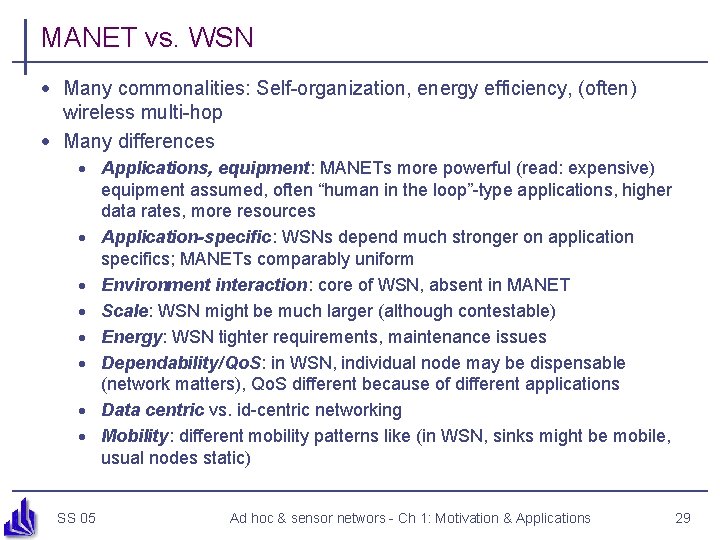
MANET vs. WSN · Many commonalities: Self-organization, energy efficiency, (often) wireless multi-hop · Many differences · Applications, equipment: MANETs more powerful (read: expensive) equipment assumed, often “human in the loop”-type applications, higher data rates, more resources · Application-specific: WSNs depend much stronger on application specifics; MANETs comparably uniform · Environment interaction: core of WSN, absent in MANET · Scale: WSN might be much larger (although contestable) · Energy: WSN tighter requirements, maintenance issues · Dependability/Qo. S: in WSN, individual node may be dispensable (network matters), Qo. S different because of different applications · Data centric vs. id-centric networking · Mobility: different mobility patterns like (in WSN, sinks might be mobile, usual nodes static) SS 05 Ad hoc & sensor networs - Ch 1: Motivation & Applications 29
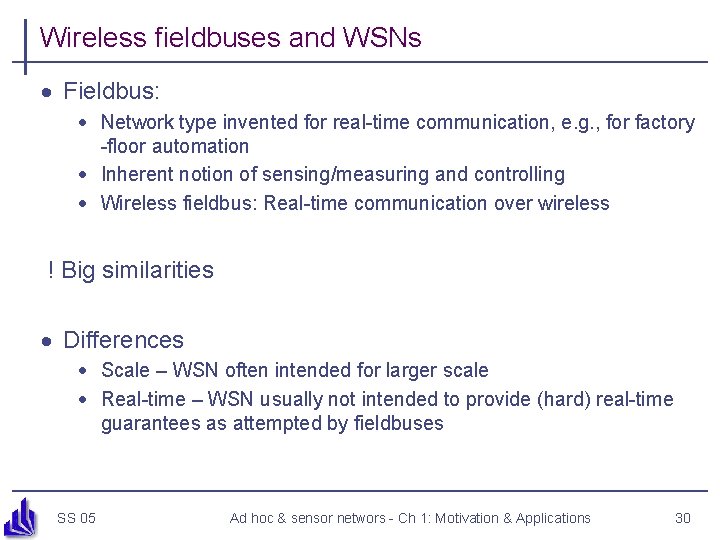
Wireless fieldbuses and WSNs · Fieldbus: · Network type invented for real-time communication, e. g. , for factory -floor automation · Inherent notion of sensing/measuring and controlling · Wireless fieldbus: Real-time communication over wireless ! Big similarities · Differences · Scale – WSN often intended for larger scale · Real-time – WSN usually not intended to provide (hard) real-time guarantees as attempted by fieldbuses SS 05 Ad hoc & sensor networs - Ch 1: Motivation & Applications 30
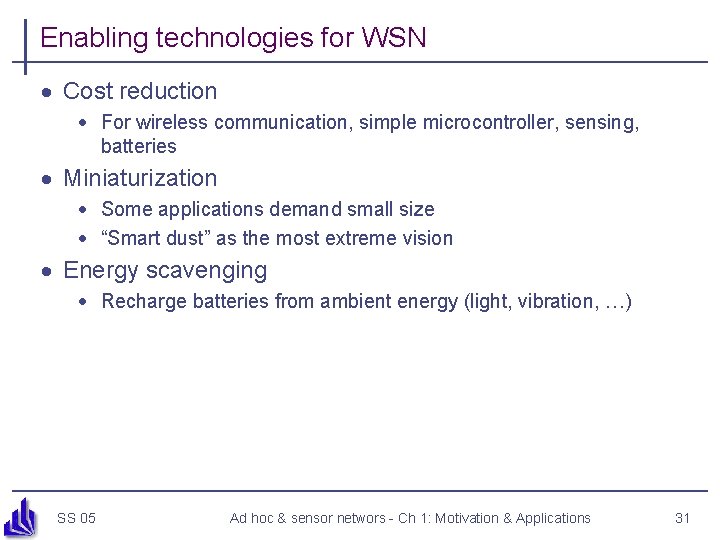
Enabling technologies for WSN · Cost reduction · For wireless communication, simple microcontroller, sensing, batteries · Miniaturization · Some applications demand small size · “Smart dust” as the most extreme vision · Energy scavenging · Recharge batteries from ambient energy (light, vibration, …) SS 05 Ad hoc & sensor networs - Ch 1: Motivation & Applications 31
Conclusion · MANETs and WSNs are challenging and promising system concepts · Many similarities, many differences · Both require new types of architectures & protocols compared to “traditional” wired/wireless networks · In particular, application-specificness is a new issue SS 05 Ad hoc & sensor networs - Ch 1: Motivation & Applications 32