
AD 70 The AD 70 Doctrine PART TWO
- Slides: 82
AD 70 The AD 70 Doctrine PART TWO In July Olsen Park will host a debate Holger Neubauer & Bruce Reeves “Will Jesus Really Come Again? ” Before this the elders have asked me to do some lessons to familiarize us with this unusual doctrine
AD 70 The AD 70 Doctrine TERMINOLOGY “AD 70 Doctrine” In AD 70 the Roman commander Titus besieged Jerusalem from April to September during which 1, 100, 000 died and 97, 000 were taken away captive (Josephus, Wars 6. 9. 3). 600, 000 dead bodies were thrown from the gates, and within the city the bodies of the dead lay in heaps (ibid. 5. 13. 7).
AD 70 The AD 70 Doctrine TERMINOLOGY “AD 70 Doctrine” During this horrible time, lack of food led to fighting over food, with the hungry gnawing on leather straps and sandals for some sustenance (ibid. 6. 3. 3). Some even killed nursing infants and cooked them for food (ibid. 6. 3. 4). Ultimately, the temple itself was burned, against the command of Titus (ibid. 6. 5. 1).
AD 70 The AD 70 Doctrine TERMINOLOGY “AD 70 Doctrine” 1. Jesus foretold this event (Matt. 24: 1 -3). 2. It was an act of Divine judgment (Luke 19: 41 -44) 3. THEORY: It fulfilled all promises of a final Day of Judgment, Christ’s Second Coming, and resurrection of the dead.
AD 70 The AD 70 Doctrine TERMINOLOGY Realized Eschatology “Eschatology” is the study of end times. REALIZED Eschatology—all end times events have been “realized”—no events yet to come. In NT, already the “last days” (Heb. 1: 1 -4). Some were promised to that generation alive at the time (Matt. 16: 27 -28; 23: 33 -36; 24: 34).
AD 70 The AD 70 Doctrine TERMINOLOGY Realized Eschatology Proponents of this view argue this means that all end times promises were fulfilled in the first century.
AD 70 The AD 70 Doctrine TERMINOLOGY Preterism Lat. Praeter “past” or “before” Unlike Premillennialism which argues there will be a future 1000 -year reign of Christ on earth, Preterism argues that end times events are now in the past.
AD 70 The AD 70 Doctrine TERMINOLOGY Preterism 1. Partial Preterism. Most members of the church (Matt. 28: 18; Col. 1: 13 -14). 2. Full Preterism. All things are now past. Some say we know nothing about life after death. Others say one goes to heaven or hell upon death, and apply Scriptures to the church or events of AD 70.
AD 70 The AD 70 Doctrine TERMINOLOGY Covenant Eschatology Transmillennialism™
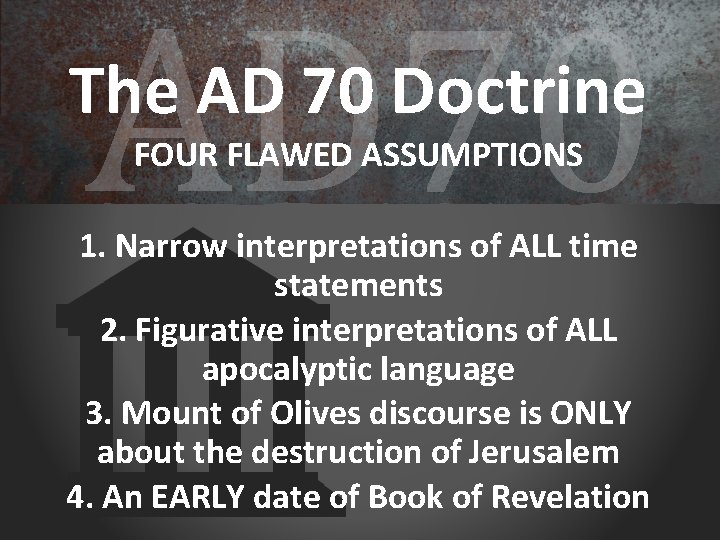
AD 70 The AD 70 Doctrine FOUR FLAWED ASSUMPTIONS 1. Narrow interpretations of ALL time statements 2. Figurative interpretations of ALL apocalyptic language 3. Mount of Olives discourse is ONLY about the destruction of Jerusalem 4. An EARLY date of Book of Revelation
AD 70 The AD 70 Doctrine FOUR FLAWED ASSUMPTIONS All of these assumptions must be correct for this doctrine to stand.
AD 70 The AD 70 Doctrine FOUR FLAWED ASSUMPTIONS If any of these assumptions are incorrect this doctrine collapses.
AD 70 The AD 70 Doctrine FOUR FLAWED ASSUMPTIONS 3. Mount of Olives discourse is ONLY about the destruction of Jerusalem
AD 70 The AD 70 Doctrine MOUNT OF OLIVES DISCOURSE Matthew 24: 1 -3 “Then Jesus went out and departed from the temple, and His disciples came up to show Him the buildings of the temple. And Jesus said to them, ‘Do you not see all these things? Assuredly, I say to you, not one stone shall be left here upon another, that shall not be thrown down. . . ’”
AD 70 The AD 70 Doctrine MOUNT OF OLIVES DISCOURSE Matthew 24: 1 -3 “. . . Now as He sat on the Mount of Olives, the disciples came to Him privately, saying, ‘Tell us, when will these things be? And what will be the sign of Your coming, and of the end of the age? ’” (NKJV).
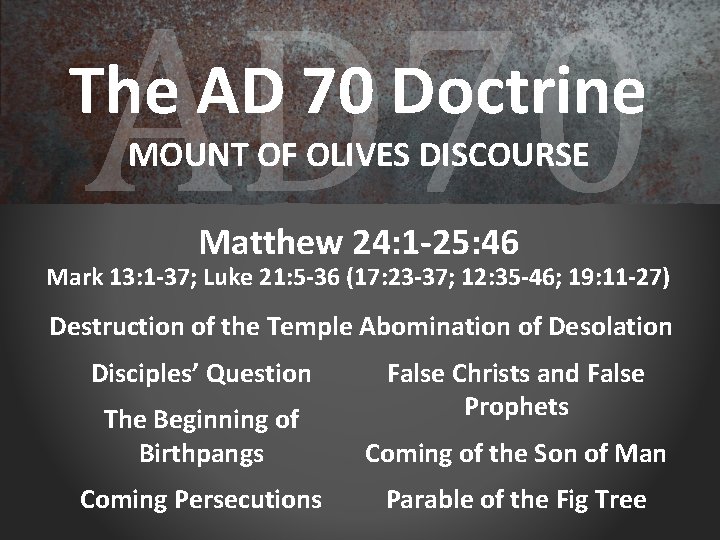
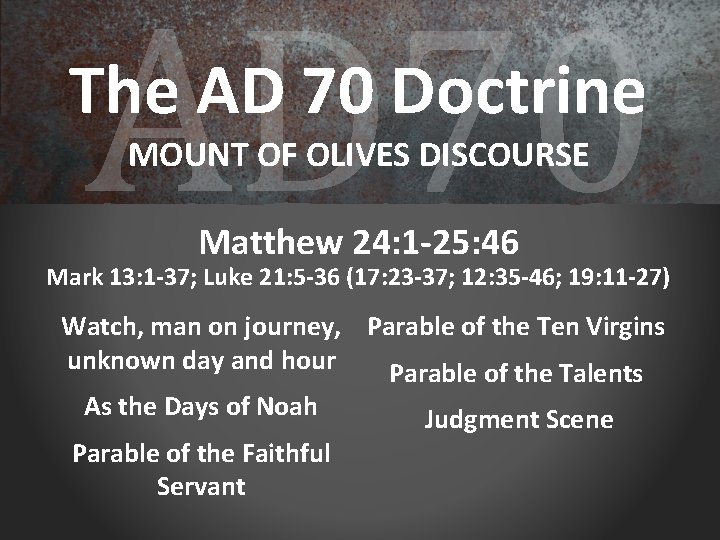
AD 70 The AD 70 Doctrine MOUNT OF OLIVES DISCOURSE Matthew 24: 1 -25: 46 Mark 13: 1 -37; Luke 21: 5 -36 (17: 23 -37; 12: 35 -46; 19: 11 -27) Destruction of the Temple Abomination of Desolation Disciples’ Question False Christs and False Prophets The Beginning of Birthpangs Coming of the Son of Man Coming Persecutions Parable of the Fig Tree
AD 70 The AD 70 Doctrine MOUNT OF OLIVES DISCOURSE Matthew 24: 1 -25: 46 Mark 13: 1 -37; Luke 21: 5 -36 (17: 23 -37; 12: 35 -46; 19: 11 -27) Watch, man on journey, Parable of the Ten Virgins unknown day and hour Parable of the Talents As the Days of Noah Judgment Scene Parable of the Faithful Servant
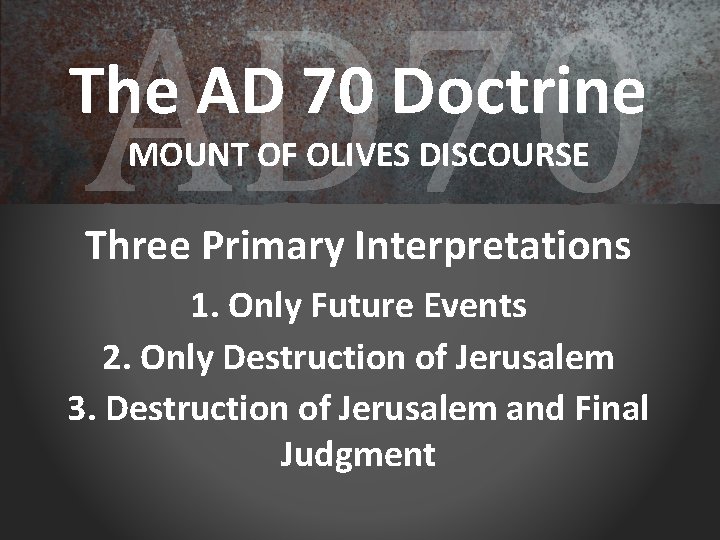
AD 70 The AD 70 Doctrine MOUNT OF OLIVES DISCOURSE Three Primary Interpretations 1. Only Future Events 2. Only Destruction of Jerusalem 3. Destruction of Jerusalem and Final Judgment
AD 70 The AD 70 Doctrine MOUNT OF OLIVES DISCOURSE A view that considers all of this in the future ignores the immediate context of Jesus’s foretelling of the temple’s destruction and relies on a hypothetical theory of a rebuilding of the temple. Premillennialism
AD 70 The AD 70 Doctrine MOUNT OF OLIVES DISCOURSE In the early 20 th Century some members of the church wrestled with this false doctrine. Vigorous teaching in those years led most to reject it.
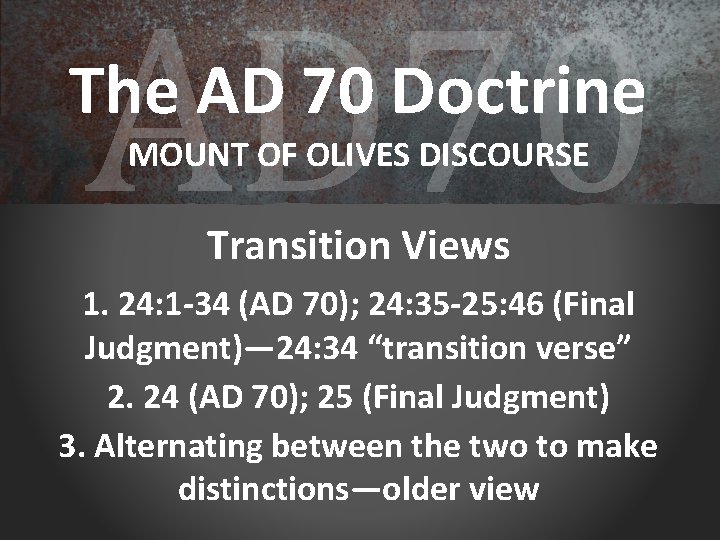
AD 70 The AD 70 Doctrine MOUNT OF OLIVES DISCOURSE Transition Views 1. 24: 1 -34 (AD 70); 24: 35 -25: 46 (Final Judgment)— 24: 34 “transition verse” 2. 24 (AD 70); 25 (Final Judgment) 3. Alternating between the two to make distinctions—older view
AD 70 The AD 70 Doctrine MOUNT OF OLIVES DISCOURSE The “AD 70 Doctrine” argues that all of the discourse dealt with the destruction of Jerusalem and none of it looks to a future coming, resurrection, or final judgment. Full-Preterism
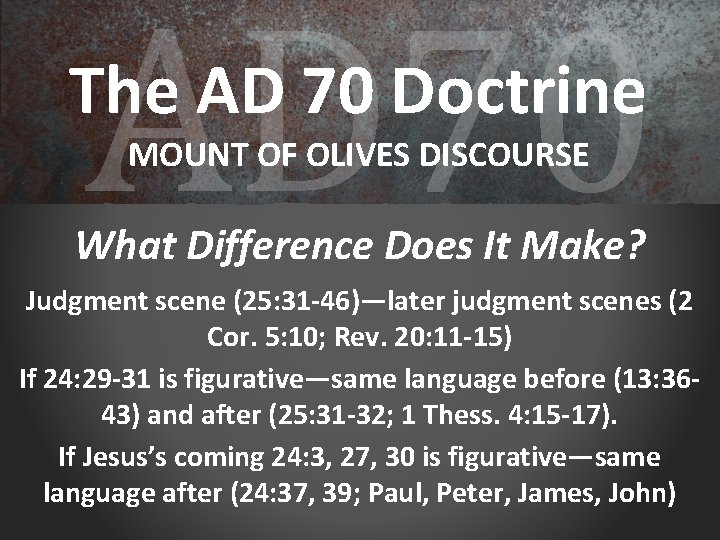
AD 70 The AD 70 Doctrine MOUNT OF OLIVES DISCOURSE What Difference Does It Make? Judgment scene (25: 31 -46)—later judgment scenes (2 Cor. 5: 10; Rev. 20: 11 -15) If 24: 29 -31 is figurative—same language before (13: 3643) and after (25: 31 -32; 1 Thess. 4: 15 -17). If Jesus’s coming 24: 3, 27, 30 is figurative—same language after (24: 37, 39; Paul, Peter, James, John)
AD 70 The AD 70 Doctrine MOUNT OF OLIVES DISCOURSE The “Transition Verse” View “Assuredly, I say to you, this generation will by no means pass away till all these things take place” (24: 34). ARGUMENT: “All these things” must refer to everything mentioned in 24: 1 -33.
AD 70 The AD 70 Doctrine MOUNT OF OLIVES DISCOURSE The Questions “Tell us, when will these things be? And what will be the sign of Your coming, and of the end of the age? ” (Matt. 24: 3 b)
AD 70 The AD 70 Doctrine MOUNT OF OLIVES DISCOURSE The Questions “Tell us, when will these things be? And what will be the sign when all these things will be fulfilled? ” (Mark 13: 4)
AD 70 The AD 70 Doctrine MOUNT OF OLIVES DISCOURSE The Questions “Teacher, but when will these things be? And what sign will there be when these things are about to take place? ” (Luke 21: 5 -6)
AD 70 The AD 70 Doctrine MOUNT OF OLIVES DISCOURSE Three Key Words “End” “Sign” “Coming (Gr. parousia)”
AD 70 The AD 70 Doctrine MOUNT OF OLIVES DISCOURSE What They Will and Will Not See False Christs (24: 4 -5) Wars (24: 6 -7) “The end is not yet” (24: 6 b) What “end” (cf. 24: 3; 13: 39, 49; 28: 20)?
AD 70 The AD 70 Doctrine MOUNT OF OLIVES DISCOURSE What They Will and Will Not See Preterists argue it is the end of the Jewish age (i. e. AD 70) Its use before and after this refute this conclusion. If Final Judgment—mentioned before 24: 34.
AD 70 The AD 70 Doctrine MOUNT OF OLIVES DISCOURSE What They Will and Will Not See Persecution and apostasy (24: 8 -12) “He who endures to the end shall be saved” (24: 13)—End of life? Gospel to all the world—“then the end will come” (24: 14).
AD 70 The AD 70 Doctrine MOUNT OF OLIVES DISCOURSE What They Will and Will Not See Gospel to all the world in First Century (Col. 1: 6) —end of Judaism? If Final Judgment, a third reference before 24: 34. Things they would not see or see that don’t signal “the end. ”
AD 70 The AD 70 Doctrine MOUNT OF OLIVES DISCOURSE What They Will and Will Not See First thing they would “see”—“Abomination of Desolation” (24: 15; Dan. 11: 31; 12: 11; 1 Macc. 1: 54, 59; cf. 2 Mac. 6: 1 -5)—“flee” (24: 16 -22) Preterism argues AD 70 was “the end” and Christ’s coming. Does that match the text?
AD 70 The AD 70 Doctrine MOUNT OF OLIVES DISCOURSE What They Will and Will Not See Jesus says don’t believe claims that the Christ has come (24: 23 -26). His true, final “coming (parousia)” will be like lightning (24: 27). The very fact that we debate if AD 70 was His coming proves it could not have been!
AD 70 The AD 70 Doctrine MOUNT OF OLIVES DISCOURSE What They Will and Will Not See PIVOTAL PASSAGE (24: 29 -31). “Great Tribulation” can’t = “coming of the Son of Man”—it comes “after” it. “Immediately” = “straightaway” (KJV)—cf. 26: 64 —broadly applied time statement.
AD 70 The AD 70 Doctrine MOUNT OF OLIVES DISCOURSE What They Will and Will Not See Matthew, Mark, & Luke all include “what is the sign” in the question. Only Matthew records a direct answer. They will “see” the Abomination of Desolation, but the “sign” of Jesus’s coming will be His coming (24: 30)—Unpredictable (cf. 24: 36 -44)
AD 70 The AD 70 Doctrine MOUNT OF OLIVES DISCOURSE What They Will and Will Not See Are 24: 29 -31 figurative of AD 70? If so, cf. 25: 31 -32—is that figurative? Preterists say yes—“transition verse” view says yes and. no—I say, no! Jesus looks ahead to Final Judgment using the same language used before and after this in the NT the same way.
AD 70 The AD 70 Doctrine MOUNT OF OLIVES DISCOURSE What are “all these things” (24: 34)? The things He said they would see (i. e. “Abomination of Desolation”— “Great Tribulation” (cf. 23: 34 -36)
AD 70 The AD 70 Doctrine MOUNT OF OLIVES DISCOURSE “Your Coming” Are there Divine “comings” that are not visible? Yes (cf. Matt. 16: 28; John 14: 23; etc. ) Can parousia be used that way? No!
AD 70 The AD 70 Doctrine MOUNT OF OLIVES DISCOURSE “Your Coming” Eng. “coming” movement and direction “How could the disciples have asked about His second coming when they did not believe He would be killed? ” (R. L. Whiteside, Doctrinal Discourses, 295).
AD 70 The AD 70 Doctrine MOUNT OF OLIVES DISCOURSE “Your Coming” No, they did not yet understand He would later ascend to heaven and then return in judgment. Gr. parousia, is not movement and direction but presence and location.
AD 70 The AD 70 Doctrine MOUNT OF OLIVES DISCOURSE “Your Coming” Parousia noun from the prep. para (“beside, alongside”) and ousia (the present participle of the verb eimi, meaning “to be”). Participles = “-ing” words. Not “I see” or “you see, ” but “seeing”—participle of verb “to see. ”
AD 70 The AD 70 Doctrine MOUNT OF OLIVES DISCOURSE “Your Coming” Ousia not “I am” or “you are” but “being. ” Combined with para—a noun that literally means “being beside” someone or something.
AD 70 The AD 70 Doctrine MOUNT OF OLIVES DISCOURSE “Your Coming” Literal sense is well-attested. “Not as in my presence (parousia) only, but now much more in my absence (apousia)” (Phil. 2: 12). “His bodily presence (parousia) is weak, and his speech is contemptible” (2 Cor. 10: 10).
AD 70 The AD 70 Doctrine MOUNT OF OLIVES DISCOURSE “Your Coming” Literal sense is well-attested. “I am glad about the coming (parousia) of Stephanas, Fortunatus, and Achaicus” (1 Cor. 16: 17). Comforted “by the coming (parousia) of Titus, and not only by his coming (parousia), but also by the consolation with which he was comforted in you” (2 Cor. 7: 6 -7).
AD 70 The AD 70 Doctrine MOUNT OF OLIVES DISCOURSE “Your Coming” Literal sense is well-attested: Longs to comfort the Philippians by his “coming (parousia)” (Phil. 1: 26). In each example it is the actual “presence” of the one being considered that is addressed in the word parousia.
AD 70 The AD 70 Doctrine MOUNT OF OLIVES DISCOURSE Evidence from Ancient Greek Thucydides—military force present vs. elsewhere (The Peloponnesian War 6. 86. 3). Sophocles support of friends by their presence (Electra 948). Actual presence of bad things (Euripides, Hecuba 227; Aeschylus king’s presence protecting palace (Persians 169). Aristophanes, Thesmophoriazus Euripides those present to bury a ae 1049) or of good things (Plato, Gorgias 497 e). dead body (Alcestis 606).
AD 70 The AD 70 Doctrine MOUNT OF OLIVES DISCOURSE Evidence from Ancient Greek Misfortune could be described Not of a figurative presence as “visitations” (using the of misfortune, but its actual plural of parousia) of chance presence in the life of those (Demo-sthenes, Exordia 39. 2). affected by it.
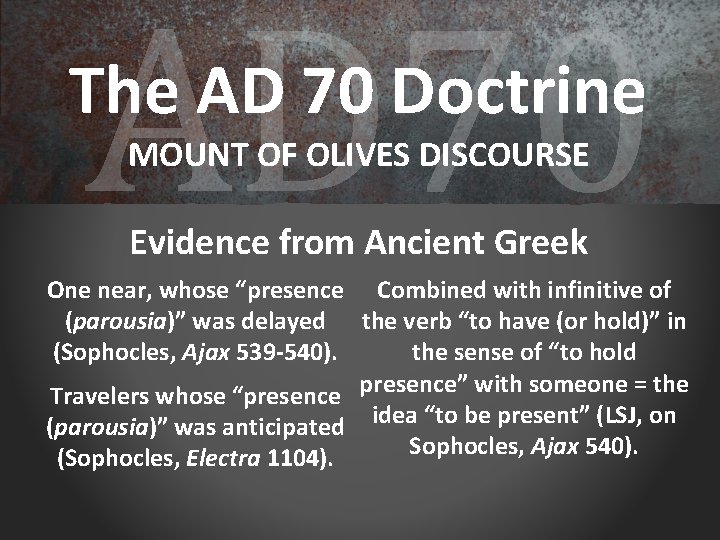
AD 70 The AD 70 Doctrine MOUNT OF OLIVES DISCOURSE Evidence from Ancient Greek One near, whose “presence Combined with infinitive of (parousia)” was delayed the verb “to have (or hold)” in (Sophocles, Ajax 539 -540). the sense of “to hold Travelers whose “presence” with someone = the (parousia)” was anticipated idea “to be present” (LSJ, on Sophocles, Ajax 540). (Sophocles, Electra 1104).
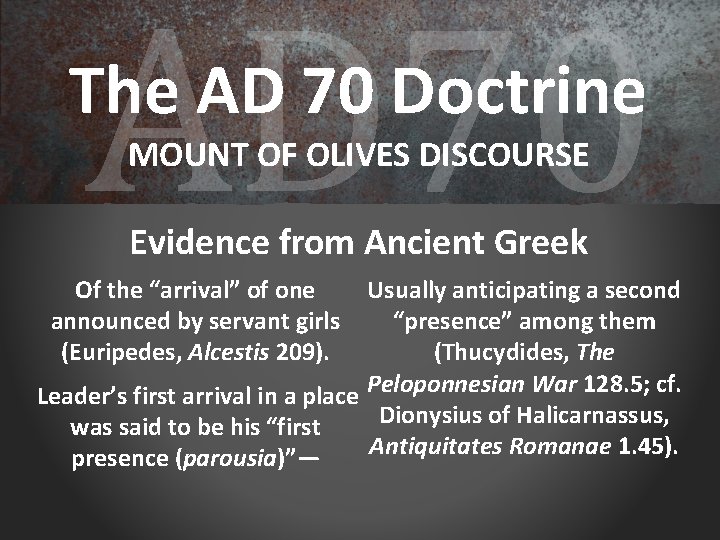
AD 70 The AD 70 Doctrine MOUNT OF OLIVES DISCOURSE Evidence from Ancient Greek Usually anticipating a second “presence” among them (Thucydides, The Leader’s first arrival in a place Peloponnesian War 128. 5; cf. Dionysius of Halicarnassus, was said to be his “first Antiquitates Romanae 1. 45). presence (parousia)”— Of the “arrival” of one announced by servant girls (Euripedes, Alcestis 209).
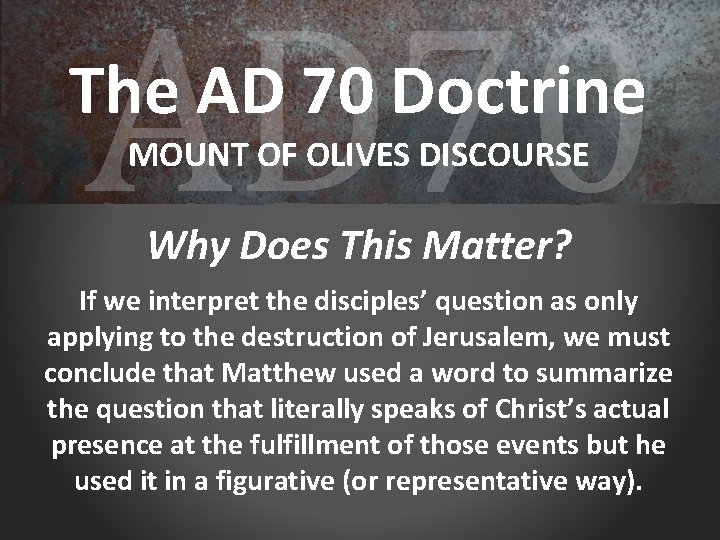
AD 70 The AD 70 Doctrine MOUNT OF OLIVES DISCOURSE Why Does This Matter? If we interpret the disciples’ question as only applying to the destruction of Jerusalem, we must conclude that Matthew used a word to summarize the question that literally speaks of Christ’s actual presence at the fulfillment of those events but he used it in a figurative (or representative way).
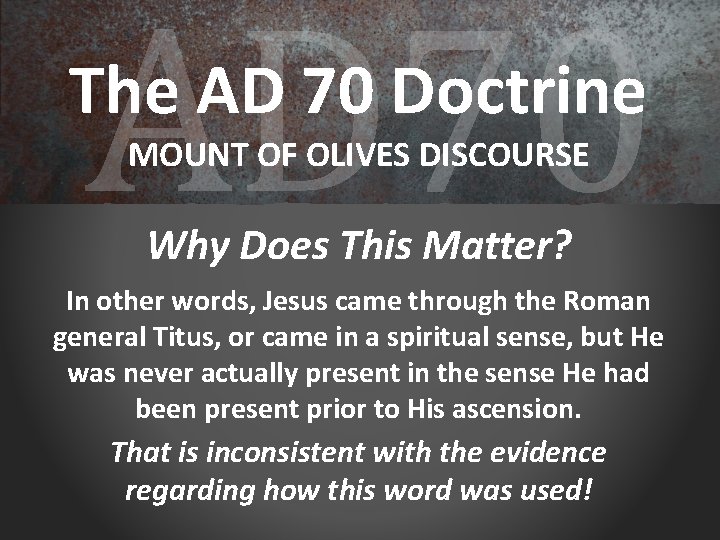
AD 70 The AD 70 Doctrine MOUNT OF OLIVES DISCOURSE Why Does This Matter? In other words, Jesus came through the Roman general Titus, or came in a spiritual sense, but He was never actually present in the sense He had been present prior to His ascension. That is inconsistent with the evidence regarding how this word was used!
AD 70 The AD 70 Doctrine MOUNT OF OLIVES DISCOURSE Why Does This Matter? Parousia is used three more times in the Discourse after their initial question. In each of these instances, Jesus seems to be responding directly to the wording of their question. If Matthew uses it figuratively he uses it in a way that does not correspond to its basic meaning.
AD 70 The AD 70 Doctrine MOUNT OF OLIVES DISCOURSE Preterist Books James Stuart Russel. The Parousia: A Critical Inquiry into the New Testament Doctrine of Our Lord’s Second Coming. London: Daldy, Isbister, & Co. , 1878. Max R. King. The Cross and the Parousia of Christ: The Two Dimensions of One Age-Changing Eschaton. Warren, OH: Parkman Road Church of Christ, 1987.
AD 70 The AD 70 Doctrine MOUNT OF OLIVES DISCOURSE Preterist Books Neither book spends much time addressing the actual meaning of the word parousia. Both books look at scores of references to various “comings” of the Lord and apply the word parousia to all of them.
AD 70 The AD 70 Doctrine MOUNT OF OLIVES DISCOURSE Compare Baptism Baptizō means “to immerse” and the noun baptisma means “immersion. ” It is not sprinkling, pouring, or anointing. Imagine a book applying every biblical reference to water to baptism!
AD 70 The AD 70 Doctrine MOUNT OF OLIVES DISCOURSE Parousia as a Technical Term “Became the official term for a visit of a person of high rank, especially of kings and emperors visiting a province” (BAGD). Ptolemaic Period (323 -30 BC) contributions for crown before “arrival (parousia)” of a king (P. Petr. II. 39 e. 18).
AD 70 The AD 70 Doctrine MOUNT OF OLIVES DISCOURSE Parousia as a Technical Term “Became the official term for a visit of a person of high rank, especially of kings and emperors visiting a province” (BAGD). Food preparation before the coming of an administrator (P. Grenf. II. 14 b. 2). Grain for the “parousia of the king” (P. Tebt. 48. 14).
AD 70 The AD 70 Doctrine MOUNT OF OLIVES DISCOURSE Parousia as a Technical Term “Became the official term for a visit of a person of high rank, especially of kings and emperors visiting a province” (BAGD). Roman Period: Polybius of the arrival of a king (Histories 12. 19. 4; 18. 4) or commander (ibid. 2. 27. 6 -7).
AD 70 The AD 70 Doctrine MOUNT OF OLIVES DISCOURSE Parousia as a Technical Term “Became the official term for a visit of a person of high rank, especially of kings and emperors visiting a province” (BAGD). Josephus coming of a king (Antiquities 11. 328; 19. 339; Wars 2. 617), elders (ibid. 12. 86, 93) or an ambassador (ibid. 12. 160)—but not representatively.
AD 70 The AD 70 Doctrine MOUNT OF OLIVES DISCOURSE Parousia as a Technical Term “Became the official term for a visit of a person of high rank, especially of kings and emperors visiting a province” (BAGD). Josephus speaks of the parousia of Titus, the Roman general who besieged and destroyed Jerusalem, but does not call it the parousia of the Lord (Wars 5. 410).
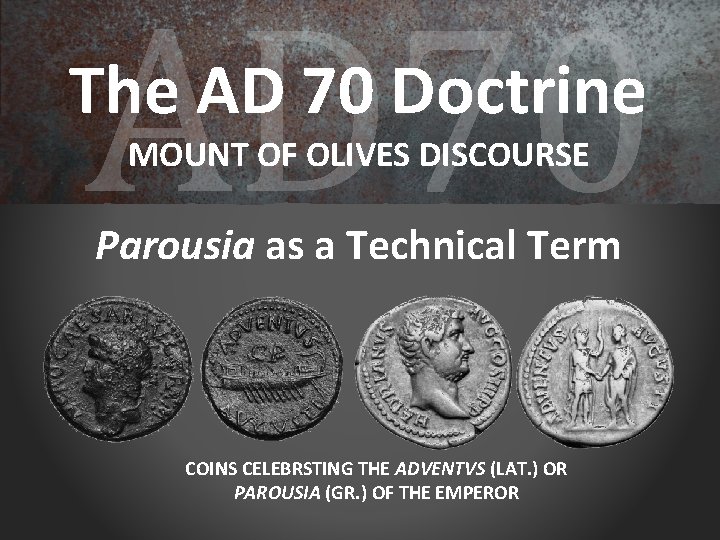
AD 70 The AD 70 Doctrine MOUNT OF OLIVES DISCOURSE Parousia as a Technical Term COINS CELEBRSTING THE ADVENTVS (LAT. ) OR PAROUSIA (GR. ) OF THE EMPEROR
AD 70 The AD 70 Doctrine MOUNT OF OLIVES DISCOURSE Parousia as a Technical Term “The word served as a sacred expression for the coming of a hidden divinity, who makes his presence felt by a revelation of his power, or whose presence is celebrated in the cult” (BAGD). The idea was that the actual presence of the Deity was there—not figuratively or representatively (cf. Diodorus Siculus, Bibliotheca Historica 3. 65. 1; Josephus, Antiquities 3. 80, 202, 203; 9. 55).
AD 70 The AD 70 Doctrine MOUNT OF OLIVES DISCOURSE Parousia as a Technical Term “The word served as a sacred expression for the coming of a hidden divinity, who makes his presence felt by a revelation of his power, or whose presence is celebrated in the cult” (BAGD). Advocates of the “AD 70 Doctrine” do not generally argue that the Lord was literally present in AD 70.
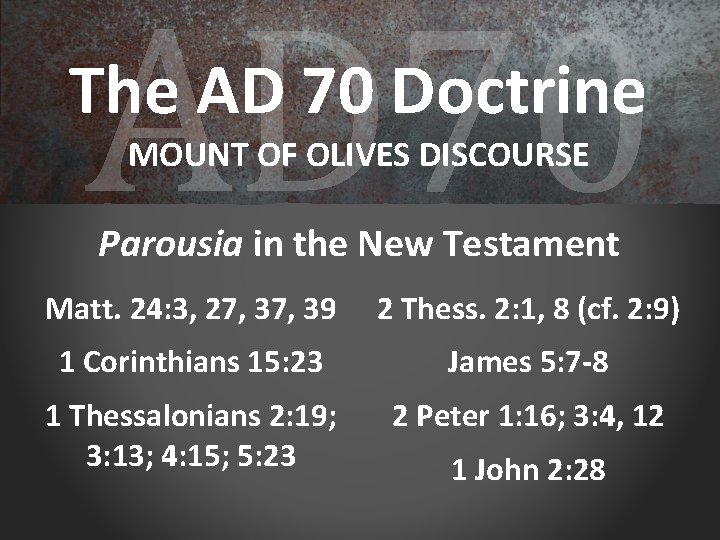
AD 70 The AD 70 Doctrine MOUNT OF OLIVES DISCOURSE Parousia in the New Testament Matt. 24: 3, 27, 39 2 Thess. 2: 1, 8 (cf. 2: 9) 1 Corinthians 15: 23 James 5: 7 -8 1 Thessalonians 2: 19; 3: 13; 4: 15; 5: 23 2 Peter 1: 16; 3: 4, 12 1 John 2: 28
AD 70 The AD 70 Doctrine MOUNT OF OLIVES DISCOURSE The use of parousia and other end times language in the Olivet Discourse lay the foundation for gospel teaching on eschatology drawn upon throughout the rest of the New Testament.
AD 70 The AD 70 Doctrine MOUNT OF OLIVES DISCOURSE Preterists are correct that if we take these things figuratively in the Olivet Discourse we should logically do the same elsewhere. The overall evidence indicates they are not being used figuratively.
AD 70 The AD 70 Doctrine MOUNT OF OLIVES DISCOURSE Parallels in Old Testament apocalyptic language do not demand that we understand them as figurative. Old Testament parallels foreshadow the realities revealed in Christ.
AD 70 The AD 70 Doctrine MOUNT OF OLIVES DISCOURSE Mosaic food and drink laws “shadow of things to come, but the substance is of Christ” (Col. 2: 17). Full-Preterism treats OT parallels as the “substance” and NT language as the “shadow. ”
AD 70 The AD 70 Doctrine MOUNT OF OLIVES DISCOURSE Parousia after the New Testament Justin Martyr born ca. AD 100 in region of Samaria Did not interpret AD 70 as the parousia of Christ. “For the prophets have proclaimed two advents (parousia) of His: the one, that which is already past, when He came as a dishonored and suffering Man; but the second, when, according to prophecy, He shall come from heaven with glory, accompanied. . . ”
AD 70 The AD 70 Doctrine MOUNT OF OLIVES DISCOURSE Parousia after the New Testament Justin Martyr born ca. AD 100 in region of Samaria Did not interpret AD 70 as the parousia of Christ. “. . . by His angelic host, when also He shall raise the bodies of all men who have lived, and shall clothe those of the worthy with immortality, and shall send those of the wicked, endued with eternal sensibility, into everlasting fire with the wicked devils” (First Apology 52. 3).
AD 70 The AD 70 Doctrine MOUNT OF OLIVES DISCOURSE Parousia after the New Testament Justin Martyr born ca. AD 100 in region of Samaria Did not interpret AD 70 as the parousia of Christ. Like the New Testament, this concept of Jesus’s incarnation as His first parousia runs throughout the writings of Justin (e. g. 1 Apology 54. 7; 48: 2; Dialogue with Trypho 36. 1; 53. 1; 88. 2; 118. 2; 120. 3).
AD 70 The AD 70 Doctrine MOUNT OF OLIVES DISCOURSE Parousia after the New Testament Justin Martyr born ca. AD 100 in region of Samaria Did not interpret AD 70 as the parousia of Christ. Justin is the first to explicitly call the parousia promised in the Olivet Discourse His “second parousia. ”
AD 70 The AD 70 Doctrine MOUNT OF OLIVES DISCOURSE Parousia after the New Testament Justin Martyr born ca. AD 100 in region of Samaria Dialogue with Trypho, a discussion with a Jew who had come to Ephesus fleeing the Bar Kochba rebellion—tries to persuade him that Jesus is the promised OT Messiah He repeatedly asserts a first and second parousia of the Messiah.
AD 70 The AD 70 Doctrine MOUNT OF OLIVES DISCOURSE Parousia after the New Testament Justin Martyr born ca. AD 100 in region of Samaria “Some have reference to the first advent (parousia) of Christ, in which He is preached as inglorious, obscure, and of mortal appearance: but others had reference to His second advent (parousia), when He shall appear in glory and above the clouds; and your nation shall see and know Him whom they have pierced, as Hosea, one of the twelve prophets, and Daniel, foretold” (14. 8)
AD 70 The AD 70 Doctrine MOUNT OF OLIVES DISCOURSE Parousia after the New Testament Justin Martyr born ca. AD 100 in region of Samaria He considered it a future event in which Jesus would “come on the clouds” (31. 1), “from heaven with glory” (110. 2), to condemn death “at the second coming (parousia) of the Christ Himself” and send some to eternal life and others “to be punished unceasingly” (45. 4), when He would act as “Judge of all” (49. 2).
AD 70 The AD 70 Doctrine MOUNT OF OLIVES DISCOURSE Parousia after the New Testament Justin Martyr born ca. AD 100 in region of Samaria For Justin, those who believed in Jesus, yet suffered “under a defect of the body” could trust in the hope that “He shall raise him up at His second advent (parousia) perfectly sound, after He has made him immortal, and incorruptible, and free from grief” (69. 7).
AD 70 The AD 70 Doctrine MOUNT OF OLIVES DISCOURSE Parousia after the New Testament Justin Martyr born ca. AD 100 in region of Samaria “. . . Amongst whom He is always present (pareimi) in power, but will be manifestly (enargōs) present (pareimi) at His second coming (parousia)” (54. 1 -2).
AD 70 The AD 70 Doctrine MOUNT OF OLIVES DISCOURSE Parousia after the New Testament Greek speaking Christians would not have understood parousia in a figurative or representative sense and neither should we. I don’t know how Jesus could have made it more clear that His final coming will be visible, palpable, and actual!
AD 70 The AD 70 Doctrine FOUR FLAWED ASSUMPTIONS To argue that the Mount of Olives Discourse only applies to AD 70 ignores numerous teachings in the discourse about the nature of Christ’s coming.
AD 70 The AD 70 Doctrine FOUR FLAWED ASSUMPTIONS It fails to address the consistent meaning of the word parousia as it is used throughout the Discourse, the rest of the New Testament, in general usage in the ancient world, and in the earliest writing by Christians after the New Testament.
AD 70 The AD 70 Doctrine FOUR FLAWED ASSUMPTIONS It must ignore the consistent use of parallel wording throughout the New Testament to Final Judgment and therefore must be rejected.