
Acute Traumatic Navicular Fracture A Rare Case Study
- Slides: 1
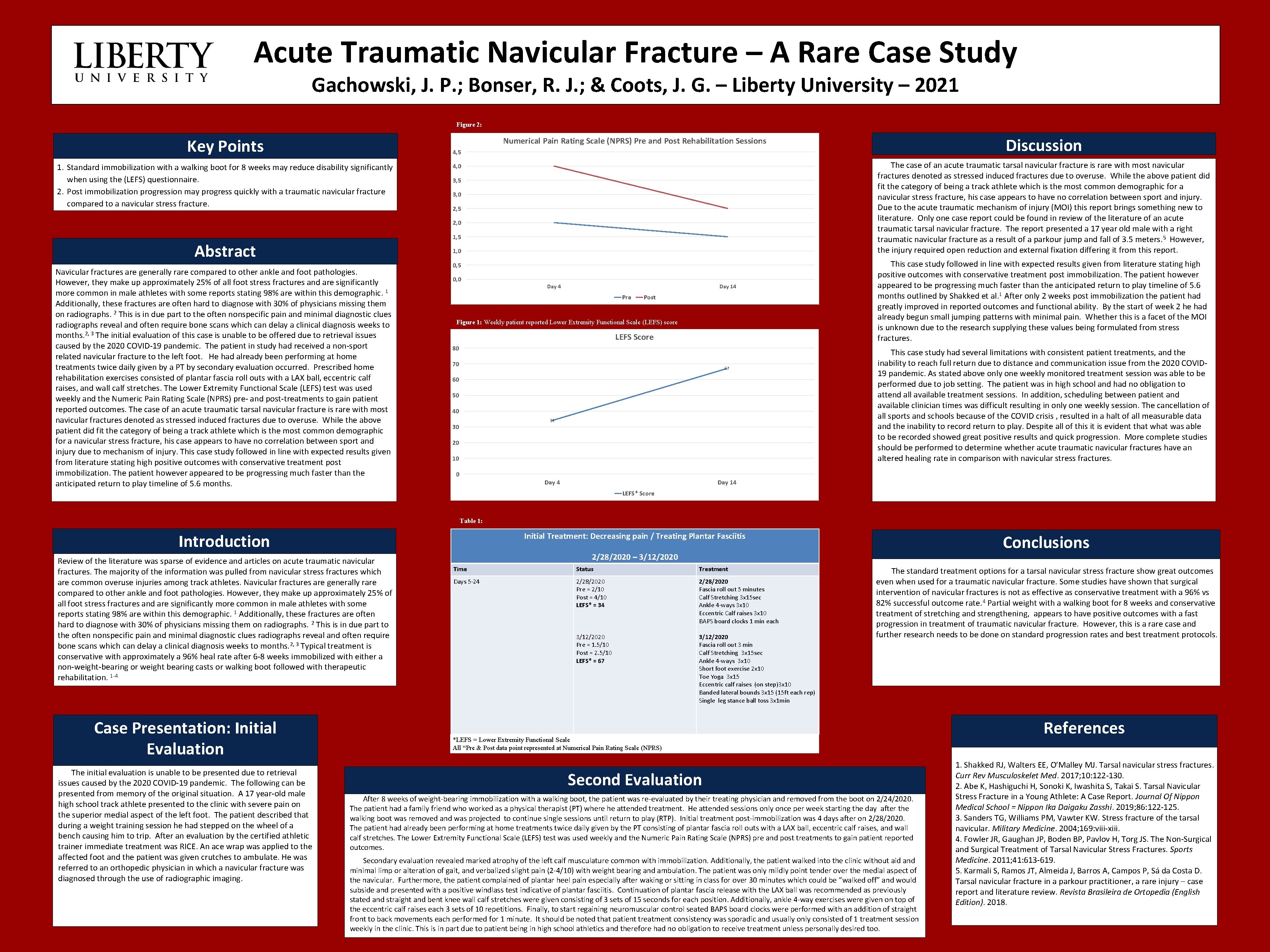
Acute Traumatic Navicular Fracture – A Rare Case Study Gachowski, J. P. ; Bonser, R. J. ; & Coots, J. G. – Liberty University – 2021 Figure 2: Key Points Discussion Numerical Pain Rating Scale (NPRS) Pre and Post Rehabilitation Sessions 4, 5 1. Standard immobilization with a walking boot for 8 weeks may reduce disability significantly when using the (LEFS) questionnaire. 2. Post immobilization progression may progress quickly with a traumatic navicular fracture compared to a navicular stress fracture. The case of an acute traumatic tarsal navicular fracture is rare with most navicular fractures denoted as stressed induced fractures due to overuse. While the above patient did fit the category of being a track athlete which is the most common demographic for a navicular stress fracture, his case appears to have no correlation between sport and injury. Due to the acute traumatic mechanism of injury (MOI) this report brings something new to literature. Only one case report could be found in review of the literature of an acute traumatic tarsal navicular fracture. The report presented a 17 year old male with a right traumatic navicular fracture as a result of a parkour jump and fall of 3. 5 meters. 5 However, the injury required open reduction and external fixation differing it from this report. 4, 0 3, 5 3, 0 2, 5 2, 0 1, 5 Abstract 1, 0 Navicular fractures are generally rare compared to other ankle and foot pathologies. However, they make up approximately 25% of all foot stress fractures and are significantly more common in male athletes with some reports stating 98% are within this demographic. 1 Additionally, these fractures are often hard to diagnose with 30% of physicians missing them on radiographs. 2 This is in due part to the often nonspecific pain and minimal diagnostic clues radiographs reveal and often require bone scans which can delay a clinical diagnosis weeks to months. 2, 3 The initial evaluation of this case is unable to be offered due to retrieval issues caused by the 2020 COVID-19 pandemic. The patient in study had received a non-sport related navicular fracture to the left foot. He had already been performing at home treatments twice daily given by a PT by secondary evaluation occurred. Prescribed home rehabilitation exercises consisted of plantar fascia roll outs with a LAX ball, eccentric calf raises, and wall calf stretches. The Lower Extremity Functional Scale (LEFS) test was used weekly and the Numeric Pain Rating Scale (NPRS) pre- and post-treatments to gain patient reported outcomes. The case of an acute traumatic tarsal navicular fracture is rare with most navicular fractures denoted as stressed induced fractures due to overuse. While the above patient did fit the category of being a track athlete which is the most common demographic for a navicular stress fracture, his case appears to have no correlation between sport and injury due to mechanism of injury. This case study followed in line with expected results given from literature stating high positive outcomes with conservative treatment post immobilization. The patient however appeared to be progressing much faster than the anticipated return to play timeline of 5. 6 months. 0, 5 0, 0 Day 4 Day 14 Pre Post Figure 1: Weekly patient reported Lower Extremity Functional Scale (LEFS) score LEFS Score 80 70 67 60 50 40 34 30 20 10 0 Day 4 This case study followed in line with expected results given from literature stating high positive outcomes with conservative treatment post immobilization. The patient however appeared to be progressing much faster than the anticipated return to play timeline of 5. 6 months outlined by Shakked et al. 1 After only 2 weeks post immobilization the patient had greatly improved in reported outcomes and functional ability. By the start of week 2 he had already begun small jumping patterns with minimal pain. Whether this is a facet of the MOI is unknown due to the research supplying these values being formulated from stress fractures. This case study had several limitations with consistent patient treatments, and the inability to reach full return due to distance and communication issue from the 2020 COVID 19 pandemic. As stated above only one weekly monitored treatment session was able to be performed due to job setting. The patient was in high school and had no obligation to attend all available treatment sessions. In addition, scheduling between patient and available clinician times was difficult resulting in only one weekly session. The cancellation of all sports and schools because of the COVID crisis , resulted in a halt of all measurable data and the inability to record return to play. Despite all of this it is evident that was able to be recorded showed great positive results and quick progression. More complete studies should be performed to determine whether acute traumatic navicular fractures have an altered healing rate in comparison with navicular stress fractures. Day 14 LEFS* Score Table 1: Introduction Initial Treatment: Decreasing pain / Treating Plantar Fasciitis Review of the literature was sparse of evidence and articles on acute traumatic navicular fractures. The majority of the information was pulled from navicular stress fractures which are common overuse injuries among track athletes. Navicular fractures are generally rare compared to other ankle and foot pathologies. However, they make up approximately 25% of all foot stress fractures and are significantly more common in male athletes with some reports stating 98% are within this demographic. 1 Additionally, these fractures are often hard to diagnose with 30% of physicians missing them on radiographs. 2 This is in due part to the often nonspecific pain and minimal diagnostic clues radiographs reveal and often require bone scans which can delay a clinical diagnosis weeks to months. 2, 3 Typical treatment is conservative with approximately a 96% heal rate after 6 -8 weeks immobilized with either a non-weight-bearing or weight bearing casts or walking boot followed with therapeutic rehabilitation. 1 -4 Case Presentation: Initial Evaluation The initial evaluation is unable to be presented due to retrieval issues caused by the 2020 COVID-19 pandemic. The following can be presented from memory of the original situation. A 17 year-old male high school track athlete presented to the clinic with severe pain on the superior medial aspect of the left foot. The patient described that during a weight training session he had stepped on the wheel of a bench causing him to trip. After an evaluation by the certified athletic trainer immediate treatment was RICE. An ace wrap was applied to the affected foot and the patient was given crutches to ambulate. He was referred to an orthopedic physician in which a navicular fracture was diagnosed through the use of radiographic imaging. Conclusions 2/28/2020 – 3/12/2020 Time Status Treatment Days 5 -24 2/28/2020 Pre = 2/10 Post = 4/10 LEFS* = 34 2/28/2020 Fascia roll out 5 minutes Calf Stretching 3 x 15 sec Ankle 4 -ways 3 x 10 Eccentric Calf raises 3 x 10 BAPS board clocks 1 min each 3/12/2020 Pre = 1. 5/10 Post = 2. 5/10 LEFS* = 67 3/12/2020 Fascia roll out 3 min Calf Stretching 3 x 15 sec Ankle 4 -ways 3 x 10 Short foot exercise 2 x 10 Toe Yoga 3 x 15 Eccentric calf raises (on step)3 x 10 Banded lateral bounds 3 x 15 (15 ft each rep) Single leg stance ball toss 3 x 1 min The standard treatment options for a tarsal navicular stress fracture show great outcomes even when used for a traumatic navicular fracture. Some studies have shown that surgical intervention of navicular fractures is not as effective as conservative treatment with a 96% vs 82% successful outcome rate. 4 Partial weight with a walking boot for 8 weeks and conservative treatment of stretching and strengthening, appears to have positive outcomes with a fast progression in treatment of traumatic navicular fracture. However, this is a rare case and further research needs to be done on standard progression rates and best treatment protocols. *LEFS = Lower Extremity Functional Scale All “Pre & Post data point represented at Numerical Pain Rating Scale (NPRS) Second Evaluation After 8 weeks of weight-bearing immobilization with a walking boot, the patient was re-evaluated by their treating physician and removed from the boot on 2/24/2020. The patient had a family friend who worked as a physical therapist (PT) where he attended treatment. He attended sessions only once per week starting the day after the walking boot was removed and was projected to continue single sessions until return to play (RTP). Initial treatment post-immobilization was 4 days after on 2/28/2020. The patient had already been performing at home treatments twice daily given by the PT consisting of plantar fascia roll outs with a LAX ball, eccentric calf raises, and wall calf stretches. The Lower Extremity Functional Scale (LEFS) test was used weekly and the Numeric Pain Rating Scale (NPRS) pre and post treatments to gain patient reported outcomes. Secondary evaluation revealed marked atrophy of the left calf musculature common with immobilization. Additionally, the patient walked into the clinic without aid and minimal limp or alteration of gait, and verbalized slight pain (2 -4/10) with weight bearing and ambulation. The patient was only mildly point tender over the medial aspect of the navicular. Furthermore, the patient complained of plantar heel pain especially after waking or sitting in class for over 30 minutes which could be “walked off” and would subside and presented with a positive windlass test indicative of plantar fasciitis. Continuation of plantar fascia release with the LAX ball was recommended as previously stated and straight and bent knee wall calf stretches were given consisting of 3 sets of 15 seconds for each position. Additionally, ankle 4 -way exercises were given on top of the eccentric calf raises each 3 sets of 10 repetitions. Finally, to start regaining neuromuscular control seated BAPS board clocks were performed with an addition of straight front to back movements each performed for 1 minute. It should be noted that patient treatment consistency was sporadic and usually only consisted of 1 treatment session weekly in the clinic. This is in part due to patient being in high school athletics and therefore had no obligation to receive treatment unless personally desired too. References 1. Shakked RJ, Walters EE, O’Malley MJ. Tarsal navicular stress fractures. Curr Rev Musculoskelet Med. 2017; 10: 122 -130. 2. Abe K, Hashiguchi H, Sonoki K, Iwashita S, Takai S. Tarsal Navicular Stress Fracture in a Young Athlete: A Case Report. Journal Of Nippon Medical School = Nippon Ika Daigaku Zasshi. 2019; 86: 122 -125. 3. Sanders TG, Williams PM, Vawter KW. Stress fracture of the tarsal navicular. Military Medicine. 2004; 169: viii-xiii. 4. Fowler JR, Gaughan JP, Boden BP, Pavlov H, Torg JS. The Non-Surgical and Surgical Treatment of Tarsal Navicular Stress Fractures. Sports Medicine. 2011; 41: 613 -619. 5. Karmali S, Ramos JT, Almeida J, Barros A, Campos P, Sá da Costa D. Tarsal navicular fracture in a parkour practitioner, a rare injury – case report and literature review. Revista Brasileira de Ortopedia (English Edition). 2018.