
ACUTE RESPONSES TO EXERCISE KEY KNOWLEDGE The mechanisms








- Slides: 46
ACUTE RESPONSES TO EXERCISE KEY KNOWLEDGE The mechanisms responsible for the acute responses to exercise in the cardiovascular, respiratory and muscular systems Oxygen uptake at rest, during exercise and during recovery including oxygen deficit, steady state and excess post-exercise oxygen consumption KEY SKILL Participate in physical activities to collect and analyse data relating to the range of acute effects that physical activity has on the cardiovascular, respiratory and muscular systems of the body
FOOD FOR THOUGHT After completing the prac on Acute Responses to exercise think about why Your heart rate increased? Your breathing increased? The colour of your face changed? You started sweating?
WHAT ARE ACUTE RESPONSES? ? • Only occur for the duration of exercise and recovery. Short Term. • Are dependent on the intensity, duration and type of exercise being undertaken • Involve the respiratory, cardiovascular and muscular systems working together to supply more energy / ATP and oxygen to working muscles and then again to remove any waste products
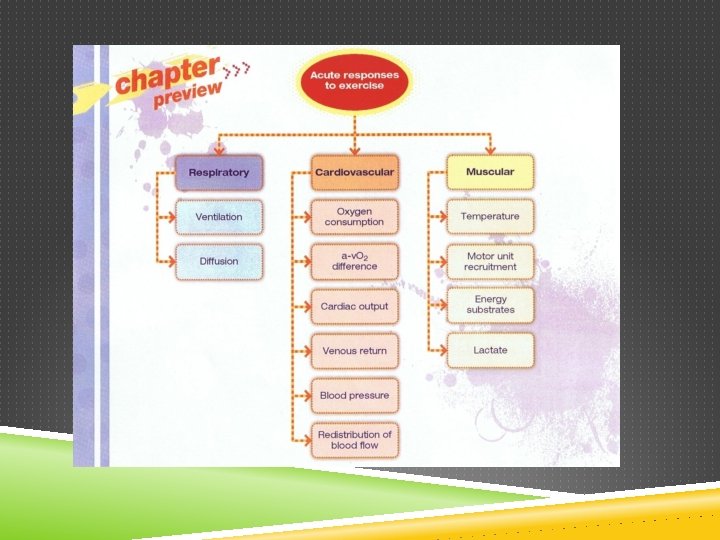
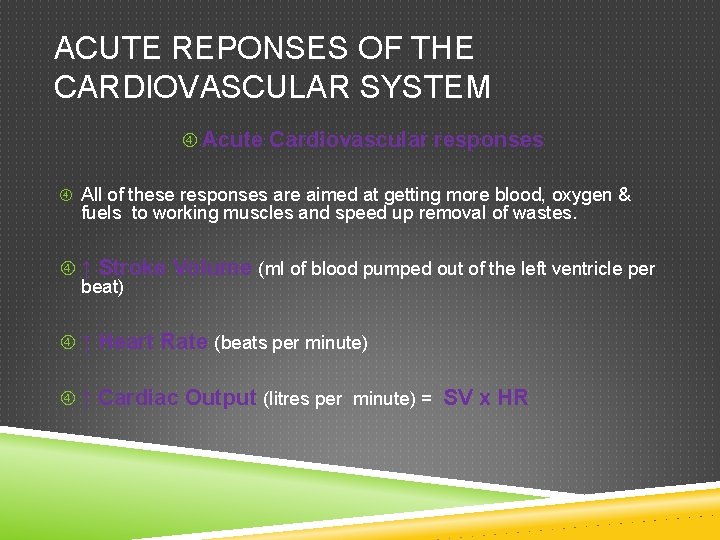
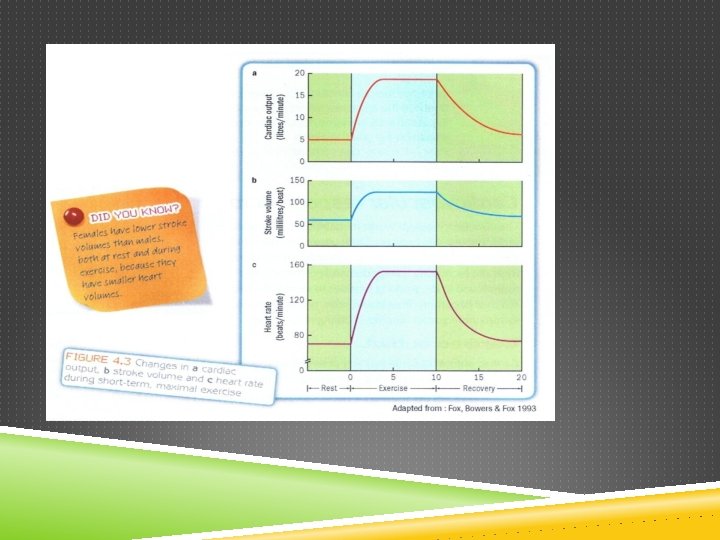
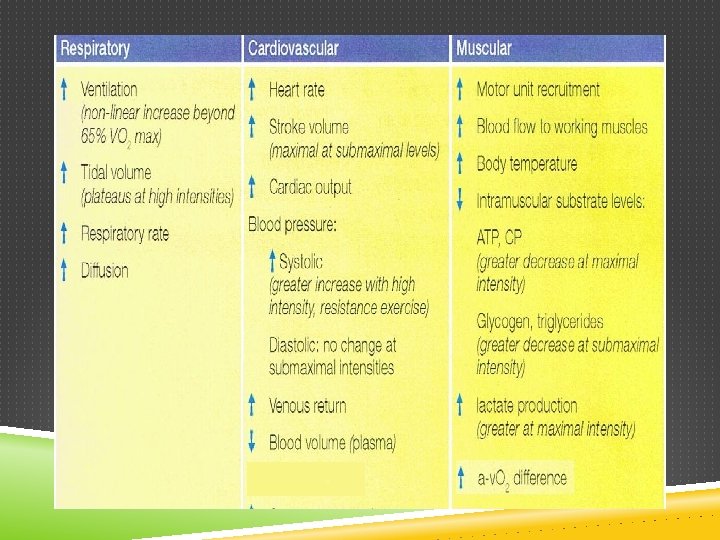
ACUTE REPONSES OF THE CARDIOVASCULAR SYSTEM Acute Cardiovascular responses All of these responses are aimed at getting more blood, oxygen & fuels to working muscles and speed up removal of wastes. ↑ Stroke Volume (ml of blood pumped out of the left ventricle per beat) ↑ Heart Rate (beats per minute) ↑ Cardiac Output (litres per minute) = SV x HR
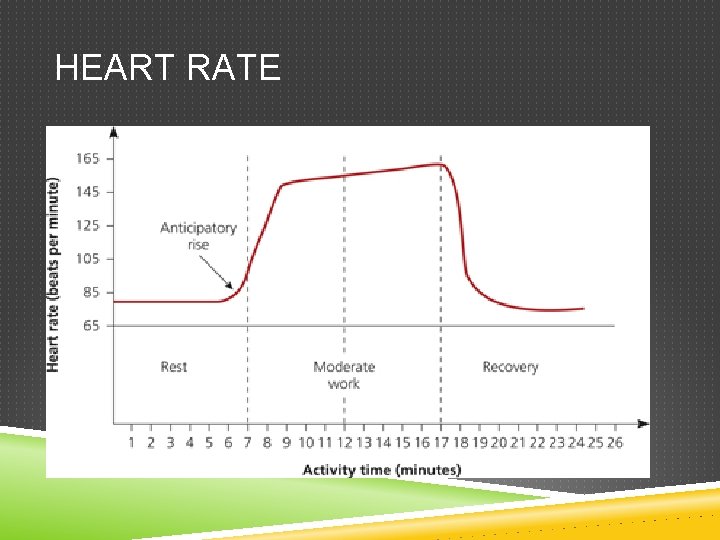
INCREASED HEART RATE Why when you start exercising your heart rate starts pumping? Heart rate is the number of times per minute your heart contracts. (bpm) Resting heart rate is generally between 60 -80 bpm. At the beginning of exercise the heart beats faster to deliver oxygen to the muscles and help remove waste products. Heart rate increases in accordance with intensity of exercise
HEART RATE
ABOUT HEART RATE (HR) Your heart rate has a maximum and this can be APPROXIMATELY calculated by following equation MAX HR = 220 - age Trained athletes will have a lower resting heart rate Heart rate increases exein anticipation to exercise – Anticipatory rise
WHAT REGULATES OUR CHANGE IN HR? Our heart rate is controlled by our nervous system and our endocrine system. To find out more read pg. 92 of textbook
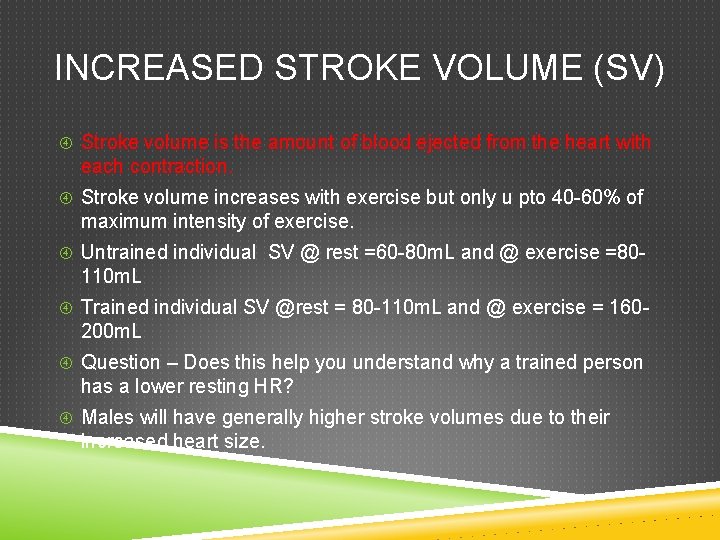
INCREASED STROKE VOLUME (SV) Stroke volume is the amount of blood ejected from the heart with each contraction. Stroke volume increases with exercise but only u pto 40 -60% of maximum intensity of exercise. Untrained individual SV @ rest =60 -80 m. L and @ exercise =80 - 110 m. L Trained individual SV @rest = 80 -110 m. L and @ exercise = 160 - 200 m. L Question – Does this help you understand why a trained person has a lower resting HR? Males will have generally higher stroke volumes due to their increased heart size.
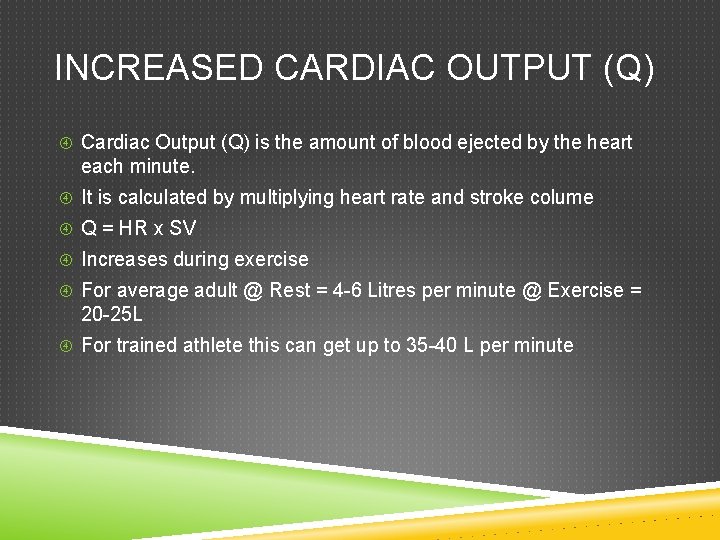
INCREASED CARDIAC OUTPUT (Q) Cardiac Output (Q) is the amount of blood ejected by the heart each minute. It is calculated by multiplying heart rate and stroke colume Q = HR x SV Increases during exercise For average adult @ Rest = 4 -6 Litres per minute @ Exercise = 20 -25 L For trained athlete this can get up to 35 -40 L per minute
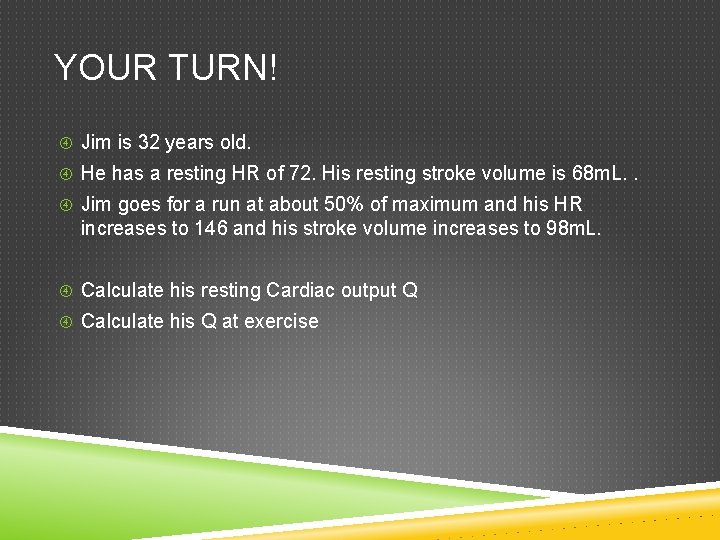
YOUR TURN! Jim is 32 years old. He has a resting HR of 72. His resting stroke volume is 68 m. L. . Jim goes for a run at about 50% of maximum and his HR increases to 146 and his stroke volume increases to 98 m. L. Calculate his resting Cardiac output Q Calculate his Q at exercise
YOUR TURN What is meant by the term “acute responses to exercise? Define what is meant by the term heart, stroke volume and cardiac output. How can I calculate my maximum heart rate? Why do females have smaller stroke volumes that males? Describe how HR, SV and Q change with increasing intensity. How do they interrellate?
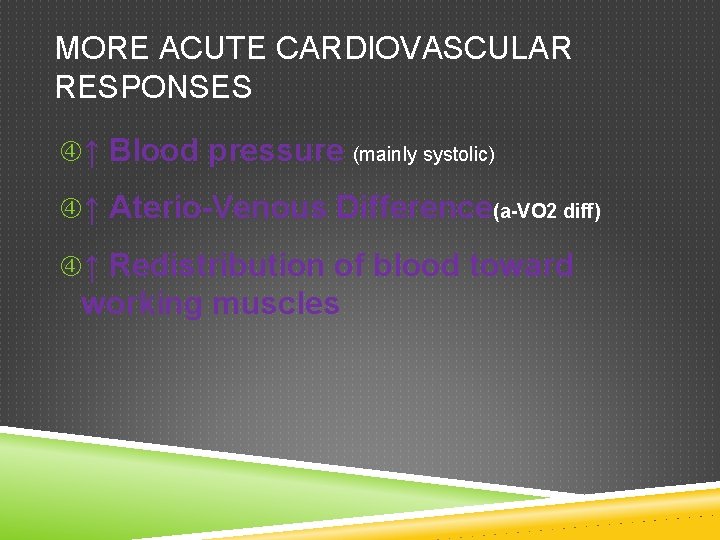
MORE ACUTE CARDIOVASCULAR RESPONSES ↑ Blood pressure (mainly systolic) ↑ Aterio-Venous Difference(a-VO 2 diff) ↑ Redistribution of blood toward working muscles
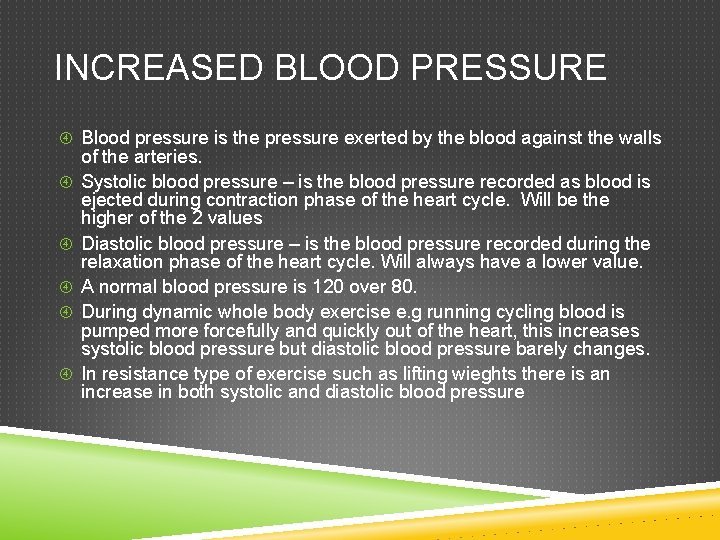
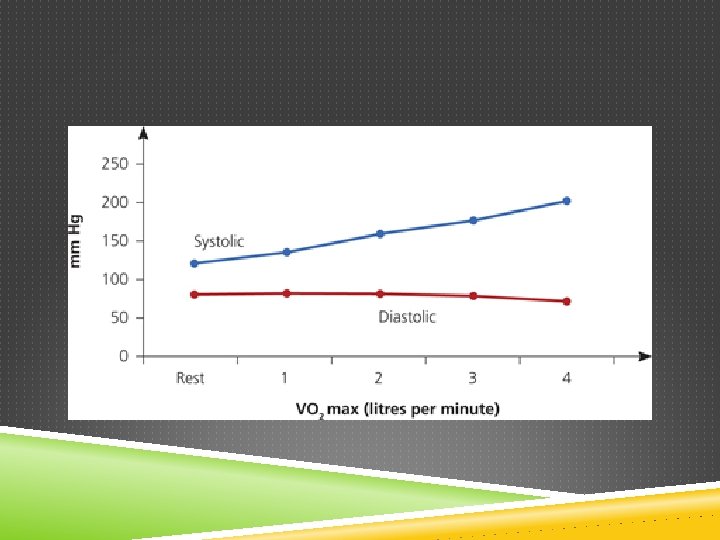
INCREASED BLOOD PRESSURE Blood pressure is the pressure exerted by the blood against the walls of the arteries. Systolic blood pressure – is the blood pressure recorded as blood is ejected during contraction phase of the heart cycle. Will be the higher of the 2 values Diastolic blood pressure – is the blood pressure recorded during the relaxation phase of the heart cycle. Will always have a lower value. A normal blood pressure is 120 over 80. During dynamic whole body exercise e. g running cycling blood is pumped more forcefully and quickly out of the heart, this increases systolic blood pressure but diastolic blood pressure barely changes. In resistance type of exercise such as lifting wieghts there is an increase in both systolic and diastolic blood pressure
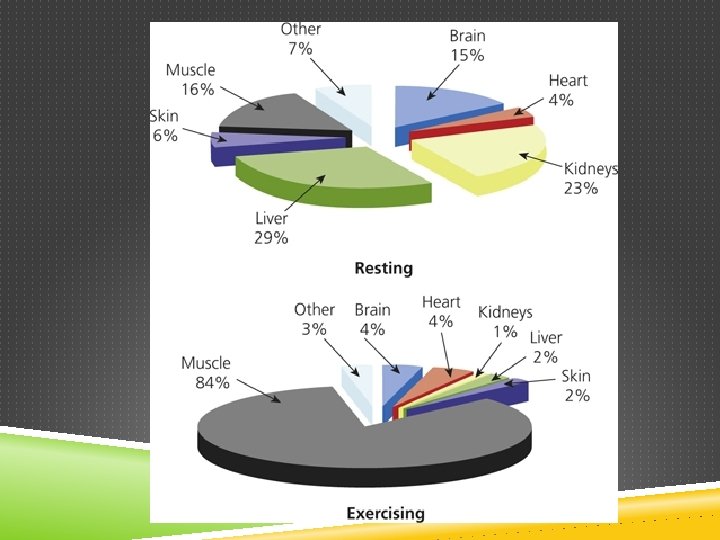
REDISTRIBUTION OF BLOOD FLOW TO WORKING MUSCLES @ Rest 15 -20% of blood flow is directed at the skeletal muscles. The rest goes to your organs. When exercising 80 -90% of blood flow will go to your muscles. How can this happen? Our blood vessels can expand increase their internal diameter to allow more blood to be pumped through to muscles. This is called VASODILATION Our blood vessels can constrict to allow less blood through. This is called VASOCONSTRICTION See figure 3. 7 on pg 97 for more info
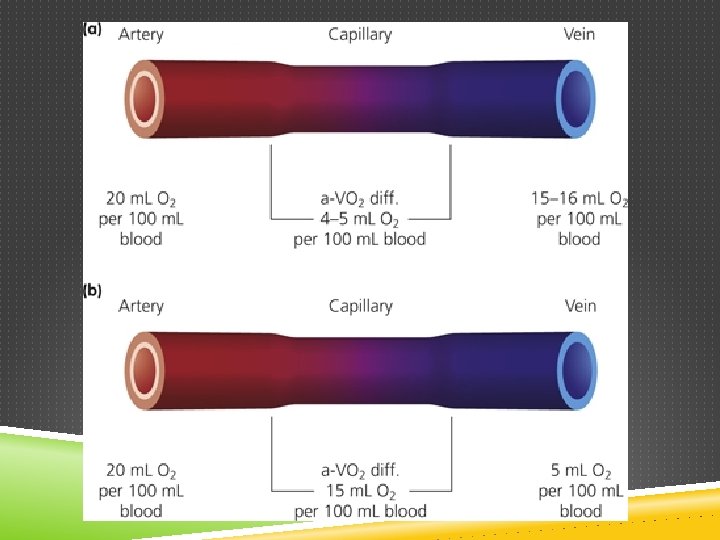
INCREASED ARTERIOVENOUS DIFFERENCE (A-VO 2 DIFF) a-VO 2 diff is a measure of the difference in the concentration of oxygen in the arterial blood (arteries and venous blood (veins). @ Rest arteries usually contain around 20 m. L of oxygen per 100 m. L of blood and the veins contain 15 m. L of oxygen per 100 m. L of blood. Therefore the a-V 02 diff is 20 -15 = 5 m. L per 100 m. L During exercise will the a-VO 2 diff increase or decrease. Why?
YOUR TURN Explain how the different blood pressures are affected by exercise. Explain vasodilation and vasoconstriction. How do these help you increase blood flow around the body? Explain a-VO 2 diff. Explain why it increases during exercise
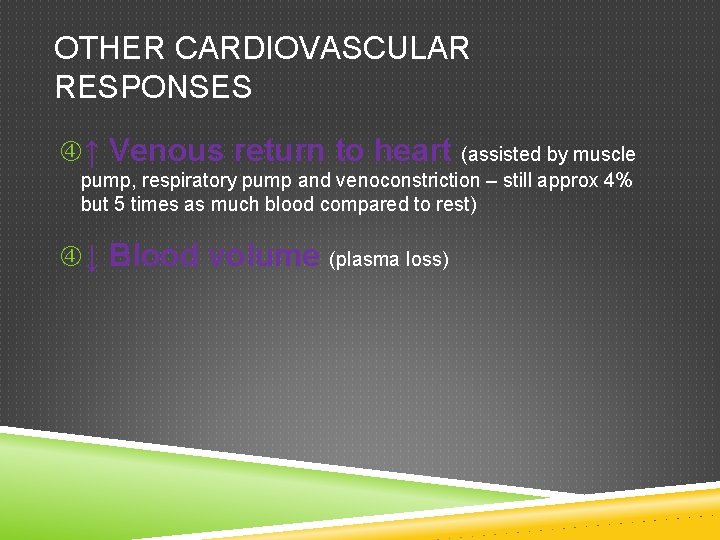
OTHER CARDIOVASCULAR RESPONSES ↑ Venous return to heart (assisted by muscle pump, respiratory pump and venoconstriction – still approx 4% but 5 times as much blood compared to rest) ↓ Blood volume (plasma loss)
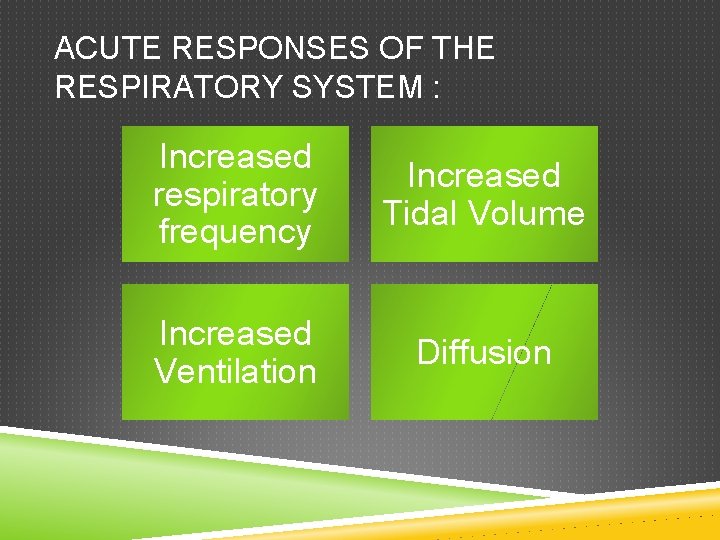
ACUTE RESPONSES OF THE RESPIRATORY SYSTEM : Increased respiratory frequency Increased Tidal Volume Increased Ventilation Diffusion
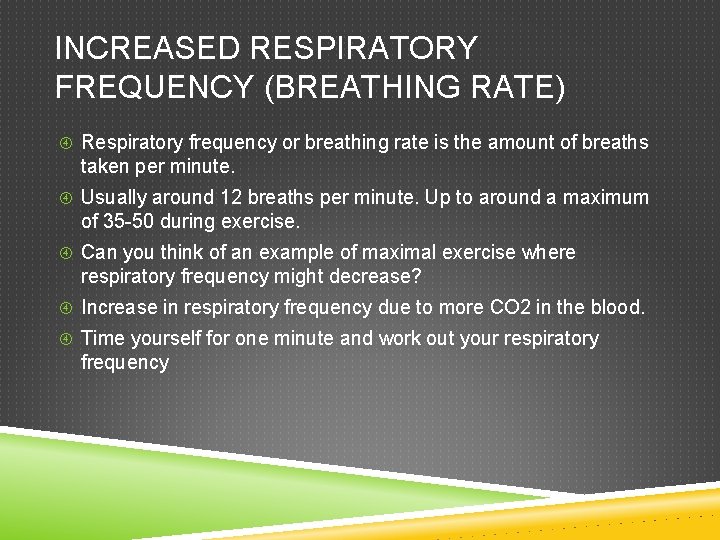
INCREASED RESPIRATORY FREQUENCY (BREATHING RATE) Respiratory frequency or breathing rate is the amount of breaths taken per minute. Usually around 12 breaths per minute. Up to around a maximum of 35 -50 during exercise. Can you think of an example of maximal exercise where respiratory frequency might decrease? Increase in respiratory frequency due to more CO 2 in the blood. Time yourself for one minute and work out your respiratory frequency
INCREASED TIDAL VOLUME Tidal volume is the depth of your breathing. Increases from 0. 5 L per breath at rest to a max of 3 -5 L per breath.
INCREASED VENTILATION Ventilation is the amount of air inspired or expired per minute by the lungs. It is calculated by multiplying respiratory frequency by tidal volume VENTILATION (V) = RESPIRATORY FREQUENCY X TIDAL VOLUME @ Rest = 5 -6 L per minute @ Maximal Exercise = 130 -180 L or beyond Greater in males than females due to lung volume. Your Turn! Calculate the Ventilation of an individual who has respiratory rate of 15 breaths per minute and a tidal volume of 0. 5 L?
INCREASED OXYGEN UPTAKE Oxygen uptake (VO 2) is the amount of oxygen transported to, taken up by and used by the body for energy production. @ Rest 0. 25 L per minute When exercise begins oxygen uptake increases as the working muscles use it made possible by the responses by the cardiovascular and respiratory systems. It increases linearly. Reaches a MAXIMUM OXYGEN UPTAKE (VO 2 max). Usually occurs around 2 -3. 5 L. How is oxygen uptake different to ventilation?
DIFFUSION Gas exchange occurs at the lungs between the alveoli and the cappilaries Gas exchange occurs in the muscle between the muscle tissue and the capillaries. When oxygen or carbon dioxide concentrations are high they want to move to a area of low concentration Refer to diagram During exercise diffusion increases to make more O 2 available and to get rid of more CO 2.
YOUR TURN Define the terms respiratory frequency, tidal volume, ventilation, oxygen uptake and maximum oxygen uptake Explain my respiratory responses in a 3 km run. Extend yourself: Explain the mechanisms of inspiration, expiration and diffusion. Pages 99 -100 in textbook
FACTORS AFFECTING MAXIMUM OXYGEN UPTAKE Body Size Gender Age Genetics Training Status
BODY SIZE A larger heavier person requires more oxygen than a smaller person. Therefore VO 2 max is expressed relative to body size in m. L/kg/min so it can be compared.
GENDER Females tend to have lower oxygen uptake than males of a similar age and athleticism. For untrained individuals can be as great as 20 -25% less. Why? Females tend to have a higher amount of body fat and lower muscle mass. Body fat doesn’t use oxygen. Females have lower blood volumes and lower levels of red blood cells and haemoglobin. Therefore less oxygen carrying capacity Females typically have smaller lung size and volume.
GENETICS Aerobic capability is largely genetically determined. Up to 25 -50% of variance. Training can still largely improve VO 2 max.
AGE Peaks around late adolescence and early adulthood and then declines after the age of 25. Declines around 10% per decade. Training and being physically active can reduce the decline.
TRAINING STATUS (AEROBIC OR CARDIOVASCULAR FITNESS LEVEL) Aerobic training can substantially increase VO 2 max. Average VO 2 max for untrained adult male 20 -29 is 43 -52 m. L/kg/min. Average VO 2 max for untrained adult female 20 -29 is 33 -42 m. L/kg/min. Trained endurance athlete can be up to 50 -75 m. L/kg/min. Refer to table 3. 1. Why does a swimmer have a higher VO 2 max than a weight lifter of the same sex and age? http: //content. jacplus. com. au/secure/File. Viewer? resource. Id=1361 79&category=e. Lesson&pk=fb 5 d 71007 f 342 bca
YOUR TURN Why is VO 2 max expressed relative to bodyweight. List and briefly summarize the factors that can affect VO 2 max in a table Have a look at the table on pages 102 -103 and explain why nordic skiiers have a much higher VO 2 max than a weightlifter?
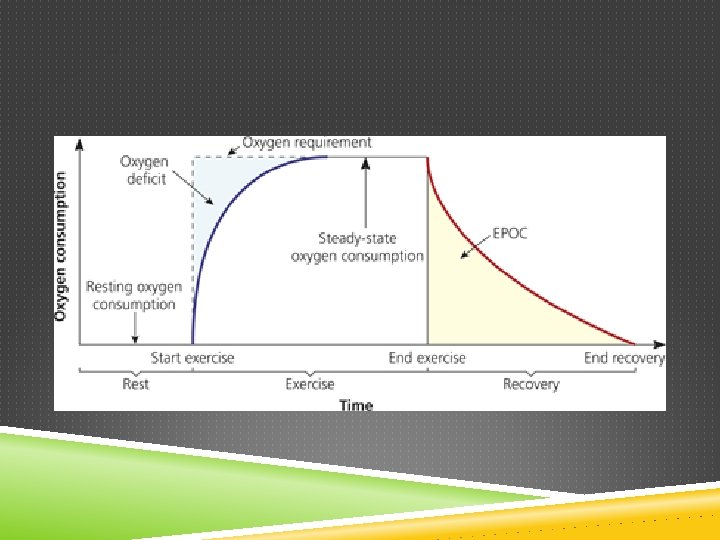
OXYGEN DEFICIT O 2 deficit is the state where there is a shortfall of oxygen consumption and use. This can often occur at the beginning of exercise. Particularly maximal intensity exercise. Where the oxygen your body requires isn’t being delivered by the cardiovascular and respiratory systems. In other words it takes your body a while to adjust. What acute responses cause oxygen deficit to occur?
STEADY STATE Steady state is the state in which OXYGEN DEMAND = OXYGEN SUPPLY. Anywhere from a few seconds to a few minutes into exercise Coincides with a plateau in HR and V.
EPOC Your turn Define EPOC? What did it used to be called? Why doesn’t our breathing and HR return to normal resting levels straight away after exercise
YOUR TURN Why does O 2 deficit accrue at the start of exercise? What factors determine the size of the O 2 deficit? When is steady state achieved during exercise? What are the functions of EPOC? How are O 2 deficit and EPOC related?
http: //content. jacplus. com. au/secure/File. Viewer? resource. Id=1361 80&category=e. Lesson&pk=0844 d 51 aa 68087 bb
ACUTE MUSCULAR RESPONSES Increased motor unit and muscle fibre recruitment – needed for muscular contractions to create force Increased blood flow to muscles – to deliver oxygen to working muscles Increased muscle temperature – due to increased blood flow Increased muscle enzyme activity – enzymes are required to break down the ATP for energy Increased oxygen supply and use – muscles extract and use more cells from the blood Depleted energy substrates (muscle energy stores – depleted ATP, PC, glycogen and triglyceride stores