
Acute respiratory failure Classification of RF Type 2


- Slides: 54
Acute respiratory failure
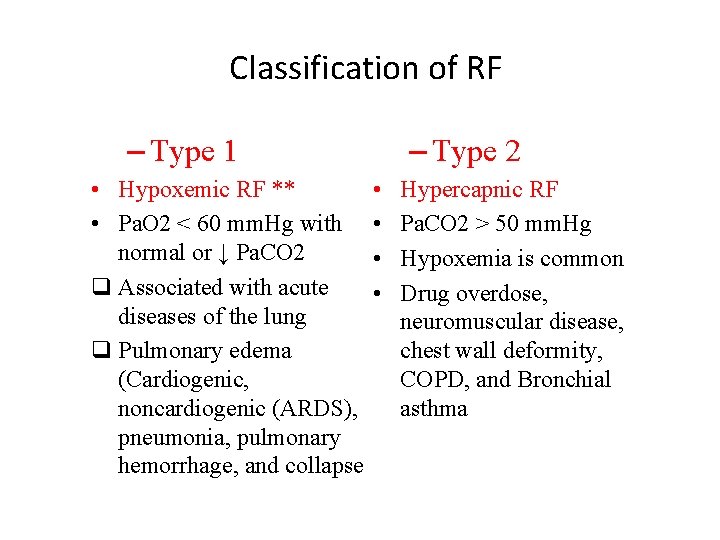
Classification of RF – Type 2 – Type 1 • Hypoxemic RF ** • Pa. O 2 < 60 mm. Hg with normal or ↓ Pa. CO 2 q Associated with acute diseases of the lung q Pulmonary edema (Cardiogenic, noncardiogenic (ARDS), pneumonia, pulmonary hemorrhage, and collapse • • Hypercapnic RF Pa. CO 2 > 50 mm. Hg Hypoxemia is common Drug overdose, neuromuscular disease, chest wall deformity, COPD, and Bronchial asthma
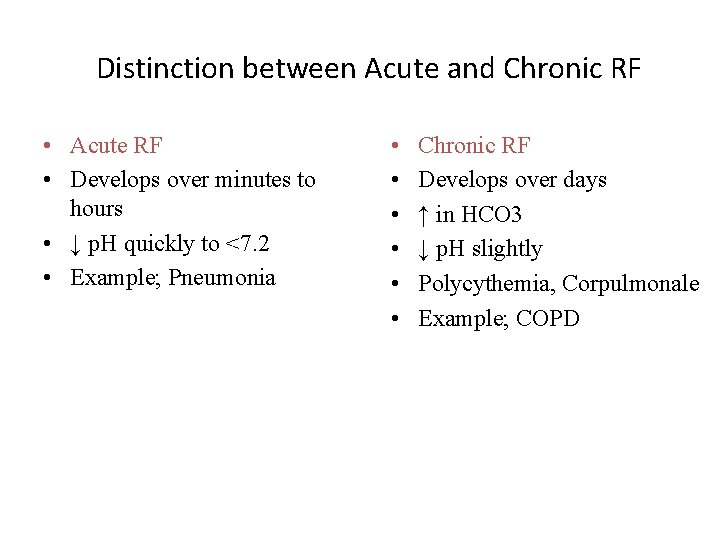
Distinction between Acute and Chronic RF • Acute RF • Develops over minutes to hours • ↓ p. H quickly to <7. 2 • Example; Pneumonia • • • Chronic RF Develops over days ↑ in HCO 3 ↓ p. H slightly Polycythemia, Corpulmonale Example; COPD
More definitions • Hypoxemia = abnormally low Pa. O 2 • Hypoxia = tissue oxygenation inadequate to meet metabolic needs • Hypercarbia = elevated Pa. CO 2 • Respiratory failure may be acute or chronic
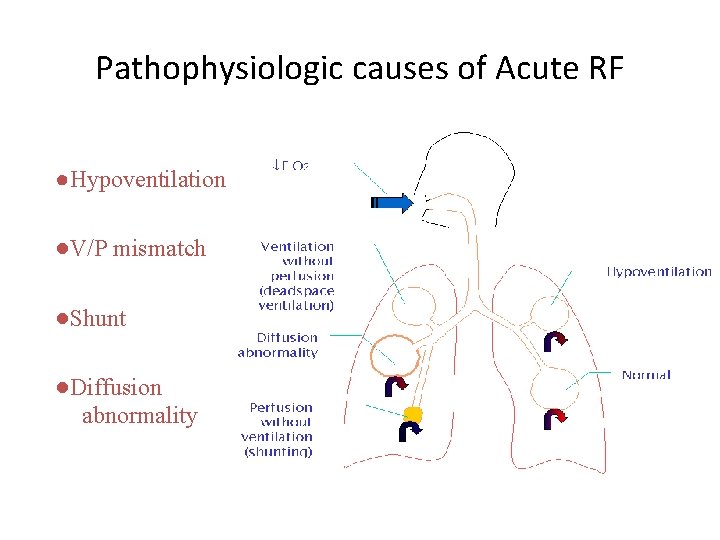
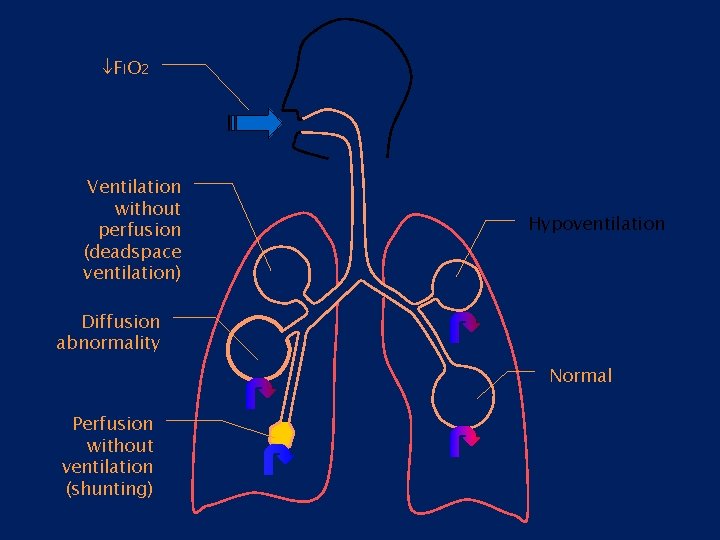
Pathophysiologic causes of Acute RF ●Hypoventilation ●V/P mismatch ●Shunt ●Diffusion abnormality
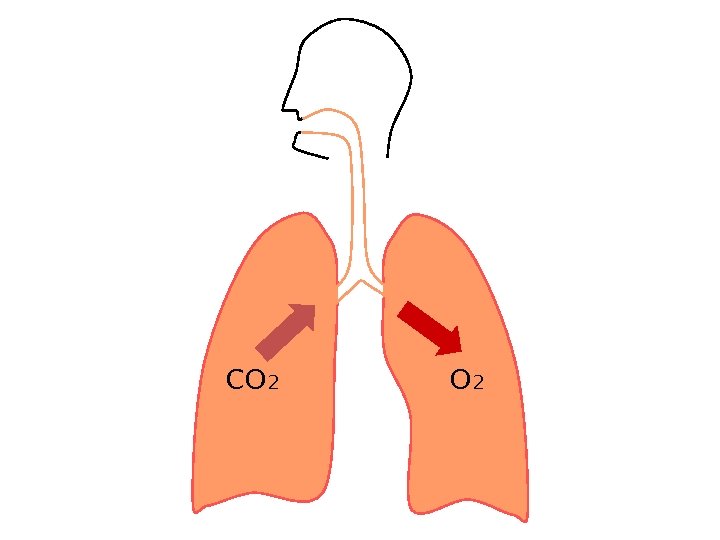
CO 2
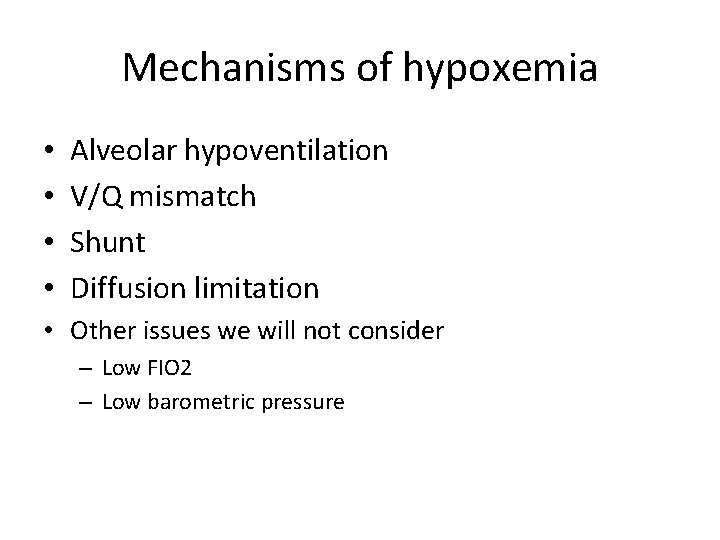
Mechanisms of hypoxemia • • Alveolar hypoventilation V/Q mismatch Shunt Diffusion limitation • Other issues we will not consider – Low FIO 2 – Low barometric pressure
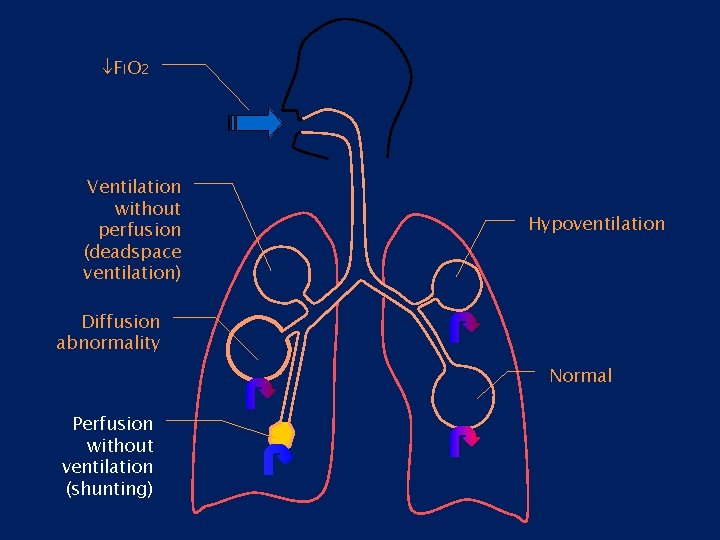
FIO 2 Ventilation without perfusion (deadspace ventilation) Hypoventilation Diffusion abnormality Normal Perfusion without ventilation (shunting)
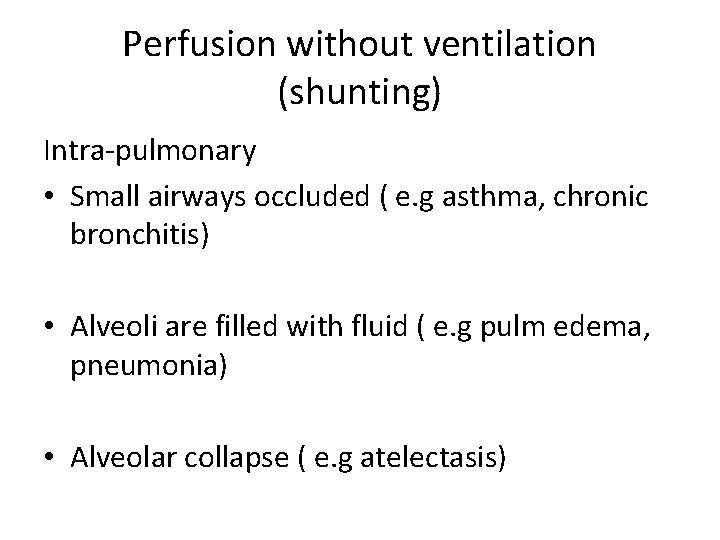
Perfusion without ventilation (shunting) Intra-pulmonary • Small airways occluded ( e. g asthma, chronic bronchitis) • Alveoli are filled with fluid ( e. g pulm edema, pneumonia) • Alveolar collapse ( e. g atelectasis)
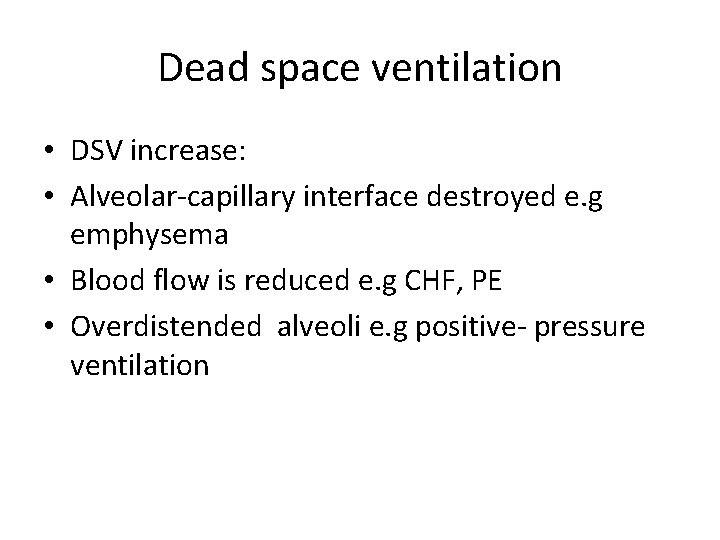
Dead space ventilation • DSV increase: • Alveolar-capillary interface destroyed e. g emphysema • Blood flow is reduced e. g CHF, PE • Overdistended alveoli e. g positive- pressure ventilation
FIO 2 Ventilation without perfusion (deadspace ventilation) Hypoventilation Diffusion abnormality Normal Perfusion without ventilation (shunting)
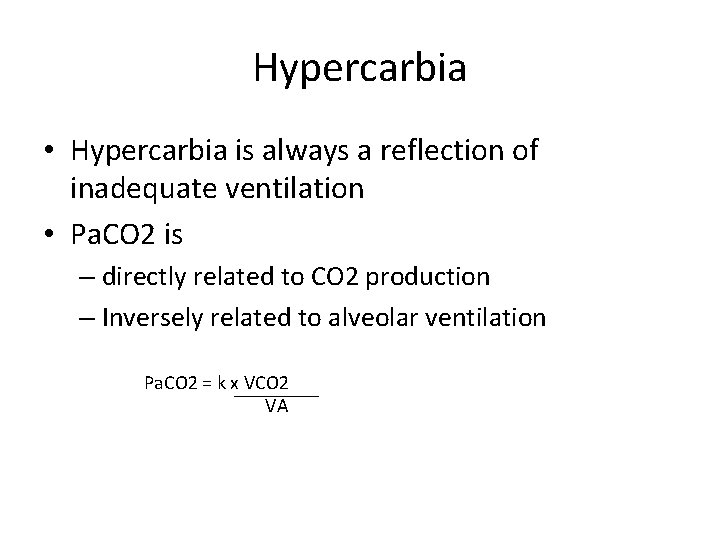
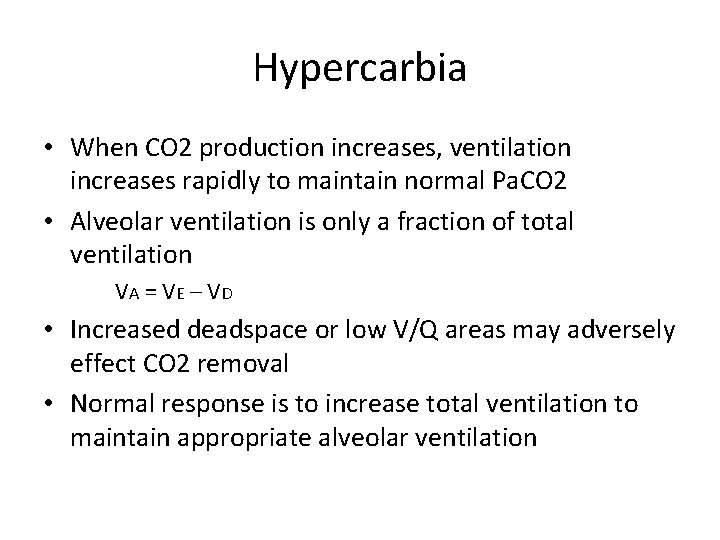
Hypercarbia • Hypercarbia is always a reflection of inadequate ventilation • Pa. CO 2 is – directly related to CO 2 production – Inversely related to alveolar ventilation Pa. CO 2 = k x VCO 2 VA
Hypercarbia • When CO 2 production increases, ventilation increases rapidly to maintain normal Pa. CO 2 • Alveolar ventilation is only a fraction of total ventilation VA = V E – V D • Increased deadspace or low V/Q areas may adversely effect CO 2 removal • Normal response is to increase total ventilation to maintain appropriate alveolar ventilation
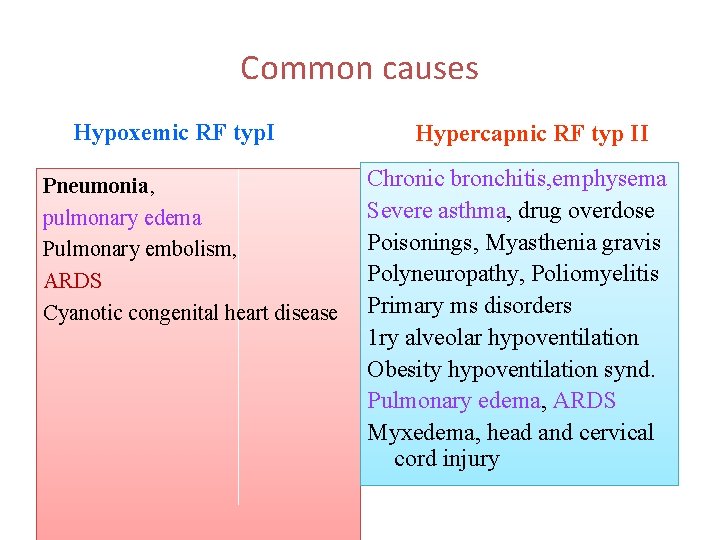
Common causes Hypoxemic RF typ. I Pneumonia, pulmonary edema Pulmonary embolism, ARDS Cyanotic congenital heart disease Hypercapnic RF typ II Chronic bronchitis, emphysema Severe asthma, drug overdose Poisonings, Myasthenia gravis Polyneuropathy, Poliomyelitis Primary ms disorders 1 ry alveolar hypoventilation Obesity hypoventilation synd. Pulmonary edema, ARDS Myxedema, head and cervical cord injury
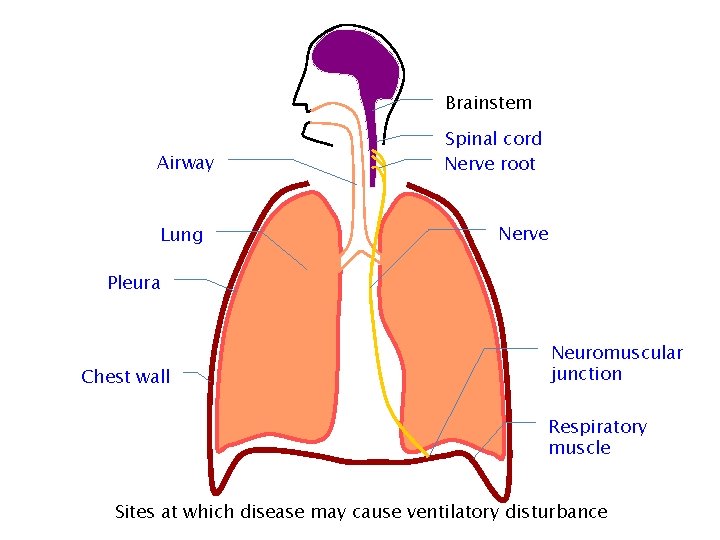
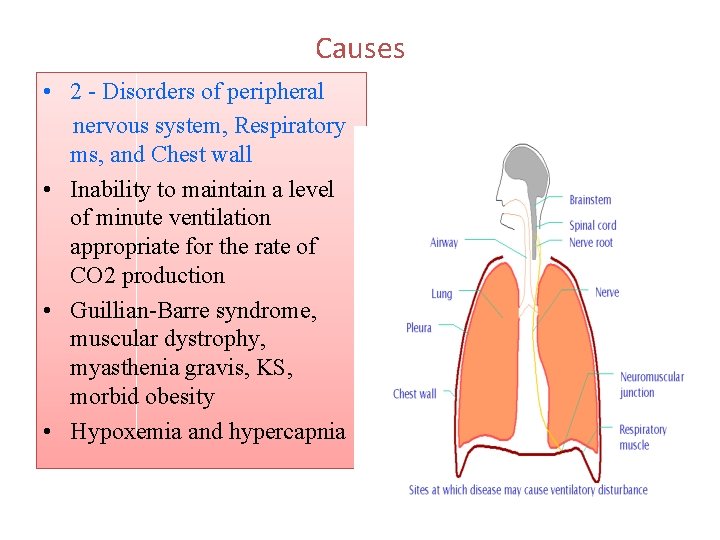
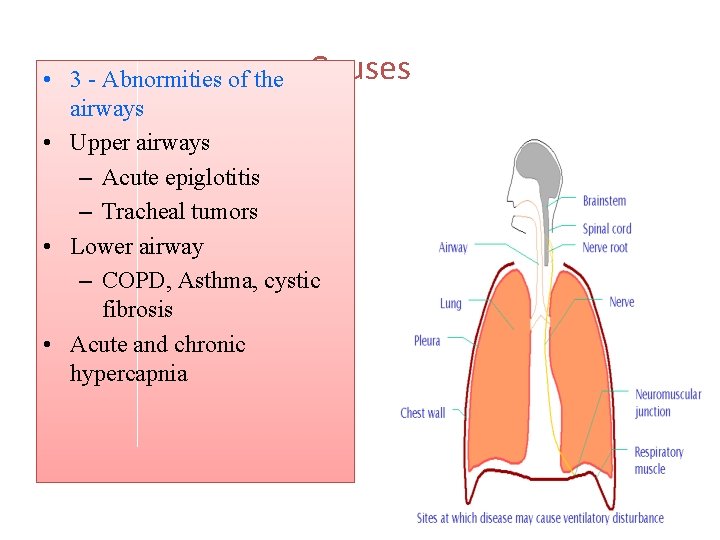
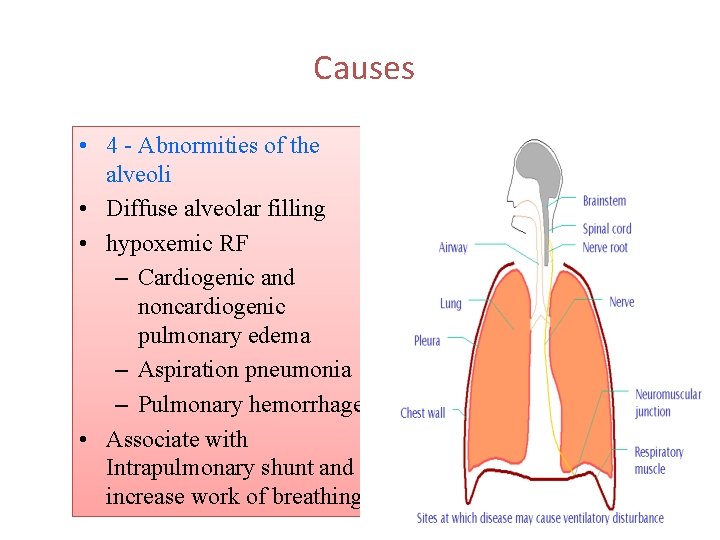
Brainstem Airway Lung Spinal cord Nerve root Nerve Pleura Chest wall Neuromuscular junction Respiratory muscle Sites at which disease may cause ventilatory disturbance
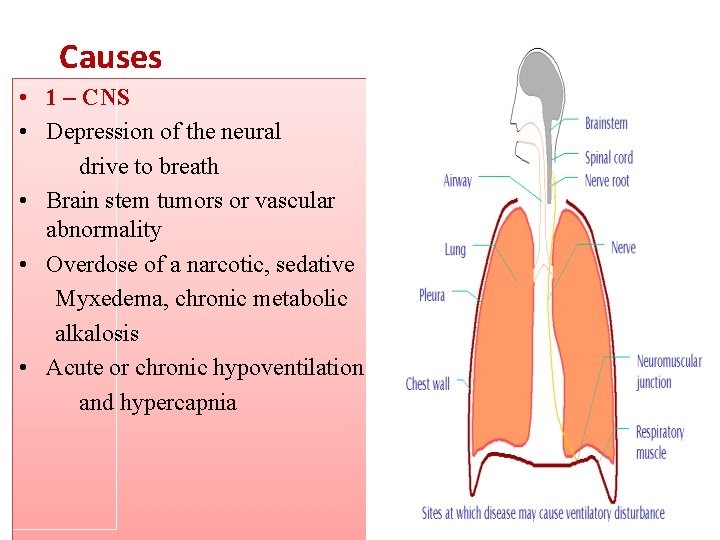
Causes • 1 – CNS • Depression of the neural drive to breath • Brain stem tumors or vascular abnormality • Overdose of a narcotic, sedative Myxedema, chronic metabolic alkalosis • Acute or chronic hypoventilation and hypercapnia
Causes • 2 - Disorders of peripheral nervous system, Respiratory ms, and Chest wall • Inability to maintain a level of minute ventilation appropriate for the rate of CO 2 production • Guillian-Barre syndrome, muscular dystrophy, myasthenia gravis, KS, morbid obesity • Hypoxemia and hypercapnia
• 3 - Abnormities of the Causes airways • Upper airways – Acute epiglotitis – Tracheal tumors • Lower airway – COPD, Asthma, cystic fibrosis • Acute and chronic hypercapnia
Causes • 4 - Abnormities of the alveoli • Diffuse alveolar filling • hypoxemic RF – Cardiogenic and noncardiogenic pulmonary edema – Aspiration pneumonia – Pulmonary hemorrhage • Associate with Intrapulmonary shunt and increase work of breathing
Diagnosis of RF 1 – Clinical (symptoms, signs) • • • Hypoxemia Dyspnea, Cyanosis Confusion, somnolence, fits Tachycardia, arrhythmia Tachypnea (good sign) Use of accessory ms Nasal flaring Recession of intercostal ms Polycythemia Pulmonary HTN, Corpulmonale, Rt. HF • Hypercapnia • ↑Cerebral blood flow, and CSF Pressure • Headache • Asterixis • Papilloedema • Warm extremities, collapsing pulse • Acidosis (respiratory, and metabolic) • ↓p. H, ↑ lactic acid
Respiratory Failure Symptoms CNS: Headache Visual Disturbances Anxiety Confusion Memory Loss Weakness Decreased Functional Performance
Respiratory Failure Symptoms Pulmonary: Cough Chest pains Sputum production Stridor Dyspnea
Respiratory Failure Symptoms Cardiac: Orthopnea Peripheral edema Chest pain Other: Fever, Abdominal pain, Anemia, Bleeding
Clinical • • Respiratory compensation Sympathetic stimulation Tissue hypoxia Haemoglobin desaturation
Clinical • Respiratory compensation – Tachypnoea RR > 35 Breath /min – Accessory muscles – Recesssion – Nasal flaring • Sympathetic stimulation • Tissue hypoxia • Haemoglobin desaturation
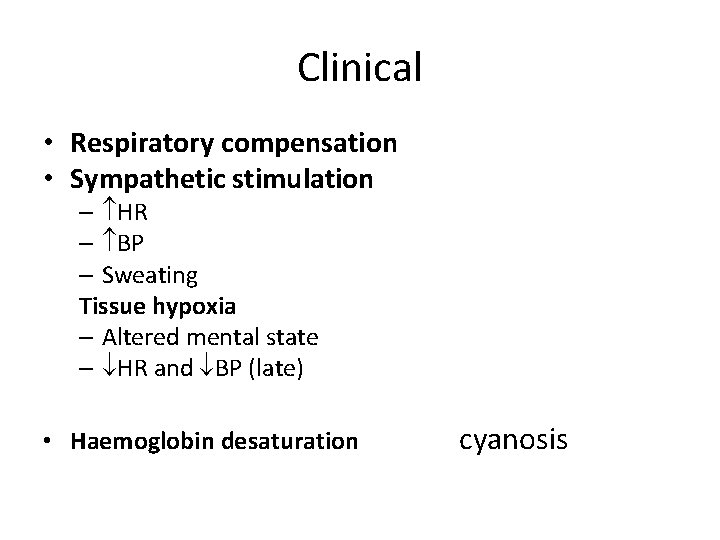
Clinical • Respiratory compensation • Sympathetic stimulation – HR – BP – Sweating Tissue hypoxia – Altered mental state – HR and BP (late) • Haemoglobin desaturation cyanosis
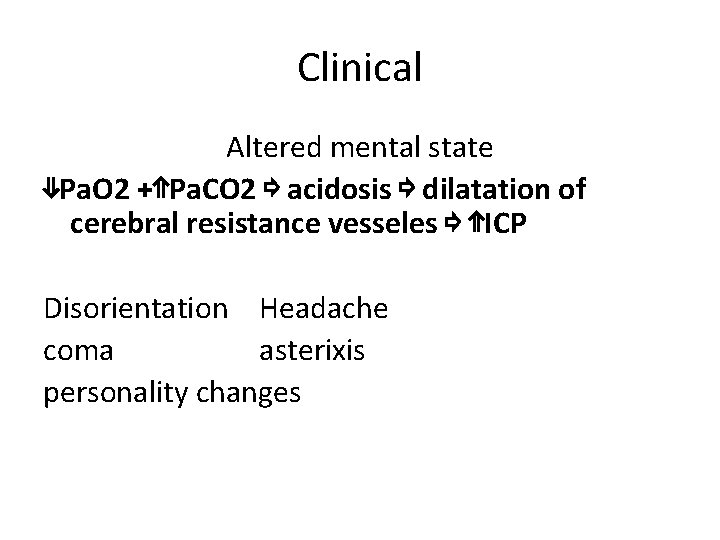
Clinical Altered mental state ⇓Pa. O 2 +⇑Pa. CO 2 ⇨ acidosis ⇨ dilatation of cerebral resistance vesseles ⇨ ⇑ICP Disorientation Headache coma asterixis personality changes
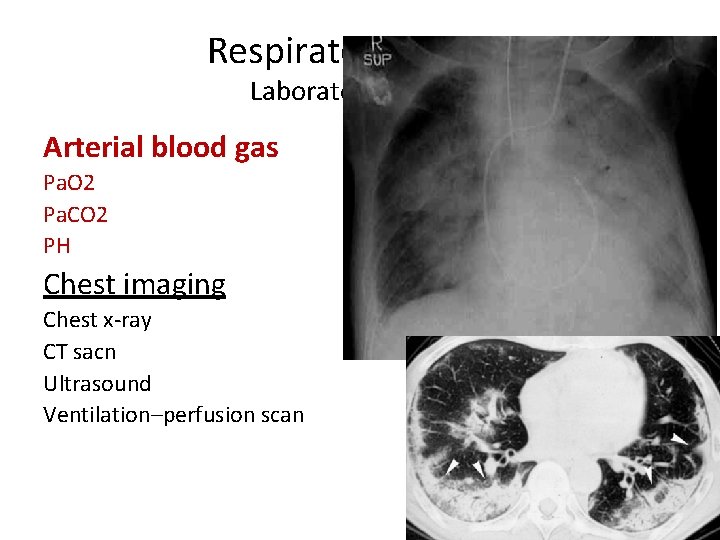
Respiratory Failure Laboratory Testing Arterial blood gas Pa. O 2 Pa. CO 2 PH Chest imaging Chest x-ray CT sacn Ultrasound Ventilation–perfusion scan
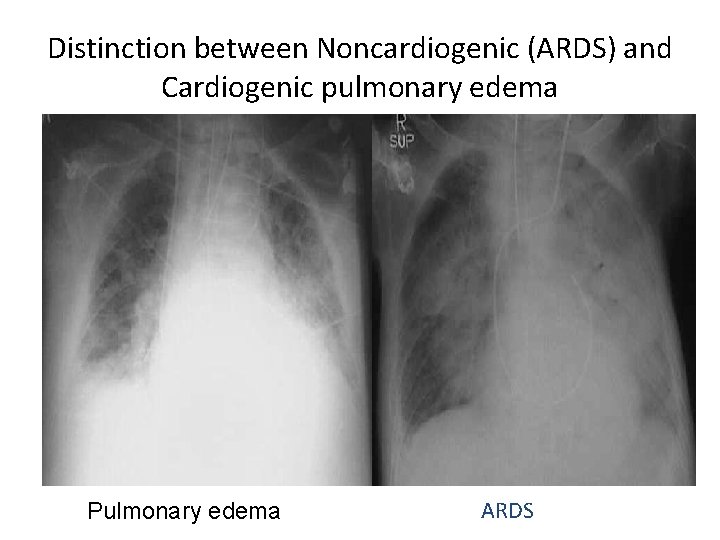
Distinction between Noncardiogenic (ARDS) and Cardiogenic pulmonary edema Pulmonary edema ARDS
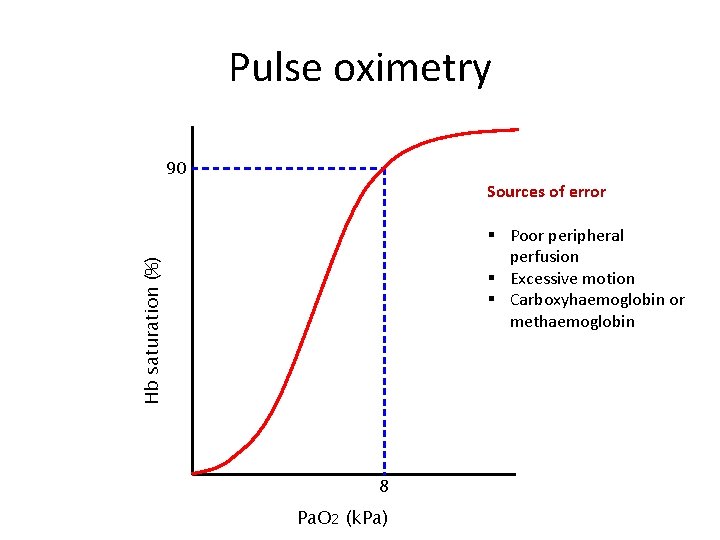
Pulse oximetry 90 Sources of error Hb saturation (%) § Poor peripheral perfusion § Excessive motion § Carboxyhaemoglobin or methaemoglobin 8 Pa. O 2 (k. Pa)
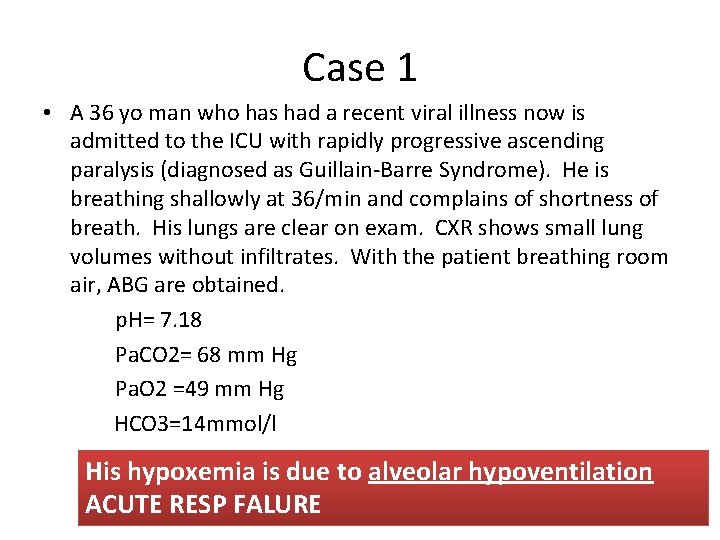
Case 1 • A 36 yo man who has had a recent viral illness now is admitted to the ICU with rapidly progressive ascending paralysis (diagnosed as Guillain-Barre Syndrome). He is breathing shallowly at 36/min and complains of shortness of breath. His lungs are clear on exam. CXR shows small lung volumes without infiltrates. With the patient breathing room air, ABG are obtained. p. H= 7. 18 Pa. CO 2= 68 mm Hg Pa. O 2 =49 mm Hg HCO 3=14 mmol/l His hypoxemia is due to alveolar hypoventilation ACUTE RESP FALURE
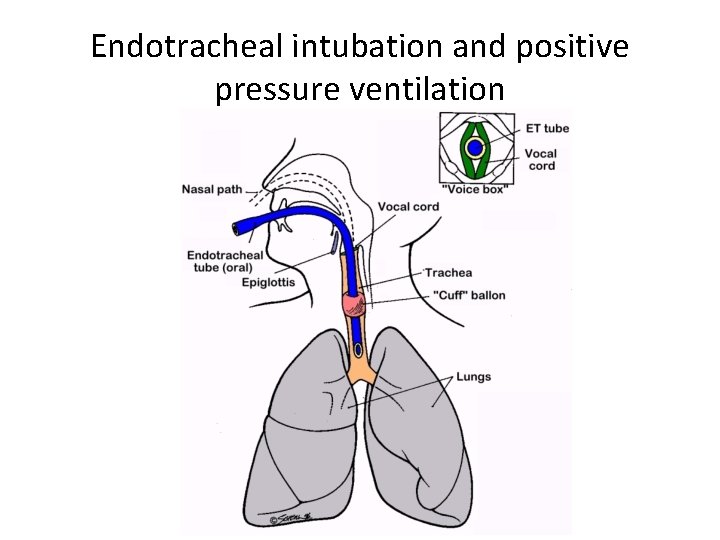
Endotracheal intubation and positive pressure ventilation
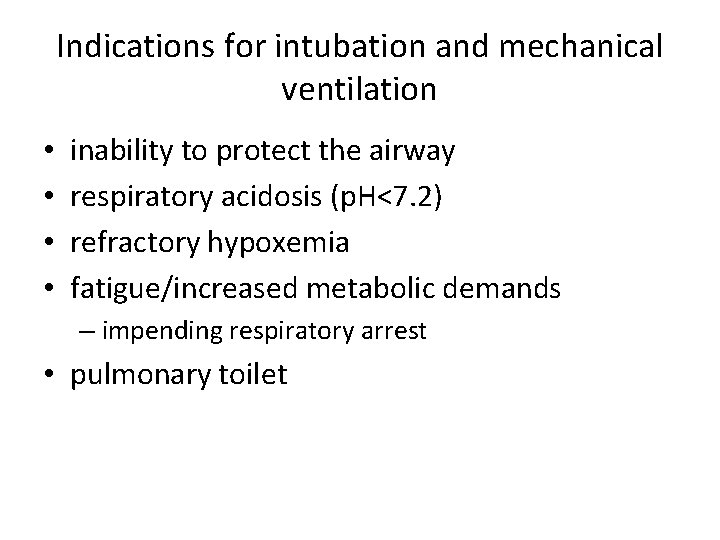
Indications for intubation and mechanical ventilation • • inability to protect the airway respiratory acidosis (p. H<7. 2) refractory hypoxemia fatigue/increased metabolic demands – impending respiratory arrest • pulmonary toilet
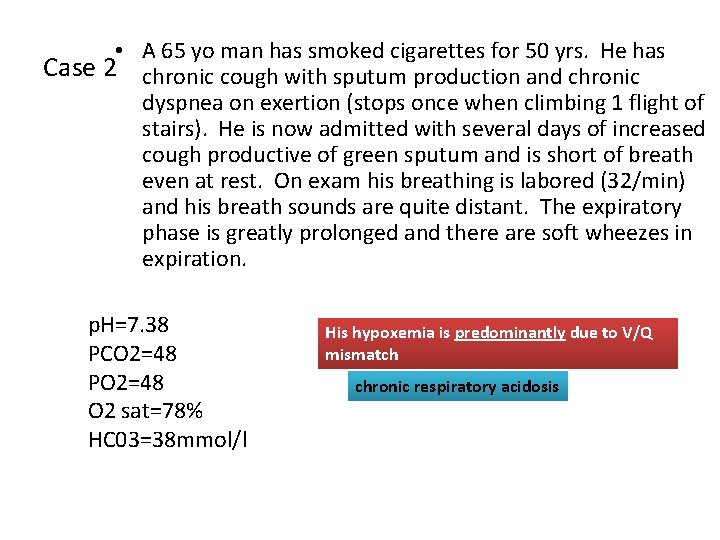
• A 65 yo man has smoked cigarettes for 50 yrs. He has Case 2 chronic cough with sputum production and chronic dyspnea on exertion (stops once when climbing 1 flight of stairs). He is now admitted with several days of increased cough productive of green sputum and is short of breath even at rest. On exam his breathing is labored (32/min) and his breath sounds are quite distant. The expiratory phase is greatly prolonged and there are soft wheezes in expiration. p. H=7. 38 PCO 2=48 PO 2=48 O 2 sat=78% HC 03=38 mmol/l His hypoxemia is predominantly due to V/Q mismatch chronic respiratory acidosis
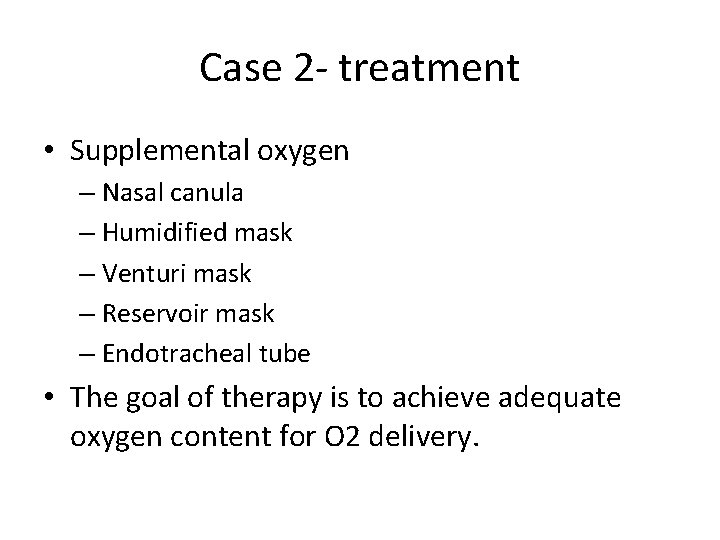
Case 2 - treatment • Supplemental oxygen – Nasal canula – Humidified mask – Venturi mask – Reservoir mask – Endotracheal tube • The goal of therapy is to achieve adequate oxygen content for O 2 delivery.
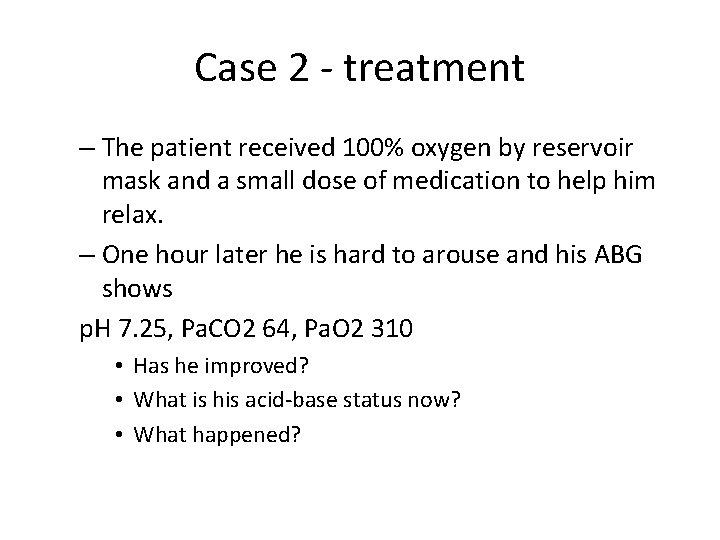
Case 2 - treatment – The patient received 100% oxygen by reservoir mask and a small dose of medication to help him relax. – One hour later he is hard to arouse and his ABG shows p. H 7. 25, Pa. CO 2 64, Pa. O 2 310 • Has he improved? • What is his acid-base status now? • What happened?
Oxygen therapy • Like most otherapies, Oxygen therapy has both benefits and risks • Potential complications of oxygen therapy – Acute lung injury – Retrolental fibroplasia – Decreased respiratory drive in individuals with chronic hypercarbia • Use the lowest possible FIO 2 to achieve adequate O 2 saturation for oxygen delivery
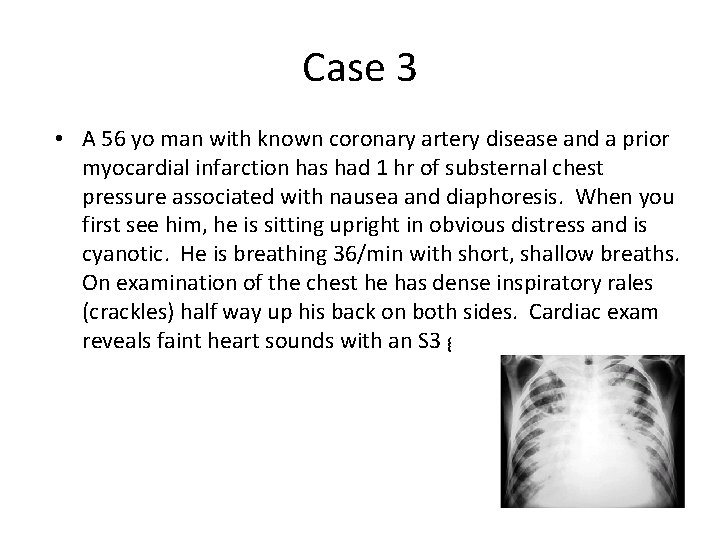
Case 3 • A 56 yo man with known coronary artery disease and a prior myocardial infarction has had 1 hr of substernal chest pressure associated with nausea and diaphoresis. When you first see him, he is sitting upright in obvious distress and is cyanotic. He is breathing 36/min with short, shallow breaths. On examination of the chest he has dense inspiratory rales (crackles) half way up his back on both sides. Cardiac exam reveals faint heart sounds with an S 3 gallop.
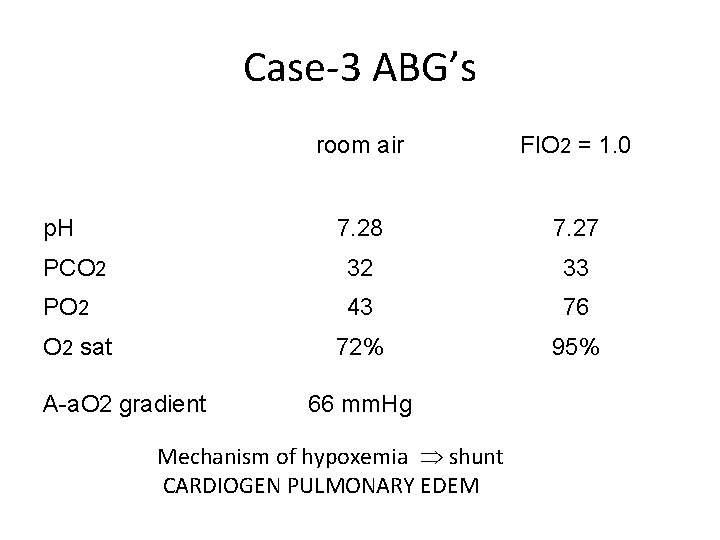
Case-3 ABG’s room air FIO 2 = 1. 0 7. 28 7. 27 PCO 2 32 33 PO 2 43 76 72% 95% p. H O 2 sat A-a. O 2 gradient 66 mm. Hg Mechanism of hypoxemia shunt CARDIOGEN PULMONARY EDEM
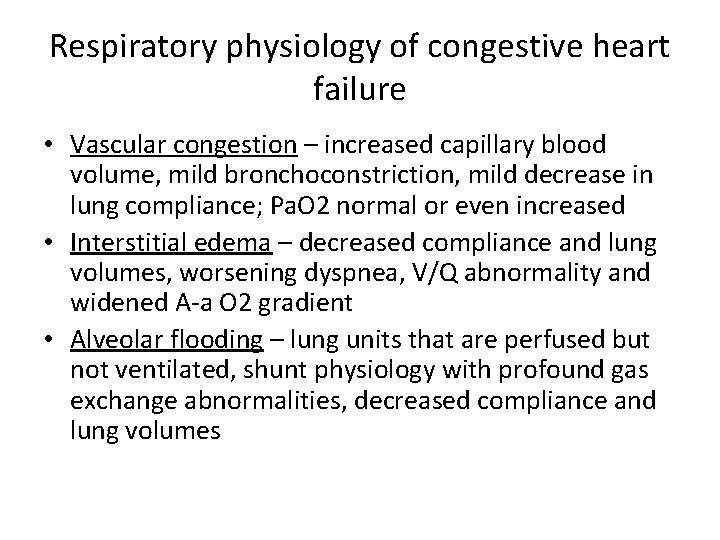
Respiratory physiology of congestive heart failure • Vascular congestion – increased capillary blood volume, mild bronchoconstriction, mild decrease in lung compliance; Pa. O 2 normal or even increased • Interstitial edema – decreased compliance and lung volumes, worsening dyspnea, V/Q abnormality and widened A-a O 2 gradient • Alveolar flooding – lung units that are perfused but not ventilated, shunt physiology with profound gas exchange abnormalities, decreased compliance and lung volumes
Treatment of cardiogenic pulmonary edema • Correct the problem with left ventricular function – – Diruetics Nitrates Vasodilators Thrombolytics, etc. • Decrease work of breathing – Ventilatory support • Improve oxygenation – Supplemental oxygen – Mechanical ventilation
Distinction between Noncardiogenic (ARDS) and Cardiogenic pulmonary edema • ARDS • Tachypnea, dyspnea, crackles • Aspiration, sepsis • 3 to 4 quadrant of alveolar flooding with normal heart size, systolic, diastolic function • Decreased compliance • Severe hypoxemia refractory to O 2 therapy • PCWP is normal <18 mm Hg • Cardiogenic edema • Tachypnea, dyspnea, crackles • Lt ventricular dysfunction, valvular disease, IHD • Cardiomegaly, vascular redistribution, pleural effusion, perihilar batwing distribution of infiltrate • Hypoxemia improved on high flow O 2 • PCWP is High >18 mm. Hg
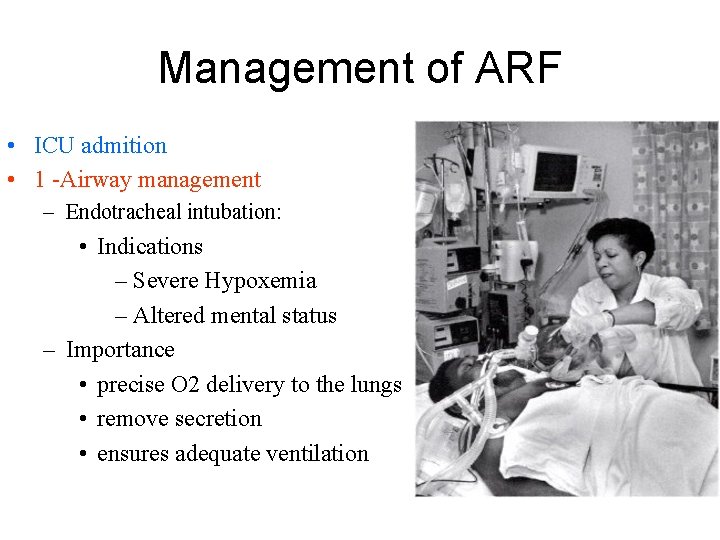
Management of ARF • ICU admition • 1 -Airway management – Endotracheal intubation: • Indications – Severe Hypoxemia – Altered mental status – Importance • precise O 2 delivery to the lungs • remove secretion • ensures adequate ventilation
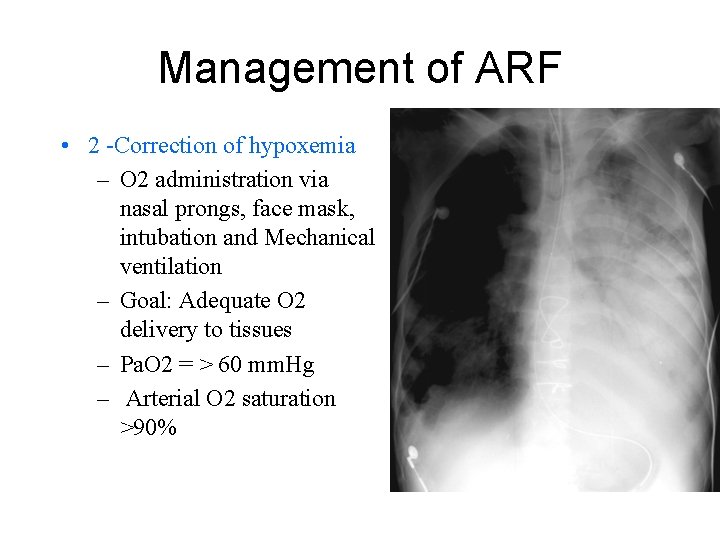
Management of ARF • 2 -Correction of hypoxemia – O 2 administration via nasal prongs, face mask, intubation and Mechanical ventilation – Goal: Adequate O 2 delivery to tissues – Pa. O 2 = > 60 mm. Hg – Arterial O 2 saturation >90%
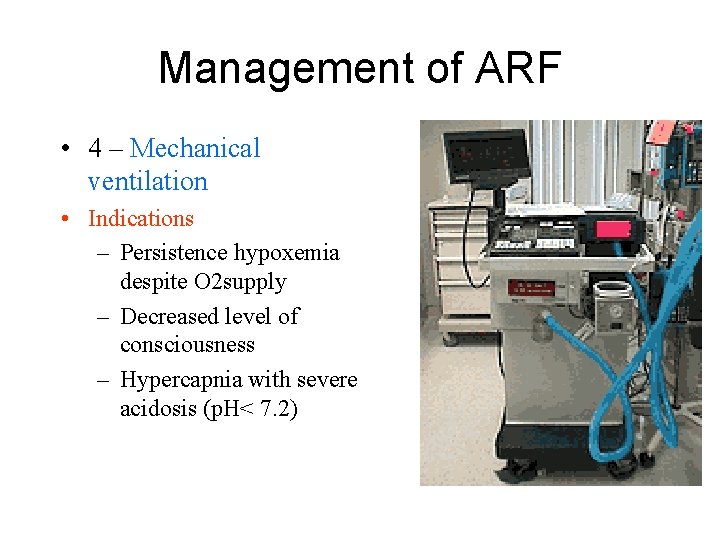
Management of ARF • 4 – Mechanical ventilation • Indications – Persistence hypoxemia despite O 2 supply – Decreased level of consciousness – Hypercapnia with severe acidosis (p. H< 7. 2)
Management of ARF • 4 - Mechanical ventilation – Increase Pa. O 2 – Lower Pa. CO 2 – Rest respiratory ms (respiratory ms fatigue) – Ventilator • Assists or controls the patient breathing – The lowest FIO 2 that produces Sa. O 2 >90% and PO 2 >60 mm. Hg should be given to avoid O 2 toxicity
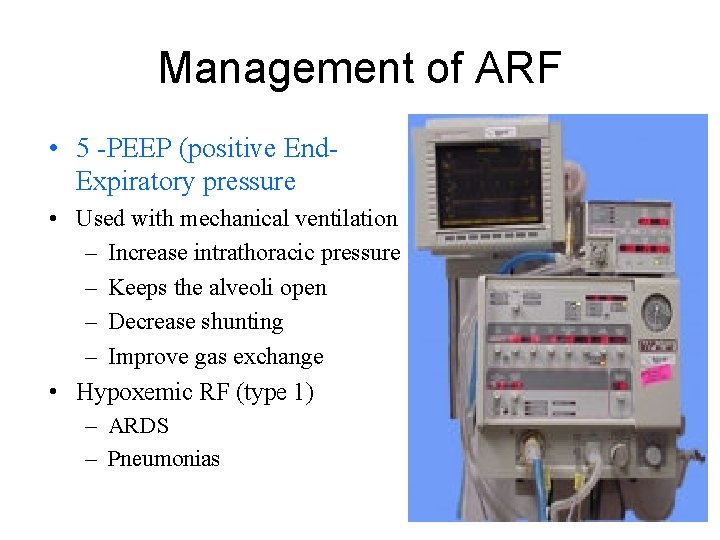
Management of ARF • 5 -PEEP (positive End. Expiratory pressure • Used with mechanical ventilation – Increase intrathoracic pressure – Keeps the alveoli open – Decrease shunting – Improve gas exchange • Hypoxemic RF (type 1) – ARDS – Pneumonias
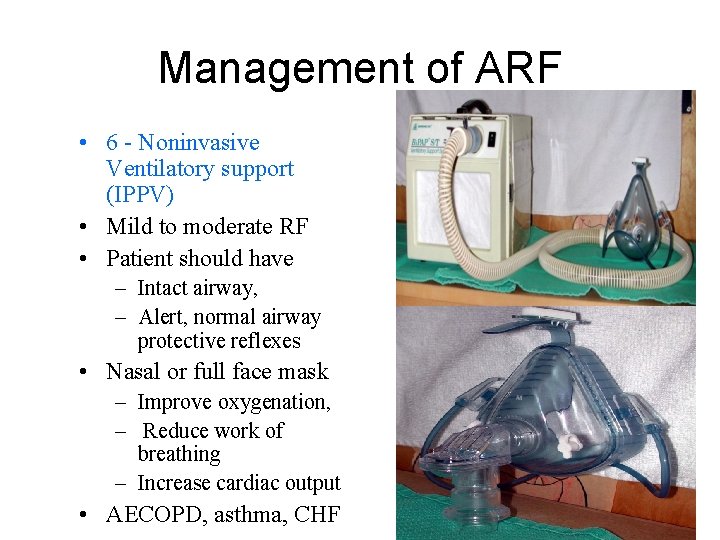
Management of ARF • 6 - Noninvasive Ventilatory support (IPPV) • Mild to moderate RF • Patient should have – Intact airway, – Alert, normal airway protective reflexes • Nasal or full face mask – Improve oxygenation, – Reduce work of breathing – Increase cardiac output • AECOPD, asthma, CHF
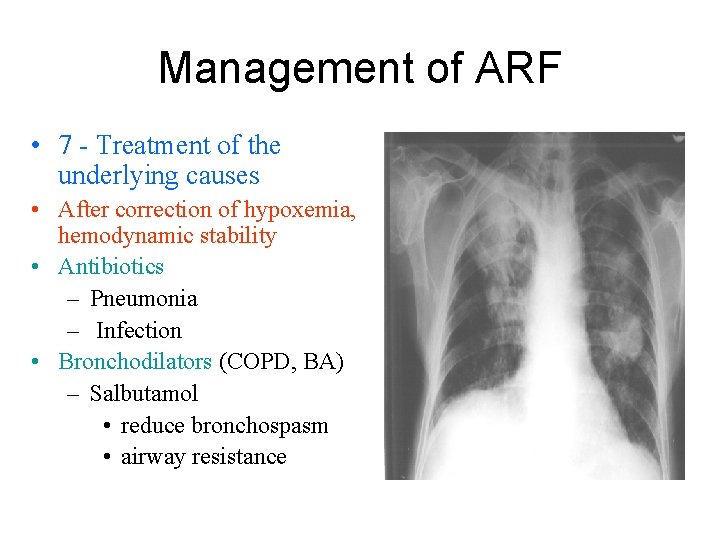
Management of ARF • 7 - Treatment of the underlying causes • After correction of hypoxemia, hemodynamic stability • Antibiotics – Pneumonia – Infection • Bronchodilators (COPD, BA) – Salbutamol • reduce bronchospasm • airway resistance
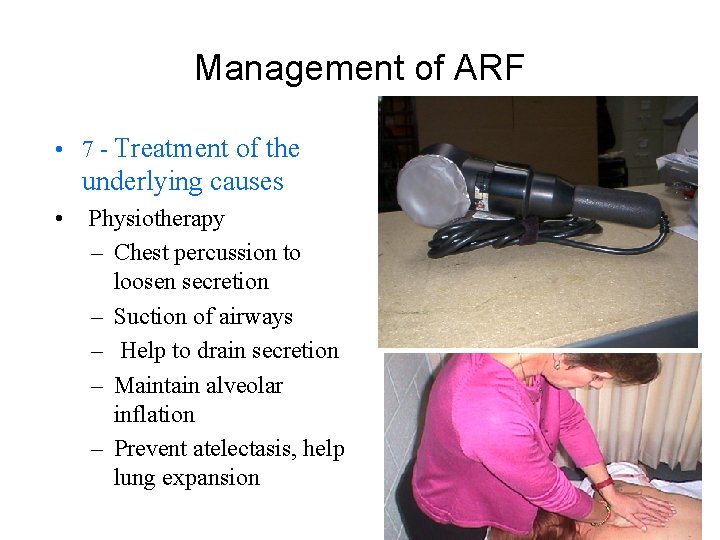
Management of ARF • 7 - Treatment of the underlying causes • Physiotherapy – Chest percussion to loosen secretion – Suction of airways – Help to drain secretion – Maintain alveolar inflation – Prevent atelectasis, help lung expansion
Management of ARF • 8 - Weaning from mechanical ventilation – – – Stable underlying respiratory status Adequate oxygenation Intact respiratory drive Stable cardiovascular status Patient is a wake, has good nutrition, able to cough and breath deeply
Complications of ARF • Pulmonary – Pulmonary embolism – barotrauma – pulmonary fibrosis (ARDS) – Nosocomial pneumonia • Cardiovascular – Hypotension, ↓COP – Arrhythmia – MI, pericarditis • GIT – Stress ulcer, ileus, diarrhea, hemorrhage • Infections – Nosocomial infection – Pneumonia, UTI, catheter related sepsis • Renal – ARF (hypoperfusion, nephrotoxic drugs) – Poor prognosis • Nutritional – Malnutrition, diarrhea hypoglycemia, electrolyte disturbances
Prognosis of ARF • Mortality rate for ARDS → 40% – Younger patient <60 has better survival rate – 75% of patient survive ARDS have impairment of pulmonary function one or more years after recovery • Mortality rate for COPD → 10% – Mortality rate increase in the presence of hepatic, cardiovascular, renal, and neurological disease