
Acute Medicine Seminar Diabetic Ketoacidosis Yeo See Seng
Acute Medicine Seminar (Diabetic Ketoacidosis) Yeo See Seng, Adrian 19/1/05

Diabetic Ketoacidosis Case Study
History • 16 year old Malay male • Admitted to A&E to Surgical ward for acute onset of severe epigastric pain associated with vomiting. • No past history of note
Examination • • Low grade fever, 37. 5 degree Celsius Drowsy Dehydrated RR: 28/min PR: 129/min BP: 110/60 Abdomen: epigastric tenderness, otherwise soft, no masses felt. Bowel sounds normal. • No other abnormal findings.
Investigations • FBC: TW 20000; Hb, platelet normal • Urine glucose 3+; Acetone 2+ • Blood gas p. H: 7. 23 p. O 2: 131 mm. Hg p. CO 2: 15. 1 mm. Hg HCO 3: 6. 3 mmol/L Sa. O 2: 98. 5% Anion gap: 41 =(Na)-(HCO 3+Cl)
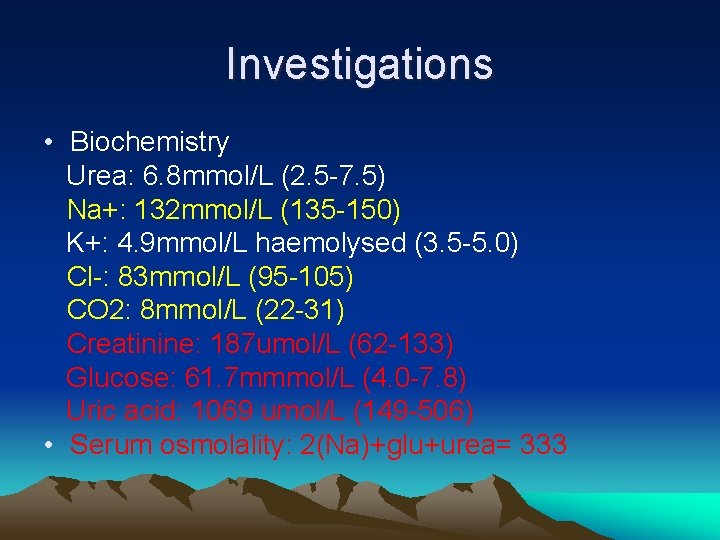
Investigations • Biochemistry Urea: 6. 8 mmol/L (2. 5 -7. 5) Na+: 132 mmol/L (135 -150) K+: 4. 9 mmol/L haemolysed (3. 5 -5. 0) Cl-: 83 mmol/L (95 -105) CO 2: 8 mmol/L (22 -31) Creatinine: 187 umol/L (62 -133) Glucose: 61. 7 mmmol/L (4. 0 -7. 8) Uric acid: 1069 umol/L (149 -506) • Serum osmolality: 2(Na)+glu+urea= 333
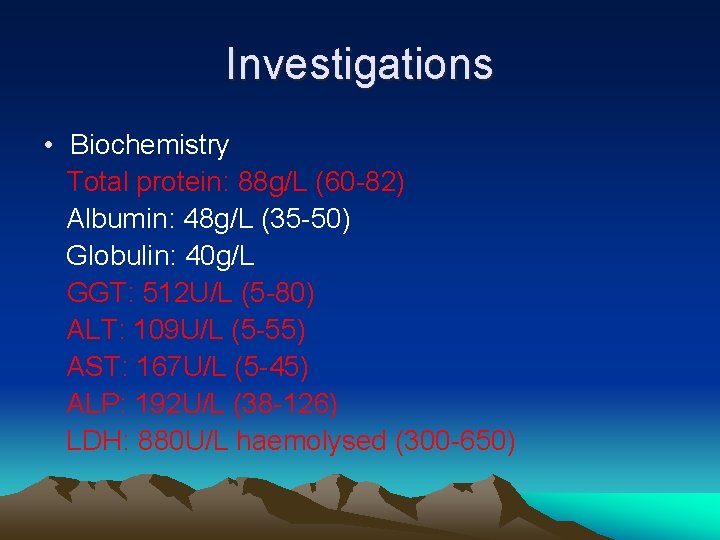
Investigations • Biochemistry Total protein: 88 g/L (60 -82) Albumin: 48 g/L (35 -50) Globulin: 40 g/L GGT: 512 U/L (5 -80) ALT: 109 U/L (5 -55) AST: 167 U/L (5 -45) ALP: 192 U/L (38 -126) LDH: 880 U/L haemolysed (300 -650)
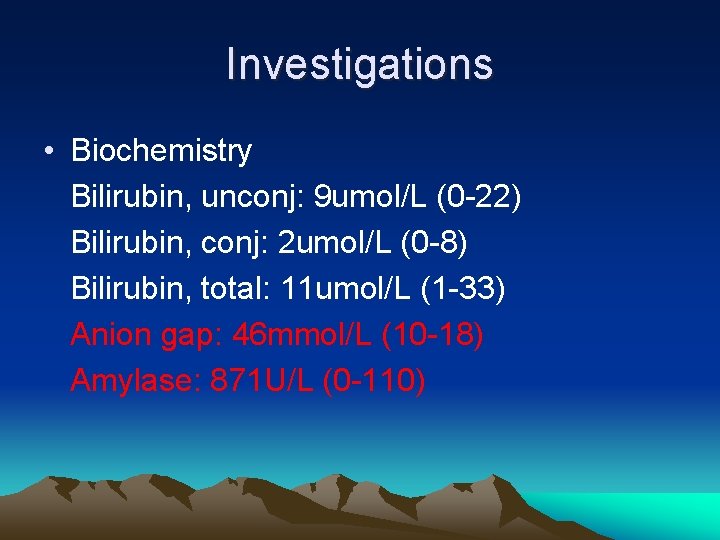
Investigations • Biochemistry Bilirubin, unconj: 9 umol/L (0 -22) Bilirubin, conj: 2 umol/L (0 -8) Bilirubin, total: 11 umol/L (1 -33) Anion gap: 46 mmol/L (10 -18) Amylase: 871 U/L (0 -110)
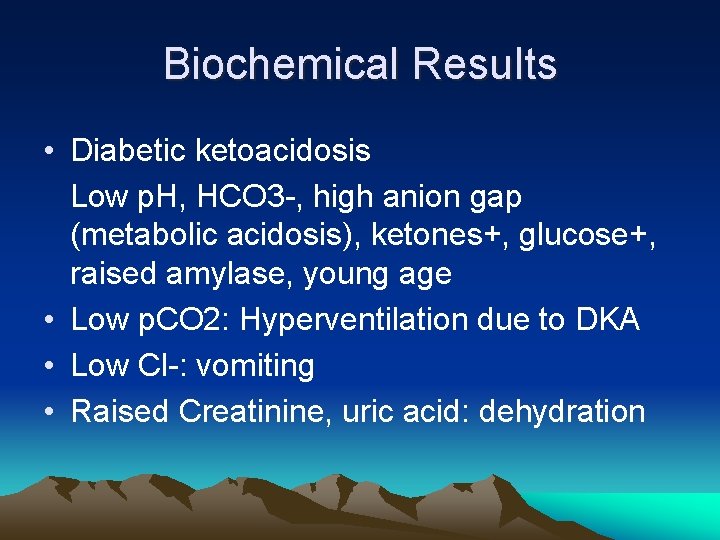
Biochemical Results • Diabetic ketoacidosis Low p. H, HCO 3 -, high anion gap (metabolic acidosis), ketones+, glucose+, raised amylase, young age • Low p. CO 2: Hyperventilation due to DKA • Low Cl-: vomiting • Raised Creatinine, uric acid: dehydration
Biochemical Results • Raised total protein and liver enzymes: liver impairment due to dehydration? • Low Na+: Pseudohyponatraemia • Raised total white: infection
Diabetic Ketoacidosis • A metabolic emergency in which hyperglycaemia is associated with a metabolic acidosis due to greatly raised ketone levels. • Occurs in type 1 diabetes only. • Causes: previously undiagnosed DM, interruption of insulin therapy, stress of intercurrent illness.
Clinical Features • • • Polyuria Polydipsia Lethargy Anorexia Hyperventilation Ketotic breath Dehydration Vomitting Abdominal pain Coma
Clinical Evaluation • Vital signs: BP, HR, conscious level (10% comatose), state of dehydration. • Respiration: Kussmaul breathing, may be depressed in severe acidosis • Pyrexia: <10% despite high incidence of infection. • Look for cause
Investigations • Bedside fingerprick glucose and lab estimation of plasma glucose. • U&E, ABG, blood lactate • Serum CK and CKMB (if indicated) • Urine ketones (+plasma ketones if available) • ECG, CXR • Septic workup: FBC, blood and urine culture, sputum culture
Management • • Replace fluids with normal saline Replace electrolyte losses Restore acid base balance Replace deficient insulin Monitor blood glucose closely Replace energy losses Treat underlying cause
Fluids • IV normal saline at 15 -20 ml/kg/hr (1 -1. 5 L) in 1 st hr with recourse to colloids if patient is still hypotensive (caution in cardiac & renal compromised patients) • Subsequent infusion rate (4 -14 ml/kg/hr) depend on hydration and urine output. • If corrected serum Na+ is low, continue IV normal saline. • If corrected serum Na is high or normal, change to 0. 45% Na. Cl.
Fluids • Corrected serum Na = Na+(Glucose-5)/3. 5 • 148=132+(61. 7 -5)/3. 5 • Fluid replacement should correct estimated deficit within 1 st 24 hr. • Serum osmolality should not decrease more than 3 momsm/kg/hr to avoid cerebral oedema. • Monitor strictly hlry fluid input, urine output, BP, pulse rate, with CVP as necessary. Check U&E every 2 -4 hrs till stable.

Insulin • Give bolus IV soluble insulin (SI) 5 -10 units, follow with IV SI infusion 0. 1 unit/kg/hr. (~35 units/hr) • Repeat IV SI bolus if blood glucose level does not decrease by at least 3 mmol/L after 1 st hr of IV SI infusion. • Monitor finger prick blood glucose hrly and adjust insulin infusion rate every 1 -2 hr to reduce blood glucose by 3 -6 mmmol/hr, until blood glucose is <14 mmol/L.
Insulin • When blood glucose falls to <12 mmol/L decrease IV SI infusion rate to 0. 050. 1 unit/kg/hr (~2 -4 units/hr) and start IV dextrose infusion. • Keep blood glucose between 8 -12 mmol/L. Maintain IV SI and dextrose infusion until DKA resolve. • DKA resolution: p. H>7. 3, anion gap<12, HCO 3 - >18
Insulin • When DKA resolves, stop IV SI, commence SC SI (between 4 -14 units) 4 hrly. • Stop IV SI infusion only 1 -2 h after 1 st SC administration. Maintain IV dextrose till oral feeding is tolerated. Keep blood glucose between 8 -12 mmol/L. • Monitor blood glucose every hour with bedside meter until it is 12 -14 mmol/L and every 2 -4 hr thereafter.
Replace Energy Losses • Let patient eat as soon as possible. When oral diet is well tolerated, stop IV dextrose. • Start S/C SI insulin regime before breakfast and dinner. • Monitor glucose premeals and bedtime.
Potassium • Insulin therapy, volume expansion and correction of acidosis will lower serum K+ • K+ replacement is given as IV KCL 7. 45% mmol/hr • Ensure adequate urine output prior K+ replacement. • Keep serum K+ at 4 -5 mmol/L • Monitor serum K+ every 2 -4 hours till stable.
Bicarbonate • Replacement not necessary unless p. H<7. 0 • If arterial p. H<7. 0 repeat blood gas after 1 hour of hydration. • If p. H still < 7. 0, give 8. 4% Na. HCO 3 - 50100 mmol in 200 ml sterile water over 1 hour as slow infusion. • Check p. H 1 hour later, repeat HCO 3 - if needed till p. H rises to 7. 1
Treat Underying Cause • Treat precipiating factors and co-morbid conditions like AMI and infection.
Monitor and Flow Chart • Intensive and continual monitoring of clinical, laboratory and fluid and electrolyte therapy parameters against date/time till DKA has resolved and patient’s condition is stable.
- Slides: 25