
Acute Knee Injury Exam Prepared by Shane Barclay
Acute Knee Injury Exam Prepared by Shane Barclay MD
Outline 1. Knee exam for acute knee injury. Will not apply equally to the ‘sore knee’ without injury. 2. Review the common knee examinations points.
Knee Exam There are multiple knee exam components. If you are consistent they can be done fairly quickly. Here is a personal perspective of what you need to know! It’s still 17 parts! The sensitivity and specificity of the individual knee exam components vary widely. It was said accuracy of diagnosis with knee exam ~ 50% I don’t believe it! Before any exam, get the history and has there been prior injury or surgery?
Knee Exam - Components 1. History and mechanism of injury 2. Effusion – immediate or delayed 3. Point of maximal pain 4. Gait 5. Thessely 6. Eges 7. Joint line Tenderness

Knee Exam 8. External Rotation Recurvatum +/- Bounce Home test 9. Valgus stress 10. Varus stress 11. Posterior Drawer 12. Anterior Drawer 13. Lachman
Knee Exam 14. Pivot shift 15. Reverse Pivot Shift 16. +/-Apley 17. Dial test.
History 1. History - Exact mechanism of injury. - When? - Prior injury or surgery to the knee
Effusion 2. Effusion - Was it immediate? (~ acute internal damage) - Was it delayed? (~ inflammation, but not necessarily acute major tears or internal derangement) (can occur with small meniscal tears)
Point of Maximal Pain 3. Point of maximal pain. - This includes onset immediate or delayed. - Actual point on knee where the pain is. This can often indicate nature of the injury when considered with the mechanism.
Gait 4. Gait - can they walk? – immediately after the injury No – more likely internal derangement of knee Yes – less likely - if walking became more difficult with time, suggests development of an effusion with possible internal damage. - watch them walk. If unable to fully extend suggests effusion, meniscal tear or instability.
Thessely 5. Thessely So far the patient should have been walking for you. Don’t have them sit down yet. Thessely test may be the most accurate test for meniscal tears. - Test uninjured leg first. - Have Pt hold onto your arms. Flex uninjured knee 20 degrees and lift injured leg enough to be off the floor
Thessely - Rotate the Pt 3 times over the tibia 3 times to each side. - Then change to lift uninjured leg off the floor. - Rotate again 3 times. - Positive test for meniscal tear if pain in joint line during rotation.

Eges - Pronounced ‘Ee guess’ - AKA “Wt bearing Mc. Murray test” - May not be appropriate in acute phase after injury due to pain in limitation of ROM. - Pt stands (with support of wall or examiner) with feet about 30 -40 cm apart. - To test for medial meniscal tear, have Pt squat to 90 degrees, with feet maximally externally rotated.
Eges - To test for lateral meniscal tears, the Pt squats with the feet maximally internally rotated. - Usually can’t squat more than 30 -40 degrees. - Positive test for meniscal tear with pain or audible click with squatting or coming out of the squat. - Anterior tears usually painful early in squat whereas posterior tears painful with more flexion. - Can be sensitive even with ACL tears and effusions.
Now have the patient lie supine on the stretcher.
Joint Line Tenderness - Flex knee to 90 degrees. - Internally rotate foot in and place on stretcher. - Palpate medial joint line. - Externally rotate foot out and place on stretcher. - Palpate lateral joint line. - Positive if pain over meniscal edge. - Jt line tenderness and Eges probably provide best tests for meniscal tears.

External Rotation Recurvatum - Holding both legs by the big toes, lift the legs off the stretcher. - Watch for hyper extended knee with external rotation of the tibia. (genu varum deformity) - Positive test indicates PCL or ACL injury or both as well as Posterolateral Corner (PLC) structures injury. - PLC = LCL, Arcuate-popliteus complex, Bicep femoris tendon and IT band.
Bounce Home test - Can be quite painful if there is an acute meniscal tear. So I don’t usually do this one! - As well there is no data as to its accuracy. - Cup heel in one hand fully flex knee. - Then fully flex knee and then allow knee to fully extend under its own weight. - Lack of full extension or pain = meniscal tear.
Valgus Stress - Do valgus stress at 0 degrees (knee straight) and 30 degrees flexion. - Hold ankle with one hand apply valgus stress over the lower femoral head. - Watch for laxity or give in the medial joint and pain. - If pain and laxity at 0 degrees = Deep MCL and ACL - If pain and laxity at 30 degrees only = Superficial MCL - If pain/laxity at 0 and 30 degrees = superficial and deep MCL plus ACL/PCL tear
Varus Stress - Do varus stress at 0 degrees (knee straight) and 30 degrees flexion. - Hold ankle with one hand apply varus stress over the lower femoral head. - Watch for laxity or give in the lateral joint and pain. - If pain and laxity at 0 degrees = LCL and ACL - If pain and laxity at 30 degrees only = Isolated LCL
Posterior Drawer - Always do this prior to Anterior Drawer and Lachman. If there is a PCL tear it can give you a false positive Anterior Drawer. - Place knee at 90 degrees. Look for posterior Sag Sign which can indicate PCL tear. - Bracing foot (ie sit on it) hold the knee by both hands on the tibia and push tibia quickly posteriorly. - Positive if there is > 6 mm tibial posterior translation or if there is a soft end point = PCL tear
Anterior Drawer - Not sensitive in acute injury with effusion. - Place knee at 90 degrees. - Bracing foot (ie sit on it) hold the knee by both hands on the tibia and pull tibia quickly anteriorly. - Positive if there is > 6 mm tibial anterior translation or if there is a soft end point = ACL tear.
Lachman - Not sensitive in acute injury with effusion. - Flex knee to 30 degrees - Fix femur with one hand externally rotate tibia with other hand. - Then try to translate the tibia anteriorly. - Positive if anterior translation is > 3 mm compared to uninjured leg or soft end point = ACL tear.
(Lateral) Pivot Shift - Low sensitivity but very high specificity. - Very low sensitivity in acute injury settings with effusion. - Hip should be abducted and flexed 30 degrees. - Hold heel and internally rotate tibia. - With other hand give valgus pressure over fibula. - Then move Pts leg from extension to flexion. - Positive if tibia reduces (clunks) backwards at around 30 degrees = ACL tear.
Reverse Pivot Shift - Low sensitivity but high specificity for PCL and PLC injury. - Flex and hold knee in 90 degrees. With one hand externally rotate tibia. - With other hand apply valgus stress to proximal tibia. - Finally apply axial load with distal arm or by placing foot on your hip and push into Pt. - Then flex and extend knee keeping axial load, external rotation and valgus force.
Reverse Pivot Shift - Positive if at around 30 degrees the tibia is reduced with a clunk = PCL and PLC tear.
Apley’s Test - Pt must be prone. Test for meniscal tear. - Low accuracy for diagnosing meniscal tears. So often not used - Fixate thigh with your leg or knee. - Flex knee 90 degrees. - Distract tibia and internally/externally rotate. - Look for excessive rotation or discomfort = ligamentous injury.
Apley’s Test - Then compress tibia and rotate as above. - Look for decrease rotation or pain = meniscal injury
Dial Test - Test for Posterolateral Complex instability (PLC) - Validity of test is unknown. - Prone. Bring knees to 30 degrees flexion with ankles together. - Cup heels and maximally externally rotate the heels. - Repeat process with knees at 90 degrees. - Look for more than 10 degrees rotation in affected knee compared to the normal knee.
Dial Test - 10 degree difference at 30 degrees = isolated PLC injury - 10 degree difference at 30 and 90 degrees = both PCL and PCL injury
Other points to knee exam - If there is bruising over the lateral knee without contusion type injury there, suspect fibular or lateral tibial plateau fracture. - Similar with the medial side, if bruising, suspect medial tibial plateau fracture. - With both these fractures, Pts will not be able to weight bear and have marked limitation in ROM.
Specific Knee Injuries Points There are really only 5 internal soft tissue components to the knee that can be injured: 1. Medial Collateral Ligament 2. Lateral Collateral Ligament 3. Anterior Cruciate Ligament 4. Posterior Cruciate Ligament 5. Posterolateral Complex
Medial Collateral Ligament - Involved in 40% of knee injuries - MCL injuries have meniscal tears associated in about 5% of the time. - Injury to other ligaments in the knee occurs with about 50% of MCL tears. - There are 3 layers to the MCL (although for practical purposes only 2) Superficial and Deep
Medial Collateral Ligament - There is a bursa between the superficial and deep MCL layers (Voshell’s bursa) - MCL provides resistance to valgus and rotation throughout flexion and extension. - The ACL assist the MCL in this but only in full extension. - Mechanism of injury Direct contact Valgus stress with external rotation
Medial Collateral Ligament - Effusions are not common with isolated or superficial MCL tears. - Effusions occur with MCL tears that are accompanied by meniscal or ACL tears. - Direct palpable tenderness over the meniscus is ~ 80% accurate for a MCL tear.
Medial Collateral Ligament - As outlined in prior slides, next to palpation tenderness, the Valgus test is the most reliable test for MCL tears: Laxity and/or pain at 0 degrees = Deep MCL +/-ACL +/- PCL tears Laxity and/or pain at 30 degrees = Superficial MCL No pain at 0 degrees but laxity and pain at 30 degrees = Superficial MCL Laxity and pain at 0 and 30 degrees = whole MCL and ACL injury.
Lateral Collateral Ligament - LCL itself is small and has ½ the tensile strength of MCL - Often included in the ‘lateral complex’ (or posterolateral complex) - LCL - IT band - Superficial bicep femoris - Posterolateral Corner = Joint capsule, arcuate ligament, popliteo-fibular ligament and popliteus tendon.
Lateral Collateral Ligament - Isolated LCL injuries are rare. - Usually occur with varus stress, hyperextension and external rotation. - Often associated with ACL, PLC and PCL injury. - When examining, easiest to palpate when knee flexed 90 degrees. - Gait with LCL/PLC injury has knee flexion, avoid full extension and internal rotation to avoid instability.
Lateral Collateral Ligament - If there is tenderness to the fibular head always xray “Arcuate sign” avulsion # fibula associated with PLC “Segond sign” avulsion # lateral tibial plateau - fracture + ACL+LCL/PLC injury - These need ortho referral.
Anterior Cruciate Ligament - Controls anterior translation of tibia. - Secondary restraint to tibial rotation - In children is the most common knee ligament injury. - Injury associated with Pt hearing/feeling a pop, quick onset of effusion, feeling of instability, especially when squatting or pivoting.
Posterior Cruciate Ligament - Largest and strongest ligament in the knee. - Is intra-articular but extra-synovial so minimal effusion if isolated injury. - Works in conjunction with PLC to prevent posterior tibial translation in flexion and external rotation.
Meniscal Tears - Peripheral meniscus has blood supply. Internal meniscus has minimal blood supply thus poor healing rates. - Tears usually occur with flexion and rotation (twisting) wherein the meniscus gets torn by the femoral condyles. - Small tears are often not that painful and will swell after 24 hrs. Then can have pain with pivoting and twisting.
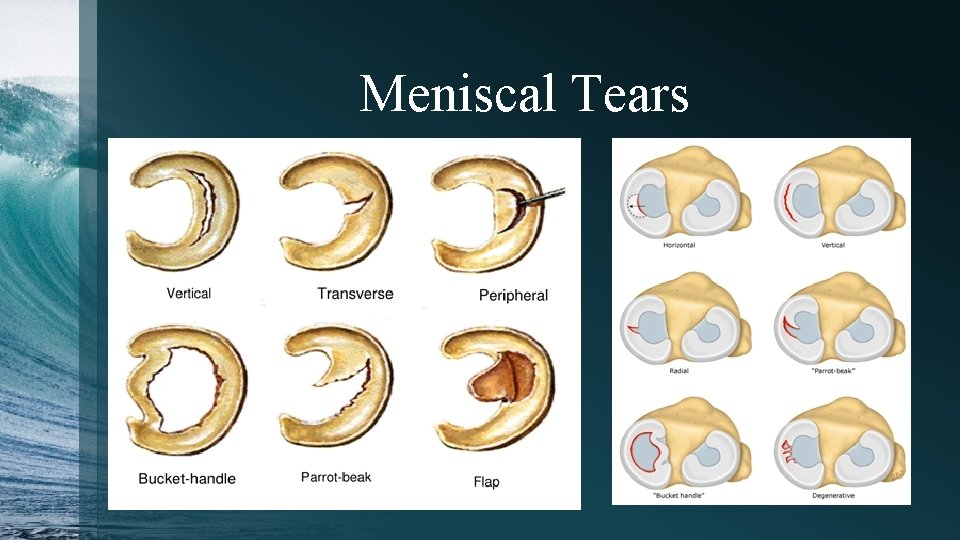
Meniscal Tears
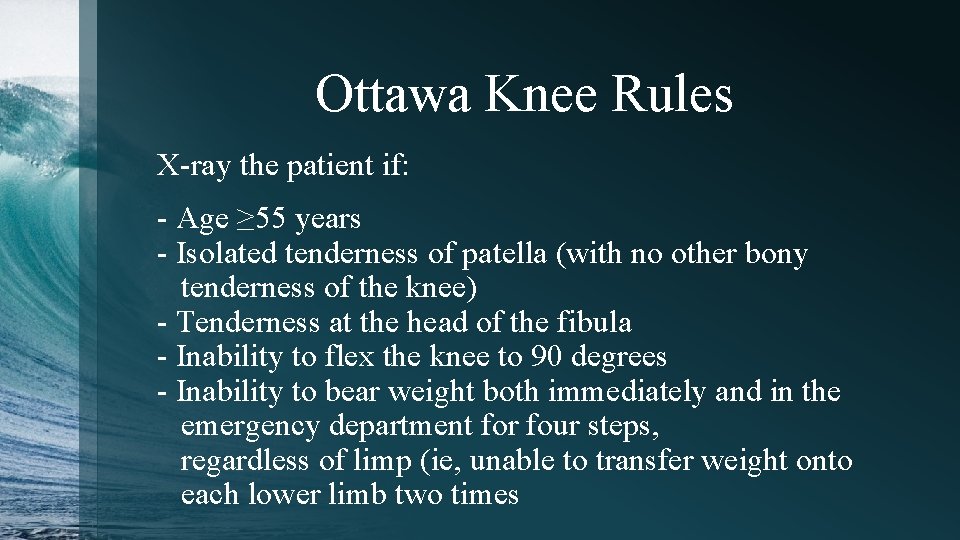
Ottawa Knee Rules X-ray the patient if: - Age ≥ 55 years - Isolated tenderness of patella (with no other bony tenderness of the knee) - Tenderness at the head of the fibula - Inability to flex the knee to 90 degrees - Inability to bear weight both immediately and in the emergency department for four steps, regardless of limp (ie, unable to transfer weight onto each lower limb two times

The END
- Slides: 45