
Acute Airway Obstruction due to Cervical Goiter in
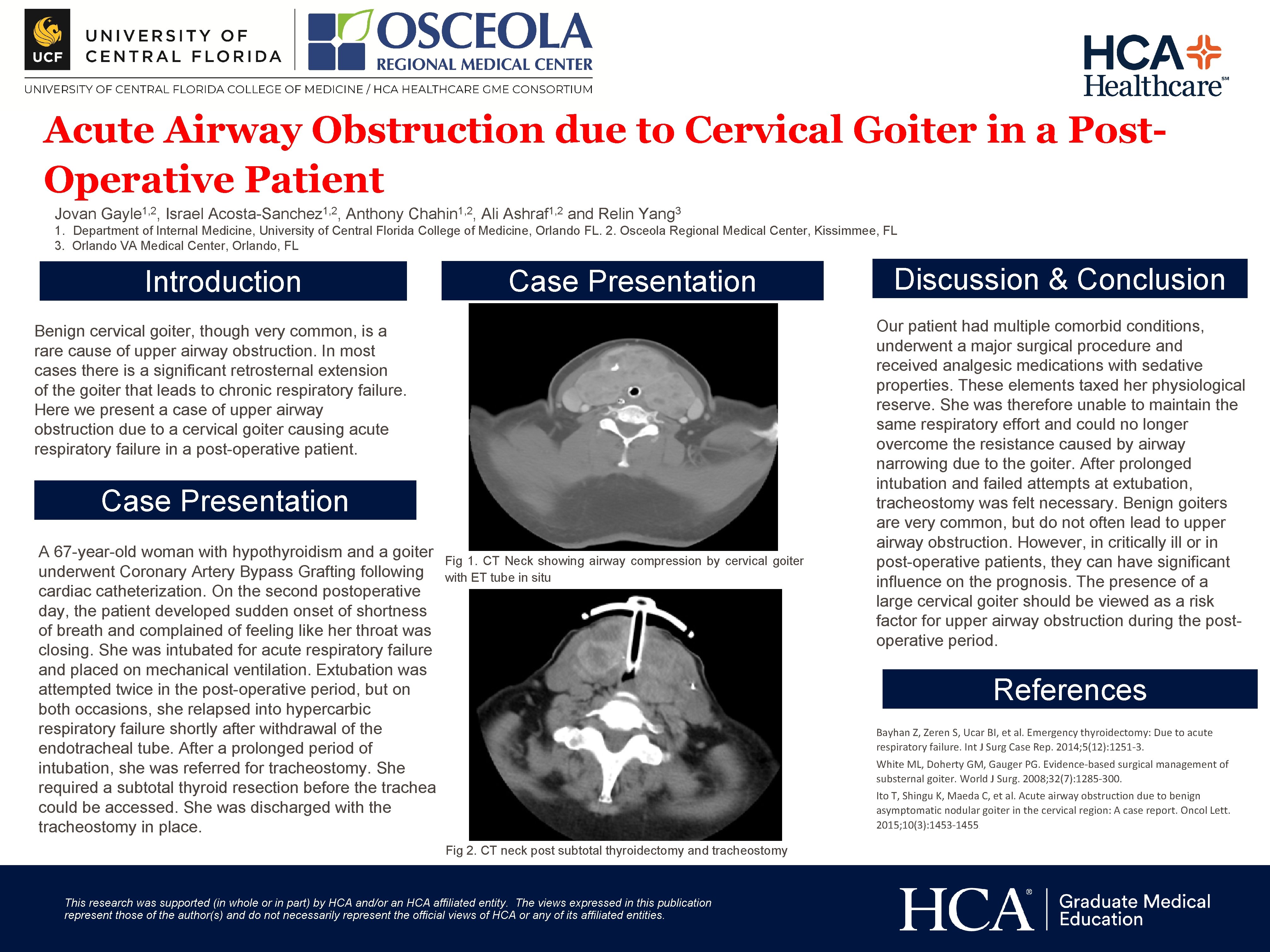
Acute Airway Obstruction due to Cervical Goiter in a Post. Operative Patient Jovan Gayle 1, 2, Israel Acosta-Sanchez 1, 2, Anthony Chahin 1, 2, Ali Ashraf 1, 2 and Relin Yang 3 1. Department of Internal Medicine, University of Central Florida College of Medicine, Orlando FL. 2. Osceola Regional Medical Center, Kissimmee, FL 3. Orlando VA Medical Center, Orlando, FL Introduction Case Presentation Benign cervical goiter, though very common, is a rare cause of upper airway obstruction. In most cases there is a significant retrosternal extension of the goiter that leads to chronic respiratory failure. Here we present a case of upper airway obstruction due to a cervical goiter causing acute respiratory failure in a post-operative patient. Case Presentation A 67 -year-old woman with hypothyroidism and a goiter underwent Coronary Artery Bypass Grafting following cardiac catheterization. On the second postoperative day, the patient developed sudden onset of shortness of breath and complained of feeling like her throat was closing. She was intubated for acute respiratory failure and placed on mechanical ventilation. Extubation was attempted twice in the post-operative period, but on both occasions, she relapsed into hypercarbic respiratory failure shortly after withdrawal of the endotracheal tube. After a prolonged period of intubation, she was referred for tracheostomy. She required a subtotal thyroid resection before the trachea could be accessed. She was discharged with the tracheostomy in place. Fig 1. CT Neck showing airway compression by cervical goiter with ET tube in situ Discussion & Conclusion Our patient had multiple comorbid conditions, underwent a major surgical procedure and received analgesic medications with sedative properties. These elements taxed her physiological reserve. She was therefore unable to maintain the same respiratory effort and could no longer overcome the resistance caused by airway narrowing due to the goiter. After prolonged intubation and failed attempts at extubation, tracheostomy was felt necessary. Benign goiters are very common, but do not often lead to upper airway obstruction. However, in critically ill or in post-operative patients, they can have significant influence on the prognosis. The presence of a large cervical goiter should be viewed as a risk factor for upper airway obstruction during the postoperative period. References Bayhan Z, Zeren S, Ucar BI, et al. Emergency thyroidectomy: Due to acute respiratory failure. Int J Surg Case Rep. 2014; 5(12): 1251 -3. White ML, Doherty GM, Gauger PG. Evidence-based surgical management of substernal goiter. World J Surg. 2008; 32(7): 1285 -300. Ito T, Shingu K, Maeda C, et al. Acute airway obstruction due to benign asymptomatic nodular goiter in the cervical region: A case report. Oncol Lett. 2015; 10(3): 1453 -1455. Fig 2. CT neck post subtotal thyroidectomy and tracheostomy This research was supported (in whole or in part) by HCA and/or an HCA affiliated entity. The views expressed in this publication represent those of the author(s) and do not necessarily represent the official views of HCA or any of its affiliated entities.
- Slides: 1