
Acute Abdominal Pain in the Elderly Kevin Biese
Acute Abdominal Pain in the Elderly Kevin Biese MD, MAT Emergency Medicine Assistant Professor, Residency Director Ellen Roberts Ph. D, MPH Jan Busby-Whitehead, MD University of North Carolina @ Chapel Hill Division of Geriatric Medicine Center for Aging and Health Department of Emergency Medicine With Support from John A. Hartford Foundation & American Geriatrics Society
Objectives • To increase appreciation of the variety of presentations of acute abdominal pathology in elderly patients. • To appreciate the differences in etiology of acute abdominal pain between elderly and younger patients. • To increase proficiency of evaluation and management of elderly patients with acute abdominal pain. 11/5/2020 2
Case 1: Ms. Jones • 85 year old (yo) woman with PMH atrial fibrillation, GERD • Chief Complaint (CC) abdominal pain • Started 8 hours before arrival, sudden onset, intermittent pain, was able to eat dinner 3 hours after onset without difficulty • Afebrile, vital signs within normal limits (WNL), no vomiting, no diarrhea, normal bowel movement 2 hours before arrival • Exam: mildly tender epigastric and right upper quadrant region without peritonitis, no murphy’s sign 11/5/2020 3
Ms. Jones: Initial Results • White Blood Cell count (WBC) 11. 7, Hematocrit 49, Platelets 193 • Chemistries WNL, liver function tests(LFTs) WNL, Lipase WNL 11/5/2020 4
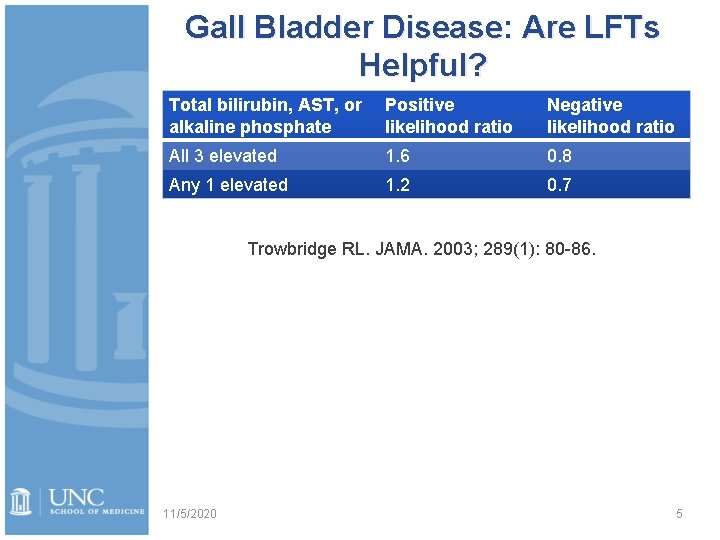
Gall Bladder Disease: Are LFTs Helpful? Total bilirubin, AST, or alkaline phosphate Positive likelihood ratio Negative likelihood ratio All 3 elevated 1. 6 0. 8 Any 1 elevated 1. 2 0. 7 Trowbridge RL. JAMA. 2003; 289(1): 80 -86. 11/5/2020 5
Ms. Jones Ultrasound Insert ultrasound image of cholecystitis with gall stones, thickened gall bladder wall, and edema. lookfordiagnosis. com retrieved June 1, 2011 11/5/2020 6
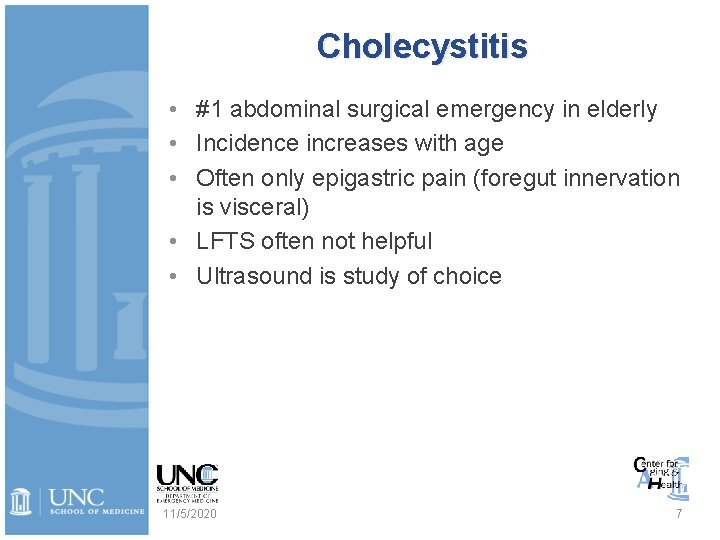
Cholecystitis • #1 abdominal surgical emergency in elderly • Incidence increases with age • Often only epigastric pain (foregut innervation is visceral) • LFTS often not helpful • Ultrasound is study of choice 11/5/2020 7
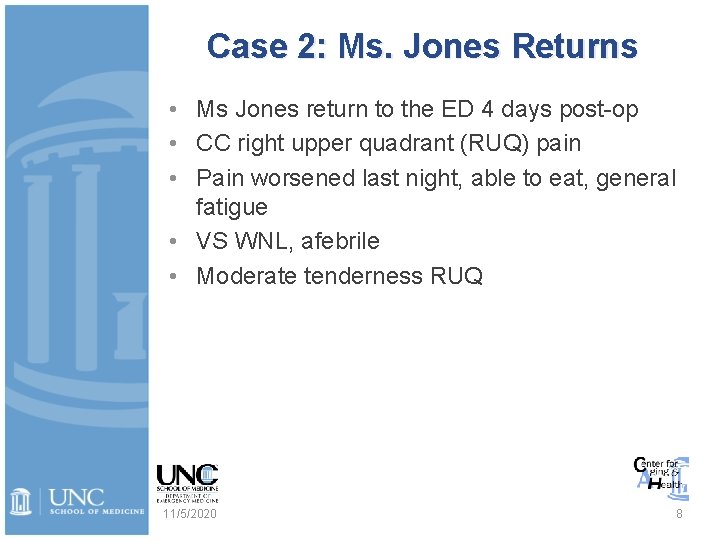
Case 2: Ms. Jones Returns • Ms Jones return to the ED 4 days post-op • CC right upper quadrant (RUQ) pain • Pain worsened last night, able to eat, general fatigue • VS WNL, afebrile • Moderate tenderness RUQ 11/5/2020 8
Ms. Jones: The Return Visit • Labs including LFTs WNL • Abdominal CT does not show abscess or other abnormalities • What to do? 11/5/2020 9
Ms. Jones: The Return Visit • The diaphragm is an unsecured border; upper abdominal pain can be » Acute coronary syndrome » Pulmonary embolism » Pneumonia » Insert CT image of pulmonary embolism 11/5/2020 10
Case 3: Ms. Smith • 80 yo woman PMH breast cancer, hypothyroid presents with abdominal pain • Sudden onset 10 hours before arrival, right lower quadrant (RLQ) pain constant in location, 10/10 intensity, + diarrhea • Exam notable for moderate RLQ tenderness, hemoccult negative 11/5/2020 11
Ms. Smith: Appendicitis Insert CT image of appendicitis. 11/5/2020 12
Ms. Smith: Appendicitis • Appendicitis in the elderly … » 5% of acute abdominal cases » Rarely have the 4 classic criteria (anorexia, elevated WBC, RLQ pain, and fever) » Diagnosis often missed (presence of diarrhea or WBC in urine can be misleading) » However, usually have at least RLQ pain Kauvar DR. Clin Geri Med. 1993; 9: 547 -58. Storm-Dickerson TL. Am J Surg 1983; 185, 198 -201 11/5/2020 13
Case 4: Ms. Doe • 67 yo woman with HTN, COPD, CAD • CC: abdominal pain • 3 days generalized, intermittent abdominal pain with n/v/d; no black stools, some urinary hesitancy • Seen by PCP 2 days prior, given phenergan • No apparent distress; exam notable for moderate RUQ and RLQ tenderness • HR 115, BP 160/ 100, T 37. 0 11/5/2020 14
Ms. Doe: R Sided Abdominal Pain • • WBC 11. 5; o/w CBC WNL Chemistries 7 and LFTS WNL UA shows 7 WBC, nitrite negative Arterial lactate 1. 0 • What to Do? » A diagnostic test was obtained several hours later… 11/5/2020 15
Ms. Doe: R Sided Abdominal Pain • Insert CT image of mesenteric ischemia 11/5/2020 16
Ms. Doe: Mesenteric Ischemia • Classically pain out of proportion to exam • Risks include atrial fibrillation, hypercoaguable, low-flow, increasing age • Arterial (usually) or venous • Embolus or thrombosis • Sometimes “intestinal angina” • Usually superior mesenteric artery • Multi-detector CT scan 77 -90% sensitive • Elevated lactate is a late finding (check >1 time) Newman TS. Am. Surg. 1998; 64: 611 -16. Emedicine 2006 Horton KM. Radiographics. 2002: 22; 161. 11/5/2020 17
Case 5: Mr. Smith • 82 yo man with HTN, chronic renal insufficiency, diverticulosis • History abdominal aortic aneurysm repair • 2 weeks flank pain wrapping around to abdomen • Referred by PCP as abnormal renal Cat Scan • Vital signs WNL including afebrile, 162/80, HR 65 • Obese male in moderate amount distress • Exam benign including abdominal exam • What to do? 11/5/2020 18
Mr. Smith: Abdominal Aortic Aneurysm (AAA) • • • Elderly + low BP + abdominal pain = AAA Get the ultrasound – Fast! Same risk factors as CAD (men>women) >3 cm defines, >5 cm rupture risk What diagnosis to consider if simultaneous rectal bleeding? Insert ultrasound image of enlarged abdominal aorta 11/5/2020 19
Case 6: Ms. Connor • 80 yo female with HTN, anxiety • 2 days crampy lower abdominal pain, mild n/v/d • In no apparent distress • Vital signs wnl other than moderate HTN • Exam notable for moderate BLQ tenderness without peritonitis 11/5/2020 20
Case 6: Ms. Connor Insert abdominal x-ray of sigmoid volvulus. 11/5/2020 21
Sigmoid Volvulus • • Risk factors: chronic constipation, round worms More common in males Abdominal x-ray 65% sensitive Usually presents with crampy left sided abdominal pain Often decompressed with sigmoid scope Can be subtle presentation Time sensitive diagnosis Atamanalp SSJ Gastroenterol Hepatol 2007 11/5/2020 Emedicine 2008 22

Case 7: Ms. Lane • • 79 yo female with HTN, diabetes CC: N/V/D 2 days Well appearing, vital signs WNL Seen 48 hours ago for n/v/d 6 WBC in UA, no nitrate, 4 squamous cells, levofloxacin started • Patient took 1 tab levofloxacin, increased vomiting and diarrhea • Completely benign abdominal exam • WBC 5, 000, chemistries WNL, UA WNL 11/5/2020 23
Ms. Lane: Gastroenteritis/ medication reaction • Observed in ED for 5 hours • No vomiting or diarrhea while in the ED with continued completely benign abdominal exam & tolerating POs • D/C with close PCP follow up or ED follow up within 24 hours • Not all elderly patients with abdominal pain need advanced imaging, but they all need observation and close follow up. 11/5/2020 24
Key Points • Acute abdominal pain in the elderly is associated with significant morbidity and mortality. • LFTs are often not revealing in acute gallbladder disease. • The diaphragm is not a secure border. • Consider mesenteric ischemia (especially with history atrial fibrillation or pain out of proportion to exam. ) • Elderly + low BP + abdominal pain = AAA (until proven otherwise) 11/5/2020 25
Case 1 An 85 year old woman presents to the ED complaining of 8 hours of abdominal pain. The pain is centered in the epigastrum and she has had no vomiting or diarrhea. She had a normal bowel movement 2 hours before arrival to the ED. She ate a meal last night without difficulty. Her past medical history is notable for atrial fibrillation and gastric reflux disease. In the ED she is afebrile with normal vital signs other than mild hypertension at 150/95. Her exam is notable for a well appearing elderly woman with mild epigastric tenderness and no peritonitis on exam. She does not have a Murphy’s sign on exam. After completing your history and exam, you order labs including liver function tests (LFTs), complete blood count, and basic chemistries. Other than a white blood cell count of 11. 7 without a left shift, these labs are all within the normal range including the LFTs. You now need to decide how you wish to proceed with this patient. 11/5/2020 26
Case 1/ Question 1 What is the most common etiology of acute abdominal pain presenting to the ED in patients over age 50? Select the one best answer. a) b) c) d) 11/5/2020 biliary tract disease constipation non-specific abdominal pain urinary tract infection 27
Case 1/ Question 2 What is the negative likelihood ratio for all liver function tests being normal in assessing if a patient has acute cholecystitis? a) b) c) d) 11/5/2020 0. 1 0. 3 0. 7 1. 0 28
Case 1/ Question 3 True or False The gallbladder’s visceral innervation originates in the midgut. 11/5/2020 29
Case 2 A 67 year old woman with a medical history of hypertension and coronary artery disease presents to the ED with 3 days of generalized intermittent abdominal pain with nausea, vomiting, diarrhea, and some urinary hesitancy. She denies black stools or fevers. She was seen 2 days ago by her Primary Care Provider and given phenergan for nausea. She is now presenting to the ED because her pain is not improving. On exam she is in significant pain but has only moderate right upper and lower quadrant abdominal tenderness. She is guaiac negative on rectal exam and her vitals are notable for a heart rate of 115, a blood pressure of 160/100, and a temperature of 37. 0 C. In the ED, her WBC count is 11. 5 without a left shift, her UA has 7 WBC without nitrite, squamous cells, or bacteria, and the rest of her labs are normal including her arterial lactate level of 1. 0. You now need to decide how to proceed in your evaluation of this patient. 11/5/2020 30
Case 2/ Question 1 Which of the following is not a risk factor for mesenteric ischemia? a) b) c) d) 11/5/2020 advancing age atrial fibrillation prior abdominal surgery recent myocardial infarction 31
Case 2/ Question 2 True or False Elevated lactate levels are a highly sensitive marker of mesenteric ischemia. 11/5/2020 32
Case 2/ Question 3 Regarding appendicitis, which of the following classic signs and symptoms do the majority of elderly patients with abdominal pain have? Select the one best answer. a) b) c) d) 11/5/2020 anorexia migration of pain localized to the right lower quadrant peritoneal signs on abdominal exam 33
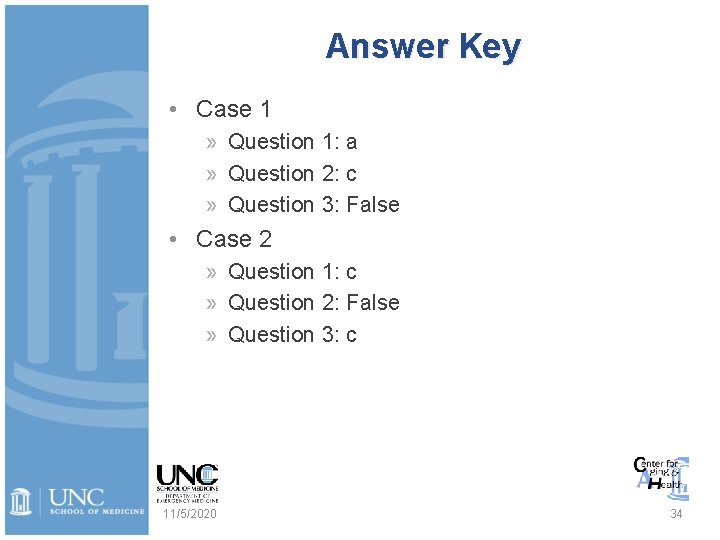
Answer Key • Case 1 » Question 1: a » Question 2: c » Question 3: False • Case 2 » Question 1: c » Question 2: False » Question 3: c 11/5/2020 34
Acknowledgements and Disclaimer This project was supported by funds from the American Geriatrics Society John A. Hartford Geriatrics for Specialists Grant. This information or content and conclusions are those of the authors and should not be construed as the official position or policy of, nor should any endorsements be inferred by the American Geriatrics Society or John A. Hartford Foundation. The UNC Center for Aging and Health and UNC Department of Emergency Medicine also provided support for this activity. This work was compiled and edited through the efforts of Jennifer Link, BA. 11/5/2020 35

Copyright © 2011 The University of North Carolina School of Medicine at Chapel Hill 11/5/2020 36
- Slides: 36