
Acute Abdomen Nurhayat Usman dr Sp BKBD 342021
Acute Abdomen Nurhayat Usman, dr Sp. B-KBD 3/4/2021
Acute Abdomen (acute abdominal pain) n “Condition which requires immediate treatment” (FD Moore, 1977): Surgery? When to perform? n (Buku Ajar Ilmu Bedah, 1997): “Clinical condition which arises from acute critical condition in the abdominal cavity, and usually manifests as pain. n Acute abdominal pain: Chief complaint: acute pain (Nyhus, Vitello, Condon, 1995)
Why is it important ? n Patient with acute abdomen: Sudden onset u Unknown etiology (not clear) u Need immediate diagnosis & treatment u u Prevent morbidity & mortality
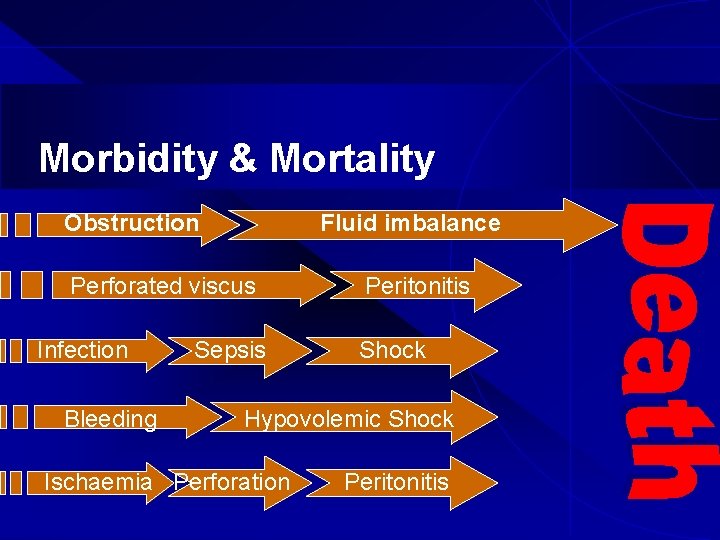
Morbidity & Mortality Obstruction Fluid imbalance Perforated viscus Infection Bleeding Sepsis Peritonitis Shock Hypovolemic Shock Ischaemia Perforation Peritonitis
Acute abdominal pain n Most can be diagnosed clinically n Require accurate and focused history taking n Need meticulous & rationale physical examination n Appropriate special investigations
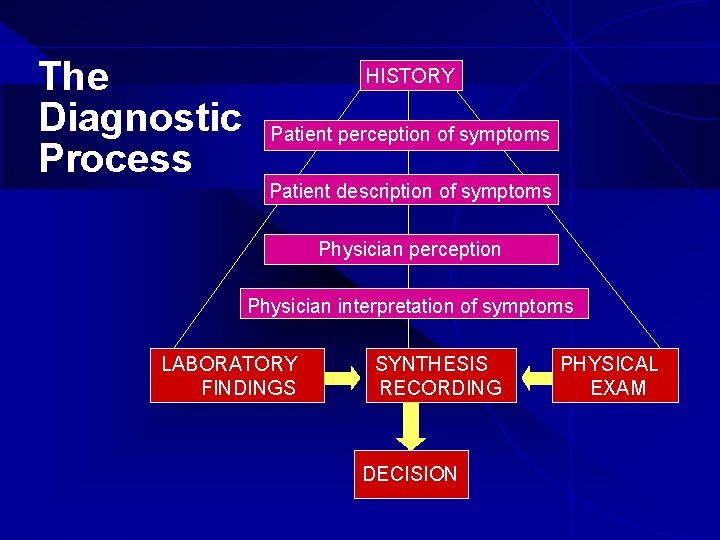
The Diagnostic Process HISTORY Patient perception of symptoms Patient description of symptoms Physician perception Physician interpretation of symptoms LABORATORY FINDINGS SYNTHESIS RECORDING DECISION PHYSICAL EXAM
History Taking n 60 - 80% of accurate diagnosis arises from good & meticulous history taking n Physical diagnosis confirms accurate diagnosis n 10 - 15% of accurate diagnosis arise from laboratory & radiological examinations
History Taking n May confirm : u Suspected diagnosis u Possible etiology u Disease stages/ complications u Differential diagnosis
History Taking Introduction • Greet the patient, and develop a warm and helpful environment • Introduce yourself to the patient
Patient Identity n Ask the patient politely concerning his/her : name age n Record the gender : u Male u Female n Ask the marital status of the patient (especially for female)
Acute abdominal pain in specific groups n In children u Acute appendicitis n In the elderly Perforated tumors u Bowel obstruction due to tumors u n During pregnancy u Complicated Ectopic pregnancy
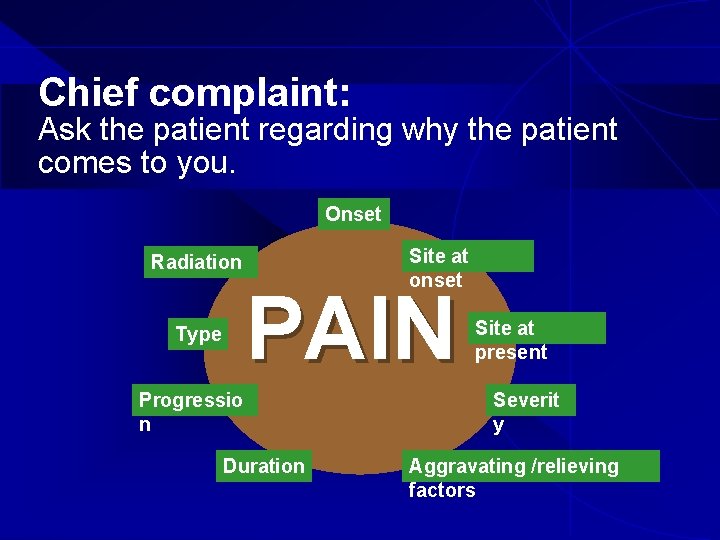
Chief complaint: Ask the patient regarding why the patient comes to you. Onset Radiation Site at onset PAIN Type Progressio n Duration Site at present Severit y Aggravating /relieving factors
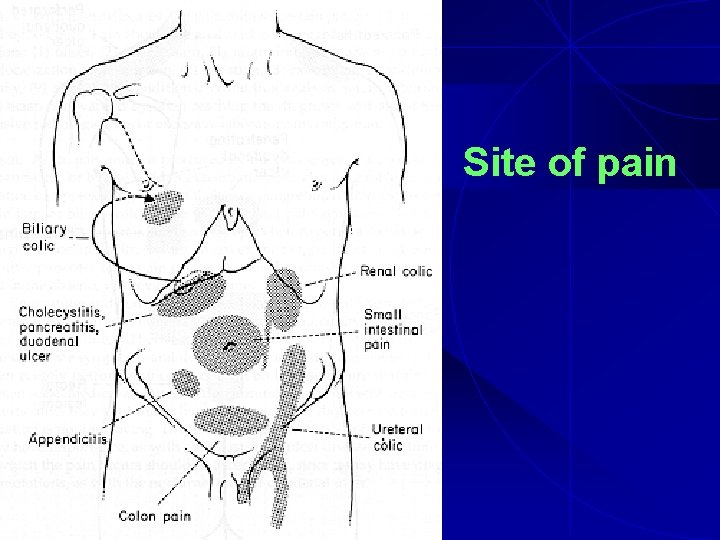
Site of pain
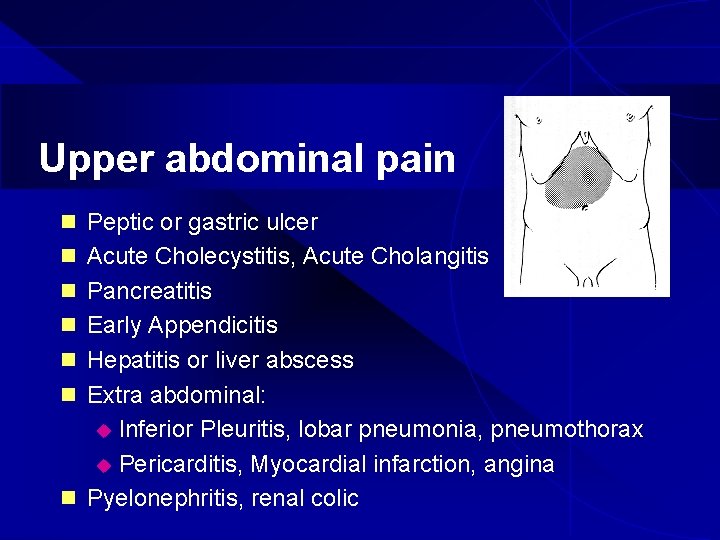
Upper abdominal pain n Peptic or gastric ulcer n Acute Cholecystitis, Acute Cholangitis n Pancreatitis n Early Appendicitis n Hepatitis or liver abscess n Extra abdominal: Inferior Pleuritis, lobar pneumonia, pneumothorax u Pericarditis, Myocardial infarction, angina n Pyelonephritis, renal colic u
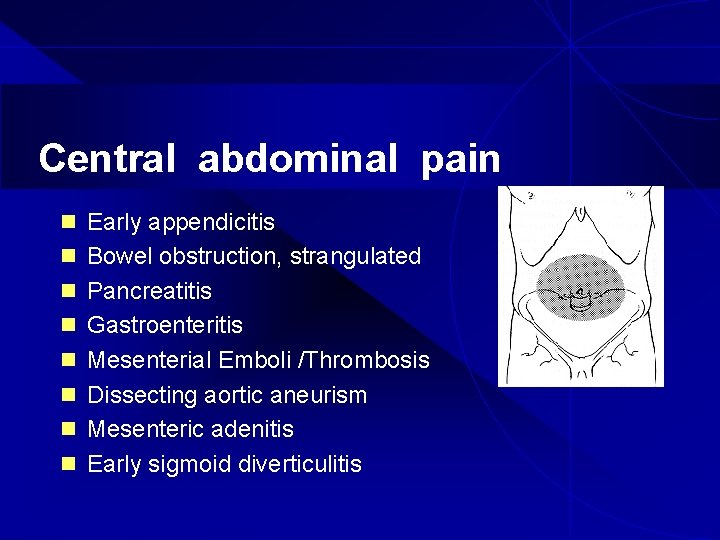
Central abdominal pain n Early appendicitis n Bowel obstruction, strangulated n Pancreatitis n Gastroenteritis n Mesenterial Emboli /Thrombosis n Dissecting aortic aneurism n Mesenteric adenitis n Early sigmoid diverticulitis
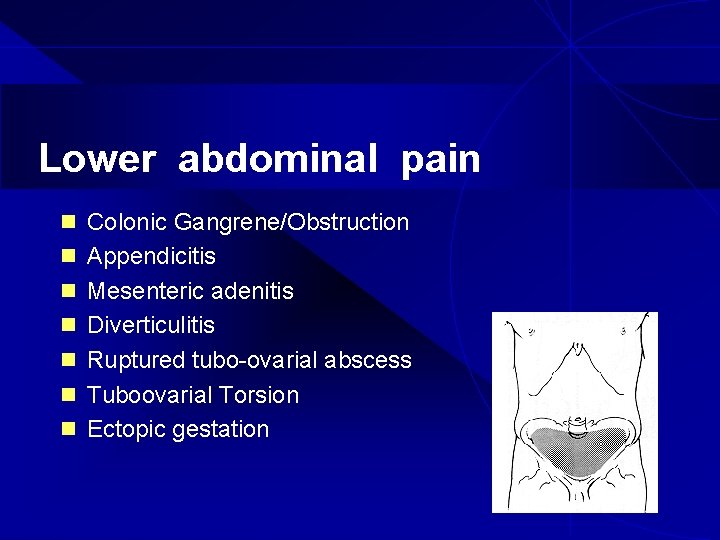
Lower abdominal pain n Colonic Gangrene/Obstruction n Appendicitis n Mesenteric adenitis n Diverticulitis n Ruptured tubo-ovarial abscess n Tuboovarial Torsion n Ectopic gestation
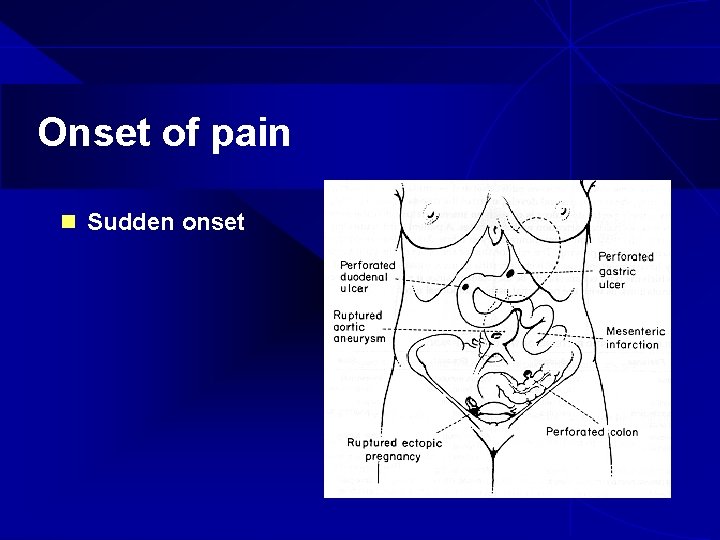
Onset of pain n Sudden onset
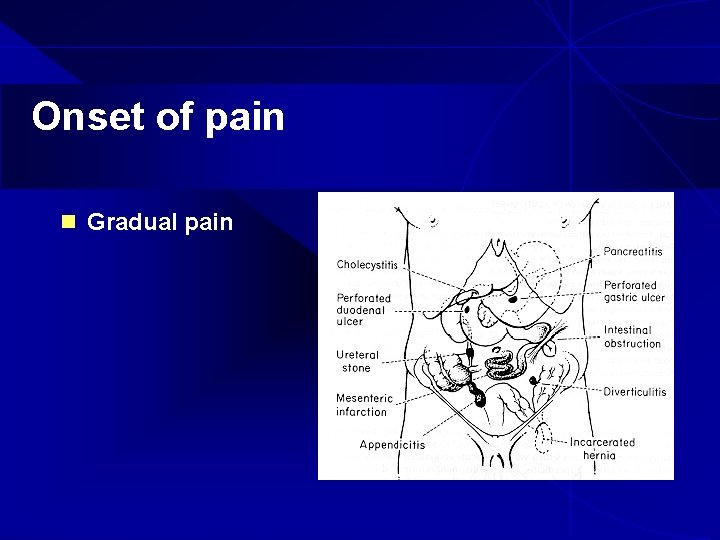
Onset of pain n Gradual pain
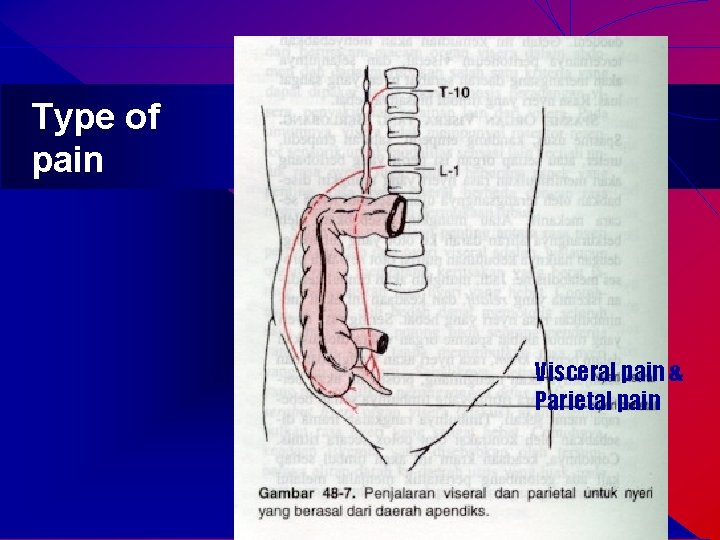
Type of pain Visceral pain & Parietal pain
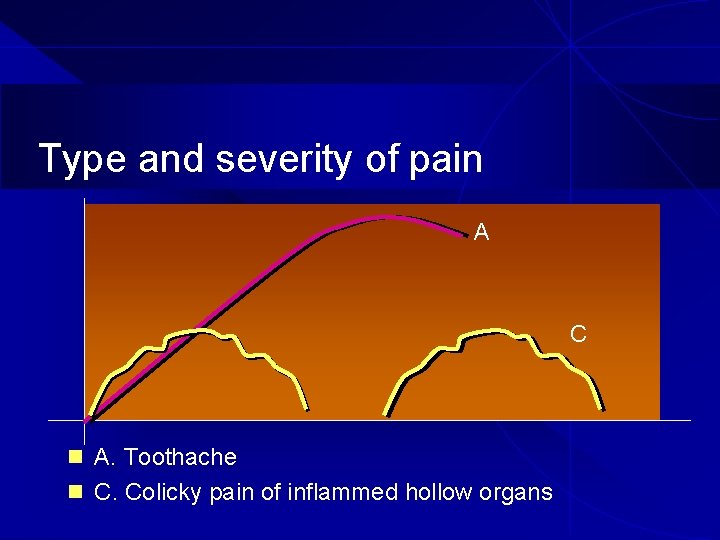
Type and severity of pain A C n A. Toothache n C. Colicky pain of inflammed hollow organs
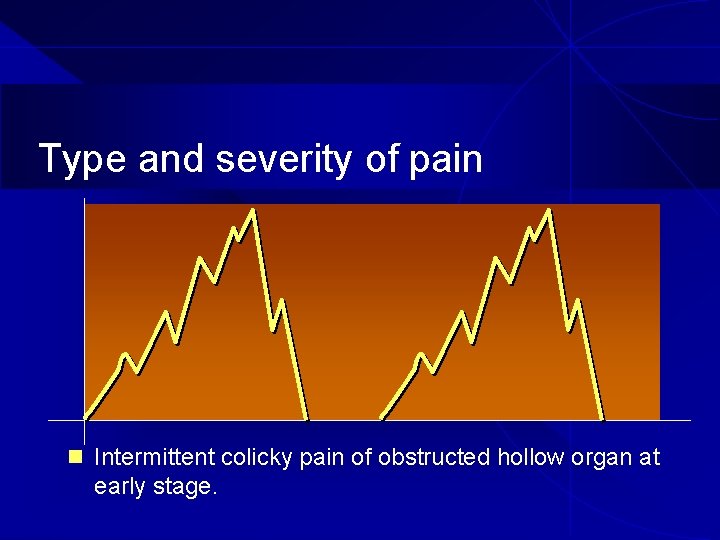
Type and severity of pain n Intermittent colicky pain of obstructed hollow organ at early stage.
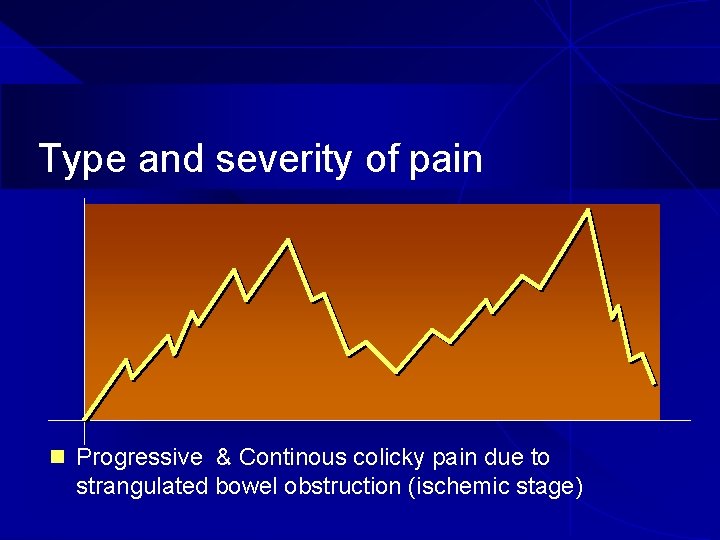
Type and severity of pain n Progressive & Continous colicky pain due to strangulated bowel obstruction (ischemic stage)
Other related symptoms: Ask the patient concerning related/concomitant symptoms of n Gastro-intestinal function: u u u Nausea Vomiting Loss of appetite Faintness Previous indigestion (habitual)
Other related symptoms: n Jaundice n Bowel habit: u Constipation? u Diarrhoea? u Colour of the stool? u Presence or absence of blood and mucus (slime)
Other related symptoms: n Urinary function: u Micturition: amount of urine, lower abdominal discomfort, colour of urine n Gynaecological function ( female) u u u Menstrual function Delayed or miss period Abnormal bleeding or discharge (colour, quantity)
Previous history n Similar pain n Abdominal surgery n Major illness: incl. fever, abdominal injury. n Drugs n Allergies
PHYSICAL EXAMINATION n Preparation u Check all the equipment required and have a good light: u Examination couch u Stethoscope u Explain the procedure and its goals to the patient. u Wash your hands with antiseptic soap. u Dry and warm your hands with tissues.
Implementation: n A General Examination u General appearance : Consciousness u Mood : Distressed? Anxious? u Immobile u Move cautiously u Colour : Pallor? Flushing? Jaundice? Cyanosis?
Implementation: n Examine the vital signs: u. Temperature u. Pulse rate u. Blood Pressure u. Respiratory rate
Implementation: n Perform other systems examination, including cardio-pulmonary system. n Ask the patient politely to expose his/her abdomen.
Abdominal Examination: Inspection u Inspect the movement: u Respiratory movement u Visible bowel peristaltics u Is there any scars on the skin of the abdomen? u Is there any abdominal distention? u Flatus ? , Fluid ? , Fetus?
Abdominal Examination: Inspection n Is there any rashes and discolouration? Cullen’s sign u Gray Turner’s sign u Ecchymosis of the abdominal wall n Is there any masses: u Tumors? u Hernial sites? u Masses with pulsation? u
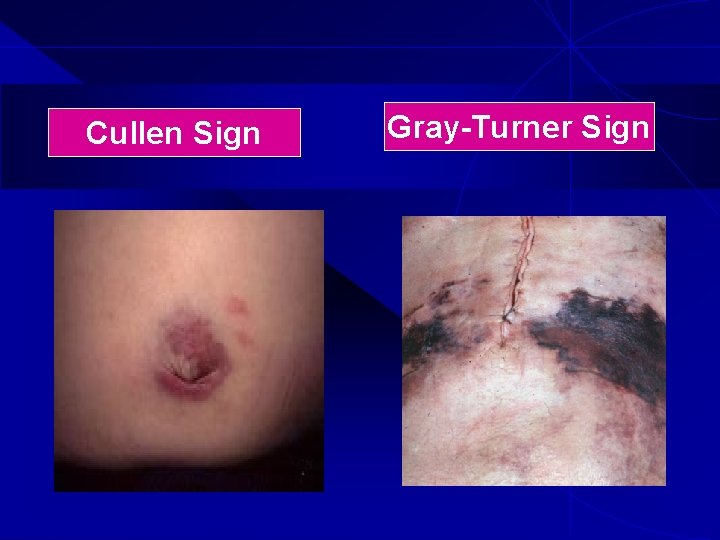
Cullen Sign Gray-Turner Sign
Abdominal Examination: Palpation n Ask the patient to locate the site of maximum pain with the tip of a finger. n Using the palmar surface of your fingers, gently palpate the abdomen, starting from a site farthest from the area of maximum pain, move gradually towards it.
While palpating, look to the face expression of the patient, and look for any signs of : n n n Tenderness Rebound tenderness Muscle guarding Rigidity Murphy’s sign
While palpating, look to the face expression of the patient, and look for any signs of : u Swelling or masses u Rovsing’s sign u Expansile pulsation u Hernial orifices u Scrotum in male

Expansile pulsation
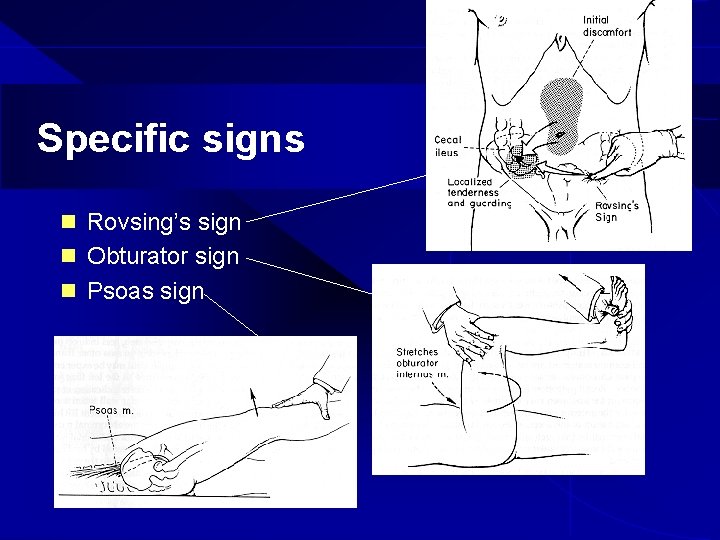
Specific signs n Rovsing’s sign n Obturator sign n Psoas sign
Abdominal Examination : Percussion n Place the palmar aspect of your left hand on the abdomen, and gently percus its dorsal aspect with the tip of the middle finger of the right hand, moving all around the abdominal region: u Is it tymphanitic ? u Is it dull ? u Is there any shifting dullness? u Site of liver dullness ? and is it disappeared ?
Auscultation n Using stethoscope, and place it gently on the abdomen, listen to the bowel sounds and bruit at least for one minute: u Absent ? u High pitched and hyperactive ? u Metallic sound ? u Vascular bruit ?
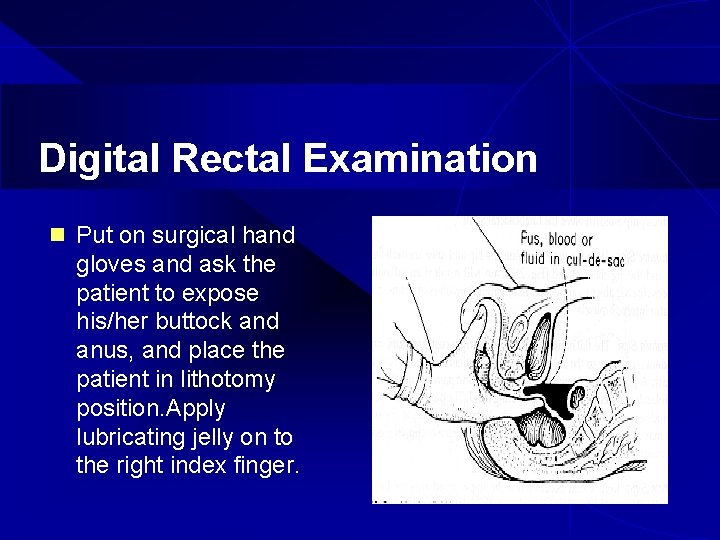
Digital Rectal Examination n Put on surgical hand gloves and ask the patient to expose his/her buttock and anus, and place the patient in lithotomy position. Apply lubricating jelly on to the right index finger.
Digital Rectal Examination n Gently insert your right index finger into the anus, move toward the anal canal slowly, and evaluate the followings: u Anal margin: piles? u Mucosal surface of the anal canal and the ampulla (collaps? ) u Sites of any pain elicited u Masses or swelling: consistency, location, surface, fixity to the surroundings. u Bowel contents: consistency of faeces? Mucus? Blood?
n Perform bimanual palpation in female patient to examine the uterus, pelvic cavity and adnexa. n Write up u Write up all significant findings in the medical record. Conclude your diagnosis and differential diagnosis, and order any necessary special investigations
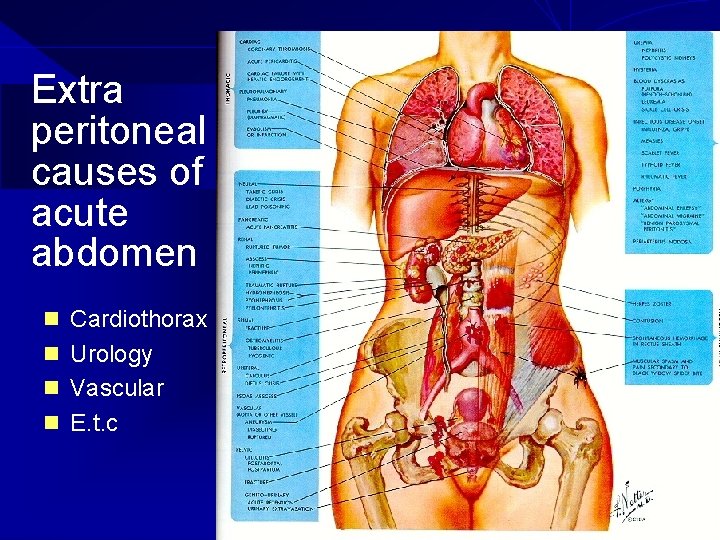
Extra peritoneal causes of acute abdomen n Cardiothorax n Urology n Vascular n E. t. c
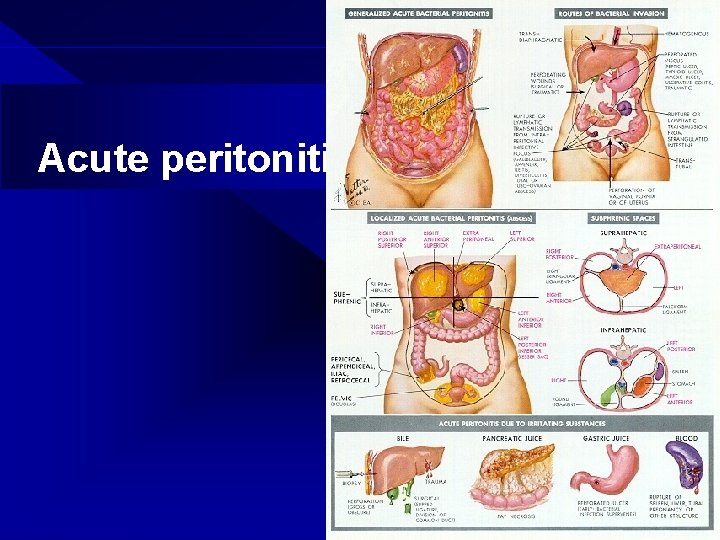
Acute peritonitis
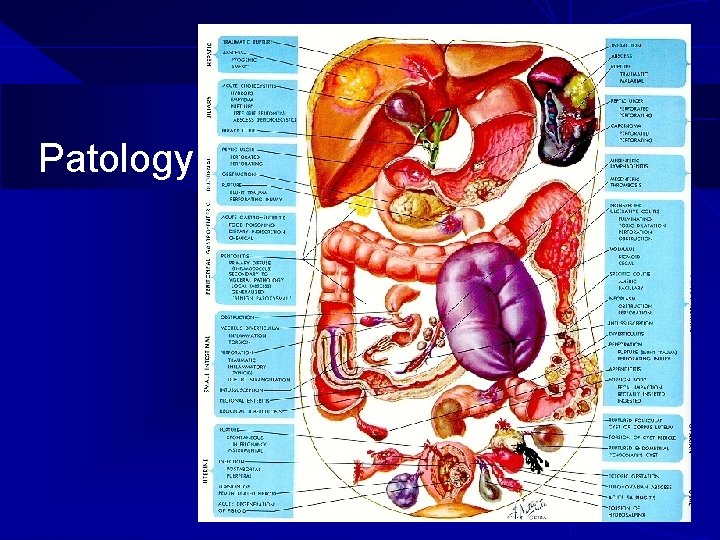
Patology
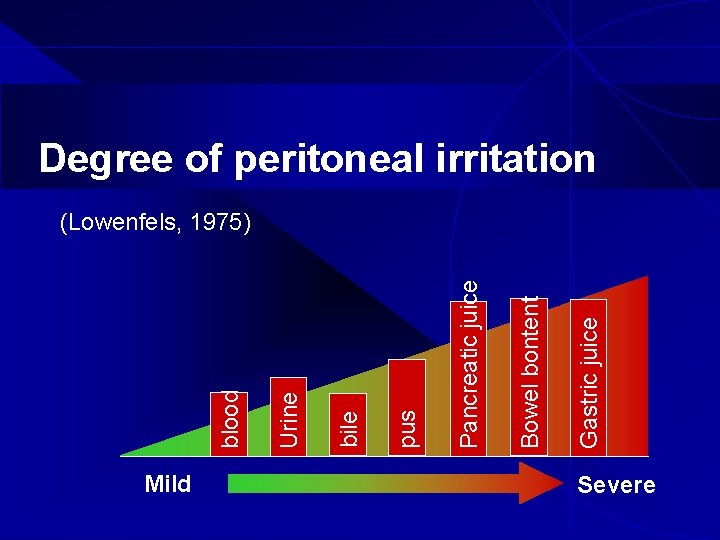
Mild Gastric juice Bowel bontent Pancreatic juice pus bile Urine blood Degree of peritoneal irritation (Lowenfels, 1975) Severe
Signs of Intrabdominal Sepsis n Fever, nausea, vomiting, tachicardia, tachipneu n Abdominal pain n Peritoneal signs n Signs of dehydration n Leucositosis n Shock, Multiple organ failure
Tips n > 6 hours: surgically related diseases !!! n Limited movement: peritonitis / ischaemia n Persistent pain on morphine : ischaemia n Sense of Crisis n Repeated exams : Very important
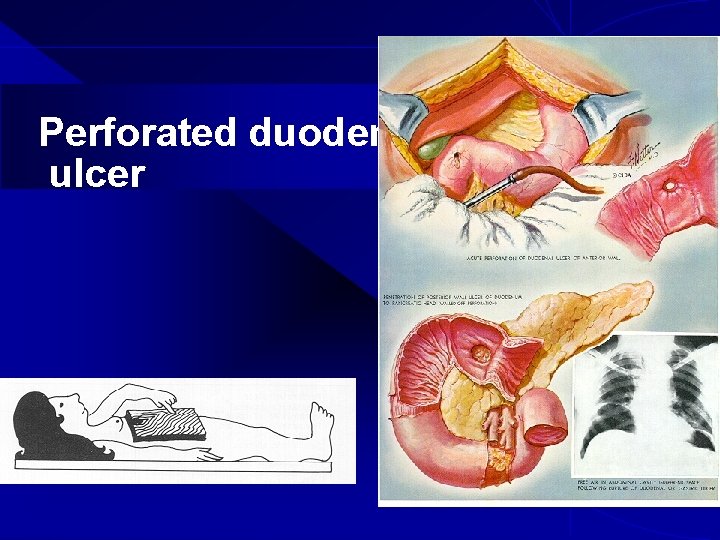
Perforated duodenal ulcer
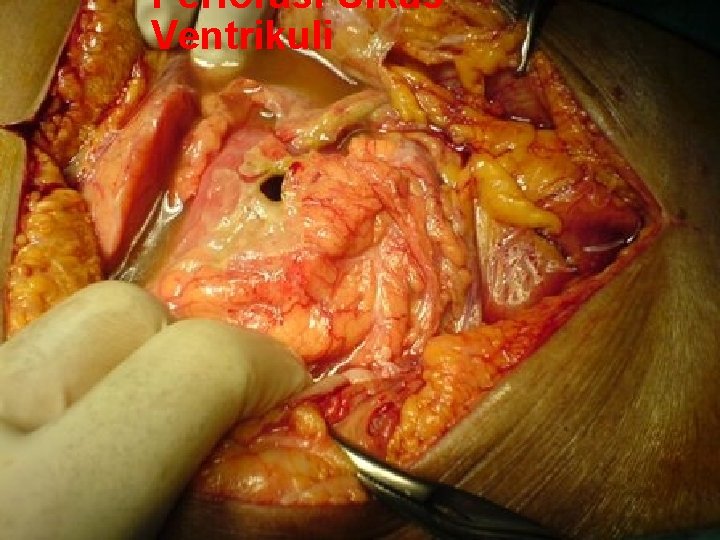
Perforasi Ulkus Ventrikuli
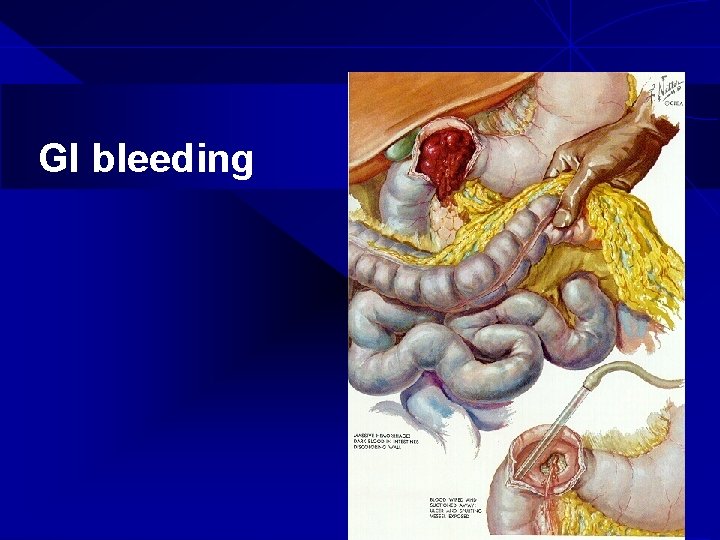
GI bleeding
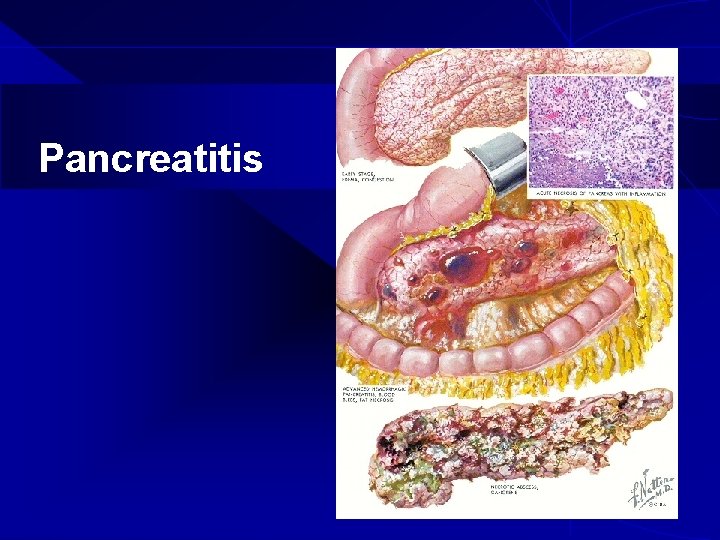
Pancreatitis
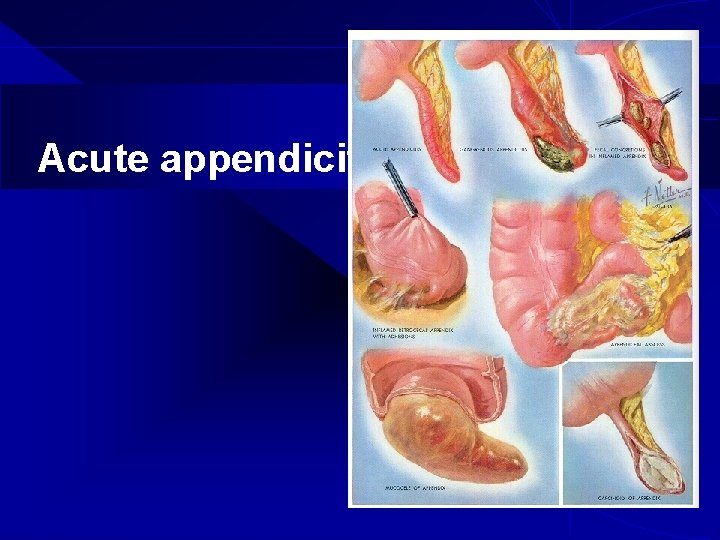
Acute appendicitis
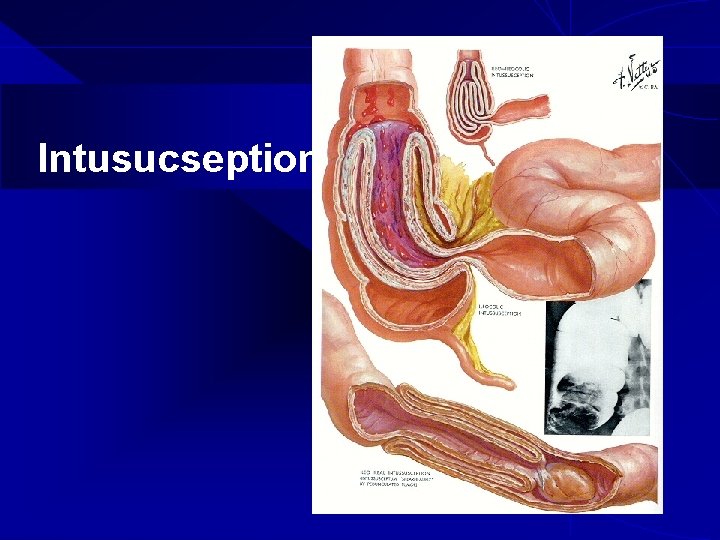
Intusucseption
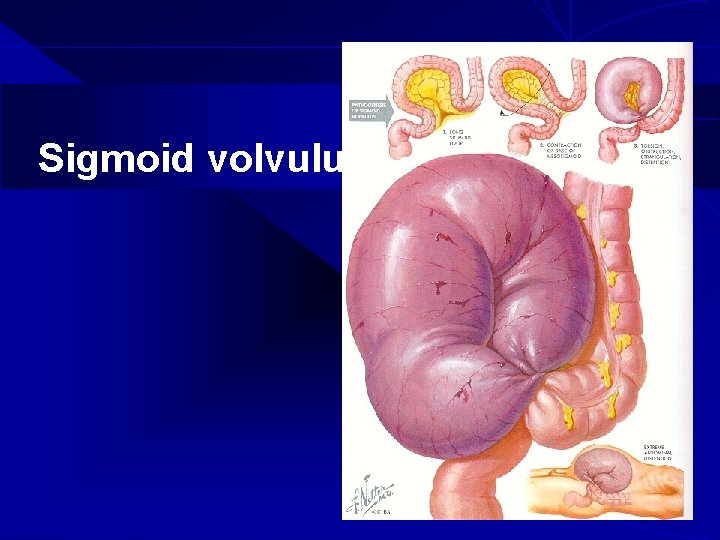
Sigmoid volvulus
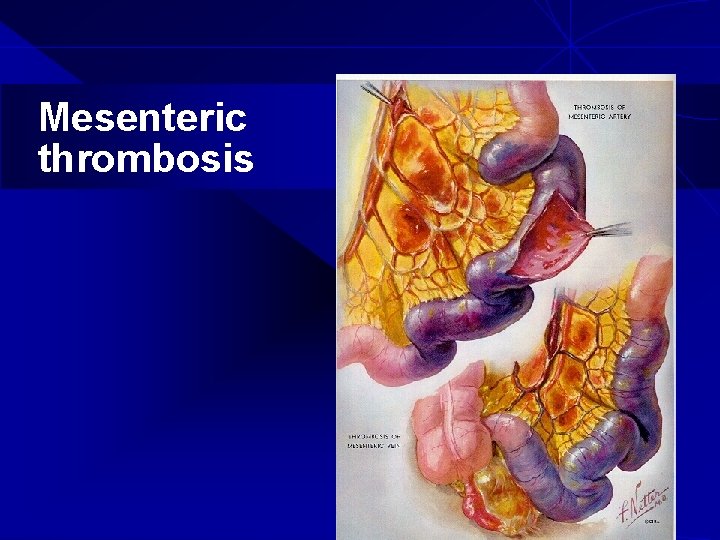
Mesenteric thrombosis
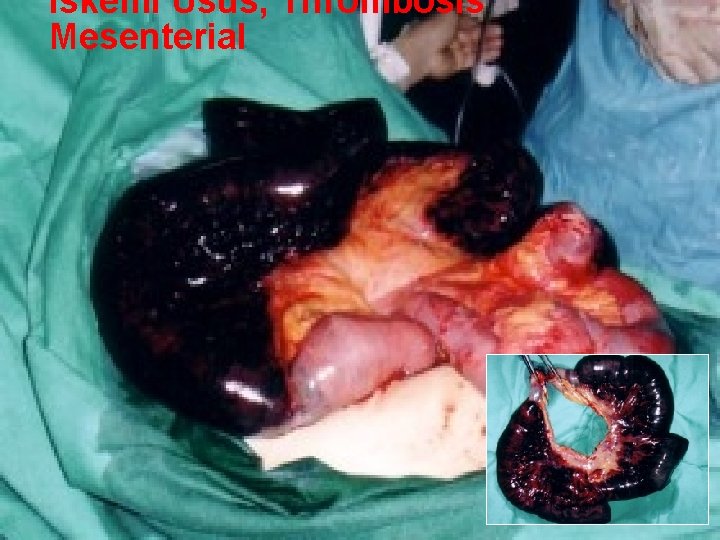
Iskemi Usus, Thrombosis Mesenterial
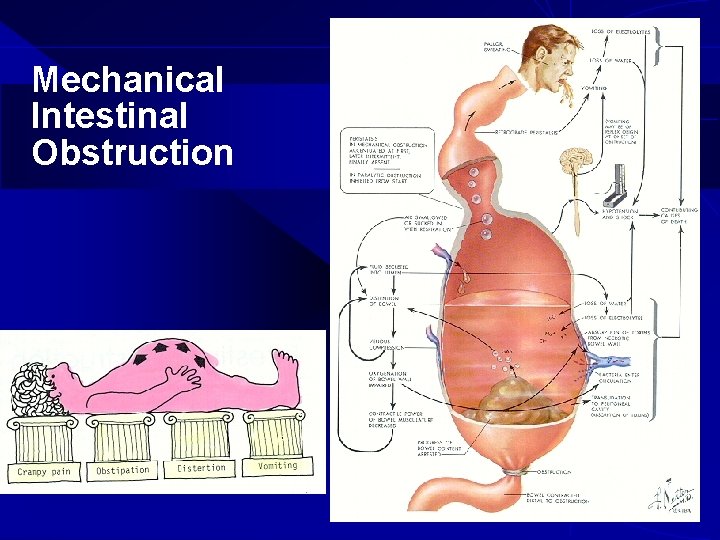
Mechanical Intestinal Obstruction
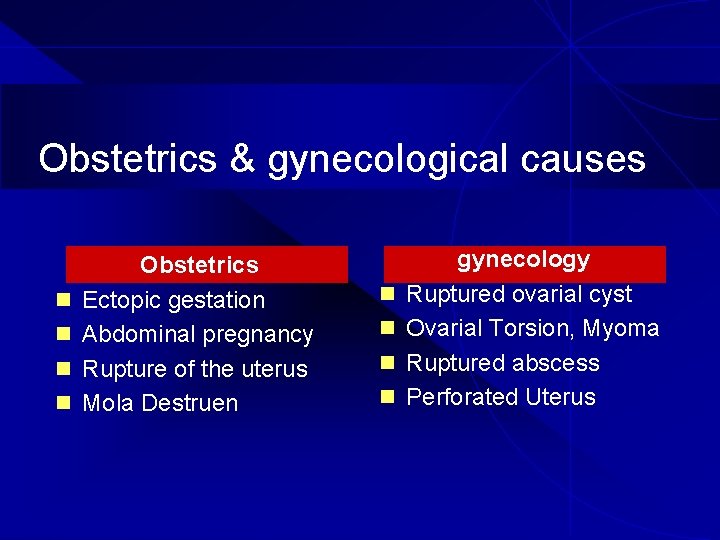
Obstetrics & gynecological causes n n Obstetrics Ectopic gestation Abdominal pregnancy Rupture of the uterus Mola Destruen n n gynecology Ruptured ovarial cyst Ovarial Torsion, Myoma Ruptured abscess Perforated Uterus
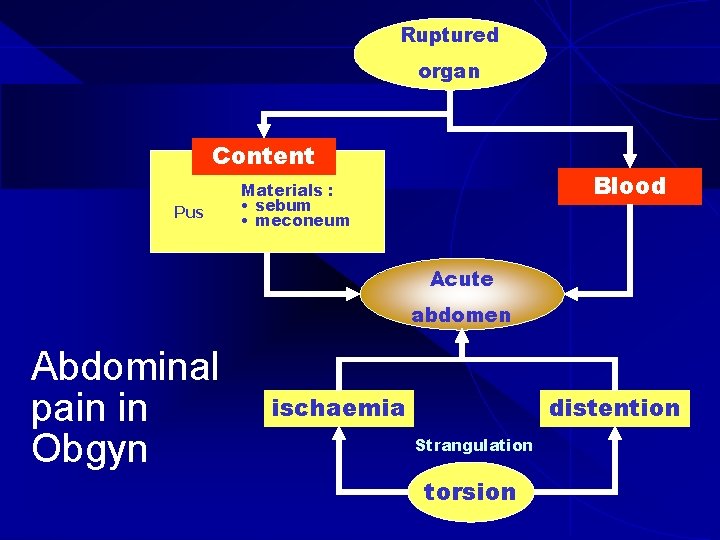
Ruptured organ Content Pus Blood Materials : • sebum • meconeum Acute abdomen Abdominal pain in Obgyn ischaemia distention Strangulation torsion
n. A Good Diagnostician is not Born, but is Developed
- Slides: 62