
Acupuncture Part 2 Physiologic Mechanisms 1 Physiologic Mechanism

![5 HT Humeral Mechanisms b [5 HT] in systemic circulation by 30 -40% following](https://slidetodoc.com/presentation_image_h2/5c10502a4248495833f1af177a4c95b4/image-18.jpg "5 HT Humeral Mechanisms b [5 HT] in systemic circulation by 30 -40% following")
- Slides: 33
Acupuncture Part 2 Physiologic Mechanisms 1
Physiologic Mechanism b Local inflammation and muscular effects b Neural (non-opioid) segmental gate theory b Neural (opioid) humeral theory b Somatovisceral (autonomic) effects b Bioelectrical theory 2
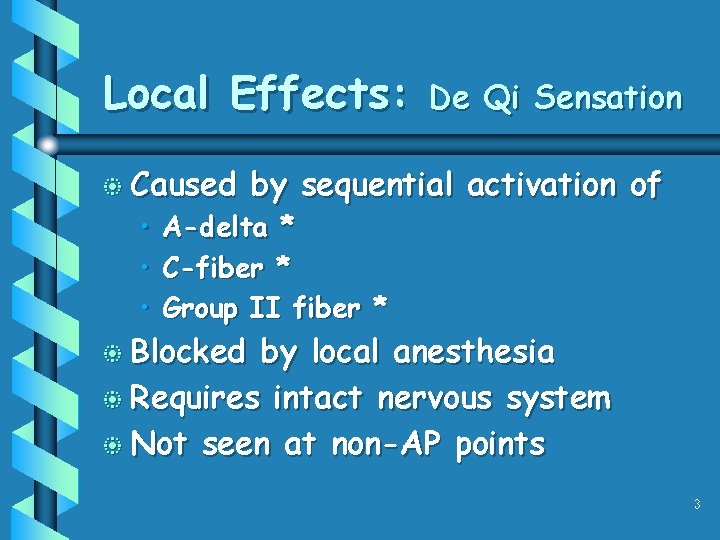
Local Effects: b Caused De Qi Sensation by sequential activation of • A-delta * • C-fiber * • Group II fiber * b Blocked by local anesthesia b Requires intact nervous system b Not seen at non-AP points 3
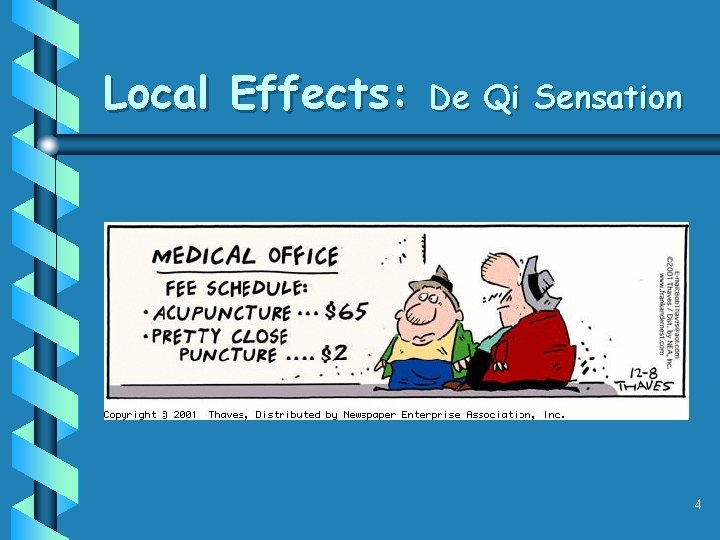
Local Effects: De Qi Sensation 4
Local Effects: b De Qi PRABM response in horses (pilomotor reaction along bladder meridian) 5
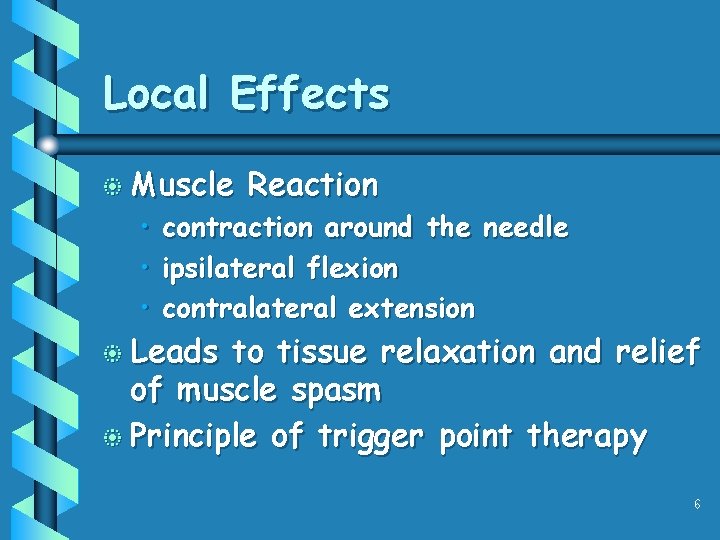
Local Effects b Muscle Reaction • contraction around the needle • ipsilateral flexion • contralateral extension b Leads to tissue relaxation and relief of muscle spasm b Principle of trigger point therapy 6
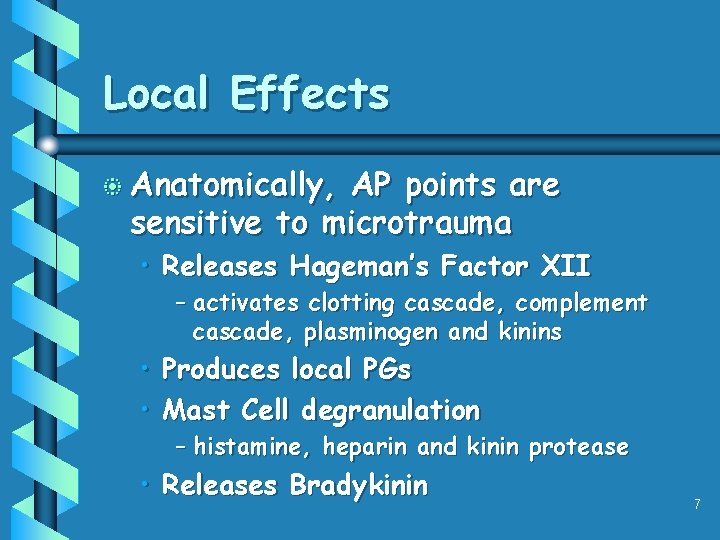
Local Effects b Anatomically, AP points are sensitive to microtrauma • Releases Hageman’s Factor XII – activates clotting cascade, complement cascade, plasminogen and kinins • Produces local PGs • Mast Cell degranulation – histamine, heparin and kinin protease • Releases Bradykinin 7
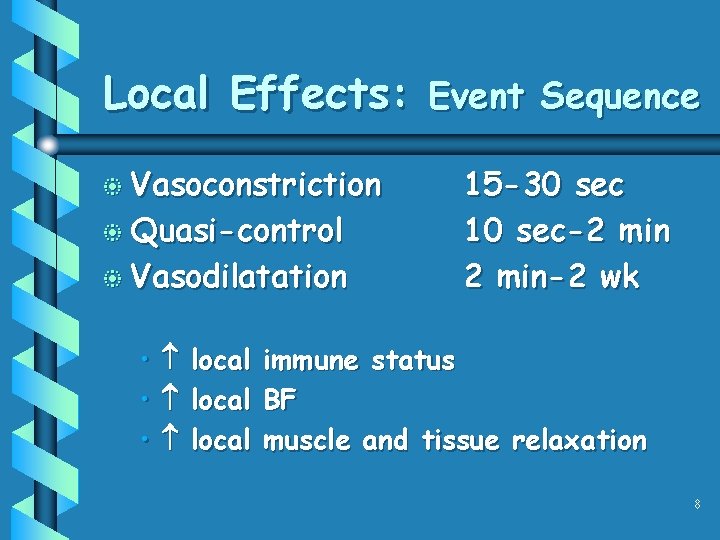
Local Effects: Event Sequence b Vasoconstriction b Quasi-control b Vasodilatation 15 -30 sec 10 sec-2 min-2 wk • local immune status • local BF • local muscle and tissue relaxation 8
Physiologic Mechanism b Local inflammation and muscular effects b Neural (non-opioid) segmental gate theory b Neural (opioid) humeral theory b Somatovisceral (autonomic) effects b Bioelectrical theory 9
Segmental Analgesia b Evoked by high frequency, low intensity stimulation of AP point b Rapid onset b Diminishes b Not after cessation reversed by naloxone 10
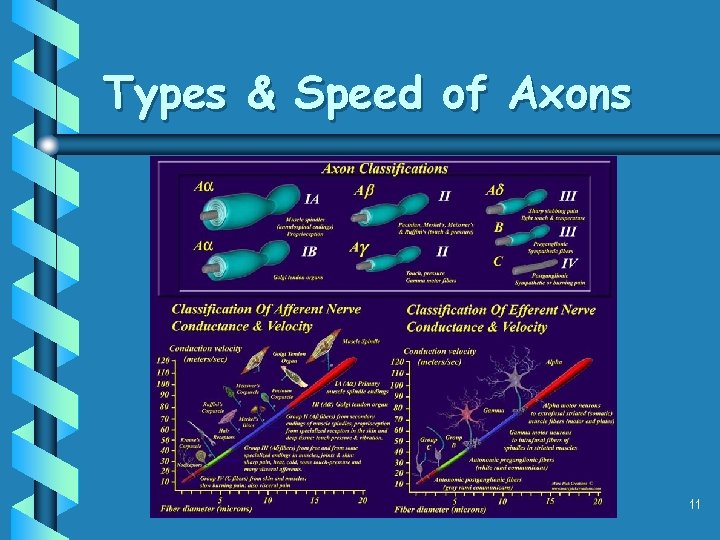
Types & Speed of Axons 11
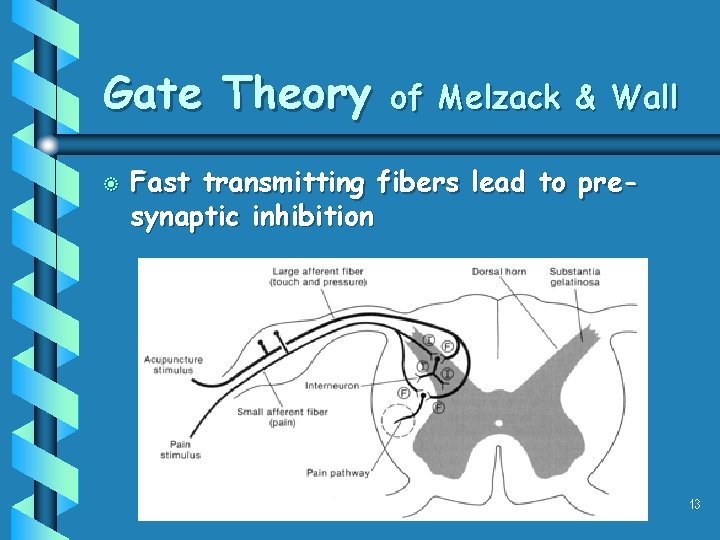
Gate Theory of Melzack & Wall b A-delta fibers conduct information to spinal cord before slow conducting C fiber information arrives b These fibers lead to inhibition (presynaptic) of information carried by the C fibers (pain) 12
Gate Theory b of Melzack & Wall Fast transmitting fibers lead to presynaptic inhibition 13
Physiologic Mechanism b Local inflammation and muscular effects b Neural (non-opioid) segmental gate theory b Neural (opioid) humeral theory b Somatovisceral (autonomic) effects b Bioelectrical theory 14
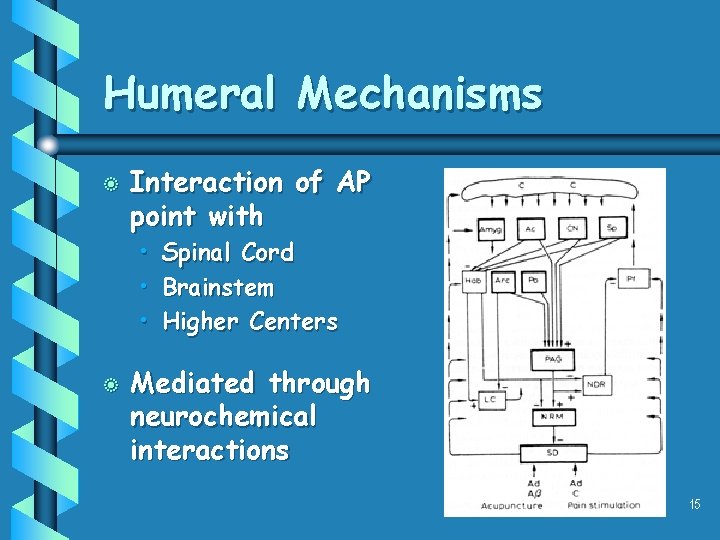
Humeral Mechanisms b Interaction of AP point with • • • b Spinal Cord Brainstem Higher Centers Mediated through neurochemical interactions 15
Opioid Humeral Mechanisms b Take 30 -40 minutes b Persists for hours b Generalized effect which is reversed by naloxone b Transferable from one patient to another b Tolerance to and cross tolerance with morphine develops 16
Opioid Humeral Mechanisms b Dexamethasone ß-endorphin levels and AP analgesia b Adrenalectomy AP analgesia ß- endorphins and b Hypophysectomy analgesia eliminates AP 17
5 HT Humeral Mechanisms b [5 HT] in systemic circulation by 30 -40% following AP b CNS maintains balance between 5 HT and ß-endorphins • endorphins alter 5 HT release (regulating pain threshold in spinal cord) • 5 HT blocks effects of naloxone 18
Other Humeral Mechanisms b Potentiators AP effects • substance P • histamine • c. GMP of b Antagonists AP effects of • GABA • c. AMP 19
Humeral Mechanisms: Systemic Endocrine Effects b Improves BF to pituitary axis and capillary wall [enzyme] b Releases somatotropin in chronic pain patients b Induces LH release b Stimulates prolactin and oxytocin release b Modulates thyroid function 20
Physiologic Mechanism b Local inflammation and muscular effects b Neural (non-opioid) segmental gate theory b Neural (opioid) humeral theory b Somatovisceral (autonomic) effects b Bioelectrical theory 21
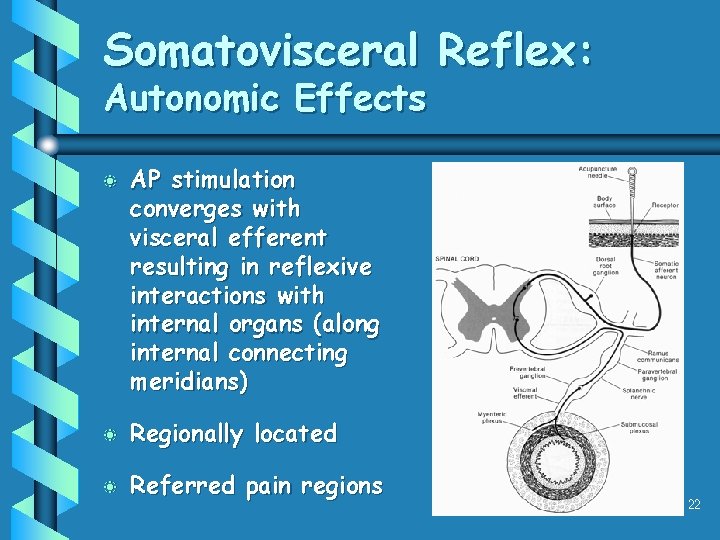
Somatovisceral Reflex: Autonomic Effects b AP stimulation converges with visceral efferent resulting in reflexive interactions with internal organs (along internal connecting meridians) b Regionally located b Referred pain regions 22
Autonomic Effects b Indication of certain AP points correlate with symptoms for viscera at the same spinal segment b Bring descending influence only to the level of stimulation, ipsilaterally b Specificity of AP points related to somatotropic location 23
Autonomic Effects b Referred pain b Convergence of Somatic and Visceral inputs in CNS • dorsolateral funiculus • spinothalamic tracts b Visceral A-delta fibers reflexively affect muscles • inflammation and cramping 24
Autonomic Effects b AP of somatic structures can treat internal organs (through meridian connections) b AP modulates both arms of ANS b Segmental sympathetic vasodialation b Highly specific • Stimulate a specific AP point, get a specific physiologic change 25
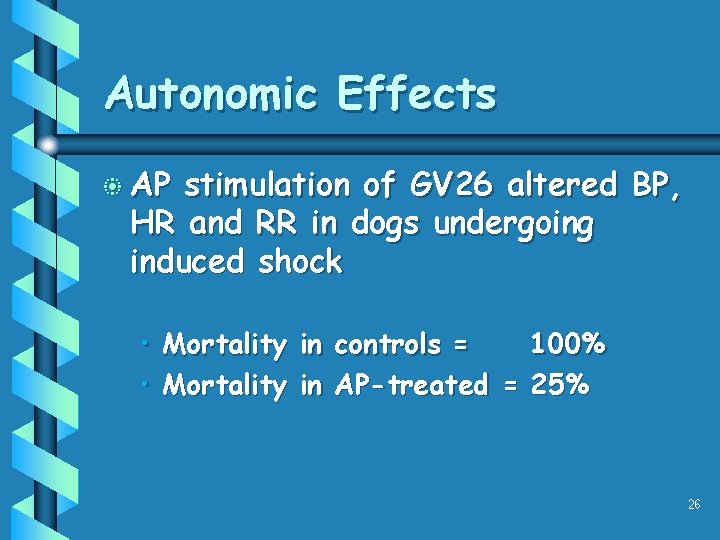
Autonomic Effects b AP stimulation of GV 26 altered BP, HR and RR in dogs undergoing induced shock • Mortality in controls = 100% • Mortality in AP-treated = 25% 26
Autonomic Effects b Stimulation of PC 6 • lipid peroxidation of the heart • coronary blood flow • improved cardiac rhythm 27
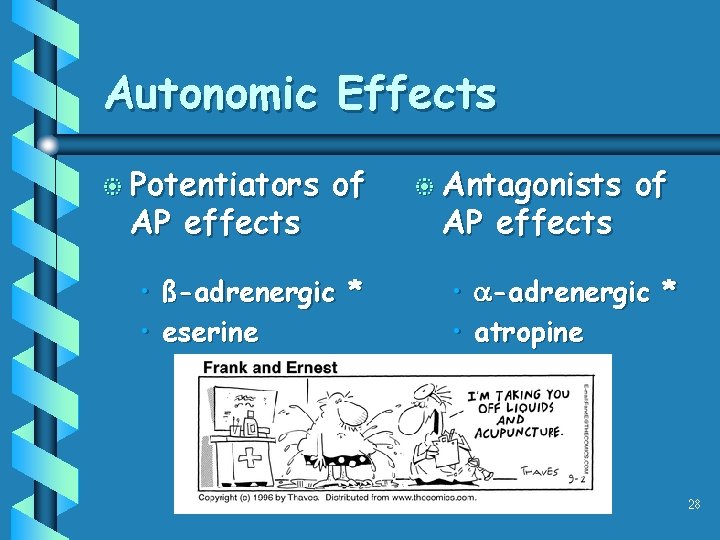
Autonomic Effects b Potentiators AP effects of • ß-adrenergic * • eserine b Antagonists AP effects of • -adrenergic * • atropine 28
Physiologic Mechanism b Local inflammation and muscular effects b Neural (non-opioid) segmental gate theory b Neural (opioid) humeral theory b Somatovisceral (autonomic) effects b Bioelectrical theory 29
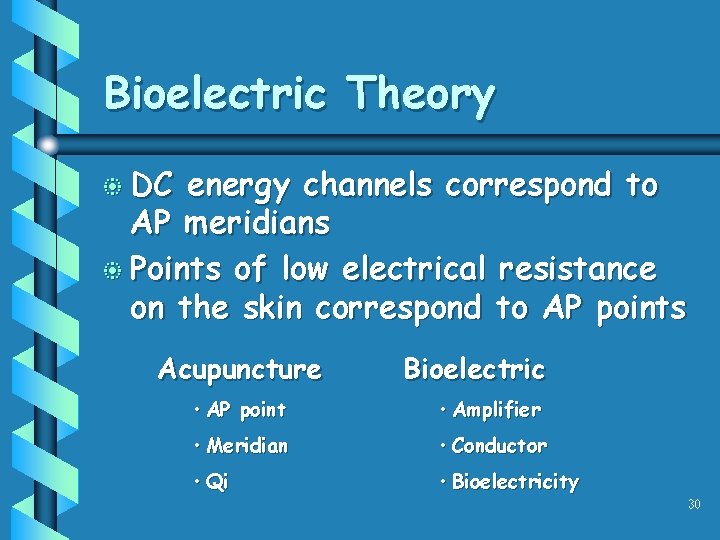
Bioelectric Theory b DC energy channels correspond to AP meridians b Points of low electrical resistance on the skin correspond to AP points Acupuncture Bioelectric • AP point • Amplifier • Meridian • Conductor • Qi • Bioelectricity 30
Other AP Effects b b b Anti-fever GI regulation Anti-inflammation effect Blood pressure regulation Stress relief b b Aging prevention Performance enhancement Improving microcirculation Face lift 31
Transcutaneous Nerve Stimulation (TENS units) b b b Well accepted method to produce analgesia Electrodes hard to apply to haired animals May just be acupuncture without needles 32
Conclusions b AP represents part of an ancient system of comprehensive health care b As scientific knowledge expands, modern correlations are being developed which help translate this ancient wisdom into today's terms b May the Qi be with you!!! 33