
ACTUATORS AUTONOMOUS GUIDED VEHICLE AGV PLT 424 AUTOMATED

- Slides: 33
ACTUATORS AUTONOMOUS GUIDED VEHICLE (AGV)
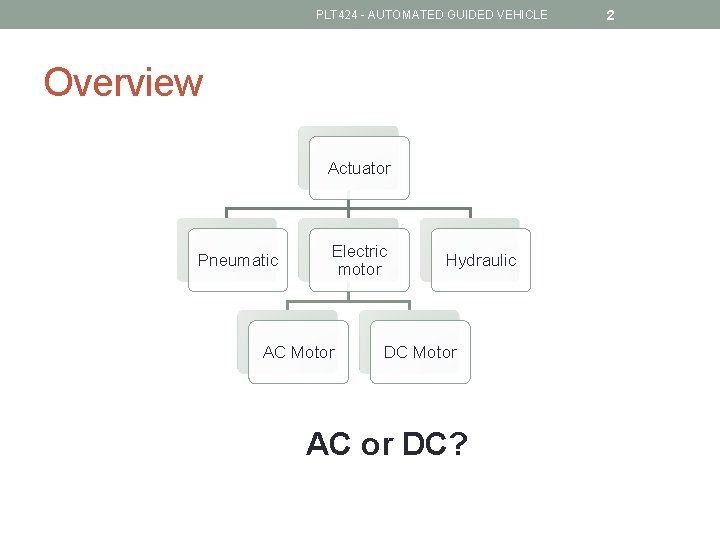
PLT 424 - AUTOMATED GUIDED VEHICLE Overview Actuator Pneumatic Electric motor AC Motor Hydraulic DC Motor AC or DC? 2
PLT 424 - AUTOMATED GUIDED VEHICLE Overview • DC motor dominates the field of robotics • What are differences between DC and AC motors? • Unidirectional or bidirectional? 3
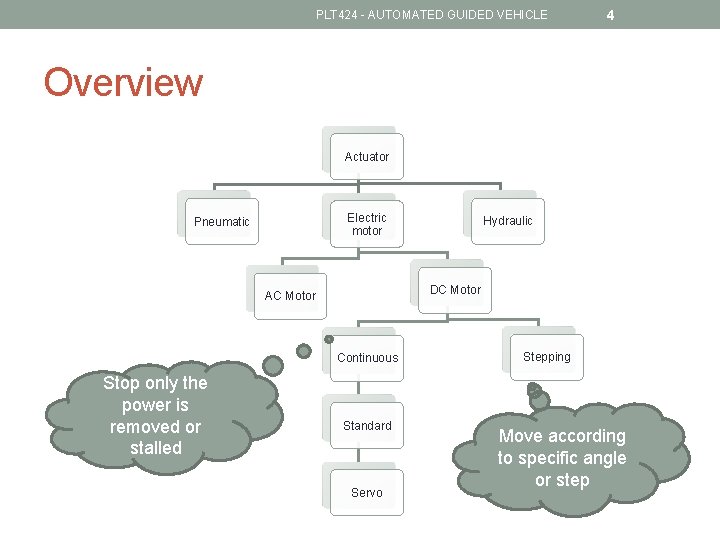
PLT 424 - AUTOMATED GUIDED VEHICLE 4 Overview Actuator Electric motor Pneumatic DC Motor AC Motor Continuous Stop only the power is removed or stalled Hydraulic Standard Servo Stepping Move according to specific angle or step
PLT 424 - AUTOMATED GUIDED VEHICLE 5 Motor Specifications • Operating Voltages • All motor rated by their operating voltage • Some in a range, some for a specific voltage • What will happen if the motor run lower or above the specified rating? • Examples: • Small DC Motor : 1. 5 V to 6 V • Specific voltage : 12 V or 24 V
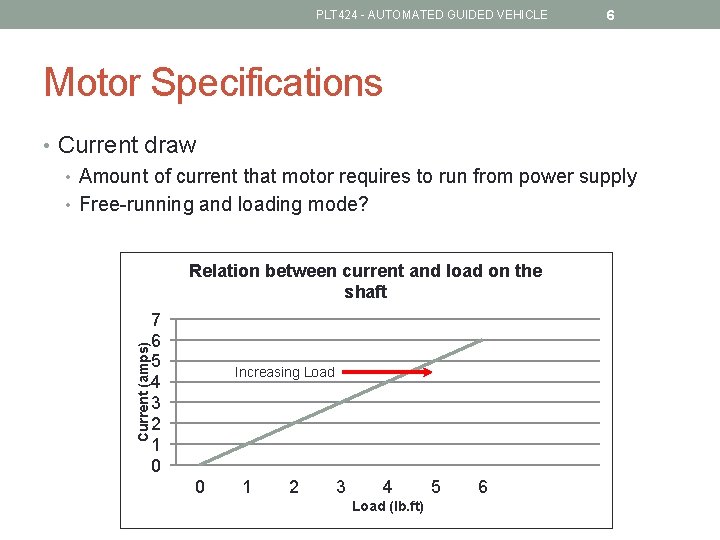
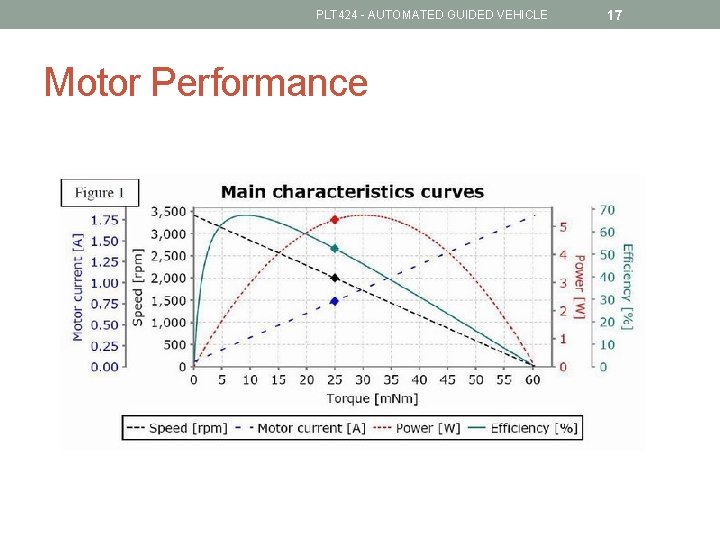
Motor Specifications Current (amps) • Current draw • Amount of current that motor requires to run from power supply • Free-running and loading mode? Load (lb. ft)
PLT 424 - AUTOMATED GUIDED VEHICLE Motor Specifications • Speed • Most are given in RPM or r/min • Standard DC motor can operate at 4000 RPM and above • Relation between speed and torque? 7
PLT 424 - AUTOMATED GUIDED VEHICLE 8 Motor Specifications • Torque • Force the motor exerts upon its load • Stall or Running Torque • Force the motor exerts as long as thee shaft continues to rotate
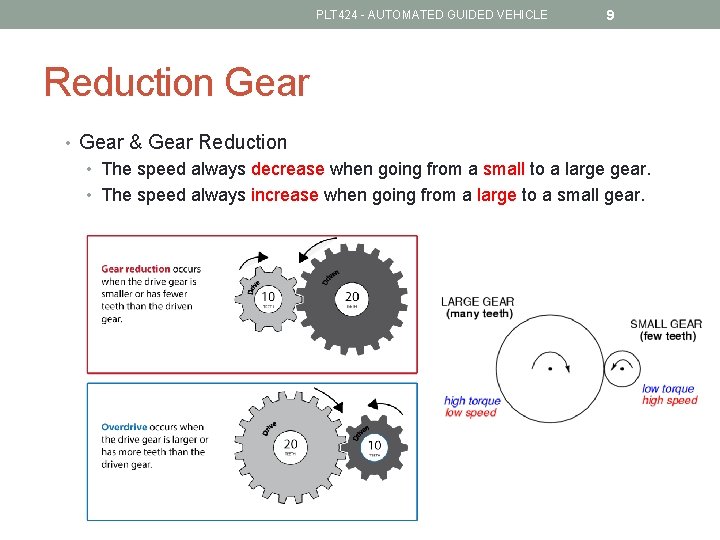
PLT 424 - AUTOMATED GUIDED VEHICLE 9 Reduction Gear • Gear & Gear Reduction • The speed always decrease when going from a small to a large gear. • The speed always increase when going from a large to a small gear.
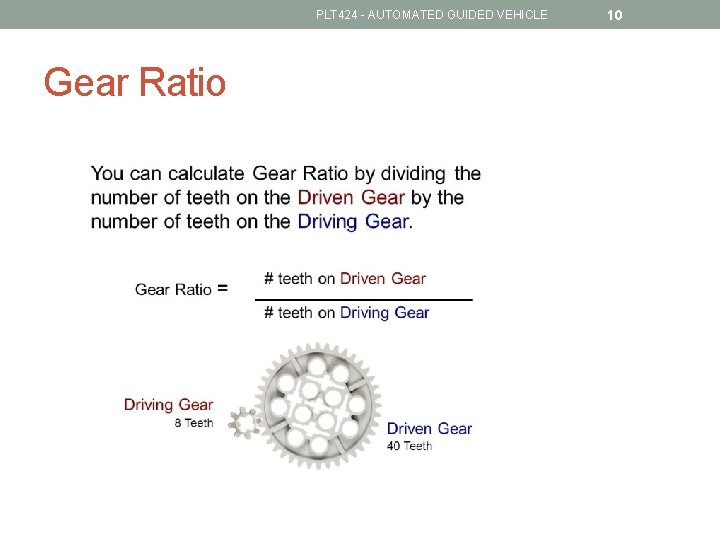
PLT 424 - AUTOMATED GUIDED VEHICLE Gear Ratio 10
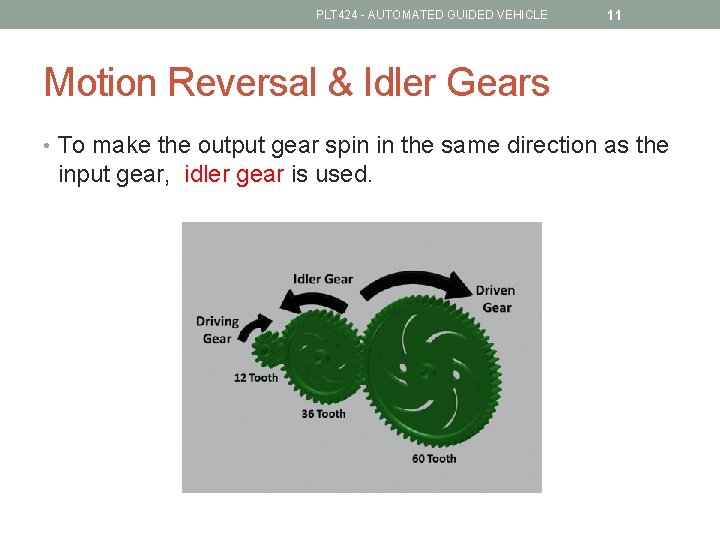
PLT 424 - AUTOMATED GUIDED VEHICLE 11 Motion Reversal & Idler Gears • To make the output gear spin in the same direction as the input gear, idler gear is used.
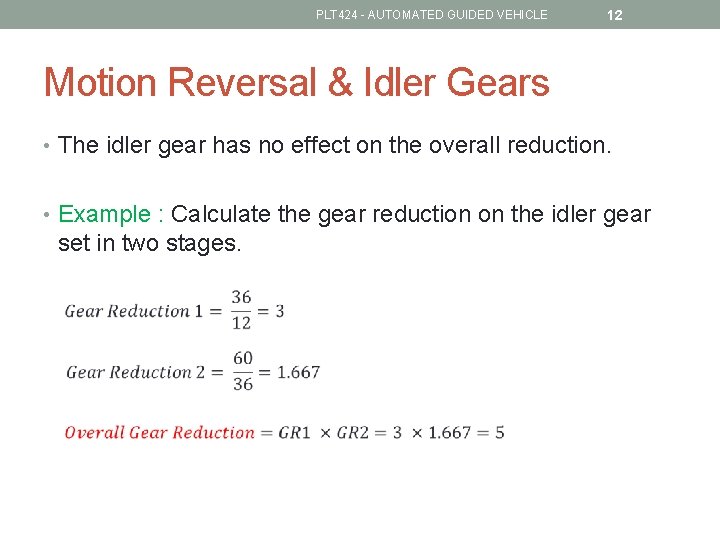
PLT 424 - AUTOMATED GUIDED VEHICLE 12 Motion Reversal & Idler Gears • The idler gear has no effect on the overall reduction. • Example : Calculate the gear reduction on the idler gear set in two stages.
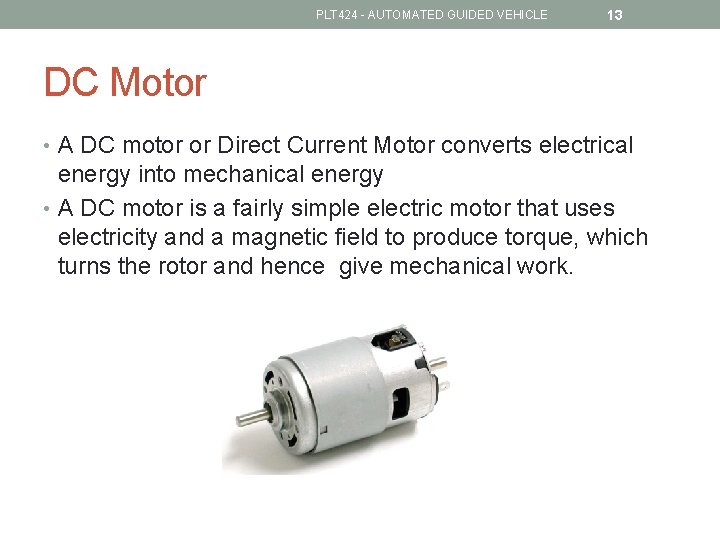
PLT 424 - AUTOMATED GUIDED VEHICLE 13 DC Motor • A DC motor or Direct Current Motor converts electrical energy into mechanical energy • A DC motor is a fairly simple electric motor that uses electricity and a magnetic field to produce torque, which turns the rotor and hence give mechanical work.
PLT 424 - AUTOMATED GUIDED VEHICLE 14 DC Motor • Clean, quiet, and can produce sufficient power for a variety of tasks. • Easier to control than pneumatic actuators, which are mainly used if very high torques are required and umbilical cords for external pressure pumps are available – so usually not an option for mobile robots. • Standard DC motors revolve freely, motor control therefore requires a feedback mechanism using shaft encoders.
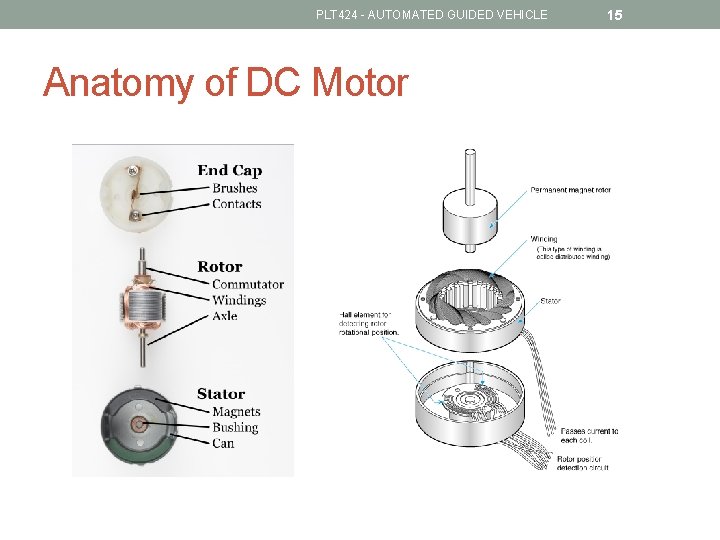
PLT 424 - AUTOMATED GUIDED VEHICLE Anatomy of DC Motor 15
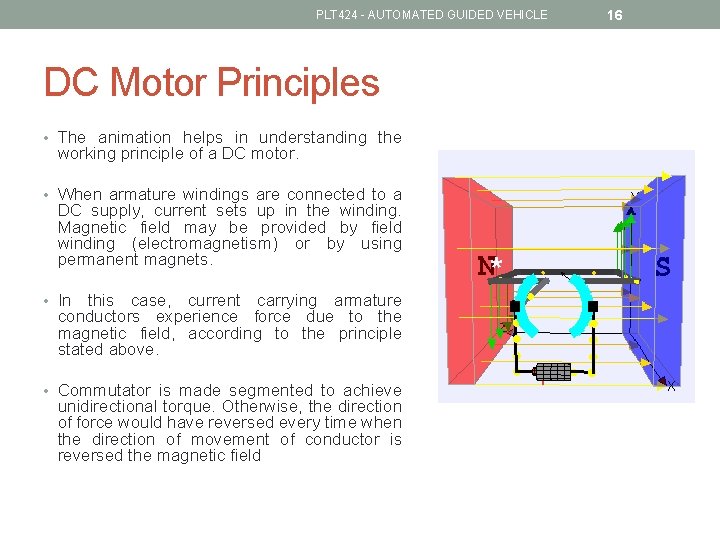
PLT 424 - AUTOMATED GUIDED VEHICLE DC Motor Principles • The animation helps in understanding the working principle of a DC motor. • When armature windings are connected to a DC supply, current sets up in the winding. Magnetic field may be provided by field winding (electromagnetism) or by using permanent magnets. • In this case, current carrying armature conductors experience force due to the magnetic field, according to the principle stated above. • Commutator is made segmented to achieve unidirectional torque. Otherwise, the direction of force would have reversed every time when the direction of movement of conductor is reversed the magnetic field 16
PLT 424 - AUTOMATED GUIDED VEHICLE Motor Performance 17
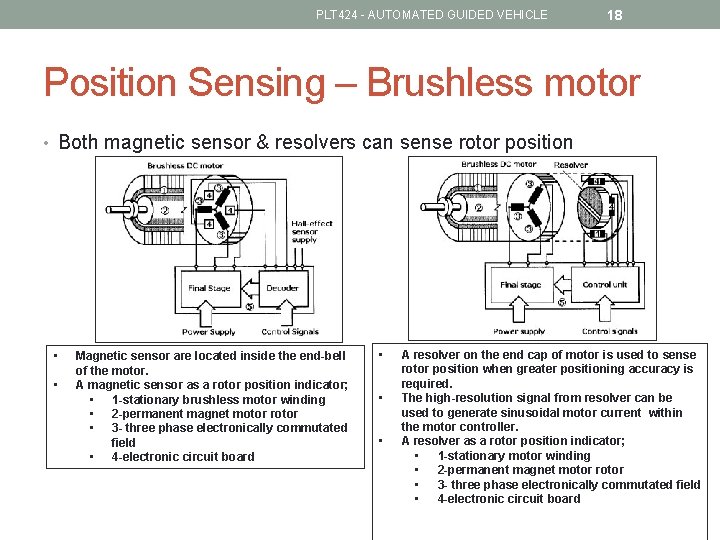
PLT 424 - AUTOMATED GUIDED VEHICLE 18 Position Sensing – Brushless motor • Both magnetic sensor & resolvers can sense rotor position • • Magnetic sensor are located inside the end-bell of the motor. A magnetic sensor as a rotor position indicator; • 1 -stationary brushless motor winding • 2 -permanent magnet motor rotor • 3 - three phase electronically commutated field • 4 -electronic circuit board • • • A resolver on the end cap of motor is used to sense rotor position when greater positioning accuracy is required. The high-resolution signal from resolver can be used to generate sinusoidal motor current within the motor controller. A resolver as a rotor position indicator; • 1 -stationary motor winding • 2 -permanent magnet motor rotor • 3 - three phase electronically commutated field • 4 -electronic circuit board
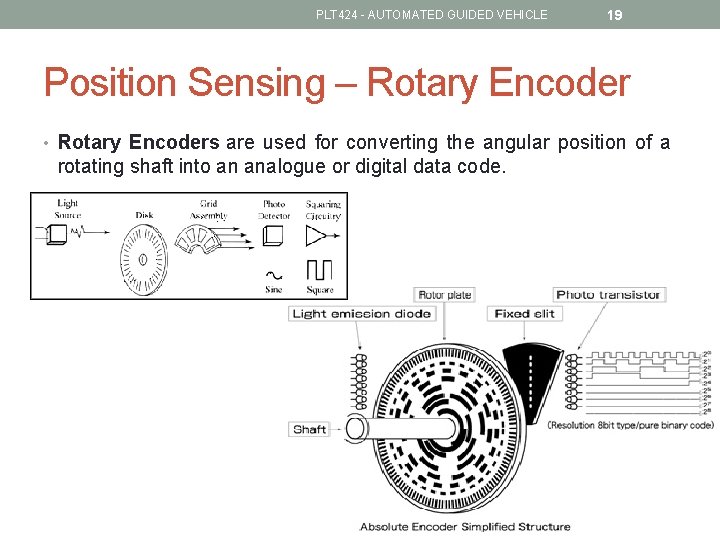
PLT 424 - AUTOMATED GUIDED VEHICLE 19 Position Sensing – Rotary Encoder • Rotary Encoders are used for converting the angular position of a rotating shaft into an analogue or digital data code.
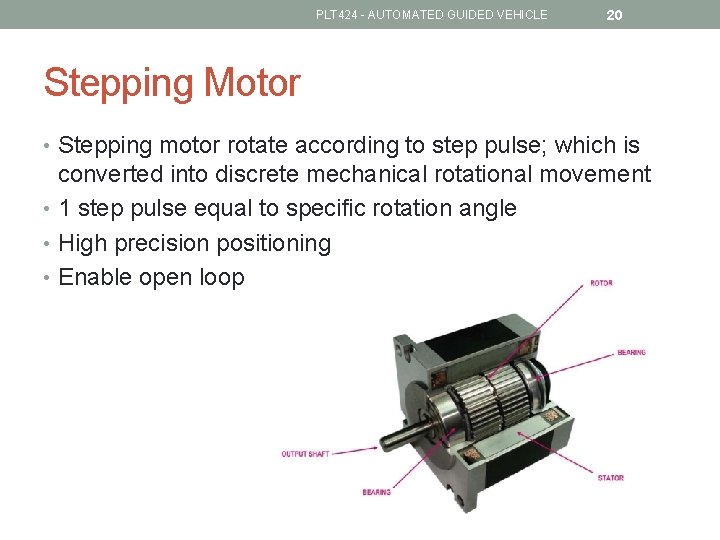
PLT 424 - AUTOMATED GUIDED VEHICLE 20 Stepping Motor • Stepping motor rotate according to step pulse; which is converted into discrete mechanical rotational movement • 1 step pulse equal to specific rotation angle • High precision positioning • Enable open loop
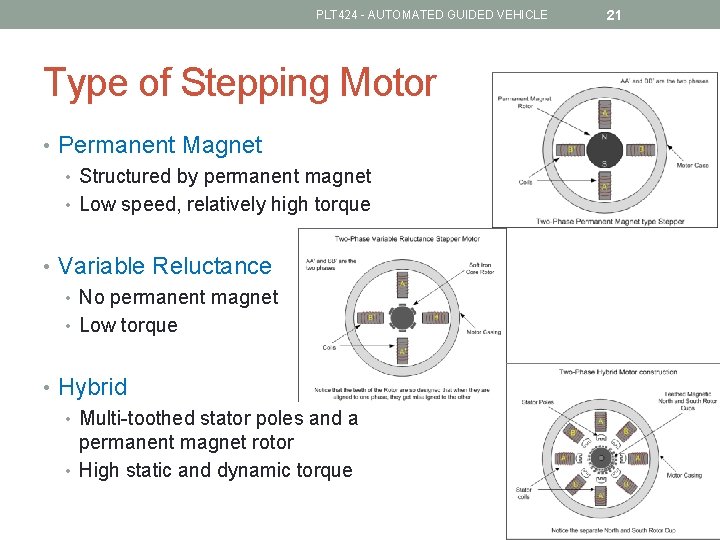
PLT 424 - AUTOMATED GUIDED VEHICLE Type of Stepping Motor • Permanent Magnet • Structured by permanent magnet • Low speed, relatively high torque • Variable Reluctance • No permanent magnet • Low torque • Hybrid • Multi-toothed stator poles and a permanent magnet rotor • High static and dynamic torque 21
PLT 424 - AUTOMATED GUIDED VEHICLE 22 Design Consideration • Stepper Phasing • More phase, more accurate/high resolution • Step Angle • The smallest angle the shaft can rotate when winding energized • Determine the no. of pulse per rotation • Pulse Rate • No. of pulse can be generated per second to move the shaft
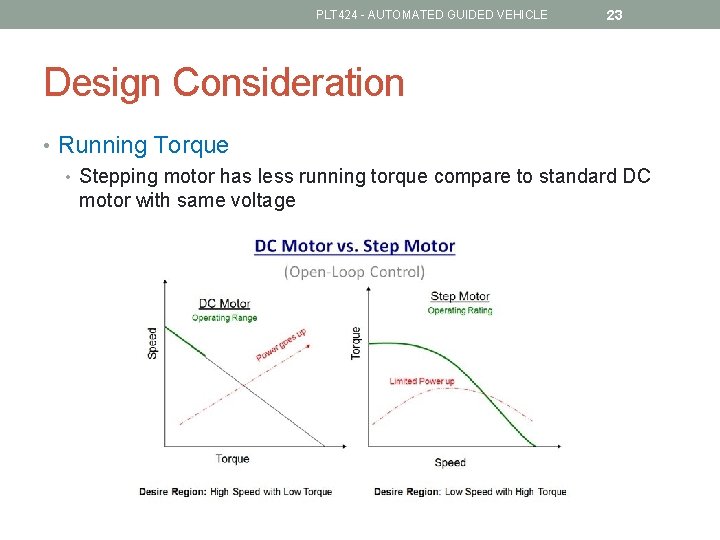
PLT 424 - AUTOMATED GUIDED VEHICLE 23 Design Consideration • Running Torque • Stepping motor has less running torque compare to standard DC motor with same voltage
PLT 424 - AUTOMATED GUIDED VEHICLE 24 Design Consideration • Braking Effect • Every stepping motor has braking effect as the winding is not rotate although the current is supplied continuously • Voltage Rating • Higher the voltage, higher running and holding torque • Current Rating • Usually expressed per phase-specification • Current requirement supplied to the motor depends on the sequence • Eg : For 4 -step actuation, at least twice current is needed
PLT 424 - AUTOMATED GUIDED VEHICLE 25 Step Mode • FULL STEP • Standard (hybrid) stepping motor have 200 rotor teeth, or 200 full steps per revolution of the motor shaft. Dividing the 200 steps into the 360° rotation equals a 1. 8° full step angle. Normally, full step mode is achieved by energizing both winding while reversing the current alternately. Essentially one digital input from the driver is equivalent to one step. • HALF STEP • Half step simply means that the motor is rotating at 400 steps per revolution. In this mode, one winding is energized and then two winding are energized alternately, causing the rotor to rotate at half the distance, or 0. 9°. (The same effect can be achieved by operating in full step mode with a 400 step per revolution motor). Half stepping is a more practical solution however, in industrial applications. Although it provides slightly less torque, half step mode reduces the amount “jumpiness” inherent in running in full step mode.
PLT 424 - AUTOMATED GUIDED VEHICLE 26 Step Mode • MICROSTEP • Microstepping is a relatively new stepper motor technology that controls the current in the motor winding to a degree that further subdivides the no. of positions between poles. AMS microstep drives are capable of rotating at 1/256 of a step (per step), or over 50, 000 steps per revolution.
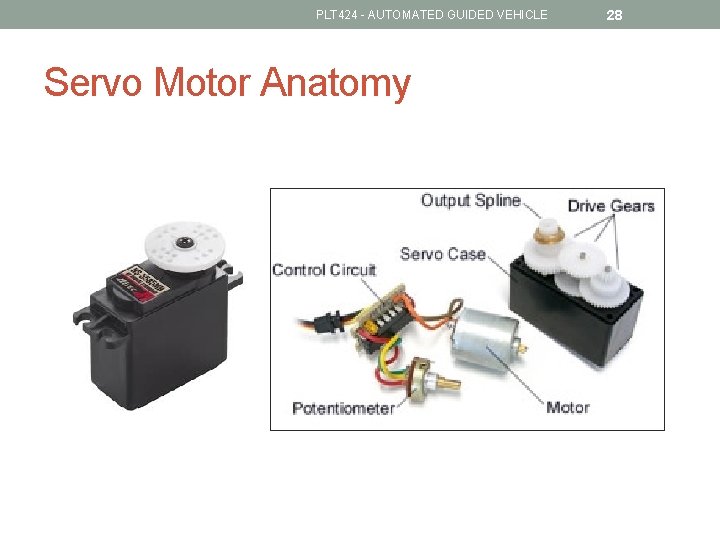
PLT 424 - AUTOMATED GUIDED VEHICLE 27 Servo Motor • Design for closed feedback system • “Servo” – capability to self-regulate its behavior, to measure its own position and compensate for external loads when responding to a control signal. • Components : • DC motor • Gear reduction unit • Shaft position sensor • Electronic circuit that controls the motor’s operation
PLT 424 - AUTOMATED GUIDED VEHICLE Servo Motor Anatomy 28
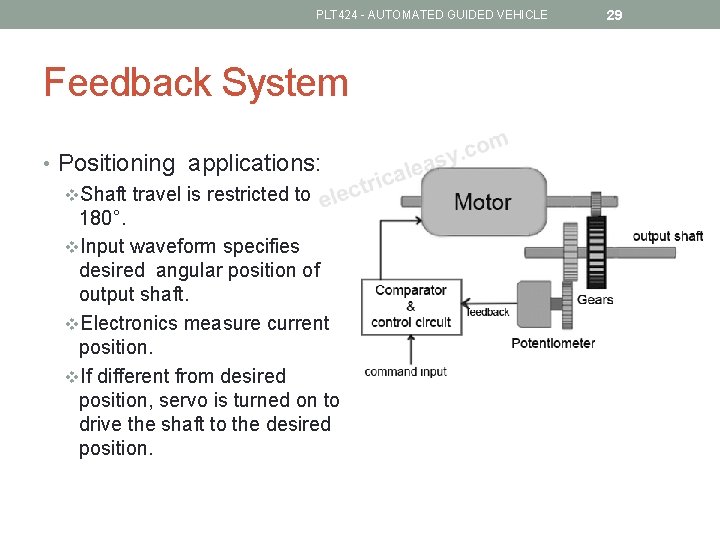
PLT 424 - AUTOMATED GUIDED VEHICLE Feedback System • Positioning applications: v. Shaft travel is restricted to 180°. v. Input waveform specifies desired angular position of output shaft. v. Electronics measure current position. v. If different from desired position, servo is turned on to drive the shaft to the desired position. 29
PLT 424 - AUTOMATED GUIDED VEHICLE 30 Positioning Control • Servos are controlled by sending an electrical pulse of variable width, or pulse width modulation (PWM), through the control wire. • A servo motor can usually only turn 90 degrees in either direction for a total of 180 degree movement. The motor's neutral position is defined as the position where the servo has the same amount of potential rotation in the both the clockwise or counter-clockwise direction. • The PWM sent to the motor determines position of the shaft, and based on the duration of the pulse sent via the control wire; the rotor will turn to the desired position. • The servo motor expects to see a pulse every 20 milliseconds (ms) and the length of the pulse will determine how far the motor turns.
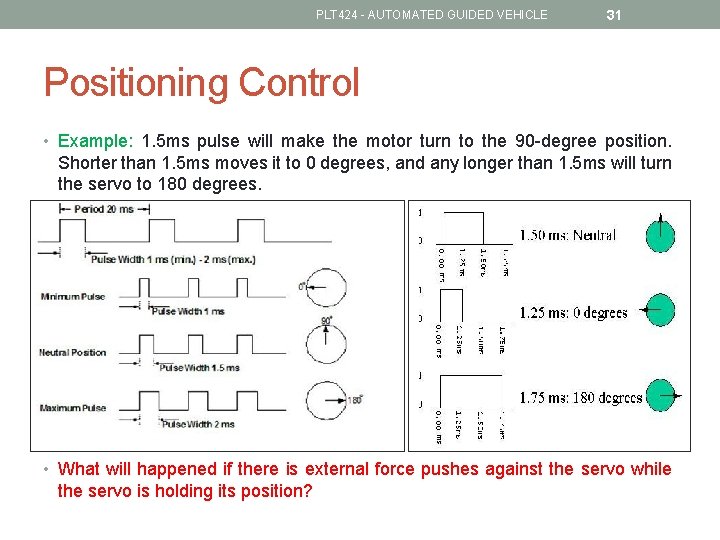
PLT 424 - AUTOMATED GUIDED VEHICLE 31 Positioning Control • Example: 1. 5 ms pulse will make the motor turn to the 90 -degree position. Shorter than 1. 5 ms moves it to 0 degrees, and any longer than 1. 5 ms will turn the servo to 180 degrees. • What will happened if there is external force pushes against the servo while the servo is holding its position?
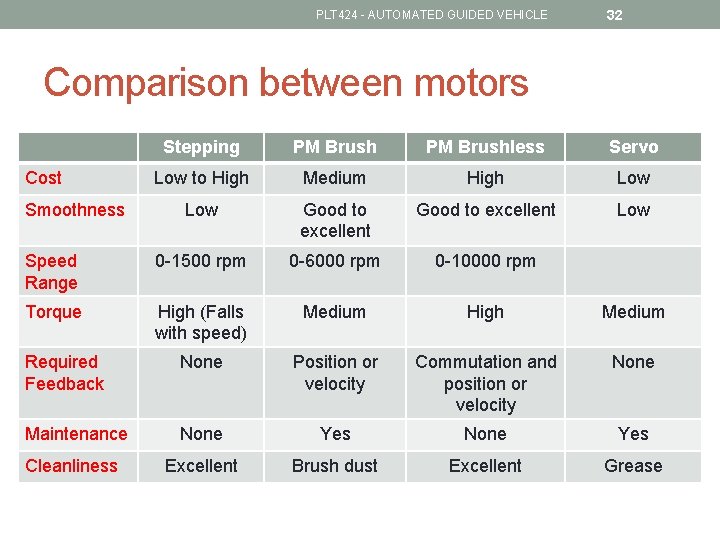
PLT 424 - AUTOMATED GUIDED VEHICLE 32 Comparison between motors Stepping PM Brushless Servo Low to High Medium High Low Good to excellent Low Speed Range 0 -1500 rpm 0 -6000 rpm 0 -10000 rpm Torque High (Falls with speed) Medium High Medium Required Feedback None Position or velocity Commutation and position or velocity None Maintenance None Yes Cleanliness Excellent Brush dust Excellent Grease Cost Smoothness
PLT 424 - AUTOMATED GUIDED VEHICLE THE END 33