
Actuarial Instruments in Risk Assessment Yale University Law
















![Index of effectiveness 3/ {log[Sn/(1 -Sn)] +log[(Sp/(1 -Sp)]}](https://slidetodoc.com/presentation_image_h/73eadee80428012fbb0a9a83b827266c/image-71.jpg "Index of effectiveness 3/ {log[Sn/(1 -Sn)] +log[(Sp/(1 -Sp)]}")


- Slides: 74
Actuarial Instruments in Risk Assessment Yale University Law & Psychiatry Division Howard Zonana MD Madelon Baranoski Ph. D Michael Norko MD Alec Buchanan Ph. D MD Governor’s Sentencing and Parole Review task Force December 3, 2007
Antisocial Personality Disorder and Psychopathy Howard Zonana MD Connecticut Mental Health Center Yale University School of Medicine 12/3/2007
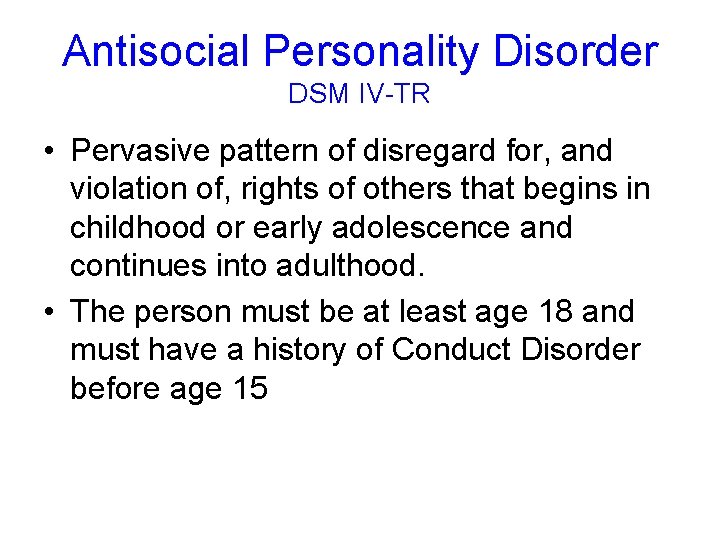
Antisocial Personality Disorder DSM IV-TR • Pervasive pattern of disregard for, and violation of, rights of others that begins in childhood or early adolescence and continues into adulthood. • The person must be at least age 18 and must have a history of Conduct Disorder before age 15
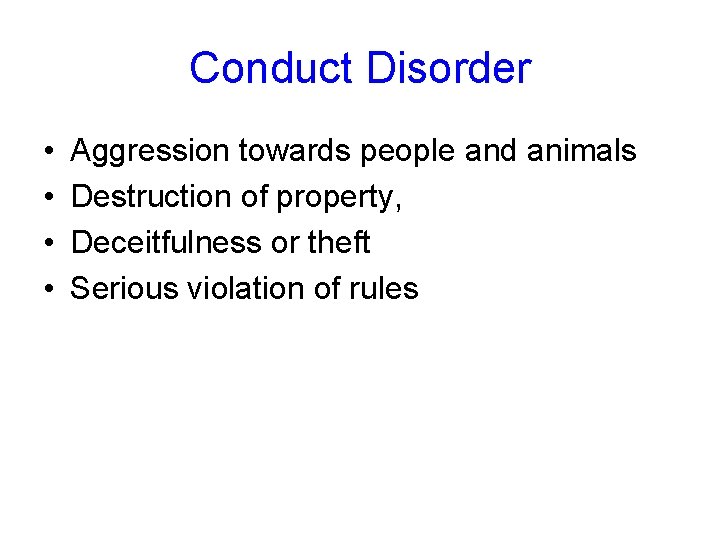
Conduct Disorder • • Aggression towards people and animals Destruction of property, Deceitfulness or theft Serious violation of rules
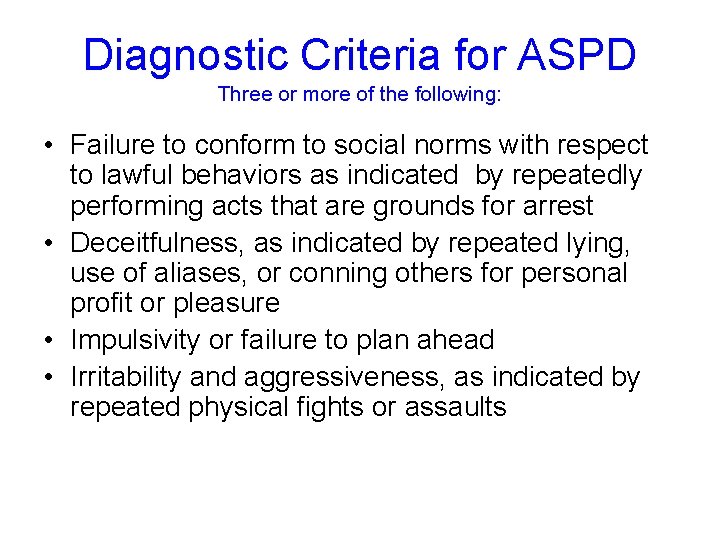
Diagnostic Criteria for ASPD Three or more of the following: • Failure to conform to social norms with respect to lawful behaviors as indicated by repeatedly performing acts that are grounds for arrest • Deceitfulness, as indicated by repeated lying, use of aliases, or conning others for personal profit or pleasure • Impulsivity or failure to plan ahead • Irritability and aggressiveness, as indicated by repeated physical fights or assaults
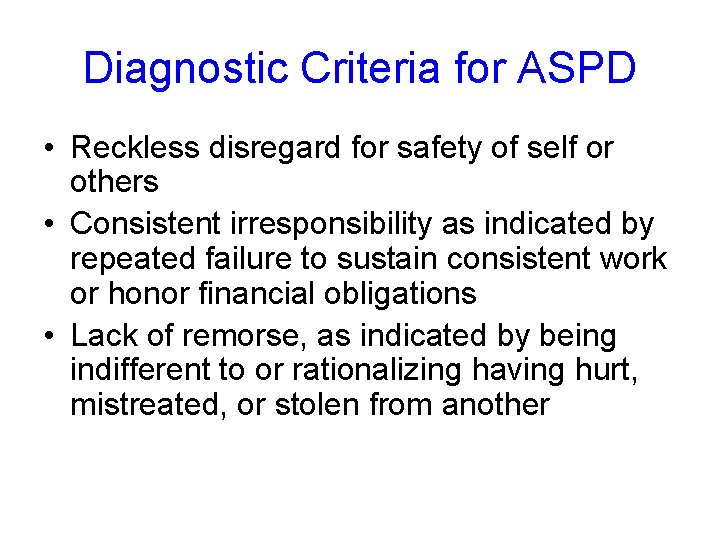
Diagnostic Criteria for ASPD • Reckless disregard for safety of self or others • Consistent irresponsibility as indicated by repeated failure to sustain consistent work or honor financial obligations • Lack of remorse, as indicated by being indifferent to or rationalizing having hurt, mistreated, or stolen from another
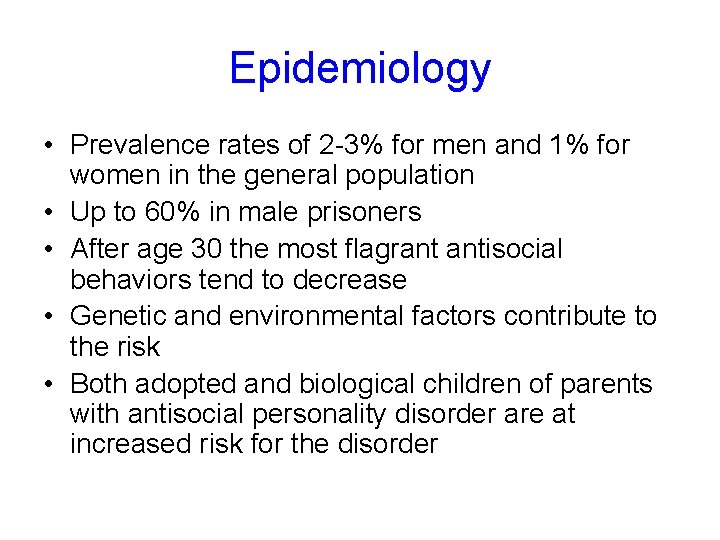
Epidemiology • Prevalence rates of 2 -3% for men and 1% for women in the general population • Up to 60% in male prisoners • After age 30 the most flagrant antisocial behaviors tend to decrease • Genetic and environmental factors contribute to the risk • Both adopted and biological children of parents with antisocial personality disorder are at increased risk for the disorder
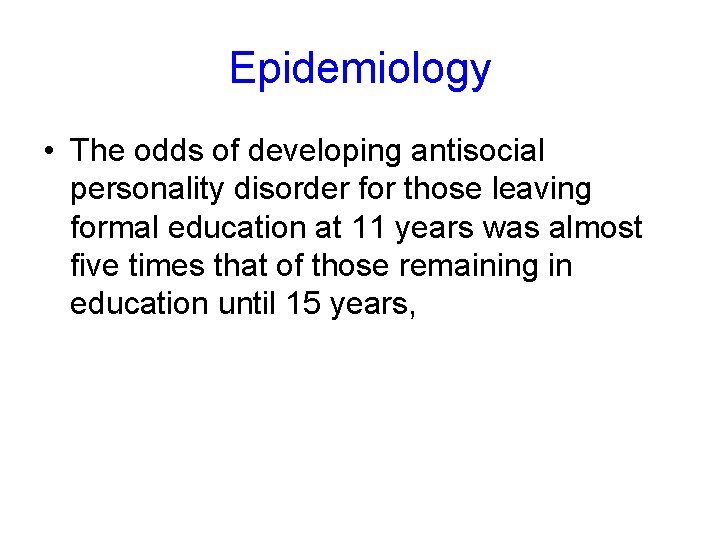
Epidemiology • The odds of developing antisocial personality disorder for those leaving formal education at 11 years was almost five times that of those remaining in education until 15 years,
Actuarial Measures and Risk Madelon Baranoski, Ph. D Associate Professor Yale School of Medicine
Outline • Actuarial measures and how they are developed • Assessing criminality and antisocial personality • Measures pertinent to re-offense – PCL-R (Psychopathy Checklist-Revised) – VRAG (Violence Risk Appraisal Guide) – LSI (Level of Service Indicator)
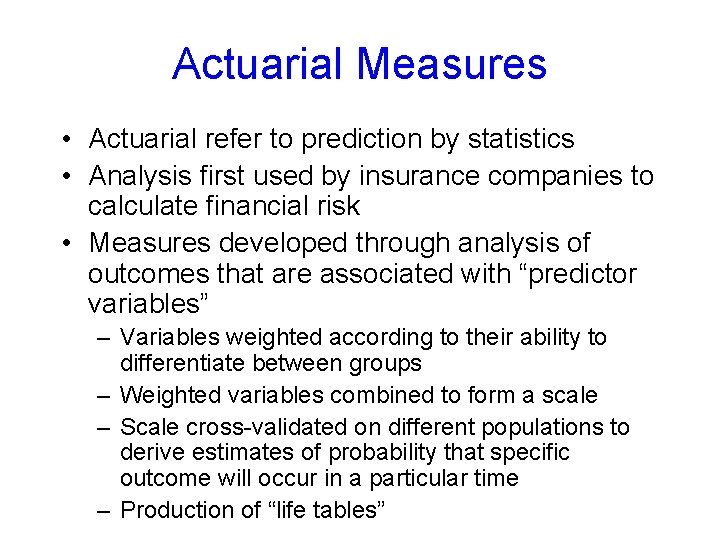
Actuarial Measures • Actuarial refer to prediction by statistics • Analysis first used by insurance companies to calculate financial risk • Measures developed through analysis of outcomes that are associated with “predictor variables” – Variables weighted according to their ability to differentiate between groups – Weighted variables combined to form a scale – Scale cross-validated on different populations to derive estimates of probability that specific outcome will occur in a particular time – Production of “life tables”
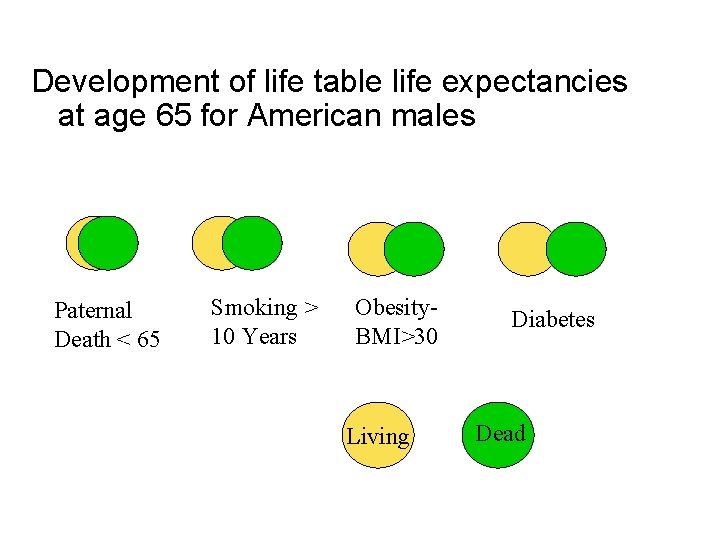
Development of life table life expectancies at age 65 for American males Paternal Death < 65 Smoking > 10 Years Obesity. BMI>30 Living Diabetes Dead
Actuarial Risk Assessment • Identification of individuals at higher risk because of selected traits that correlate with criminal recidivism or violence • Established through empirical association of traits with violence
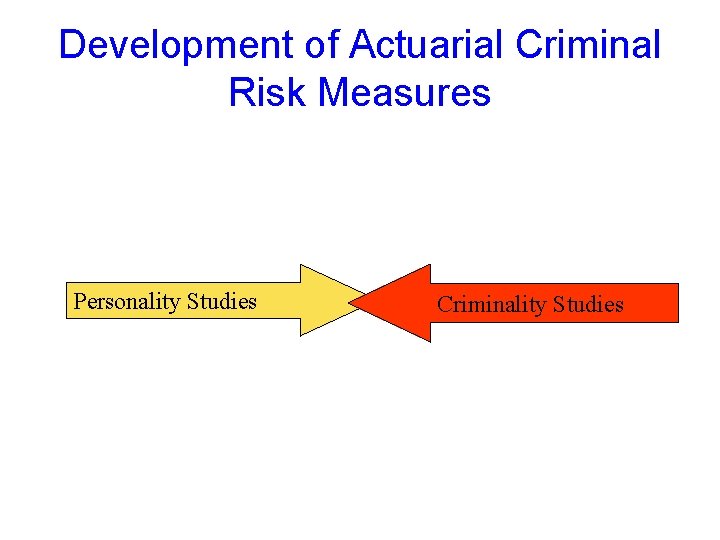
Development of Actuarial Criminal Risk Measures Personality Studies Criminality Studies
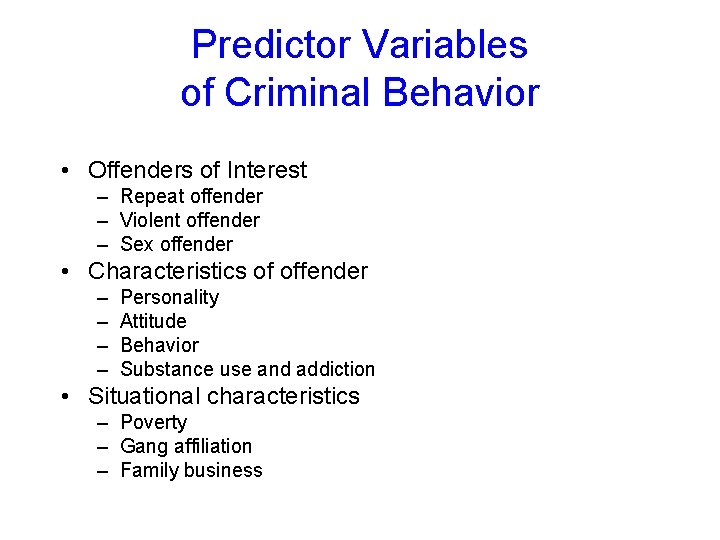
Predictor Variables of Criminal Behavior • Offenders of Interest – Repeat offender – Violent offender – Sex offender • Characteristics of offender – – Personality Attitude Behavior Substance use and addiction • Situational characteristics – Poverty – Gang affiliation – Family business
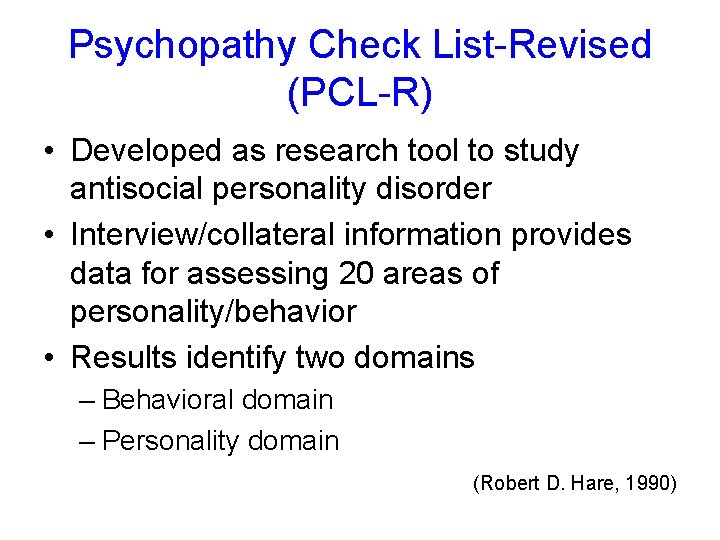
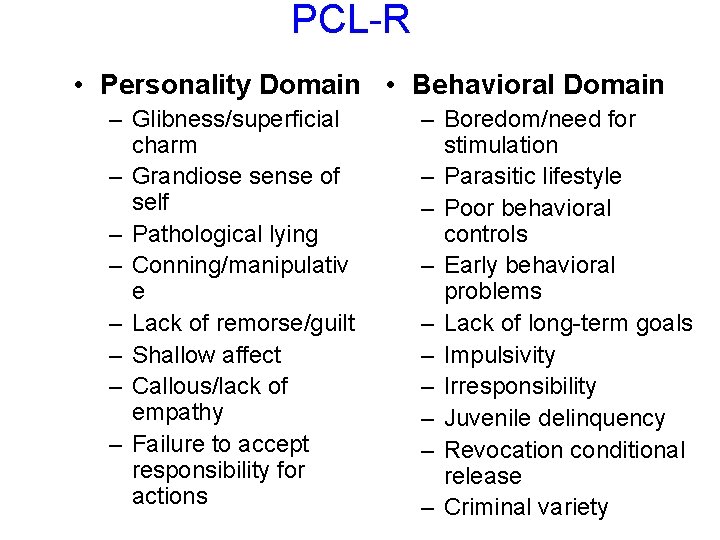
Psychopathy Check List-Revised (PCL-R) • Developed as research tool to study antisocial personality disorder • Interview/collateral information provides data for assessing 20 areas of personality/behavior • Results identify two domains – Behavioral domain – Personality domain (Robert D. Hare, 1990)
PCL-R • Personality Domain • Behavioral Domain – Glibness/superficial charm – Grandiose sense of self – Pathological lying – Conning/manipulativ e – Lack of remorse/guilt – Shallow affect – Callous/lack of empathy – Failure to accept responsibility for actions – Boredom/need for stimulation – Parasitic lifestyle – Poor behavioral controls – Early behavioral problems – Lack of long-term goals – Impulsivity – Irresponsibility – Juvenile delinquency – Revocation conditional release – Criminal variety
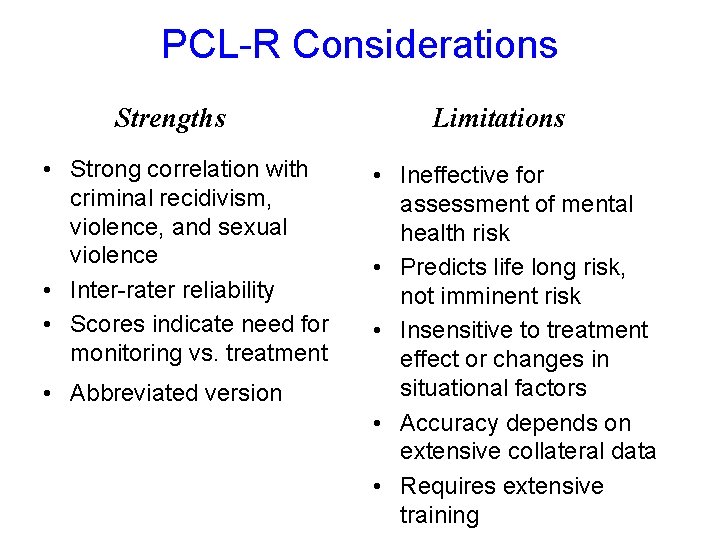
PCL-R Considerations Strengths • Strong correlation with criminal recidivism, violence, and sexual violence • Inter-rater reliability • Scores indicate need for monitoring vs. treatment • Abbreviated version Limitations • Ineffective for assessment of mental health risk • Predicts life long risk, not imminent risk • Insensitive to treatment effect or changes in situational factors • Accuracy depends on extensive collateral data • Requires extensive training
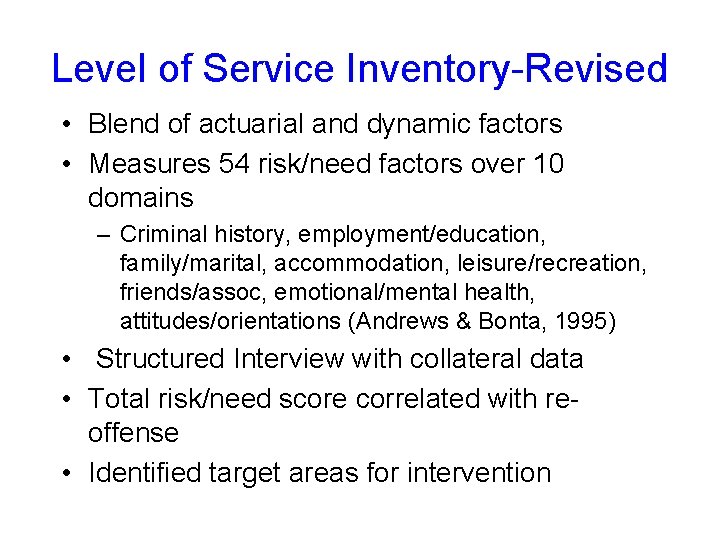
Level of Service Inventory-Revised • Blend of actuarial and dynamic factors • Measures 54 risk/need factors over 10 domains – Criminal history, employment/education, family/marital, accommodation, leisure/recreation, friends/assoc, emotional/mental health, attitudes/orientations (Andrews & Bonta, 1995) • Structured Interview with collateral data • Total risk/need score correlated with reoffense • Identified target areas for intervention
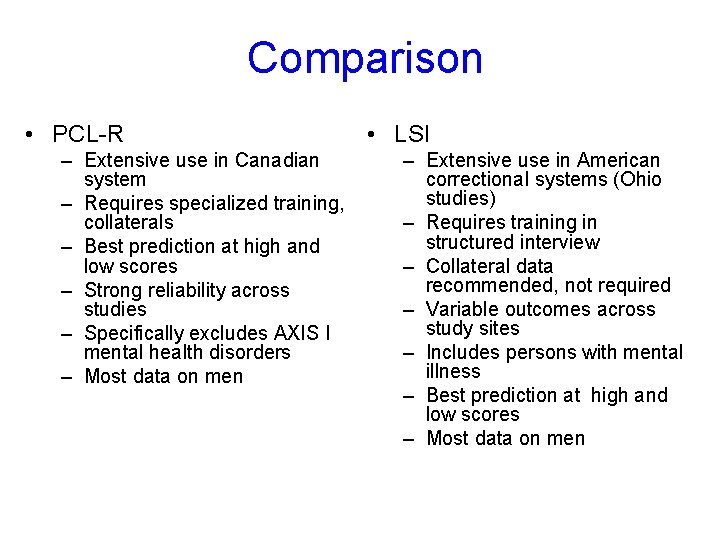
Comparison • PCL-R – Extensive use in Canadian system – Requires specialized training, collaterals – Best prediction at high and low scores – Strong reliability across studies – Specifically excludes AXIS I mental health disorders – Most data on men • LSI – Extensive use in American correctional systems (Ohio studies) – Requires training in structured interview – Collateral data recommended, not required – Variable outcomes across study sites – Includes persons with mental illness – Best prediction at high and low scores – Most data on men
Distribution of Risk Category % N=2006 Lowencamp & Latessa, 2006
Re-Incarceration Based on Risk Classification %
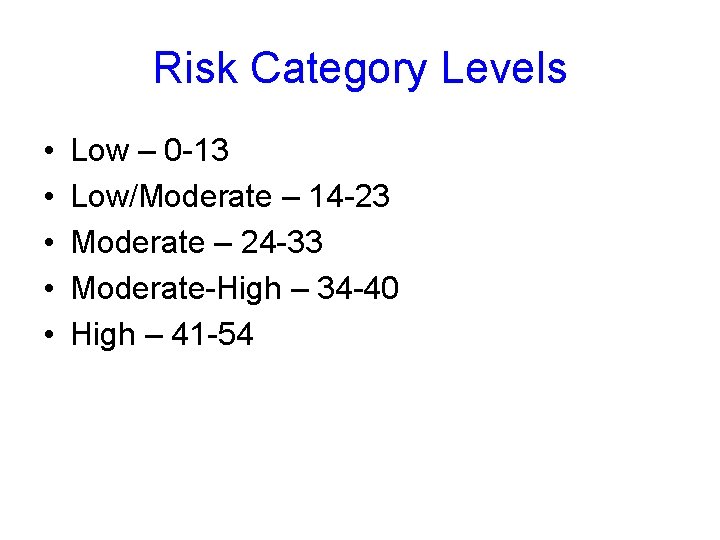
Risk Category Levels • • • Low – 0 -13 Low/Moderate – 14 -23 Moderate – 24 -33 Moderate-High – 34 -40 High – 41 -54
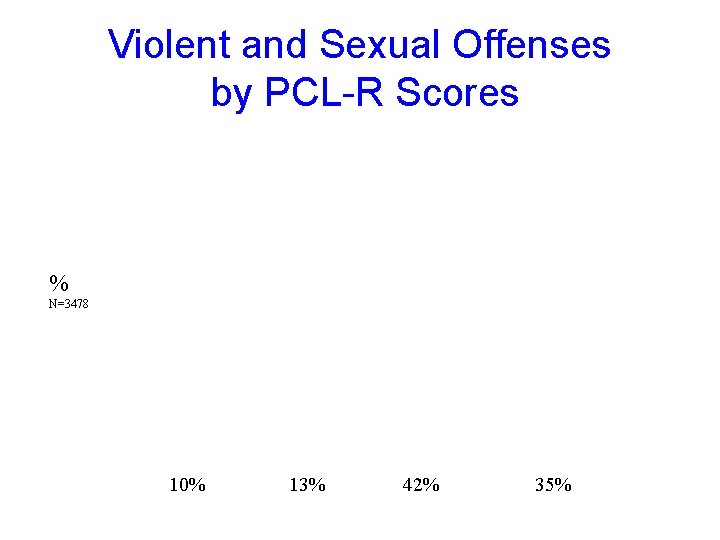
Violent and Sexual Offenses by PCL-R Scores % N=3478 10% 13% 42% 35%
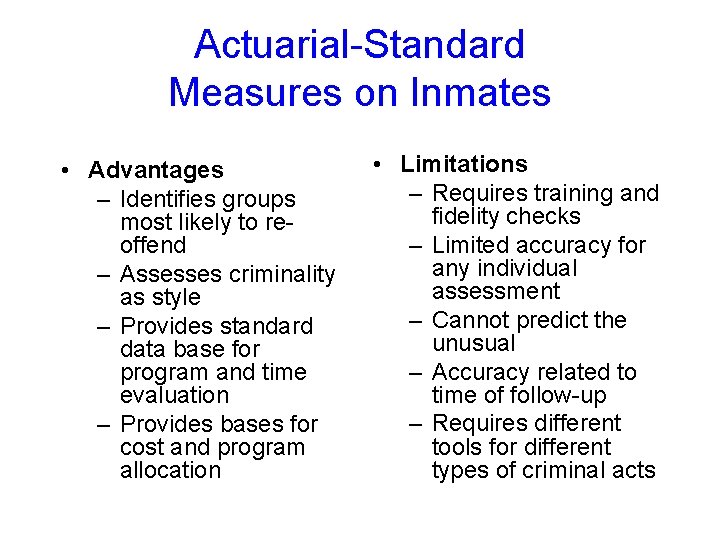
Actuarial-Standard Measures on Inmates • Advantages – Identifies groups most likely to reoffend – Assesses criminality as style – Provides standard data base for program and time evaluation – Provides bases for cost and program allocation • Limitations – Requires training and fidelity checks – Limited accuracy for any individual assessment – Cannot predict the unusual – Accuracy related to time of follow-up – Requires different tools for different types of criminal acts
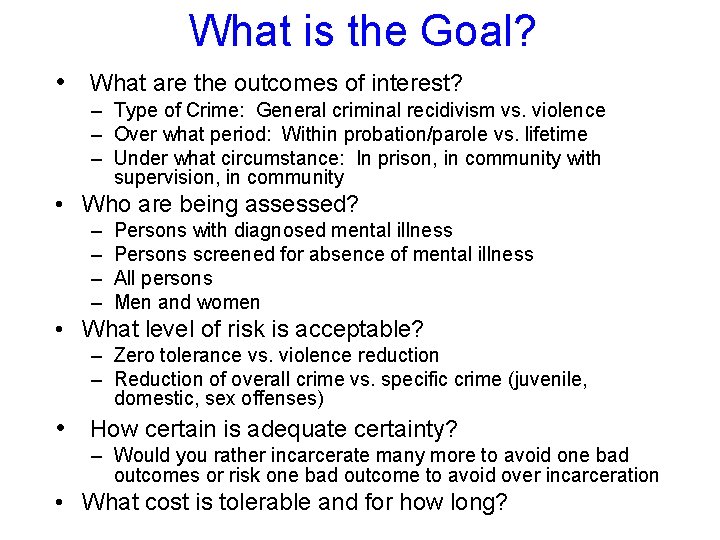
What is the Goal? • What are the outcomes of interest? – Type of Crime: General criminal recidivism vs. violence – Over what period: Within probation/parole vs. lifetime – Under what circumstance: In prison, in community with supervision, in community • Who are being assessed? – – Persons with diagnosed mental illness Persons screened for absence of mental illness All persons Men and women • What level of risk is acceptable? – Zero tolerance vs. violence reduction – Reduction of overall crime vs. specific crime (juvenile, domestic, sex offenses) • How certain is adequate certainty? – Would you rather incarcerate many more to avoid one bad outcomes or risk one bad outcome to avoid over incarceration • What cost is tolerable and for how long?
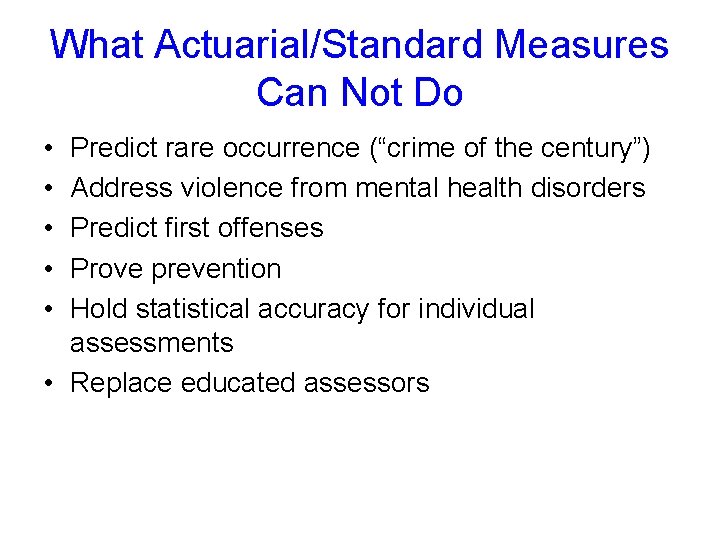
What Actuarial/Standard Measures Can Not Do • • • Predict rare occurrence (“crime of the century”) Address violence from mental health disorders Predict first offenses Prove prevention Hold statistical accuracy for individual assessments • Replace educated assessors
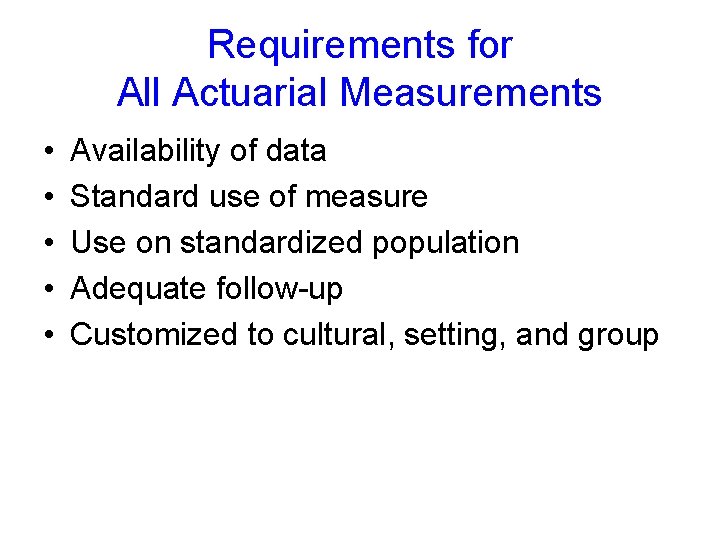
Requirements for All Actuarial Measurements • • • Availability of data Standard use of measure Use on standardized population Adequate follow-up Customized to cultural, setting, and group
Meaning of Actuarial Test Outcome Michael Norko MD Associate Professor of Psychiatry Yale University School of Medicine
Meaning of Actuarial Test Outcome • Risk level • Positive predictive power
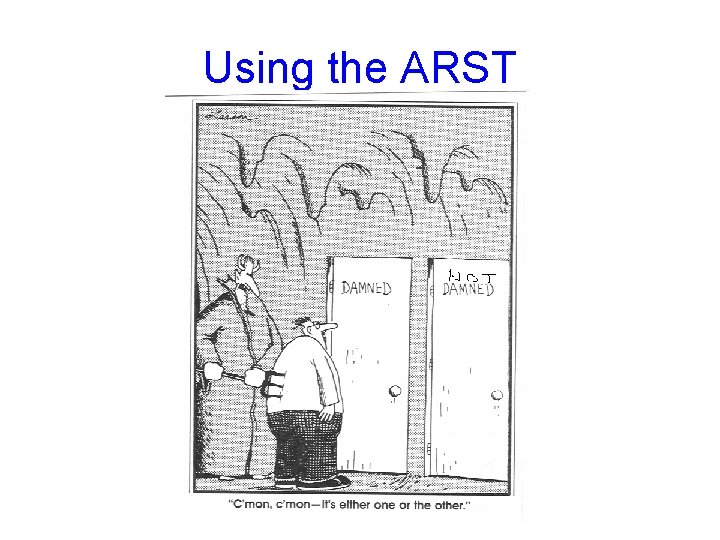
ACME Risk Screening Tool (ARST)
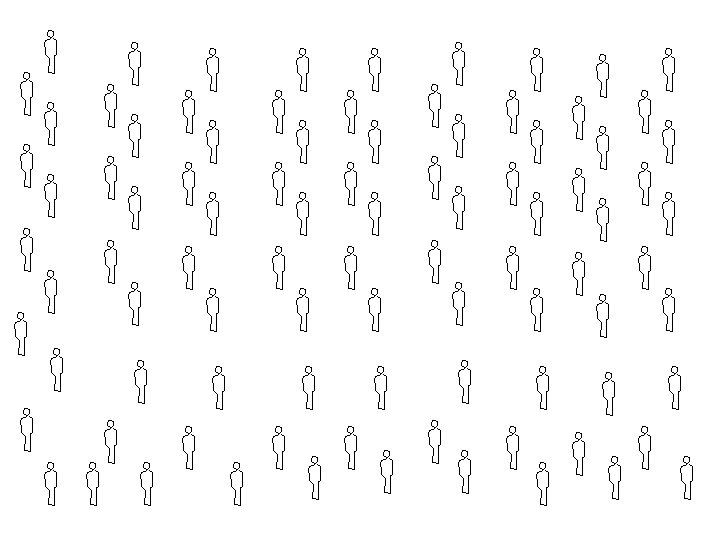
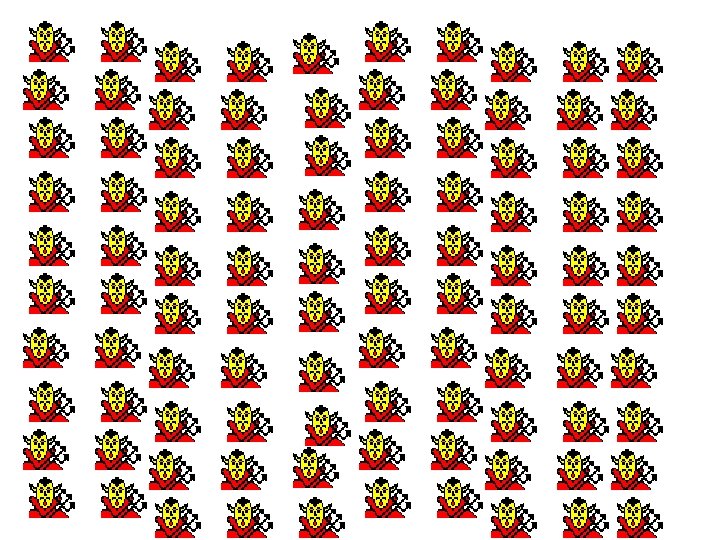
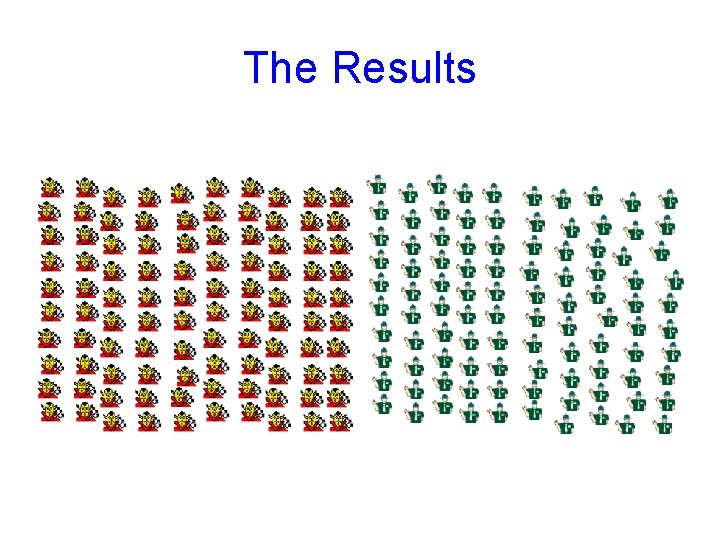
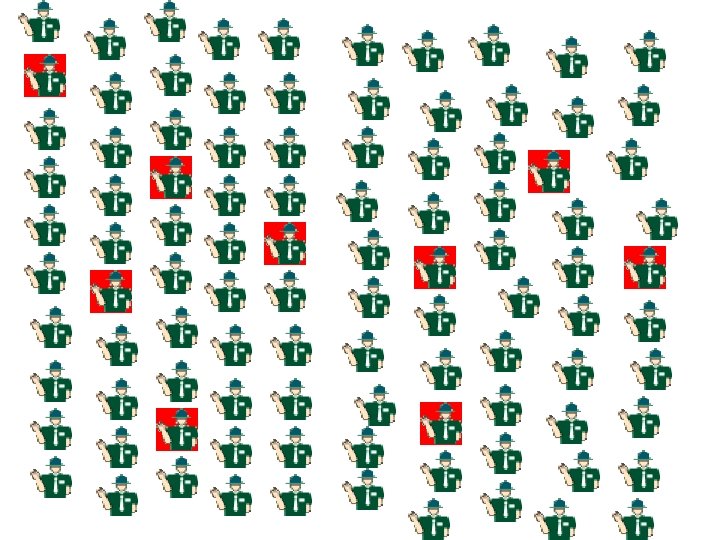
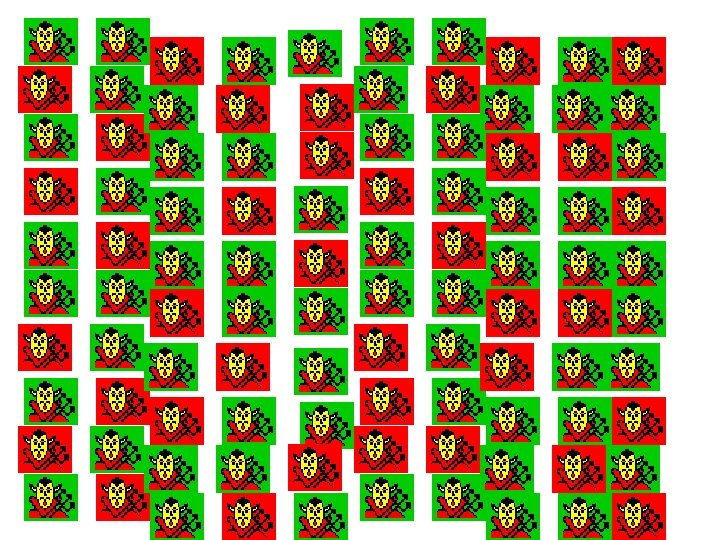
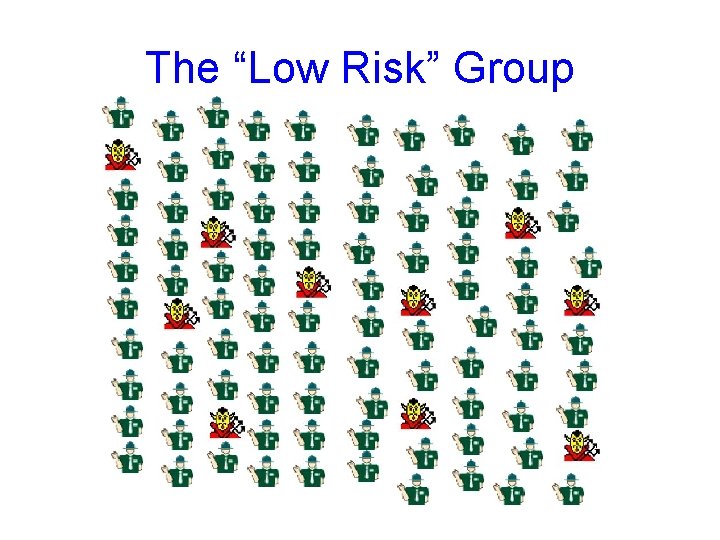
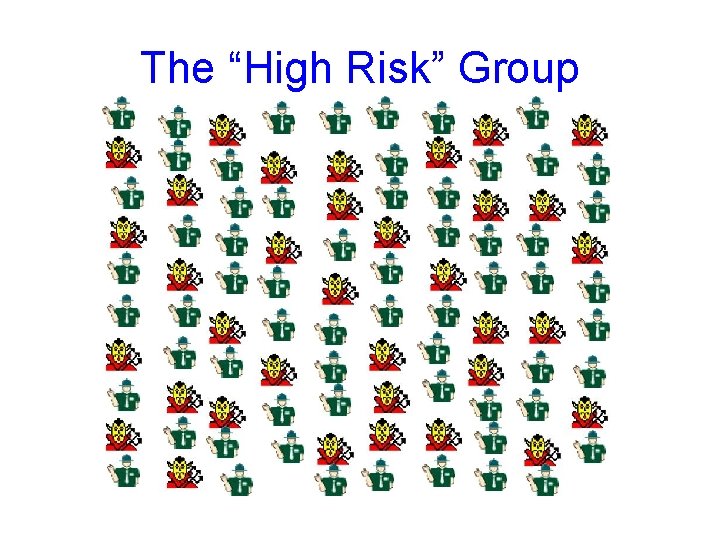
ARST Validation Data • Separates into low risk and high risk – Statistically significant separations – Quite good AUC of 75% • High risk has average risk of 37% • Low risk has average risk of 9% • Overall risk in population is 18. 5%
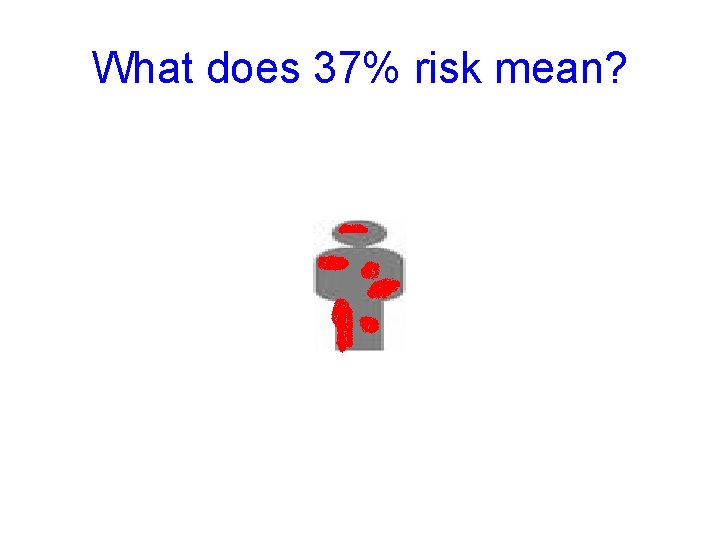
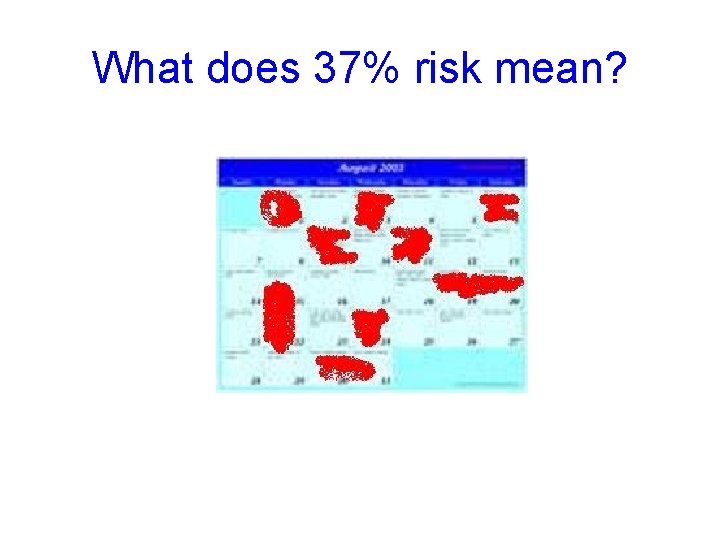
What does 37% risk mean?
What does 37% risk mean?
What does 37% risk mean?
So what does it mean?
Using the ARST
The Results
What’s the Outcome?
The “Low Risk” Group
The “High Risk” Group
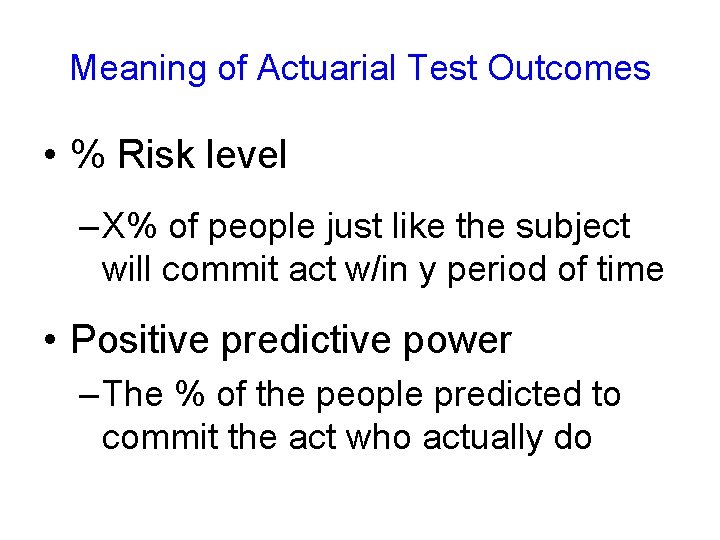
Meaning of Actuarial Test Outcomes • % Risk level – X% of people just like the subject will commit act w/in y period of time • Positive predictive power – The % of the people predicted to commit the act who actually do
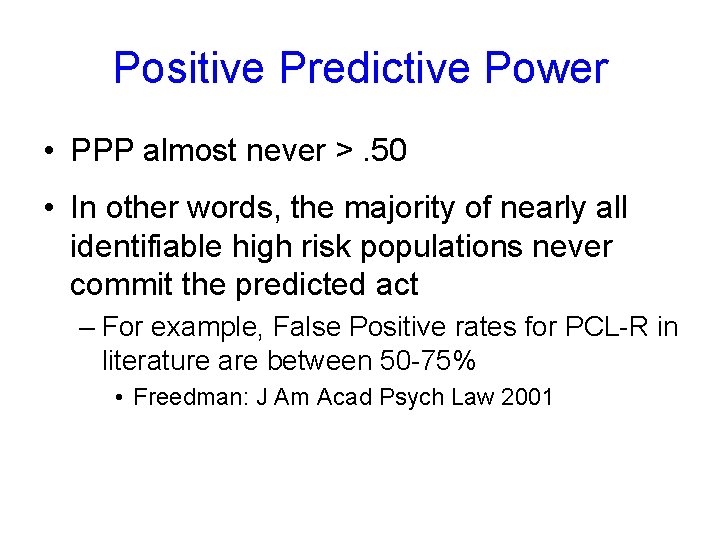
Positive Predictive Power • PPP almost never >. 50 • In other words, the majority of nearly all identifiable high risk populations never commit the predicted act – For example, False Positive rates for PCL-R in literature are between 50 -75% • Freedman: J Am Acad Psych Law 2001
Accuracy of Predictions of Offending Alec Buchanan Ph. D MD Associate Professor of Psychiatry Yale University School of Medicine
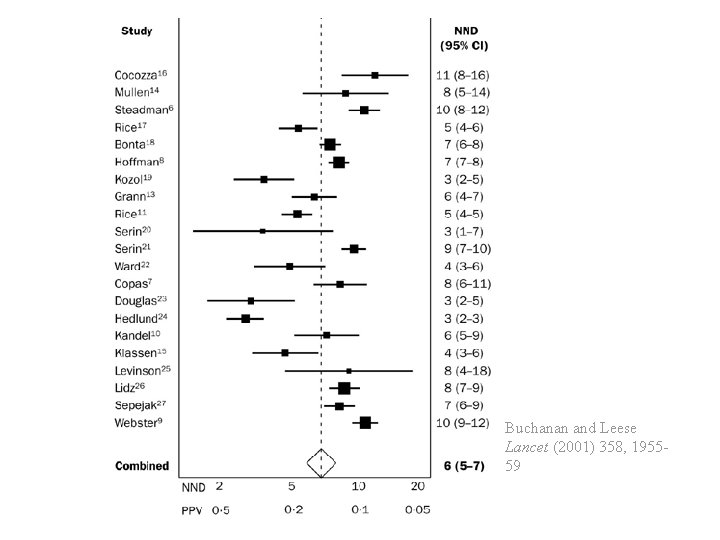
Indices of effectiveness of validated prediction studies 1970 – 2000 (from Buchanan and Leese, 2001)
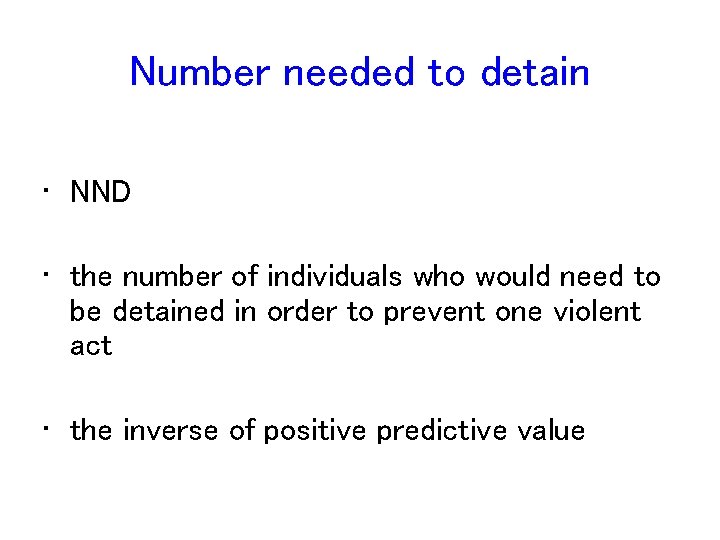
Number needed to detain • NND • the number of individuals who would need to be detained in order to prevent one violent act • the inverse of positive predictive value
Buchanan and Leese Lancet (2001) 358, 195559
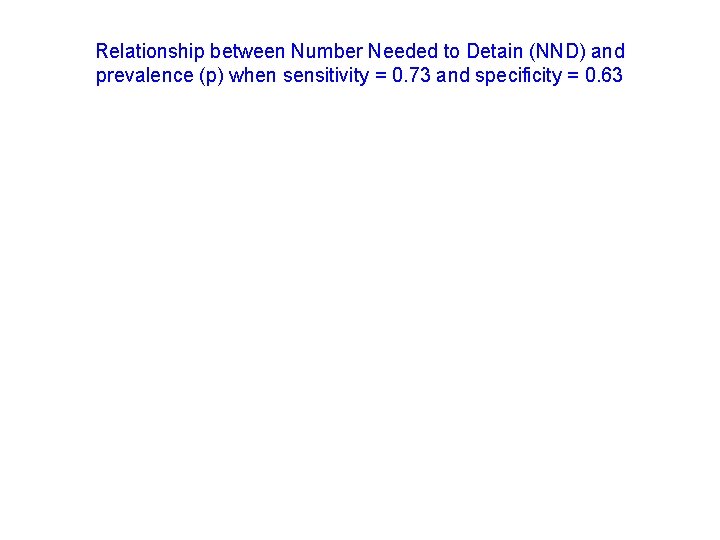
Relationship between Number Needed to Detain (NND) and prevalence (p) when sensitivity = 0. 73 and specificity = 0. 63
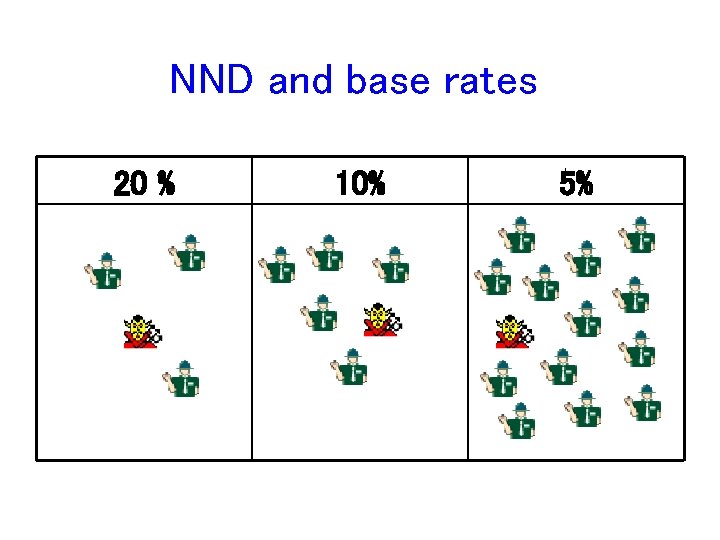
NND and base rates 20 % 10% 5%
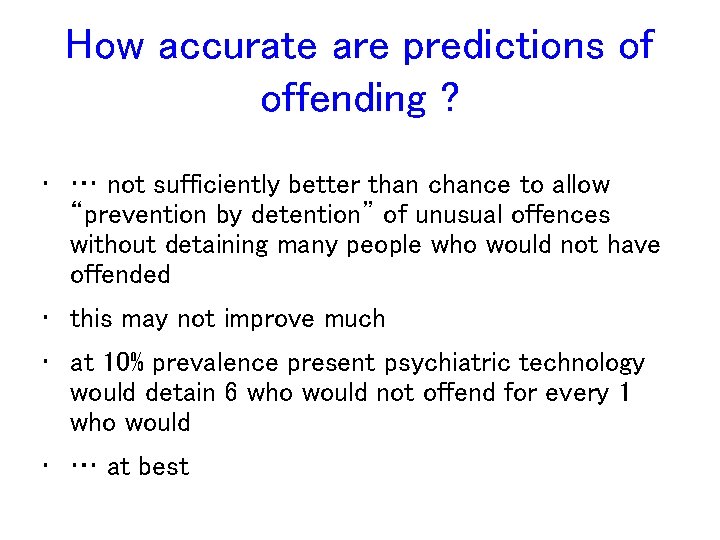
How accurate are predictions of offending ? • … not sufficiently better than chance to allow “prevention by detention” of unusual offences without detaining many people who would not have offended • this may not improve much • at 10% prevalence present psychiatric technology would detain 6 who would not offend for every 1 who would • … at best
How accurate are predictions of offending (1)? • Better than chance • How much better?
Index of effectiveness 3/ {log[Sn/(1 -Sn)] +log[(Sp/(1 -Sp)]}
Which information helps us predict?
Will accuracy improve?
What does this mean?