
Actualizing Learning Outcomes In Nursing Education with AUGMENTED
- Slides: 22
Actualizing Learning Outcomes In Nursing Education with AUGMENTED REALITY Symposium Chair: Elisabeth “Alfie” Weinbaum, Ph. D. Presenters: Helen Schleckser, Theresa Bane, Ph. D. , Myrene Magabo ‘On Site’ Moderator: Dr. Lou Falik
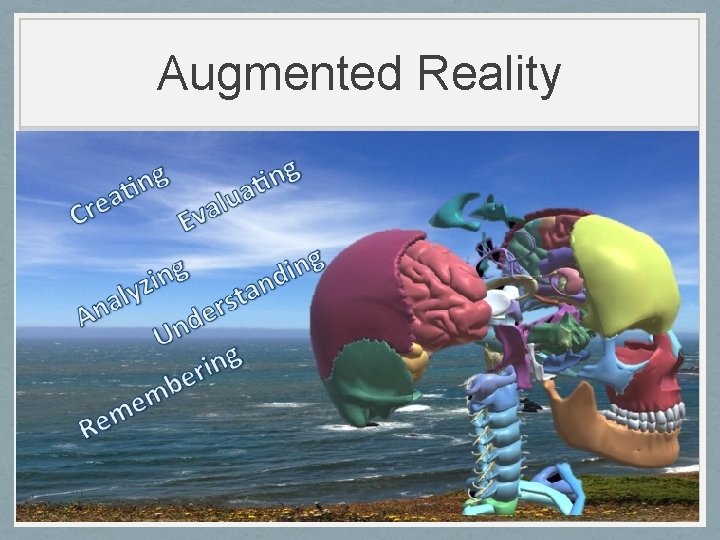
Augmented Reality 2
Our “Virtual” Team “Alfie” “Helen” “Terri” “Myrene” 3
Welcome Our Symposium Will Cover: • Opportunities for Nursing Education • Understanding & Evaluating AR • Understanding Learning • Global Opportunities with AR in Nursing Education 4
Opportunities for Nursing Education Background: Even though almost 3 million registered United States nurses work in hospitals, physician’s offices, home healthcare services, nursing care facilities, correctional facilities, schools, and military, demand for highly trained nurses remains high due to: • Aging populations • Diagnosis of chronic illness • Health care reform issues (Bureau of Labor Statistics, 2016). 5
Opportunities for Nursing Education Nurses require comprehension of: • Cradle-to-grave perspective on health • Collaboration models • Tele-health modalities for patient care, education, and monitoring • Capabilities for gathering and analyzing population-level data • Behaviors promoting wellness and disease prevention • Adopting and disseminating best practices (Council, 2016). 6
Opportunities for Nursing Education Resulting in A Challenges: High demand for nurses, exacerbated by an increased expectation for nurses competent in a variety of everchanging complex skills. • Nursing is a complex practice discipline (Fawcett, 1996; Zaccagnini and White, 2015) • Articulating practice knowledge is challenging within nursing education (Carr, 2005) 1. Knowledge acquisition is not an independent, static state (Kolb, 1984, p. 38) 2. Experience transforms into knowledge (experiential learning (Kolb, 1984, p. 38) 7
Opportunities for Nursing Education-AR Augmented Reality (AR): • Potential for emerging technologies (such as AR) to contribute to nursing education by improving human performance (Gartner, 2013) • Preliminary literature review revealed sporadic, anecdotal accounts of AR in instructional designs and gaps in overall support of teaching and learning 8
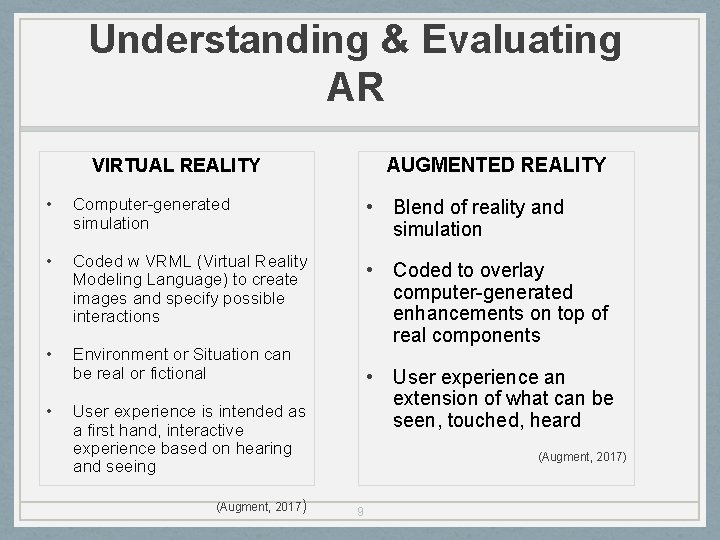
Understanding & Evaluating AR AUGMENTED REALITY VIRTUAL REALITY • Computer-generated simulation • Blend of reality and simulation • Coded w VRML (Virtual Reality Modeling Language) to create images and specify possible interactions • Environment or Situation can be real or fictional • Coded to overlay computer-generated enhancements on top of real components • • User experience an extension of what can be seen, touched, heard User experience is intended as a first hand, interactive experience based on hearing and seeing (Augment, 2017) 9
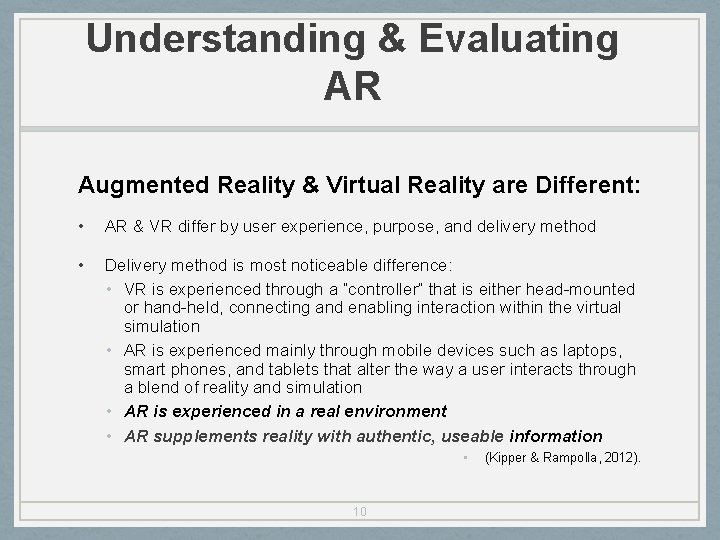
Understanding & Evaluating AR Augmented Reality & Virtual Reality are Different: • AR & VR differ by user experience, purpose, and delivery method • Delivery method is most noticeable difference: • VR is experienced through a “controller” that is either head-mounted or hand-held, connecting and enabling interaction within the virtual simulation • AR is experienced mainly through mobile devices such as laptops, smart phones, and tablets that alter the way a user interacts through a blend of reality and simulation • AR is experienced in a real environment • AR supplements reality with authentic, useable information • (Kipper & Rampolla, 2012). 10
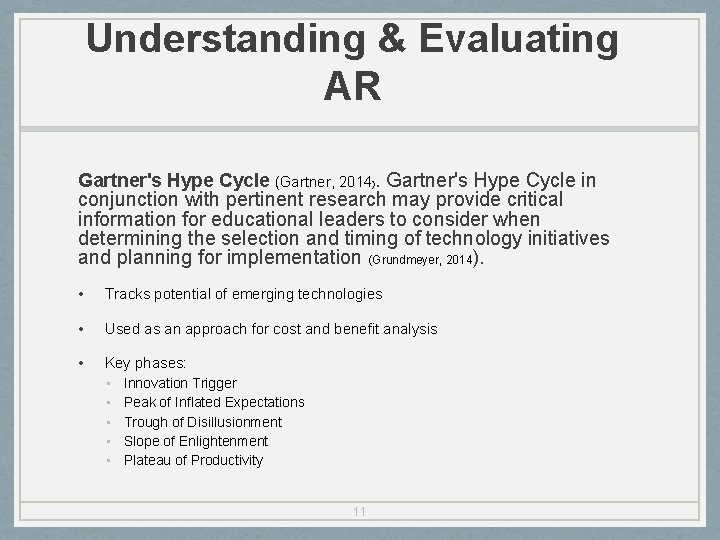
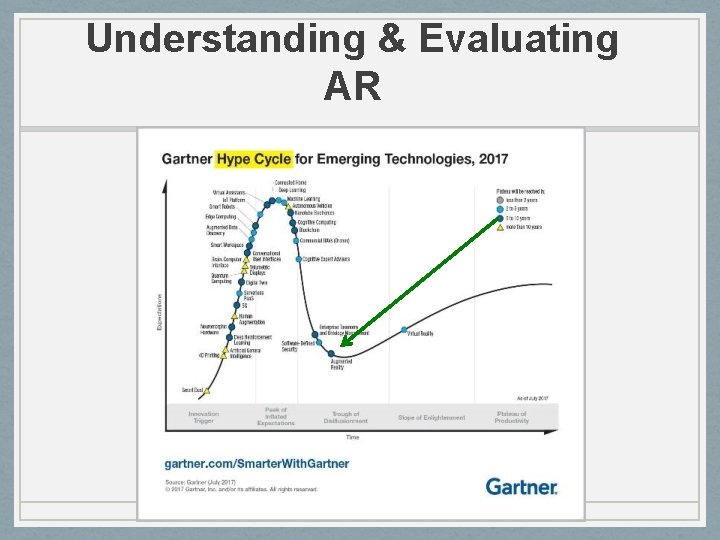
Understanding & Evaluating AR Gartner's Hype Cycle (Gartner, 2014). Gartner's Hype Cycle in conjunction with pertinent research may provide critical information for educational leaders to consider when determining the selection and timing of technology initiatives and planning for implementation (Grundmeyer, 2014). • Tracks potential of emerging technologies • Used as an approach for cost and benefit analysis • Key phases: • Innovation Trigger • Peak of Inflated Expectations • Trough of Disillusionment • Slope of Enlightenment • Plateau of Productivity 11
Understanding & Evaluating AR 12
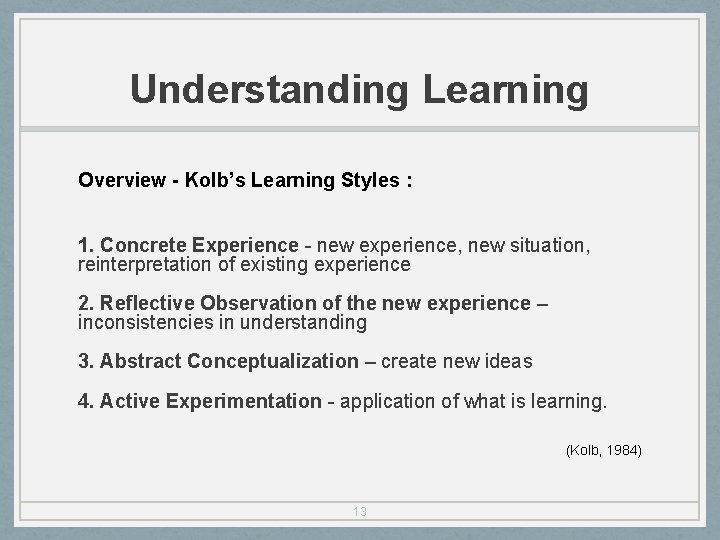
Understanding Learning Overview - Kolb’s Learning Styles : 1. Concrete Experience - new experience, new situation, reinterpretation of existing experience 2. Reflective Observation of the new experience – inconsistencies in understanding 3. Abstract Conceptualization – create new ideas 4. Active Experimentation - application of what is learning. (Kolb, 1984) 13
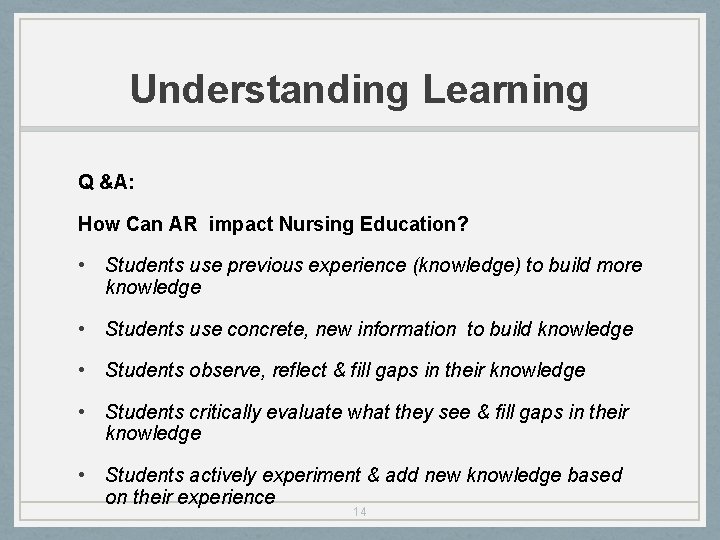
Understanding Learning Q &A: How Can AR impact Nursing Education? • Students use previous experience (knowledge) to build more knowledge • Students use concrete, new information to build knowledge • Students observe, reflect & fill gaps in their knowledge • Students critically evaluate what they see & fill gaps in their knowledge • Students actively experiment & add new knowledge based on their experience 14
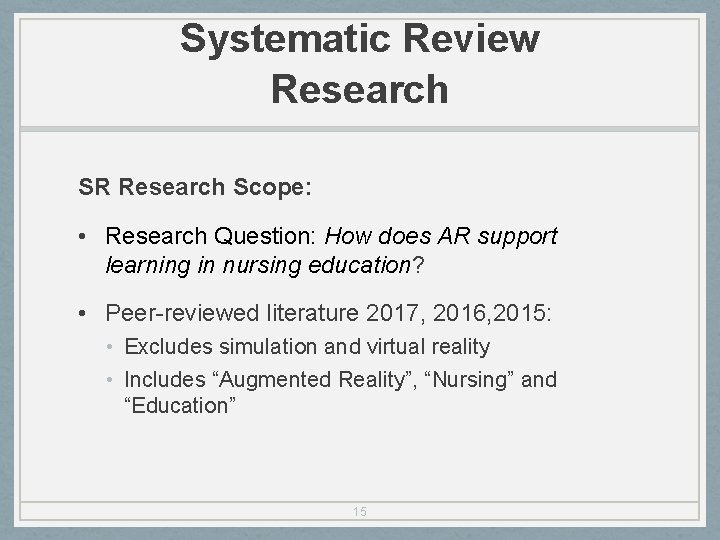
Systematic Review Research SR Research Scope: • Research Question: How does AR support learning in nursing education? • Peer-reviewed literature 2017, 2016, 2015: • Excludes simulation and virtual reality • Includes “Augmented Reality”, “Nursing” and “Education” 15
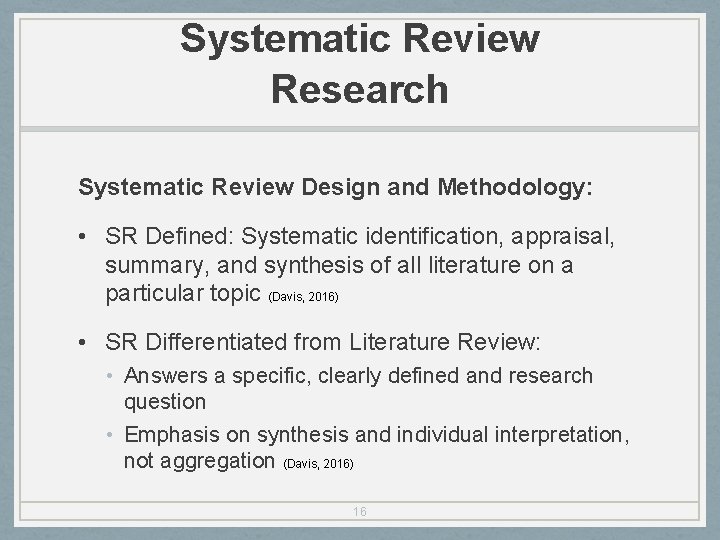
Systematic Review Research Systematic Review Design and Methodology: • SR Defined: Systematic identification, appraisal, summary, and synthesis of all literature on a particular topic (Davis, 2016) • SR Differentiated from Literature Review: • Answers a specific, clearly defined and research question • Emphasis on synthesis and individual interpretation, not aggregation (Davis, 2016) 16
Systematic Review Research Preliminary Findings: • AR supplements, does not replace other learning materials • AR enhances teaching & learning • Definitions for competency and learning objectives vary, creating perception of sporadic, anecdotal accounts • Role of commercial product share is unclear, diluting results 17
Limitations AR in Nursing Education According to our research • AR extends learning: • Provides context for learning situations • Supplements theoretical information with ability to see, hear, and interact • AR enhances practice: • Creates opportunities to apply knowledge • Provides opportunities to test knowledge 18
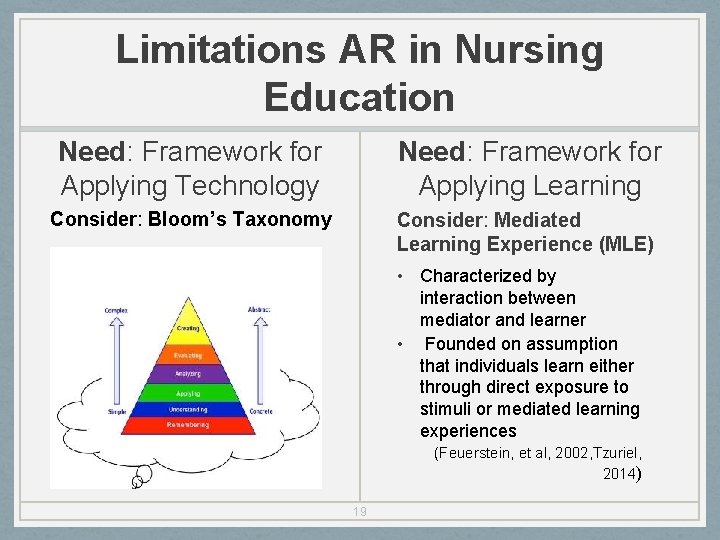
Limitations AR in Nursing Education Need: Framework for Applying Technology Need: Framework for Applying Learning Consider: Bloom’s Taxonomy Consider: Mediated Learning Experience (MLE) • Characterized by interaction between mediator and learner • Founded on assumption that individuals learn either through direct exposure to stimuli or mediated learning experiences (Feuerstein, et al, 2002, Tzuriel, 2014) 19
Conclusions u. AR Technology can enhance Nursing Education: üUsed in conjunction with cognitive learning objectives üUsed as stimuli to promote learning üApplied through a mediating entity such as a mentor or instructor 20
References Gartner hype cycle maps out human-machine relationship. (2013). Network. World Asia, 10(3), 10 -11. Global Opportunities • Cultural diversity & global issues increase demand for competent effective care with a worldwide view of knowledge and how to apply it. (Sagar, 2014) • Individuals, families, communities, and organizations share this critical need, regardless of income, age, race, nationality, and location. 21
References 22