
ACTR 5 0 Architecture Christian Lebiere HumanComputer Interaction
ACT-R 5. 0 Architecture Christian Lebiere Human-Computer Interaction Institute Carnegie Mellon University cl+@cmu. edu
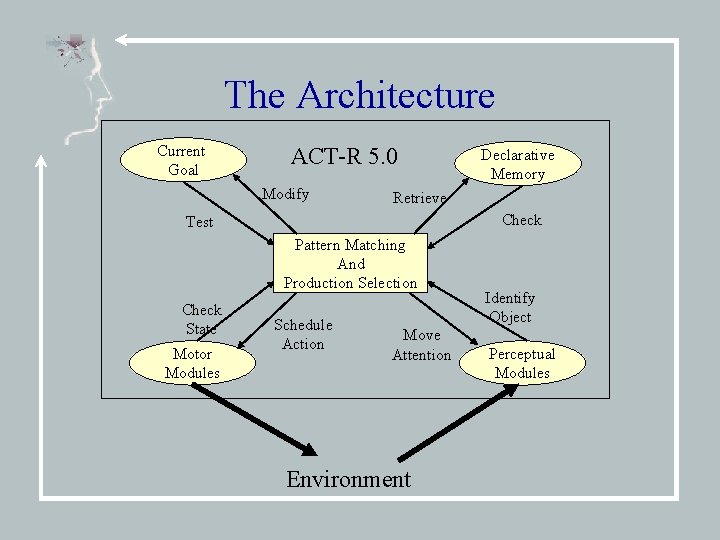
The Architecture Current Goal ACT-R 5. 0 Modify Retrieve Check Test Pattern Matching And Production Selection Check State Motor Modules Declarative Memory Schedule Action Move Attention Environment Identify Object Perceptual Modules
Asynchronous Production Cycle • Need to be less fixated on the goal and more interruptible • Asynchronous matching responds to changes and interrupts • Matches and acts on several sources of information (buffers) • Any of them can occur in any order or not at all (e. g. no goal) • What is a buffer? Active part or select location of module? • Event-centered firing: new cycle as response to buffer change • Production matching and selection has replaced goal as linchpin • It also simplifies production cycle since there are no failures • Need to do something about retrievals that can tie up production matching for several hundred ms and repeatedly during a cycle
Retrieval as Internal Action • Separate the request for retrieval from test of results – Implausibly long matching cycle and perfect sequential search – Unification with treatment of visual perception – Better account of neuroscience literature • Result of retrieval appears in retrieval buffer when complete • If it fails, a failure (“don’t know”) chunk is put in the buffer • Retrieval buffer is reset to nil when a new request is made – Alternatives: when it is accessed or finite time after available • Explicit retrieval-state buffer? Busy, time and/or probability? • Learning (BLL, AL) when and on what basis? – Currently: as before at the end of the matching cycle – Makes some sense for BLL but how about source changes for AL?
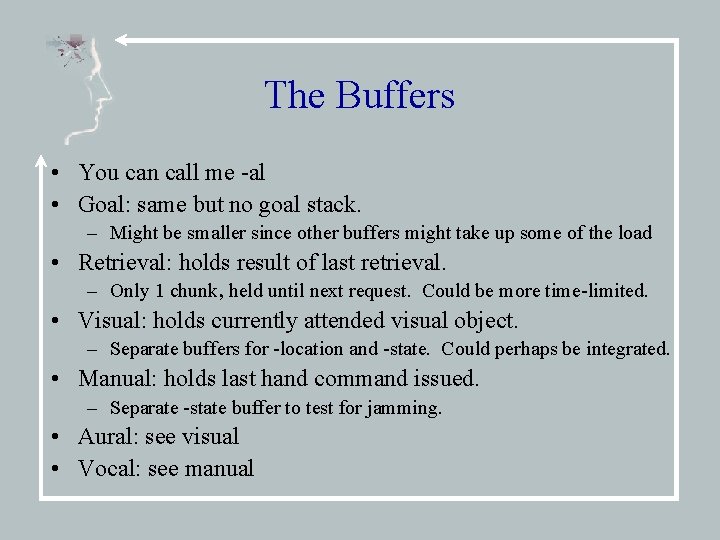
The Buffers • You can call me -al • Goal: same but no goal stack. – Might be smaller since other buffers might take up some of the load • Retrieval: holds result of last retrieval. – Only 1 chunk, held until next request. Could be more time-limited. • Visual: holds currently attended visual object. – Separate buffers for -location and -state. Could perhaps be integrated. • Manual: holds last hand command issued. – Separate -state buffer to test for jamming. • Aural: see visual • Vocal: see manual
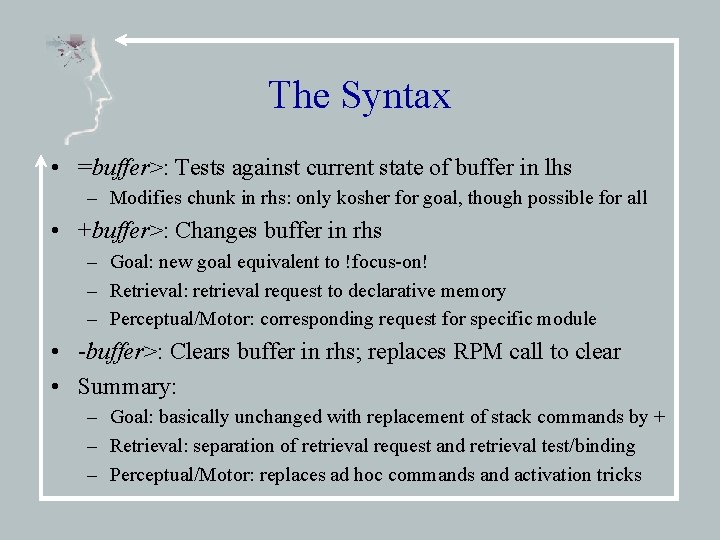
The Syntax • =buffer>: Tests against current state of buffer in lhs – Modifies chunk in rhs: only kosher for goal, though possible for all • +buffer>: Changes buffer in rhs – Goal: new goal equivalent to !focus-on! – Retrieval: retrieval request to declarative memory – Perceptual/Motor: corresponding request for specific module • -buffer>: Clears buffer in rhs; replaces RPM call to clear • Summary: – Goal: basically unchanged with replacement of stack commands by + – Retrieval: separation of retrieval request and retrieval test/binding – Perceptual/Motor: replaces ad hoc commands and activation tricks
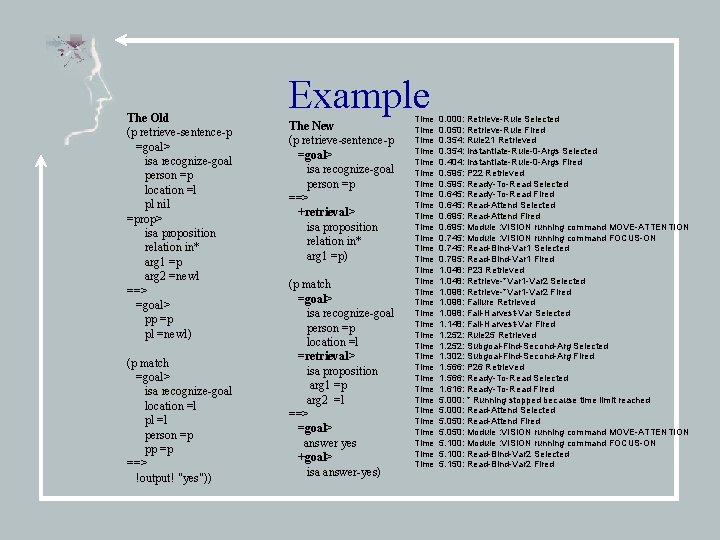
The Old (p retrieve-sentence-p =goal> isa recognize-goal person =p location =l pl nil =prop> isa proposition relation in* arg 1 =p arg 2 =newl ==> =goal> pp =p pl =newl) (p match =goal> isa recognize-goal location =l pl =l person =p pp =p ==> !output! "yes")) Example The New (p retrieve-sentence-p =goal> isa recognize-goal person =p ==> +retrieval> isa proposition relation in* arg 1 =p) (p match =goal> isa recognize-goal person =p location =l =retrieval> isa proposition arg 1 =p arg 2 =l ==> =goal> answer yes +goal> isa answer-yes) Time Time Time Time Time Time Time Time Time 0. 000: Retrieve-Rule Selected 0. 050: Retrieve-Rule Fired 0. 354: Rule 21 Retrieved 0. 354: Instantiate-Rule-0 -Args Selected 0. 404: Instantiate-Rule-0 -Args Fired 0. 595: P 22 Retrieved 0. 595: Ready-To-Read Selected 0. 645: Ready-To-Read Fired 0. 645: Read-Attend Selected 0. 695: Read-Attend Fired 0. 695: Module : VISION running command MOVE-ATTENTION 0. 745: Module : VISION running command FOCUS-ON 0. 745: Read-Bind-Var 1 Selected 0. 795: Read-Bind-Var 1 Fired 1. 048: P 23 Retrieved 1. 048: Retrieve-*Var 1 -Var 2 Selected 1. 098: Retrieve-*Var 1 -Var 2 Fired 1. 098: Failure Retrieved 1. 098: Fail-Harvest-Var Selected 1. 148: Fail-Harvest-Var Fired 1. 252: Rule 25 Retrieved 1. 252: Subgoal-Find-Second-Arg Selected 1. 302: Subgoal-Find-Second-Arg Fired 1. 566: P 26 Retrieved 1. 566: Ready-To-Read Selected 1. 616: Ready-To-Read Fired 5. 000: * Running stopped because time limit reached 5. 000: Read-Attend Selected 5. 050: Read-Attend Fired 5. 050: Module : VISION running command MOVE-ATTENTION 5. 100: Module : VISION running command FOCUS-ON 5. 100: Read-Bind-Var 2 Selected 5. 150: Read-Bind-Var 2 Fired
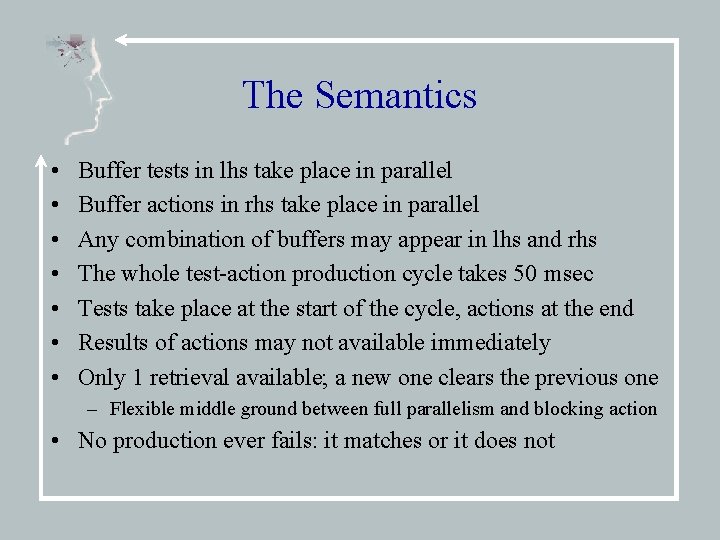
The Semantics • • Buffer tests in lhs take place in parallel Buffer actions in rhs take place in parallel Any combination of buffers may appear in lhs and rhs The whole test-action production cycle takes 50 msec Tests take place at the start of the cycle, actions at the end Results of actions may not available immediately Only 1 retrieval available; a new one clears the previous one – Flexible middle ground between full parallelism and blocking action • No production ever fails: it matches or it does not
Production Rule Learning • Need for a more automatic production creation mechanism working directly from execution rather than memory trace • Works by collapsing consecutive productions together • Combines buffer tests and actions while avoiding conflicts • For perceptual/motor buffers, prevent jamming (2 accesses) • For retrieval buffer, delete request and test when no error • The resulting production specializes the parent productions • For goal buffer, merge references unless conflicting changes • Set parameters to reflect low confidence and cost of entry • Leave in the more explicit dependency-based mechanism?
Goal Stack • The goal stack is an idealistic construct – Perfect memory – Instantaneous retrievals • Use declarative memory instead – – Changing to new goal stores previous goal as new memory chunk Old goal can be retrieved from memory (direct link or not? ) Recency (and perhaps priming) provides approximation to goal stack Implications of duplicating retrieved goal vs reinstating it directly • Is goal memory the same as declarative memory or separate? • No more architectural support for subgoal discounting • Still a useful abstraction: leave the old commands in place
Miscellaneous • Outside of the reserved -al keywords, other headers in the lhs are interpreted as retrievals and in rhs as chunk creation (4. 0) • Ultimately: get rid of all !! Commands • Generalizes negation modifier - to comparison >, <, >=, <= • New trace format time/event-based instead of cycle-based – Cycle trace prints events, latency trace prints durations • • Enable Rational Analysis: Enable Subsymbolic Computations Buffers command generalizes goal-focus (and retrieval) How central is the goal to cognition given the other sources? Issues of compatibility: how to implement the transition?
Open Issues • What to do if no production matches? – Stop: put in a wait production if you want to continue – Advance to next cycle and retry: matching and selection can be noisy – Advance to next event: need good integrated scheduler • Find-location (and find-sound): lhs or rhs? – Used to be lhs: too powerful because 0 -cost matching – Currently unified: rhs request and lhs test on visual-location – How to handle onset detection: buffer-stuffing of new events • Questions about direct links, i. e. chunks as slot values – Problems with direct retrieval, e. g. competitive latency – Problematic direct assignments to buffers: +buffer> =variable – Has similar but slightly less power than the goal stack
- Slides: 12