
Actor Network Theory Structure Origins Developement Key concepts

- Slides: 19
Actor Network Theory
Structure Origins & Developement Key concepts Modes of researching ◦ First discussion round Key critiques ◦ Second discussion round Future directions 06. 2020 FABIAN MARKS I EVITA GIEBELER I CONTEMPORARY PLANNING THEORY I PROF. DR. ZIMMERMANN 2
Origins & Development 1. Origins & Development 2. Key Concepts 3. Modes of Research • Main representers: Latour, Callon • Planning: Rydin Discussion 4. Critique • Ethnographic origins. Discussion 5. Further Directions • First texts dealt with the „knowledge“ • Combination between „post-positivist“ social constructivism and realism 06. 2020 FABIAN MARKS I EVITA GIEBELER I CONTEMPORARY PLANNING THEORY I PROF. DR. ZIMMERMANN 3
Key concepts 1. Origins & Development 2. Key Concepts 3. Modes of Research Discussion 4. Critique Discussion 5. Further Directions Network • Linkages between actors (actants) • „assemblage approach“ • No fixed connections • Focussing on the relationships • Latour: society is ordered through relationships Relationships (associations) • Associations between actants are temporarily (assemblage) • Cross-scalarity • No layered scales (local, national, international) • Associations across all scales 06. 2020 FABIAN MARKS I EVITA GIEBELER I CONTEMPORARY PLANNING THEORY I PROF. DR. ZIMMERMANN 4
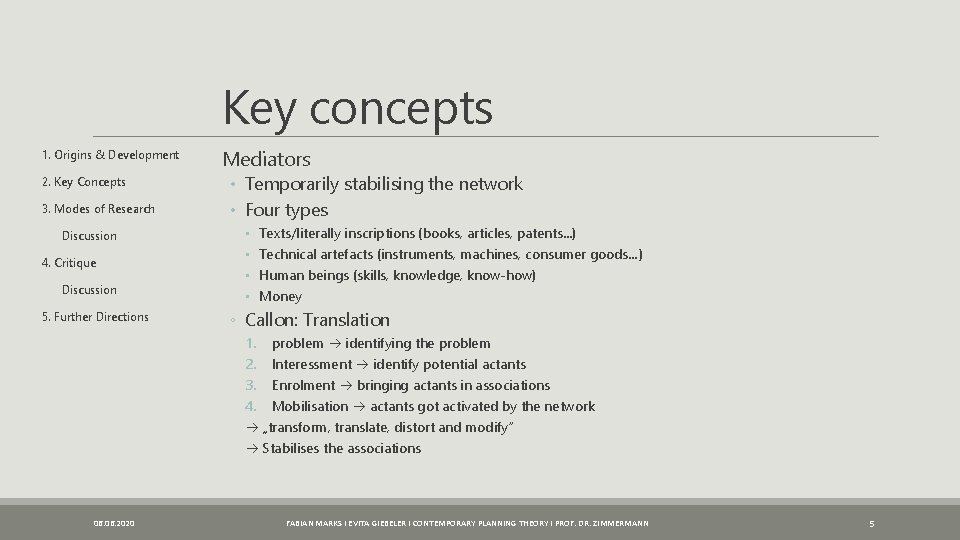
Key concepts 1. Origins & Development 2. Key Concepts 3. Modes of Research Discussion 4. Critique Discussion 5. Further Directions Mediators • Temporarily stabilising the network • Four types • • Texts/literally inscriptions (books, articles, patents. . . ) Technical artefacts (instruments, machines, consumer goods…) Human beings (skills, knowledge, know-how) Money ◦ Callon: Translation 1. problem identifying the problem 2. Interessment identify potential actants 3. Enrolment bringing actants in associations 4. Mobilisation actants got activated by the network „transform, translate, distort and modify“ Stabilises the associations 06. 2020 FABIAN MARKS I EVITA GIEBELER I CONTEMPORARY PLANNING THEORY I PROF. DR. ZIMMERMANN 5
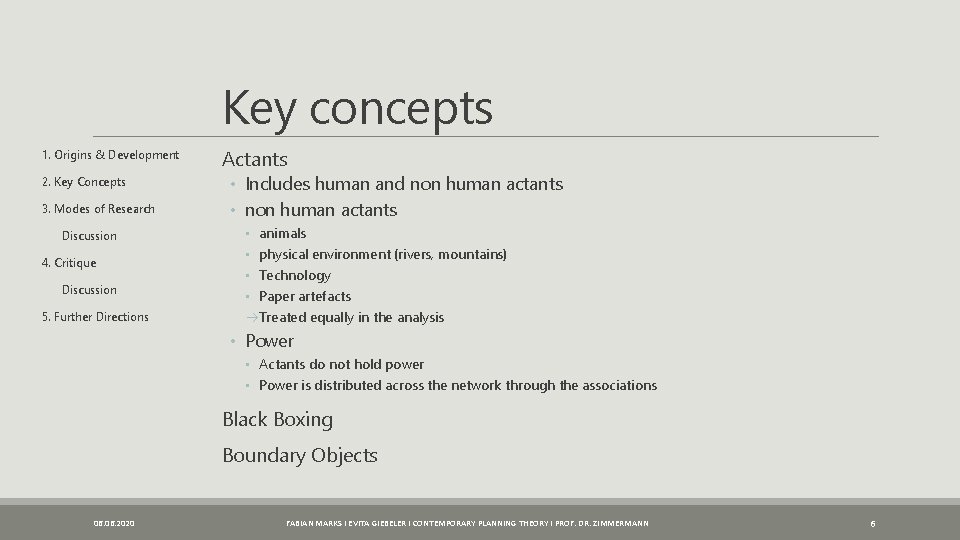
Key concepts 1. Origins & Development 2. Key Concepts 3. Modes of Research Discussion 4. Critique Discussion 5. Further Directions Actants • Includes human and non human actants • animals • physical environment (rivers, mountains) • Technology • Paper artefacts Treated equally in the analysis • Power • Actants do not hold power • Power is distributed across the network through the associations Black Boxing Boundary Objects 06. 2020 FABIAN MARKS I EVITA GIEBELER I CONTEMPORARY PLANNING THEORY I PROF. DR. ZIMMERMANN 6
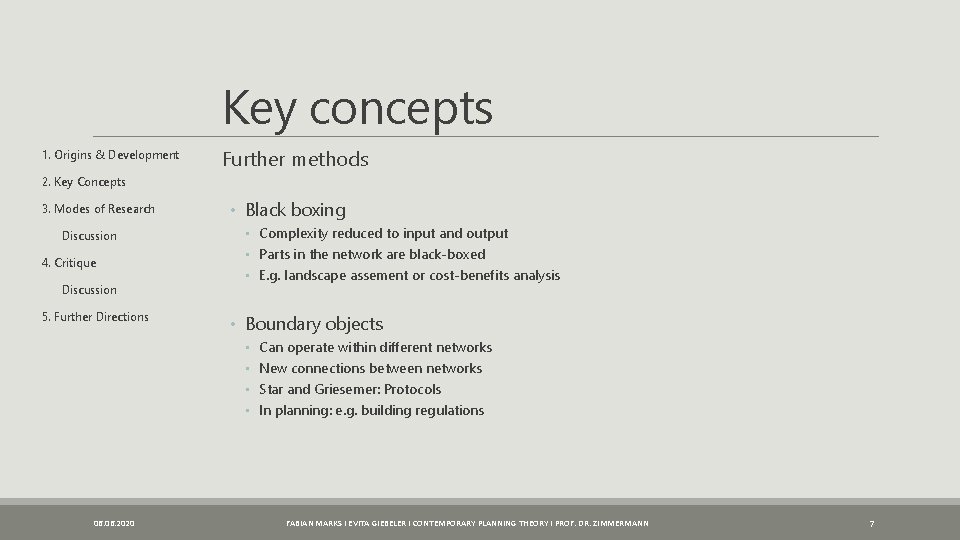
Key concepts 1. Origins & Development Further methods 2. Key Concepts 3. Modes of Research Discussion 4. Critique Discussion 5. Further Directions • Black boxing • Complexity reduced to input and output • Parts in the network are black-boxed • E. g. landscape assement or cost-benefits analysis • Boundary objects • • 06. 2020 Can operate within different networks New connections between networks Star and Griesemer: Protocols In planning: e. g. building regulations FABIAN MARKS I EVITA GIEBELER I CONTEMPORARY PLANNING THEORY I PROF. DR. ZIMMERMANN 7
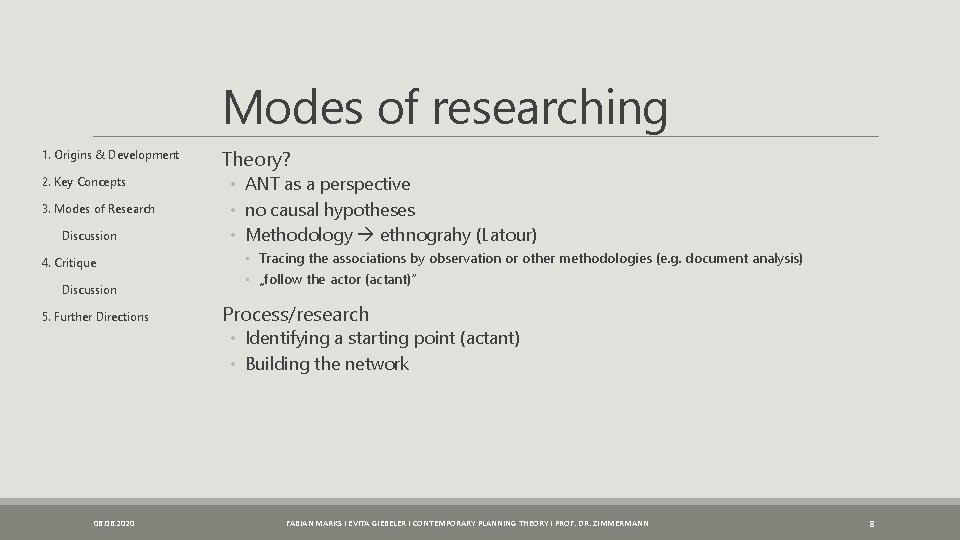
Modes of researching 1. Origins & Development 2. Key Concepts 3. Modes of Research Discussion 4. Critique Discussion 5. Further Directions Theory? • ANT as a perspective • no causal hypotheses • Methodology ethnograhy (Latour) • Tracing the associations by observation or other methodologies (e. g. document analysis) • „follow the actor (actant)“ Process/research • Identifying a starting point (actant) • Building the network 06. 2020 FABIAN MARKS I EVITA GIEBELER I CONTEMPORARY PLANNING THEORY I PROF. DR. ZIMMERMANN 8
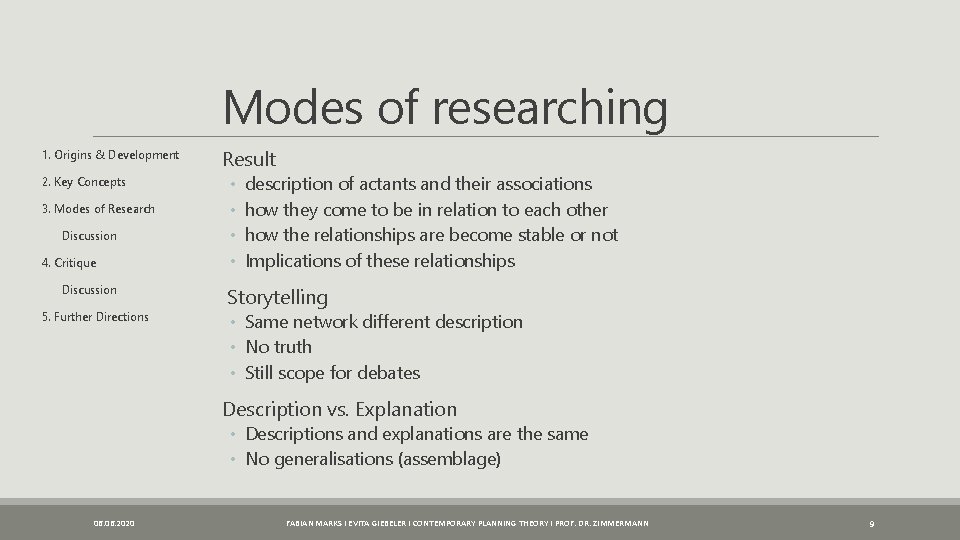
Modes of researching 1. Origins & Development 2. Key Concepts 3. Modes of Research Discussion 4. Critique Discussion 5. Further Directions Result • • description of actants and their associations how they come to be in relation to each other how the relationships are become stable or not Implications of these relationships Storytelling • Same network different description • No truth • Still scope for debates Description vs. Explanation • Descriptions and explanations are the same • No generalisations (assemblage) 06. 2020 FABIAN MARKS I EVITA GIEBELER I CONTEMPORARY PLANNING THEORY I PROF. DR. ZIMMERMANN 9
What examples can you think of? WHAT ACTANTS DO YOU START WITH? WHAT ACTANTS DO YOU FIND? WHAT ARE THE ASSOCIATIONS? …
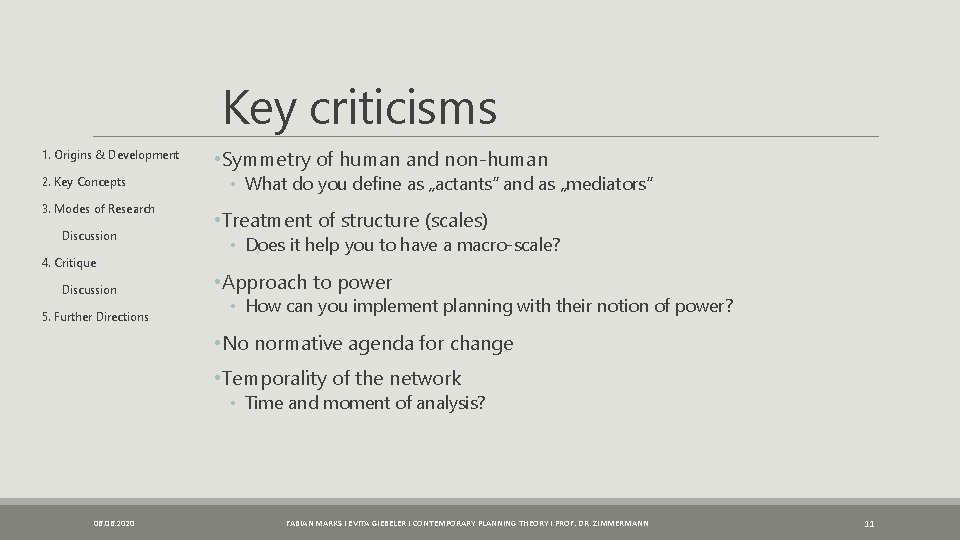
Key criticisms 1. Origins & Development 2. Key Concepts 3. Modes of Research Discussion 4. Critique Discussion 5. Further Directions • Symmetry of human and non-human • What do you define as „actants“ and as „mediators“ • Treatment of structure (scales) • Does it help you to have a macro-scale? • Approach to power • How can you implement planning with their notion of power? • No normative agenda for change • Temporality of the network • Time and moment of analysis? 06. 2020 FABIAN MARKS I EVITA GIEBELER I CONTEMPORARY PLANNING THEORY I PROF. DR. ZIMMERMANN 11
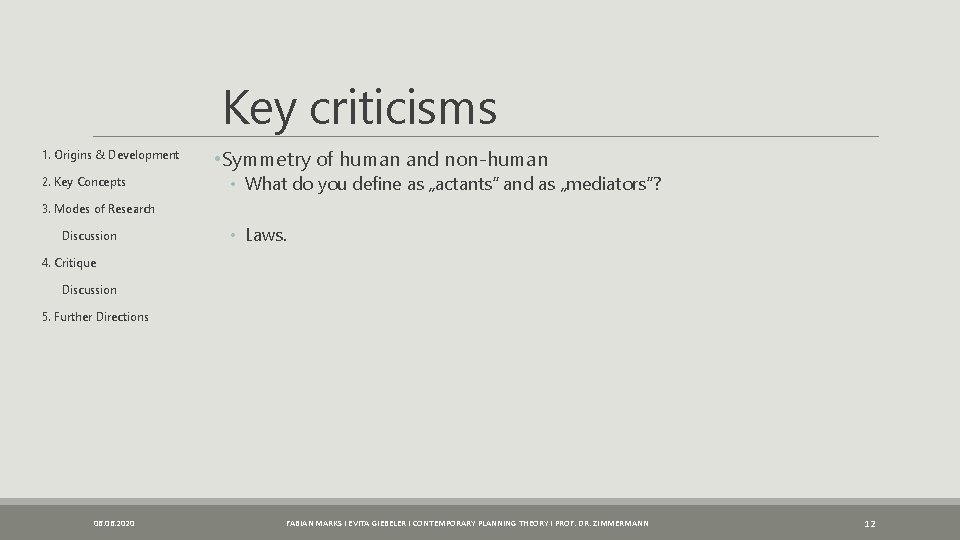
Key criticisms 1. Origins & Development 2. Key Concepts • Symmetry of human and non-human • What do you define as „actants“ and as „mediators“? 3. Modes of Research Discussion • Laws. 4. Critique Discussion 5. Further Directions 06. 2020 FABIAN MARKS I EVITA GIEBELER I CONTEMPORARY PLANNING THEORY I PROF. DR. ZIMMERMANN 12
Key criticisms 1. Origins & Development 2. Key Concepts • Treatment of structure (scales) • Does it help you to have a macro-scale? 3. Modes of Research Discussion 4. Critique • No hierarchy of scale Discussion 5. Further Directions 06. 2020 FABIAN MARKS I EVITA GIEBELER I CONTEMPORARY PLANNING THEORY I PROF. DR. ZIMMERMANN 13
Key criticisms 1. Origins & Development 2. Key Concepts • Approach to power • How can you implement planning with their notion of power? 3. Modes of Research Discussion 4. Critique Discussion 5. Further Directions 06. 2020 FABIAN MARKS I EVITA GIEBELER I CONTEMPORARY PLANNING THEORY I PROF. DR. ZIMMERMANN 14
Key criticisms 1. Origins & Development • No normative agenda for change 2. Key Concepts 3. Modes of Research Discussion 4. Critique Discussion 5. Further Directions 06. 2020 FABIAN MARKS I EVITA GIEBELER I CONTEMPORARY PLANNING THEORY I PROF. DR. ZIMMERMANN 15
Key criticisms 1. Origins & Development 2. Key Concepts • Temporality of the network • Time and moment of analysis? 3. Modes of Research Discussion 4. Critique Discussion 5. Further Directions 06. 2020 FABIAN MARKS I EVITA GIEBELER I CONTEMPORARY PLANNING THEORY I PROF. DR. ZIMMERMANN 16
„Like any theoretical perspective, it highlights some aspects and downplays or even ignores others. If those areas on which it shines a spotlight seem significant and even practically useful, then ANT has a role to play. “ (Rydin 2017) Would you use this Theory? 06. 2020 FABIAN MARKS I EVITA GIEBELER I CONTEMPORARY PLANNING THEORY I PROF. DR. ZIMMERMANN 17
Future Directions: • Analysis of current planning: ◦ Artefacts of planning: forms, files, models, plans –what is their role? ◦ Planning and Natural environment: how does the materiality shape the planning practice • Normative, even radical agenda of ANT ◦ Path dependency – identify and how they work and silences (thorugh blackboxing) ◦ „Specifying directed agency through procedural innovations“ learning how to understand ANT for better intervention by planners 06. 2020 FABIAN MARKS I EVITA GIEBELER I CONTEMPORARY PLANNING THEORY I PROF. DR. ZIMMERMANN 18
Thank you, for listening!