
ActivityBased Model Sensitivity Testing Showing the Models Sensitive
Activity-Based Model Sensitivity Testing – Showing the Model’s Sensitive Side Yijing Luadd (Baltimore Click to date Metropolitan Council) David Kurth (Cambridge Systematics) Charles Baber (Baltimore Metropolitan Council) Matt de Rouville (Baltimore Metropolitan Council) Thomas Rossi (Cambridge Systematics)
Model Region (2012) • • • 10 Jurisdictions (6 BMC/4 MWCOG) 2793 Traffic Analysis Zones (TAZ) 5+ Million Persons 2+ Million Households 3+ Million Jobs 13+ Million Daily Trips
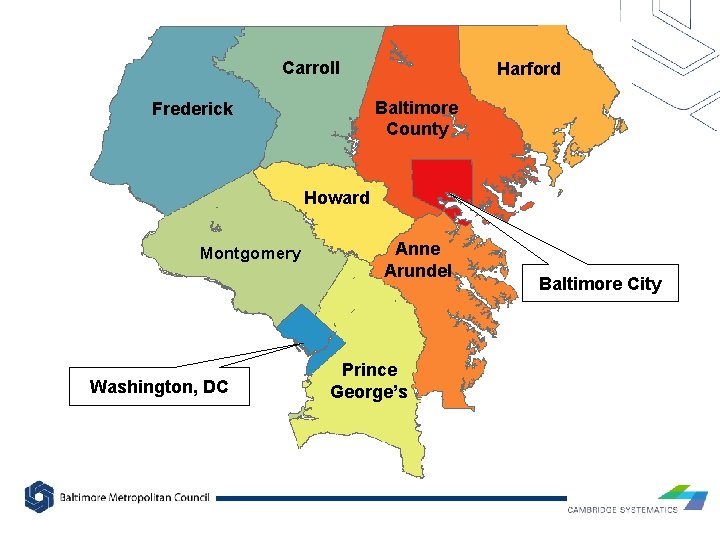
Carroll Harford Baltimore County Frederick Howard Montgomery Washington, DC Anne Arundel Prince George’s Baltimore City
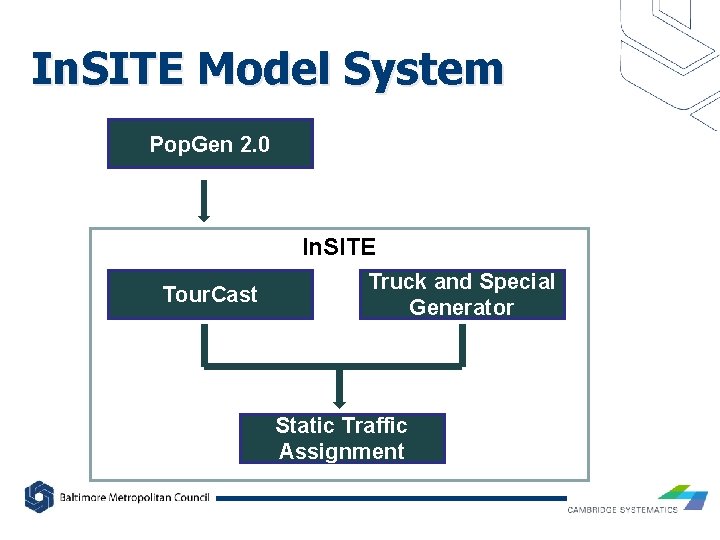
In. SITE Model System Pop. Gen 2. 0 In. SITE Tour. Cast Truck and Special Generator Static Traffic Assignment

Model Scenarios Synthetic Population Land Use Pattern Transportation Networks 2012 Base Year Base Aging Population Modified Base Brownfield Redevelopment Base Modified Base Freeway Capacity Increase Base Modified Scenario
Aging Population Scenario Changes from Base Scenario • 30 percent increase in: – 1 & 2 person households with at least one person in retirement age (65+) • Total population & households unchanged • Employment levels unchanged
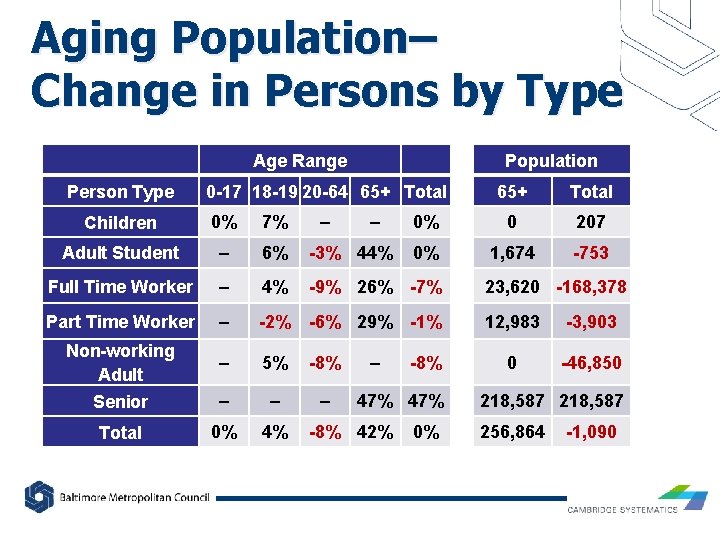
Aging Population– Change in Persons by Type Age Range Person Type Population 0 -17 18 -19 20 -64 65+ Total – – 65+ Total 0% 0 207 0% 1, 674 -753 Children 0% 7% Adult Student – 6% -3% 44% Full Time Worker – 4% -9% 26% -7% 23, 620 -168, 378 Part Time Worker – -2% -6% 29% -1% 12, 983 -3, 903 Non-working Adult – 5% -8% 0 -46, 850 Senior – – – Total 0% 4% – -8% 47% -8% 42% 0% 218, 587 256, 864 -1, 090
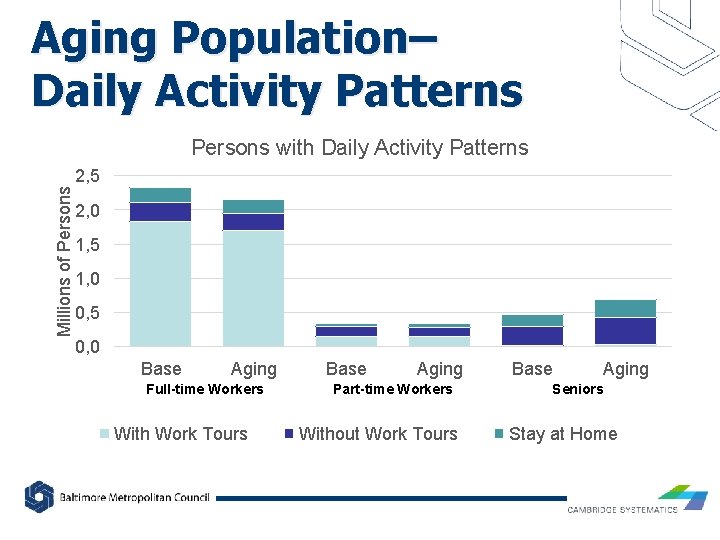
Aging Population– Daily Activity Patterns Millions of Persons with Daily Activity Patterns 2, 5 2, 0 1, 5 1, 0 0, 5 0, 0 Base Aging Full-time Workers With Work Tours Base Aging Part-time Workers Without Work Tours Base Aging Seniors Stay at Home
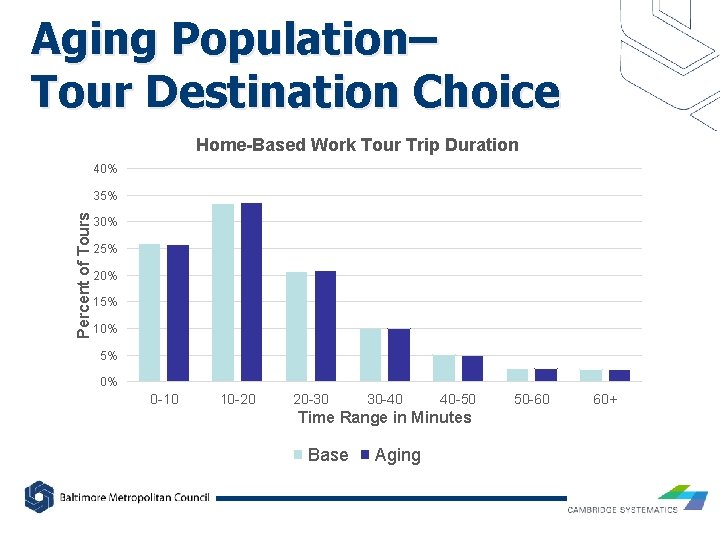
Aging Population– Tour Destination Choice Home-Based Work Tour Trip Duration 40% Percent of Tours 35% 30% 25% 20% 15% 10% 5% 0% 0 -10 10 -20 20 -30 30 -40 40 -50 Time Range in Minutes Base Aging 50 -60 60+
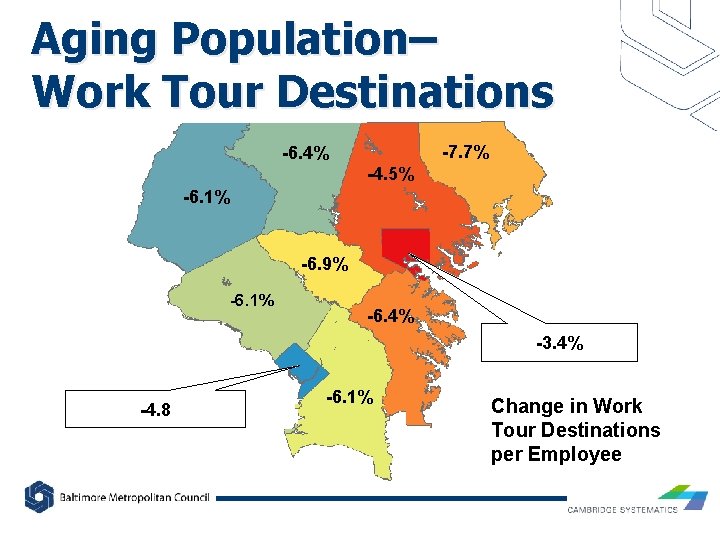
Aging Population– Work Tour Destinations -7. 7% -6. 4% -4. 5% -6. 1% -6. 9% -6. 1% -6. 4% -3. 4% -4. 8 -6. 1% Change in Work Tour Destinations per Employee
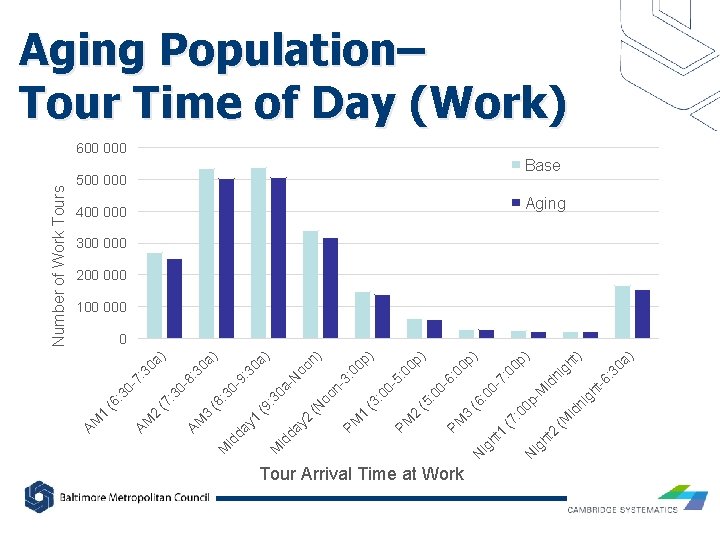
Tour Arrival Time at Work t 2 0 a ) : 3 t) 0 p ) : 0 ni gh id t-6 ig h id n (M -M (7 : 0 0 p 07 : 0 (6 400 000 ig h t 1 ig h 00 p) 6: (5 : 0 0 - 00 p) 5: ) 00 p ) oo n ) 500 000 N N 3 PM 2 PM (3 : 0 0 - n 3: oo (N a. N 30 9: 30 a (8 : 3 0 - 30 a) 8: (7 : 3 0 - 0 a ) 7: 3 0 - (6 (9 : 1 PM da y 2 id M da y 1 id M 3 AM 2 AM 1 AM Number of Work Tours Aging Population– Tour Time of Day (Work) 600 000 Base Aging 300 000 200 000 100 0
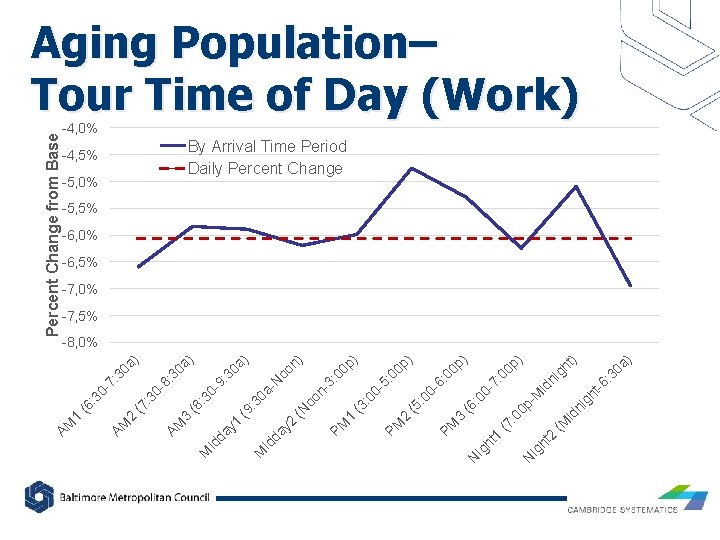
N t 2 t 1 ig h N 0 a ) : 3 ) gh t ni t-6 ig h id n (M id -M 0 p ) 7: 0 0 - (6 0 p ) 6: 0 0 p ) 5: 0 0 - (5 (7 : 0 0 p 3 PM 2 PM : 0 0 - p) n) 00 -3 : oo n (3 (N oo 0 a ) 9: 3 a. N 30 (9 : 1 PM da y 2 id M da y 1 : 3 0 - -5, 0% id (8 0 a ) ) 30 a 8: 3 0 - (7 07: (6 : 3 Percent Change from Base -4, 5% M 3 AM 2 AM 1 AM Aging Population– Tour Time of Day (Work) -4, 0% By Arrival Time Period Daily Percent Change -5, 5% -6, 0% -6, 5% -7, 0% -7, 5% -8, 0%
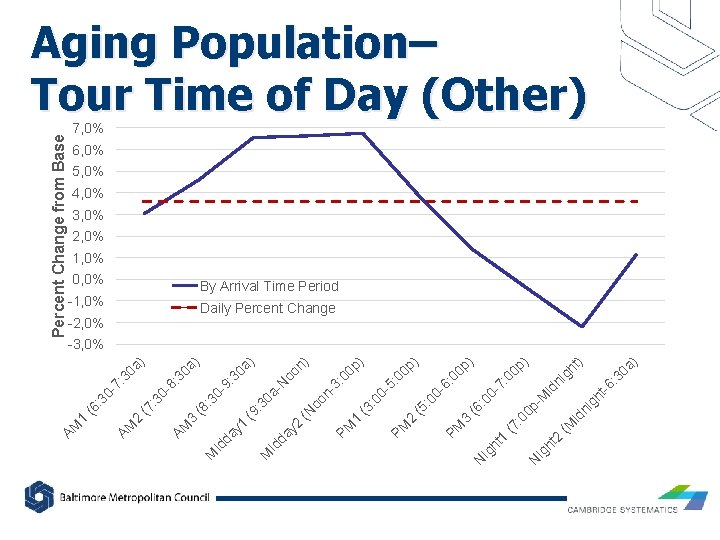
t 2 ig h t 1 ig h N N 0 a ) : 3 ) gh t ni t-6 ig h id n (M id -M 0 p ) 7: 0 0 - (6 0 p ) 00 p) 5: 6: 0 0 - (5 (7 : 0 0 p 3 PM 2 PM p) 00 -3 : oo n n) 0 a ) oo a. N 30 (3 : 0 0 - (N 1 PM da y 2 id M (9 : 9: 3 -2, 0% da y 1 : 3 0 - -1, 0% id (8 ) 0 a ) 8: 3 0 - (7 7: 30 a (6 : 3 0 - Percent Change from Base 0, 0% M 3 AM 2 AM 1 AM Aging Population– Tour Time of Day (Other) 7, 0% 6, 0% 5, 0% 4, 0% 3, 0% 2, 0% 1, 0% By Arrival Time Period Daily Percent Change -3, 0%
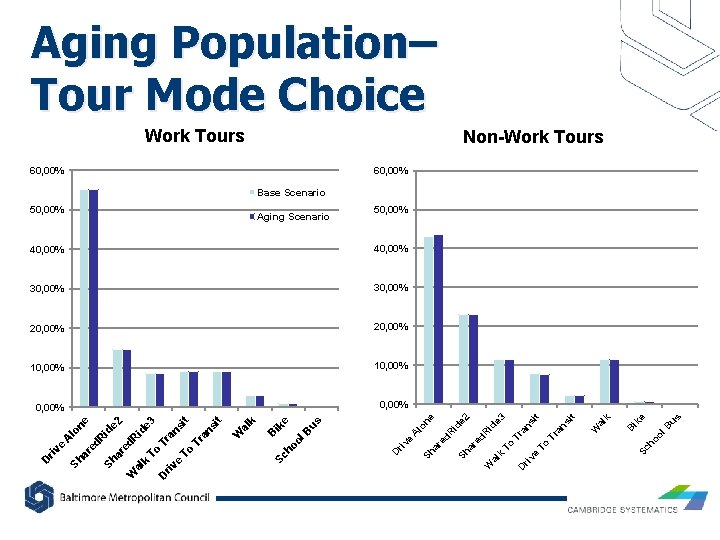
Aging Population– Tour Mode Choice Work Tours Non-Work Tours 60, 00% Base Scenario B us ik e ol ho al k B Sc e riv D W t si Tr an To Tr an si t e 3 To R id ed R id al k D riv e A lo us ol B ik ho k al W B Sc To Tr an si an s riv e D W al k To Tr id e 2 ed R id Sh ar ed R ar e A Sh riv D ed 0, 00% W 0, 00% ar 10, 00% Sh 10, 00% ne 20, 00% t 30, 00% it 30, 00% e 3 40, 00% lo ne 40, 00% e 2 50, 00% ar Aging Scenario Sh 50, 00%
Brownfield Redevelopment Scenario Changes from Base Scenario • Move from BMC suburban areas to brownfield area : – 13, 700 employees – 4, 700 households – 12, 000 residents • “Simple” TAZ moves – Pop. Gen 2 not rerun
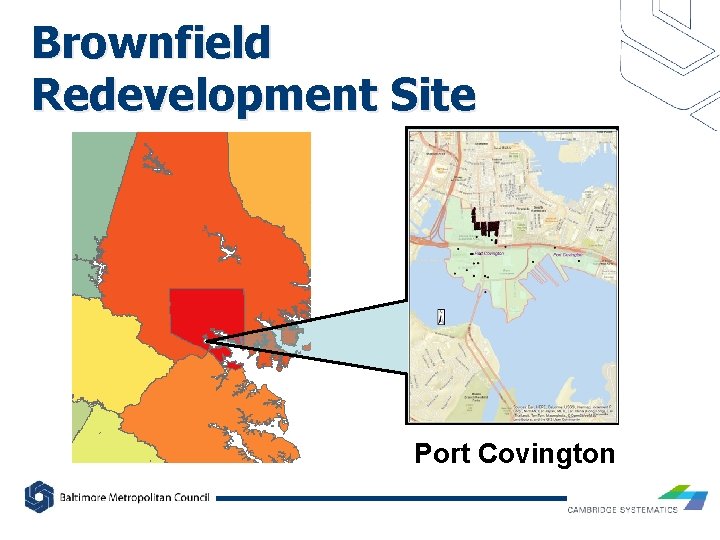
Brownfield Redevelopment Site Port Covington
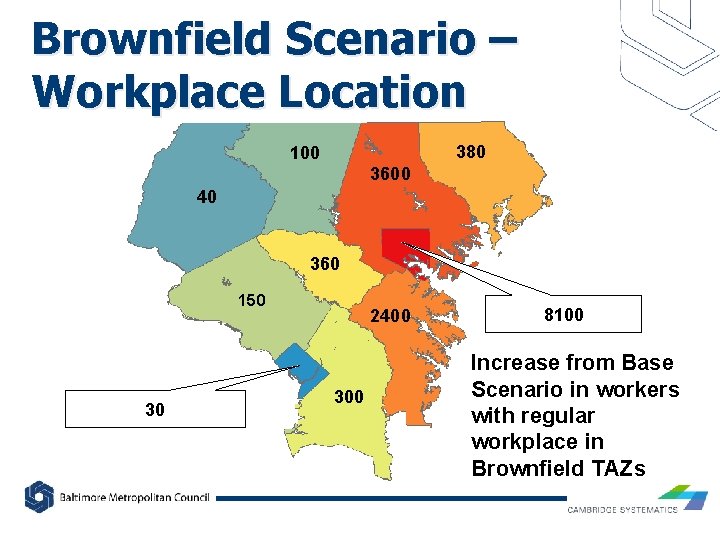
Brownfield Scenario – Workplace Location 380 100 3600 40 360 150 30 2400 300 8100 Increase from Base Scenario in workers with regular workplace in Brownfield TAZs
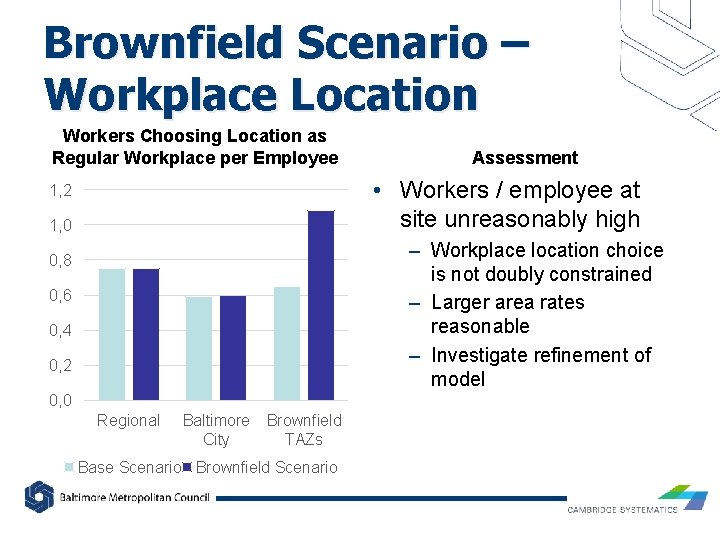
Brownfield Scenario – Workplace Location Workers Choosing Location as Regular Workplace per Employee Assessment • Workers / employee at site unreasonably high 1, 2 1, 0 – Workplace location choice is not doubly constrained – Larger area rates reasonable – Investigate refinement of model 0, 8 0, 6 0, 4 0, 2 0, 0 Regional Baltimore City Brownfield TAZs Base Scenario Brownfield Scenario
Brownfield Scenario Impacts on Other Results • Very little regionwide impact on other models in comparison to Base Scenario • Localized impacts: – Increase in transit ridership – Decrease in roadway levels of service
Freeway Capacity Increase Scenario Changes from Base Scenario • Increase per lane capacity by 10 percent on Baltimore Beltway between Harrisburg Expressway and I-95 • No changes to population and employment data
Freeway Capacity Increase Scenario Impacts Changes from Base Scenario • No noticeable impact on: – – Workplace location choice Tour destination choice Tour time-of-day choice Transit assignment • Minimal impact on: – Tour mode choice for auto modes ¦ ¦ No discernable patterns Result of “random noise” from static equilibrium assignment?
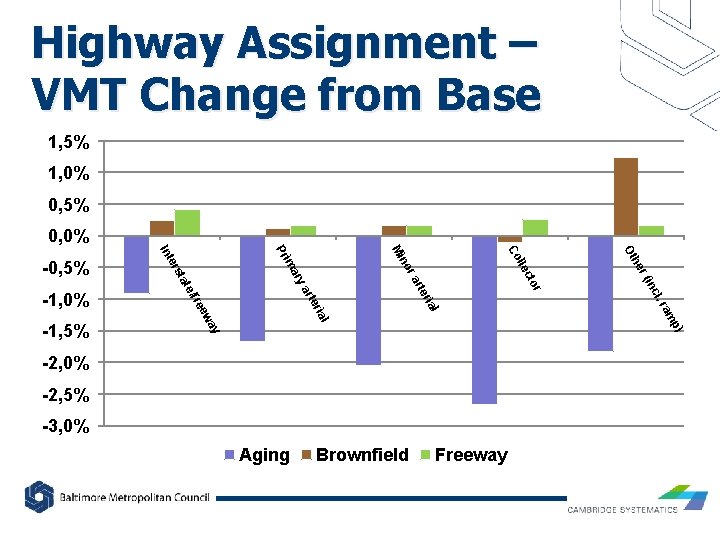
Highway Assignment – VMT Change from Base 1, 5% 1, 0% 0, 5% 0, 0% r he Ot cl. tor (in ec mp ra l ria rte ) ay ew l ria fre rte te/ ya ra ar no ll Co Mi im Pr sta -1, 5% er -1, 0% Int -0, 5% -2, 0% -2, 5% -3, 0% Aging Brownfield Freeway
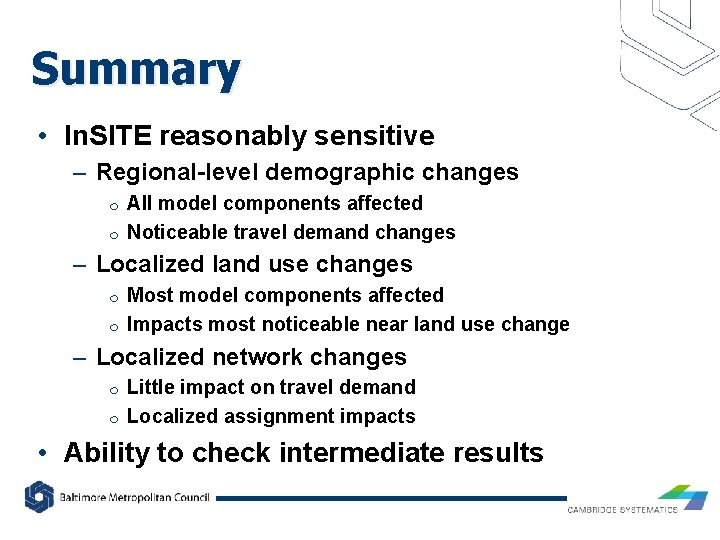
Summary • In. SITE reasonably sensitive – Regional-level demographic changes ¦ ¦ All model components affected Noticeable travel demand changes – Localized land use changes ¦ ¦ Most model components affected Impacts most noticeable near land use change – Localized network changes ¦ ¦ Little impact on travel demand Localized assignment impacts • Ability to check intermediate results

For More Information Yijing Lu: ylu@baltometro. org Charles Baber: cbaber@baltometro. org David Kurth: dkurth@camsys. com Thomas Rossi: trossi@camsys. com
- Slides: 24