
ACTIVITYBASED COSTING CHAPTER 4 2014 Cengage Learning All
ACTIVITY-BASED COSTING CHAPTER 4 © 2014 Cengage Learning. All Rights Reserved. May not be copied, scanned, or duplicated, in whole or in part, except for use as permitted in a license distributed with a certain product or service or otherwise on a password-protected website for classroom use.
CHAPTER 4 OBJECTIVES 1. Describe the basics of plantwide and departmental overhead costing 2. Explain why plantwide and departmental overhead costing may not be accurate 3. Provide a detailed description of activity-based product costing 4. Explain how ABC can be simplified © 2014 Cengage Learning. All Rights Reserved. May not be copied, scanned, or duplicated, in whole or in part, except for use as permitted in a license distributed with a certain product or service or otherwise on a password-protected website for classroom use.
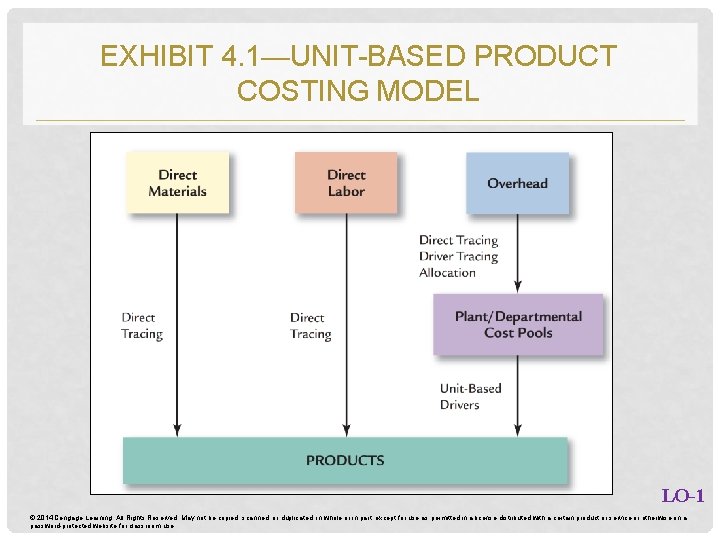
EXHIBIT 4. 1—UNIT-BASED PRODUCT COSTING MODEL LO-1 © 2014 Cengage Learning. All Rights Reserved. May not be copied, scanned, or duplicated, in whole or in part, except for use as permitted in a license distributed with a certain product or service or otherwise on a password-protected website for classroom use.
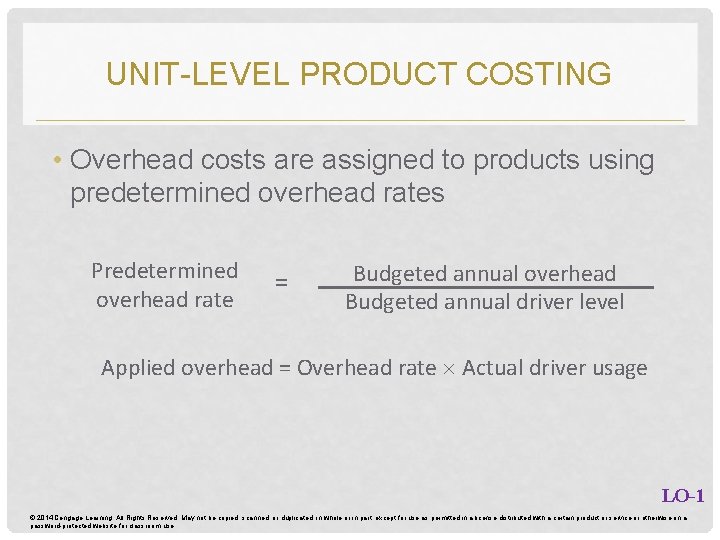
UNIT-LEVEL PRODUCT COSTING • Overhead costs are assigned to products using predetermined overhead rates Predetermined overhead rate = Budgeted annual overhead Budgeted annual driver level Applied overhead = Overhead rate Actual driver usage LO-1 © 2014 Cengage Learning. All Rights Reserved. May not be copied, scanned, or duplicated, in whole or in part, except for use as permitted in a license distributed with a certain product or service or otherwise on a password-protected website for classroom use.
UNIT-LEVEL PRODUCT COSTING • Unit level drivers: factors that measure the demands placed on unit-level activities by products • Unit level activities: activities performed each and every time a unit of a product is produced • Five most commonly used unit level drivers • • • Units produced Direct labor hours Direct labor dollars Machine hours Direct material dollars LO-1 © 2014 Cengage Learning. All Rights Reserved. May not be copied, scanned, or duplicated, in whole or in part, except for use as permitted in a license distributed with a certain product or service or otherwise on a password-protected website for classroom use.
UNIT-LEVEL PRODUCT COSTING Overhead Variances • The difference between actual overhead and applied overhead • If actual overhead > applied overhead: underapplied overhead • If actual overhead < applied overhead: overapplied overhead LO-1 © 2014 Cengage Learning. All Rights Reserved. May not be copied, scanned, or duplicated, in whole or in part, except for use as permitted in a license distributed with a certain product or service or otherwise on a password-protected website for classroom use.
UNIT-LEVEL PRODUCT COSTING Overhead Variances Disposal of Variance • If immaterial, assign to cost of goods sold • If material, allocate among work-in-process inventory, finished goods inventory, and cost of goods sold LO-1 © 2014 Cengage Learning. All Rights Reserved. May not be copied, scanned, or duplicated, in whole or in part, except for use as permitted in a license distributed with a certain product or service or otherwise on a password-protected website for classroom use.
UNIT-LEVEL PRODUCT COSTING Overhead Application: Departmental Rates • Costs assigned to individual production department, creating departmental overhead cost pools • Unit level drivers are used to compute predetermined overhead rates for each department • Overhead is assigned to products by multiplying the departmental rates by the amount of the driver used in the respective departments LO-1 © 2014 Cengage Learning. All Rights Reserved. May not be copied, scanned, or duplicated, in whole or in part, except for use as permitted in a license distributed with a certain product or service or otherwise on a password-protected website for classroom use.
LIMITATIONS OF PLANTWIDE AND DEPARTMENTAL RATES Non-Unit-Related Overhead Costs • Plantwide and department rates assume that a product’s consumption of overhead is directly related to units produced • Some costs, however, such as setups cost a certain amount no matter how many products are produced • Other costs, such as engineering hours, may depend on something entirely different, such as work orders, not units • Non-unit-based drivers are factors, other than the number of units produced, that measure the demands that cost objects place on activities LO-2 © 2014 Cengage Learning. All Rights Reserved. May not be copied, scanned, or duplicated, in whole or in part, except for use as permitted in a license distributed with a certain product or service or otherwise on a password-protected website for classroom use.
LIMITATIONS OF PLANTWIDE AND DEPARTMENTAL RATES Product Diversity • Even if there are significant non-unit driven overhead costs, it will not cause distorted costing if the products all consume overhead in the same proportion as unit-level driven overhead costs LO-2 © 2014 Cengage Learning. All Rights Reserved. May not be copied, scanned, or duplicated, in whole or in part, except for use as permitted in a license distributed with a certain product or service or otherwise on a password-protected website for classroom use.
LIMITATIONS OF PLANTWIDE AND DEPARTMENTAL RATES Product Diversity • Products consume overhead activities in different proportions • Caused by differences in product size, complexity, setup time, batch size, etc. • The proportion of each activity consumed by a product is called the consumption ratio LO-2 © 2014 Cengage Learning. All Rights Reserved. May not be copied, scanned, or duplicated, in whole or in part, except for use as permitted in a license distributed with a certain product or service or otherwise on a password-protected website for classroom use.
LIMITATIONS OF PLANTWIDE AND DEPARTMENTAL RATES • Two producing departments: molding and Assembly • Two products: race cars and robots • Five times more race cars than robots are produced making race cars a high-volume product and robots a low-volume product • The molds for robots are larger and more varied than those for race cars • Four types of overhead activities are performed: setups, machining, inspection, and moving batches LO-2 © 2014 Cengage Learning. All Rights Reserved. May not be copied, scanned, or duplicated, in whole or in part, except for use as permitted in a license distributed with a certain product or service or otherwise on a password-protected website for classroom use.
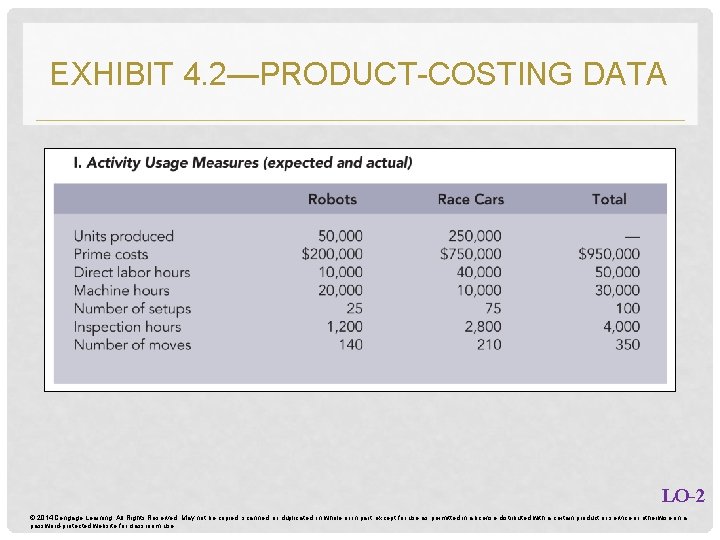
EXHIBIT 4. 2—PRODUCT-COSTING DATA LO-2 © 2014 Cengage Learning. All Rights Reserved. May not be copied, scanned, or duplicated, in whole or in part, except for use as permitted in a license distributed with a certain product or service or otherwise on a password-protected website for classroom use.
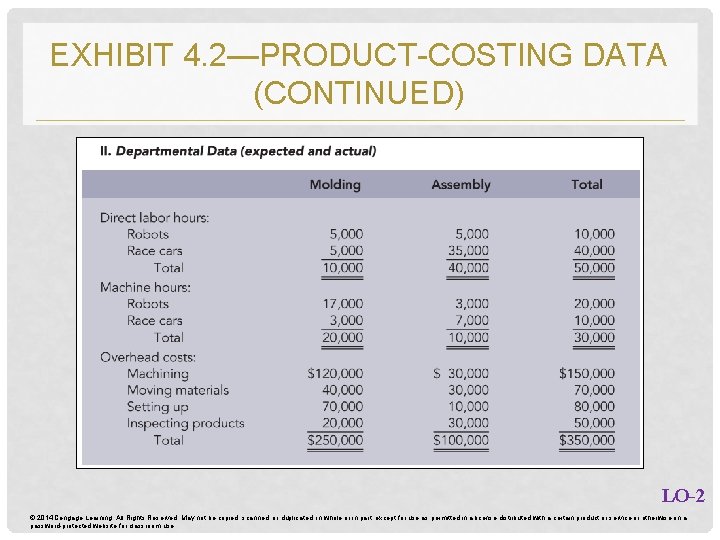
EXHIBIT 4. 2—PRODUCT-COSTING DATA (CONTINUED) LO-2 © 2014 Cengage Learning. All Rights Reserved. May not be copied, scanned, or duplicated, in whole or in part, except for use as permitted in a license distributed with a certain product or service or otherwise on a password-protected website for classroom use.
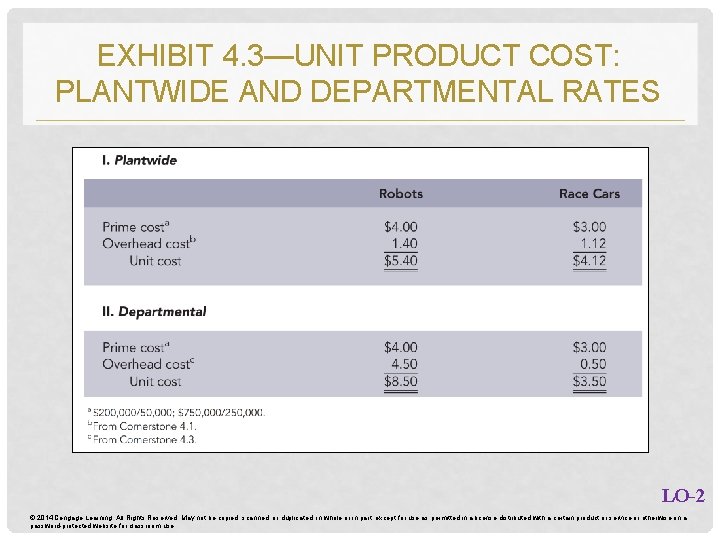
EXHIBIT 4. 3—UNIT PRODUCT COST: PLANTWIDE AND DEPARTMENTAL RATES LO-2 © 2014 Cengage Learning. All Rights Reserved. May not be copied, scanned, or duplicated, in whole or in part, except for use as permitted in a license distributed with a certain product or service or otherwise on a password-protected website for classroom use.
LIMITATIONS OF PLANTWIDE AND DEPARTMENTAL RATES Problems with Costing Accuracy • The main problem with using either plantwide or departmental rates is the assumption that machine hours and/or direct labor hours drive or cause all overhead costs • Race cars, the high-volume product, use four times the direct labor hours used by robots, the low-volume product • If a plantwide rate is used, the race cars will receive four times more overhead cost than will the robots • This might not be reasonable LO-2 © 2014 Cengage Learning. All Rights Reserved. May not be copied, scanned, or duplicated, in whole or in part, except for use as permitted in a license distributed with a certain product or service or otherwise on a password-protected website for classroom use.
LIMITATIONS OF PLANTWIDE AND DEPARTMENTAL RATES • The data in Exhibit 4. 2 suggest that a significant portion of overhead costs is not driven or caused by the units produced • The high-volume product, race cars, uses three times the number of setups of robots, about 2. 33 times as many inspection hours, and only one and one-half times as many moves • Use of direct labor hours, a unit-based activity driver, and a plantwide rate assigns four times more overhead costs to the race cars than to the robots LO-2 © 2014 Cengage Learning. All Rights Reserved. May not be copied, scanned, or duplicated, in whole or in part, except for use as permitted in a license distributed with a certain product or service or otherwise on a password-protected website for classroom use.
LIMITATIONS OF PLANTWIDE AND DEPARTMENTAL RATES Activity Rates: A Better Approach • Instead of using a single pool or department pools based on units, expand the number of pools and rates and base them on activities • The rates are based on causal factors that measure consumption – both unit and non-unit level activity drivers • Costs are assigned to each product by multiplying the activity rates by the amount consumed by each activity LO-2 © 2014 Cengage Learning. All Rights Reserved. May not be copied, scanned, or duplicated, in whole or in part, except for use as permitted in a license distributed with a certain product or service or otherwise on a password-protected website for classroom use.
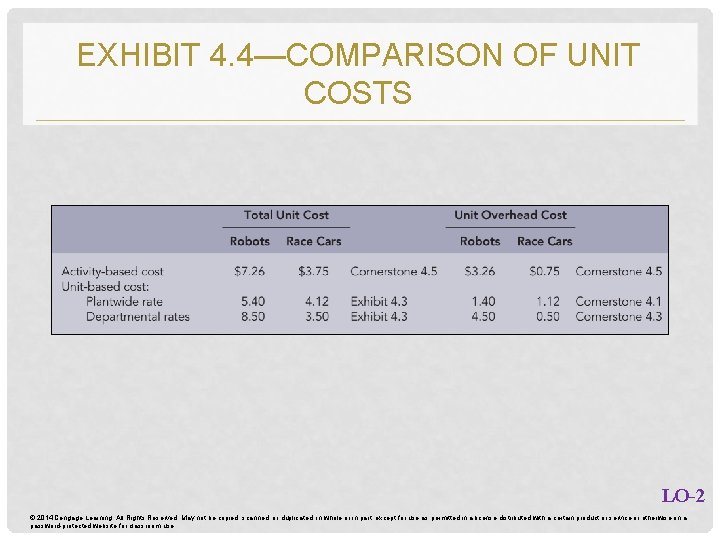
EXHIBIT 4. 4—COMPARISON OF UNIT COSTS LO-2 © 2014 Cengage Learning. All Rights Reserved. May not be copied, scanned, or duplicated, in whole or in part, except for use as permitted in a license distributed with a certain product or service or otherwise on a password-protected website for classroom use.
LIMITATIONS OF PLANTWIDE AND DEPARTMENTAL RATES • The activity-based cost assignment follows a cause-and-effect pattern of overhead consumption and is therefore the most accurate of the three costs • In the presence of significant non-unit overhead costs and product diversity, using only unitbased activity drivers can lead to one product subsidizing another LO-2 © 2014 Cengage Learning. All Rights Reserved. May not be copied, scanned, or duplicated, in whole or in part, except for use as permitted in a license distributed with a certain product or service or otherwise on a password-protected website for classroom use.
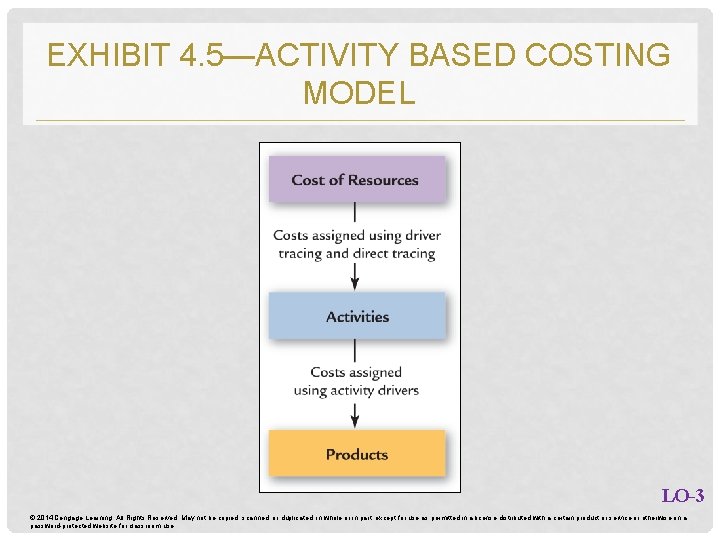
EXHIBIT 4. 5—ACTIVITY BASED COSTING MODEL LO-3 © 2014 Cengage Learning. All Rights Reserved. May not be copied, scanned, or duplicated, in whole or in part, except for use as permitted in a license distributed with a certain product or service or otherwise on a password-protected website for classroom use.
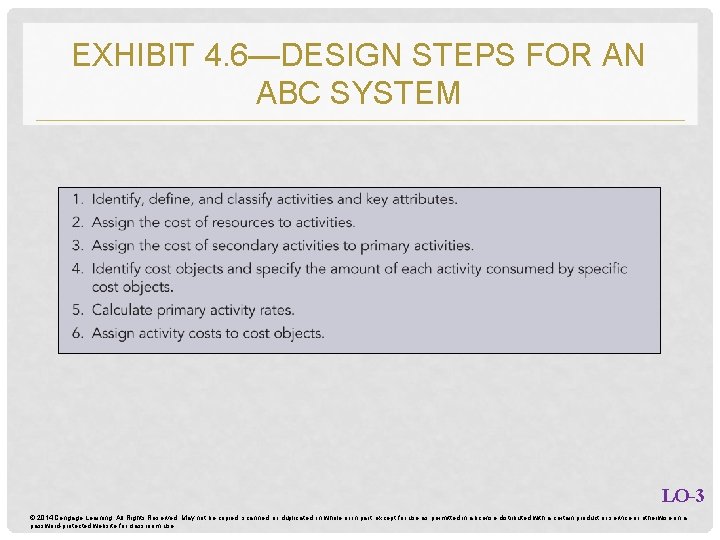
EXHIBIT 4. 6—DESIGN STEPS FOR AN ABC SYSTEM LO-3 © 2014 Cengage Learning. All Rights Reserved. May not be copied, scanned, or duplicated, in whole or in part, except for use as permitted in a license distributed with a certain product or service or otherwise on a password-protected website for classroom use.
ACTIVITY-BASED COSTING SYSTEM 1. Identify, define, and classify activities and key attributes • Activity inventory: a simple list of activities identified • Activity attributes: nonfinancial and financial information items that describe individual activities • Activity dictionary: lists the activities in an organization along with desired attributes • Primary activity: consumed by the final cost object • Secondary activity: consumed by intermediate cost objects • Interviews, questionnaires, surveys, and observation are means of gathering data for an ABC system LO-3 © 2014 Cengage Learning. All Rights Reserved. May not be copied, scanned, or duplicated, in whole or in part, except for use as permitted in a license distributed with a certain product or service or otherwise on a password-protected website for classroom use.
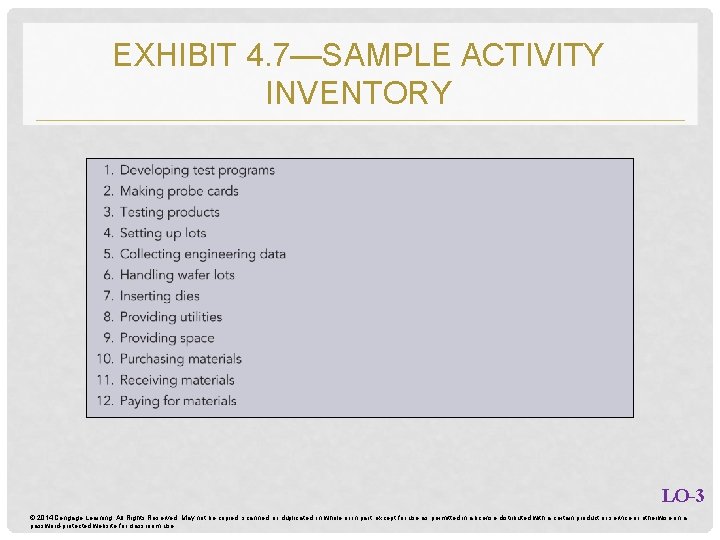
EXHIBIT 4. 7—SAMPLE ACTIVITY INVENTORY LO-3 © 2014 Cengage Learning. All Rights Reserved. May not be copied, scanned, or duplicated, in whole or in part, except for use as permitted in a license distributed with a certain product or service or otherwise on a password-protected website for classroom use.
ACTIVITY-BASED COSTING SYSTEM 2. Assign the cost of resources to activities • The cost of an activity is the resources consumed by that activity • If a resource is exclusive to an activity, assign 100% of the cost to the activity • If the resource is split between more than one activity, determine a resource driver • Resource drivers are factors that measure the consumption of resources by activities LO-3 © 2014 Cengage Learning. All Rights Reserved. May not be copied, scanned, or duplicated, in whole or in part, except for use as permitted in a license distributed with a certain product or service or otherwise on a password-protected website for classroom use.
ACTIVITY-BASED COSTING SYSTEM 3. Assign the cost of secondary activities to primary activities • Treat the secondary activity like a resource from the previous step LO-3 © 2014 Cengage Learning. All Rights Reserved. May not be copied, scanned, or duplicated, in whole or in part, except for use as permitted in a license distributed with a certain product or service or otherwise on a password-protected website for classroom use.
ACTIVITY-BASED COSTING SYSTEM 4. Identify cost objects and specify the amount of each activity consumed by them • Assign costs consumed by more than one activity in proportion to their usage of the activity as measured by the activity driver • Transaction drivers measure the number of times an activity is performed • Duration drivers measure the demands in terms of the amount of time it takes to perform an activity LO-3 © 2014 Cengage Learning. All Rights Reserved. May not be copied, scanned, or duplicated, in whole or in part, except for use as permitted in a license distributed with a certain product or service or otherwise on a password-protected website for classroom use.
ACTIVITY-BASED COSTING SYSTEM • A bill of activities specifies the product, expected product quantity, activities, and amount of each activity expected to be consumed by each product LO-3 © 2014 Cengage Learning. All Rights Reserved. May not be copied, scanned, or duplicated, in whole or in part, except for use as permitted in a license distributed with a certain product or service or otherwise on a password-protected website for classroom use.
ACTIVITY-BASED COSTING SYSTEM 5. Calculate primary activity rates • Primary activity rates are computed by dividing budgeted activity costs by practical activity capacity • Practical activity capacity is the activity output that can be produced when the activity is performed efficiently LO-3 © 2014 Cengage Learning. All Rights Reserved. May not be copied, scanned, or duplicated, in whole or in part, except for use as permitted in a license distributed with a certain product or service or otherwise on a password-protected website for classroom use.
ACTIVITY-BASED COSTING SYSTEM 6. Assign activity costs to cost objects • Multiply the activity rate by the actual number of activity drivers consumed. LO-3 © 2014 Cengage Learning. All Rights Reserved. May not be copied, scanned, or duplicated, in whole or in part, except for use as permitted in a license distributed with a certain product or service or otherwise on a password-protected website for classroom use.
ACTIVITY-BASED COSTING SYSTEM • Classifying activities into categories aids in product costing because the cost behavior differs by level • • Unit-level Batch-level Product-level Facility-level LO-3 © 2014 Cengage Learning. All Rights Reserved. May not be copied, scanned, or duplicated, in whole or in part, except for use as permitted in a license distributed with a certain product or service or otherwise on a password-protected website for classroom use.
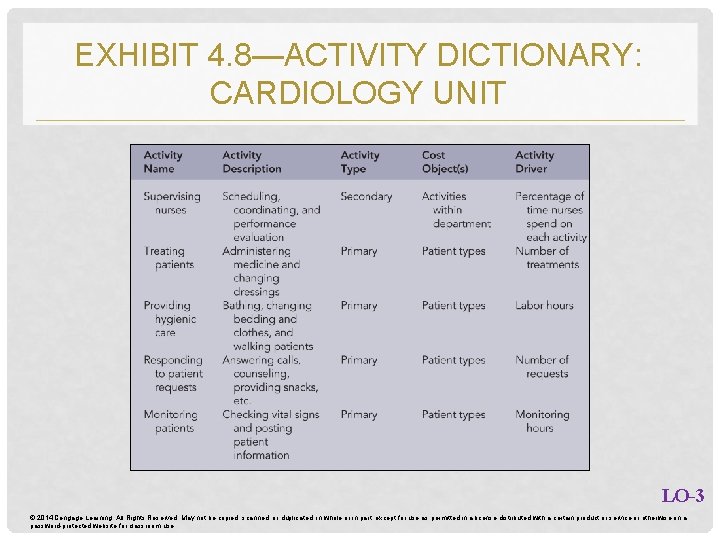
EXHIBIT 4. 8—ACTIVITY DICTIONARY: CARDIOLOGY UNIT LO-3 © 2014 Cengage Learning. All Rights Reserved. May not be copied, scanned, or duplicated, in whole or in part, except for use as permitted in a license distributed with a certain product or service or otherwise on a password-protected website for classroom use.
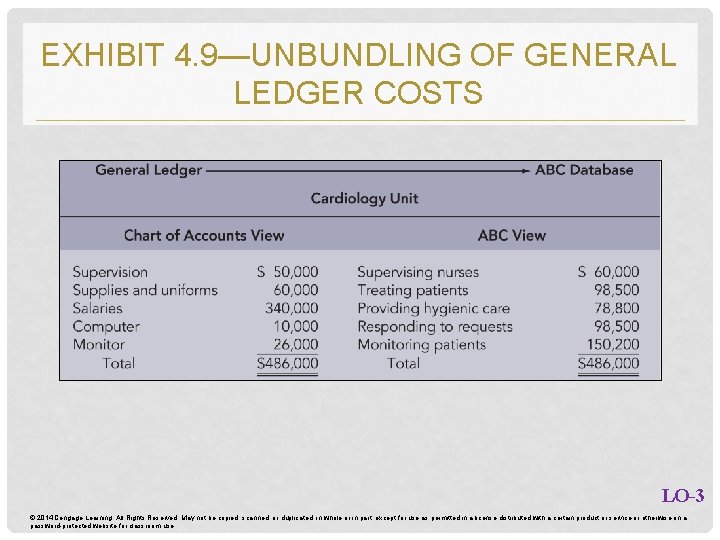
EXHIBIT 4. 9—UNBUNDLING OF GENERAL LEDGER COSTS LO-3 © 2014 Cengage Learning. All Rights Reserved. May not be copied, scanned, or duplicated, in whole or in part, except for use as permitted in a license distributed with a certain product or service or otherwise on a password-protected website for classroom use.
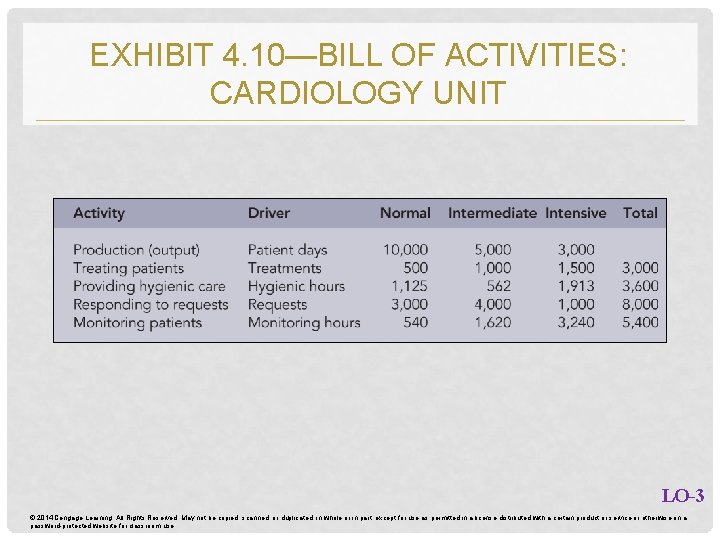
EXHIBIT 4. 10—BILL OF ACTIVITIES: CARDIOLOGY UNIT LO-3 © 2014 Cengage Learning. All Rights Reserved. May not be copied, scanned, or duplicated, in whole or in part, except for use as permitted in a license distributed with a certain product or service or otherwise on a password-protected website for classroom use.
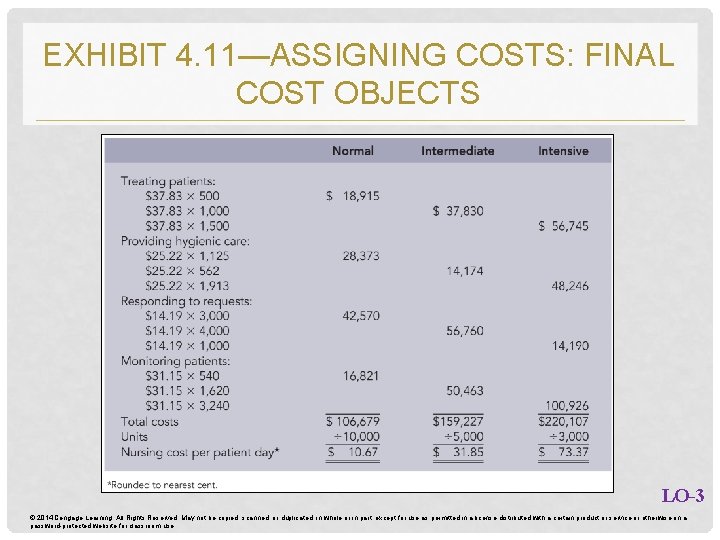
EXHIBIT 4. 11—ASSIGNING COSTS: FINAL COST OBJECTS LO-3 © 2014 Cengage Learning. All Rights Reserved. May not be copied, scanned, or duplicated, in whole or in part, except for use as permitted in a license distributed with a certain product or service or otherwise on a password-protected website for classroom use.
REDUCING THE SIZE AND COMPLEXITY OF AN ABC SYSTEM Before-the-Fact Simplification: TDABC • A before-the-fact simplification method, eliminates the need to identify resource drivers, eliminating the need for much of the detailed implementation interviews LO-4 © 2014 Cengage Learning. All Rights Reserved. May not be copied, scanned, or duplicated, in whole or in part, except for use as permitted in a license distributed with a certain product or service or otherwise on a password-protected website for classroom use.
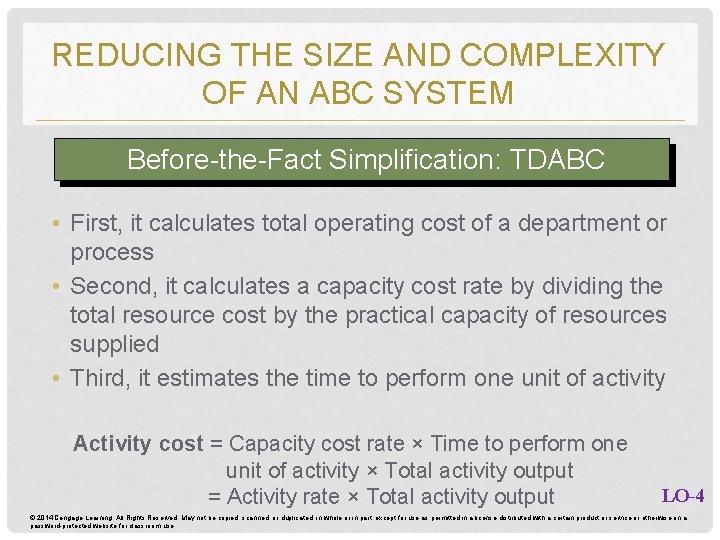
REDUCING THE SIZE AND COMPLEXITY OF AN ABC SYSTEM Before-the-Fact Simplification: TDABC • First, it calculates total operating cost of a department or process • Second, it calculates a capacity cost rate by dividing the total resource cost by the practical capacity of resources supplied • Third, it estimates the time to perform one unit of activity Activity cost = Capacity cost rate × Time to perform one unit of activity × Total activity output = Activity rate × Total activity output LO-4 © 2014 Cengage Learning. All Rights Reserved. May not be copied, scanned, or duplicated, in whole or in part, except for use as permitted in a license distributed with a certain product or service or otherwise on a password-protected website for classroom use.
REDUCING THE SIZE AND COMPLEXITY OF AN ABC SYSTEM After-the-Fact Simplification: TDABC • Approximately Relevant ABC Systems • Calculate the cost of your activities • Combine the less expensive activity costs into the more expensive activity costs making fewer categories • Equally Accurate Reduced ABC Systems • Use expected consumption ratios to reduce the number of drivers LO-4 © 2014 Cengage Learning. All Rights Reserved. May not be copied, scanned, or duplicated, in whole or in part, except for use as permitted in a license distributed with a certain product or service or otherwise on a password-protected website for classroom use.
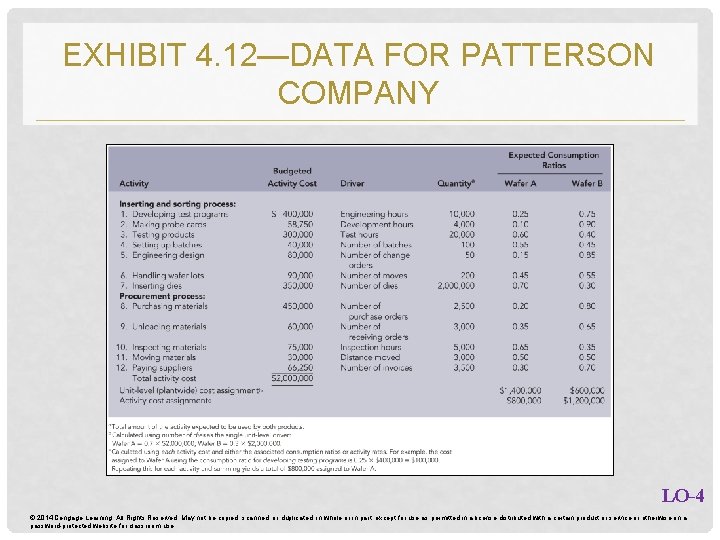
EXHIBIT 4. 12—DATA FOR PATTERSON COMPANY LO-4 © 2014 Cengage Learning. All Rights Reserved. May not be copied, scanned, or duplicated, in whole or in part, except for use as permitted in a license distributed with a certain product or service or otherwise on a password-protected website for classroom use.

END OF CHAPTER 4 © 2014 Cengage Learning. All Rights Reserved. May not be copied, scanned, or duplicated, in whole or in part, except for use as permitted in a license distributed with a certain product or service or otherwise on a password-protected website for classroom use.
- Slides: 40