
ActivityBased Costing and Other Cost Management Tools Chapter
Activity-Based Costing and Other Cost Management Tools Chapter 17
Learning Objective 1 Develop activity-based costs (ABC)
Activity-Based Costing Refines the way indirect costs are allocated to production Focuses on costs incurred by each production activity Each activity has its own cost driver Copyright (c) 2009 Prentice Hall. All rights reserved. 3
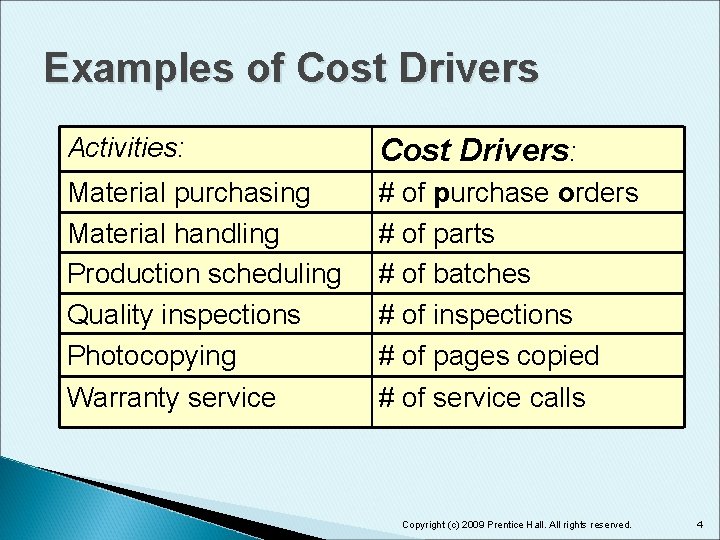
Examples of Cost Drivers Activities: Cost Drivers: Material purchasing Material handling Production scheduling Quality inspections Photocopying # of purchase orders # of parts # of batches # of inspections # of pages copied Warranty service # of service calls Copyright (c) 2009 Prentice Hall. All rights reserved. 4
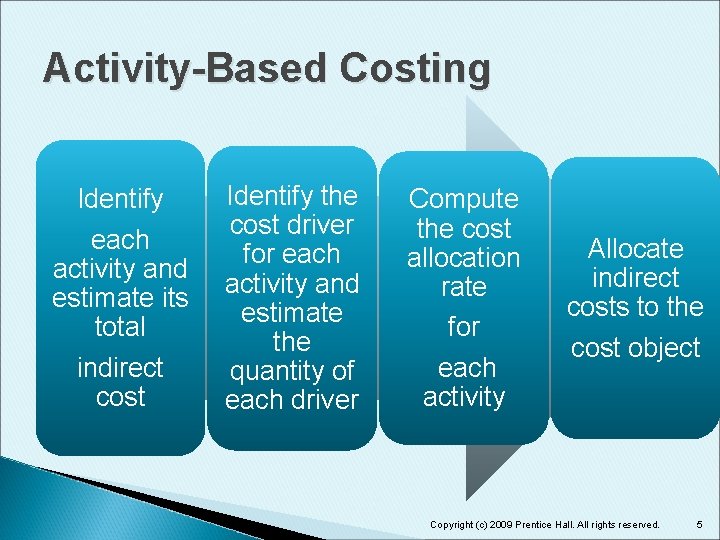
Activity-Based Costing Identify each activity and estimate its total indirect cost Identify the cost driver for each activity and estimate the quantity of each driver Compute the cost allocation rate for each activity Allocate indirect costs to the cost object Copyright (c) 2009 Prentice Hall. All rights reserved. 5

Cost Allocation Rate Cost allocation rate Estimated total indirect cost Estimated total quantity of the allocation base Copyright (c) 2009 Prentice Hall. All rights reserved. 6
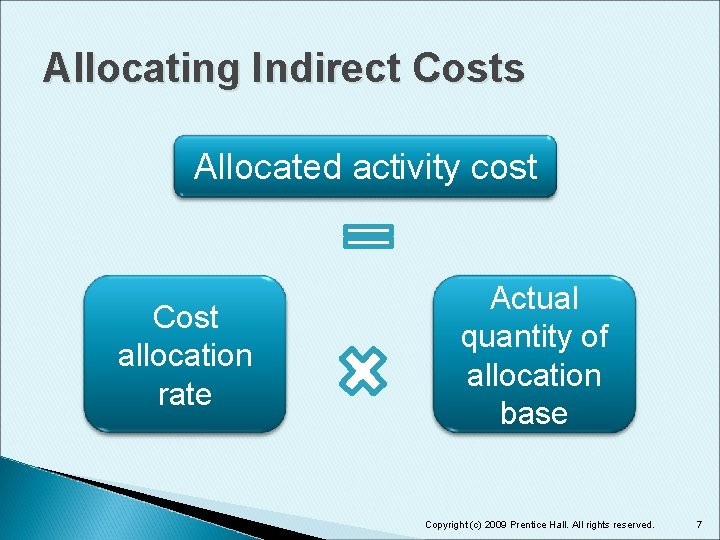
Allocating Indirect Costs Allocated activity cost Cost allocation rate Actual quantity of allocation base Copyright (c) 2009 Prentice Hall. All rights reserved. 7
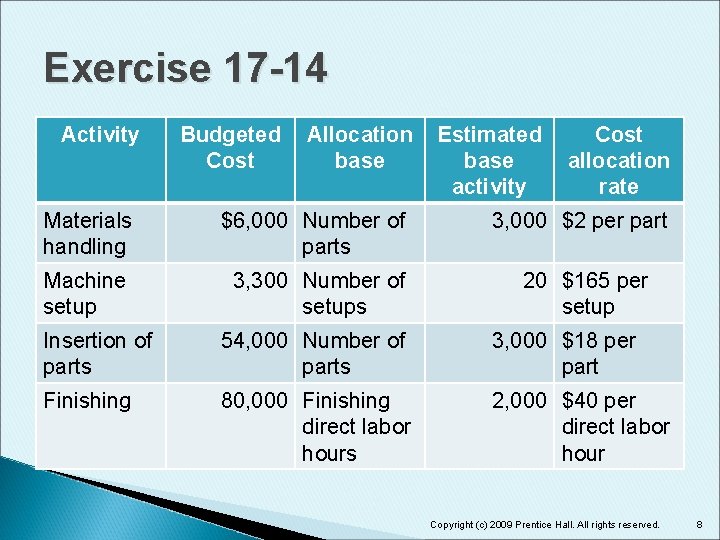
Exercise 17 -14 Activity Budgeted Cost Allocation base Estimated base activity Cost allocation rate Materials handling $6, 000 Number of parts 3, 000 $2 per part Machine setup 3, 300 Number of setups 20 $165 per setup Insertion of parts 54, 000 Number of parts 3, 000 $18 per part Finishing 80, 000 Finishing direct labor hours 2, 000 $40 per direct labor hour Copyright (c) 2009 Prentice Hall. All rights reserved. 8
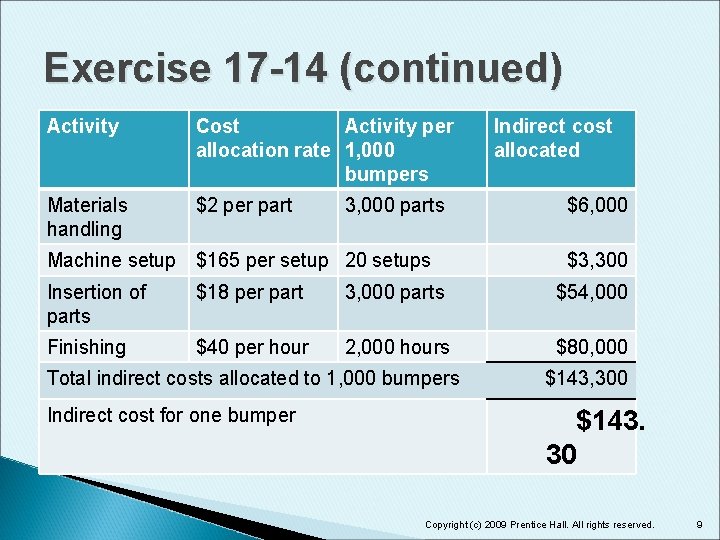
Exercise 17 -14 (continued) Activity Cost Activity per allocation rate 1, 000 bumpers Materials handling $2 per part 3, 000 parts Machine setup $165 per setup 20 setups Indirect cost allocated $6, 000 $3, 300 Insertion of parts $18 per part 3, 000 parts $54, 000 Finishing $40 per hour 2, 000 hours $80, 000 Total indirect costs allocated to 1, 000 bumpers $143, 300 Indirect cost for one bumper $143. 30 Copyright (c) 2009 Prentice Hall. All rights reserved. 9
Learning Objective 2 Use activity-based management (ABM) to achieve target costs
Activity-Based Management Uses ABC to make decisions that increase profits while meeting customer needs Types of decisions: ◦ Pricing and product mix ABC provides a more accurate cost of products Helps companies determine how profitable products are ◦ Cost cutting Copyright (c) 2009 Prentice Hall. All rights reserved. 11
Value Engineering Reevaluating activities to reduce costs Requires cross-functional teams ◦ Marketers ◦ Engineers ◦ Accountants Setting sales prices based on target prices ◦ What customers are willing to pay Copyright (c) 2009 Prentice Hall. All rights reserved. 12
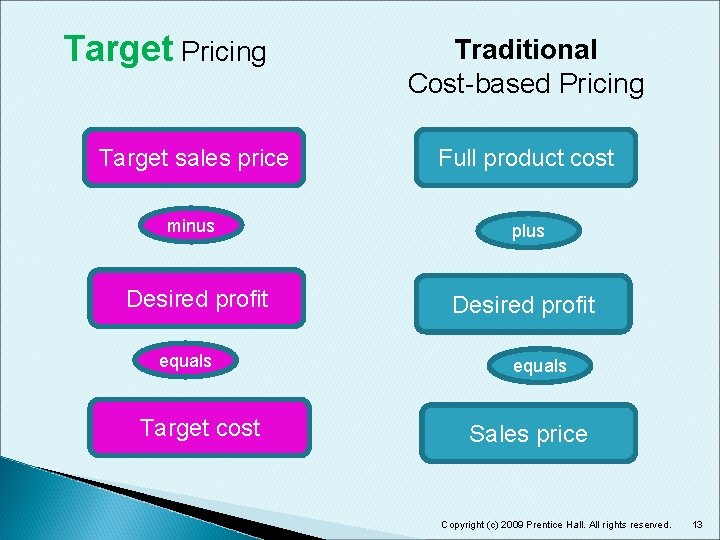
Target Pricing Traditional Cost-based Pricing Target sales price Full product cost minus plus Desired profit equals Target cost Desired profit equals Sales price Copyright (c) 2009 Prentice Hall. All rights reserved. 13
Review Questions? Copyright (c) 2009 Prentice Hall. All rights reserved. 14
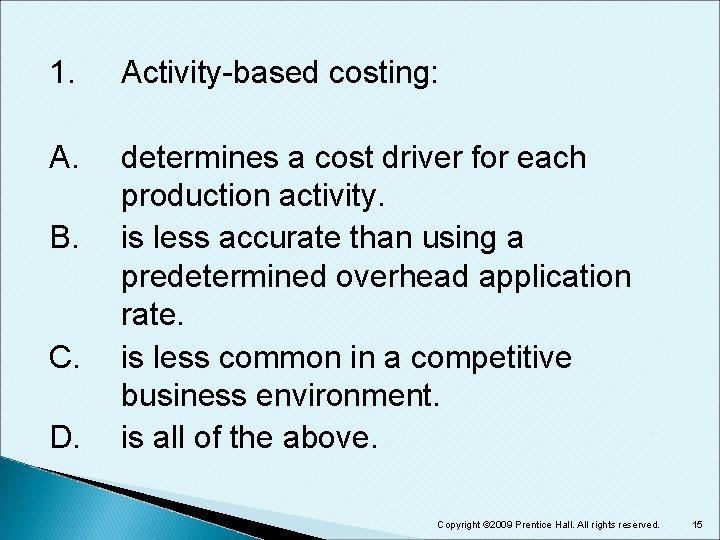
1. Activity-based costing: A. determines a cost driver for each production activity. is less accurate than using a predetermined overhead application rate. is less common in a competitive business environment. is all of the above. B. C. D. Copyright © 2009 Prentice Hall. All rights reserved. 15
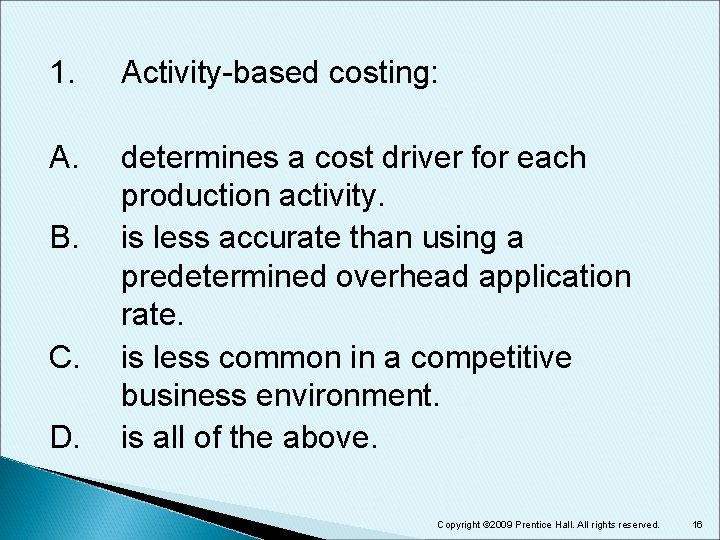
1. Activity-based costing: A. determines a cost driver for each production activity. is less accurate than using a predetermined overhead application rate. is less common in a competitive business environment. is all of the above. B. C. D. Copyright © 2009 Prentice Hall. All rights reserved. 16
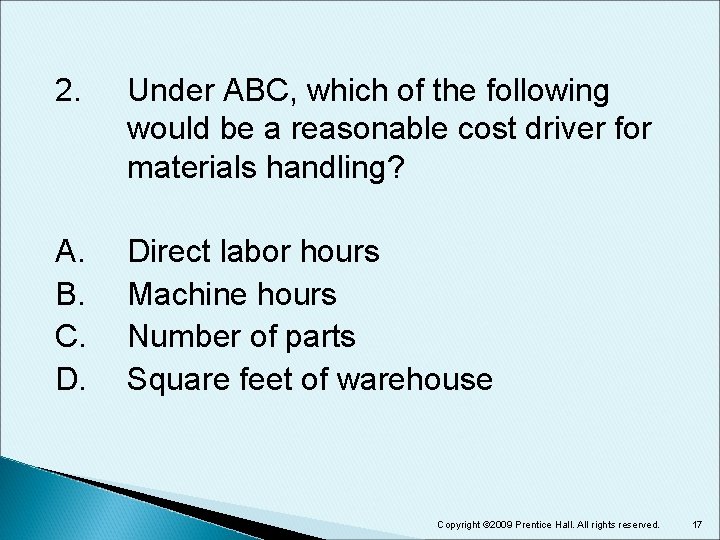
2. Under ABC, which of the following would be a reasonable cost driver for materials handling? A. B. C. D. Direct labor hours Machine hours Number of parts Square feet of warehouse Copyright © 2009 Prentice Hall. All rights reserved. 17
2. Under ABC, which of the following would be a reasonable cost driver for materials handling? A. B. C. D. Direct labor hours Machine hours Number of parts Square feet of warehouse Copyright © 2009 Prentice Hall. All rights reserved. 18
3. What types of decisions are made with activity-based management? A. B. C. D. Pricing Product mix Cost cutting All of the above Copyright © 2009 Prentice Hall. All rights reserved. 19
3. What types of decisions are made with activity-based management? A. B. C. D. Pricing Product mix Cost cutting All of the above Copyright © 2009 Prentice Hall. All rights reserved. 20
4. This method of pricing begins with the amount customers are willing to pay and subtracts desired profit to determine the desired cost. A. B. C. D. Traditional costing Target pricing Market-based costing Price profit analysis Copyright © 2009 Prentice Hall. All rights reserved. 21
4. This method of pricing begins with the amount customers are willing to pay and subtracts desired profit to determine the desired cost. A. B. C. D. Traditional costing Target pricing Market-based costing Price profit analysis Copyright © 2009 Prentice Hall. All rights reserved. 22
Learning Objective 3 Describe a just-in-time (JIT) production system, and record its transactions
Just-in-Time Systems Materials purchased & goods completed “just in time” for delivery Production completed in work cells Employees work in a team without supervision Goods completed in small batches that are inspected for quality Copyright (c) 2009 Prentice Hall. All rights reserved. 24
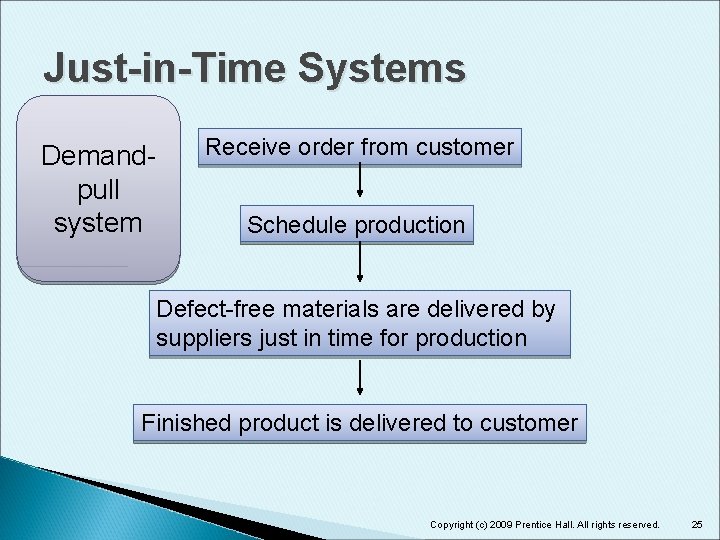
Just-in-Time Systems Demandpull system Receive order from customer Schedule production Defect-free materials are delivered by suppliers just in time for production Finished product is delivered to customer Copyright (c) 2009 Prentice Hall. All rights reserved. 25
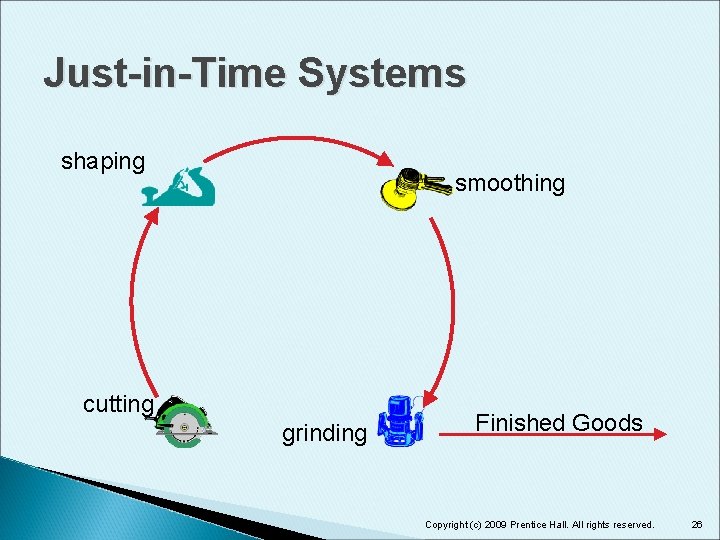
Just-in-Time Systems shaping smoothing cutting grinding Finished Goods Copyright (c) 2009 Prentice Hall. All rights reserved. 26
JIT Issues Lost sales can occur if materials do not arrive on time or if the materials are of poor-quality Strong relations with quality materials’ vendors are essential Some JIT companies have small inventories of critical materials Copyright (c) 2009 Prentice Hall. All rights reserved. 27
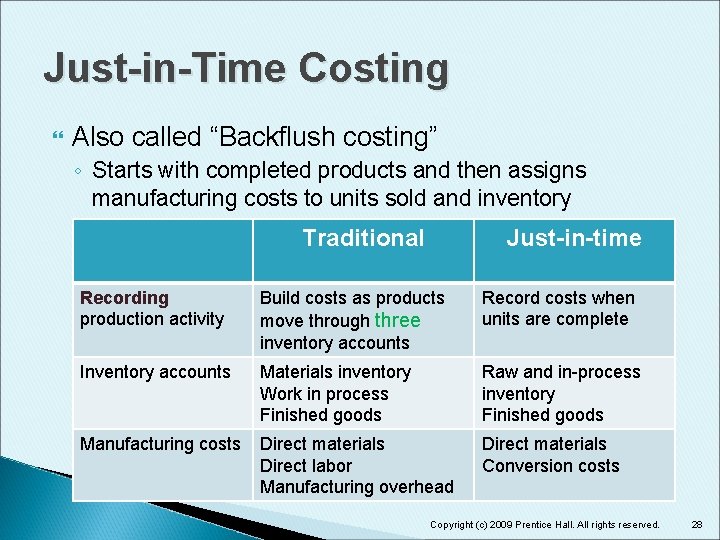
Just-in-Time Costing Also called “Backflush costing” ◦ Starts with completed products and then assigns manufacturing costs to units sold and inventory Traditional Just-in-time Recording production activity Build costs as products move through three inventory accounts Record costs when units are complete Inventory accounts Materials inventory Work in process Finished goods Raw and in-process inventory Finished goods Manufacturing costs Direct materials Direct labor Manufacturing overhead Direct materials Conversion costs Copyright (c) 2009 Prentice Hall. All rights reserved. 28
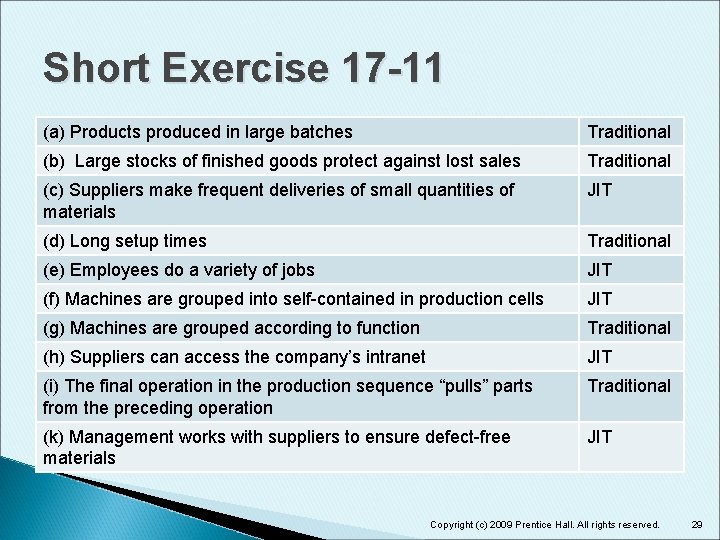
Short Exercise 17 -11 (a) Products produced in large batches Traditional (b) Large stocks of finished goods protect against lost sales Traditional (c) Suppliers make frequent deliveries of small quantities of materials JIT (d) Long setup times Traditional (e) Employees do a variety of jobs JIT (f) Machines are grouped into self-contained in production cells JIT (g) Machines are grouped according to function Traditional (h) Suppliers can access the company’s intranet JIT (i) The final operation in the production sequence “pulls” parts from the preceding operation Traditional (k) Management works with suppliers to ensure defect-free materials JIT Copyright (c) 2009 Prentice Hall. All rights reserved. 29
Learning Objective 4 Use the four types of quality costs to make decisions
Total Quality Management (TQM) Goals To provide customers with superior products and services Continuous improvement ◦ Improve quality ◦ Eliminate defects and waste ◦ Invest in research & development Copyright (c) 2009 Prentice Hall. All rights reserved. 31
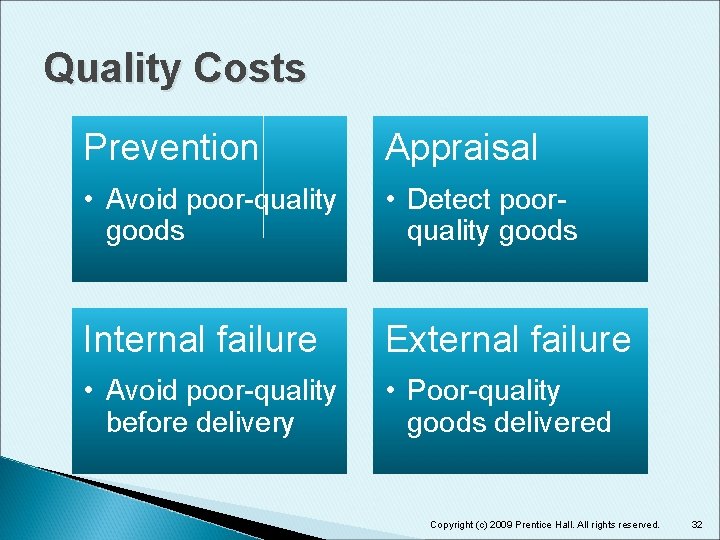
Quality Costs Prevention Appraisal • Avoid poor-quality goods • Detect poorquality goods Internal failure External failure • Avoid poor-quality before delivery • Poor-quality goods delivered Copyright (c) 2009 Prentice Hall. All rights reserved. 32
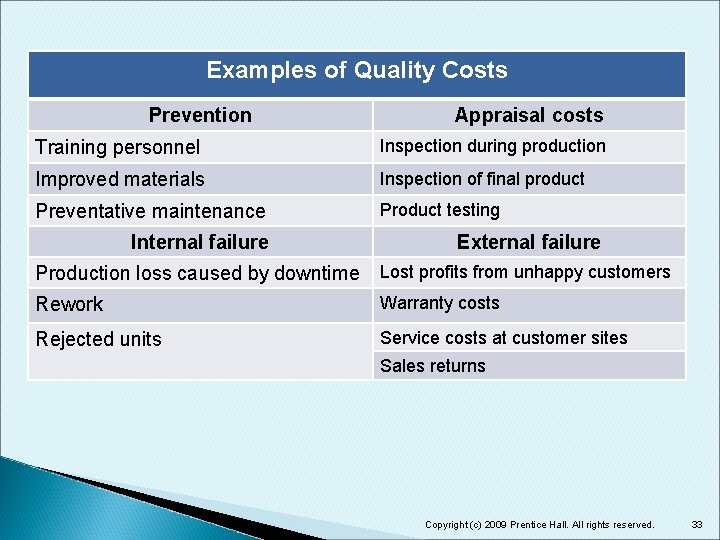
Examples of Quality Costs Prevention Appraisal costs Training personnel Inspection during production Improved materials Inspection of final product Preventative maintenance Product testing Internal failure External failure Production loss caused by downtime Lost profits from unhappy customers Rework Warranty costs Rejected units Service costs at customer sites Sales returns Copyright (c) 2009 Prentice Hall. All rights reserved. 33
? Review Questions ? Copyright (c) 2009 Prentice Hall. All rights reserved. 34
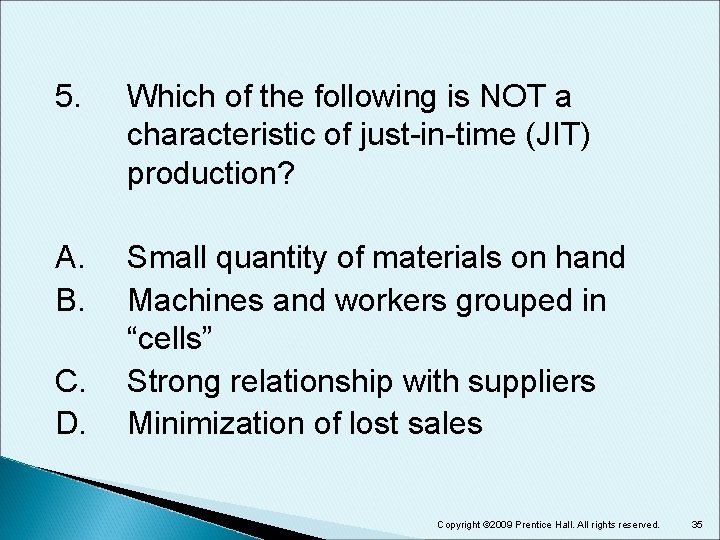
5. Which of the following is NOT a characteristic of just-in-time (JIT) production? A. B. Small quantity of materials on hand Machines and workers grouped in “cells” Strong relationship with suppliers Minimization of lost sales C. D. Copyright © 2009 Prentice Hall. All rights reserved. 35
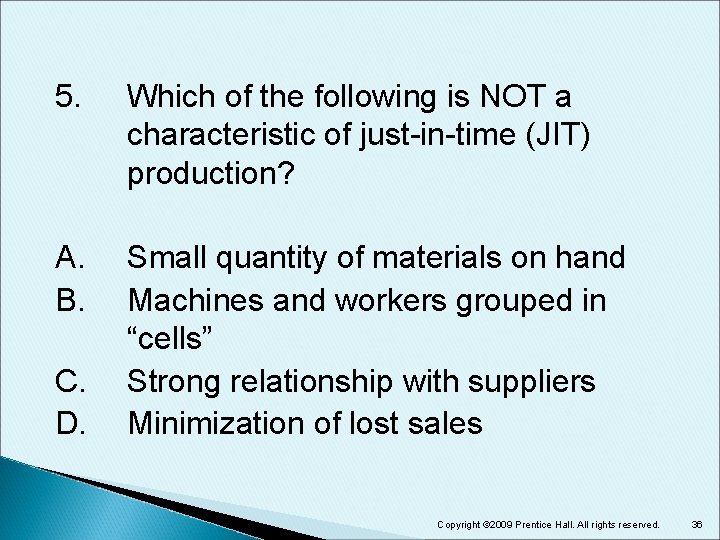
5. Which of the following is NOT a characteristic of just-in-time (JIT) production? A. B. Small quantity of materials on hand Machines and workers grouped in “cells” Strong relationship with suppliers Minimization of lost sales C. D. Copyright © 2009 Prentice Hall. All rights reserved. 36
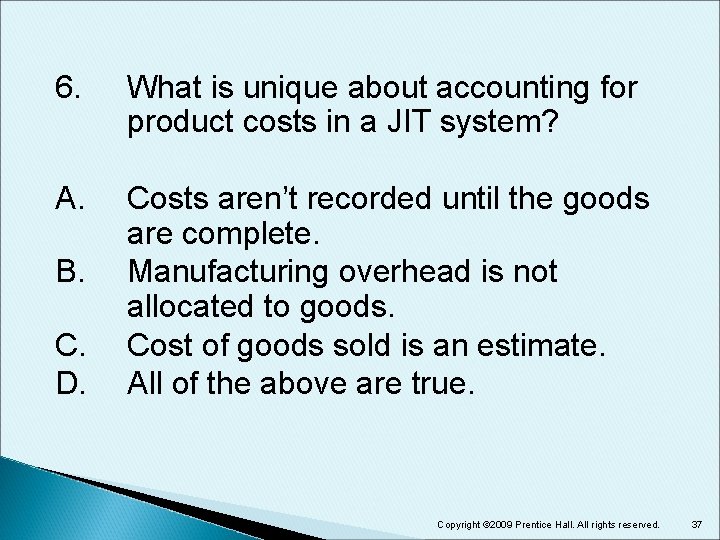
6. What is unique about accounting for product costs in a JIT system? A. Costs aren’t recorded until the goods are complete. Manufacturing overhead is not allocated to goods. Cost of goods sold is an estimate. All of the above are true. B. C. D. Copyright © 2009 Prentice Hall. All rights reserved. 37
6. What is unique about accounting for product costs in a JIT system? A. Costs aren’t recorded until the goods are complete. Manufacturing overhead is not allocated to goods. Cost of goods sold is an estimate. All of the above are true. B. C. D. Copyright © 2009 Prentice Hall. All rights reserved. 38
7. Continuous improvement is an essential piece of which management approach? A. B. C. D. Profit maximization Total quality management Autocratic approach Efficiency model Copyright © 2009 Prentice Hall. All rights reserved. 39
7. Continuous improvement is an essential piece of which management approach? A. B. C. D. Profit maximization Total quality management Autocratic approach Efficiency model Copyright © 2009 Prentice Hall. All rights reserved. 40
8. Which of the following of the four quality costs is likely to be the most expensive? A. B. C. D. Prevention Appraisal Internal failure External failure Copyright © 2009 Prentice Hall. All rights reserved. 41
8. Which of the following of the four quality costs is likely to be the most expensive? A. B. C. D. Prevention Appraisal Internal failure External failure Copyright © 2009 Prentice Hall. All rights reserved. 42
9. Product testing is an example of which quality cost? A. B. C. D. Prevention Appraisal Internal failure External failure Copyright © 2009 Prentice Hall. All rights reserved. 43
9. Product testing is an example of which quality cost? A. B. C. D. Prevention Appraisal Internal failure External failure Copyright © 2009 Prentice Hall. All rights reserved. 44
10. Training personnel is an example of which quality cost? A. B. C. D. Prevention Appraisal Internal failure External failure Copyright © 2009 Prentice Hall. All rights reserved. 45
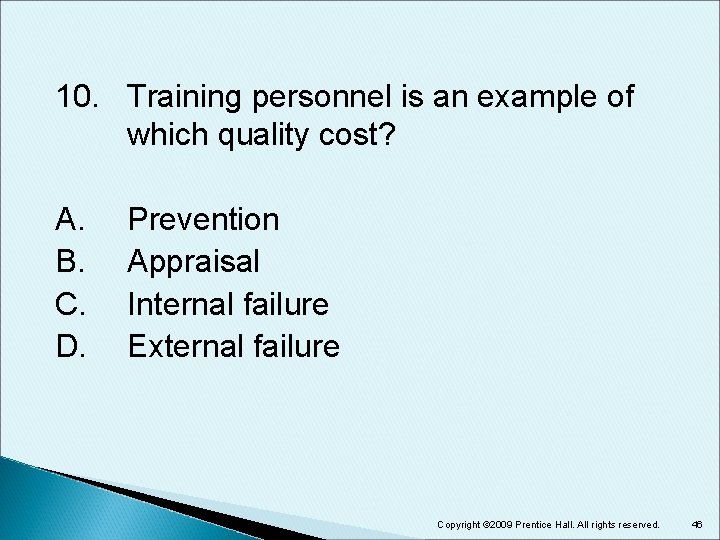
10. Training personnel is an example of which quality cost? A. B. C. D. Prevention Appraisal Internal failure External failure Copyright © 2009 Prentice Hall. All rights reserved. 46
End of Chapter 17
- Slides: 47