
Activity tracking and awareness A transdisciplinary automation framework

- Slides: 58
Activity tracking and awareness: A transdisciplinary automation framework Alexander Muzy Bernard P. Zeigler Cargese Interdisciplinary Seminar Corsica, April 2009
Activity Concept Hypothesis • Activity is a generic concept (like “information”) refers to the spatial temporal distribution of state transitions in component-based model • Activity concepts have been used to speed up simulation in the form of activity tracking which focuses computational resources on components based on their activities – it arises naturally in DEVS models with space/time heterogeneity (e. g. crowds, fires) • Generalization Claim: Just as “information” is a useful abstraction for distinguishing behaviors from physical implementations, “activity” is a useful abstraction to enable energy consumption to be coupled to information flow for a more complete representation of how systems work • Particular Hypothesis: “Activity awareness” can support “built-in” learning/adaptation similar to how it appears to work in biological systems, e. g. the brain
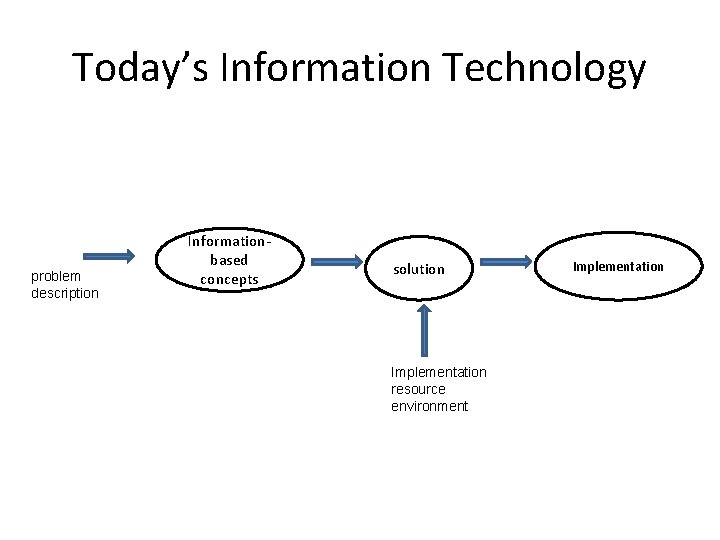
Today’s Information Technology problem description Informationbased concepts solution Implementation resource environment Implementation
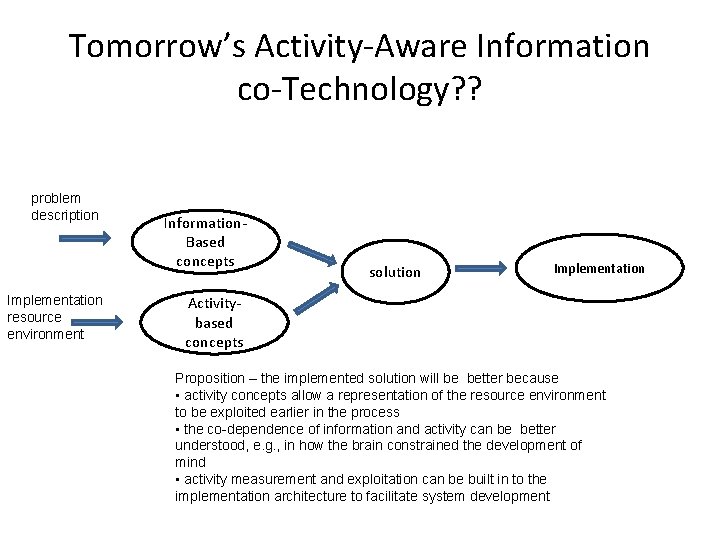
Tomorrow’s Activity-Aware Information co-Technology? ? problem description Implementation resource environment Information. Based concepts solution Implementation Activitybased concepts Proposition – the implemented solution will be better because • activity concepts allow a representation of the resource environment to be exploited earlier in the process • the co-dependence of information and activity can be better understood, e. g. , in how the brain constrained the development of mind • activity measurement and exploitation can be built in to the implementation architecture to facilitate system development
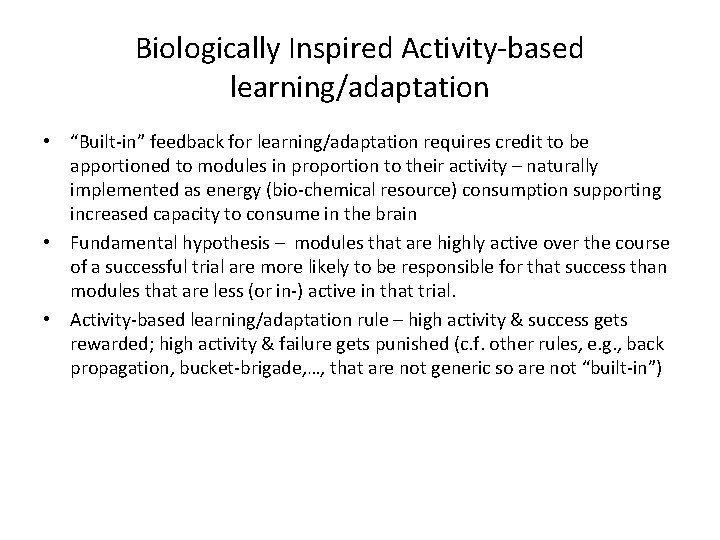
Biologically Inspired Activity-based learning/adaptation • “Built-in” feedback for learning/adaptation requires credit to be apportioned to modules in proportion to their activity – naturally implemented as energy (bio-chemical resource) consumption supporting increased capacity to consume in the brain • Fundamental hypothesis – modules that are highly active over the course of a successful trial are more likely to be responsible for that success than modules that are less (or in-) active in that trial. • Activity-based learning/adaptation rule – high activity & success gets rewarded; high activity & failure gets punished (c. f. other rules, e. g. , back propagation, bucket-brigade, …, that are not generic so are not “built-in”)
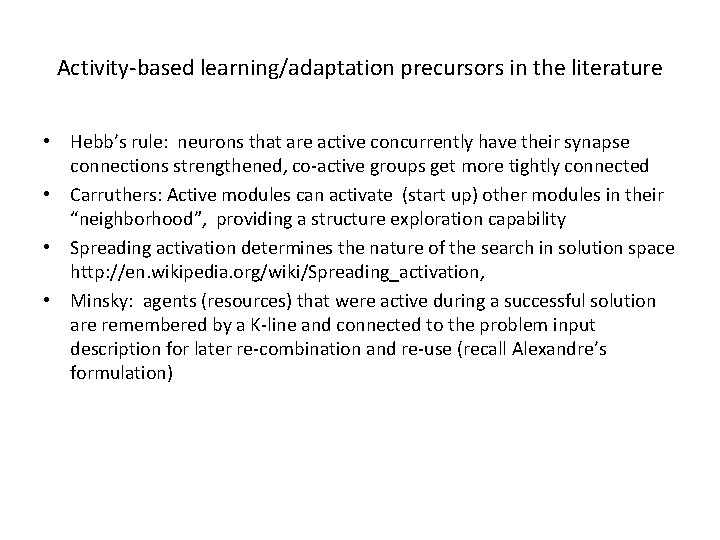
Activity-based learning/adaptation precursors in the literature • Hebb’s rule: neurons that are active concurrently have their synapse connections strengthened, co-active groups get more tightly connected • Carruthers: Active modules can activate (start up) other modules in their “neighborhood”, providing a structure exploration capability • Spreading activation determines the nature of the search in solution space http: //en. wikipedia. org/wiki/Spreading_activation, • Minsky: agents (resources) that were active during a successful solution are remembered by a K-line and connected to the problem input description for later re-combination and re-use (recall Alexandre’s formulation)
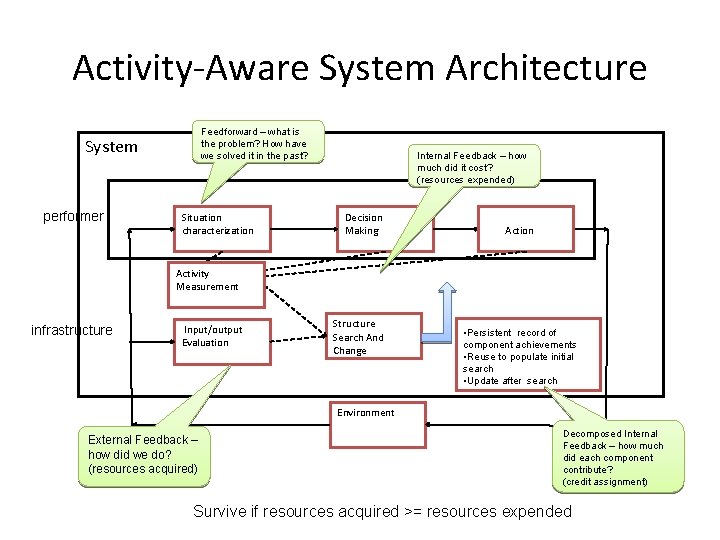
Activity-Aware System Architecture Feedforward – what is the problem? How have we solved it in the past? System performer Situation characterization Internal Feedback – how much did it cost? (resources expended) Decision Making Action Activity Measurement infrastructure Input/output Evaluation Structure Search And Change • Persistent record of component achievements • Reuse to populate initial search • Update after search Environment External Feedback – how did we do? (resources acquired) Decomposed Internal Feedback – how much did each component contribute? (credit assignment) Survive if resources acquired >= resources expended
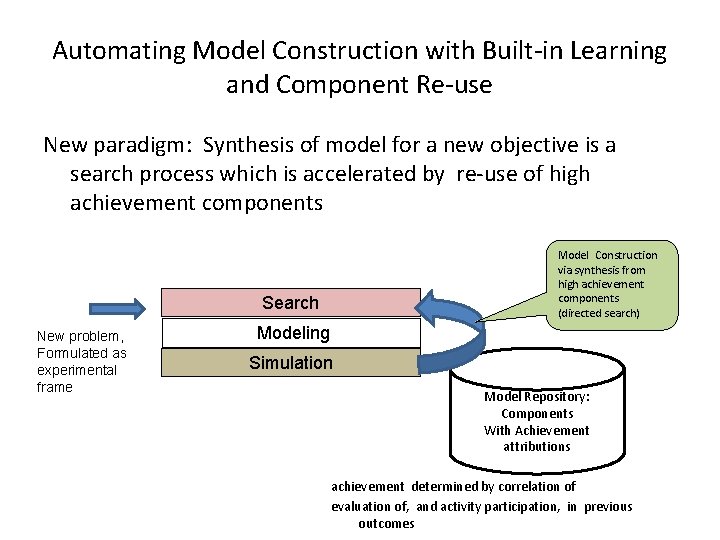
Automating Model Construction with Built-in Learning and Component Re-use New paradigm: Synthesis of model for a new objective is a search process which is accelerated by re-use of high achievement components Model Construction via synthesis from high achievement components (directed search) Search New problem, Formulated as experimental frame Modeling Simulation Model Repository: Components With Achievement attributions achievement determined by correlation of evaluation of, and activity participation, in previous outcomes
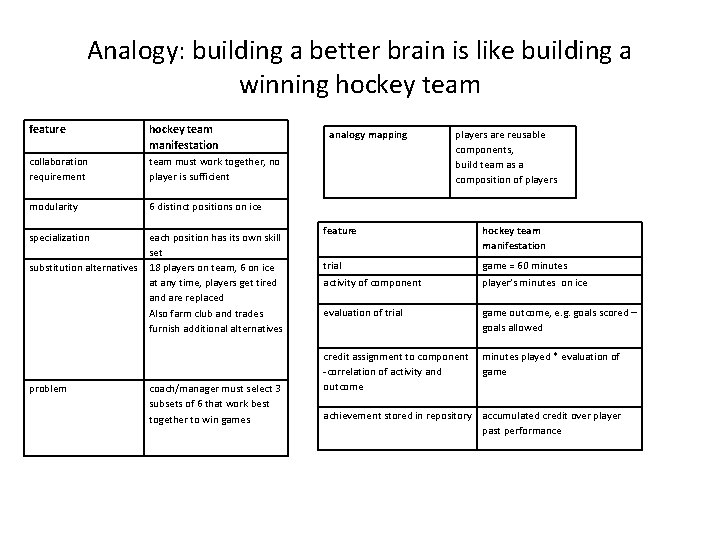
Analogy: building a better brain is like building a winning hockey team feature hockey team manifestation collaboration requirement team must work together, no player is sufficient modularity 6 distinct positions on ice specialization each position has its own skill set 18 players on team, 6 on ice at any time, players get tired and are replaced Also farm club and trades furnish additional alternatives substitution alternatives problem coach/manager must select 3 subsets of 6 that work best together to win games analogy mapping players are reusable components, build team as a composition of players feature hockey team manifestation trial game = 60 minutes activity of component player’s minutes on ice evaluation of trial game outcome, e. g. goals scored – goals allowed credit assignment to component -correlation of activity and outcome minutes played * evaluation of game achievement stored in repository accumulated credit over player past performance
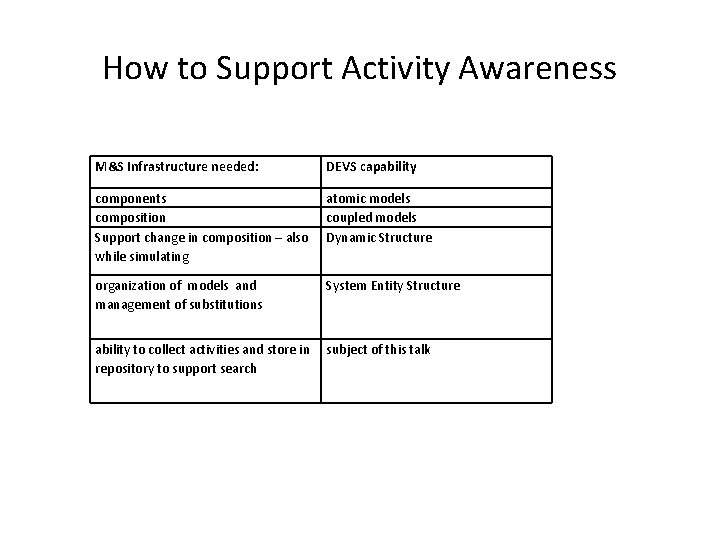
How to Support Activity Awareness M&S Infrastructure needed: DEVS capability components composition Support change in composition – also while simulating atomic models coupled models Dynamic Structure organization of models and management of substitutions System Entity Structure ability to collect activities and store in repository to support search subject of this talk
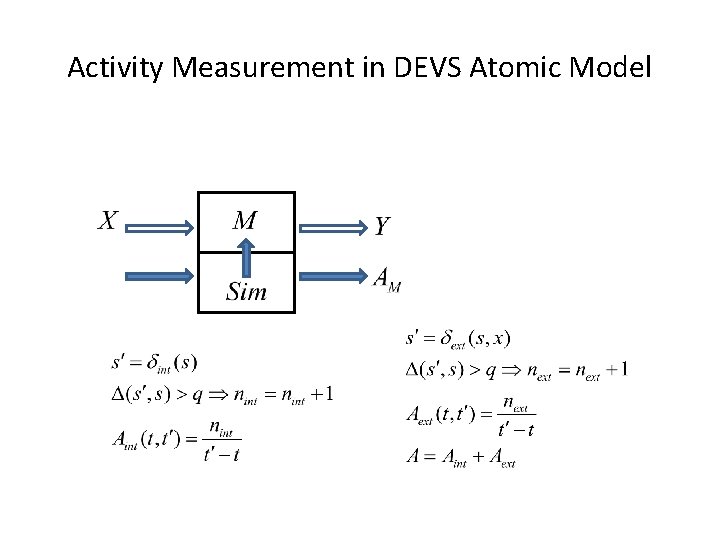
Activity Measurement in DEVS Atomic Model
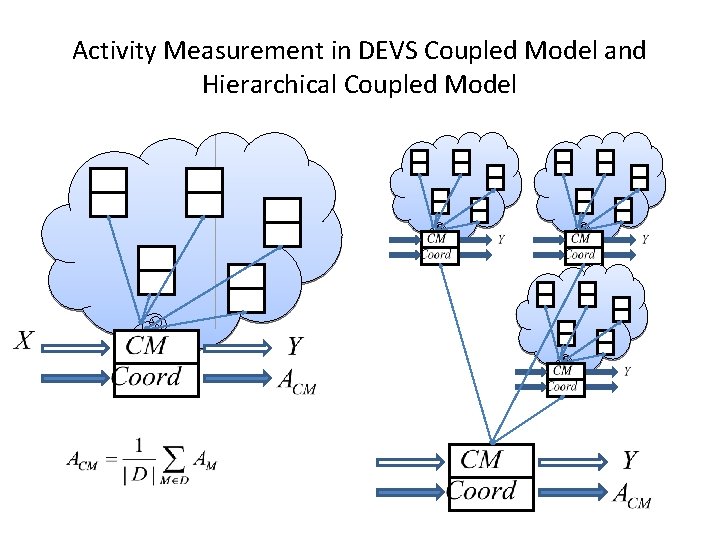
Activity Measurement in DEVS Coupled Model and Hierarchical Coupled Model
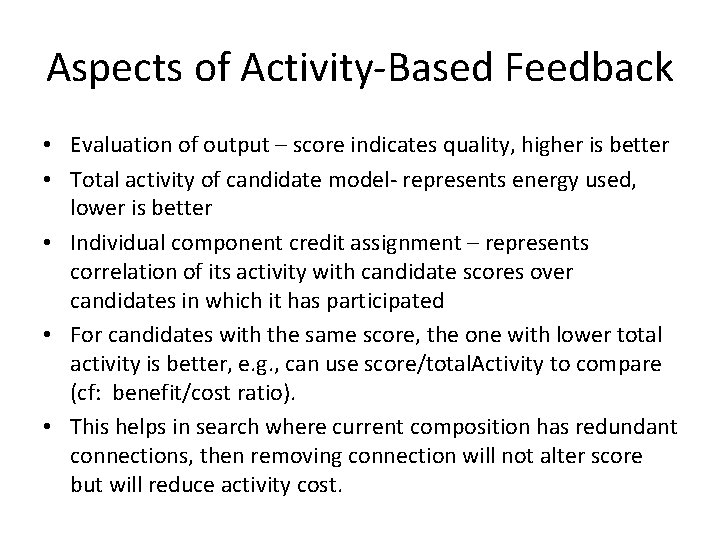
Aspects of Activity-Based Feedback • Evaluation of output – score indicates quality, higher is better • Total activity of candidate model- represents energy used, lower is better • Individual component credit assignment – represents correlation of its activity with candidate scores over candidates in which it has participated • For candidates with the same score, the one with lower total activity is better, e. g. , can use score/total. Activity to compare (cf: benefit/cost ratio). • This helps in search where current composition has redundant connections, then removing connection will not alter score but will reduce activity cost.
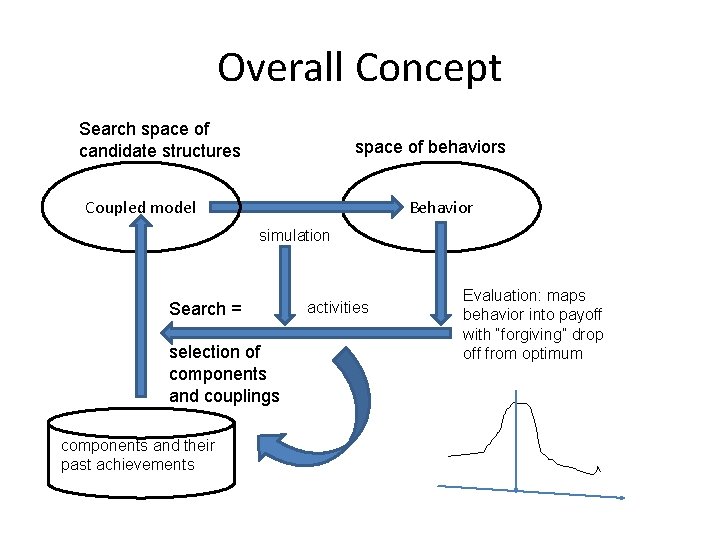
Overall Concept Search space of candidate structures space of behaviors Coupled model Behavior simulation Search = selection of components and couplings components and their past achievements activities Evaluation: maps behavior into payoff with “forgiving” drop off from optimum
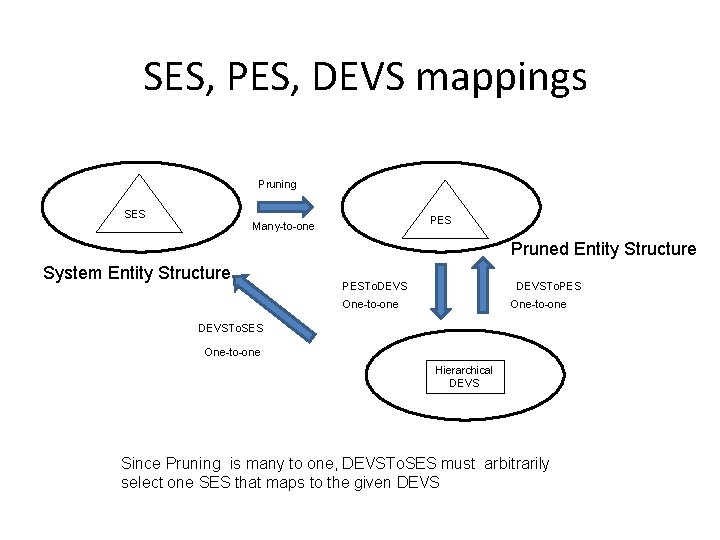
SES, PES, DEVS mappings Pruning SES PES Many-to-one Pruned Entity Structure System Entity Structure PESTo. DEVSTo. PES One-to-one DEVSTo. SES One-to-one Hierarchical DEVS Since Pruning is many to one, DEVSTo. SES must arbitrarily select one SES that maps to the given DEVS
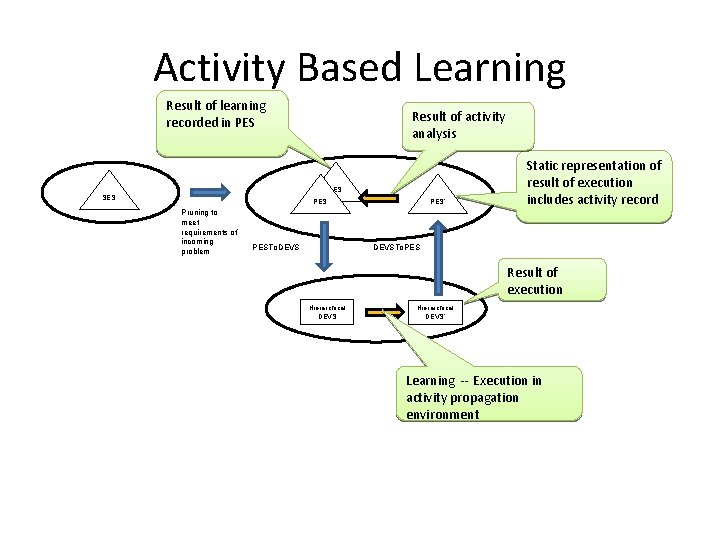
Activity Based Learning Result of learning recorded in PES Result of activity analysis PES SES PES’ PES Pruning to meet requirements of incoming problem PESTo. DEVS Static representation of result of execution includes activity record DEVSTo. PES Result of execution Hierarchical DEVS’ Learning -- Execution in activity propagation environment
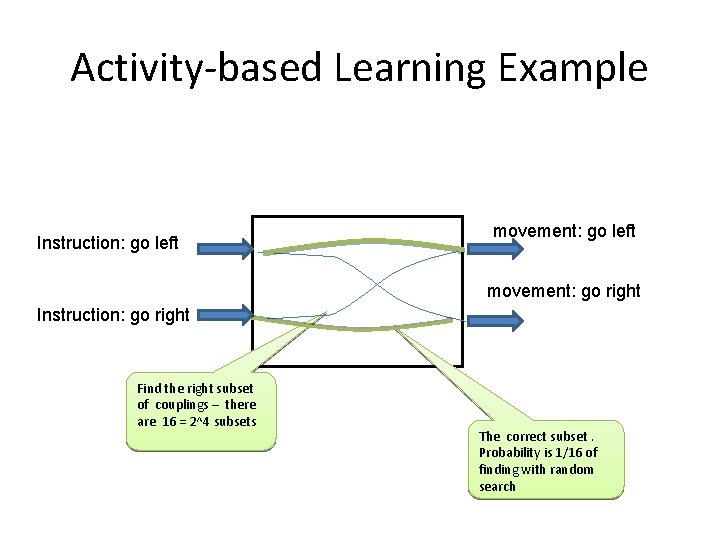
Activity-based Learning Example Instruction: go left movement: go right Instruction: go right Find the right subset of couplings – there are 16 = 2^4 subsets The correct subset. Probability is 1/16 of finding with random search
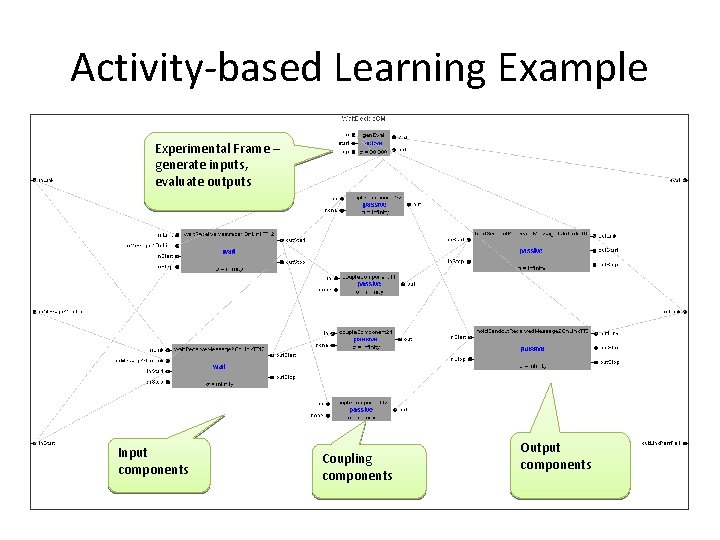
Activity-based Learning Example Experimental Frame – generate inputs, evaluate outputs Input components Coupling components Output components
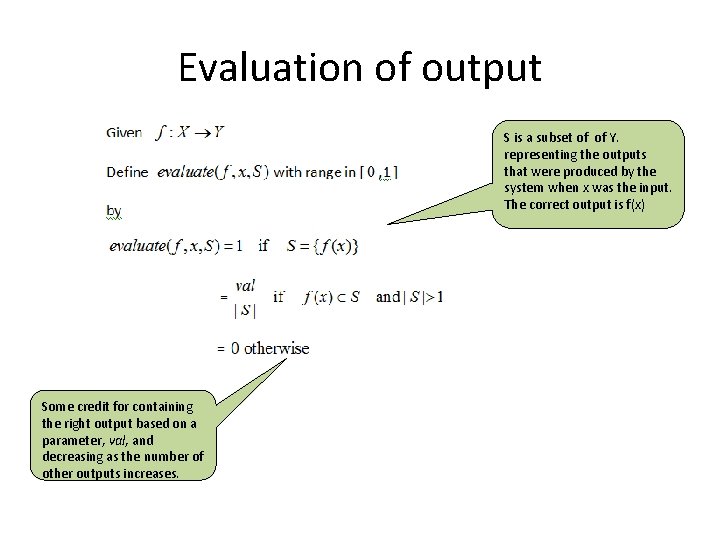
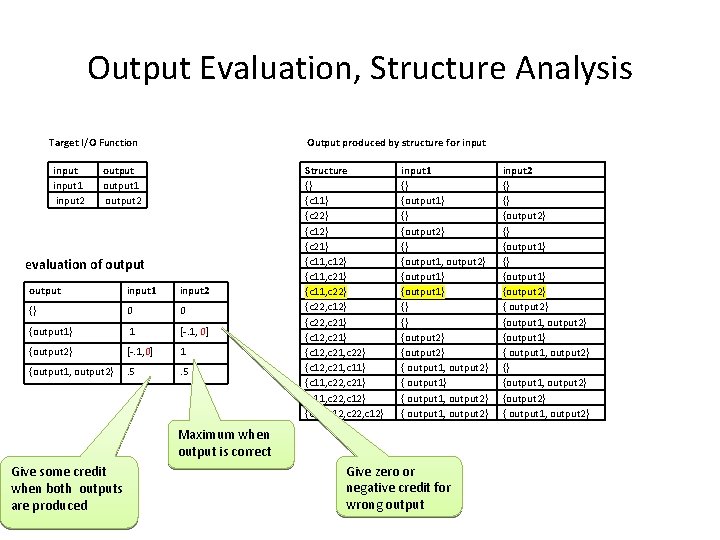
Evaluation of output S is a subset of of Y. representing the outputs that were produced by the system when x was the input. The correct output is f(x) Some credit for containing the right output based on a parameter, val, and decreasing as the number of other outputs increases.
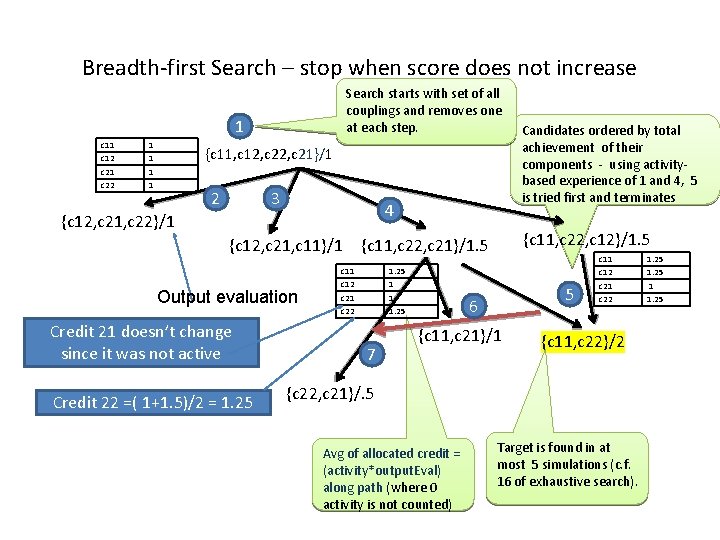
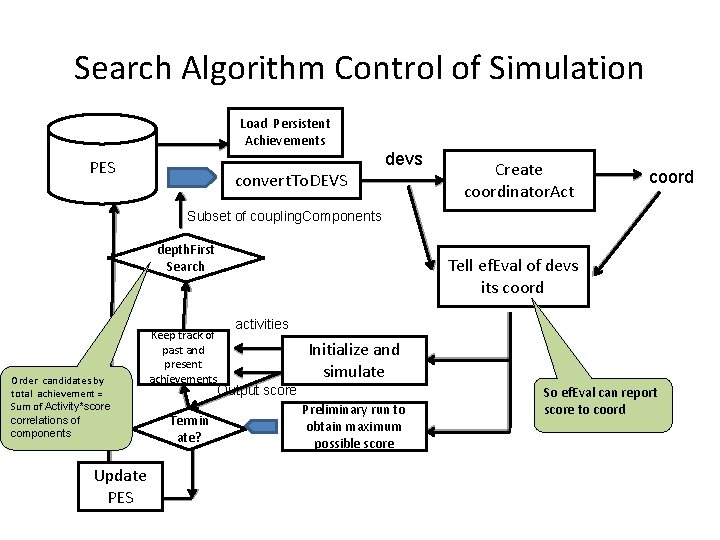
Breadth-first Search – stop when score does not increase Search starts with set of all couplings and removes one at each step. 1 c 12 c 21 c 22 1 1 {c 11, c 12, c 21}/1 2 3 4 {c 12, c 21, c 22}/1 {c 12, c 21, c 11}/1 Output evaluation Credit 21 doesn’t change since it was not active Credit 22 =( 1+1. 5)/2 = 1. 25 {c 11, c 22, c 12}/1. 5 {c 11, c 22, c 21}/1. 5 c 11 c 12 c 21 c 22 1. 25 1 1 1. 25 7 Candidates ordered by total achievement of their components - using activitybased experience of 1 and 4, 5 is tried first and terminates 5 6 {c 11, c 21}/1 c 12 c 21 c 22 {c 11, c 22}/2 {c 22, c 21}/. 5 Avg of allocated credit = (activity*output. Eval) along path (where 0 activity is not counted) Target is found in at most 5 simulations (c. f. 16 of exhaustive search). 1. 25 1 1. 25
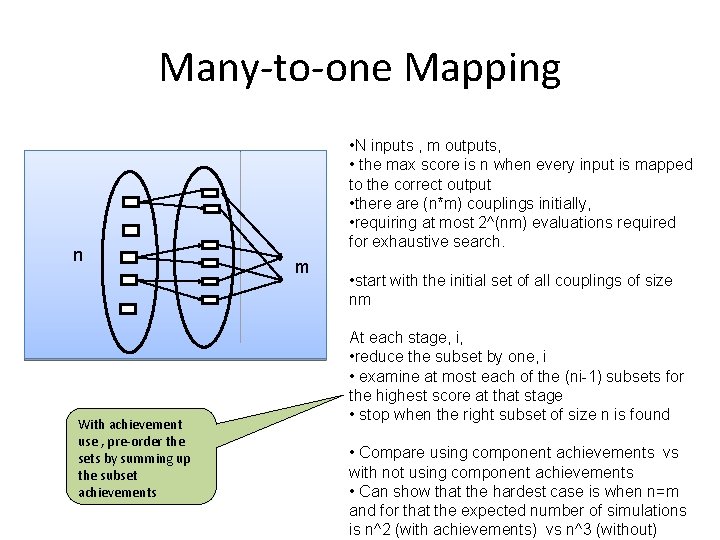
Many-to-one Mapping n With achievement use , pre-order the sets by summing up the subset achievements • N inputs , m outputs, • the max score is n when every input is mapped to the correct output • there are (n*m) couplings initially, • requiring at most 2^(nm) evaluations required for exhaustive search. m • start with the initial set of all couplings of size nm At each stage, i, • reduce the subset by one, i • examine at most each of the (ni-1) subsets for the highest score at that stage • stop when the right subset of size n is found • Compare using component achievements vs with not using component achievements • Can show that the hardest case is when n=m and for that the expected number of simulations is n^2 (with achievements) vs n^3 (without)
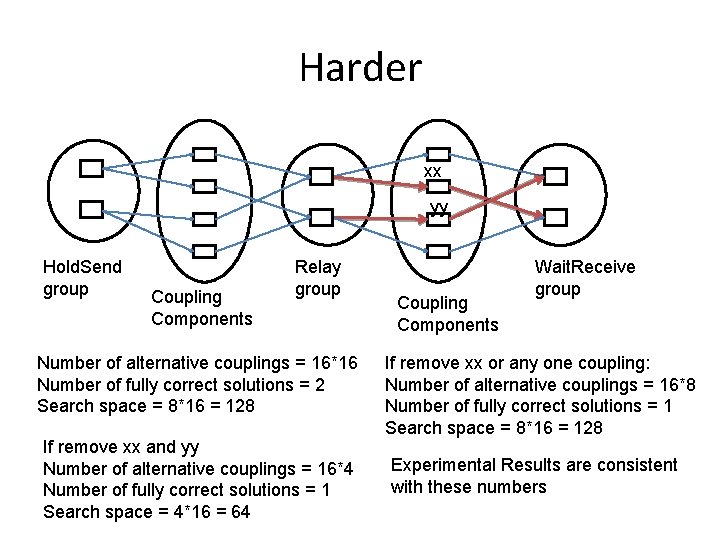
Harder xx yy Hold. Send group Coupling Components Relay group Number of alternative couplings = 16*16 Number of fully correct solutions = 2 Search space = 8*16 = 128 If remove xx and yy Number of alternative couplings = 16*4 Number of fully correct solutions = 1 Search space = 4*16 = 64 Coupling Components Wait. Receive group If remove xx or any one coupling: Number of alternative couplings = 16*8 Number of fully correct solutions = 1 Search space = 8*16 = 128 Experimental Results are consistent with these numbers
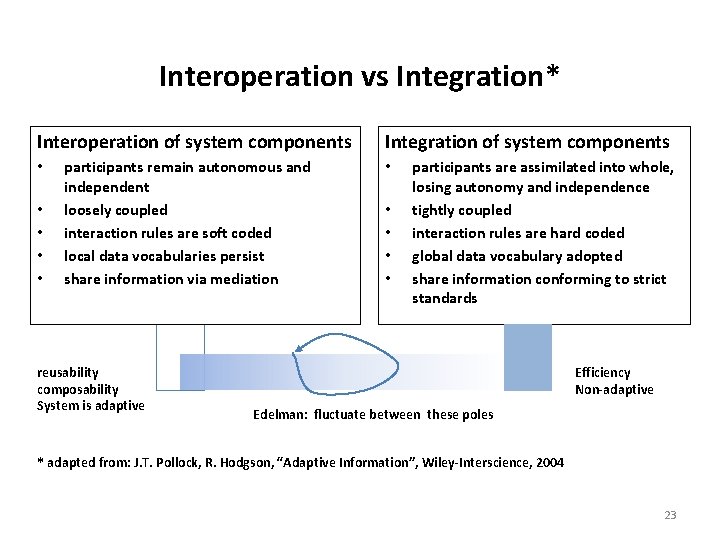
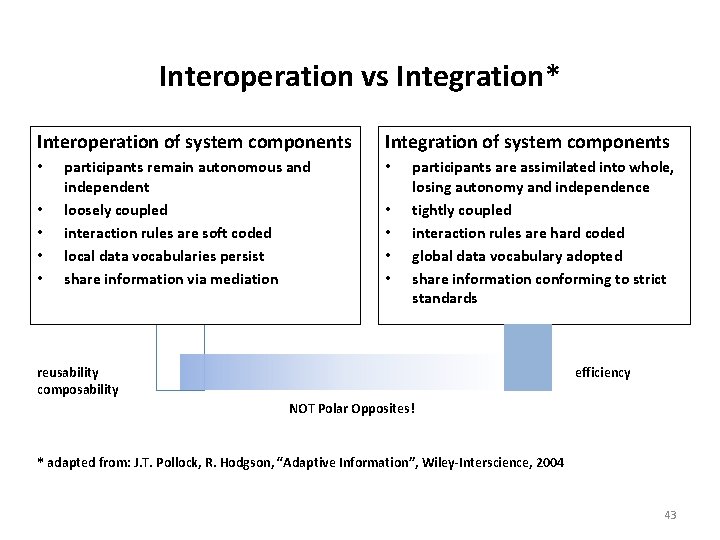
Interoperation vs Integration* Interoperation of system components • • • participants remain autonomous and independent loosely coupled interaction rules are soft coded local data vocabularies persist share information via mediation reusability composability System is adaptive Integration of system components • • • participants are assimilated into whole, losing autonomy and independence tightly coupled interaction rules are hard coded global data vocabulary adopted share information conforming to strict standards Efficiency Non-adaptive Edelman: fluctuate between these poles * adapted from: J. T. Pollock, R. Hodgson, “Adaptive Information”, Wiley-Interscience, 2004 23
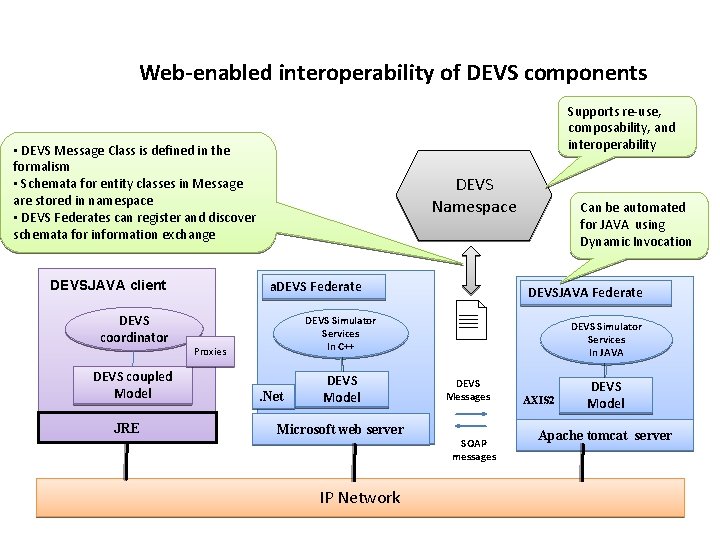
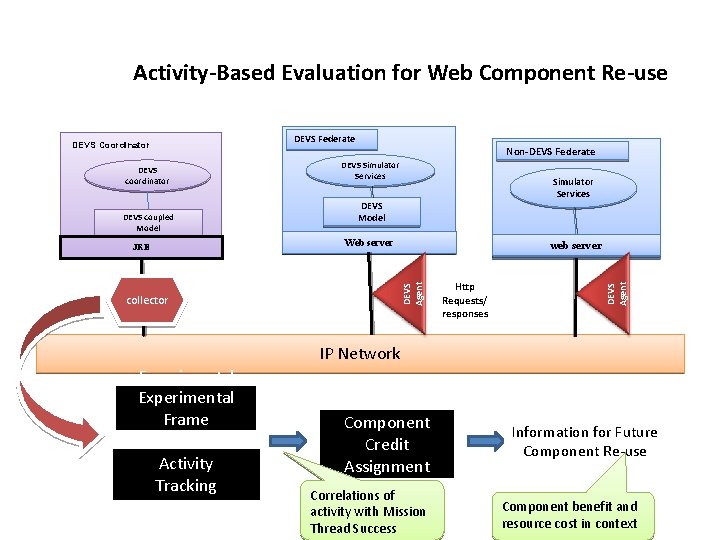
Web-enabled interoperability of DEVS components Supports re-use, composability, and interoperability • DEVS Message Class is defined in the formalism • Schemata for entity classes in Message are stored in namespace • DEVS Federates can register and discover schemata for information exchange DEVSJAVA client DEVS coordinator DEVS coupled Model JRE DEVS Namespace a. DEVS Federate Can be automated for JAVA using Dynamic Invocation DEVSJAVA Federate DEVS Simulator Services In C++ Proxies . Net DEVS Model Microsoft web server IP Network DEVS Simulator Services In JAVA DEVS Messages SOAP messages AXIS 2 DEVS Model Apache tomcat server
Activity-Based Evaluation for Web Component Re-use DEVS coupled Model JRE collector Non-DEVS Federate DEVS Simulator Services DEVS Model Web server web server Http Requests/ responses DEVS Agent DEVS coordinator DEVS Federate DEVS Agent DEVS Coordinator IP Network Experimental Frame Evaluation Activity Tracking Component Credit Assignment Correlations of activity with Mission Thread Success Information for Future Component Re-use Component benefit and resource cost in context
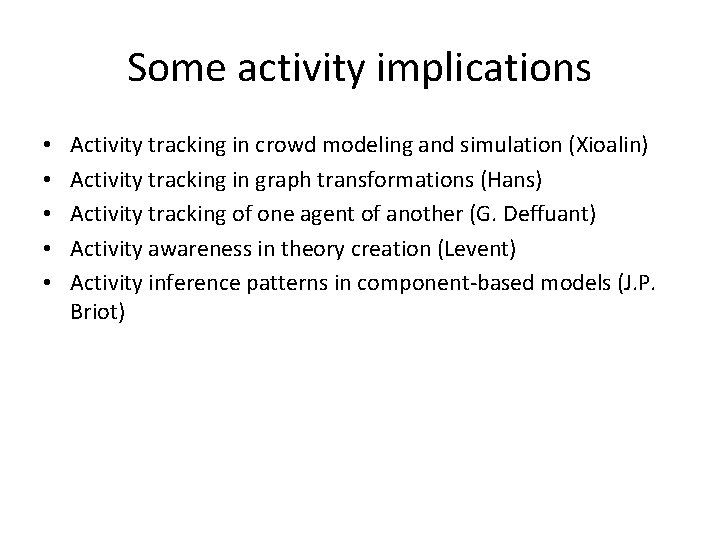
Some activity implications • • • Activity tracking in crowd modeling and simulation (Xioalin) Activity tracking in graph transformations (Hans) Activity tracking of one agent of another (G. Deffuant) Activity awareness in theory creation (Levent) Activity inference patterns in component-based models (J. P. Briot)
Books and Web Links devsworld. org www. acims. arizona. edu Rtsync. com 27
More Demos and Links http: //www. acims. arizona. edu/demos. shtml • Integrated Development and Testing Methodology: • Auto. DEVS (ppt) & DEMO – Natural language-based Automated DEVS model generation – BPMN/BPEL-based Automated DEVS model generation – Net-centric SOA Execution of DEVS models – DEVS Unified Process for Integrated Development and Testing of SOA • Intrusion Detection System on DEVS/SOA 28
Backup
Search Algorithm Control of Simulation Load Persistent Achievements PES devs convert. To. DEVS Create coordinator. Act coord Subset of coupling. Components depth. First Search Order candidates by total achievement = Sum of Activity*score correlations of components Update PES Keep track of past and present achievements Termin ate? Tell ef. Eval of devs its coord activities Initialize and simulate Output score Preliminary run to obtain maximum possible score So ef. Eval can report score to coord
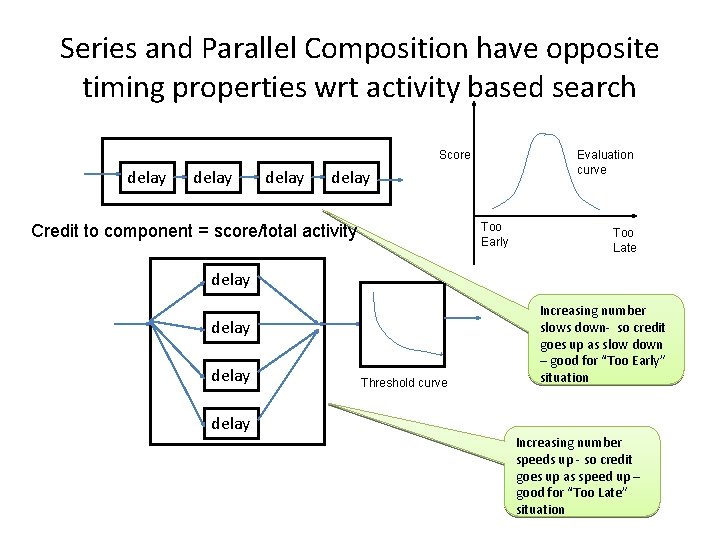
Series and Parallel Composition have opposite timing properties wrt activity based search Score delay Evaluation curve delay Too Early Credit to component = score/total activity Too Late delay Threshold curve Increasing number slows down- so credit goes up as slow down – good for “Too Early” situation Increasing number speeds up - so credit goes up as speed up – good for “Too Late” situation
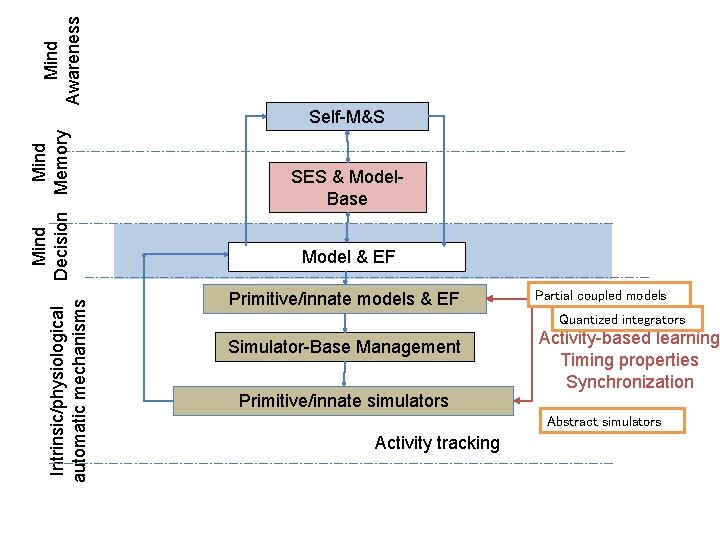
Mind Awareness Intrinsic/physiological automatic mechanisms Mind Decision Memory Self-M&S SES & Model. Base Model & EF Primitive/innate models & EF Partial coupled models Quantized integrators Simulator-Base Management Primitive/innate simulators Activity-based learning Timing properties Synchronization Abstract simulators Activity tracking
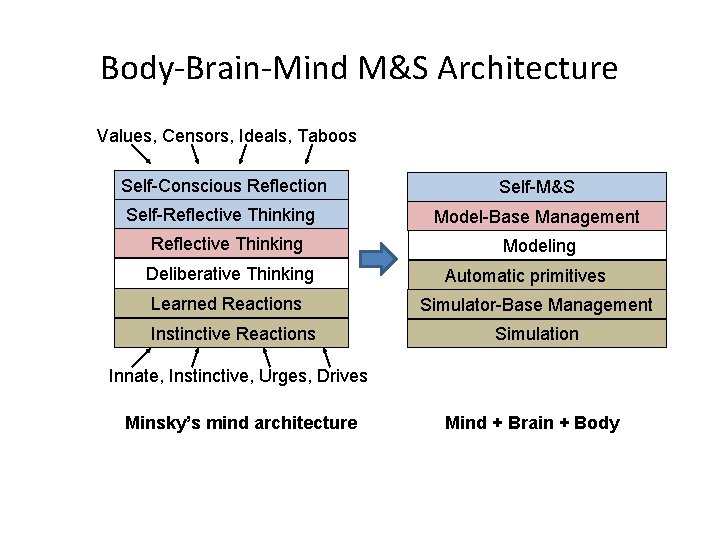
Body-Brain-Mind M&S Architecture Values, Censors, Ideals, Taboos Self-Conscious Reflection Self-M&S Self-Reflective Thinking Model-Base Management Reflective Thinking Deliberative Thinking Learned Reactions Instinctive Reactions Modeling Automatic primitives Simulator-Base Management Simulation Innate, Instinctive, Urges, Drives Minsky’s mind architecture Mind + Brain + Body
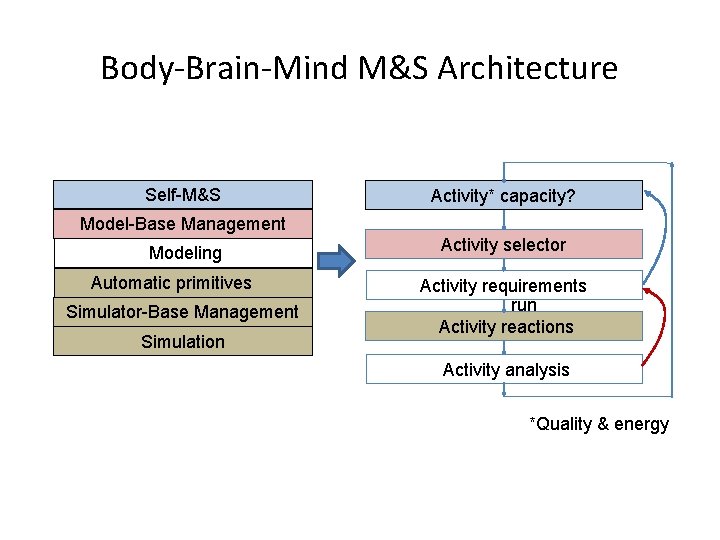
Body-Brain-Mind M&S Architecture Self-M&S Activity* capacity? Model-Base Management Modeling Automatic primitives Simulator-Base Management Simulation Activity selector Activity requirements run Activity reactions Activity analysis *Quality & energy
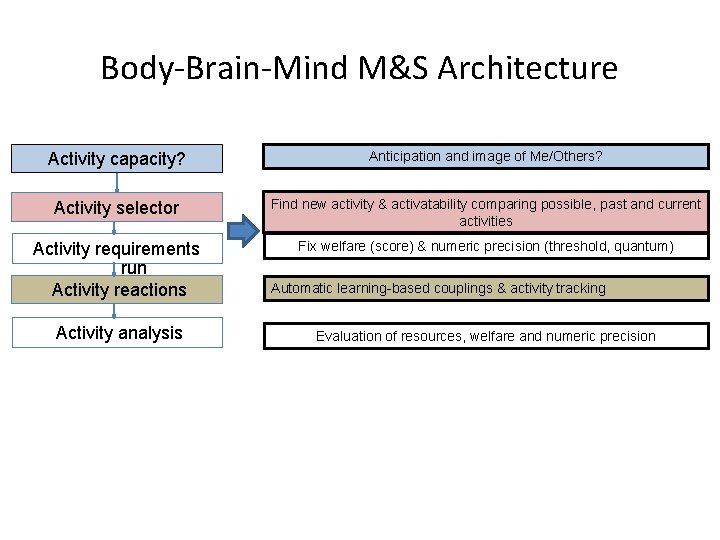
Body-Brain-Mind M&S Architecture Activity capacity? Anticipation and image of Me/Others? Activity selector Find new activity & activatability comparing possible, past and current activities Activity requirements run Activity reactions Fix welfare (score) & numeric precision (threshold, quantum) Activity analysis Automatic learning-based couplings & activity tracking Evaluation of resources, welfare and numeric precision
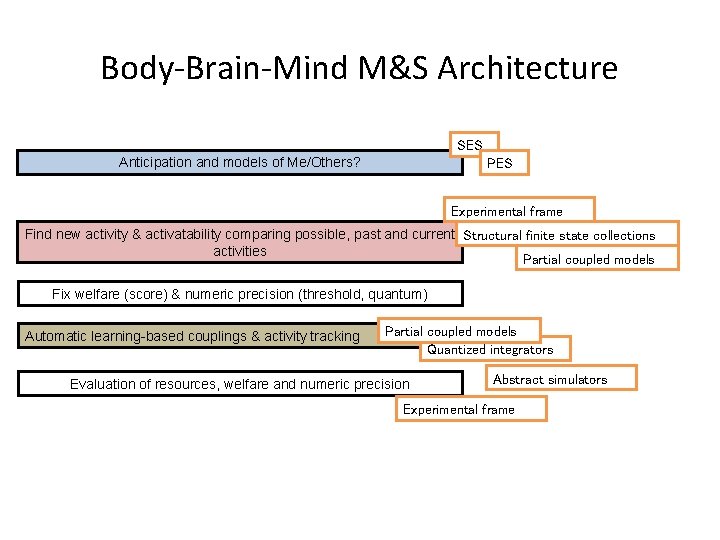
Body-Brain-Mind M&S Architecture SES Anticipation and models of Me/Others? PES Experimental frame Find new activity & activatability comparing possible, past and current Structural finite state collections activities Partial coupled models Fix welfare (score) & numeric precision (threshold, quantum) Automatic learning-based couplings & activity tracking Partial coupled models Quantized integrators Evaluation of resources, welfare and numeric precision Abstract simulators Experimental frame
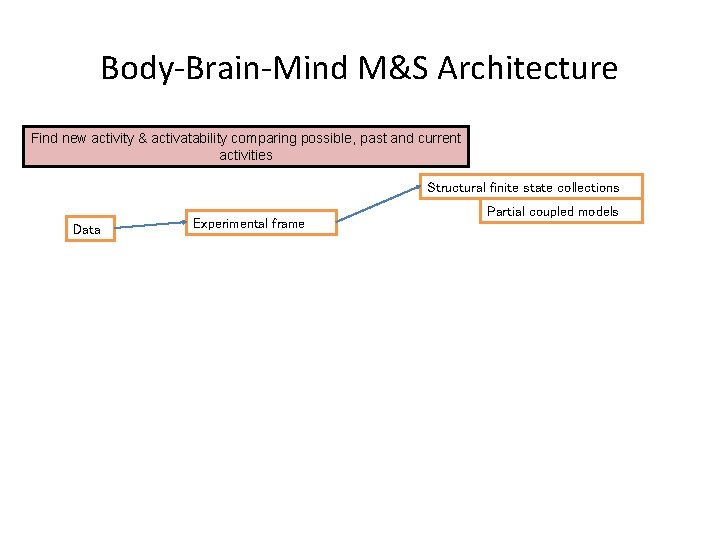
Body-Brain-Mind M&S Architecture Find new activity & activatability comparing possible, past and current activities Structural finite state collections Data Experimental frame Partial coupled models
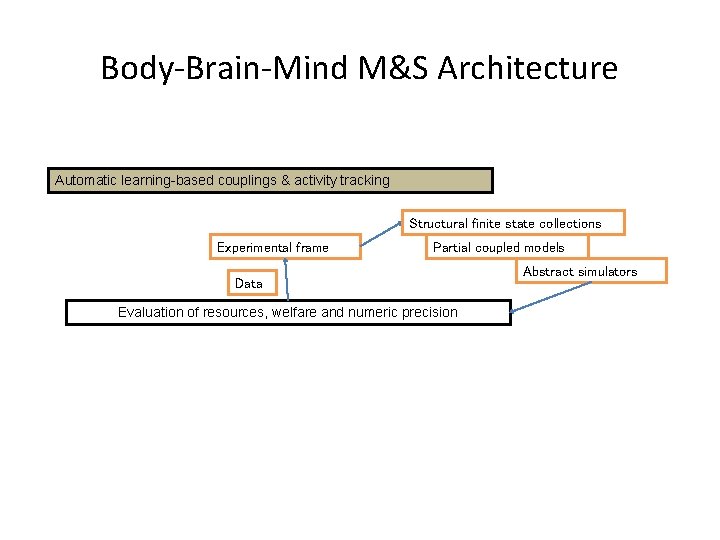
Body-Brain-Mind M&S Architecture Automatic learning-based couplings & activity tracking Structural finite state collections Experimental frame Partial coupled models Data Evaluation of resources, welfare and numeric precision Abstract simulators
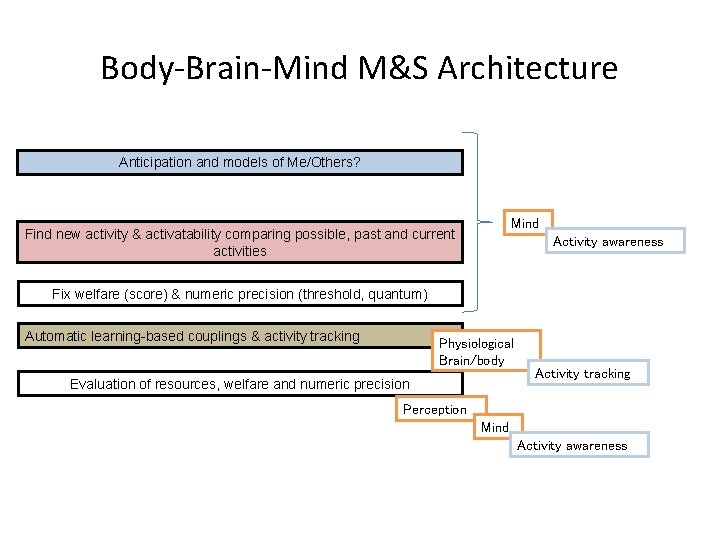
Body-Brain-Mind M&S Architecture Anticipation and models of Me/Others? Mind Find new activity & activatability comparing possible, past and current activities Activity awareness Fix welfare (score) & numeric precision (threshold, quantum) Automatic learning-based couplings & activity tracking Physiological Brain/body Evaluation of resources, welfare and numeric precision Activity tracking Perception Mind Activity awareness
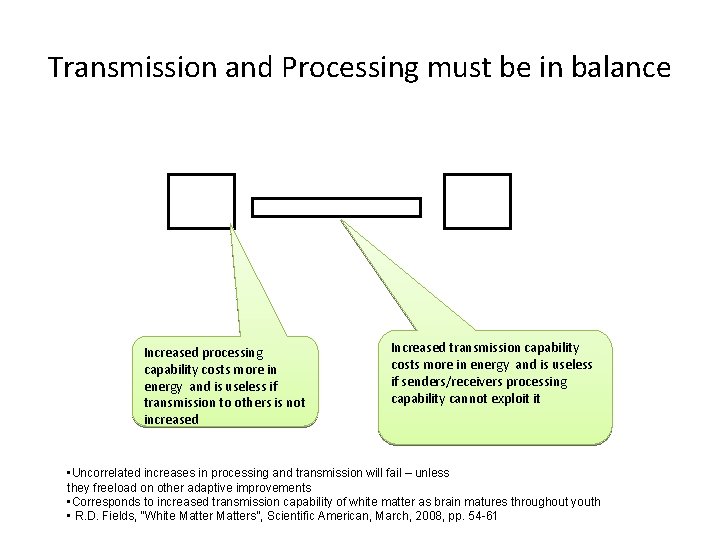
Transmission and Processing must be in balance Increased processing capability costs more in energy and is useless if transmission to others is not increased Increased transmission capability costs more in energy and is useless if senders/receivers processing capability cannot exploit it • Uncorrelated increases in processing and transmission will fail – unless they freeload on other adaptive improvements • Corresponds to increased transmission capability of white matter as brain matures throughout youth • R. D. Fields, “White Matters”, Scientific American, March, 2008, pp. 54 -61
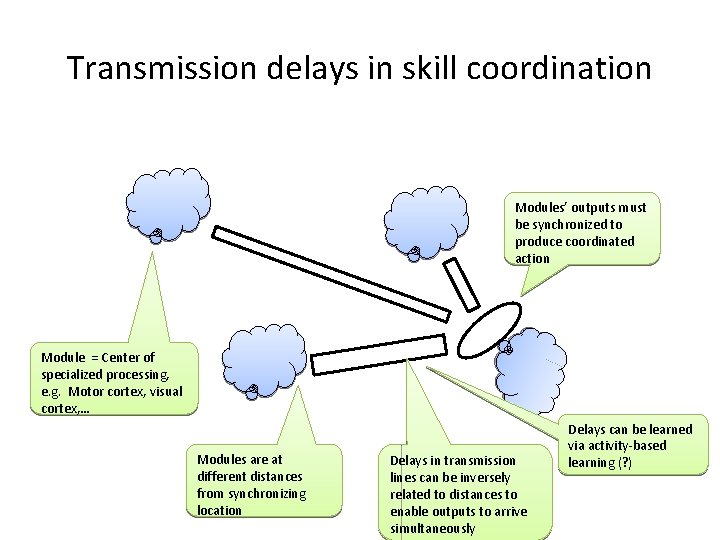
Transmission delays in skill coordination Modules’ outputs must be synchronized to produce coordinated action Module = Center of specialized processing, e. g. Motor cortex, visual cortex, … Modules are at different distances from synchronizing location Delays in transmission lines can be inversely related to distances to enable outputs to arrive simultaneously Delays can be learned via activity-based learning (? )
Interoperation vs Integration* Interoperation of system components • • • participants remain autonomous and independent loosely coupled interaction rules are soft coded local data vocabularies persist share information via mediation Integration of system components • • • participants are assimilated into whole, losing autonomy and independence tightly coupled interaction rules are hard coded global data vocabulary adopted share information conforming to strict standards reusability composability efficiency NOT Polar Opposites! * adapted from: J. T. Pollock, R. Hodgson, “Adaptive Information”, Wiley-Interscience, 2004 43
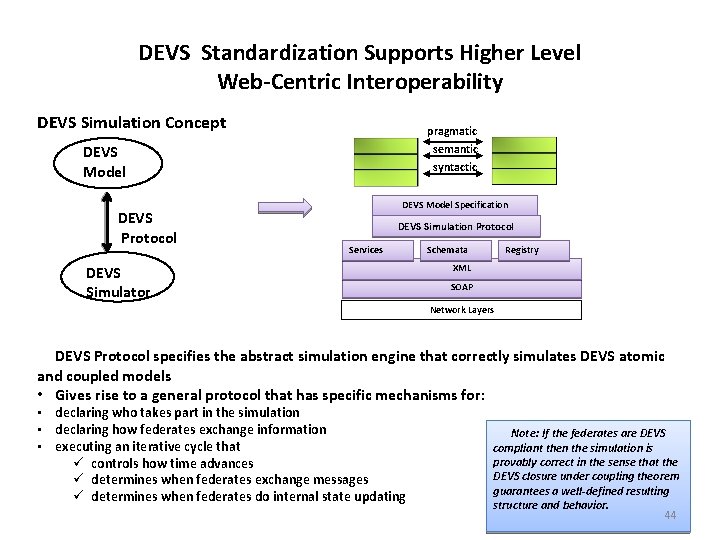
DEVS Standardization Supports Higher Level Web-Centric Interoperability DEVS Simulation Concept pragmatic semantic syntactic DEVS Model DEVS Protocol DEVS Model Specification DEVS Simulation Protocol Services DEVS Simulator Schemata Registry XML SOAP Network Layers DEVS Protocol specifies the abstract simulation engine that correctly simulates DEVS atomic and coupled models • Gives rise to a general protocol that has specific mechanisms for: • declaring who takes part in the simulation • declaring how federates exchange information • executing an iterative cycle that ü controls how time advances ü determines when federates exchange messages ü determines when federates do internal state updating Note: If the federates are DEVS compliant then the simulation is provably correct in the sense that the DEVS closure under coupling theorem guarantees a well-defined resulting structure and behavior. 44
• N inputs , m outputs, • the max score is n when every input is mapped to the correct output • there are (n*m) couplings initially, • requiring at most 2^(nm) evaluations required for exhaustive search. • start with the initial set of all couplings of size nm At each stage, I, • reduce the subset by one, i • looking at most through each of the (ni-1) subsets • without using component achievements vs with using component achievements • Can show that the expected search takes time n^3 vs n^2 for • at that stage (size ni) which adds to about (nm)^2 -- this is less then exhaustive search and made possible by the fact that only the best subset needs to be found at each stage (depends on the evaluation function). When activity-based achievements of individual couplings are used, we order the next level subsets by the total achievements and after a few stages, this results in getting the best one on the first try. So this amounts to about nm evaluations. But also for m outputs, we simulate for about nm execution time, so the first takes about (nm)^3 versus the second (nm)^2. The hardest is when m = n and we have n^3 vs n^2. I have tried up to n = 9 and found this to be verified. But like you say, this will all depend on the particular task and algorithm used - the point is activities may be able to accelerate any such search (learning or evollution process). On the coord and EF -- the coord works under the control of the search algorithm -- and at the end of a simulation the EF gives the result to the coord to pass on the search (actually in my current implementation it can bypass the
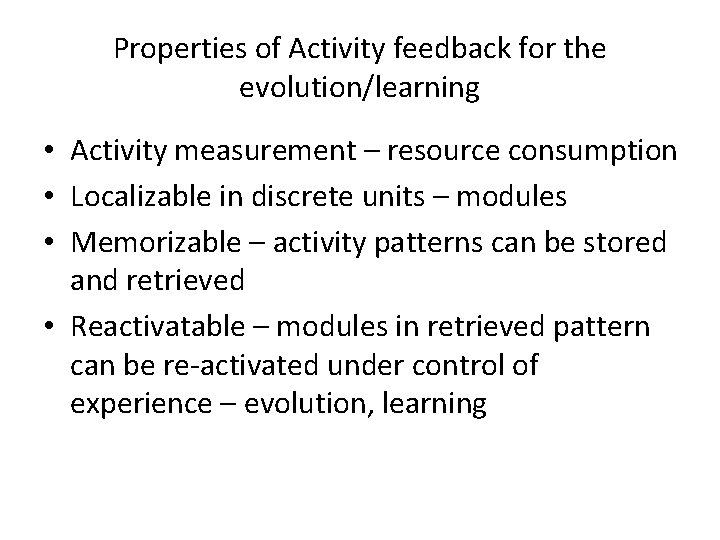
Properties of Activity feedback for the evolution/learning • Activity measurement – resource consumption • Localizable in discrete units – modules • Memorizable – activity patterns can be stored and retrieved • Reactivatable – modules in retrieved pattern can be re-activated under control of experience – evolution, learning
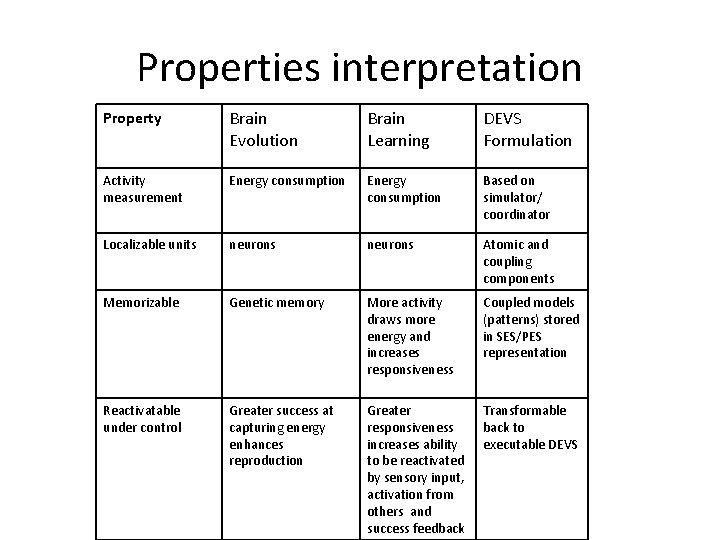
Properties interpretation Property Brain Evolution Brain Learning DEVS Formulation Activity measurement Energy consumption Based on simulator/ coordinator Localizable units neurons Atomic and coupling components Memorizable Genetic memory More activity draws more energy and increases responsiveness Coupled models (patterns) stored in SES/PES representation Reactivatable under control Greater success at capturing energy enhances reproduction Greater responsiveness increases ability to be reactivated by sensory input, activation from others and success feedback Transformable back to executable DEVS
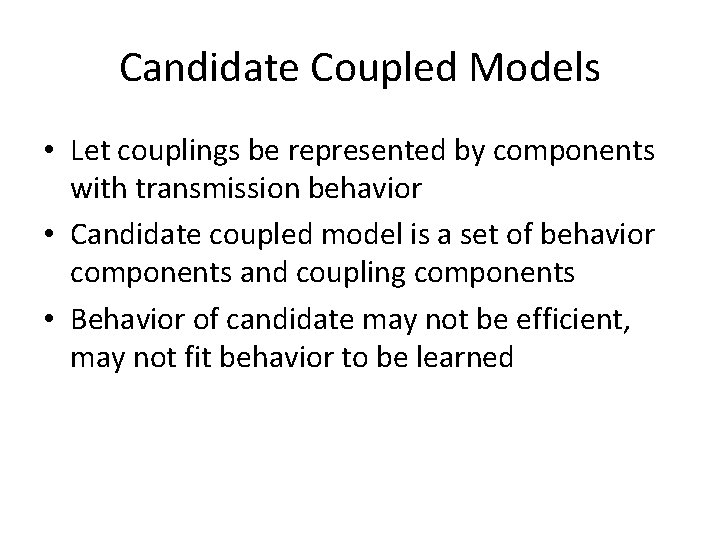
Candidate Coupled Models • Let couplings be represented by components with transmission behavior • Candidate coupled model is a set of behavior components and coupling components • Behavior of candidate may not be efficient, may not fit behavior to be learned
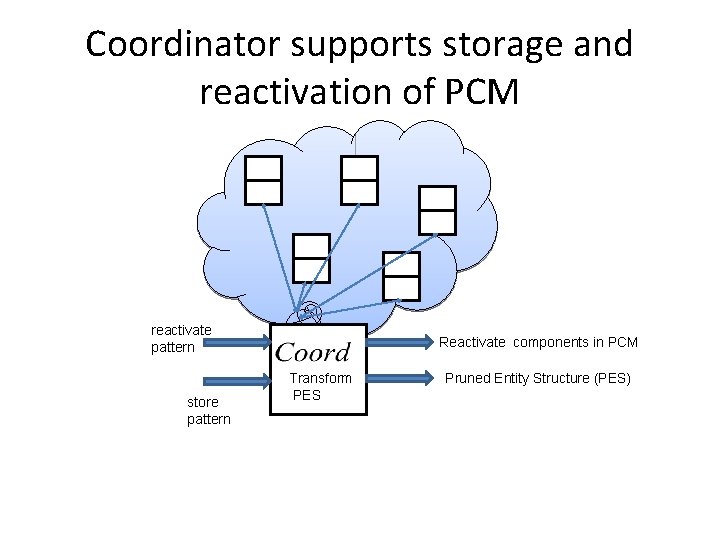
Coordinator supports storage and reactivation of PCM reactivate pattern store pattern Reactivate components in PCM Transform PES Pruned Entity Structure (PES)
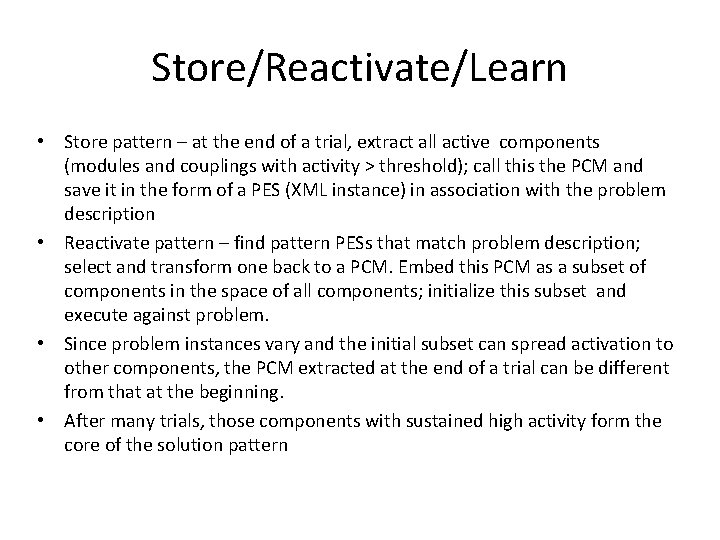
Store/Reactivate/Learn • Store pattern – at the end of a trial, extract all active components (modules and couplings with activity > threshold); call this the PCM and save it in the form of a PES (XML instance) in association with the problem description • Reactivate pattern – find pattern PESs that match problem description; select and transform one back to a PCM. Embed this PCM as a subset of components in the space of all components; initialize this subset and execute against problem. • Since problem instances vary and the initial subset can spread activation to other components, the PCM extracted at the end of a trial can be different from that at the beginning. • After many trials, those components with sustained high activity form the core of the solution pattern
Output Evaluation, Structure Analysis Target I/O Function input 1 input 2 Output produced by structure for input output 1 output 2 evaluation of output input 1 input 2 {} 0 0 {output 1} 1 [-. 1, 0] {output 2} [-. 1, 0] 1 {output 1, output 2} . 5 Structure {} {c 11} {c 22} {c 12} {c 21} {c 11, c 12} {c 11, c 21} {c 11, c 22} {c 22, c 12} {c 22, c 21} {c 12, c 21, c 22} {c 12, c 21, c 11} {c 11, c 22, c 21} {c 11, c 22, c 12} {c 11, c 12, c 22, c 12} input 1 {} {output 1} {} {output 2} {} {output 1, output 2} {output 1} {} {} {output 2} { output 1, output 2} Maximum when output is correct Give some credit when both outputs are produced Give zero or negative credit for wrong output input 2 {} {} {output 2} {} {output 1} {output 2} {output 1, output 2} {output 1} { output 1, output 2} {} {output 1, output 2} { output 1, output 2}
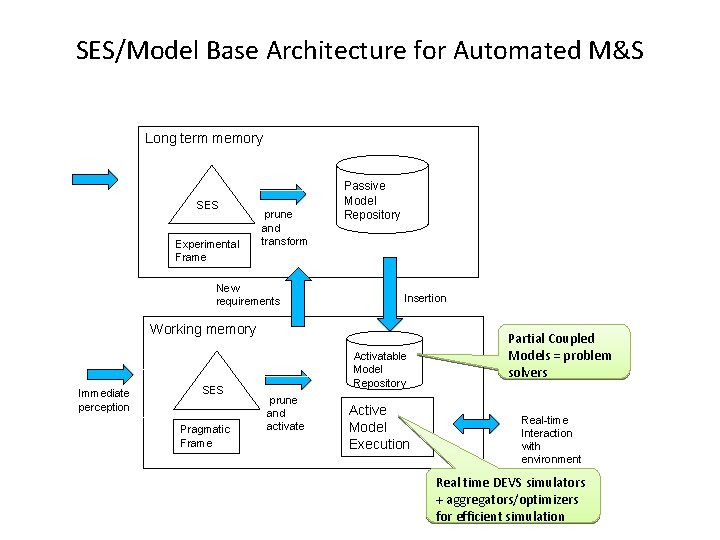
SES/Model Base Architecture for Automated M&S Long term memory SES Experimental Frame prune and transform New requirements Passive Model Repository Insertion Working memory Immediate perception SES Pragmatic Frame Activatable Model Repository prune and activate Active Model Execution Partial Coupled Models = problem solvers Real-time Interaction with environment Real time DEVS simulators + aggregators/optimizers for efficient simulation
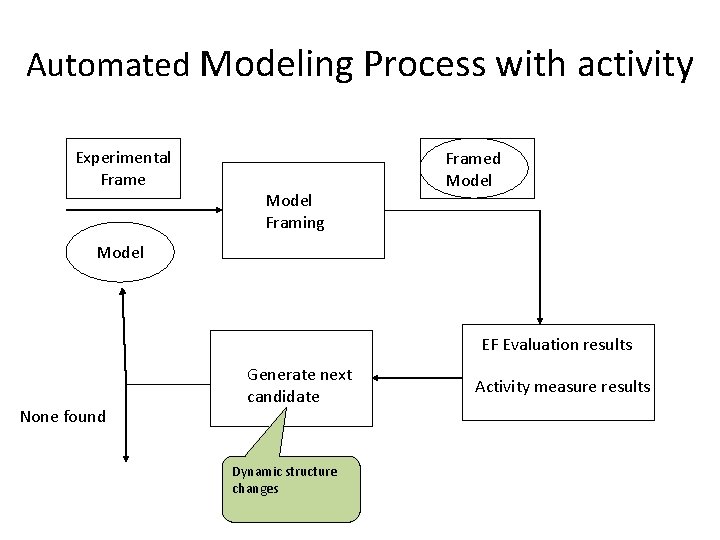
Automated Modeling Process with activity Experimental Frame Model Framing Framed Model EF Evaluation results None found Generate next candidate Dynamic structure changes Activity measure results
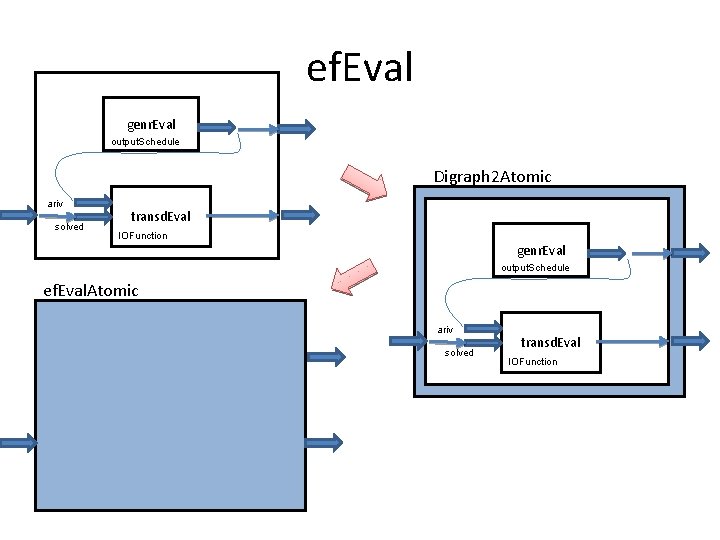
ef. Eval genr. Eval output. Schedule Digraph 2 Atomic ariv solved transd. Eval IOFunction genr. Eval output. Schedule ef. Eval. Atomic ariv solved transd. Eval IOFunction
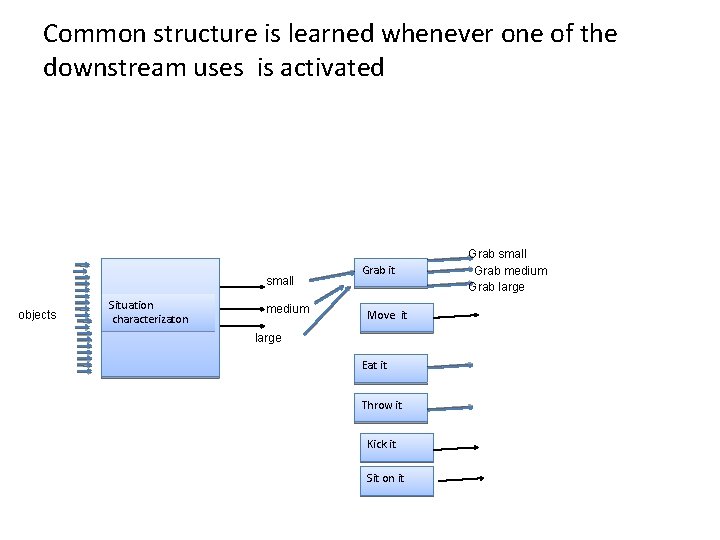
Common structure is learned whenever one of the downstream uses is activated small objects Situation characterizaton medium Grab it Move it large Eat it Throw it Kick it Sit on it Grab small Grab medium Grab large
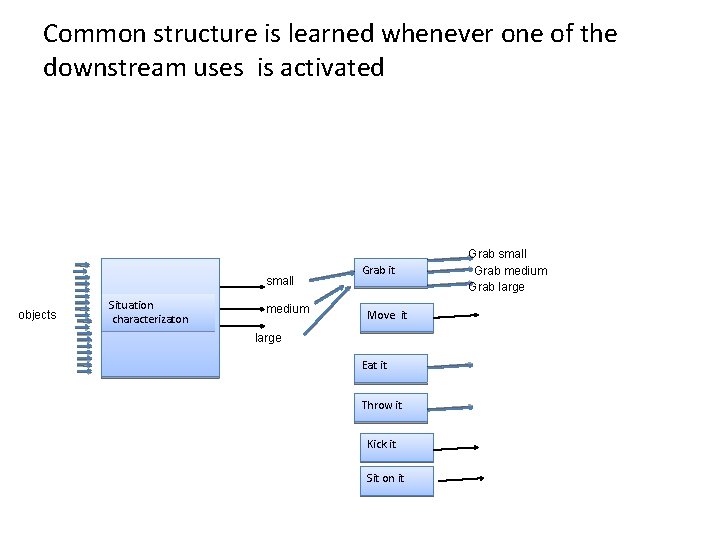
Common structure is learned whenever one of the downstream uses is activated small objects Situation characterizaton medium Grab it Move it large Eat it Throw it Kick it Sit on it Grab small Grab medium Grab large
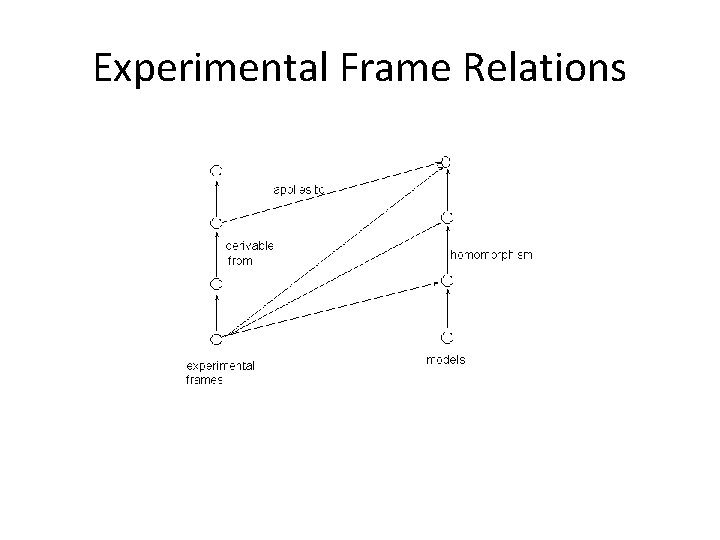
Experimental Frame Relations
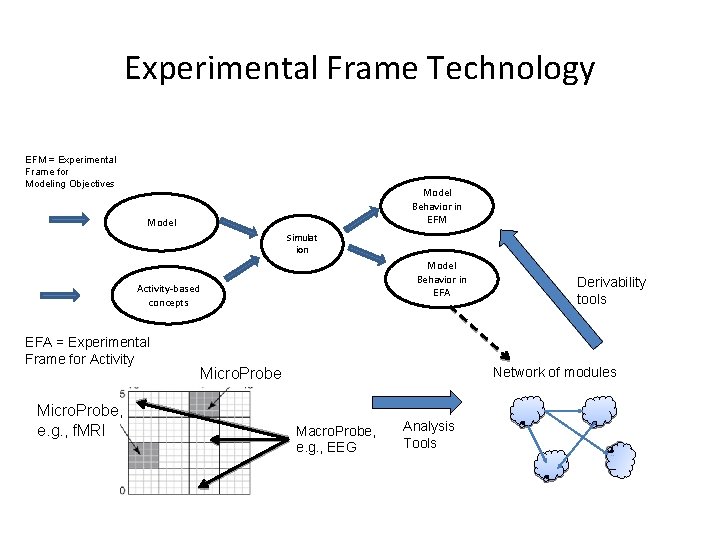
Experimental Frame Technology EFM = Experimental Frame for Modeling Objectives Model Behavior in EFM Model Simulat ion Model Behavior in EFA Activity-based concepts EFA = Experimental Frame for Activity Micro. Probe, e. g. , f. MRI Derivability tools Network of modules Micro. Probe Macro. Probe, e. g. , EEG Analysis Tools