
ACTIVITY RESOURCE USAGE MODEL AND TACTICAL DECISION MAKING


- Slides: 14
ACTIVITY RESOURCE USAGE MODEL AND TACTICAL DECISION MAKING CHAPTER 17 © 2014 Cengage Learning. All Rights Reserved. May not be copied, scanned, or duplicated, in whole or in part, except for use as permitted in a license distributed with a certain product or service or otherwise on a password-protected website for classroom use.
CHAPTER 17 OBJECTIVES 1. Describe the tactical decision-making model 2. Define the concept of relevant costs and revenues 3. Explain how the activity resource usage model is used in assessing relevancy 4. Apply the tactical decision-making concepts in a variety of business situations © 2014 Cengage Learning. All Rights Reserved. May not be copied, scanned, or duplicated, in whole or in part, except for use as permitted in a license distributed with a certain product or service or otherwise on a password-protected website for classroom use.
TACTICAL DECISION MAKING • Choosing among alternatives with an immediate or limited end in view LO-1 © 2014 Cengage Learning. All Rights Reserved. May not be copied, scanned, or duplicated, in whole or in part, except for use as permitted in a license distributed with a certain product or service or otherwise on a password-protected website for classroom use.
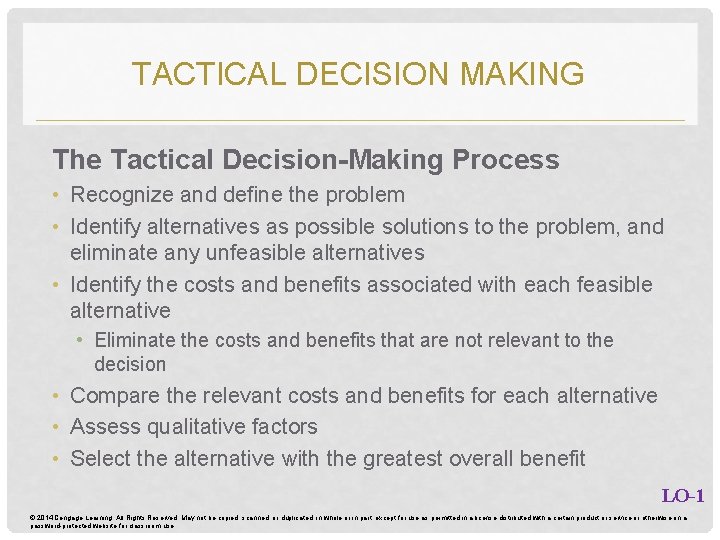
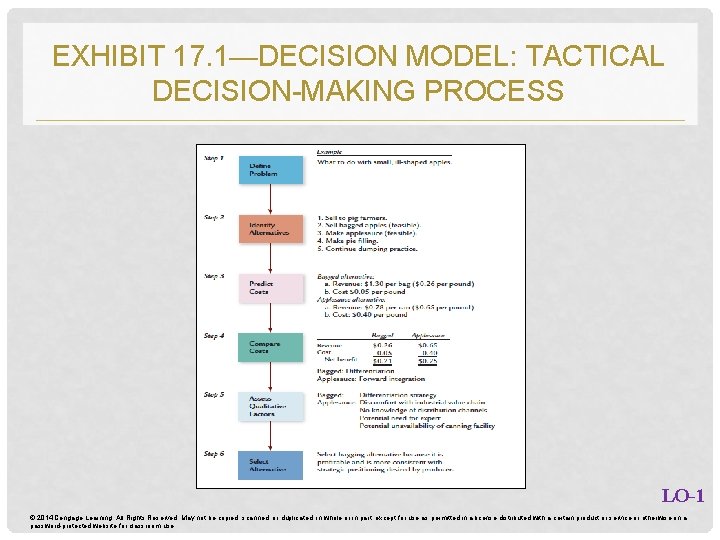
TACTICAL DECISION MAKING The Tactical Decision-Making Process • Recognize and define the problem • Identify alternatives as possible solutions to the problem, and eliminate any unfeasible alternatives • Identify the costs and benefits associated with each feasible alternative • Eliminate the costs and benefits that are not relevant to the decision • Compare the relevant costs and benefits for each alternative • Assess qualitative factors • Select the alternative with the greatest overall benefit LO-1 © 2014 Cengage Learning. All Rights Reserved. May not be copied, scanned, or duplicated, in whole or in part, except for use as permitted in a license distributed with a certain product or service or otherwise on a password-protected website for classroom use.
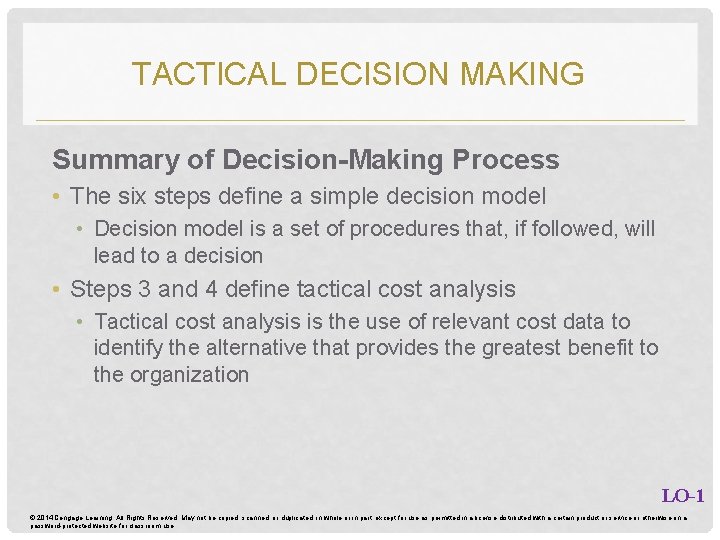
TACTICAL DECISION MAKING Summary of Decision-Making Process • The six steps define a simple decision model • Decision model is a set of procedures that, if followed, will lead to a decision • Steps 3 and 4 define tactical cost analysis • Tactical cost analysis is the use of relevant cost data to identify the alternative that provides the greatest benefit to the organization LO-1 © 2014 Cengage Learning. All Rights Reserved. May not be copied, scanned, or duplicated, in whole or in part, except for use as permitted in a license distributed with a certain product or service or otherwise on a password-protected website for classroom use.
EXHIBIT 17. 1—DECISION MODEL: TACTICAL DECISION-MAKING PROCESS LO-1 © 2014 Cengage Learning. All Rights Reserved. May not be copied, scanned, or duplicated, in whole or in part, except for use as permitted in a license distributed with a certain product or service or otherwise on a password-protected website for classroom use.
RELEVANT COSTS AND REVENUES • Relevant costs (revenues) are future costs (revenues) that differ across alternatives • If a future cost is the same for more than one alternative, it has no effect on the decision • Such a cost is an irrelevant cost LO-2 © 2014 Cengage Learning. All Rights Reserved. May not be copied, scanned, or duplicated, in whole or in part, except for use as permitted in a license distributed with a certain product or service or otherwise on a password-protected website for classroom use.
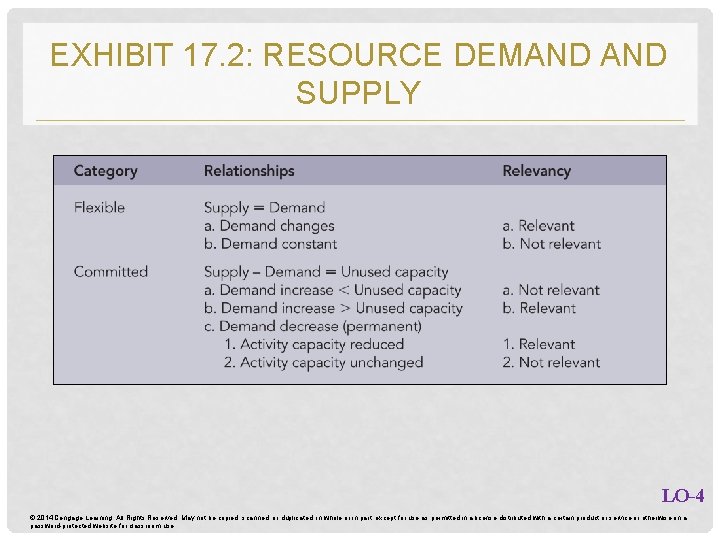
RELEVANCY, COST BEHAVIOR, AND THE ACTIVITY RESOURCE USAGE MODEL • The activity resource usage model focuses on the use of resources and has two categories • Flexible resources: purchased in the amount needed and at the time of use (like electricity) • Committed resources: acquired in advance of usage through implicit contracting (like salaried employees) • Usually acquired in lumpy amounts LO-3 © 2014 Cengage Learning. All Rights Reserved. May not be copied, scanned, or duplicated, in whole or in part, except for use as permitted in a license distributed with a certain product or service or otherwise on a password-protected website for classroom use.
EXHIBIT 17. 2: RESOURCE DEMAND SUPPLY LO-4 © 2014 Cengage Learning. All Rights Reserved. May not be copied, scanned, or duplicated, in whole or in part, except for use as permitted in a license distributed with a certain product or service or otherwise on a password-protected website for classroom use.
ILLUSTRATIVE EXAMPLES OF TACTICAL DECISION MAKING Make or Buy Decisions • A decision whether to make or to buy components or services used in making a product or providing a service • Outsourcing refers to the move of a business function to another company, either inside or outside the United States LO-4 © 2014 Cengage Learning. All Rights Reserved. May not be copied, scanned, or duplicated, in whole or in part, except for use as permitted in a license distributed with a certain product or service or otherwise on a password-protected website for classroom use.
ILLUSTRATIVE EXAMPLES OF TACTICAL DECISION MAKING Keep-or-Drop Decisions • Involves determining whether a segment or line of business should be kept or dropped • Uses relevant cost analysis LO-4 © 2014 Cengage Learning. All Rights Reserved. May not be copied, scanned, or duplicated, in whole or in part, except for use as permitted in a license distributed with a certain product or service or otherwise on a password-protected website for classroom use.
ILLUSTRATIVE EXAMPLES OF TACTICAL DECISION MAKING Special-Order Decisions • Focuses on whether a specially priced order should be accepted or rejected LO-4 © 2014 Cengage Learning. All Rights Reserved. May not be copied, scanned, or duplicated, in whole or in part, except for use as permitted in a license distributed with a certain product or service or otherwise on a password-protected website for classroom use.
ILLUSTRATIVE EXAMPLES OF TACTICAL DECISION MAKING Decisions to Sell or Process Further • Joint products have common processes and costs of production up to a split off point • The point of separation is called the split off point • Key point in this decision is that all the joint production costs are irrelevant to the sell or process further decision LO-4 © 2014 Cengage Learning. All Rights Reserved. May not be copied, scanned, or duplicated, in whole or in part, except for use as permitted in a license distributed with a certain product or service or otherwise on a password-protected website for classroom use.
END OF CHAPTER 17 © 2014 Cengage Learning. All Rights Reserved. May not be copied, scanned, or duplicated, in whole or in part, except for use as permitted in a license distributed with a certain product or service or otherwise on a password-protected website for classroom use.