
Activity Real Life Scenarios Overview In this activity

- Slides: 23
Activity: Real Life Scenarios Overview: In this activity, you will be given a life to ‘play’ – just remember that in the real world you largely decide what life you will have
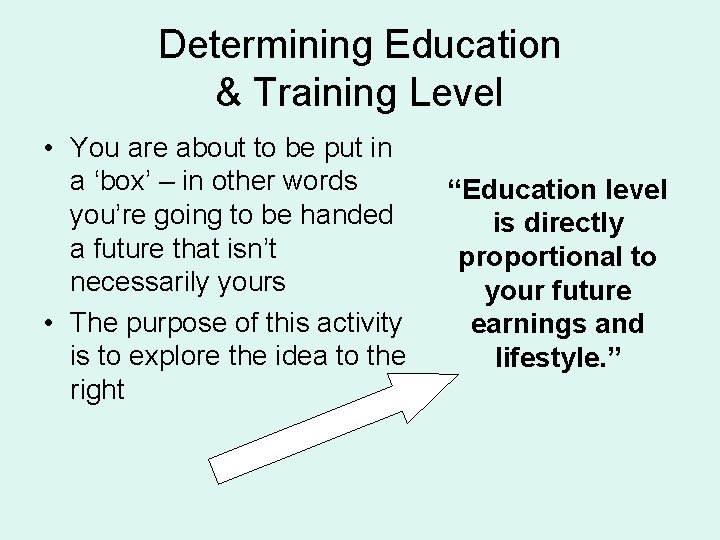
Determining Education & Training Level • You are about to be put in a ‘box’ – in other words you’re going to be handed a future that isn’t necessarily yours • The purpose of this activity is to explore the idea to the right “Education level is directly proportional to your future earnings and lifestyle. ”
Monthly Budget Make sure you have a blank Monthly Budget Worksheet
Directions 1. Fill in your name 2. Record your birth date 3. Add your birth month and birth day to get a number between 2 and 43 4. Use the chart on the next slide to record your education level and monthly salary – This information is from the 2000 US Census
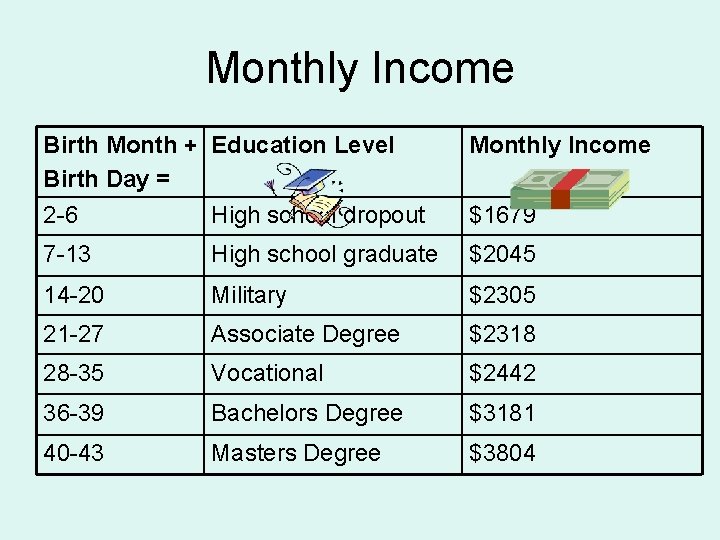
Monthly Income Birth Month + Education Level Birth Day = 2 -6 High school dropout Monthly Income 7 -13 High school graduate $2045 14 -20 Military $2305 21 -27 Associate Degree $2318 28 -35 Vocational $2442 36 -39 Bachelors Degree $3181 40 -43 Masters Degree $3804 $1679
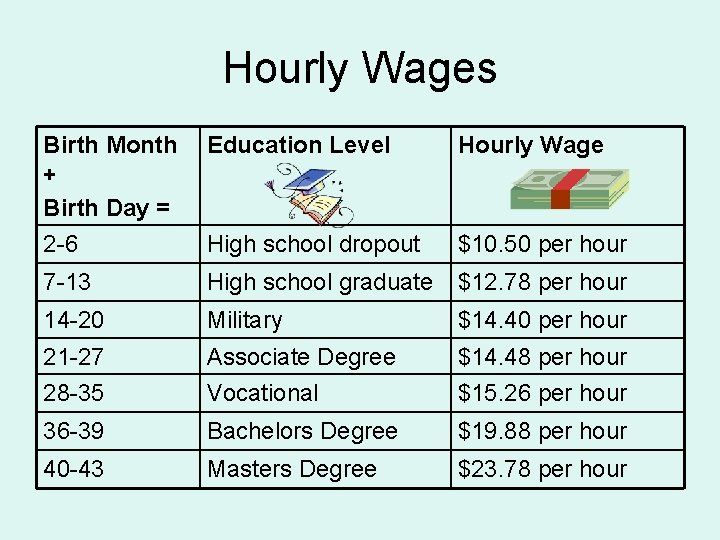
Hourly Wages Birth Month + Birth Day = Education Level Hourly Wage 2 -6 High school dropout $10. 50 per hour 7 -13 High school graduate $12. 78 per hour 14 -20 Military $14. 40 per hour 21 -27 Associate Degree $14. 48 per hour 28 -35 Vocational $15. 26 per hour 36 -39 Bachelors Degree $19. 88 per hour 40 -43 Masters Degree $23. 78 per hour
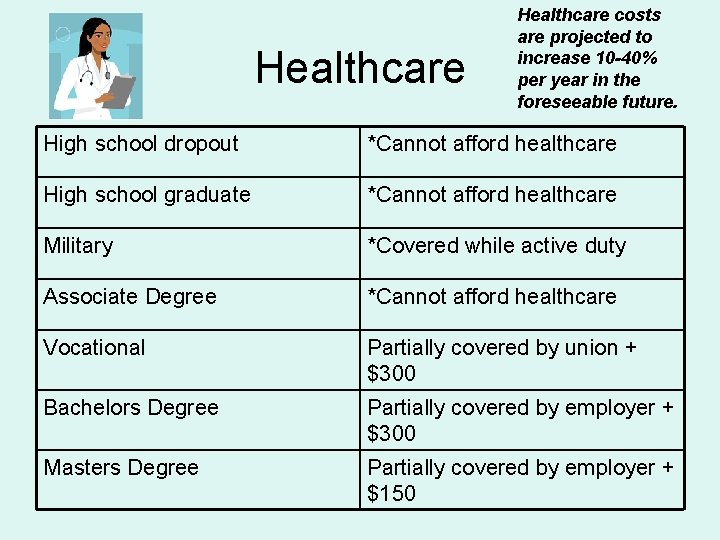
Healthcare costs are projected to increase 10 -40% per year in the foreseeable future. High school dropout *Cannot afford healthcare High school graduate *Cannot afford healthcare Military *Covered while active duty Associate Degree *Cannot afford healthcare Vocational Partially covered by union + $300 Bachelors Degree Partially covered by employer + $300 Masters Degree Partially covered by employer + $150
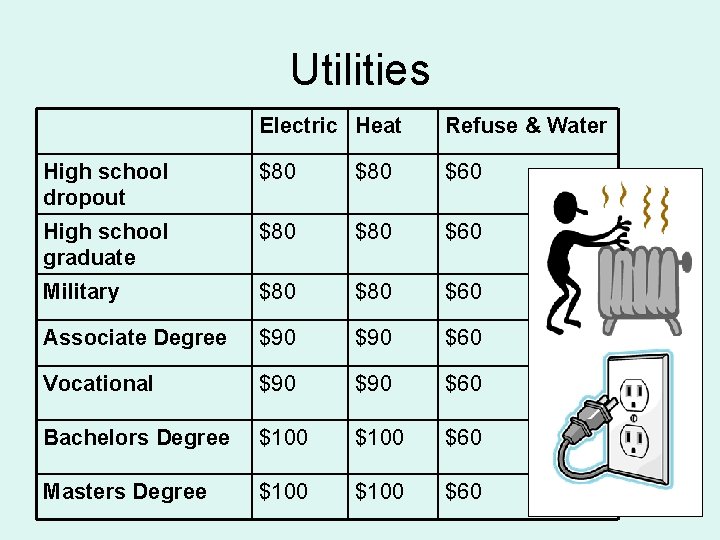
Utilities Electric Heat Refuse & Water High school dropout $80 $60 High school graduate $80 $60 Military $80 $60 Associate Degree $90 $60 Vocational $90 $60 Bachelors Degree $100 $60 Masters Degree $100 $60
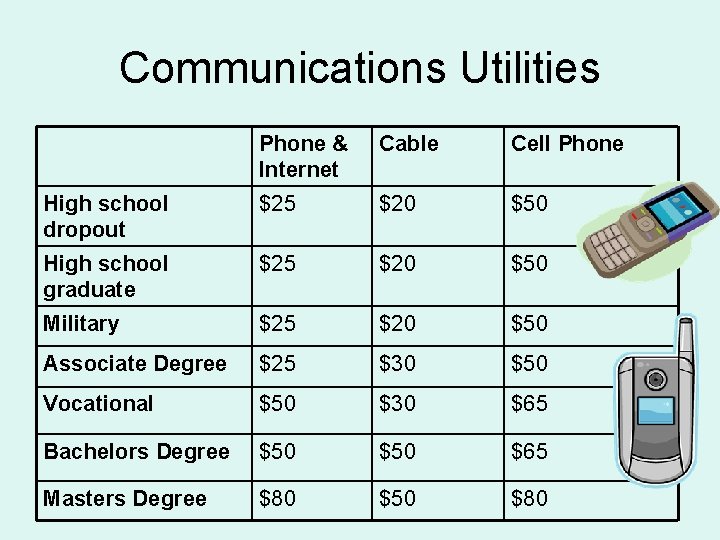
Communications Utilities Phone & Internet Cable Cell Phone High school dropout $25 $20 $50 High school graduate $25 $20 $50 Military $25 $20 $50 Associate Degree $25 $30 $50 Vocational $50 $30 $65 Bachelors Degree $50 $65 Masters Degree $80 $50 $80
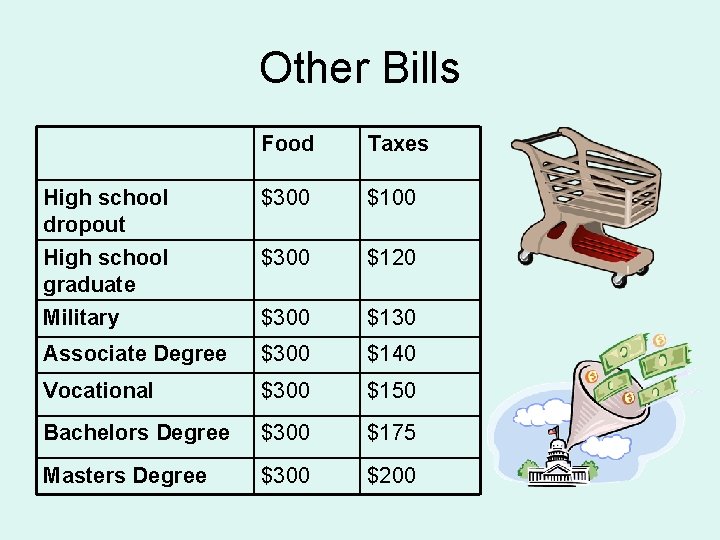
Other Bills Food Taxes High school dropout $300 $100 High school graduate $300 $120 Military $300 $130 Associate Degree $300 $140 Vocational $300 $150 Bachelors Degree $300 $175 Masters Degree $300 $200
Add It Up Add up the amounts in your monthly expenses column and put the number in the “Total Expenses” Space
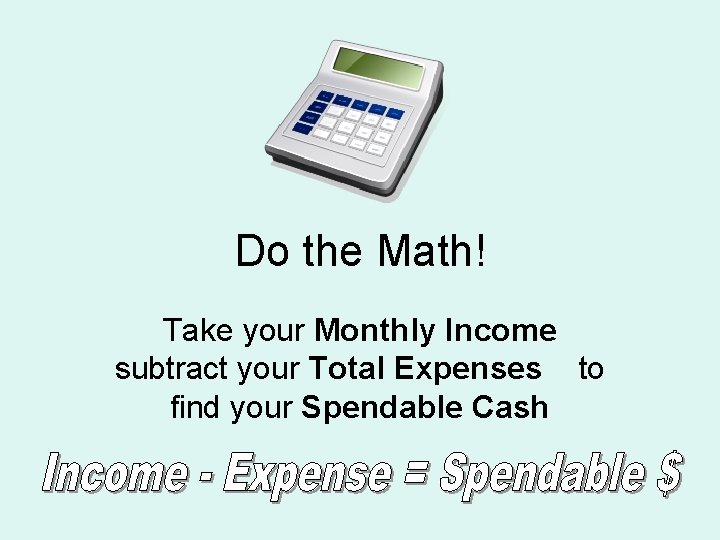
Do the Math! Take your Monthly Income subtract your Total Expenses to find your Spendable Cash
It’s Time to Shop! • Now you can begin shopping with what’s left over. • The next slides show different types of items you may want and some you need. • You must pick out a housing situation, clothing option, and a means of transportation – the rest is up to you and your budget
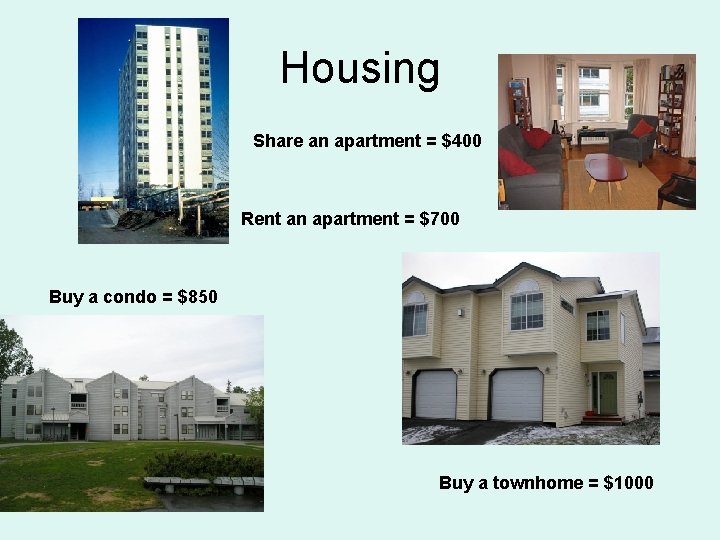
Housing Share an apartment = $400 Rent an apartment = $700 Buy a condo = $850 Buy a townhome = $1000
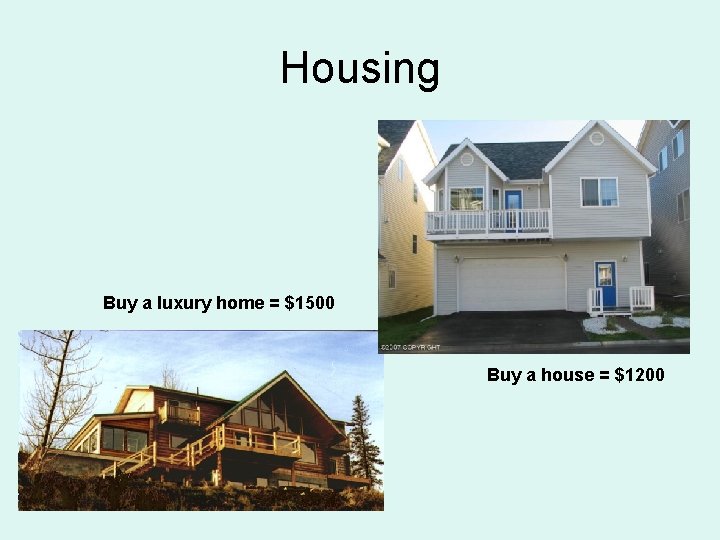
Housing Buy a luxury home = $1500 Buy a house = $1200
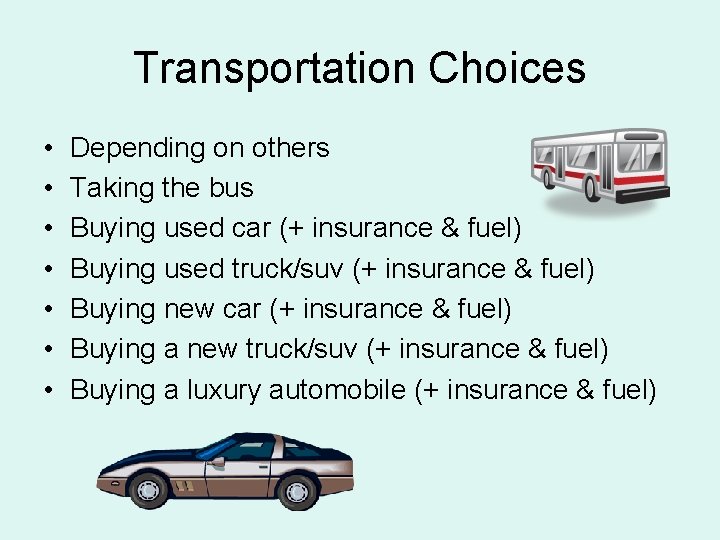
Transportation Choices • • Depending on others Taking the bus Buying used car (+ insurance & fuel) Buying used truck/suv (+ insurance & fuel) Buying new car (+ insurance & fuel) Buying a new truck/suv (+ insurance & fuel) Buying a luxury automobile (+ insurance & fuel)
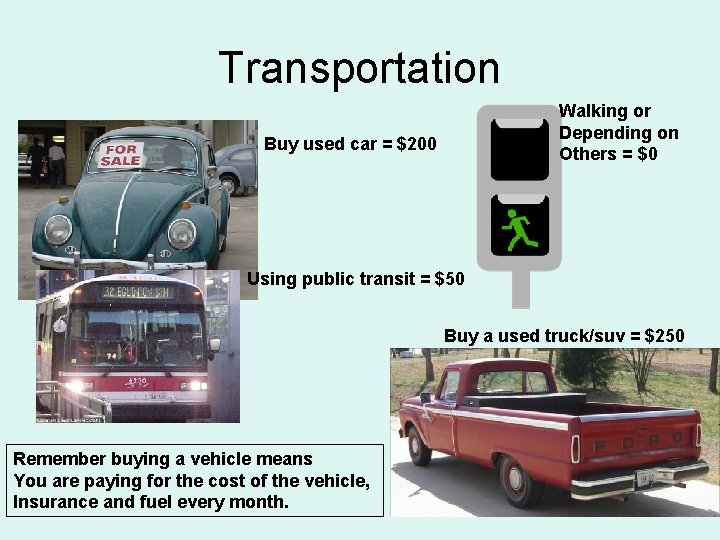
Transportation Walking or Depending on Others = $0 Buy used car = $200 Using public transit = $50 Buy a used truck/suv = $250 Remember buying a vehicle means You are paying for the cost of the vehicle, Insurance and fuel every month.
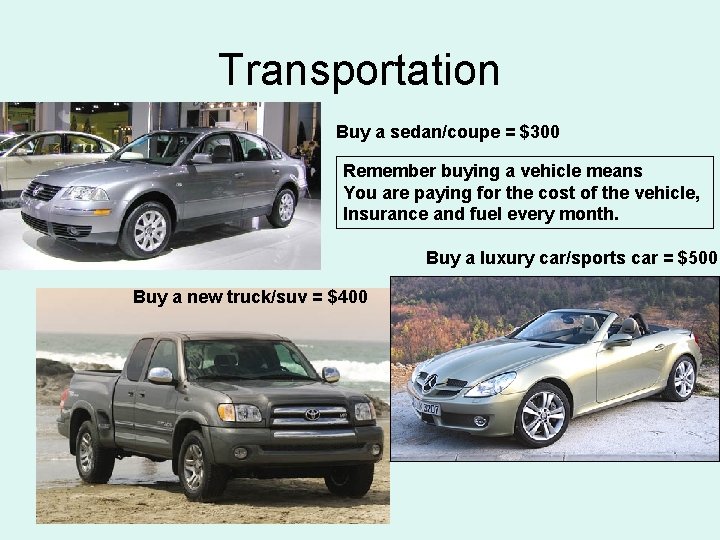
Transportation Buy a sedan/coupe = $300 Remember buying a vehicle means You are paying for the cost of the vehicle, Insurance and fuel every month. Buy a luxury car/sports car = $500 Buy a new truck/suv = $400
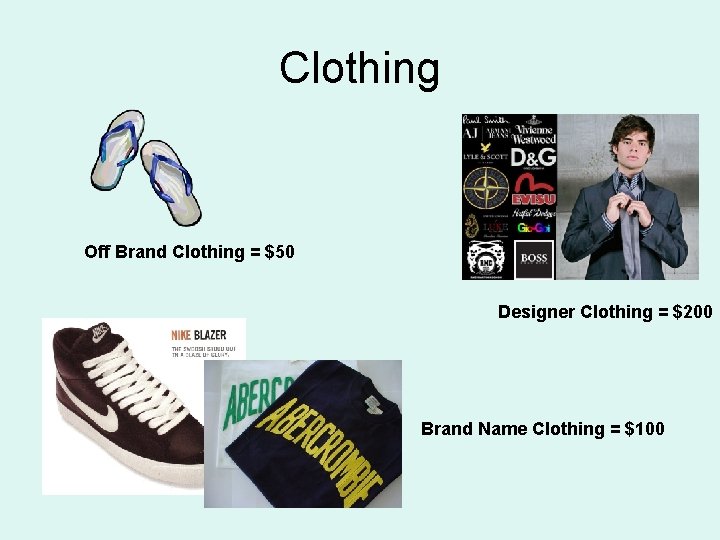
Clothing Off Brand Clothing = $50 Designer Clothing = $200 Brand Name Clothing = $100
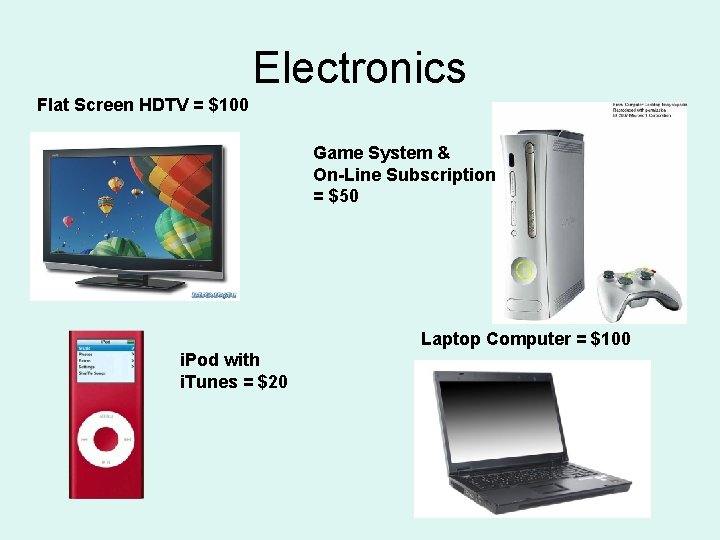
Electronics Flat Screen HDTV = $100 Game System & On-Line Subscription = $50 Laptop Computer = $100 i. Pod with i. Tunes = $20
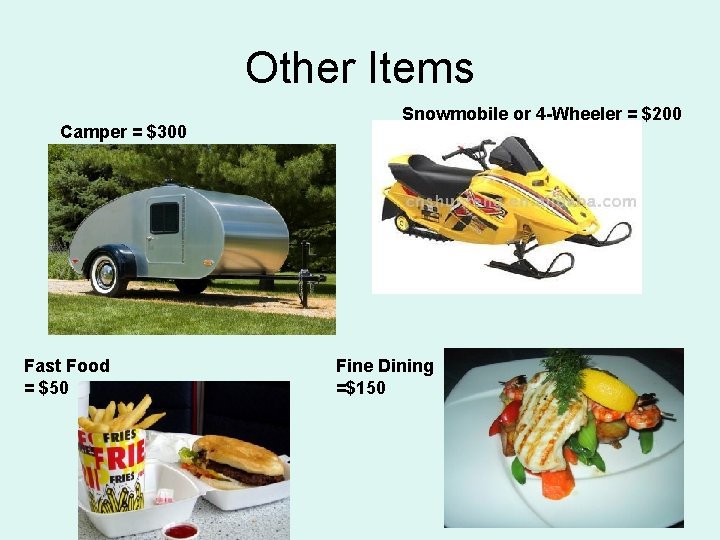
Other Items Camper = $300 Fast Food = $50 Snowmobile or 4 -Wheeler = $200 Fine Dining =$150
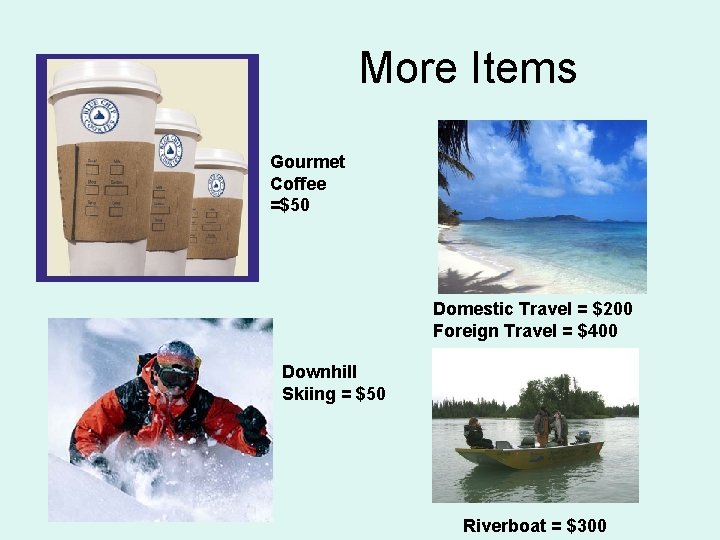
More Items Gourmet Coffee =$50 Domestic Travel = $200 Foreign Travel = $400 Downhill Skiing = $50 Riverboat = $300
Do the Math! Add up your Total Shopping Cost and make sure it is less than the Spendable Income figure – if it is not adjust it until you are at $0 or have some left in Savings When do you plan on retiring?