
Activity Planning Contents Introduction Defining Activities Approaches for
![Reading • [Chapter 6] “Software Project Management by Bob Hughes and Mike Cotterell, Mc.](https://slidetodoc.com/presentation_image_h2/9f290068550d09e8717e2c094343ae10/image-25.jpg "Reading • [Chapter 6] “Software Project Management by Bob Hughes and Mike Cotterell, Mc.")
- Slides: 25
Activity Planning
Contents • • • Introduction Defining Activities Approaches for Identifying Activities Project Schedules Network Planning Models
Introduction • We have looked at the methods forecasting the effort required both for a project as a whole and for individual activities. • A detailed plan, however, must also include a schedule indicating the start and completion times both for project as a whole and for individual activities.
Introduction • A detailed project plan will enable us to – Ensure availability of resources when required. – Produce a detailed schedule showing which staff carry out each activity. – Avoid different activities competing for the same resources at the same time. – Produce a detailed plan against which actual achievement may be measured.
Defining Activities • A project is composed of a number of interrelated activities. • An activity: – Must have a clearly defined start and a clearly defined end-point. – It should produce a tangible deliverable. – Duration and required resources for an activity must be forecastable. – Some activities may require that other activities be completed before they can begin.
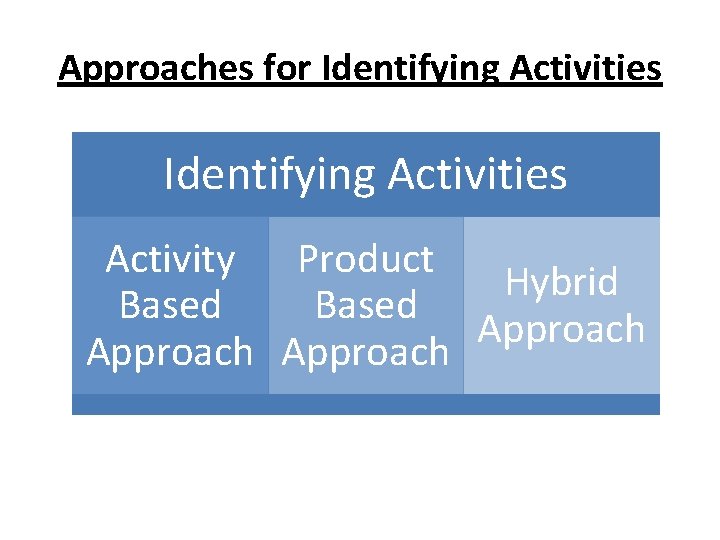
Approaches for Identifying Activities Activity Product Hybrid Based Approach
Activity Based Approach • The activity based approach consists of creating a list of all activities that the project is thought to involve. • This can be done by – Brainstorming session involving the whole project team – The analysis of similar past projects.
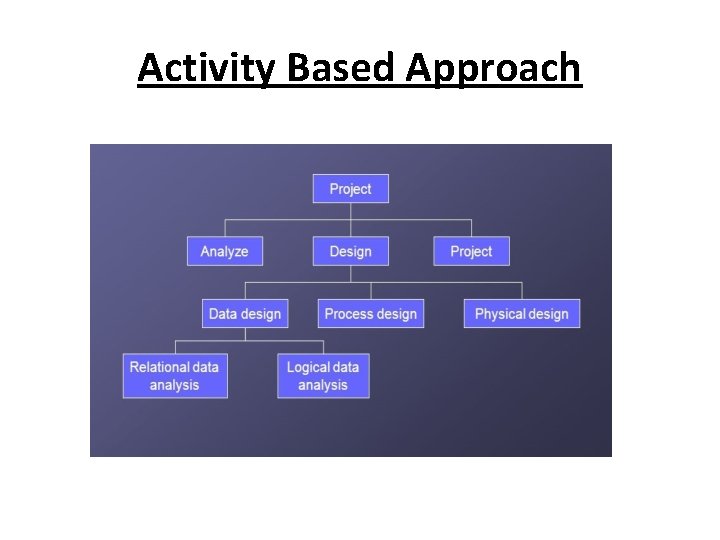
Activity Based Approach • Previously mentioned ways are prone to the obvious risks of omitting or double counting tasks, therefore a much favored way of generating a task list is to create a work breakdown structure. • In WBS we: – Identify the main (high level) tasks (activities) required to complete a project. – Then break each of these down into a set of lowerlevel tasks.
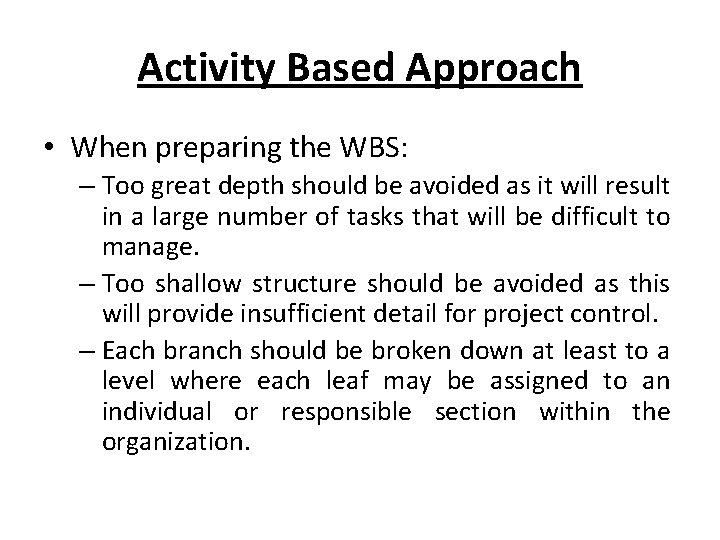
Activity Based Approach • When preparing the WBS: – Too great depth should be avoided as it will result in a large number of tasks that will be difficult to manage. – Too shallow structure should be avoided as this will provide insufficient detail for project control. – Each branch should be broken down at least to a level where each leaf may be assigned to an individual or responsible section within the organization.
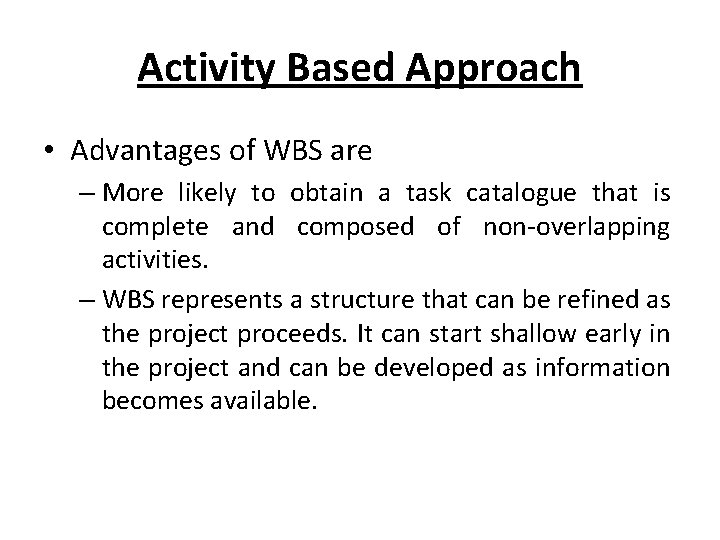
Activity Based Approach • Advantages of WBS are – More likely to obtain a task catalogue that is complete and composed of non-overlapping activities. – WBS represents a structure that can be refined as the project proceeds. It can start shallow early in the project and can be developed as information becomes available.
Activity Based Approach
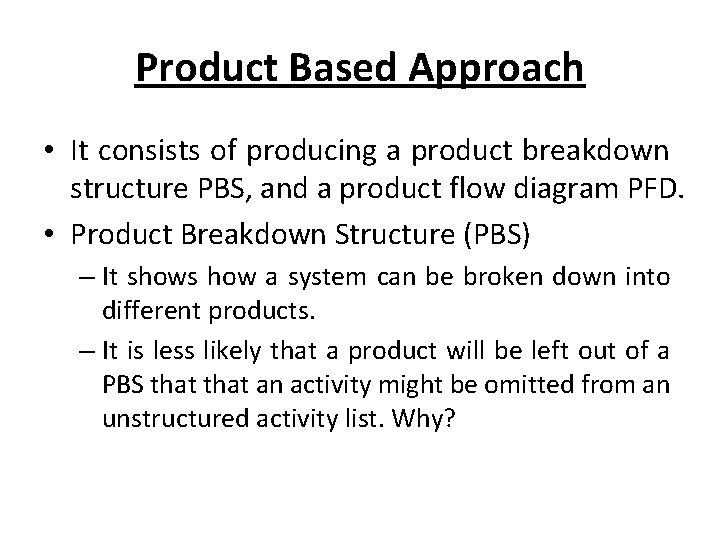
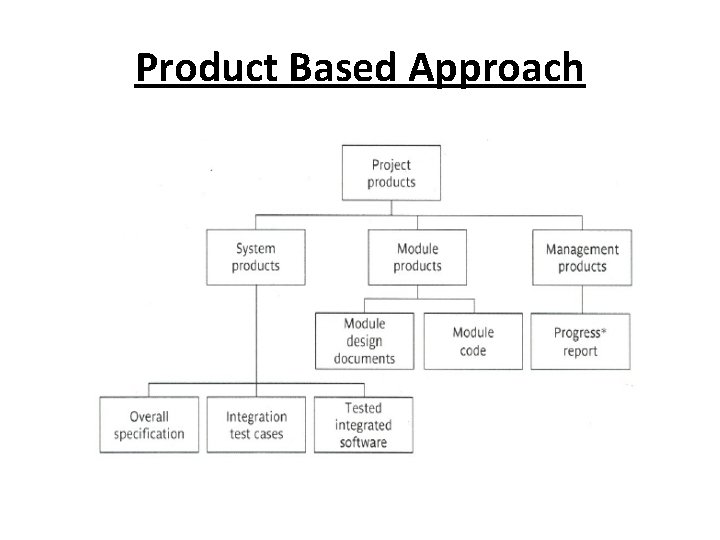
Product Based Approach • It consists of producing a product breakdown structure PBS, and a product flow diagram PFD. • Product Breakdown Structure (PBS) – It shows how a system can be broken down into different products. – It is less likely that a product will be left out of a PBS that an activity might be omitted from an unstructured activity list. Why?
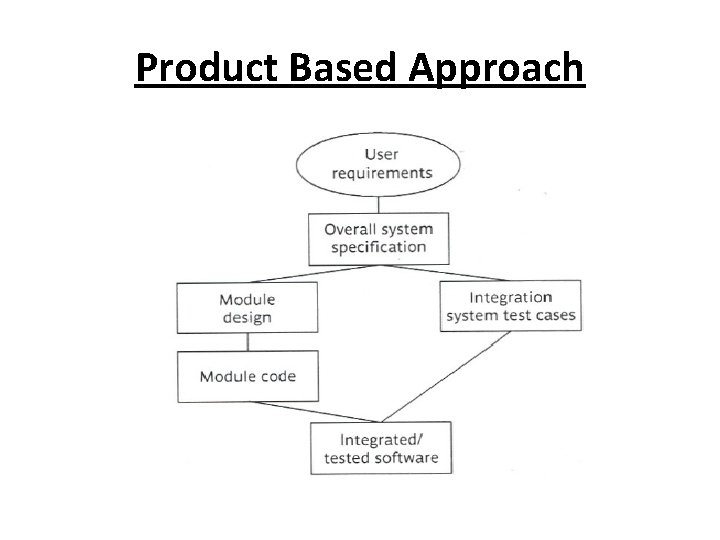
Product Based Approach • Product Flow Diagram (PFD) – It indicates for each product, which other products are required as ‘inputs’. – It is easily transformed into an ordered list of activities by identifying the transformations that turn some products into others.
Product Based Approach
Product Based Approach
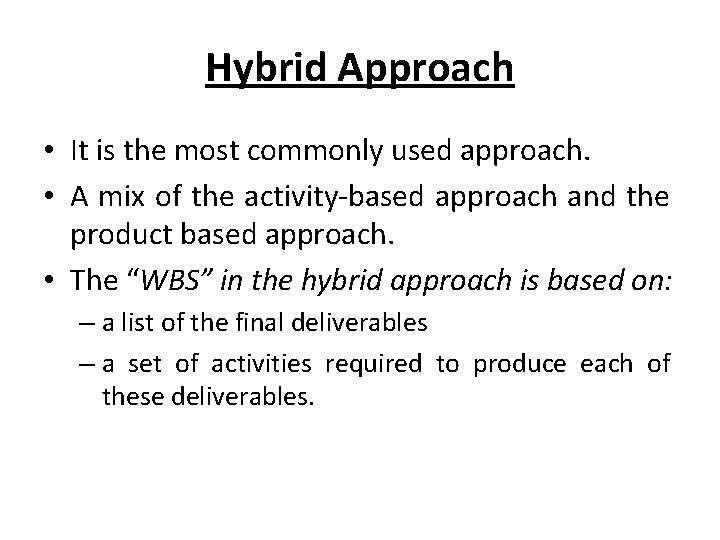
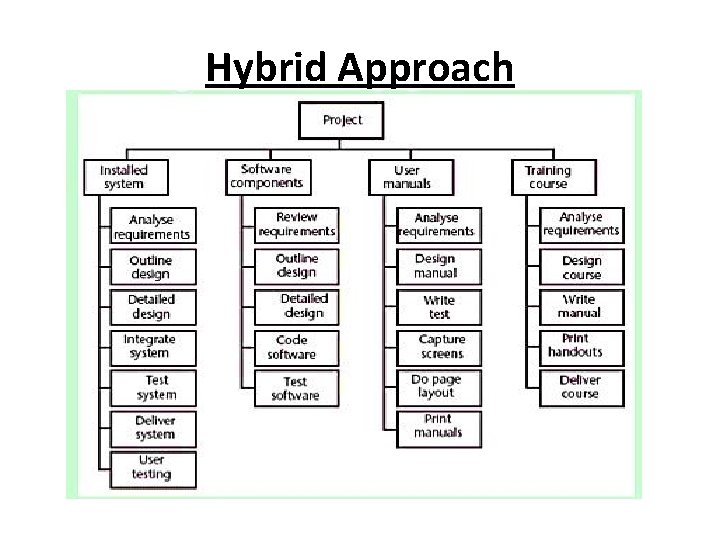
Hybrid Approach • It is the most commonly used approach. • A mix of the activity-based approach and the product based approach. • The “WBS” in the hybrid approach is based on: – a list of the final deliverables – a set of activities required to produce each of these deliverables.
Hybrid Approach
Project Schedules • Once the project activities have been identified they will need to be sequenced. • This can be done by creating a project schedule. • A project schedule is a project plan, that shows the start and finish date of each activity and resources required.
Project Schedules • Creating a project schedule comprises four steps: • Step 1: – Decide what activities need to be carried out. – Identify the order they are to be done. – Based on that, construct an ideal activity plan. – An ideal activity plan is a plan where there are no constraints on the resources.
Project Schedules • Step 2: – The ideal activity plan is subjected to an activity risk analysis to identify potential problems. – This might suggest alterations to the ideal activity plan • Step 3: – Third step is resource allocation. – The availability of resources may place constraints on when certain activities can be carried out. – The ideal plan might need to be adapted accordingly.
Project Schedules • Step 4: – A Project Schedule is produced and published which contains: • Start date for each activity. • End date for each activity. • Resource requirement statement for each activity.
Network Planning Models • Network planning models are the project scheduling techniques that model the project’s activities and their relationships as a precedence network. • Critical path method (CPM) is the most commonly used technique for creating a precedence network. • It represents activities as nodes and their relationship as links.
Network Planning Models • There are some rules that should be considered while constructing a precedence network. – A project network should have only one start node. – A project network should have only one end node. – A node should have a duration. – Links have no duration. – Precedents are the immediate preceding activities.
Network Planning Models – Time moves from left to right. – A network should not contain loops. – A network should not contain dangles • Complete process of creating a network will be demonstrated on white board during lecture.
Reading • [Chapter 6] “Software Project Management by Bob Hughes and Mike Cotterell, Mc. Graw-Hill Education; 6 th Edition (2009). ISBN-10: 0077122798”