
Activity of Moxifloxacin against Staphylococcus aureus in Models
- Slides: 1
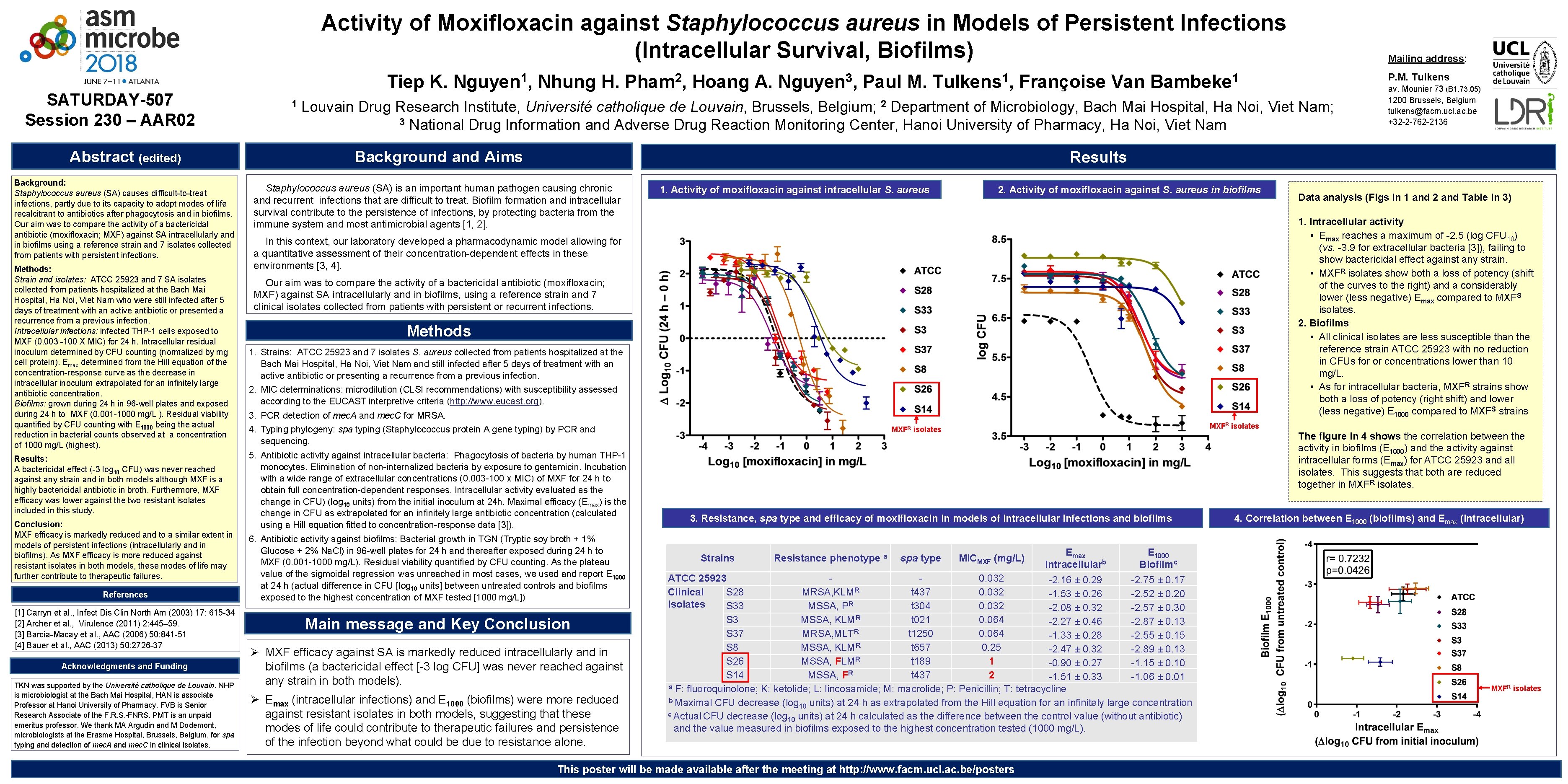
Activity of Moxifloxacin against Staphylococcus aureus in Models of Persistent Infections (Intracellular Survival, Biofilms) SATURDAY-507 Session 230 – AAR 02 Abstract (edited) Background: Staphylococcus aureus (SA) causes difficult-to-treat infections, partly due to its capacity to adopt modes of life recalcitrant to antibiotics after phagocytosis and in biofilms. Our aim was to compare the activity of a bactericidal antibiotic (moxifloxacin; MXF) against SA intracellularly and in biofilms using a reference strain and 7 isolates collected from patients with persistent infections. Methods: Strain and isolates: ATCC 25923 and 7 SA isolates collected from patients hospitalized at the Bach Mai Hospital, Ha Noi, Viet Nam who were still infected after 5 days of treatment with an active antibiotic or presented a recurrence from a previous infection. Intracellular infections: infected THP-1 cells exposed to MXF (0. 003 -100 X MIC) for 24 h. Intracellular residual inoculum determined by CFU counting (normalized by mg cell protein). Emax determined from the Hill equation of the concentration-response curve as the decrease in intracellular inoculum extrapolated for an infinitely large antibiotic concentration. Biofilms: grown during 24 h in 96 -well plates and exposed during 24 h to MXF (0. 001 -1000 mg/L ). Residual viability quantified by CFU counting with E 1000 being the actual reduction in bacterial counts observed at a concentration of 1000 mg/L (highest). Results: A bactericidal effect (-3 log 10 CFU) was never reached against any strain and in both models although MXF is a highly bactericidal antibiotic in broth. Furthermore, MXF efficacy was lower against the two resistant isolates included in this study. Conclusion: MXF efficacy is markedly reduced and to a similar extent in models of persistent infections (intracellularly and in biofilms). As MXF efficacy is more reduced against resistant isolates in both models, these modes of life may further contribute to therapeutic failures. References [1] Carryn et al. , Infect Dis Clin North Am (2003) 17: 615 -34 [2] Archer et al. , Virulence (2011) 2: 445– 59. [3] Barcia-Macay et al. , AAC (2006) 50: 841 -51 [4] Bauer et al. , AAC (2013) 50: 2726 -37 Acknowledgments and Funding TKN was supported by the Université catholique de Louvain. NHP is microbiologist at the Bach Mai Hospital, HAN is associate Professor at Hanoi University of Pharmacy. FVB is Senior Research Associate of the F. R. S. -FNRS. PMT is an unpaid emeritus professor. We thank MA Argudin and M Dodemont, microbiologists at the Erasme Hospital, Brussels, Belgium, for spa typing and detection of mec. A and mec. C in clinical isolates. Tiep K. 1 Nguyen 1, Nhung H. Pham 2, Hoang A. Nguyen 3, Paul M. Tulkens 1, Françoise Van Mailing address: Bambeke 1 P. M. Tulkens Louvain Drug Research Institute, Université catholique de Louvain, Brussels, Belgium; 2 Department of Microbiology, Bach Mai Hospital, Ha Noi, Viet Nam; 3 National Drug Information and Adverse Drug Reaction Monitoring Center, Hanoi University of Pharmacy, Ha Noi, Viet Nam Background and Aims av. Mounier 73 (B 1. 73. 05) 1200 Brussels, Belgium tulkens@facm. ucl. ac. be +32 -2 -762 -2136 Results Staphylococcus aureus (SA) is an important human pathogen causing chronic and recurrent infections that are difficult to treat. Biofilm formation and intracellular survival contribute to the persistence of infections, by protecting bacteria from the immune system and most antimicrobial agents [1, 2]. 1. Activity of moxifloxacin against intracellular S. aureus 2. Activity of moxifloxacin against S. aureus in biofilms 1. Intracellular activity • Emax reaches a maximum of -2. 5 (log CFU 10) (vs. -3. 9 for extracellular bacteria [3]), failing to show bactericidal effect against any strain. • MXFR isolates show both a loss of potency (shift of the curves to the right) and a considerably lower (less negative) Emax compared to MXFS isolates. 2. Biofilms • All clinical isolates are less susceptible than the reference strain ATCC 25923 with no reduction in CFUs for or concentrations lower than 10 mg/L. • As for intracellular bacteria, MXFR strains show both a loss of potency (right shift) and lower (less negative) E 1000 compared to MXFS strains In this context, our laboratory developed a pharmacodynamic model allowing for a quantitative assessment of their concentration-dependent effects in these environments [3, 4]. Our aim was to compare the activity of a bactericidal antibiotic (moxifloxacin; MXF) against SA intracellularly and in biofilms, using a reference strain and 7 clinical isolates collected from patients with persistent or recurrent infections. Methods 1. Strains: ATCC 25923 and 7 isolates S. aureus collected from patients hospitalized at the Bach Mai Hospital, Ha Noi, Viet Nam and still infected after 5 days of treatment with an active antibiotic or presenting a recurrence from a previous infection. 2. MIC determinations: microdilution (CLSI recommendations) with susceptibility assessed according to the EUCAST interpretive criteria (http: //www. eucast. org). 3. PCR detection of mec. A and mec. C for MRSA. 4. Typing phylogeny: spa typing (Staphylococcus protein A gene typing) by PCR and sequencing. 5. Antibiotic activity against intracellular bacteria: Phagocytosis of bacteria by human THP-1 monocytes. Elimination of non-internalized bacteria by exposure to gentamicin. Incubation with a wide range of extracellular concentrations (0. 003 -100 x MIC) of MXF for 24 h to obtain full concentration-dependent responses. Intracellular activity evaluated as the change in CFU) (log 10 units) from the initial inoculum at 24 h. Maximal efficacy (Emax) is the change in CFU as extrapolated for an infinitely large antibiotic concentration (calculated using a Hill equation fitted to concentration-response data [3]). 6. Antibiotic activity against biofilms: Bacterial growth in TGN (Tryptic soy broth + 1% Glucose + 2% Na. Cl) in 96 -well plates for 24 h and thereafter exposed during 24 h to MXF (0. 001 -1000 mg/L). Residual viability quantified by CFU counting. As the plateau value of the sigmoidal regression was unreached in most cases, we used and report E 1000 at 24 h (actual difference in CFU [log 10 units] between untreated controls and biofilms exposed to the highest concentration of MXF tested [1000 mg/L]) Main message and Key Conclusion Ø MXF efficacy against SA is markedly reduced intracellularly and in biofilms (a bactericidal effect [-3 log CFU] was never reached against any strain in both models). Ø Emax (intracellular infections) and E 1000 (biofilms) were more reduced against resistant isolates in both models, suggesting that these modes of life could contribute to therapeutic failures and persistence of the infection beyond what could be due to resistance alone. Data analysis (Figs in 1 and 2 and Table in 3) MXFR isolates The figure in 4 shows the correlation between the activity in biofilms (E 1000) and the activity against intracellular forms (Emax) for ATCC 25923 and all isolates. This suggests that both are reduced together in MXFR isolates. 3. Resistance, spa type and efficacy of moxifloxacin in models of intracellular infections and biofilms Strains Resistance phenotype a spa type MICMXF (mg/L) Emax Intracellularb E 1000 Biofilmc ATCC 25923 0. 032 -2. 16 ± 0. 29 -2. 75 ± 0. 17 Clinical S 28 MRSA, KLMR t 437 0. 032 -1. 53 ± 0. 26 -2. 52 ± 0. 20 isolates S 33 MSSA, PR t 304 0. 032 -2. 08 ± 0. 32 -2. 57 ± 0. 30 S 3 MSSA, KLMR t 021 0. 064 -2. 27 ± 0. 46 -2. 87 ± 0. 13 S 37 MRSA, MLTR t 1250 0. 064 -1. 33 ± 0. 28 -2. 55 ± 0. 15 S 8 MSSA, KLMR t 657 0. 25 -2. 47 ± 0. 32 -2. 89 ± 0. 13 S 26 MSSA, FLMR t 189 1 -0. 90 ± 0. 27 -1. 15 ± 0. 10 S 14 MSSA, FR t 437 2 -1. 51 ± 0. 33 -1. 06 ± 0. 01 a F: fluoroquinolone; K: ketolide; L: lincosamide; M: macrolide; P: Penicillin; T: tetracycline b Maximal CFU decrease (log 10 units) at 24 h as extrapolated from the Hill equation for an infinitely large concentration c Actual CFU decrease (log 10 units) at 24 h calculated as the difference between the control value (without antibiotic) and the value measured in biofilms exposed to the highest concentration tested (1000 mg/L). This poster will be made available after the meeting at http: //www. facm. ucl. ac. be/posters 4. Correlation between E 1000 (biofilms) and Emax (intracellular) MXFR isolates