
ACTIVITY Is it Alive CELLULAR RESPIRATION IN YEAST





- Slides: 43
ACTIVITY Is it Alive?
CELLULAR RESPIRATION IN YEAST • Yeast (the living organisms in soil sample C of the “It’s Alive” activity) are facultative aerobes. • Undergo aerobic respiration when O 2 is present – as was the case during the activity – sugar molecules, CO 2 (what caused the bubbling in the sample), water, and a high yield of ATP C 6 H 12 O 6 + 6 O 2 6 CO 2 + 6 H 2 O + ATP (hi yield) • Undergo alcoholic fermentation when O 2 is absent – sugar molecules broken down into ethanol, CO 2 and a low yield of ATP C 6 H 12 O 6 6 C 2 H 5 OH + 2 CO 2 + ATP (low yield)
ENERGY FLOW & CHEMICAL CYCLING IMSS BIOLOGY ~ SUMMER 2012
LEARNING TARGETS • To distinguish the abiotic & biotic factors that compose an ecosystem. • To understand the roles of photosynthesis & cellular respiration on an ecological scale (review). • To understands what characterizes the major ecosystems on Earth. • To describe the flow of energy and cycling of matter through an ecosystem (food webs). • To describe the major biogeochemical cycles that are components of an ecosystem. • To demonstrate how the global carbon cycle is impacted by human activity.
OVERVIEW OF THE BIOSPHERE • The biosphere is the global ecosystem which includes all of life and their interactions, with other life as well as with the physical elements (atmosphere, hydrosphere, lithosphere) • Recall that the living and physical factors making up the biosphere are categorized into • Abiotic factors • Biotic factors
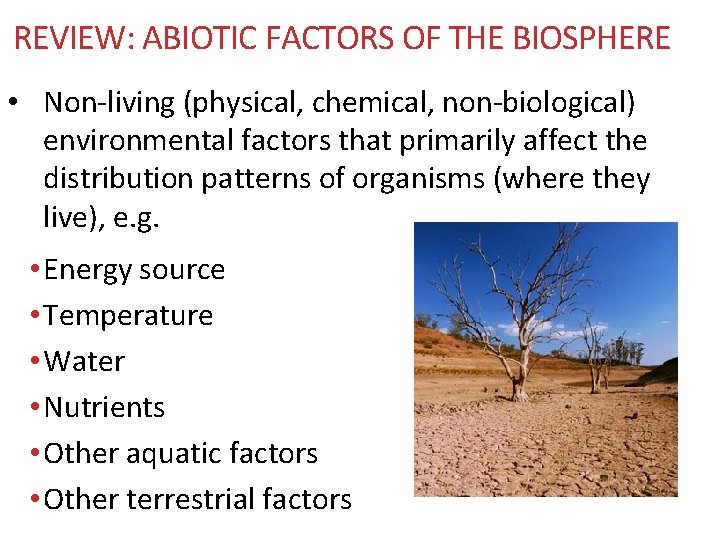
REVIEW: ABIOTIC FACTORS OF THE BIOSPHERE • Non-living (physical, chemical, non-biological) environmental factors that primarily affect the distribution patterns of organisms (where they live), e. g. • Energy source • Temperature • Water • Nutrients • Other aquatic factors • Other terrestrial factors
ENERGY SOURCE (A REVIEW) • Recall that all organisms require a source of energy (the energy contained in ATP) to sustain cellular metabolism (aka cellular respiration). • The power for most ecosystems is solar energy captured by chlorophyll (photosystems) during photosynthesis. Thus, solar energy is used to convert (fix) atmospheric CO 2 into usable chemical energy (ultimately, sugars) by primary producers (i. e. , photoautotrophs) • Sunlight is used to fix CO 2 into sugars. These sugars are available for use as “fuel” by the producers themselves (e. g. plants) AND the consumers (e. g. herbivorous animals) biologycorner. com
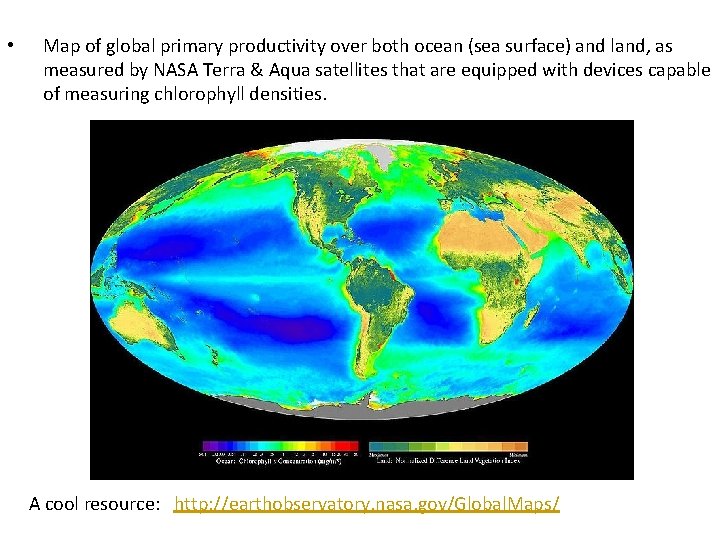
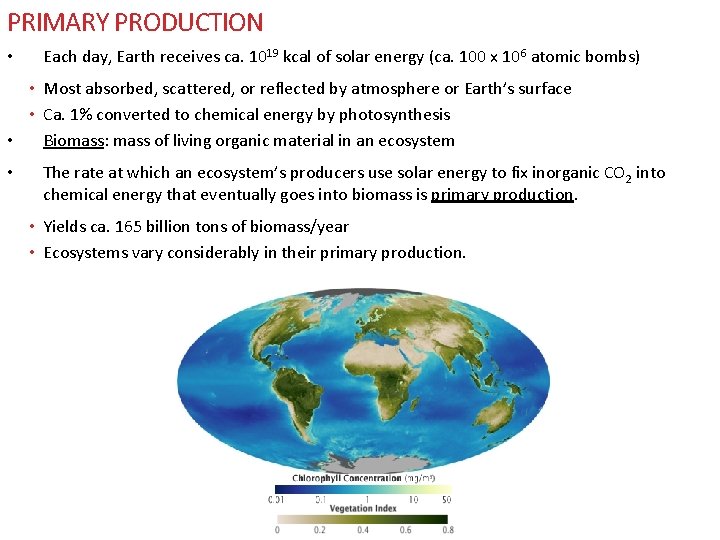
• Map of global primary productivity over both ocean (sea surface) and land, as measured by NASA Terra & Aqua satellites that are equipped with devices capable of measuring chlorophyll densities. A cool resource: http: //earthobservatory. nasa. gov/Global. Maps/
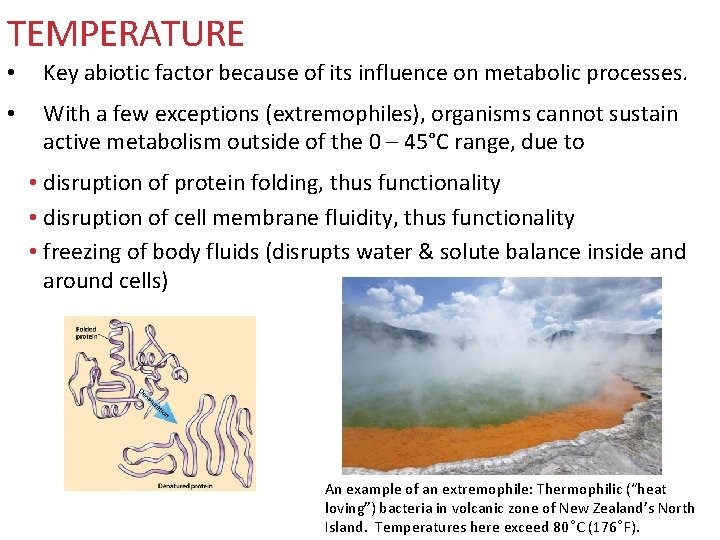
TEMPERATURE • Key abiotic factor because of its influence on metabolic processes. • With a few exceptions (extremophiles), organisms cannot sustain active metabolism outside of the 0 – 45°C range, due to • disruption of protein folding, thus functionality • disruption of cell membrane fluidity, thus functionality • freezing of body fluids (disrupts water & solute balance inside and around cells) An example of an extremophile: Thermophilic (“heat loving”) bacteria in volcanic zone of New Zealand’s North Island. Temperatures here exceed 80°C (176°F).
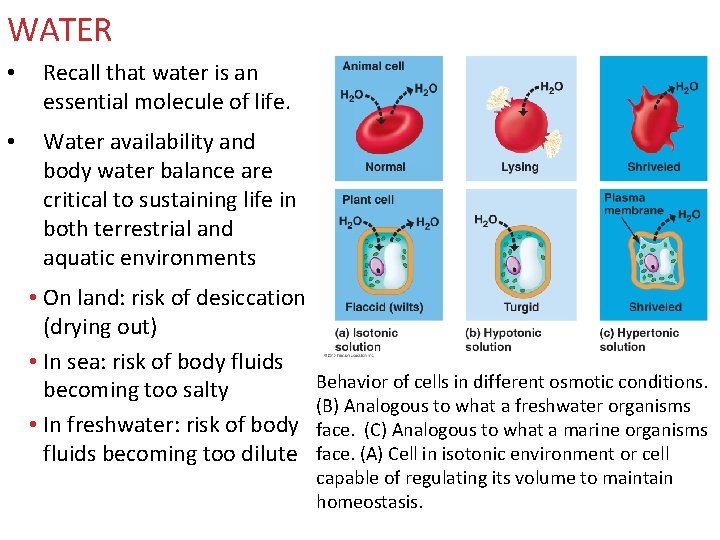
WATER • Recall that water is an essential molecule of life. • Water availability and body water balance are critical to sustaining life in both terrestrial and aquatic environments • On land: risk of desiccation (drying out) • In sea: risk of body fluids becoming too salty • In freshwater: risk of body fluids becoming too dilute Behavior of cells in different osmotic conditions. (B) Analogous to what a freshwater organisms face. (C) Analogous to what a marine organisms face. (A) Cell in isotonic environment or cell capable of regulating its volume to maintain homeostasis.
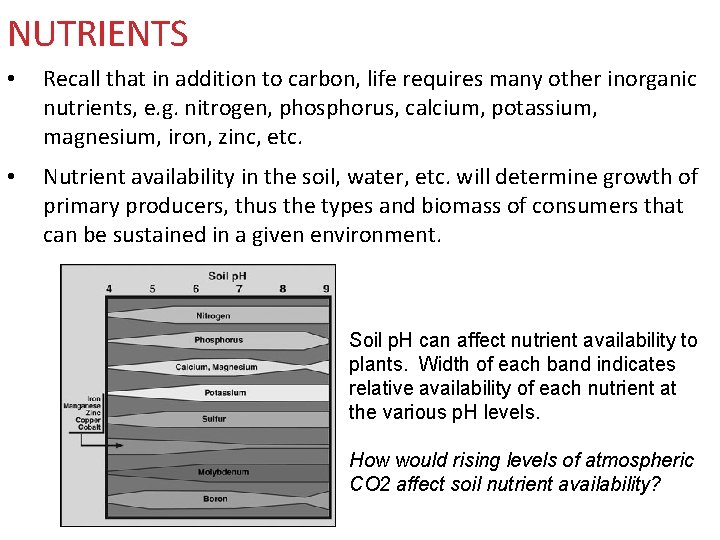
NUTRIENTS • Recall that in addition to carbon, life requires many other inorganic nutrients, e. g. nitrogen, phosphorus, calcium, potassium, magnesium, iron, zinc, etc. • Nutrient availability in the soil, water, etc. will determine growth of primary producers, thus the types and biomass of consumers that can be sustained in a given environment. Soil p. H can affect nutrient availability to plants. Width of each band indicates relative availability of each nutrient at the various p. H levels. How would rising levels of atmospheric CO 2 affect soil nutrient availability?
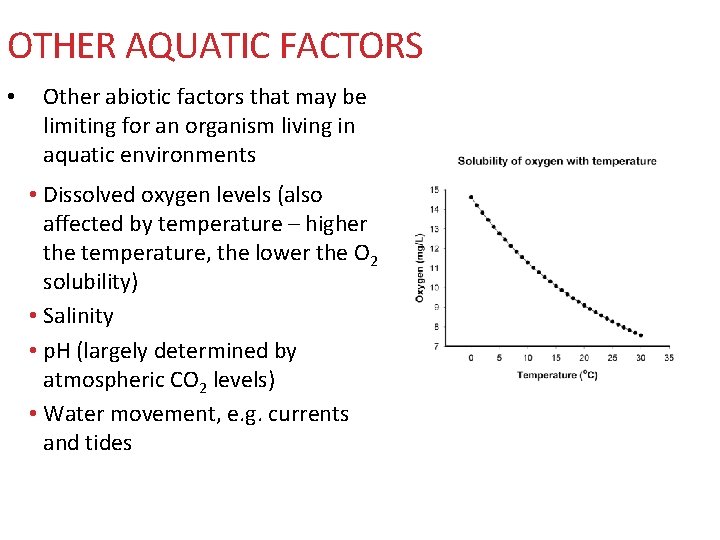
OTHER AQUATIC FACTORS • Other abiotic factors that may be limiting for an organism living in aquatic environments • Dissolved oxygen levels (also affected by temperature – higher the temperature, the lower the O 2 solubility) • Salinity • p. H (largely determined by atmospheric CO 2 levels) • Water movement, e. g. currents and tides
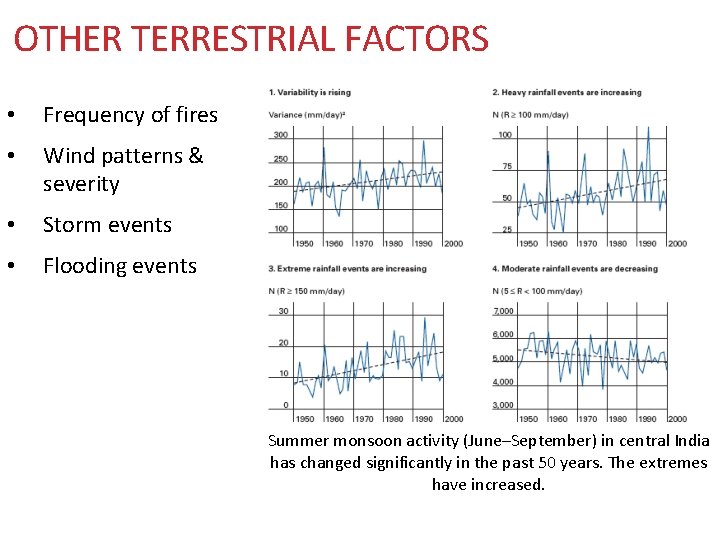
OTHER TERRESTRIAL FACTORS • Frequency of fires • Wind patterns & severity • Storm events • Flooding events Summer monsoon activity (June–September) in central India has changed significantly in the past 50 years. The extremes have increased.
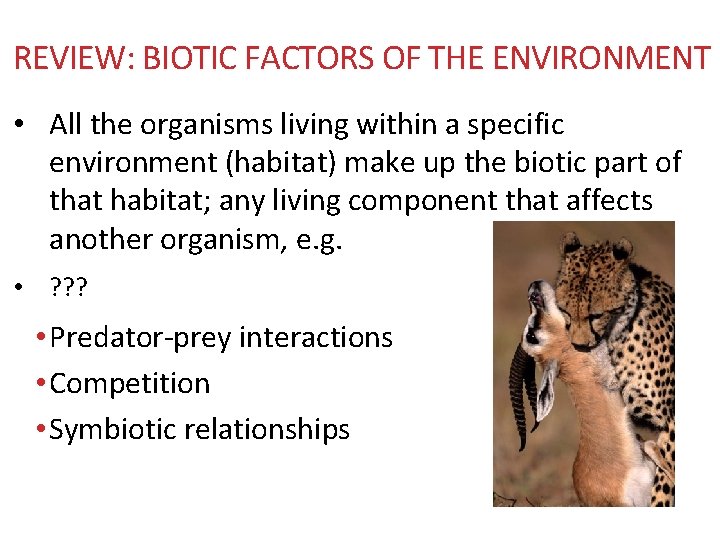
REVIEW: BIOTIC FACTORS OF THE ENVIRONMENT • All the organisms living within a specific environment (habitat) make up the biotic part of that habitat; any living component that affects another organism, e. g. • ? ? ? • Predator-prey interactions • Competition • Symbiotic relationships
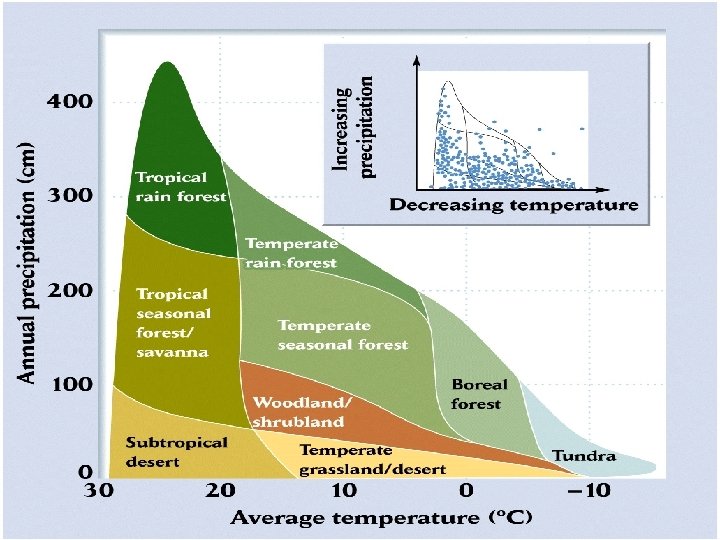
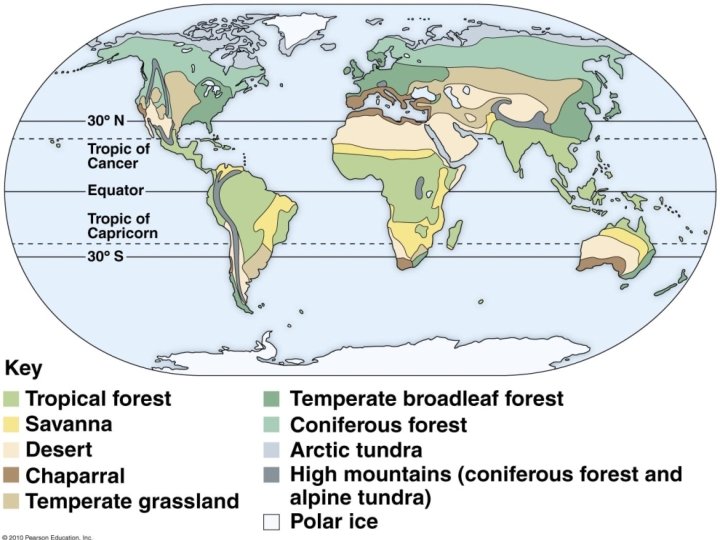
TERRESTRIAL ECOSYSTEMS • The biosphere can be thought of the sum of all ecosystems on Earth. • Terrestrial ecosystems (biomes) are distinguished by their vegetation pattern, which is ultimately determined by abiotic factors, namely • Precipitation Climate • Temperature • Other important influences on these climatic factors • Altitude (elevation) • Latitude
Fig. 18. 27
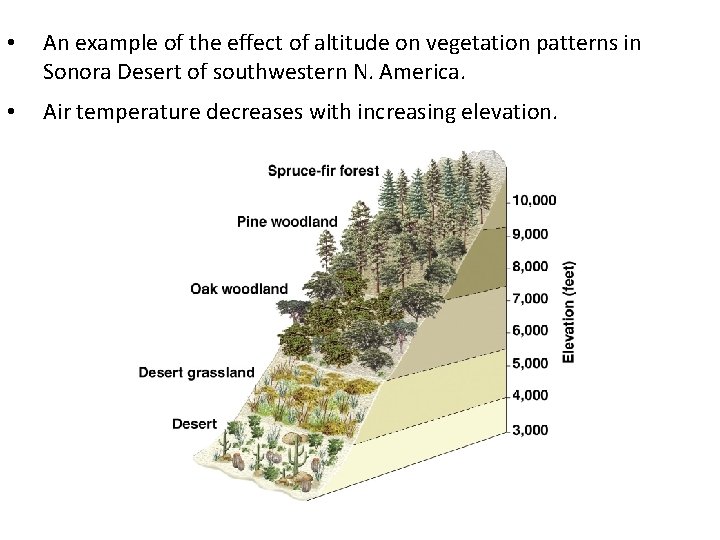
• An example of the effect of altitude on vegetation patterns in Sonora Desert of southwestern N. America. • Air temperature decreases with increasing elevation.
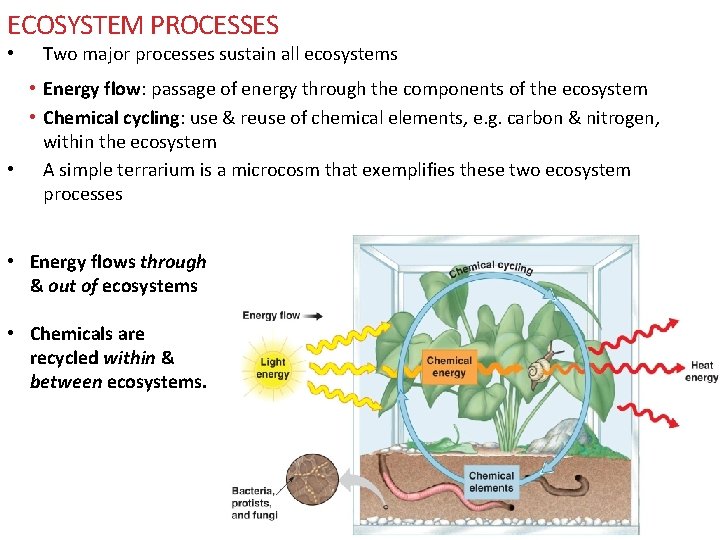
ECOSYSTEM PROCESSES • Two major processes sustain all ecosystems • Energy flow: passage of energy through the components of the ecosystem • Chemical cycling: use & reuse of chemical elements, e. g. carbon & nitrogen, within the ecosystem • A simple terrarium is a microcosm that exemplifies these two ecosystem processes • Energy flows through & out of ecosystems • Chemicals are recycled within & between ecosystems.
ENERGY FLOW IN ECOSYSTEMS • All organisms require energy for • Growth • Maintenance • Reproduction • Movement (in many) • What actually powers cellular work? • Where does this energy ultimately come from? • What other details do you need to answer these questions adequately? • http: //earthobservatory. nasa. gov/Features/World. Of. Change/biosph ere. php …
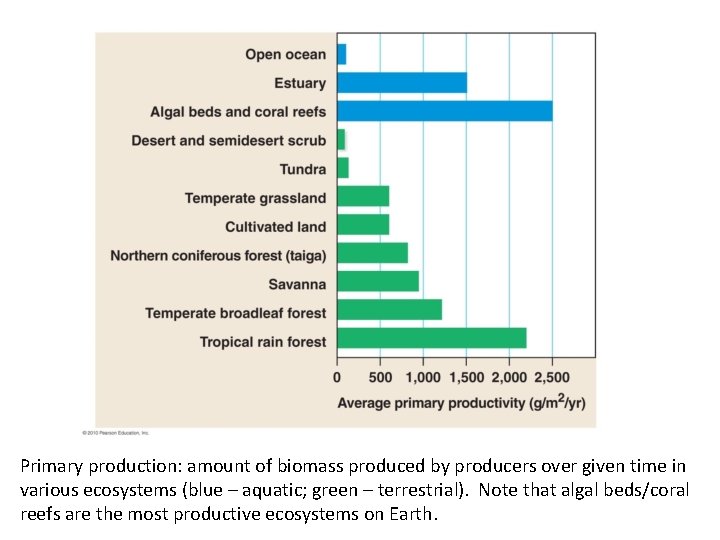
PRIMARY PRODUCTION • Each day, Earth receives ca. 1019 kcal of solar energy (ca. 100 x 106 atomic bombs) • Most absorbed, scattered, or reflected by atmosphere or Earth’s surface • Ca. 1% converted to chemical energy by photosynthesis • Biomass: mass of living organic material in an ecosystem • The rate at which an ecosystem’s producers use solar energy to fix inorganic CO 2 into chemical energy that eventually goes into biomass is primary production. • Yields ca. 165 billion tons of biomass/year • Ecosystems vary considerably in their primary production.
Primary production: amount of biomass produced by producers over given time in various ecosystems (blue – aquatic; green – terrestrial). Note that algal beds/coral reefs are the most productive ecosystems on Earth.
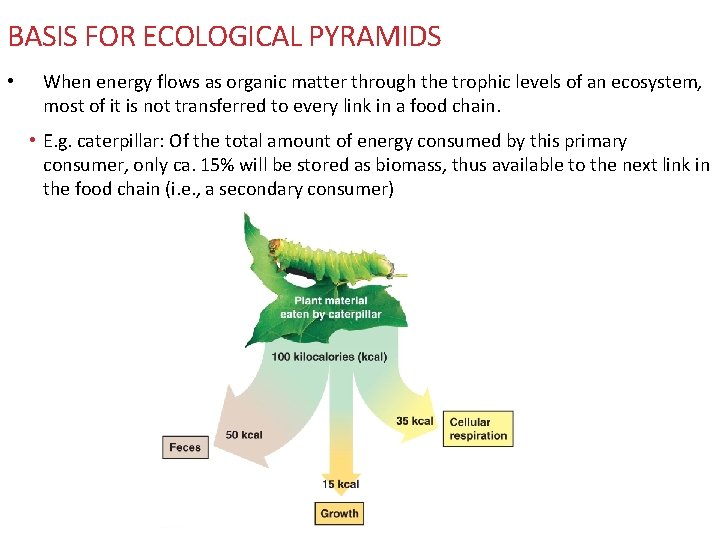
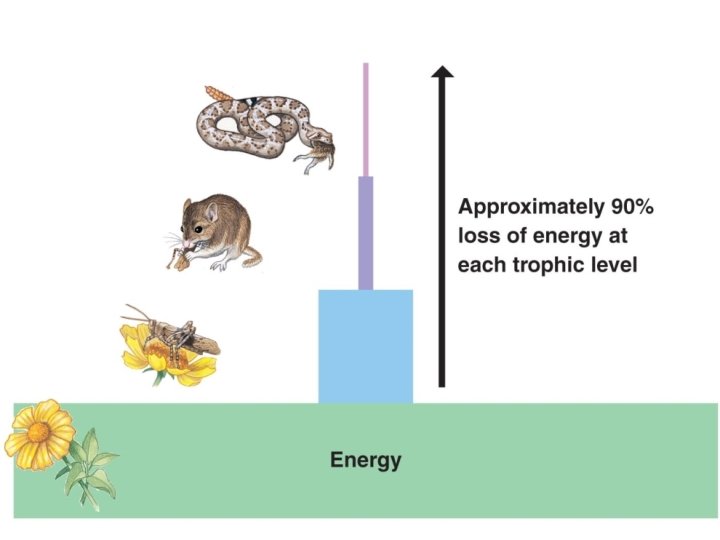
BASIS FOR ECOLOGICAL PYRAMIDS • When energy flows as organic matter through the trophic levels of an ecosystem, most of it is not transferred to every link in a food chain. • E. g. caterpillar: Of the total amount of energy consumed by this primary consumer, only ca. 15% will be stored as biomass, thus available to the next link in the food chain (i. e. , a secondary consumer)
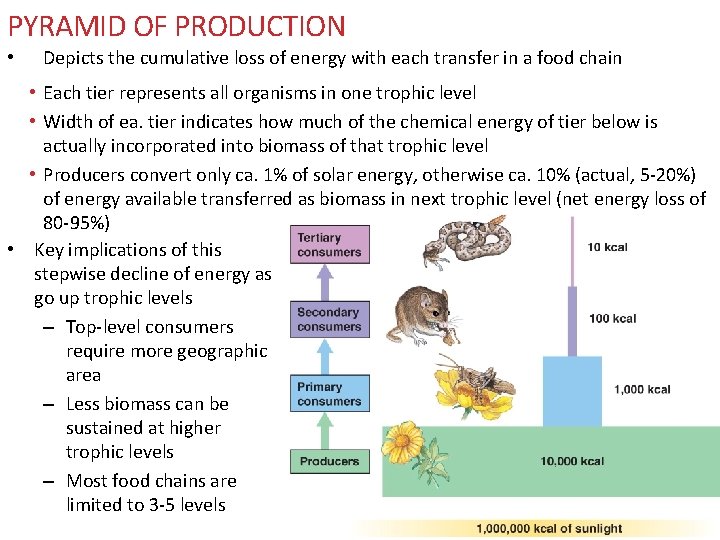
PYRAMID OF PRODUCTION • Depicts the cumulative loss of energy with each transfer in a food chain • Each tier represents all organisms in one trophic level • Width of ea. tier indicates how much of the chemical energy of tier below is actually incorporated into biomass of that trophic level • Producers convert only ca. 1% of solar energy, otherwise ca. 10% (actual, 5 -20%) of energy available transferred as biomass in next trophic level (net energy loss of 80 -95%) • Key implications of this stepwise decline of energy as go up trophic levels – Top-level consumers require more geographic area – Less biomass can be sustained at higher trophic levels – Most food chains are limited to 3 -5 levels
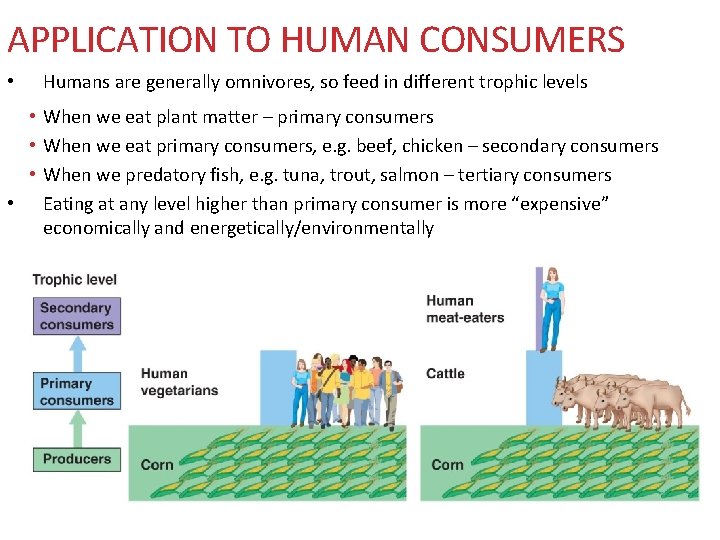
APPLICATION TO HUMAN CONSUMERS • Humans are generally omnivores, so feed in different trophic levels • When we eat plant matter – primary consumers • When we eat primary consumers, e. g. beef, chicken – secondary consumers • When we predatory fish, e. g. tuna, trout, salmon – tertiary consumers • Eating at any level higher than primary consumer is more “expensive” economically and energetically/environmentally
BIOGEOCHEMICAL CYCLES • We model Earth as a set of interacting “spheres” (biosphere, atmosphere, hydrosphere, lithosphere) which are open systems in which energy & mass are constantly flowing & cycling • The transport & transformation of substances through Earth’s systems are collectively known as biogeochemical cycles, which include • • • Hydrologic (water) cycle Nitrogen cycle Oxygen cycle Carbon cycle Phosphorus cycle Except for the hydrologic cycle, biogeochemical cycles follow a general scheme…
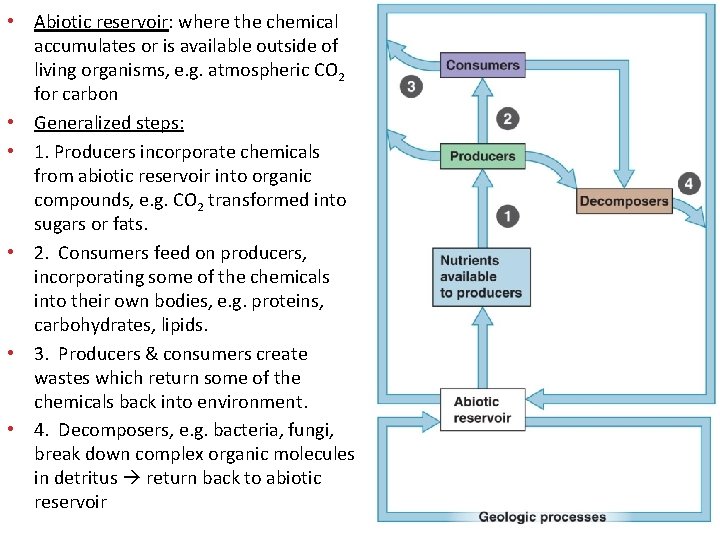
• Abiotic reservoir: where the chemical accumulates or is available outside of living organisms, e. g. atmospheric CO 2 for carbon • Generalized steps: • 1. Producers incorporate chemicals from abiotic reservoir into organic compounds, e. g. CO 2 transformed into sugars or fats. • 2. Consumers feed on producers, incorporating some of the chemicals into their own bodies, e. g. proteins, carbohydrates, lipids. • 3. Producers & consumers create wastes which return some of the chemicals back into environment. • 4. Decomposers, e. g. bacteria, fungi, break down complex organic molecules in detritus return back to abiotic reservoir
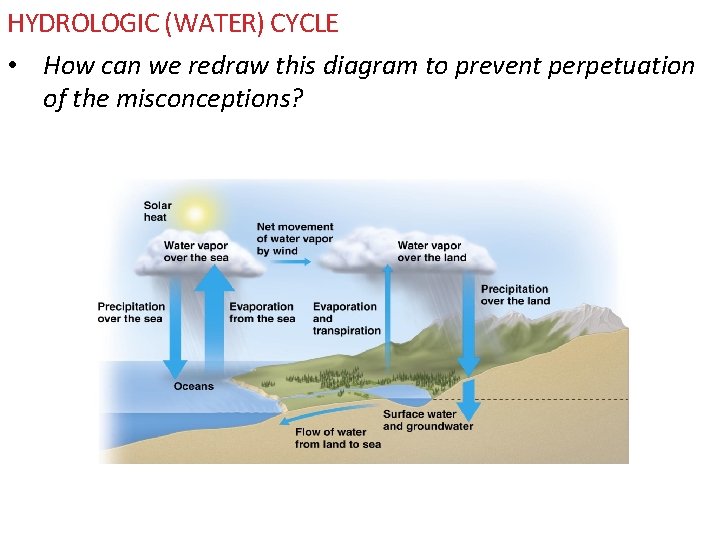
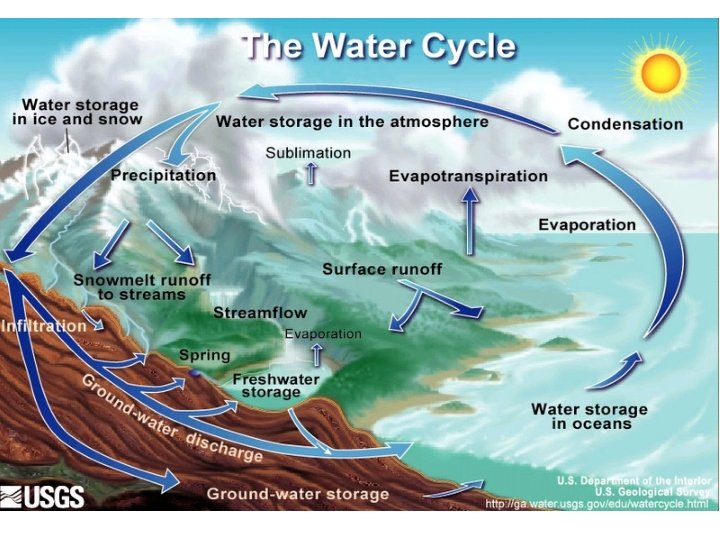
HYDROLOGIC (WATER) CYCLE • How can we redraw this diagram to prevent perpetuation of the misconceptions?
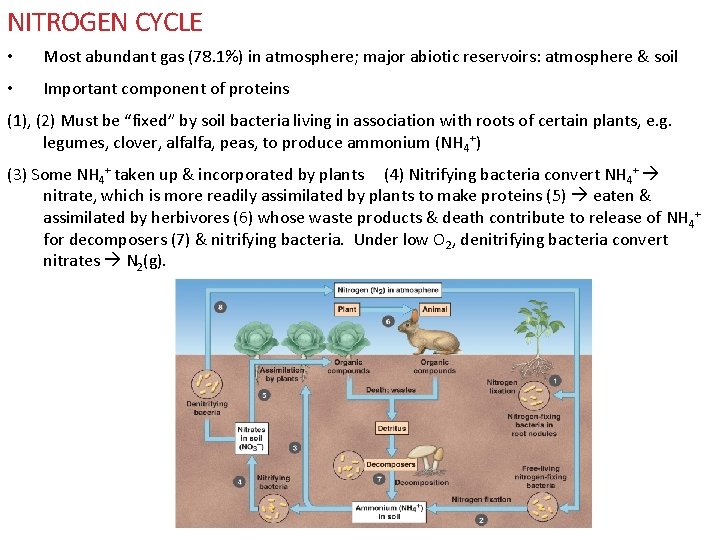
NITROGEN CYCLE • Most abundant gas (78. 1%) in atmosphere; major abiotic reservoirs: atmosphere & soil • Important component of proteins (1), (2) Must be “fixed” by soil bacteria living in association with roots of certain plants, e. g. legumes, clover, alfalfa, peas, to produce ammonium (NH 4+) (3) Some NH 4+ taken up & incorporated by plants (4) Nitrifying bacteria convert NH 4+ nitrate, which is more readily assimilated by plants to make proteins (5) eaten & assimilated by herbivores (6) whose waste products & death contribute to release of NH 4+ for decomposers (7) & nitrifying bacteria. Under low O 2, denitrifying bacteria convert nitrates N 2(g).
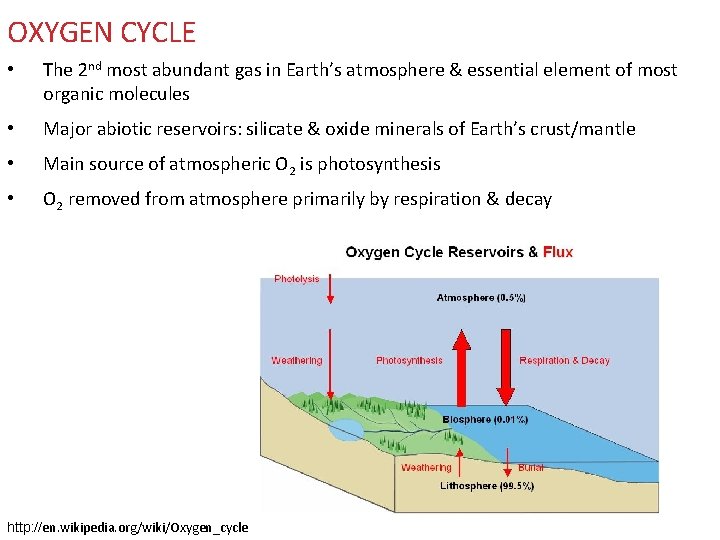
OXYGEN CYCLE • The 2 nd most abundant gas in Earth’s atmosphere & essential element of most organic molecules • Major abiotic reservoirs: silicate & oxide minerals of Earth’s crust/mantle • Main source of atmospheric O 2 is photosynthesis • O 2 removed from atmosphere primarily by respiration & decay http: //en. wikipedia. org/wiki/Oxygen_cycle
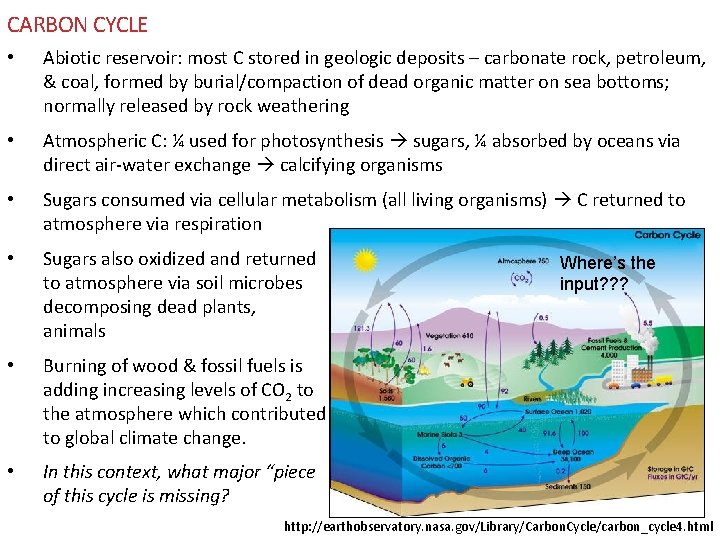
CARBON CYCLE • Abiotic reservoir: most C stored in geologic deposits – carbonate rock, petroleum, & coal, formed by burial/compaction of dead organic matter on sea bottoms; normally released by rock weathering • Atmospheric C: ¼ used for photosynthesis sugars, ¼ absorbed by oceans via direct air-water exchange calcifying organisms • Sugars consumed via cellular metabolism (all living organisms) C returned to atmosphere via respiration • Sugars also oxidized and returned to atmosphere via soil microbes decomposing dead plants, animals • Burning of wood & fossil fuels is adding increasing levels of CO 2 to the atmosphere which contributed to global climate change. • In this context, what major “piece of this cycle is missing? Where’s the input? ? ? glob http: //earthobservatory. nasa. gov/Library/Carbon. Cycle/carbon_cycle 4. html
CARBON CYCLE AND CLIMATE CHANGE • http: //educypedia. karadimov. info/library/globalcarboncy cle. swf • http: //www. sciencemuseum. org. uk/educators/classroom _and_homework_resources/carbon_cycle_cap er. aspx
ACTIVITY A Carbon Cycle Story • Use each cycle component card in your storyboard. • Consider using arrows and connecting words to give “flow” to your story. Explain your story – visually, verbally. • • Photosynthesis Respiration Decomposition Combustion Release Die Eat Absorption
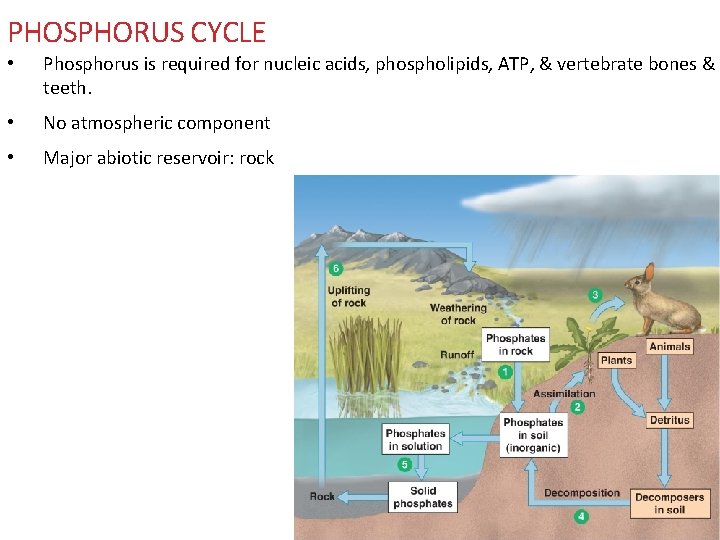
PHOSPHORUS CYCLE • Phosphorus is required for nucleic acids, phospholipids, ATP, & vertebrate bones & teeth. • No atmospheric component • Major abiotic reservoir: rock
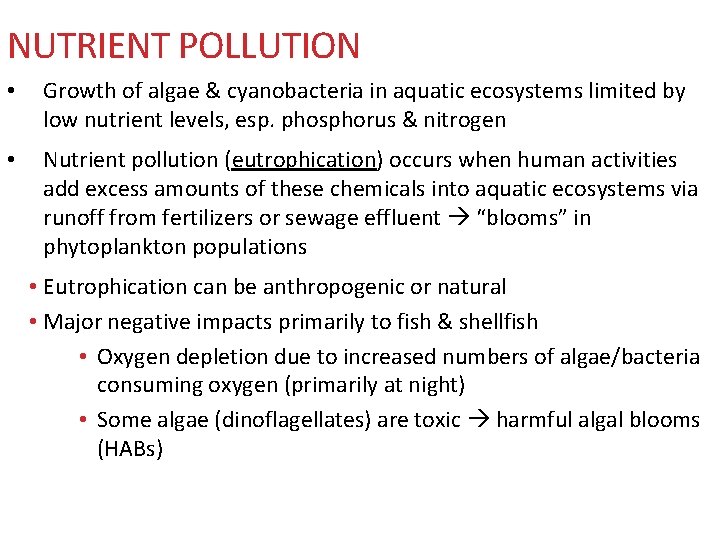
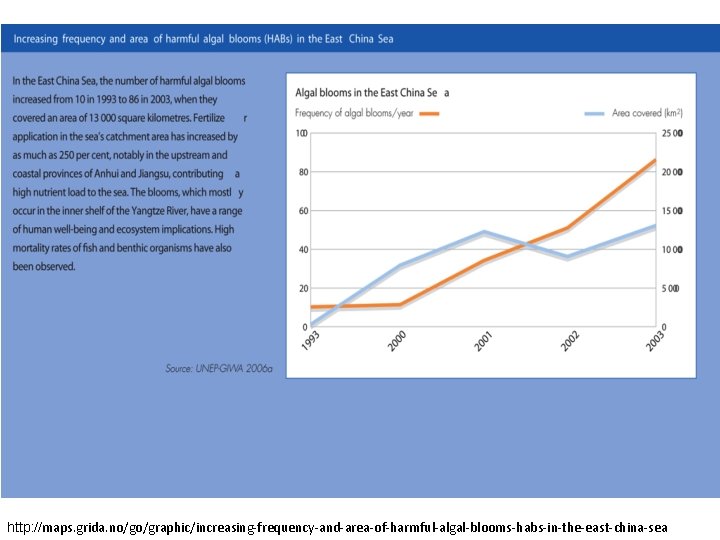
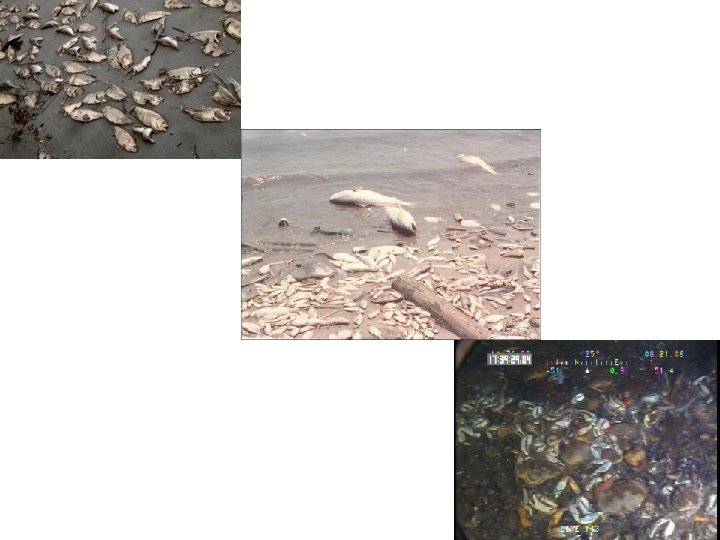
NUTRIENT POLLUTION • Growth of algae & cyanobacteria in aquatic ecosystems limited by low nutrient levels, esp. phosphorus & nitrogen • Nutrient pollution (eutrophication) occurs when human activities add excess amounts of these chemicals into aquatic ecosystems via runoff from fertilizers or sewage effluent “blooms” in phytoplankton populations • Eutrophication can be anthropogenic or natural • Major negative impacts primarily to fish & shellfish • Oxygen depletion due to increased numbers of algae/bacteria consuming oxygen (primarily at night) • Some algae (dinoflagellates) are toxic harmful algal blooms (HABs)
http: //maps. grida. no/go/graphic/increasing-frequency-and-area-of-harmful-algal-blooms-habs-in-the-east-china-sea
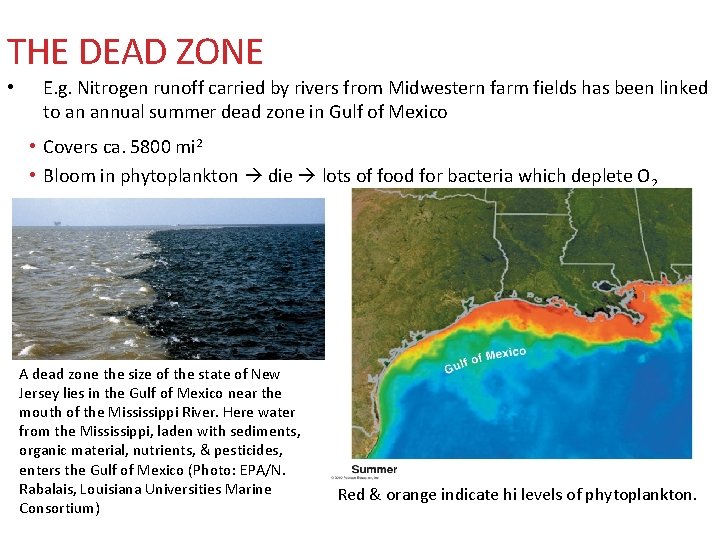
THE DEAD ZONE • E. g. Nitrogen runoff carried by rivers from Midwestern farm fields has been linked to an annual summer dead zone in Gulf of Mexico • Covers ca. 5800 mi 2 • Bloom in phytoplankton die lots of food for bacteria which deplete O 2 A dead zone the size of the state of New Jersey lies in the Gulf of Mexico near the mouth of the Mississippi River. Here water from the Mississippi, laden with sediments, organic material, nutrients, & pesticides, enters the Gulf of Mexico (Photo: EPA/N. Rabalais, Louisiana Universities Marine Consortium) Red & orange indicate hi levels of phytoplankton.