
ACTIVITY IDENTIFICATION FROM ANIMAL GPS TRACKS WITH SPATIAL






- Slides: 38
ACTIVITY IDENTIFICATION FROM ANIMAL GPS TRACKS WITH SPATIAL TEMPORAL CLUSTERING METHOD DDB-SMOT Master’s Thesis Defense Simiao Sun Advisor: Dr. Yi Shang
1 Overview • Introduction • Related Work • Methodology • Experiment • Summary and Future Work
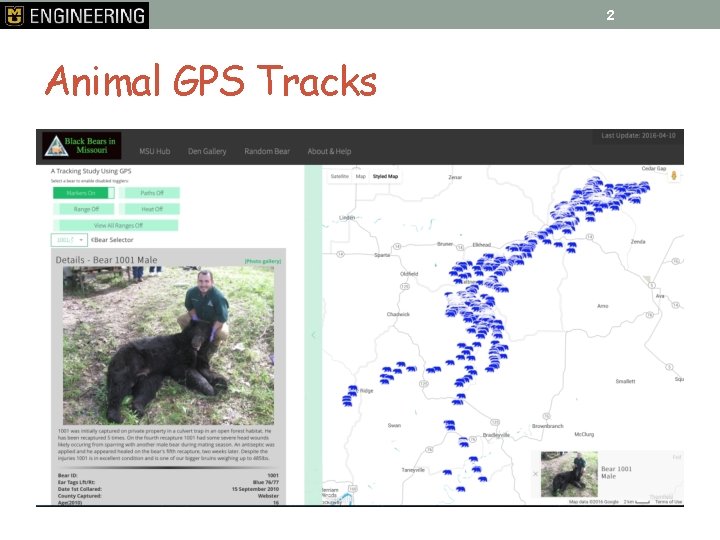
2 Animal GPS Tracks
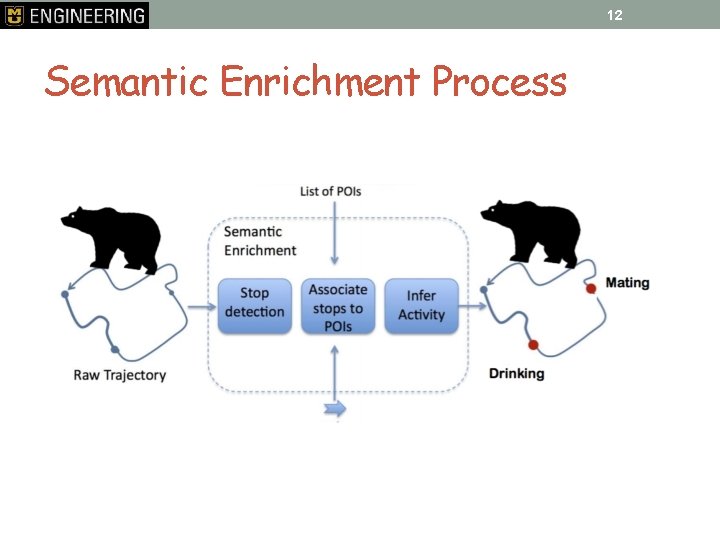
3 Infer Animal Activity from GPS Tracks • Current Condition: • Lots of GPS devices provide us with huge amount of wildlife GPS data • GPS data does not directly improve semantic richness • Still have no information about the meaning of the GPS data • Need to associate GPS data with the real world • Problem: • How to solve the semantic gap between raw GPS data and the real world
4 Motivation • Wildlife semantic data is more useful than raw GPS data • Better control the animal population • Better protection for animal • Better understanding of animals • Find a way to fill the semantic gaps • Large amount of GPS tracks • Lack of wildlife semantic data
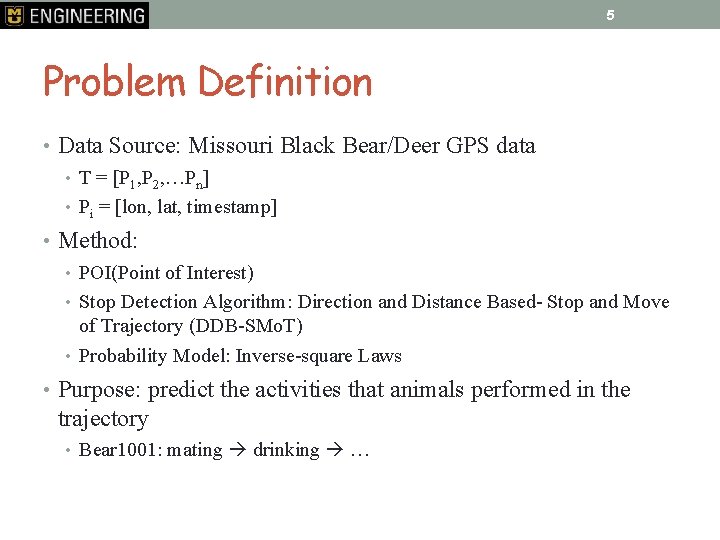
5 Problem Definition • Data Source: Missouri Black Bear/Deer GPS data • T = [P 1, P 2, …Pn] • Pi = [lon, lat, timestamp] • Method: • POI(Point of Interest) • Stop Detection Algorithm: Direction and Distance Based- Stop and Move of Trajectory (DDB-SMo. T) • Probability Model: Inverse-square Laws • Purpose: predict the activities that animals performed in the trajectory • Bear 1001: mating drinking …
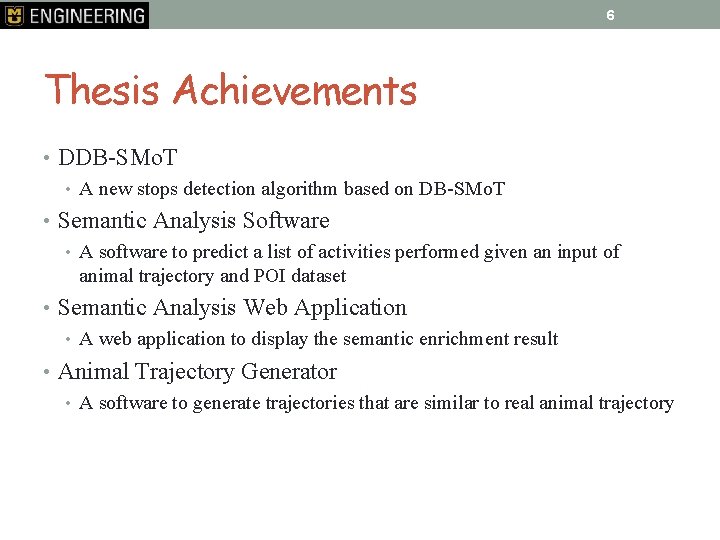
6 Thesis Achievements • DDB-SMo. T • A new stops detection algorithm based on DB-SMo. T • Semantic Analysis Software • A software to predict a list of activities performed given an input of animal trajectory and POI dataset • Semantic Analysis Web Application • A web application to display the semantic enrichment result • Animal Trajectory Generator • A software to generate trajectories that are similar to real animal trajectory
7 Overview • Introduction • Related Work • Methodology • Experiment • Summary and Future Work
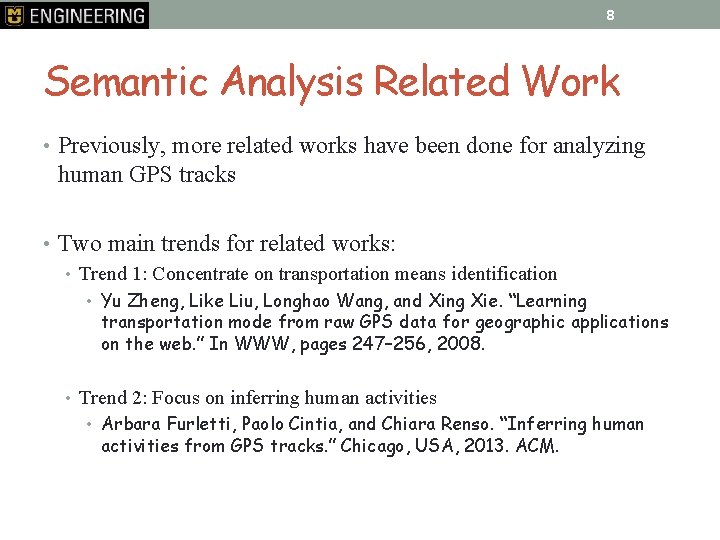
8 Semantic Analysis Related Work • Previously, more related works have been done for analyzing human GPS tracks • Two main trends for related works: • Trend 1: Concentrate on transportation means identification • Yu Zheng, Like Liu, Longhao Wang, and Xing Xie. “Learning transportation mode from raw GPS data for geographic applications on the web. ” In WWW, pages 247– 256, 2008. • Trend 2: Focus on inferring human activities • Arbara Furletti, Paolo Cintia, and Chiara Renso. “Inferring human activities from GPS tracks. ” Chicago, USA, 2013. ACM.
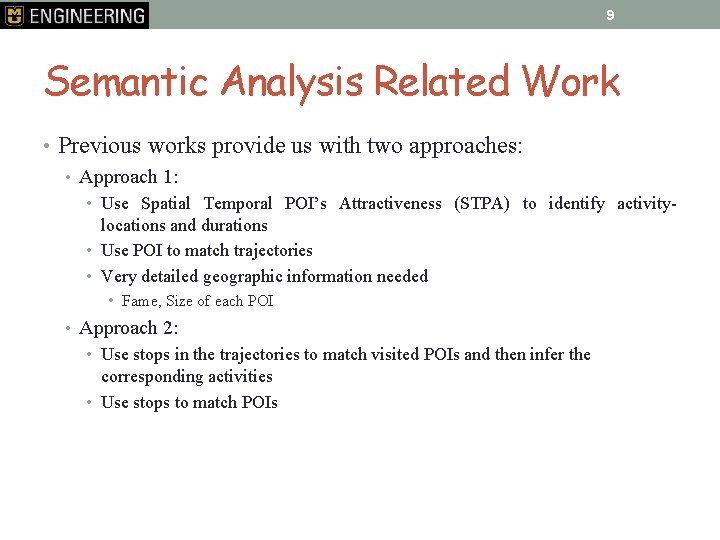
9 Semantic Analysis Related Work • Previous works provide us with two approaches: • Approach 1: • Use Spatial Temporal POI’s Attractiveness (STPA) to identify activity- locations and durations • Use POI to match trajectories • Very detailed geographic information needed • Fame, Size of each POI • Approach 2: • Use stops in the trajectories to match visited POIs and then infer the corresponding activities • Use stops to match POIs
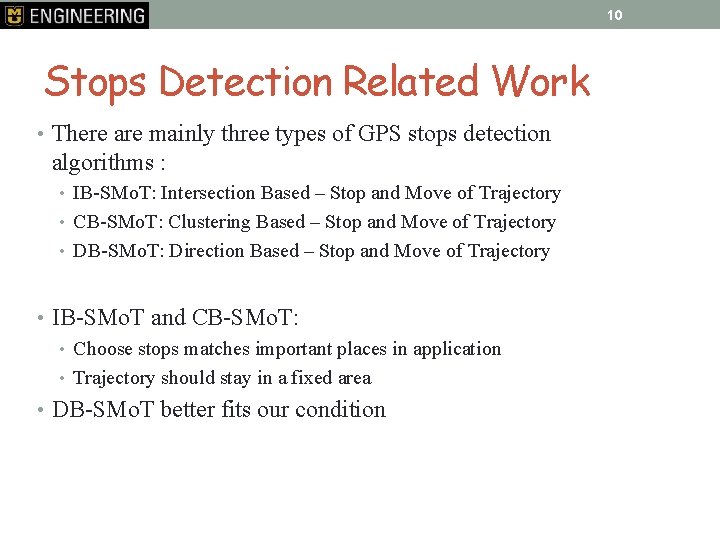
10 Stops Detection Related Work • There are mainly three types of GPS stops detection algorithms : • IB-SMo. T: Intersection Based – Stop and Move of Trajectory • CB-SMo. T: Clustering Based – Stop and Move of Trajectory • DB-SMo. T: Direction Based – Stop and Move of Trajectory • IB-SMo. T and CB-SMo. T: • Choose stops matches important places in application • Trajectory should stay in a fixed area • DB-SMo. T better fits our condition
11 Overview • Introduction • Related Work • Methodology • Experiment • Summary and Future Work
12 Semantic Enrichment Process
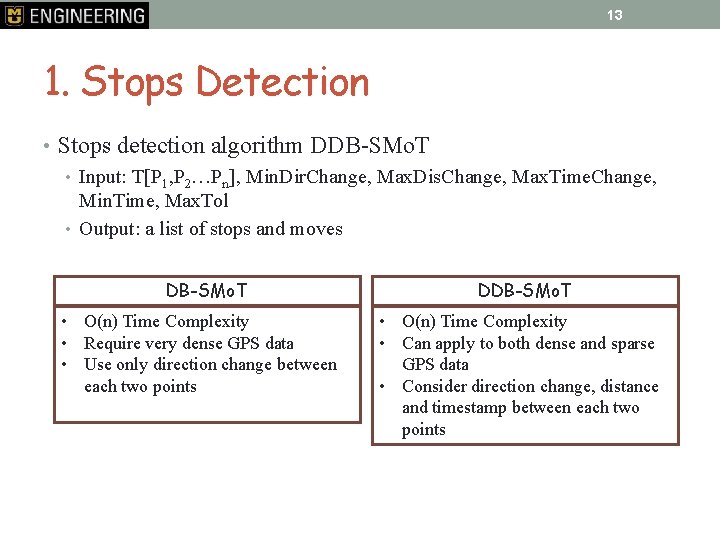
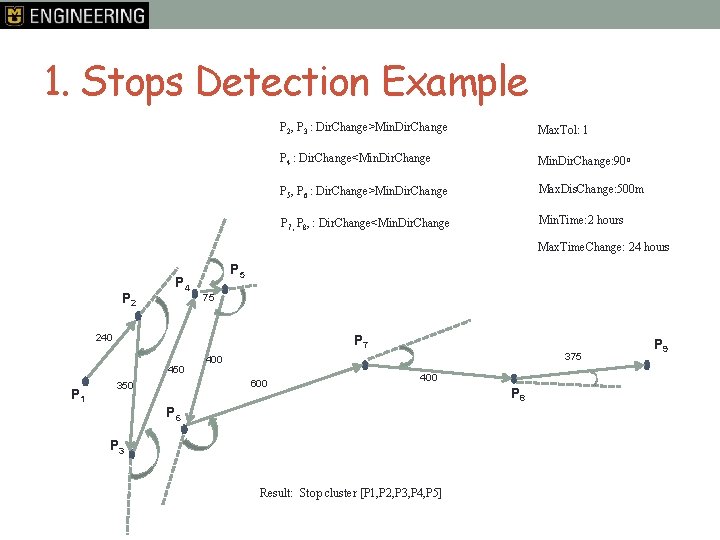
13 1. Stops Detection • Stops detection algorithm DDB-SMo. T • Input: T[P 1, P 2…Pn], Min. Dir. Change, Max. Dis. Change, Max. Time. Change, Min. Time, Max. Tol • Output: a list of stops and moves DB-SMo. T • O(n) Time Complexity • Require very dense GPS data • Use only direction change between each two points DDB-SMo. T • O(n) Time Complexity • Can apply to both dense and sparse GPS data • Consider direction change, distance and timestamp between each two points
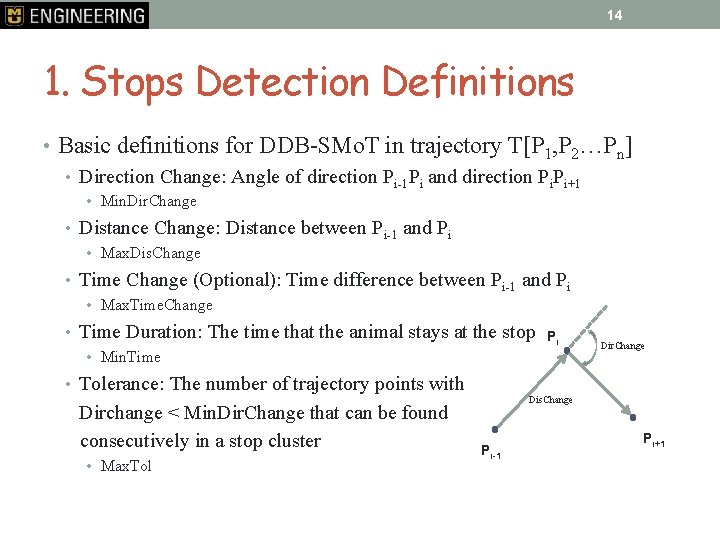
14 1. Stops Detection Definitions • Basic definitions for DDB-SMo. T in trajectory T[P 1, P 2…Pn] • Direction Change: Angle of direction Pi-1 Pi and direction Pi. Pi+1 • Min. Dir. Change • Distance Change: Distance between Pi-1 and Pi • Max. Dis. Change • Time Change (Optional): Time difference between Pi-1 and Pi • Max. Time. Change • Time Duration: The time that the animal stays at the stop Pi • Min. Time Dir. Change • Tolerance: The number of trajectory points with Dirchange < Min. Dir. Change that can be found consecutively in a stop cluster • Max. Tol Dis. Change Pi-1 Pi+1
1. Stops Detection Example P 2, P 3 : Dir. Change>Min. Dir. Change Max. Tol: 1 P 4 : Dir. Change<Min. Dir. Change: 90 o P 5, P 6 : Dir. Change>Min. Dir. Change Max. Dis. Change: 500 m P 7, P 8, : Dir. Change<Min. Dir. Change Min. Time: 2 hours Max. Time. Change: 24 hours P 2 P 4 P 5 75 240 P 7 450 P 1 375 400 600 350 400 P 6 P 3 Result: Stop cluster [P 1, P 2, P 3, P 4, P 5] P 8 P 9
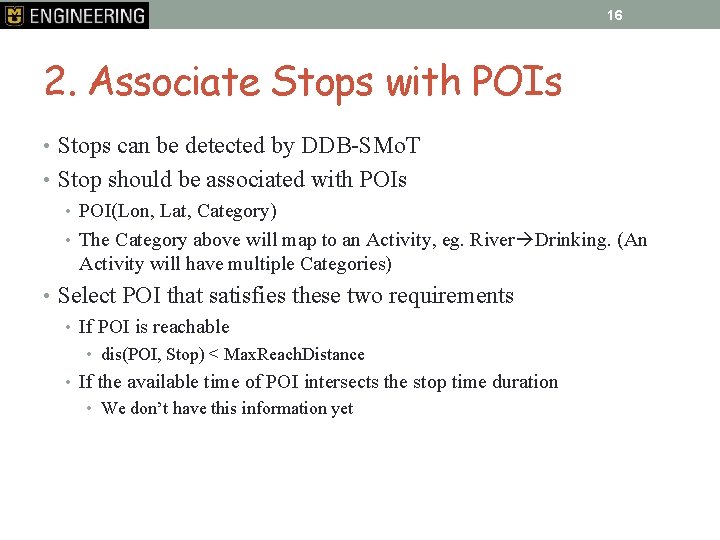
16 2. Associate Stops with POIs • Stops can be detected by DDB-SMo. T • Stop should be associated with POIs • POI(Lon, Lat, Category) • The Category above will map to an Activity, eg. River Drinking. (An Activity will have multiple Categories) • Select POI that satisfies these two requirements • If POI is reachable • dis(POI, Stop) < Max. Reach. Distance • If the available time of POI intersects the stop time duration • We don’t have this information yet
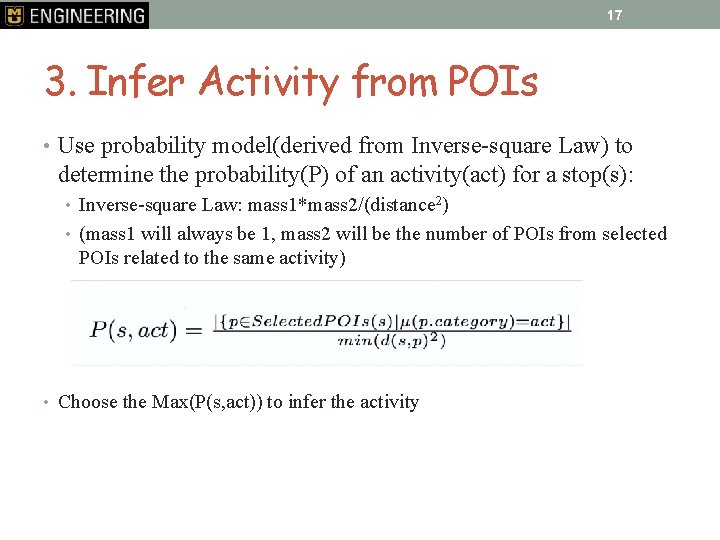
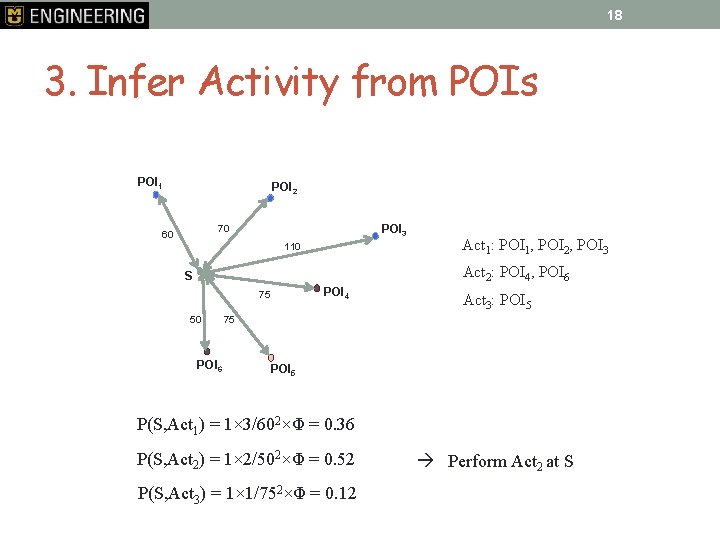
17 3. Infer Activity from POIs • Use probability model(derived from Inverse-square Law) to determine the probability(P) of an activity(act) for a stop(s): • Inverse-square Law: mass 1*mass 2/(distance 2) • (mass 1 will always be 1, mass 2 will be the number of POIs from selected POIs related to the same activity) • Choose the Max(P(s, act)) to infer the activity
18 3. Infer Activity from POIs POI 1 POI 2 POI 3 70 60 110 Act 1: POI 1, POI 2, POI 3 Act 2: POI 4, POI 6 S POI 4 75 50 POI 6 Act 3: POI 5 75 POI 5 P(S, Act 1) = 1× 3/602×Φ = 0. 36 P(S, Act 2) = 1× 2/502×Φ = 0. 52 P(S, Act 3) = 1× 1/752×Φ = 0. 12 Perform Act 2 at S
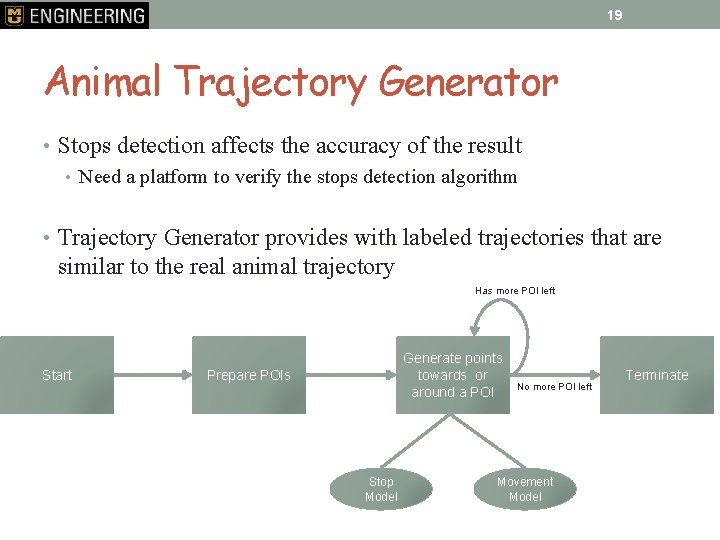
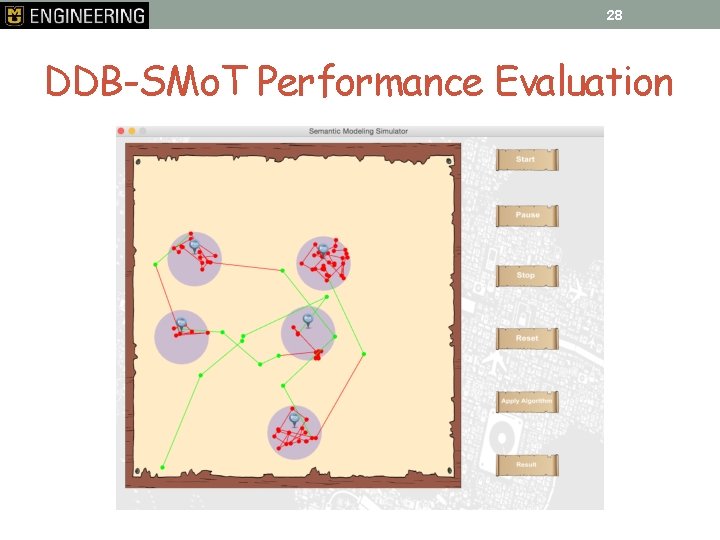
19 Animal Trajectory Generator • Stops detection affects the accuracy of the result • Need a platform to verify the stops detection algorithm • Trajectory Generator provides with labeled trajectories that are similar to the real animal trajectory Has more POI left Start Generate points towards or around a POI Prepare POIs Stop Model No more POI left Movement Model Terminate
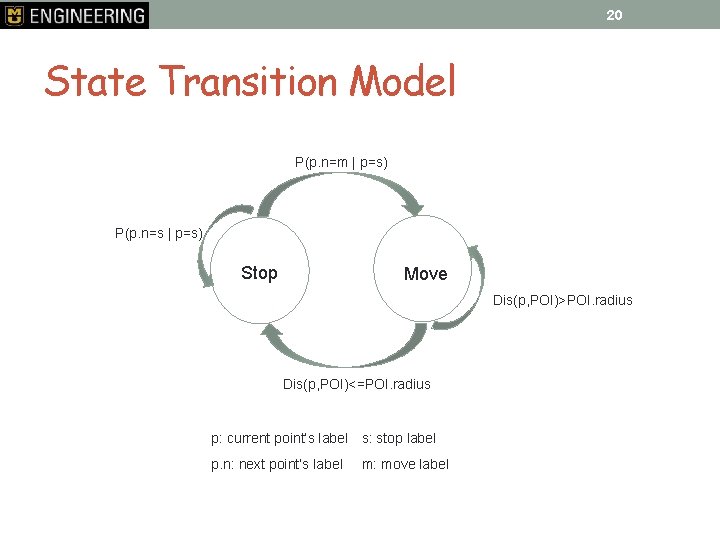
20 State Transition Model P(p. n=m | p=s) P(p. n=s | p=s) Stop Move Dis(p, POI)>POI. radius Dis(p, POI)<=POI. radius p: current point’s label s: stop label p. n: next point’s label m: move label
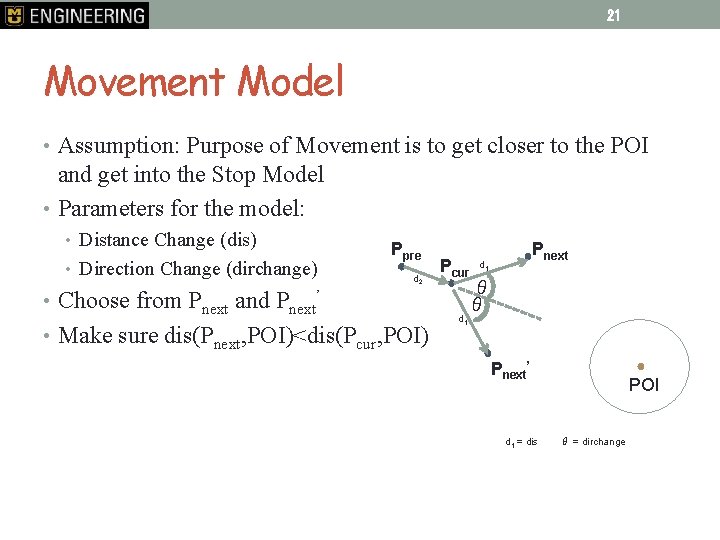
21 Movement Model • Assumption: Purpose of Movement is to get closer to the POI and get into the Stop Model • Parameters for the model: • Distance Change (dis) • Direction Change (dirchange) • Choose from Pnext and Pnext Ppre d 2 Pcur ’ • Make sure dis(Pnext, POI)<dis(Pcur, POI) d 1 Pnext d 1 θ θ Pnext’ d 1 = dis POI θ = dirchange
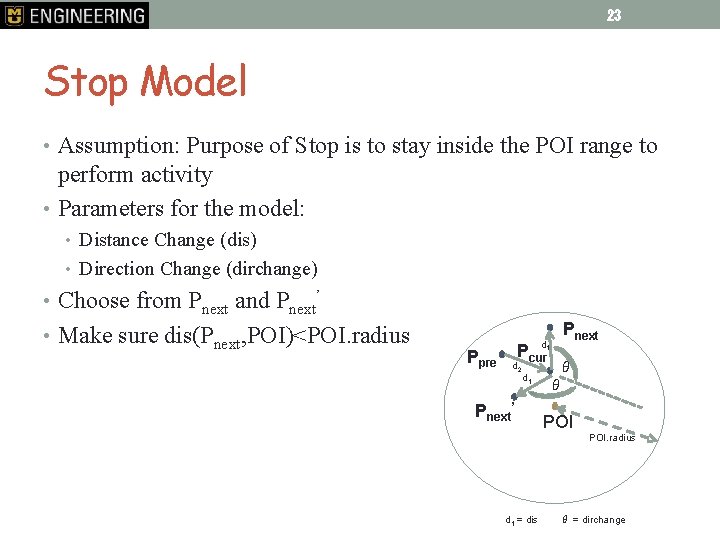
23 Stop Model • Assumption: Purpose of Stop is to stay inside the POI range to perform activity • Parameters for the model: • Distance Change (dis) • Direction Change (dirchange) • Choose from Pnext and Pnext’ • Make sure dis(Pnext, POI)<POI. radius Ppre d 1 Pcur d 2 d 1 Pnext’ Pnext θ θ POI. radius d 1 = dis θ = dirchange
24 Overview • Introduction • Related Work • Methodology • Experiment • Summary and Future Work
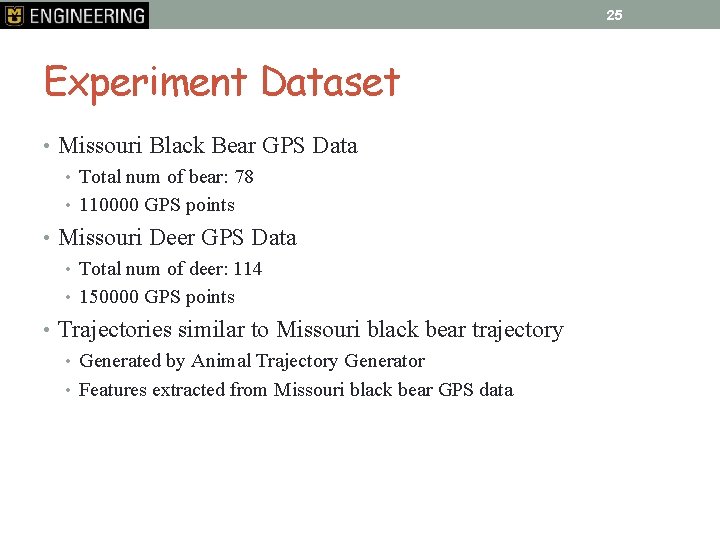
25 Experiment Dataset • Missouri Black Bear GPS Data • Total num of bear: 78 • 110000 GPS points • Missouri Deer GPS Data • Total num of deer: 114 • 150000 GPS points • Trajectories similar to Missouri black bear trajectory • Generated by Animal Trajectory Generator • Features extracted from Missouri black bear GPS data
26 Experiments • Performance evaluation for DDB-SMo. T • Use trajectories provided by Animal Trajectory Generator • Features extracted from black bear trajectory • Compare accuracy with DB-SMo. T • Semantic Analysis Experiments • Use Missouri black bear and deer GPS data
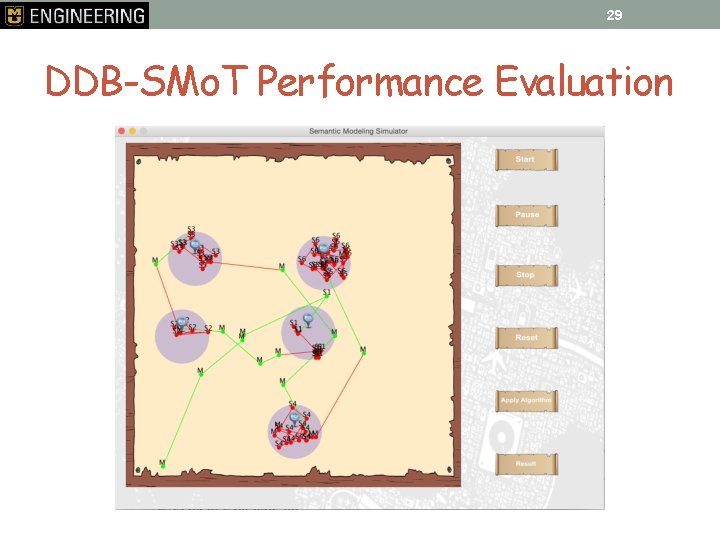
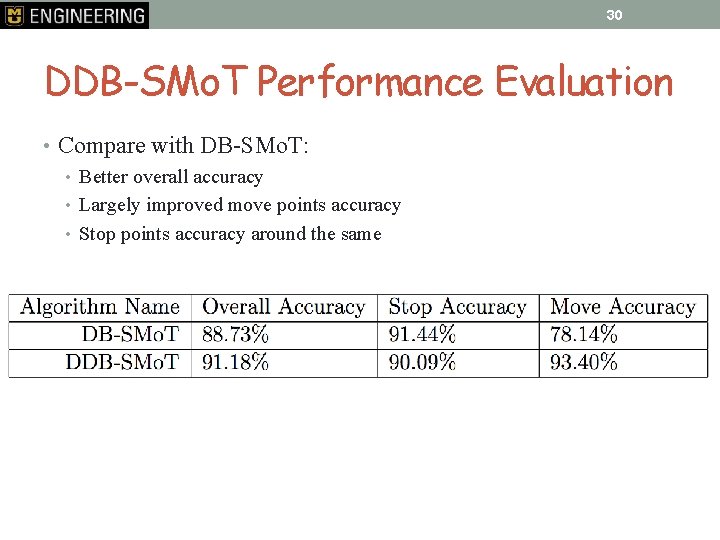
27 DDB-SMo. T Performance Evaluation • Use labeled trajectory • Apply DDB-SMo. T • Label each point with prediction result • Evaluate the accuracy of the stops detection algorithm from three bench marks: • Stop points accuracy • Move points accuracy • Overall accuracy
28 DDB-SMo. T Performance Evaluation
29 DDB-SMo. T Performance Evaluation
30 DDB-SMo. T Performance Evaluation • Compare with DB-SMo. T: • Better overall accuracy • Largely improved move points accuracy • Stop points accuracy around the same
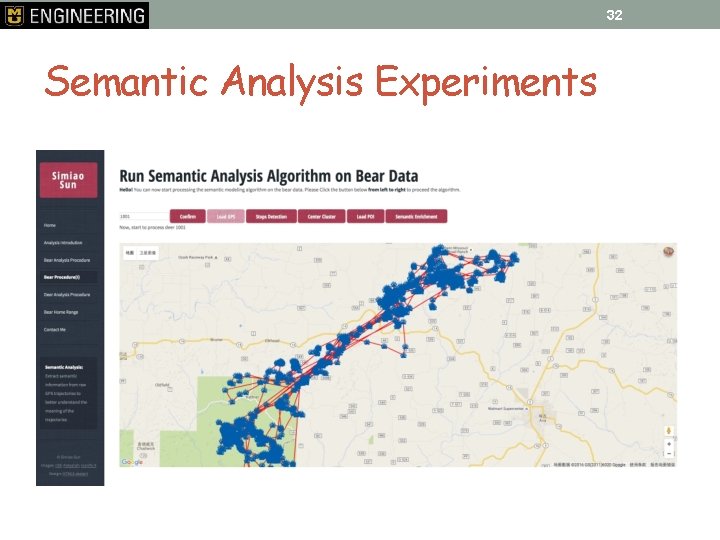
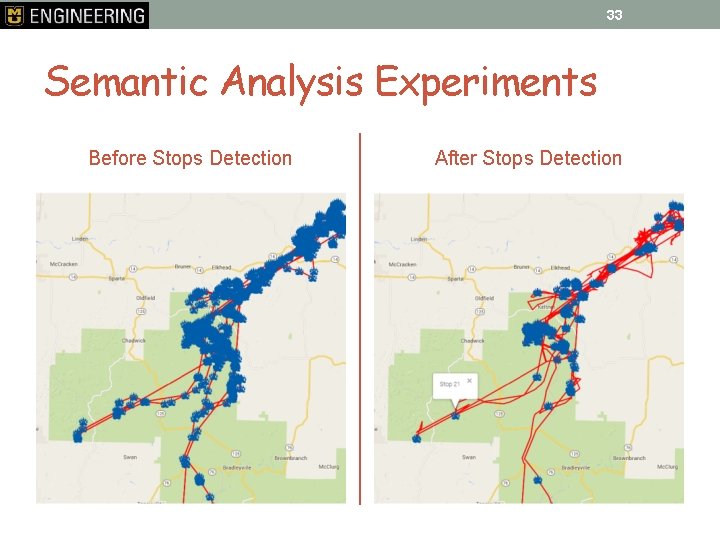
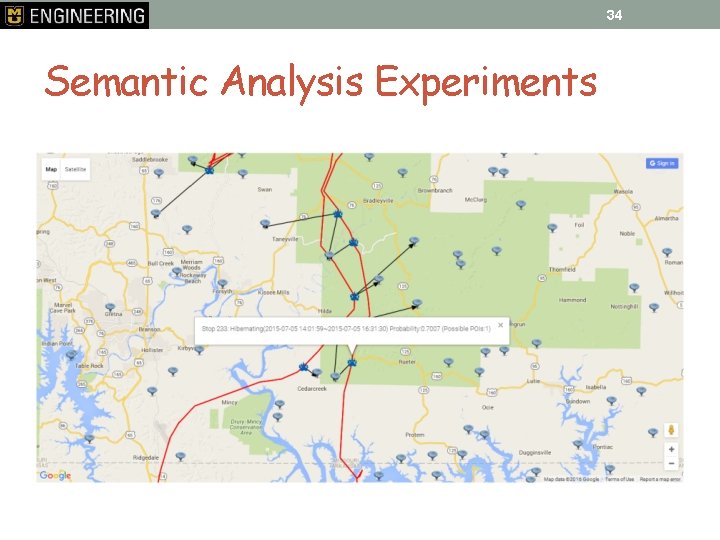
31 Semantic Analysis Experiments • Currently, no accuracy of semantic analysis can be calculated • POI dataset not available • No ground truth labeled with the GPS points • Semantic analysis web application • Visualize the whole semantic enrichment process • Semantic analysis for black bear and deer GPS data
32 Semantic Analysis Experiments
33 Semantic Analysis Experiments Before Stops Detection After Stops Detection
34 Semantic Analysis Experiments
35 Overview • Introduction • Related Work • Methodology • Experiment • Summary and Future Work
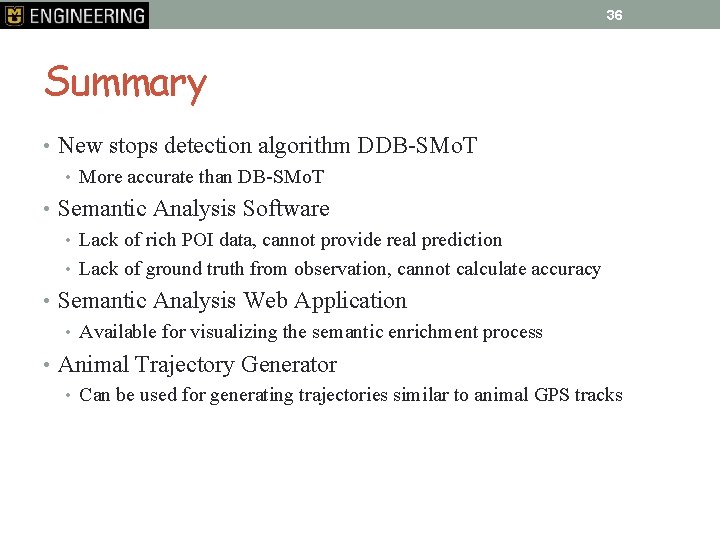
36 Summary • New stops detection algorithm DDB-SMo. T • More accurate than DB-SMo. T • Semantic Analysis Software • Lack of rich POI data, cannot provide real prediction • Lack of ground truth from observation, cannot calculate accuracy • Semantic Analysis Web Application • Available for visualizing the semantic enrichment process • Animal Trajectory Generator • Can be used for generating trajectories similar to animal GPS tracks
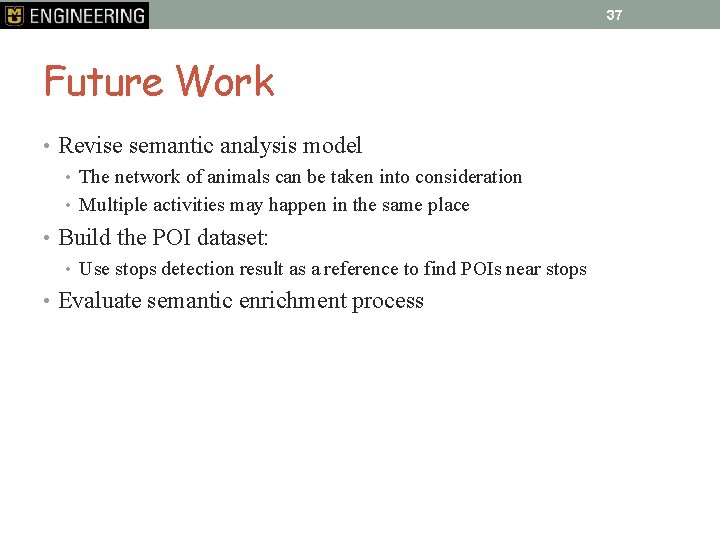
37 Future Work • Revise semantic analysis model • The network of animals can be taken into consideration • Multiple activities may happen in the same place • Build the POI dataset: • Use stops detection result as a reference to find POIs near stops • Evaluate semantic enrichment process
38 Thanks For Presences Questions ?