
Activity 2 Pythagoras Theorem Class 10 th Prepared



- Slides: 12
Activity- 2 Pythagoras Theorem Class 10 th Prepared & Presented By Mrs. Pramila Kumari Sahoo TGT, Mathematics JNV, Jagatsinghpur, Odisha
Objective To verify Pythagoras theorem by performing an activity The area of the square constructed on the hypotenuse of a rightangled triangle is equal to the sum of the areas of squares constructed on the other two sides of a rightangled triangle.
Materials Required • • Colored Papers • Sketch Pens Pair of Scissor • Light colored square sheet Fevicol Geometry Box
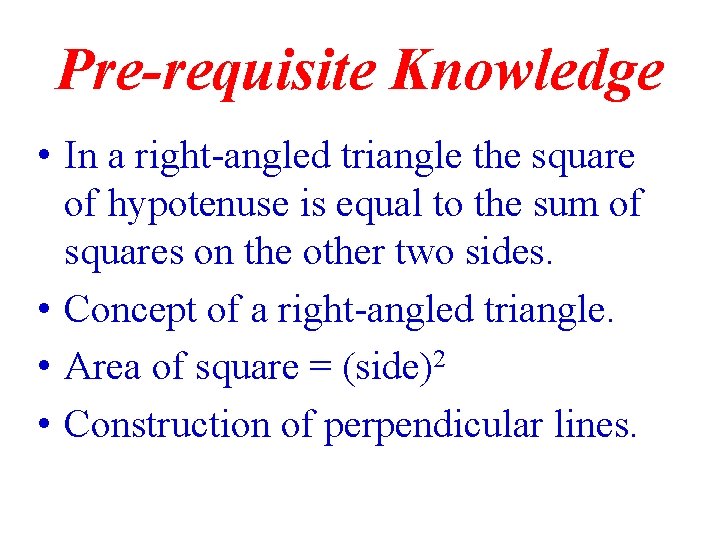
Pre-requisite Knowledge • In a right-angled triangle the square of hypotenuse is equal to the sum of squares on the other two sides. • Concept of a right-angled triangle. • Area of square = (side)2 • Construction of perpendicular lines.
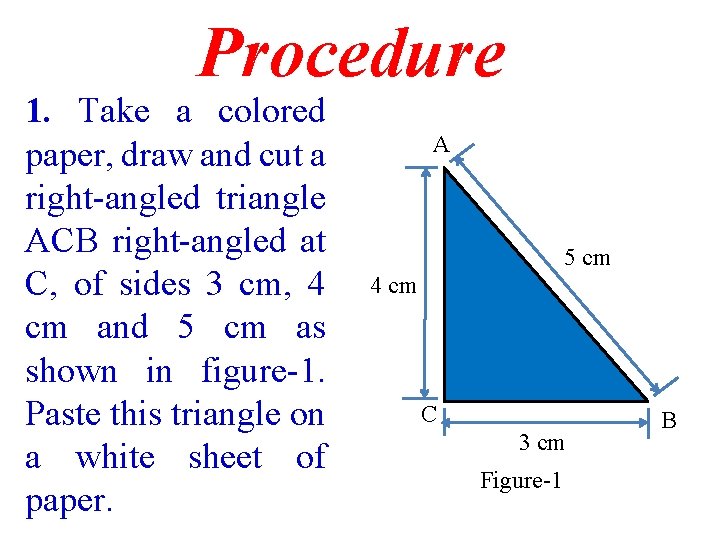
Procedure 1. Take a colored paper, draw and cut a right-angled triangle ACB right-angled at C, of sides 3 cm, 4 cm and 5 cm as shown in figure-1. Paste this triangle on a white sheet of paper. A 5 cm 4 cm C 3 cm Figure-1 B
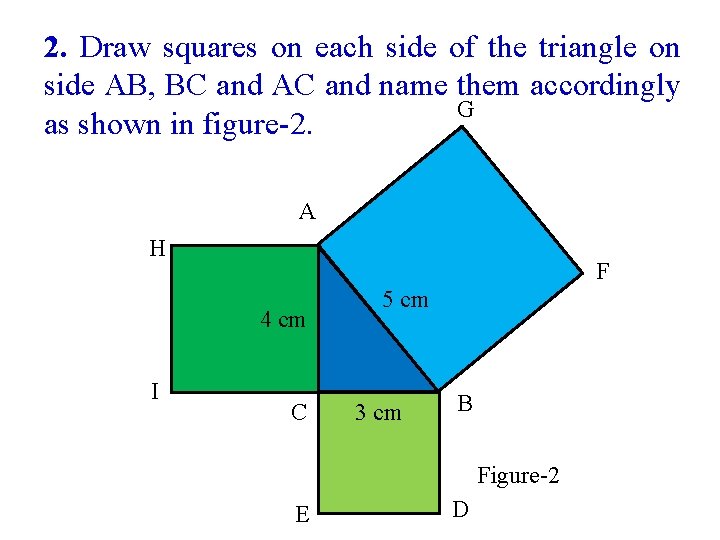
2. Draw squares on each side of the triangle on side AB, BC and AC and name them accordingly G as shown in figure-2. A H F 4 cm I C 5 cm 3 cm B Figure-2 E D
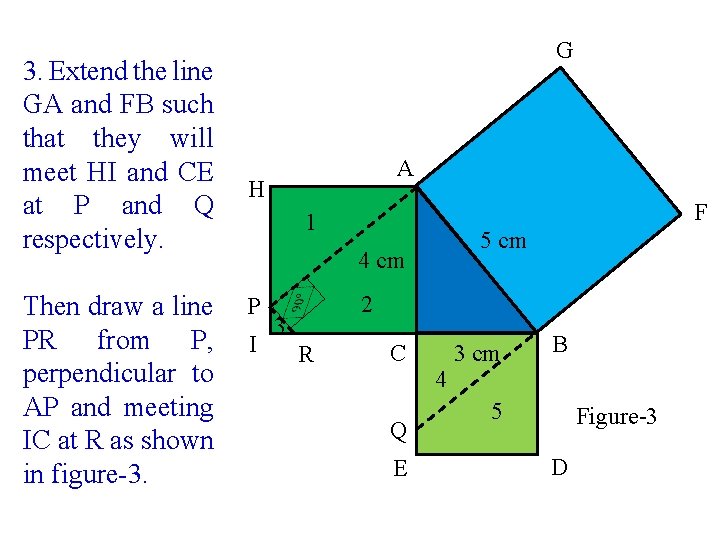
3. Extend the line GA and FB such that they will meet HI and CE at P and Q respectively. Then draw a line PR from P, perpendicular to AP and meeting IC at R as shown in figure-3. G A H F 1 5 cm 4 cm P I 3 2 R C Q E 4 3 cm B 5 Figure-3 D
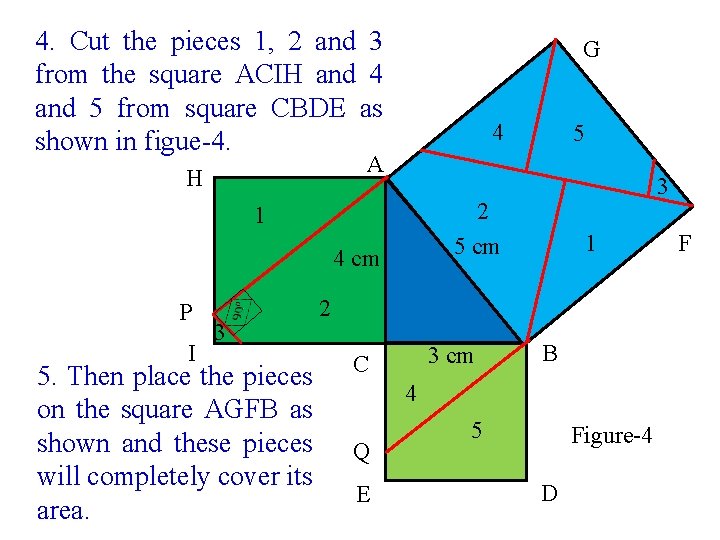
4. Cut the pieces 1, 2 and 3 from the square ACIH and 4 and 5 from square CBDE as shown in figue-4. G 4 A H 4 cm I 3 5. Then place the pieces on the square AGFB as shown and these pieces will completely cover its area. 3 2 5 cm 1 P 5 1 2 3 cm C B 4 Q E 5 Figure-4 D F
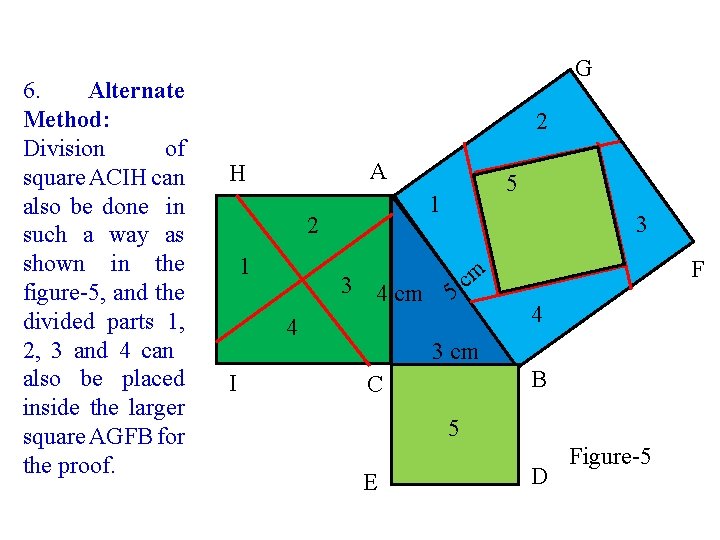
6. Alternate Method: Division of square ACIH can also be done in such a way as shown in the figure-5, and the divided parts 1, 2, 3 and 4 can also be placed inside the larger square AGFB for the proof. G 2 A H 1 2 1 3 4 cm 4 I 5 3 m c 5 F 4 3 cm B C 5 E D Figure-5
Observation •
Result Pythagoras theorem is verified.
k n a h T ou Y