
Activities of The NELAC Institute TNI to Improve
- Slides: 30
Activities of The NELAC Institute (TNI) to Improve Data Quality April 27, 2017
WHAT DO WE PROVIDE? q q A Forum for Stakeholders Consensus building for establishing requirements for: Ø Ø Ø q q Organizations that accredit Organizations that are accredited Proficiency testing programs Recognition of organizations that operate accreditation programs Assistance to members and others
WHAT DO WE NOT DO? ¨ ¨ ¨ Accredit laboratories Resolve disputes between laboratories and their Accreditation Bodies Interpret questions on methods
TNI Consensus Standards Elements ¨ Meets requirements of OMB A-119 Ø Ø Ø ¨ Balance of interest Openness Due process Consensus Appeals process Accredited by the American National Standards Institute (ANSI)
TNI Laboratory Standards ¨ NELAP Ø Ø Requirements for labs Requirements for ABs Requirements for PT provider accreditors Laboratory standard based on ISO 17025 but contains additional specificity to ensure applicability to environmental testing and promote consistent assessments
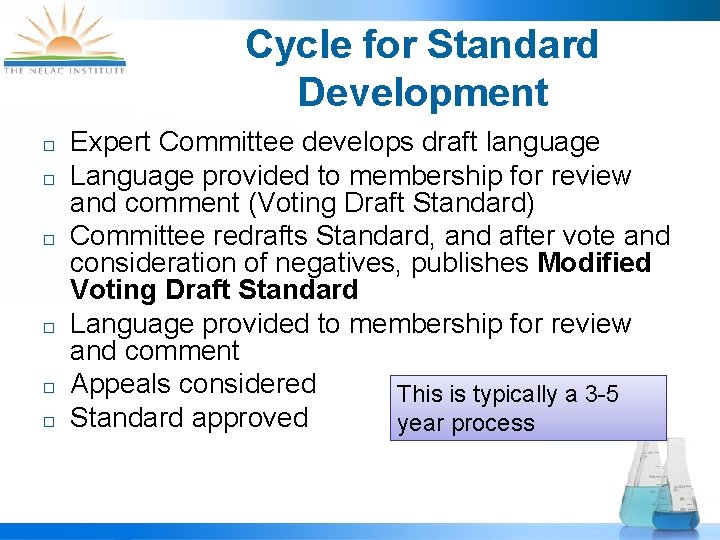
Cycle for Standard Development ¨ ¨ ¨ Expert Committee develops draft language Language provided to membership for review and comment (Voting Draft Standard) Committee redrafts Standard, and after vote and consideration of negatives, publishes Modified Voting Draft Standard Language provided to membership for review and comment Appeals considered This is typically a 3 -5 Standard approved year process
GUIDING PRINCIPLES ¨ ¨ ¨ Flexible: Allow laboratories freedom to use their experience and expertise in performing their work and allow for new and novel approaches. specify the What and avoid where possible the How To. Auditable: Sufficient detail included so that the assessors can evaluate laboratories consistently. Practical and Essential: Necessary policies and procedures that should not place an unreasonable burden upon laboratories. Widely Applicable: Applicable to laboratories regardless of size and complexity. Appropriate: Ensure that data is of known quality and that the quality is adequate for the intended use.
Ways to Modify the Standard ¨ ¨ ¨ Send a comment to the committee chair Come to a meeting and provide comments Join a committee and actively participate Vote negative with comment Vote positive with comment
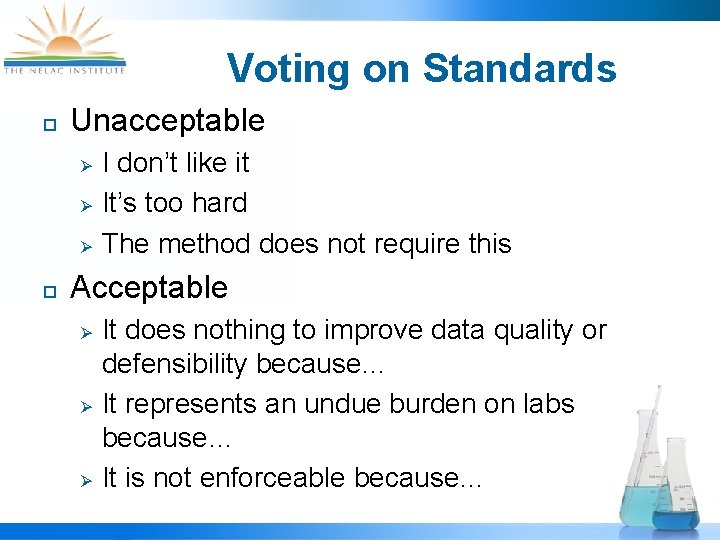
Voting on Standards ¨ Unacceptable Ø Ø Ø ¨ I don’t like it It’s too hard The method does not require this Acceptable Ø Ø Ø It does nothing to improve data quality or defensibility because… It represents an undue burden on labs because… It is not enforceable because…
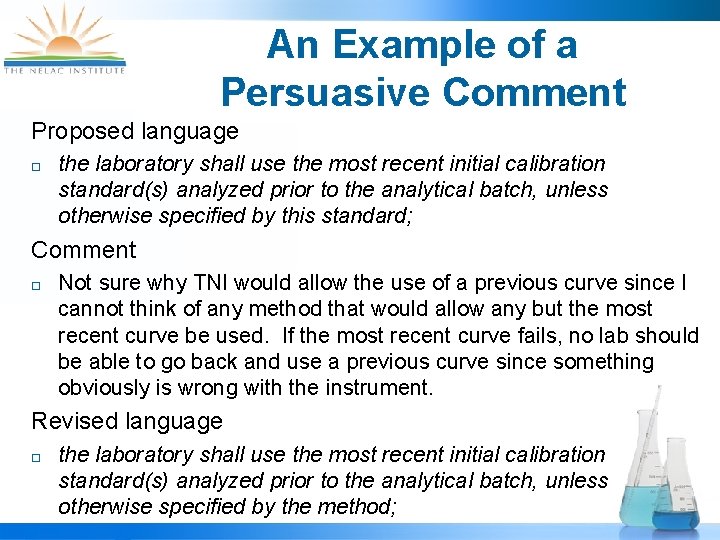
An Example of a Persuasive Comment Proposed language ¨ the laboratory shall use the most recent initial calibration standard(s) analyzed prior to the analytical batch, unless otherwise specified by this standard; Comment ¨ Not sure why TNI would allow the use of a previous curve since I cannot think of any method that would allow any but the most recent curve be used. If the most recent curve fails, no lab should be able to go back and use a previous curve since something obviously is wrong with the instrument. Revised language ¨ the laboratory shall use the most recent initial calibration standard(s) analyzed prior to the analytical batch, unless otherwise specified by the method;
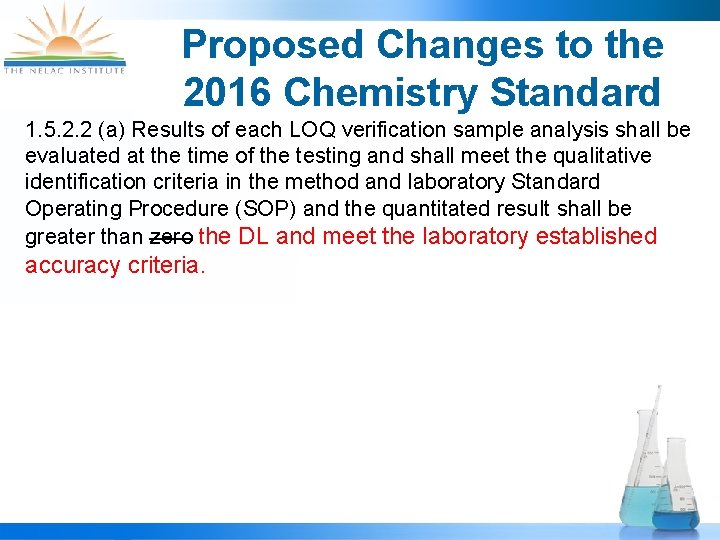
Proposed Changes to the 2016 Chemistry Standard 1. 5. 2. 2 (a) Results of each LOQ verification sample analysis shall be evaluated at the time of the testing and shall meet the qualitative identification criteria in the method and laboratory Standard Operating Procedure (SOP) and the quantitated result shall be greater than zero the DL and meet the laboratory established accuracy criteria.
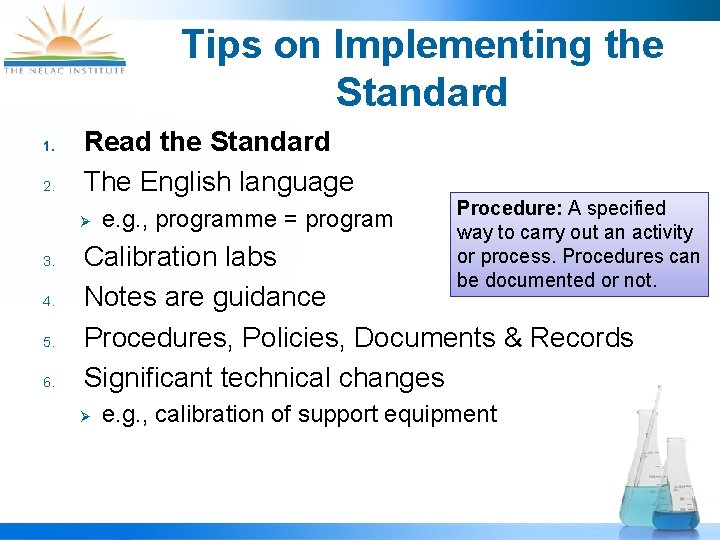
Tips on Implementing the Standard 1. 2. Read the Standard The English language Ø 3. 4. 5. 6. e. g. , programme = program Procedure: A specified way to carry out an activity or process. Procedures can be documented or not. Calibration labs Notes are guidance Procedures, Policies, Documents & Records Significant technical changes Ø e. g. , calibration of support equipment
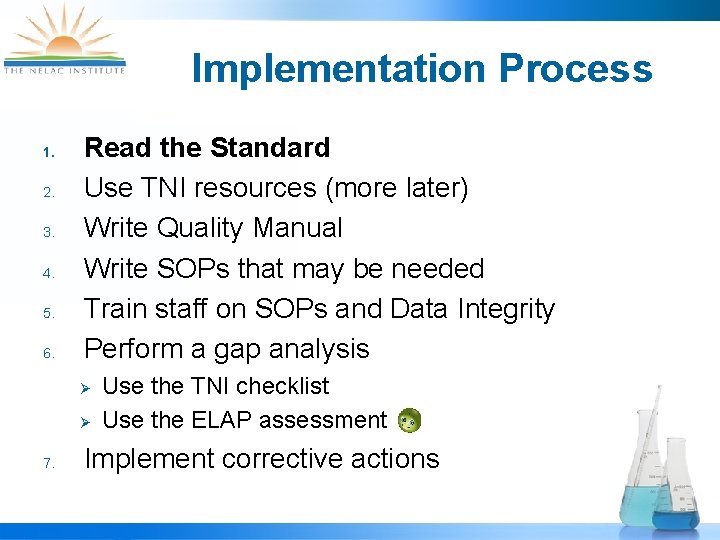
Implementation Process 1. 2. 3. 4. 5. 6. Read the Standard Use TNI resources (more later) Write Quality Manual Write SOPs that may be needed Train staff on SOPs and Data Integrity Perform a gap analysis Ø Ø 7. Use the TNI checklist Use the ELAP assessment Implement corrective actions
Most Common Findings ¨ ¨ Not following SOP Data integrity training Internal audits Records
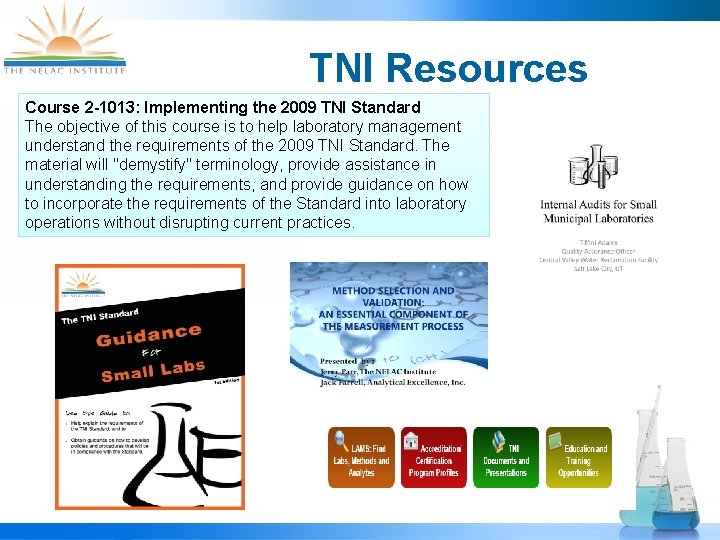
TNI Resources Course 2 -1013: Implementing the 2009 TNI Standard The objective of this course is to help laboratory management understand the requirements of the 2009 TNI Standard. The material will "demystify" terminology, provide assistance in understanding the requirements, and provide guidance on how to incorporate the requirements of the Standard into laboratory operations without disrupting current practices.
Technical Assistance ¨ Small Laboratory Handbook Ø ¨ Quality Manual Template Ø ¨ Fill in the blank template TNI Standard webcast Ø ¨ Tips and Hints for implementing the standard 16 - hour comprehensive training on the TNI Standard TNI Quality Systems webcast lectures Ø A series of 10 lectures on various topics (e. g. , data integrity, corrective actions, LOD/LOQ)
Small Laboratory Handbook 4. 4 Review of Contracts Small laboratories, and particularly small in-house or municipal laboratories, will commonly address this as “Not Applicable”. While this may be generally true, it is becoming more prevalent where these laboratories are also doing work for the local public and private sectors. If in-house laboratories are also doing work for the local public and private sectors, the laboratory should address policies and procedures for accepting outside work, including making sure it does not impact their ability to respond to their primary function.
Quality Manual Template 4. 4 Review of Contracts The <Laboratory Director? Client Services Manager? Project Manager? Quality Manager? Technical Managers? Who? > determines if the laboratory has the necessary accreditations, resources, including schedule, equipment, deliverables, and personnel to meet the work request. <How is the review documented? > The <Who? > informs the client of the results of the review if it indicates any potential conflict, deficiency, lack of accreditation, or inability of the lab to the complete the work satisfactorily.
Technical Assistance ¨ ¨ ¨ ¨ ¨ Listing of consultants to help laboratories How to get accredited flow chart Quality Systems checklist Standards Interpretations Small Laboratory Advocacy Group bulletin board Assessment Forum and Mentor Sessions Fields of Proficiency Testing Tables LAMS Guidance Documents Ø Calibration and LOD/LOQ (Summer 2017)
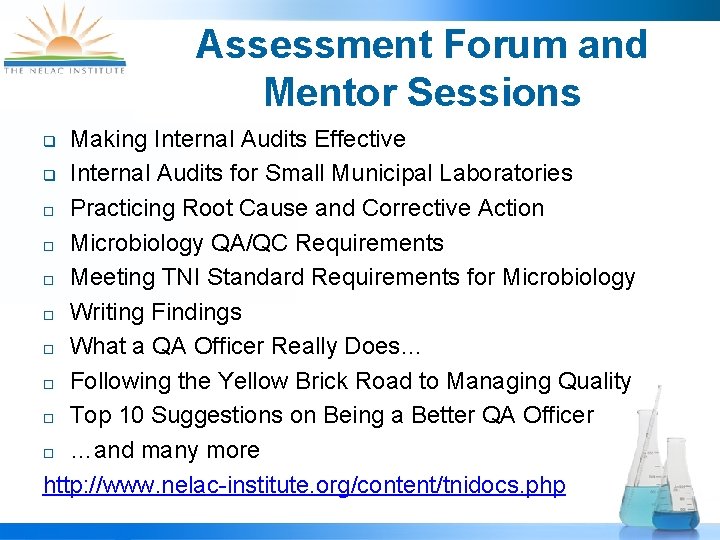
Assessment Forum and Mentor Sessions Making Internal Audits Effective q Internal Audits for Small Municipal Laboratories ¨ Practicing Root Cause and Corrective Action ¨ Microbiology QA/QC Requirements ¨ Meeting TNI Standard Requirements for Microbiology ¨ Writing Findings ¨ What a QA Officer Really Does… ¨ Following the Yellow Brick Road to Managing Quality ¨ Top 10 Suggestions on Being a Better QA Officer ¨ …and many more http: //www. nelac-institute. org/content/tnidocs. php q
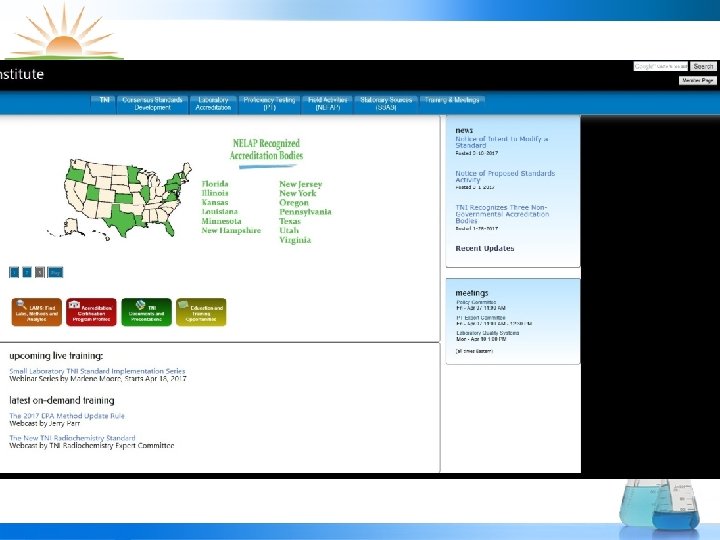
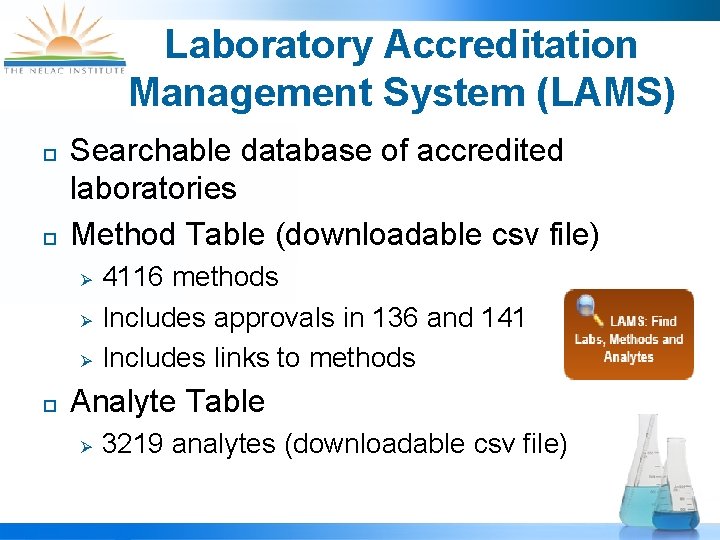
Laboratory Accreditation Management System (LAMS) ¨ ¨ Searchable database of accredited laboratories Method Table (downloadable csv file) Ø Ø Ø ¨ 4116 methods Includes approvals in 136 and 141 Includes links to methods Analyte Table Ø 3219 analytes (downloadable csv file)
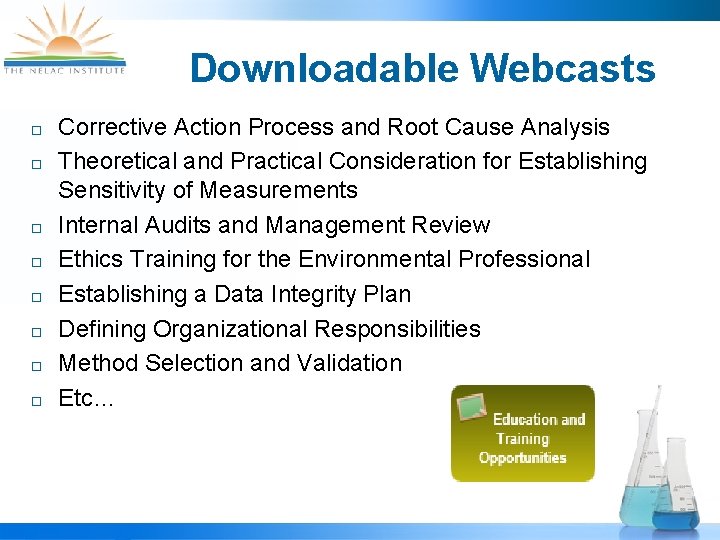
Downloadable Webcasts ¨ ¨ ¨ ¨ Corrective Action Process and Root Cause Analysis Theoretical and Practical Consideration for Establishing Sensitivity of Measurements Internal Audits and Management Review Ethics Training for the Environmental Professional Establishing a Data Integrity Plan Defining Organizational Responsibilities Method Selection and Validation Etc…
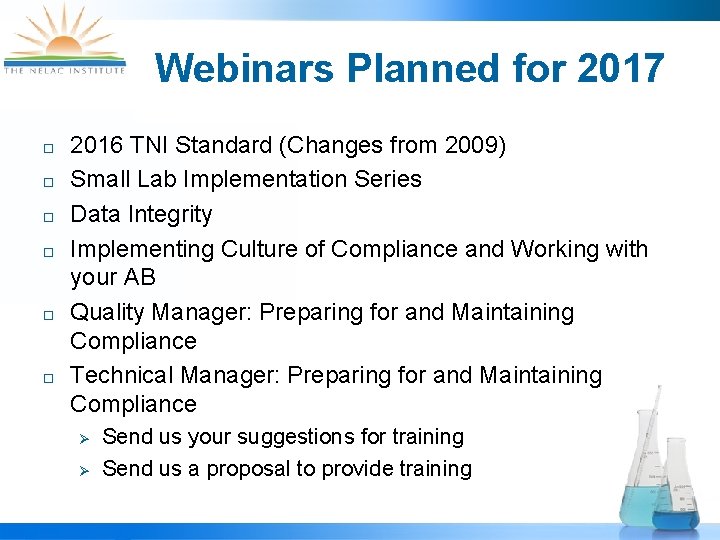
Webinars Planned for 2017 ¨ ¨ ¨ 2016 TNI Standard (Changes from 2009) Small Lab Implementation Series Data Integrity Implementing Culture of Compliance and Working with your AB Quality Manager: Preparing for and Maintaining Compliance Technical Manager: Preparing for and Maintaining Compliance Ø Ø Send us your suggestions for training Send us a proposal to provide training
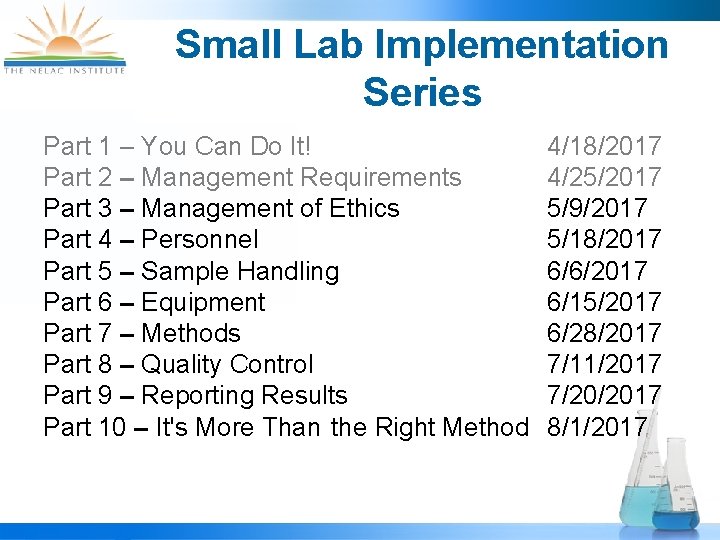
Small Lab Implementation Series Part 1 – You Can Do It! Part 2 – Management Requirements Part 3 – Management of Ethics Part 4 – Personnel Part 5 – Sample Handling Part 6 – Equipment Part 7 – Methods Part 8 – Quality Control Part 9 – Reporting Results Part 10 – It's More Than the Right Method 4/18/2017 4/25/2017 5/9/2017 5/18/2017 6/6/2017 6/15/2017 6/28/2017 7/11/2017 7/20/2017 8/1/2017
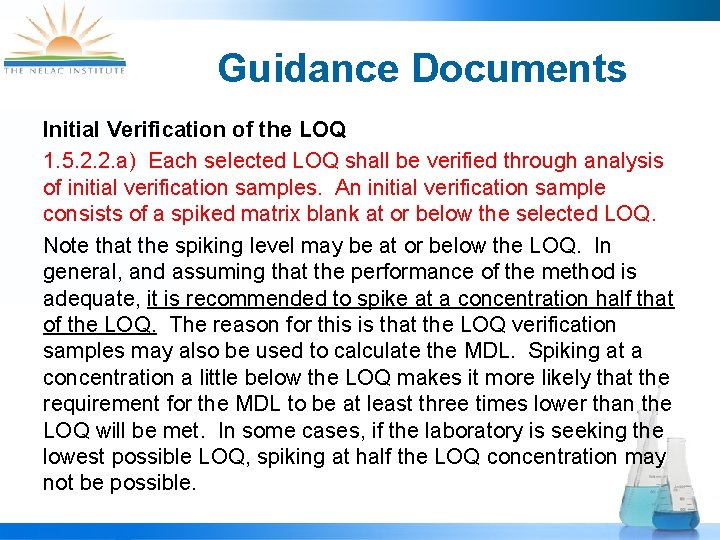
Guidance Documents Initial Verification of the LOQ 1. 5. 2. 2. a) Each selected LOQ shall be verified through analysis of initial verification samples. An initial verification sample consists of a spiked matrix blank at or below the selected LOQ. Note that the spiking level may be at or below the LOQ. In general, and assuming that the performance of the method is adequate, it is recommended to spike at a concentration half that of the LOQ. The reason for this is that the LOQ verification samples may also be used to calculate the MDL. Spiking at a concentration a little below the LOQ makes it more likely that the requirement for the MDL to be at least three times lower than the LOQ will be met. In some cases, if the laboratory is seeking the lowest possible LOQ, spiking at half the LOQ concentration may not be possible.
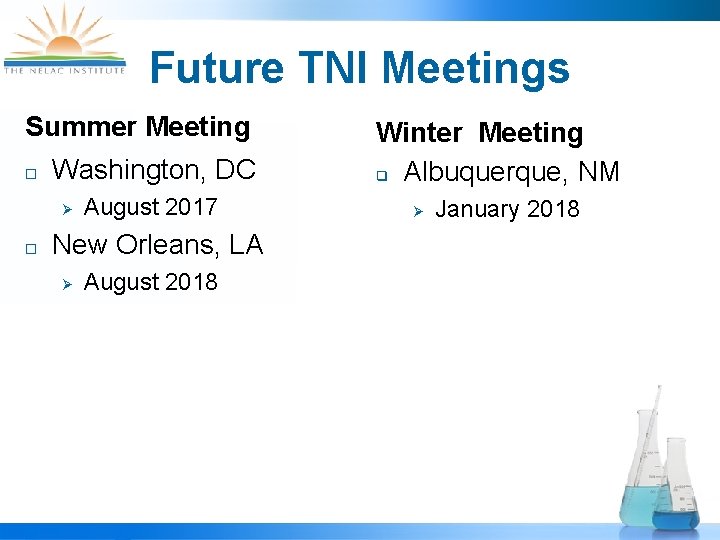
Future TNI Meetings Summer Meeting ¨ Washington, DC Ø ¨ August 2017 New Orleans, LA Ø August 2018 Winter Meeting q Albuquerque, NM Ø January 2018
Summer Meeting ¨ ¨ ¨ In conjunction with National Environmental Monitoring Conference August 7 -11 www. nemc. us
Summer Meeting ¨ ¨ 180 Oral and Poster presentations Special session on California Special session on ISO 17025 Mentor session on California issues
Contact TNI Jerry Parr, Executive Director www. nelac-institute. org Ø jerry. parr@nelac-institute. org Ø 817 -598 -1624 Ø 817 -598 -1155 (Direct) Ø