
Activities in Relation to Kohlbergs theory of Moral
Activities in Relation to Kohlberg’s theory of Moral Reasoning A Study that investigates if certain activities correlate with higher levels of Moral Reasoning, as defined by Kohlberg by Jonathan Guedalia
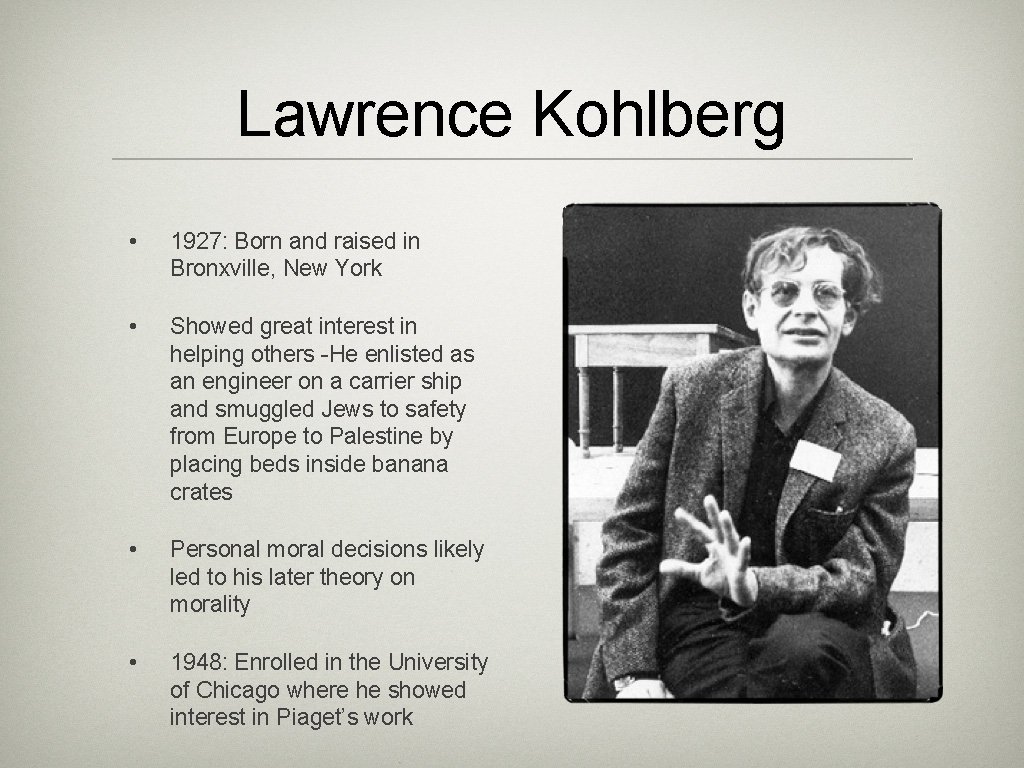
Lawrence Kohlberg • 1927: Born and raised in Bronxville, New York • Showed great interest in helping others -He enlisted as an engineer on a carrier ship and smuggled Jews to safety from Europe to Palestine by placing beds inside banana crates • Personal moral decisions likely led to his later theory on morality • 1948: Enrolled in the University of Chicago where he showed interest in Piaget’s work
Kohlberg cont. • 1949: Just a year after enrolling, Kohlberg earns his bachelor's degree in psychology • 1958: Completed Dissertation with in-depth approach of his six-stage theory of cognitive moral development • Taught at the University of Chicago as a developmental psychologist • 1968: Taught education and social psychology at Harvard University
Kohlberg. . . • Visited Israel and countries in Asia to test his theories. • Adapted the dilemmas to fit the culture • (ie. Bridge Dilemma) • 1971: While researching in Belize, Kohlberg gets a tropical disease that causes both physical pain and depression • 1984: Essays on the Philosophy and Psychology of Moral Development are Published in 1981 & 1984 • January 19, 1987: Kohlberg commits suicide in Boston Harbor
Definition • Morality reasoning: judgements about right and wrong. http: //eqi. org/kohlberg. htm
theory • Expands on Piaget’s theory • 6 stages; 2 levels
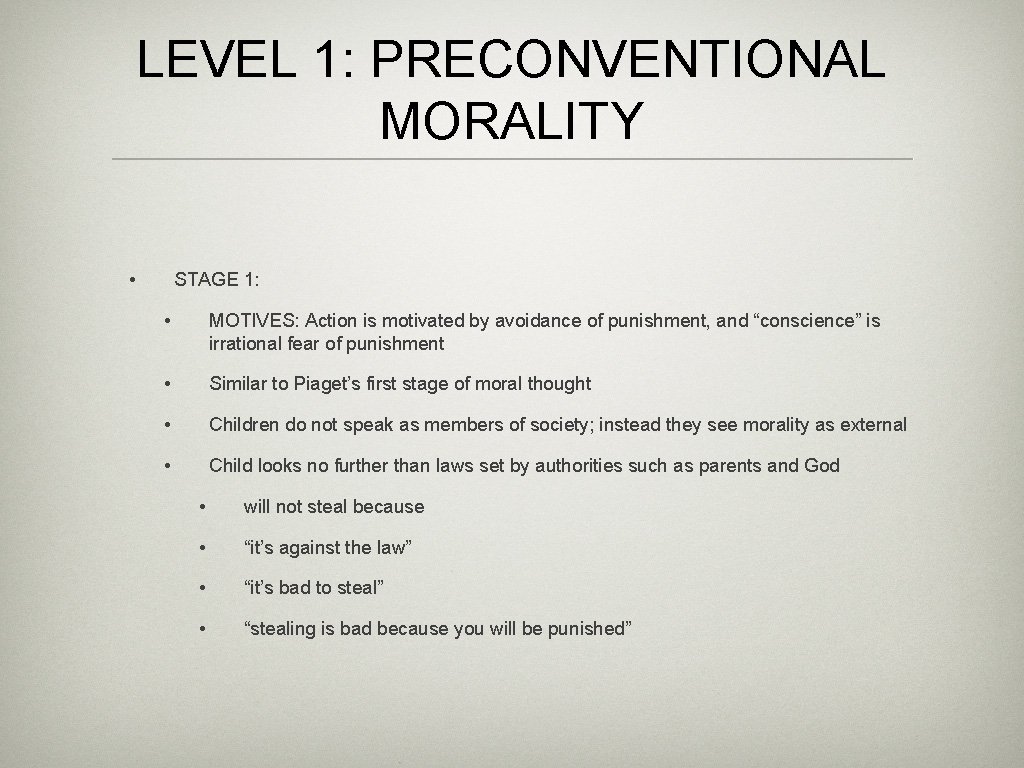
LEVEL 1: PRECONVENTIONAL MORALITY • STAGE 1: • MOTIVES: Action is motivated by avoidance of punishment, and “conscience” is irrational fear of punishment • Similar to Piaget’s first stage of moral thought • Children do not speak as members of society; instead they see morality as external • Child looks no further than laws set by authorities such as parents and God • will not steal because • “it’s against the law” • “it’s bad to steal” • “stealing is bad because you will be punished”
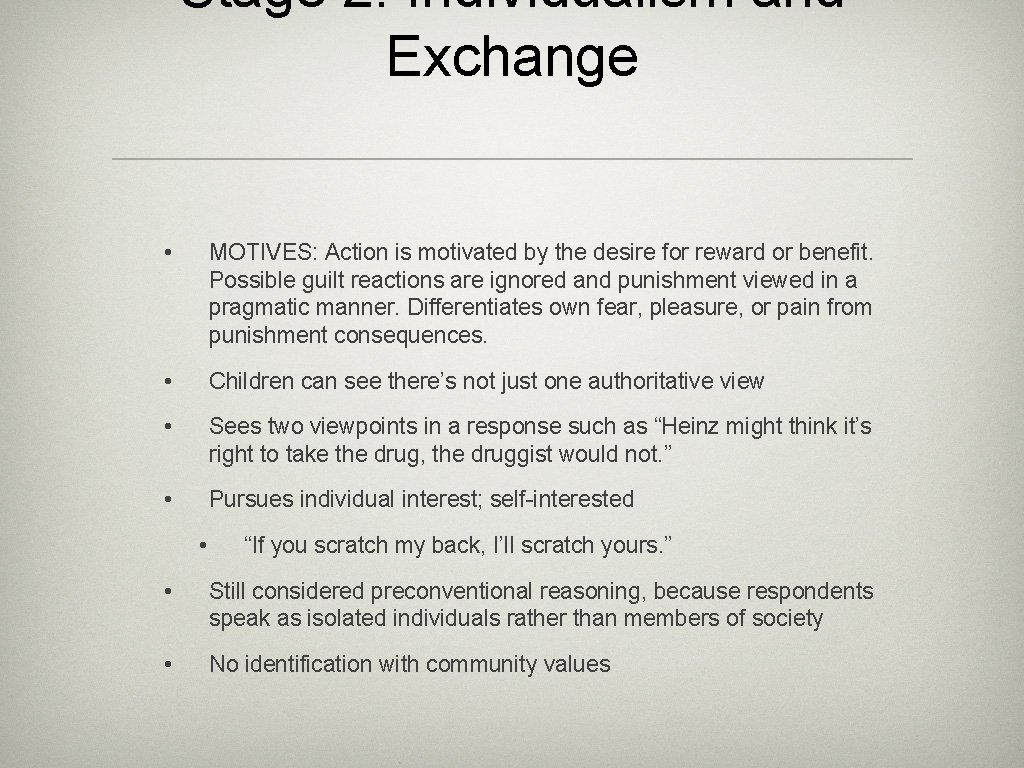
Stage 2: Individualism and Exchange • MOTIVES: Action is motivated by the desire for reward or benefit. Possible guilt reactions are ignored and punishment viewed in a pragmatic manner. Differentiates own fear, pleasure, or pain from punishment consequences. • Children can see there’s not just one authoritative view • Sees two viewpoints in a response such as “Heinz might think it’s right to take the drug, the druggist would not. ” • Pursues individual interest; self-interested • “If you scratch my back, I’ll scratch yours. ” • Still considered preconventional reasoning, because respondents speak as isolated individuals rather than members of society • No identification with community values
Level 2: Conventional Morality • STAGE 3: Good Interpersonal Relationships • MOTIVES: Action is motivated by anticipation of disapproval of others, actual or imagined hypothetical (ie. guilt). Differentiates disapproval from punishment, fear, and pain. • This stage usually apparent as children entering their teens • Recognize that one should live up to community standards by showing good behavior such as love, empathy and trust for others • “he was a good man for wanting to save her” • “his intentions were good, that of saving the life of someone he loves” • describing druggist as “selfish” and “greedy”
Social Order • MOTIVES: Action is motivated by anticipation of dishonor; that is, institutionalized blame for failures of duty, and by guilt over concrete harm done to others. • Respondent becomes concerned with society as a whole • Following rules to maintain social order • • People think “from a full-fledged member of society perspective. ” • “I shouldn’t steal because if we all started breaking laws whenever we felt we had a good reason, chaos would erupt and society couldn’t function” Seems similar to stage 1? As far as the “No” answer’s concerned, yes, but the reasoning in stage 4 transcends the thought process of stage 1 by acknowledging the function of laws in society of a whole.
Morality • Stage 5: Social Contract and Individual Rights • Respondents think past a functional society to consider if it’s a good society by considering the rights and values a society should maintain • • • Think from a “prior-to-society” perspective by evaluating what makes a society good This perspective usually includes democratic principles, such as basic rights, fair laws and democratic procedures • “It is the husband’s duty to save his wife. The fact that they her life is in danger transcends every other standard you might use to judge his action. ” • “Still should maintain a legal standpoint by punishing Heinz slightly if he steals the drug. ” Think more independently than stage 4 respondents. Does not base “right to life” on conventional thinking, but instead on logical thinking of what society should value.
Stage 6: Universal Principles (theoretical stage) • MOTIVES: Principles that seek to achieve justice that a democracy or majority vote cannot always satisfy • Based on philosophers such as Immanuel Kant and leaders such as Mohandas Gandhi • Principles of justice that equally respect each person. (ie. minorities) • This perspective requires taking the role of others by looking at a situation in the eyes of both parties involved • Very few people tested consistently in stage 6, so Kohlberg classified it as theoretical.
Question? • Do certain activities such as interaction with parents, watching television or reading translate to higher levels of moral reasoning?
Hypothesis • Children who spend the most time interacting and discussing issues with parents will show higher levels of moral reasoning.
Study: • Activities questionnaire • Heinz dilemma • 21 students in middle school • 7 th and 8 th grade classes


Testing environment
Heinz Dilemma • “In Europe, a woman was near death from a special kind of cancer. There was one drug that the doctors thought might save her. It was a form of radium that a druggist in the same town had recently discovered. The drug was expensive to make, but the druggist was charging ten times what the drug cost him to make. He paid $400 for the radium and charged $4, 000 for a small dose of the drug. The sick woman’s husband, Heinz, went to everyone he knew to borrow the money and tried every legal means, but he could only get together about $2, 000 which is half of what it cost. He told the druggist that his wife was dying and asked him to sell it cheaper or let him pay later. But the druggist said: “No, I discovered the drug and I’m going to make money from it. ” So having tried every legal means, Heinz gets desperate and considers breaking into the man’s store to steal the drug for his wife. ”
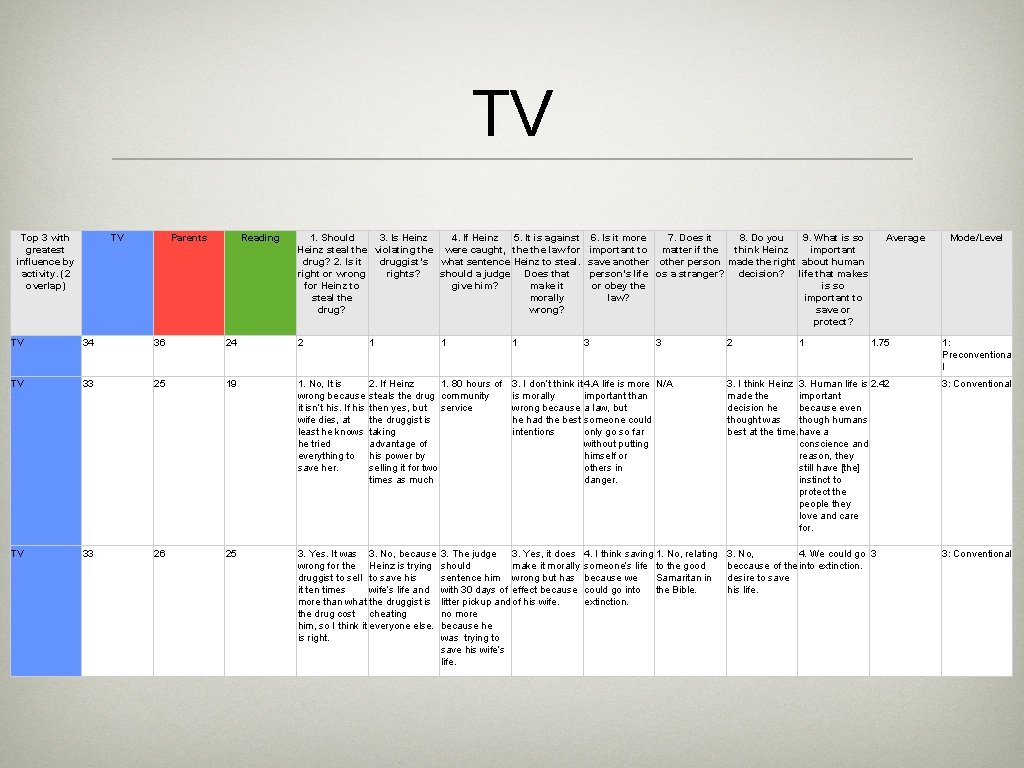
TV Top 3 with greatest influence by activity. (2 overlap) TV Parents Reading 1. Should 3. Is Heinz 4. If Heinz 5. It is against 6. Is it more 7. Does it 8. Do you 9. What is so Heinz steal the violating the were caught, the law for important to matter if the think Heinz important drug? 2. Is it druggist’s what sentence Heinz to steal. save another person made the right about human right or wrong rights? should a judge Does that person’s life os a stranger? decision? life that makes for Heinz to give him? make it or obey the is so steal the morally law? important to drug? wrong? save or protect? TV 34 36 24 2 1 1 1 3 3 TV 33 25 19 1. No, It is 2. If Heinz 1. 80 hours of wrong because steals the drug community it isn’t his. If his then yes, but service wife dies, at the druggist is least he knows taking he tried advantage of everything to his power by save her. selling it for two times as much TV 33 26 25 3. Yes. It was 3. No, because 3. The judge 3. Yes, it does 4. I think saving 1. No, relating wrong for the Heinz is trying should make it morally someone’s life to the good druggist to sell to save his sentence him wrong but has because we Samaritan in it ten times wife’s life and with 30 days of effect because could go into the Bible. more than what the druggist is litter pickup and of his wife. extinction. the drug cost cheating no more him, so I think it everyone else. because he is right. was trying to save his wife’s life. 3. I don’t think it 4. A life is more N/A is morally important than wrong because a law, but he had the best someone could intentions only go so far without putting himself or others in danger. 2 1 Average Mode/Level 1. 75 1: Preconventiona l 3. I think Heinz 3. Human life is 2. 42 made the important decision he because even thought was though humans best at the time. have a conscience and reason, they still have [the] instinct to protect the people they love and care for. 3: Conventional 3. No, 4. We could go 3 beccause of the into extinction. desire to save his life. 3: Conventional
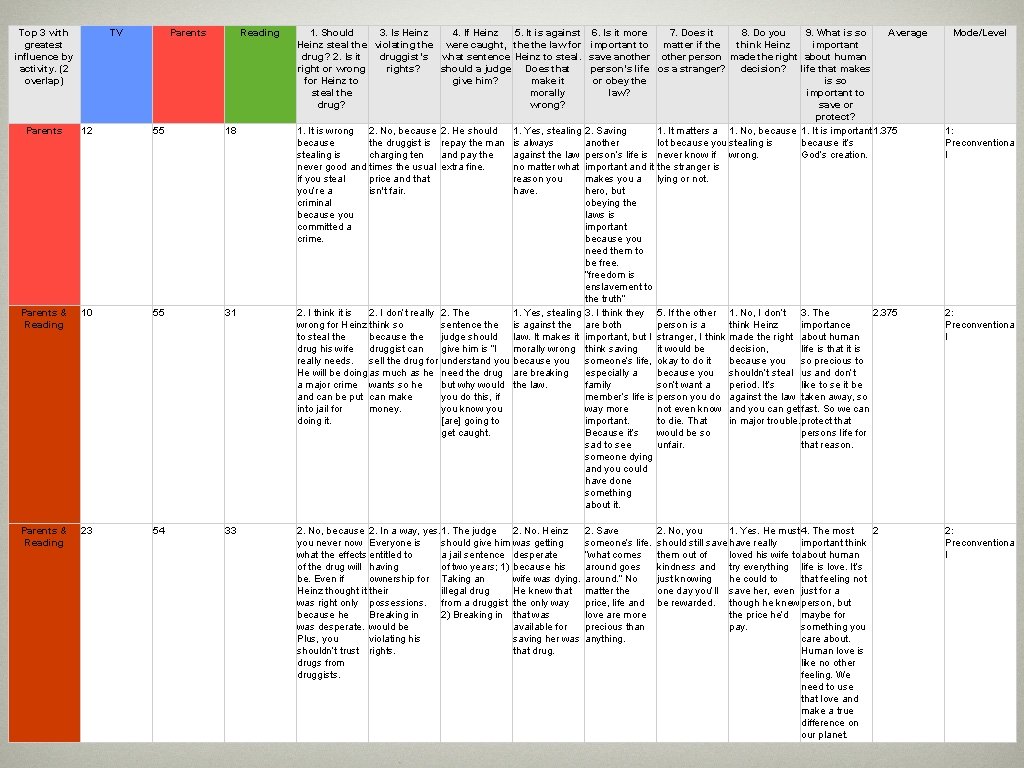
Top 3 with greatest influence by activity. (2 overlap) TV Parents Reading Parents 12 55 18 Parents & Reading 10 55 31 Parents & Reading 23 54 33 1. Should 3. Is Heinz 4. If Heinz 5. It is against 6. Is it more 7. Does it 8. Do you 9. What is so Average Heinz steal the violating the were caught, the law for important to matter if the think Heinz important drug? 2. Is it druggist’s what sentence Heinz to steal. save another person made the right about human right or wrong rights? should a judge Does that person’s life os a stranger? decision? life that makes for Heinz to give him? make it or obey the is so steal the morally law? important to drug? wrong? save or protect? 1. It is wrong 2. No, because 2. He should 1. Yes, stealing 2. Saving 1. It matters a 1. No, because 1. It is important 1. 375 because the druggist is repay the man is always another lot because you stealing is because it’s stealing is charging ten and pay the against the law person’s life is never know if wrong. God’s creation. never good and times the usual extra fine. no matter what important and it the stranger is if you steal price and that reason you makes you a lying or not. you’re a isn't fair. have. hero, but criminal obeying the because you laws is committed a important crime. because you need them to be free. “freedom is enslavement to the truth” 2. I think it is 2. I don’t really 2. The 1. Yes, stealing 3. I think they 5. If the other 1. No, I don’t 3. The 2. 375 wrong for Heinz think so sentence the is against the are both person is a think Heinz importance to steal the because the judge should law. It makes it important, but I stranger, I think made the right about human drug his wife druggist can give him is “I morally wrong think saving it would be decision, life is that it is really needs. sell the drug for understand you because you someone’s life, okay to do it because you so precious to He will be doing as much as he need the drug are breaking especially a because you shouldn’t steal us and don’t a major crime wants so he but why would the law. family son’t want a period. It’s like to se it be and can be put can make you do this, if member’s life is person you do against the law taken away, so into jail for money. you know you way more not even know and you can get fast. So we can doing it. [are] going to important. to die. That in major trouble. protect that get caught. Because it’s would be so persons life for sad to see unfair. that reason. someone dying and you could have done something about it. Parents 2. No, because 2. In a way, yes. 1. The judge 2. No. Heinz 2. Save 2. No, you 1. Yes. He must 4. The most 2 you never now Everyone is should give him was getting someone’s life. should still save have really important think what the effects entitled to a jail sentence desperate “what comes them out of loved his wife to about human of the drug will having of two years; 1) because his around goes kindness and try everything life is love. It’s be. Even if ownership for Taking an wife was dying. around. ” No just knowing he could to that feeling not Heinz thought it their illegal drug He knew that matter the one day you’ll save her, even just for a was right only possessions. from a druggist the only way price, life and be rewarded. though he knew person, but because he Breaking in 2) Breaking in that was love are more the price he’d maybe for was desperate. would be available for precious than pay. something you Plus, you violating his saving her was anything. care about. shouldn’t trust rights. that drug. Human love is drugs from like no other druggists. feeling. We need to use that love and make a true difference on our planet. Mode/Level 1: Preconventiona l 2: Preconventiona l
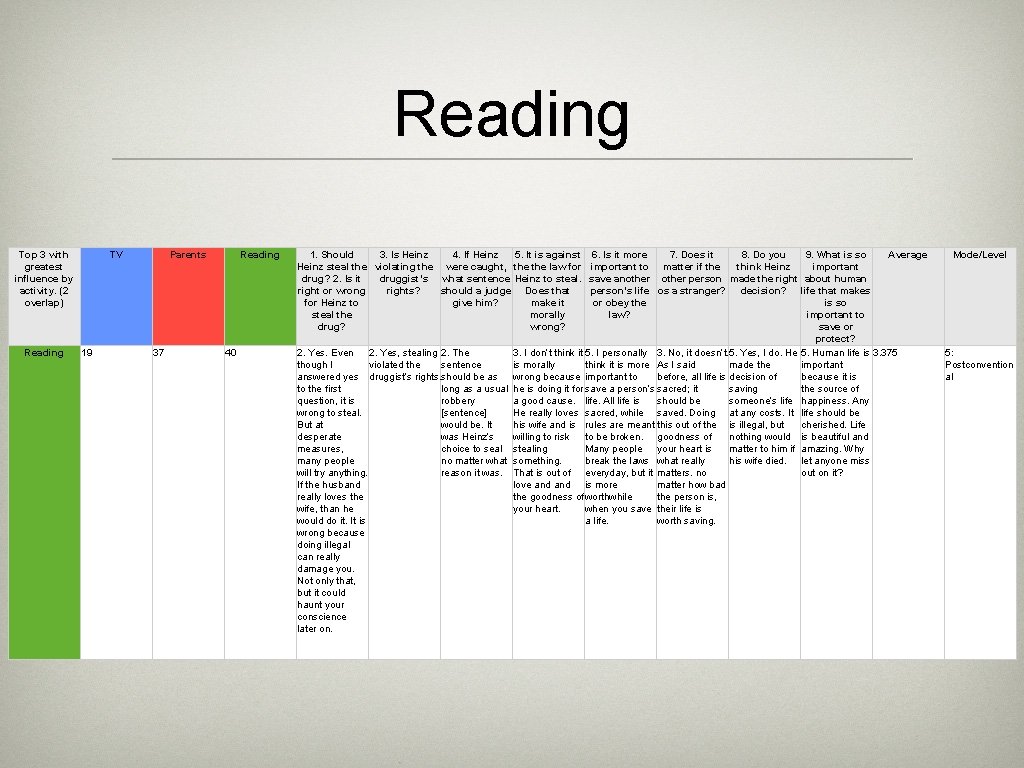
Reading Top 3 with greatest influence by activity. (2 overlap) Reading TV 19 Parents 37 Reading 40 1. Should 3. Is Heinz 4. If Heinz 5. It is against 6. Is it more 7. Does it 8. Do you 9. What is so Average Heinz steal the violating the were caught, the law for important to matter if the think Heinz important drug? 2. Is it druggist’s what sentence Heinz to steal. save another person made the right about human right or wrong rights? should a judge Does that person’s life os a stranger? decision? life that makes for Heinz to give him? make it or obey the is so steal the morally law? important to drug? wrong? save or protect? 2. Yes. Even 2. Yes, stealing 2. The 3. I don’t think it 5. I personally 3. No, it doesn’t. 5. Yes, I do. He 5. Human life is 3. 375 though I violated the sentence is morally think it is more As I said made the important answered yes druggist’s rights. should be as wrong because important to before, all life is decision of because it is to the first long as a usual he is doing it for save a person’s sacred; it saving the source of question, it is robbery a good cause. life. All life is should be someone’s life happiness. Any wrong to steal. [sentence] He really loves sacred, while saved. Doing at any costs. It life should be But at would be. It his wife and is rules are meant this out of the is illegal, but cherished. Life desperate was Heinz’s willing to risk to be broken. goodness of nothing would is beautiful and measures, choice to seal stealing Many people your heart is matter to him if amazing. Why many people no matter what something. break the laws what really his wife died. let anyone miss will try anything. reason it was. That is out of everyday, but it matters. no out on it? If the husband love and is more matter how bad really loves the goodness of worthwhile the person is, wife, than he your heart. when you save their life is would do it. It is a life. worth saving. wrong because doing illegal can really damage you. Not only that, but it could haunt your conscience later on. Mode/Level 5: Postconvention al
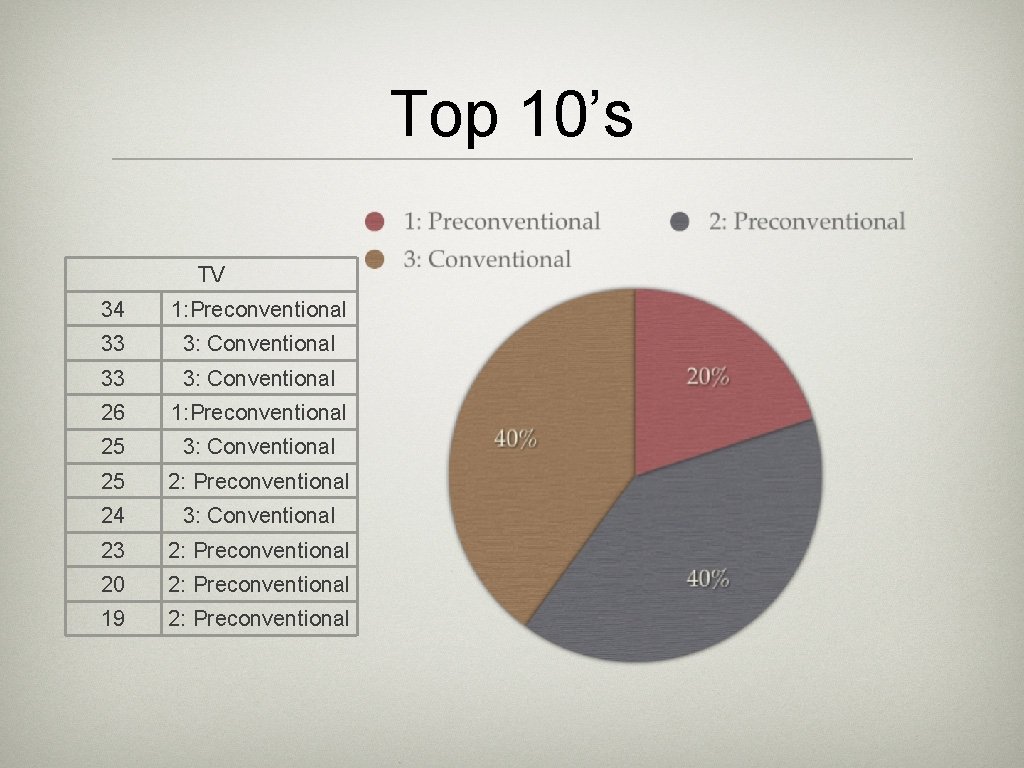
Top 10’s TV 34 1: Preconventional 33 3: Conventional 26 1: Preconventional 25 3: Conventional 25 2: Preconventional 24 3: Conventional 23 2: Preconventional 20 2: Preconventional 19 2: Preconventional
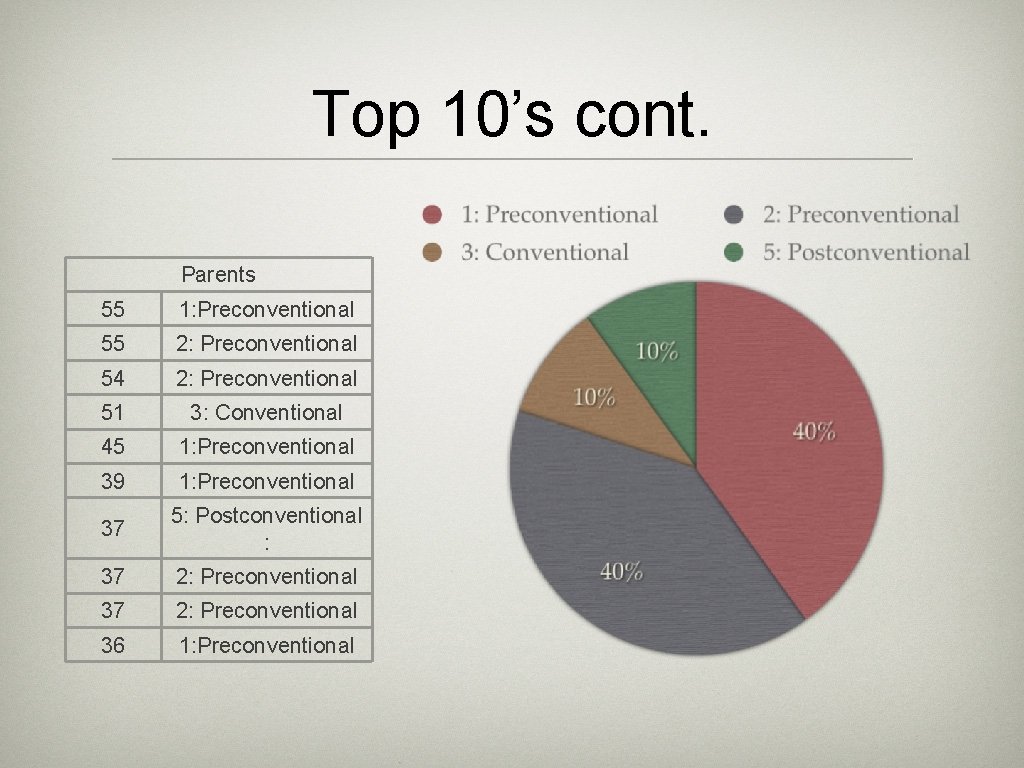
Top 10’s cont. Parents 55 1: Preconventional 55 2: Preconventional 54 2: Preconventional 51 3: Conventional 45 1: Preconventional 39 1: Preconventional 37 5: Postconventional : 37 2: Preconventional 36 1: Preconventional
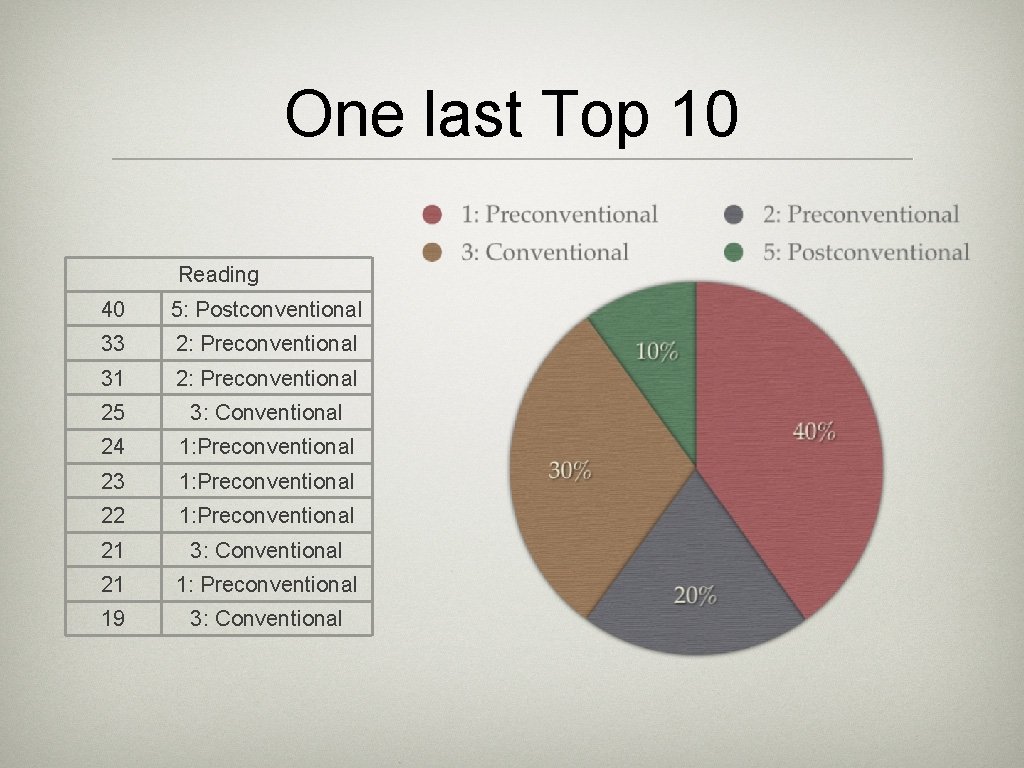
One last Top 10 Reading 40 5: Postconventional 33 2: Preconventional 31 2: Preconventional 25 3: Conventional 24 1: Preconventional 23 1: Preconventional 22 1: Preconventional 21 3: Conventional 21 1: Preconventional 19 3: Conventional
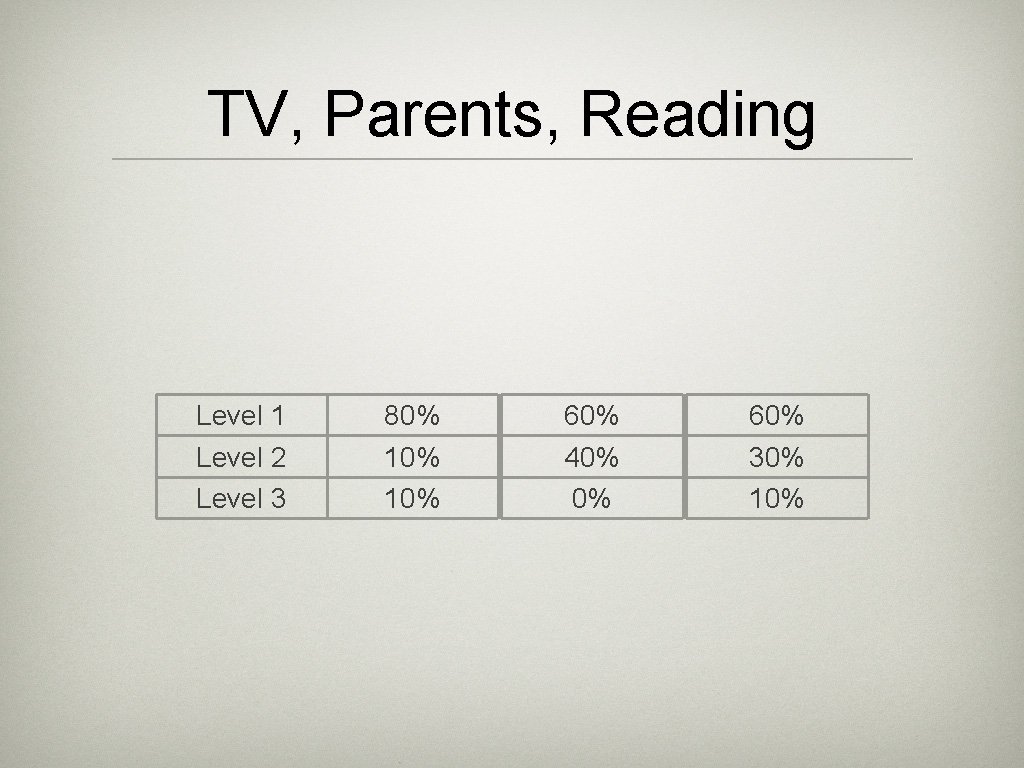
TV, Parents, Reading Level 1 Level 2 Level 3 80% 10% 60% 40% 0% 60% 30% 10%
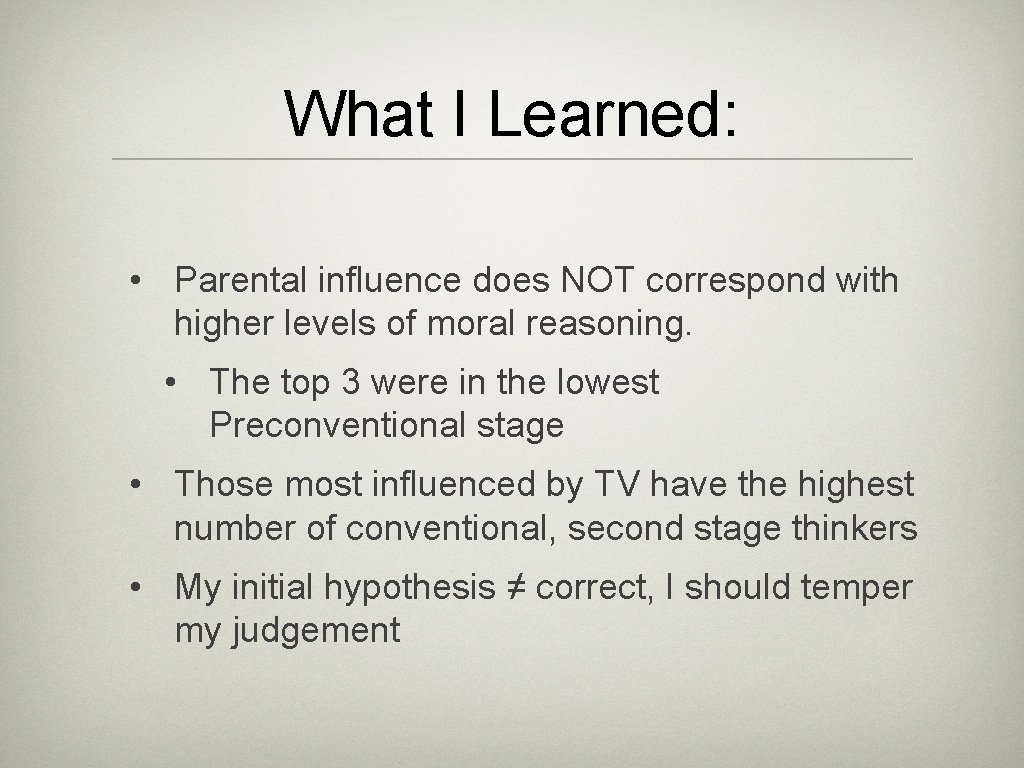
What I Learned: • Parental influence does NOT correspond with higher levels of moral reasoning. • The top 3 were in the lowest Preconventional stage • Those most influenced by TV have the highest number of conventional, second stage thinkers • My initial hypothesis ≠ correct, I should temper my judgement
Limitations • Surveys are on paper; It may be better to interview the students to get more input and make sure they understand the dilemma and questions • Survey was limited in determining the quality of material students read and watch • Not enough time for interviews
Works Cited • "Kohlberg. " Emotional Intelligence. N. p. , n. d. Web. 4 Dec. 2011. <http: //eqi. org/kohlberg. htm>. • Kohlberg, Lawrence. The philosophy of moral development: moral stages and the idea of justice. San Francisco: Harper & Row, 1981. Print. • Kohlberg, Lawrence. The psychology of moral development: the nature and validity of moral stages. San Francisco: Harper & Row, 1984. Print. • Kohlberg's Dissertation • Textbook
- Slides: 28