
Activities Adapted Functional activities for all Occupational Therapy
- Slides: 34
Activities Adapted Functional activities for all
Occupational Therapy • Occupational Therapy is the study of everyday activities and the function within them. We are able to assist someone regain the ability to function within their daily lives. • When someone is injured or sick they can loose the ability to function within their lives independently. As OT’s our ultimate goal is for someone to regain their independence, no matter the task at hand.
Occupational Therapy • As we work with an individual we assess each task and break it down to see where the problem or difficulty comes. We are able to adapt the task to allow the individual to then be able to learn how to become independent again.
Occupational Therapy • Each task that is adapted doesn’t have to remain at a particular level. As the individual gets stronger the adaptation can change or be removed. • However sometimes the person needs to have the task remain at the adapted level and this is okay.
Activity coordinators • Activities in any center are the primary method for individuals to get social interactions. • To bring entertainment to the day • To bring function and meaning to the individual’s life. • Gives the individual something to look forward to.
OT and Activities • We are able to share the main focus of our careers by bringing activity happiness to others. • OT and the activities department can work together to bring function into the lives of residents in a facility. • We are able to bring happiness to the individual by allowing them to experience purpose on a daily basis.
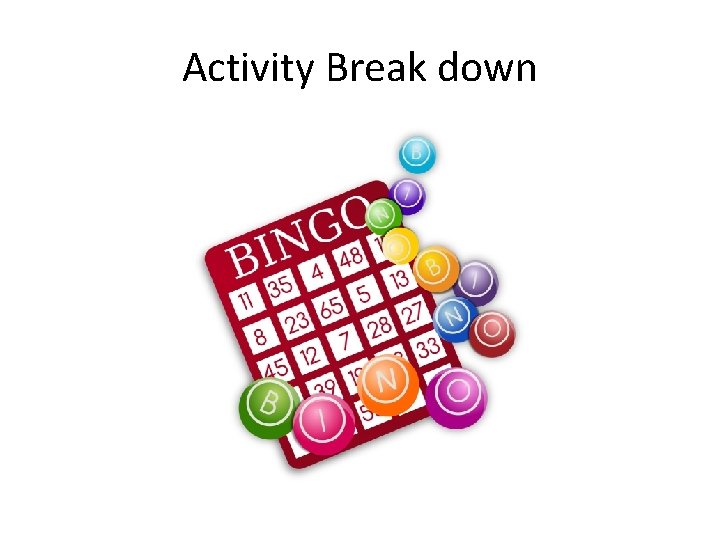
Activity Break down
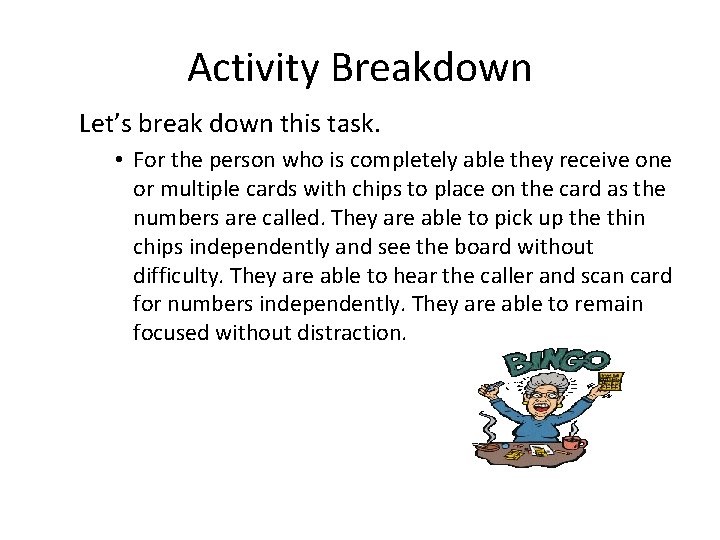
Activity Breakdown Let’s break down this task. • For the person who is completely able they receive one or multiple cards with chips to place on the card as the numbers are called. They are able to pick up the thin chips independently and see the board without difficulty. They are able to hear the caller and scan card for numbers independently. They are able to remain focused without distraction.
• Impairments – mild cognitive decline – Needs to be given one card with just enough chips. – Seated somewhere close to the assistants so if needed they could be redirected to task. – Bingo caller should call numbers slowly and multiple times with a small break between repeating the number. This gives the player time to comprehend the number and begin looking for it on the card.
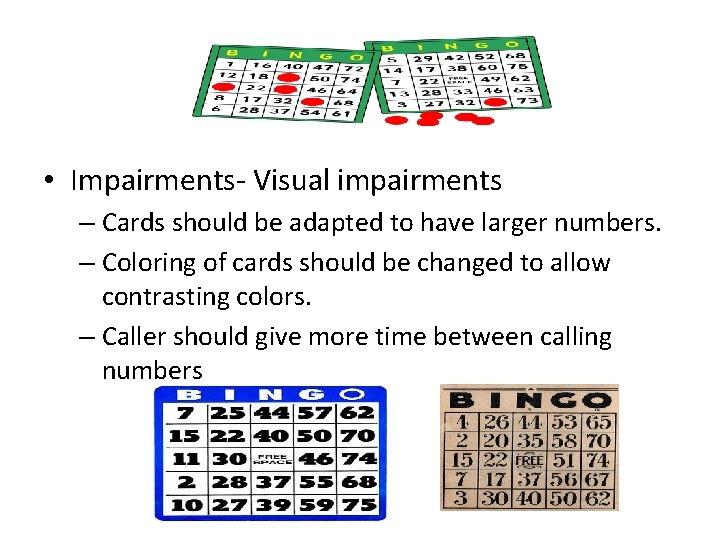
• Impairments- Visual impairments – Cards should be adapted to have larger numbers. – Coloring of cards should be changed to allow contrasting colors. – Caller should give more time between calling numbers
Contrasting colors • Contrasting color • Helps to see things differently. • Makes things stand out more. – This thought pattern should be used during meals as well. Instead of white plates on a white table cloth with a white napkin.
• Impairments- Fine motor control – Can make cards thicker. – Need to make chips bigger and thicker. • Can use bottle tops, small toy figures, small counting blocks, bingo marker if cards are one time use. • Can use chips that have different textures to allow better grip. • Give the player extended time to manipulate the pieces.
Activity Breakdown • Card Playing – Many people enjoy playing cards. • You could get larger print cards for the visually impaired • There are card holders for individuals that only have one functional hand • One on one assistance if fine motor abilities are extremely impaired.
Activity Breakdown • Exercise Groups – We need to make these groups more interactive. Videos do not keep the residents attention. • Lead the group by doing the exercises yourself. • Make fun and interesting • Bring all senses into the group. – Tactile, visual, auditory, smell
• Exercise Groups – Use props • • Exercise balls, weights Noodles, poms, balloons, parachute Upbeat music Aromatherapy
• Exercising the body will keep the brain active as well. Maintaining strength will help the individual keep their functional independence.
Activity Breakdown • Cooking groups – Cooking groups are wonderful activities. They bring in the sense of home again with the aromas. – Let the residents get hands on and assist with the activity. • They will need close supervision and good hygiene to participate. However this is more functional then sitting in the group and watching someone.
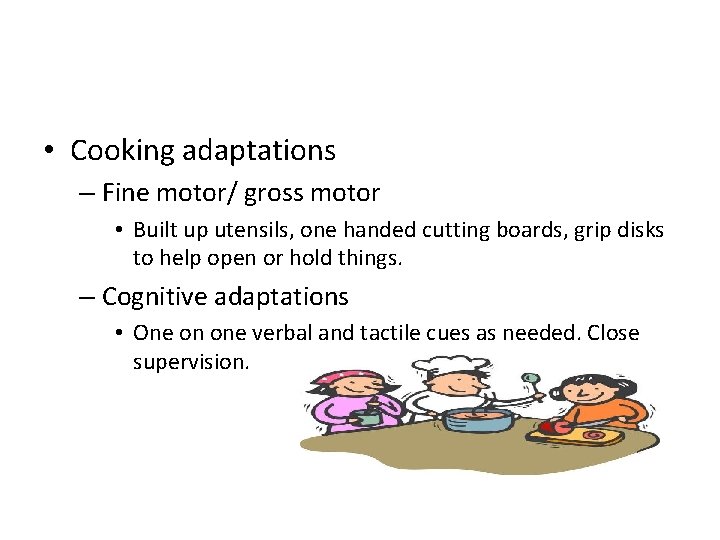
• Cooking adaptations – Fine motor/ gross motor • Built up utensils, one handed cutting boards, grip disks to help open or hold things. – Cognitive adaptations • One on one verbal and tactile cues as needed. Close supervision.
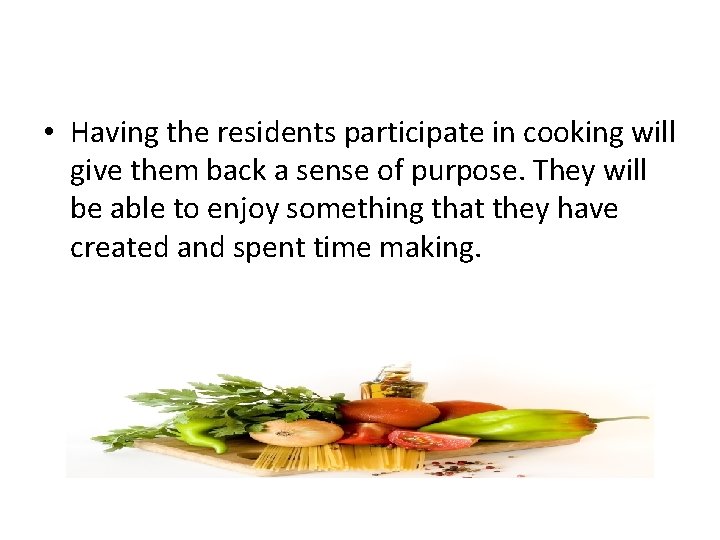
• Having the residents participate in cooking will give them back a sense of purpose. They will be able to enjoy something that they have created and spent time making.
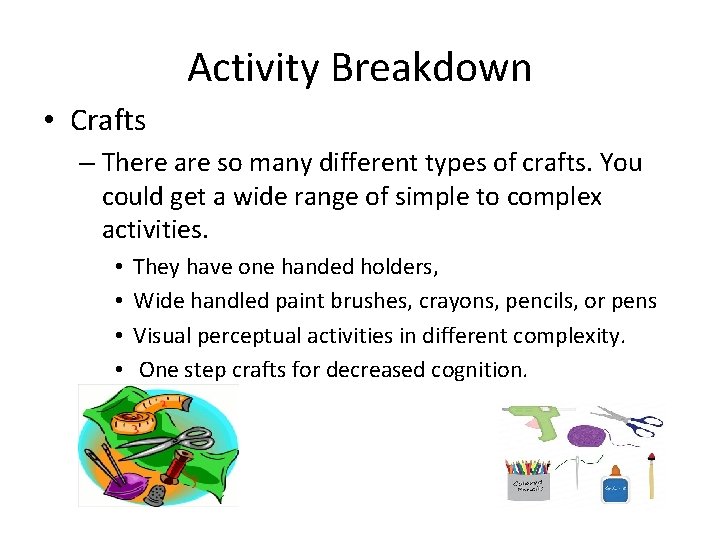
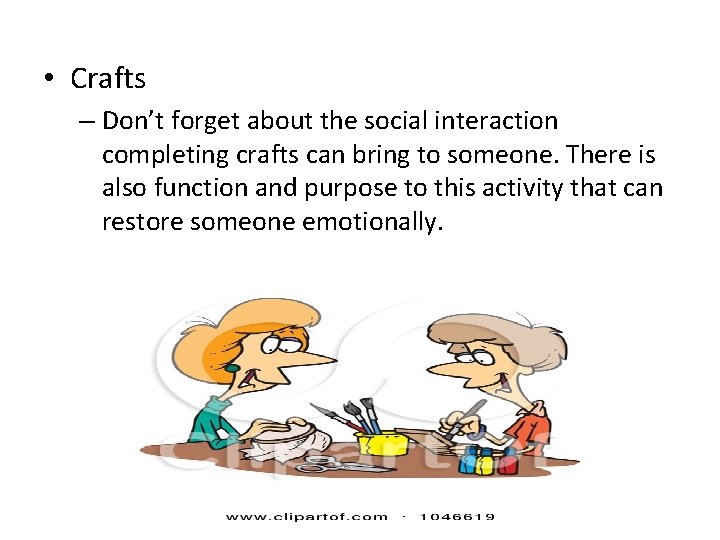
Activity Breakdown • Crafts – There are so many different types of crafts. You could get a wide range of simple to complex activities. • • They have one handed holders, Wide handled paint brushes, crayons, pencils, or pens Visual perceptual activities in different complexity. One step crafts for decreased cognition.
• Crafts – Don’t forget about the social interaction completing crafts can bring to someone. There is also function and purpose to this activity that can restore someone emotionally.
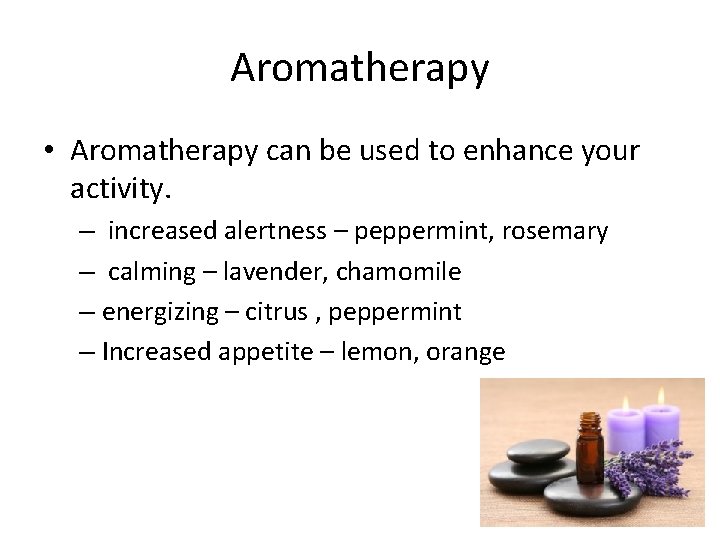
Aromatherapy • Aromatherapy can be used to enhance your activity. – increased alertness – peppermint, rosemary – calming – lavender, chamomile – energizing – citrus , peppermint – Increased appetite – lemon, orange
Aromatherapy • Diffusing essential oils throughout activity is one of the best methods of applying throughout the group session. – Diffuser are able to diffuse to a 400 sq. ft. area – They will continuously run for about 4 hours. – Effects from Aromatherapy can remain in the body for 16 hours after the session.
Sensory Gardens • Sensory Gardens can be developed in pots , raised garden beds, or in regular garden beds depending on the levels you would like to work. – Recommended to have all three types in center if applicable this way you could have everyone participate in the garden area.
Sensory Gardens • Stimulation of all sense while in the garden will help residents feel more grounded and calm. This could also give them a functional purpose as well. – Senses addressed; • • • Smell - the different fragrances throughout the garden Touch - handling the plants and dirt Hearing- listening to the birds in the garden Sight- looking at all flowers, birds, butterflies, etc Tasting- if herbs used during a cooking group.
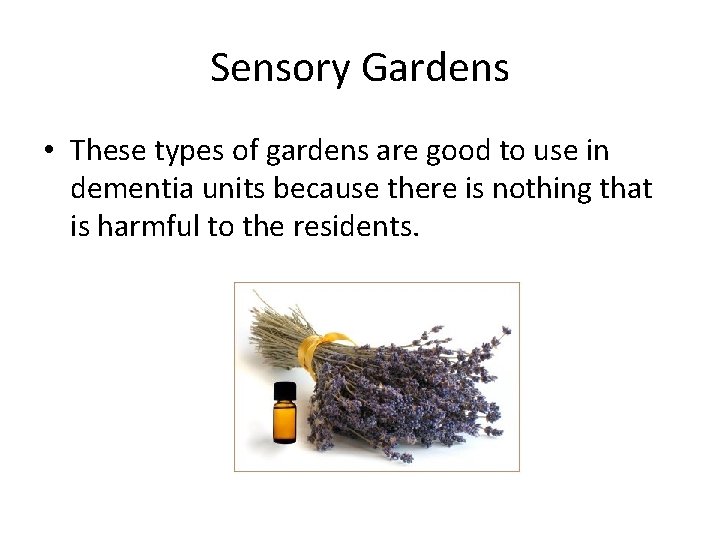
Sensory Gardens • These types of gardens are good to use in dementia units because there is nothing that is harmful to the residents.
Sensory Gardens • Recommended to plant Herbs throughout the garden such as: • • • Lavender Peppermint Rosemary Thyme Basil Sage
Daily need of purpose • If we sit in a wheelchair all day staring at the wall, what purpose do we have? If we are alone all day, what purpose do we have? – When we grow older we still have the need to do something. We, as humans, have to feel a purpose in our life and a social connection. – As activities coordinators you could change the lives of the residents.
Daily need of purpose • There needs to be activity areas or boxes set up throughout the facility. This is needed especially if you have dementia units. • If people are not active, this is when behaviors and agitation can be created. • We need to make sure the activity box is setup for the population correctly with the right items to keep them busy but safe.
Activity Areas/ Boxes Laundry area Simple craft area Office duties area Baby area Relaxation areas (music, aromatherapy, lighting) • Busy blankets • What other suggestions do you have? • • •
New culture • In the last few years, things have been changing. The age of the patient coming into a nursing center has decreased. • We need to change our culture of activities to allow for these individuals to participate as well. • We need different activities that men or women would be interested in.
New culture • Not only do we need to make sure the activities are variable for age and gender we also need to make sure different levels of cognitive awareness is remembered. • This means we will need multiple activities going on at one time – Different levels of adaptations can be made within the same activity. Separating into smaller groups.
Conclusion • You are the heart and soul of any center. Without activity in the daily lives of residents they wouldn’t have meaning or purpose for the day. They wouldn’t have anything to look forward to and no way of interacting with others. Continue spreading happiness throughout others lives by bringing a functional purpose.
Contact information • Amanda Popp • 410 -591 -5808 • www. Mydoterra. com/amandapopp 1#