
Activeregion magnetic structures and their perturbations by flares
Active-region magnetic structures and their perturbations by flares H. S. Hudson SSL/UCB MRT workshop, August 10, 2004

Outline • • Description of a solar active region Magnetic structure Waves, oscillations, and restructuring RHESSI observations of eruptive flares MRT workshop, August 10, 2004
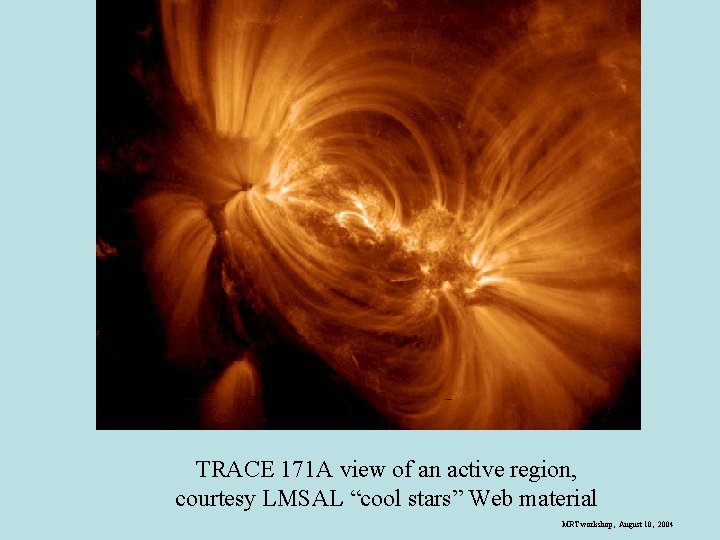
TRACE 171 A view of an active region, courtesy LMSAL “cool stars” Web material MRT workshop, August 10, 2004
Mechanical properties of an active region in the corona • Flares and CMEs are magnetically driven, according to consensus, from energy stored in the corona • In such conditions, (low plasma b), the mechanical stresses can be represented as a pressure and a tension • Dissipation is normally slow • The volume is electrically equipotential except for the Rosseland-Pannekoek potential MRT workshop, August 10, 2004
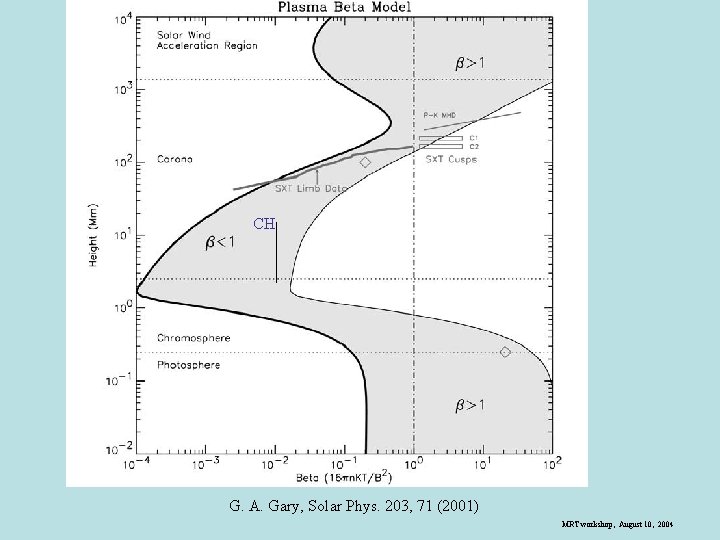
CH G. A. Gary, Solar Phys. 203, 71 (2001) MRT workshop, August 10, 2004
What are the loops? • The loops show the direction of the magnetic field • The X-ray visibility of the corona is a monotonic increasing function of the gas pressure • In an active region, the loop dimensions are typically smaller than the scale height • The footpoints of a loop lie in a transition layer at the appropriate pressure • The magnetic field must be slightly depressed in the visible loops MRT workshop, August 10, 2004
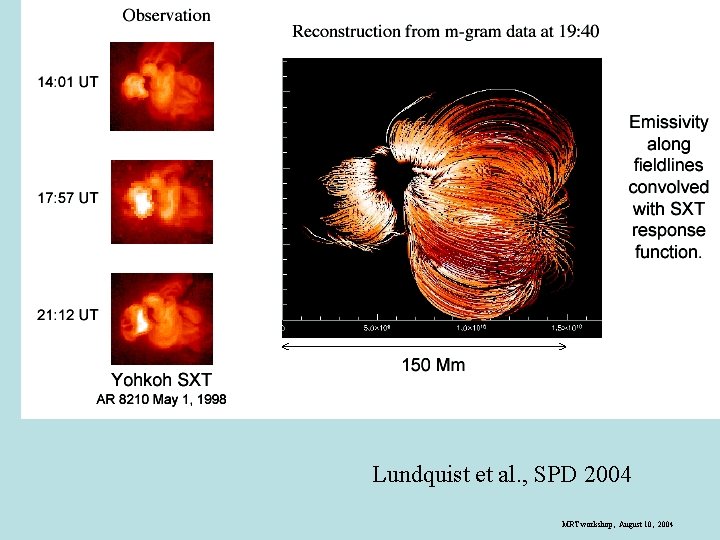
Lundquist et al. , SPD 2004 MRT workshop, August 10, 2004
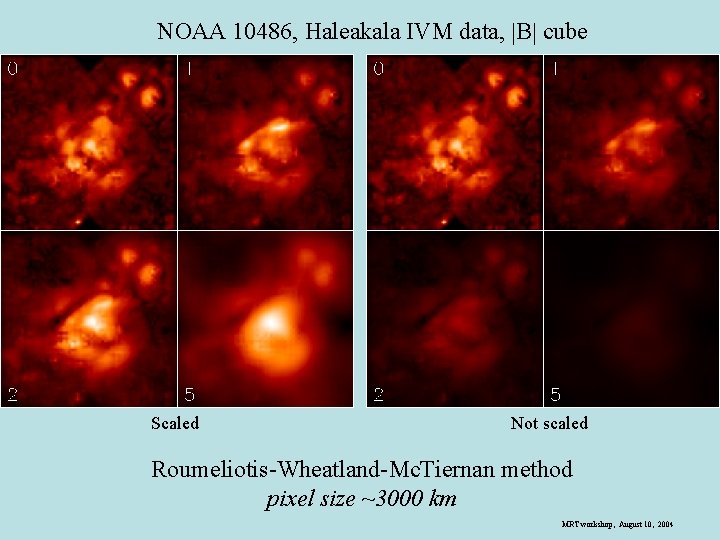
NOAA 10486, Haleakala IVM data, |B| cube Scaled Not scaled Roumeliotis-Wheatland-Mc. Tiernan method pixel size ~3000 km MRT workshop, August 10, 2004
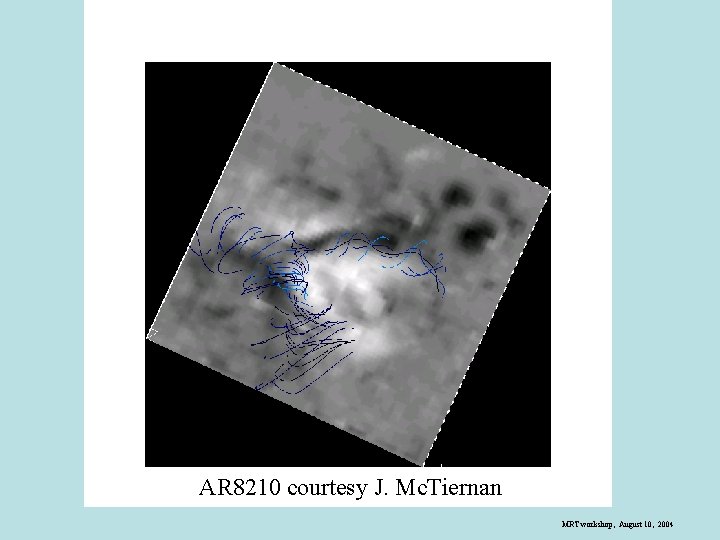
AR 8210 courtesy J. Mc. Tiernan MRT workshop, August 10, 2004
Conjecture: Most of the free energy in an active region is concentrated very near its base MRT workshop, August 10, 2004
The normal state of the activeregion corona is an equilibrium • An equilibrium system will oscillate around its rest configuration if perturbed slightly • We observe coronal oscillations via spectroscopy, photometry, and in movies • The oscillations have small amplitudes and can be studied via MHD theory MRT workshop, August 10, 2004
Kink-mode oscillations • Flare waves associated with metric type II bursts often (12/30 cases) appear with TRACE loop oscillations • These oscillations allow us to study the equilibrium state of the non-erupting part of the corona MRT workshop, August 10, 2004
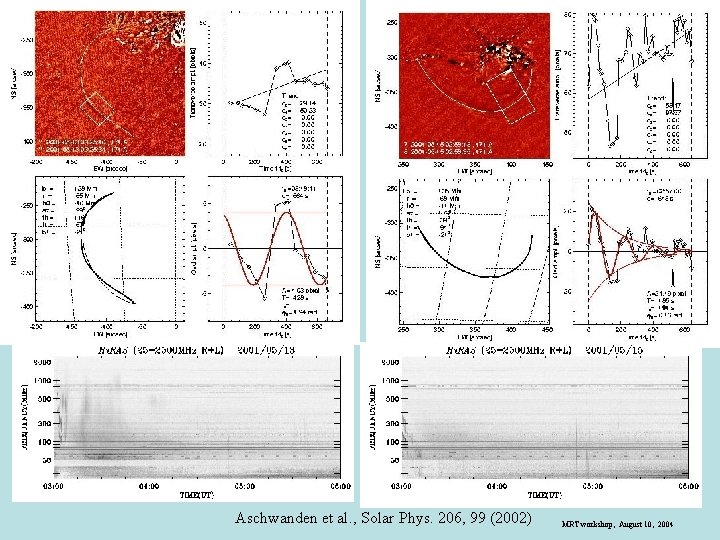
Aschwanden et al. , Solar Phys. 206, 99 (2002) MRT workshop, August 10, 2004
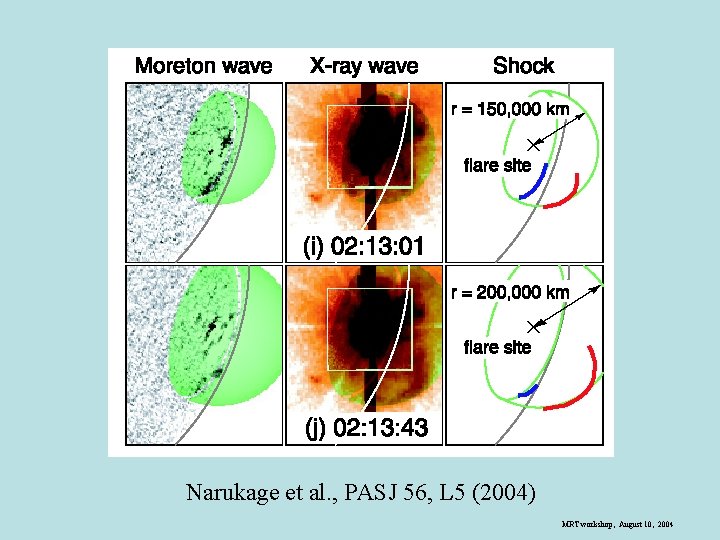
Narukage et al. , PASJ 56, L 5 (2004) MRT workshop, August 10, 2004
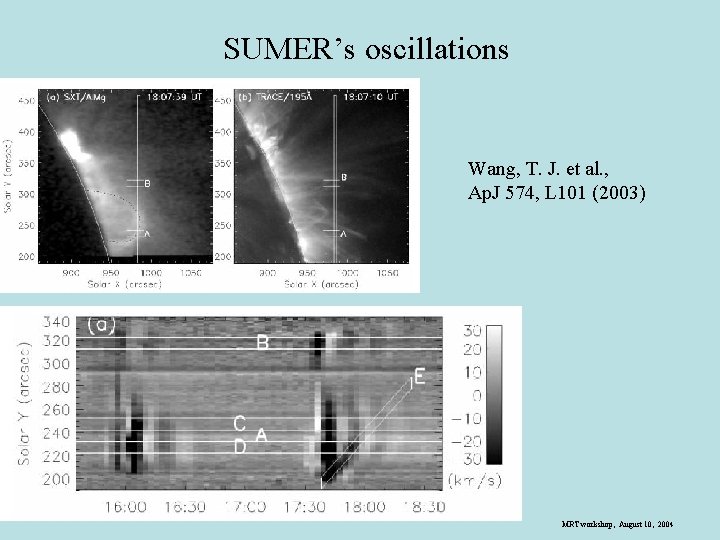
SUMER’s oscillations Wang, T. J. et al. , Ap. J 574, L 101 (2003) MRT workshop, August 10, 2004
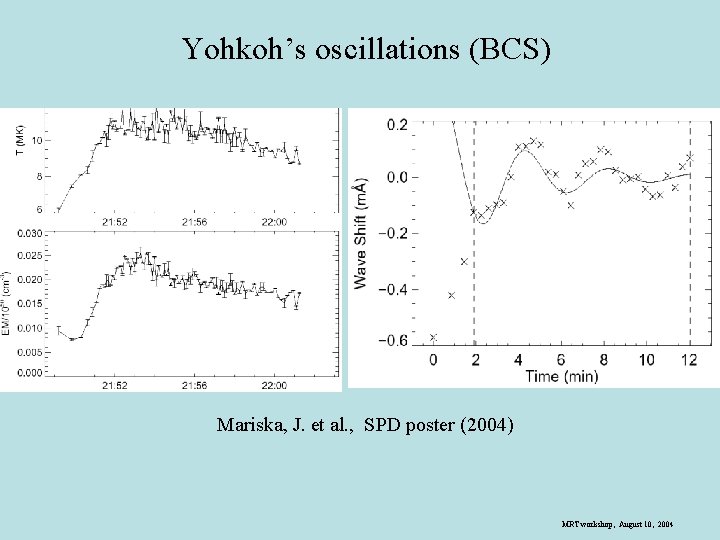
Yohkoh’s oscillations (BCS) Mariska, J. et al. , SPD poster (2004) MRT workshop, August 10, 2004
Schrijver et al. , Solar Phys. 206, 69, 2002 MRT workshop, August 10, 2004
Three things the movie showed • Early inward motions, prior to the eruption • Dimming - the CME starting off • Excitation of coupled normal modes in the arcade • (arcade blowout) MRT workshop, August 10, 2004
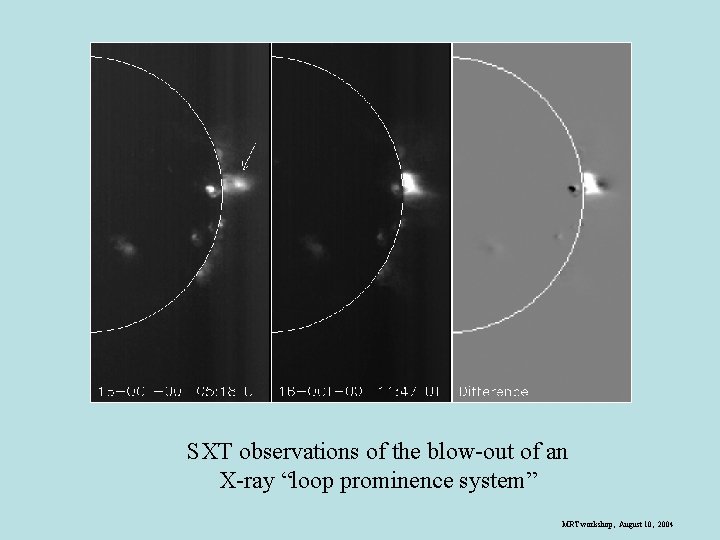
SXT observations of the blow-out of an X-ray “loop prominence system” MRT workshop, August 10, 2004
Studying coronal equilibria • On large scales the corona tends be stable • We can study the equilibrium states via the oscillations; there are several modalities • Propose to use “instrumented hammer” approach to characterize eigenstates • Propose to study before/after equilibrium states using FASR and Solar-B MRT workshop, August 10, 2004
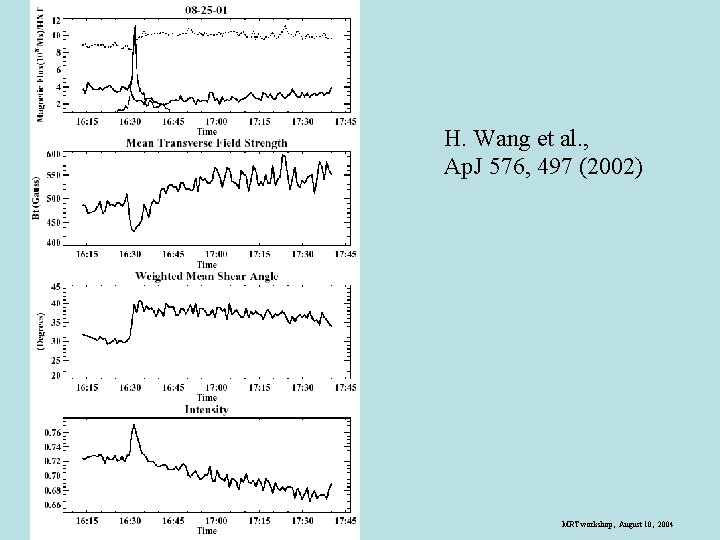
H. Wang et al. , Ap. J 576, 497 (2002) MRT workshop, August 10, 2004
Magnetic challenge: Can any existing model of a flare or CME properly describe the change in the coronal magnetic field? MRT workshop, August 10, 2004

Cartoon showing magnetic implosion Post-event field Pre-event field Isomagnetobars Limb Hudson & Cliver, JGR 106, 25, 199 (2001) MRT workshop, August 10, 2004
Conclusions • Unlike the cosmologists, we don’t have a standard model for a flare/CME - we do have cartoons, though: http: //solarmuri. ssl. berkeley. edu/~hhudson/ cartoons/ MRT workshop, August 10, 2004
Serious conclusions • Extrapolation techniques to learn about the coronal magnetic field are inherently flawed • It will be better in the future to assimilate more precise methods, such as - TRACE coronal imagery (direction of B) - FASR gyroresonance surfaces (magnitude of B) - Mechanical models (matching eigenfrequencies) MRT workshop, August 10, 2004
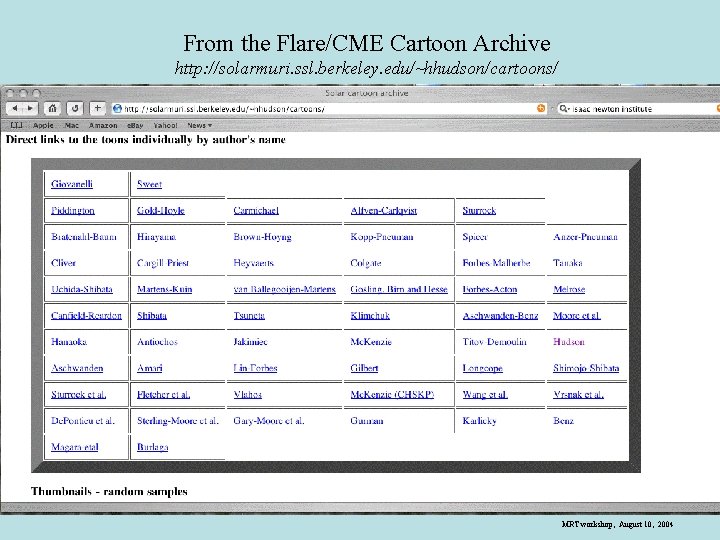
From the Flare/CME Cartoon Archive http: //solarmuri. ssl. berkeley. edu/~hhudson/cartoons/ MRT workshop, August 10, 2004
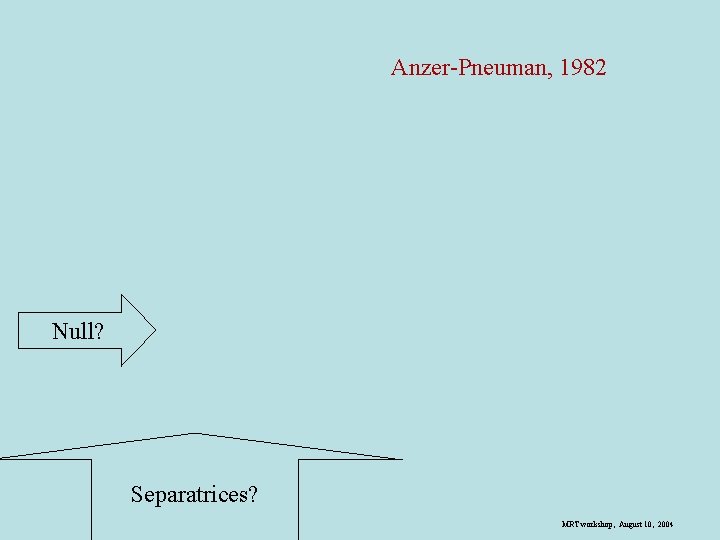
Anzer-Pneuman, 1982 Null? Separatrices? MRT workshop, August 10, 2004
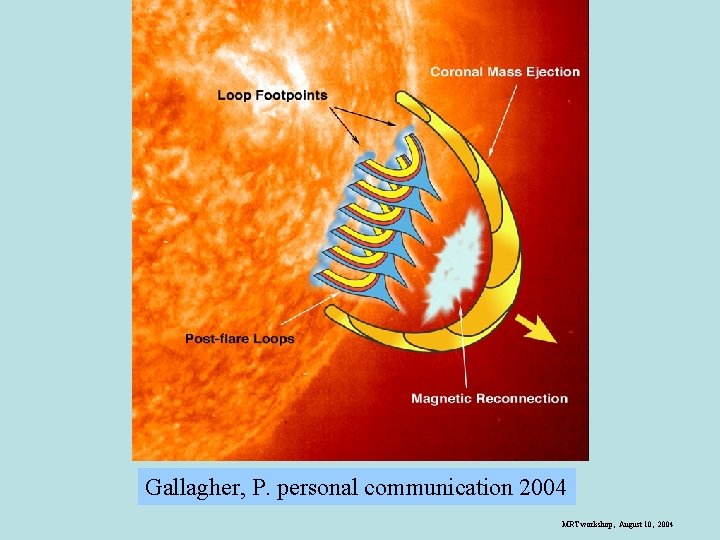
Forbes, JGR 105, 23, 153, 2000 Gallagher, P. T. , personal communication 2004 MRT workshop, August 10, 2004

MRT workshop, August 10, 2004
RHESSI observations of early inward motions MRT workshop, August 10, 2004
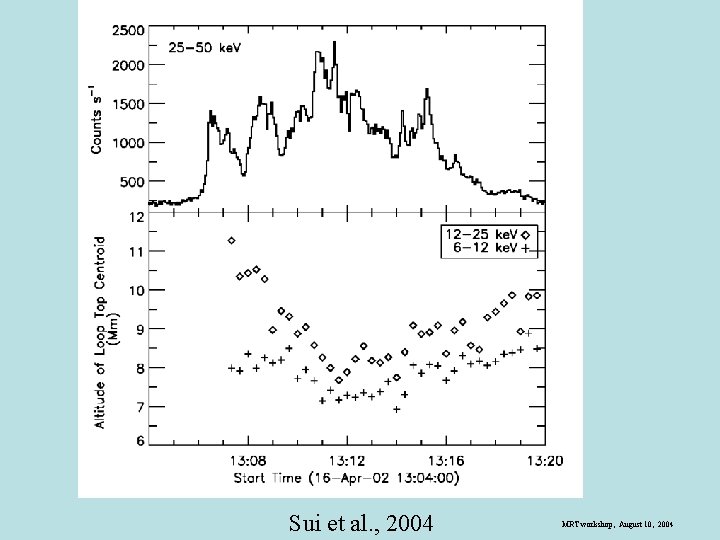
Sui et al. , 2004 MRT workshop, August 10, 2004
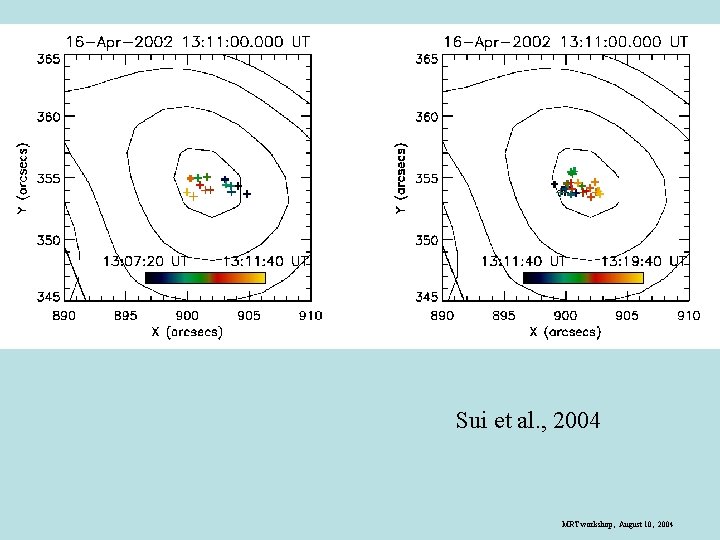
Sui et al. , 2004 MRT workshop, August 10, 2004
- Slides: 32