
Active Traffic Management Brian Kary Minnesota Department of
Active Traffic Management Brian Kary Minnesota Department of Transportation
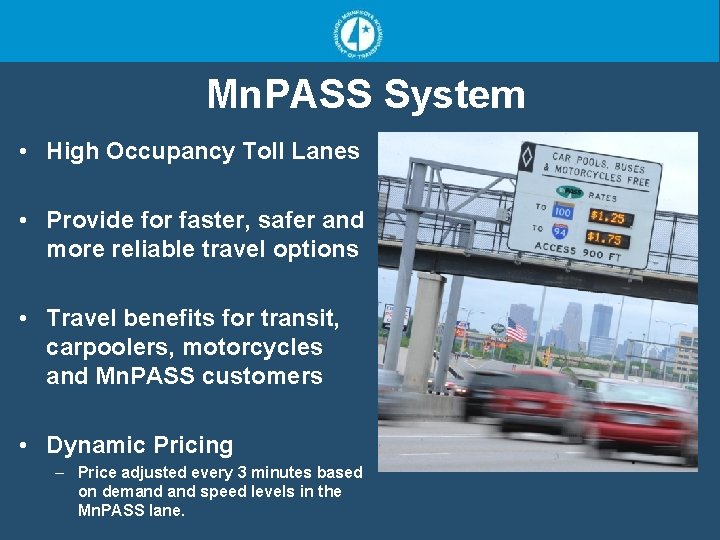
Mn. PASS System • High Occupancy Toll Lanes • Provide for faster, safer and more reliable travel options • Travel benefits for transit, carpoolers, motorcycles and Mn. PASS customers • Dynamic Pricing – Price adjusted every 3 minutes based on demand speed levels in the Mn. PASS lane.
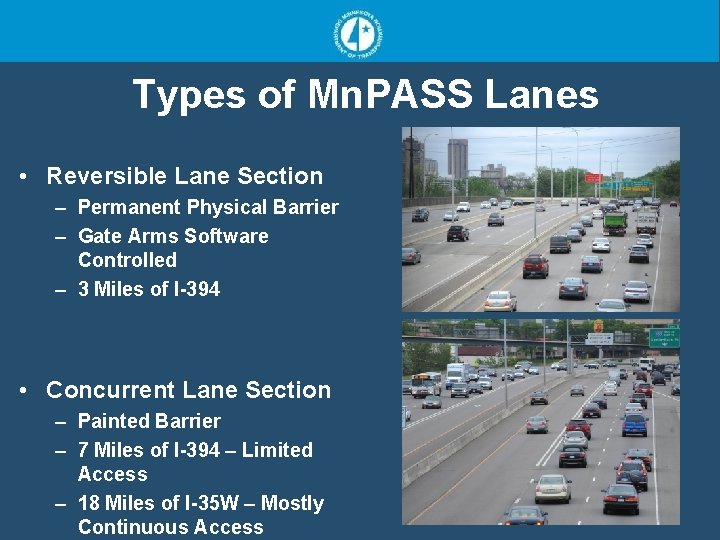
Types of Mn. PASS Lanes • Reversible Lane Section – Permanent Physical Barrier – Gate Arms Software Controlled – 3 Miles of I-394 • Concurrent Lane Section – Painted Barrier – 7 Miles of I-394 – Limited Access – 18 Miles of I-35 W – Mostly Continuous Access
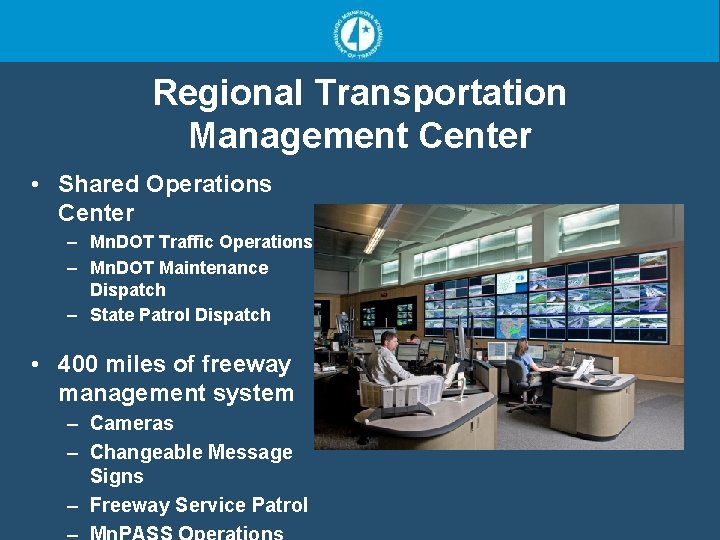
Regional Transportation Management Center • Shared Operations Center – Mn. DOT Traffic Operations – Mn. DOT Maintenance Dispatch – State Patrol Dispatch • 400 miles of freeway management system – Cameras – Changeable Message Signs – Freeway Service Patrol
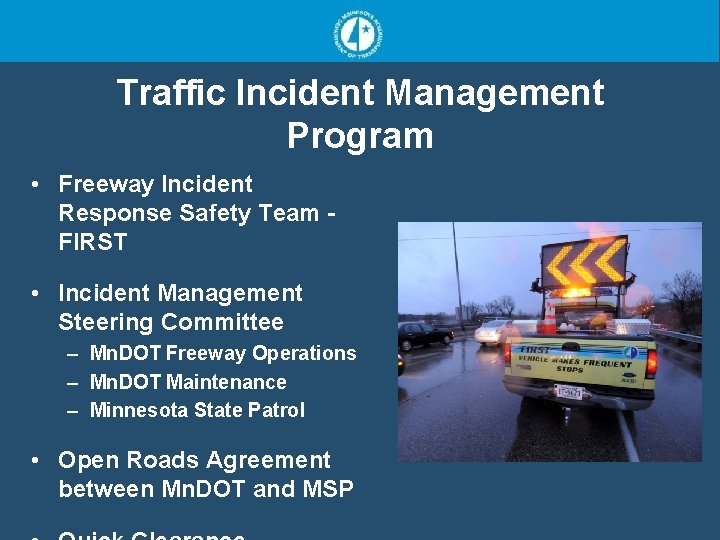
Traffic Incident Management Program • Freeway Incident Response Safety Team FIRST • Incident Management Steering Committee – Mn. DOT Freeway Operations – Mn. DOT Maintenance – Minnesota State Patrol • Open Roads Agreement between Mn. DOT and MSP
TIM in Managed Lanes • Managed Lanes are operated by Mn. DOT RTMC – Mn. DOT responsible for tolling operations and general traffic operations • Dedicated Enforcement – Mn. PASS revenues used to fund additional MSP Enforcement – Dedicated MSP trooper also available for responding to incidents • Open Roads Agreement – Makes the clearing of any traffic lane a priority – No special priority for Mn. PASS lanes • Diversions
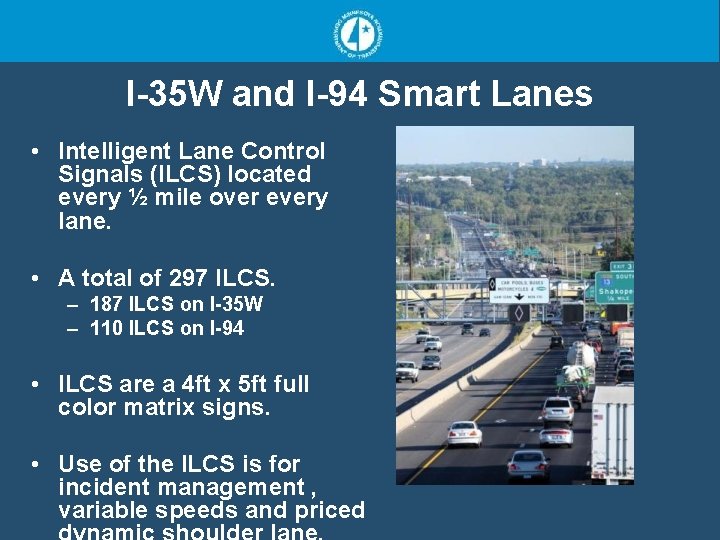
I-35 W and I-94 Smart Lanes • Intelligent Lane Control Signals (ILCS) located every ½ mile over every lane. • A total of 297 ILCS. – 187 ILCS on I-35 W – 110 ILCS on I-94 • ILCS are a 4 ft x 5 ft full color matrix signs. • Use of the ILCS is for incident management , variable speeds and priced
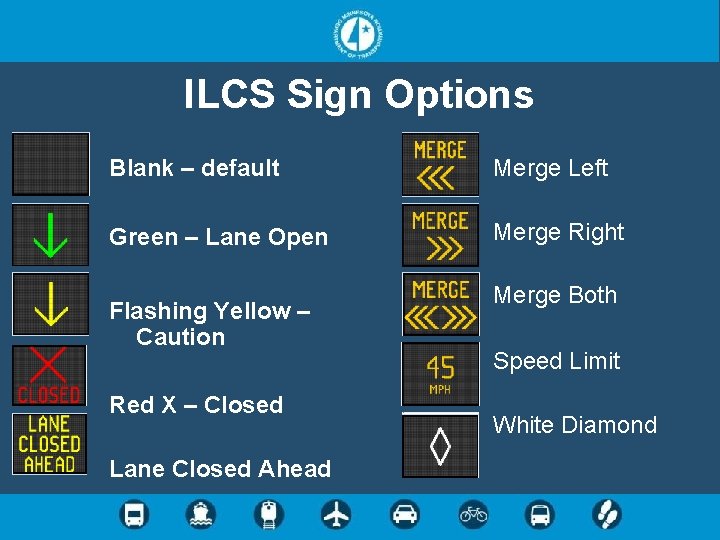
ILCS Sign Options Blank – default Merge Left Green – Lane Open Merge Right Flashing Yellow – Caution Red X – Closed Lane Closed Ahead Merge Both Speed Limit White Diamond
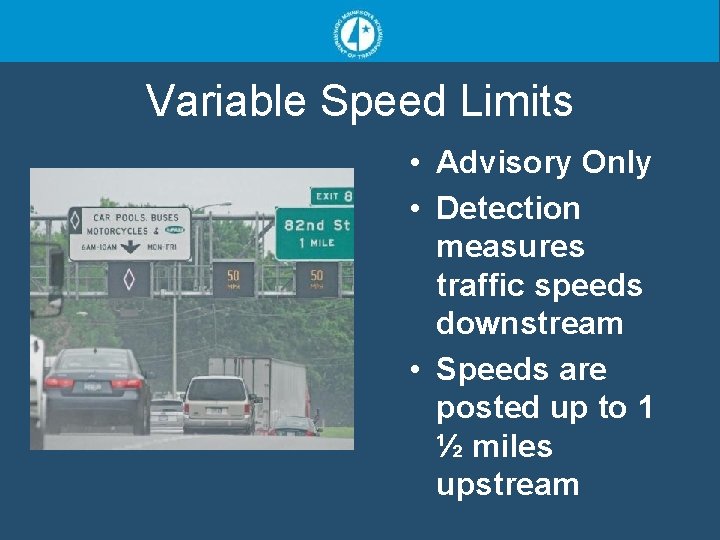
Variable Speed Limits • Advisory Only • Detection measures traffic speeds downstream • Speeds are posted up to 1 ½ miles upstream
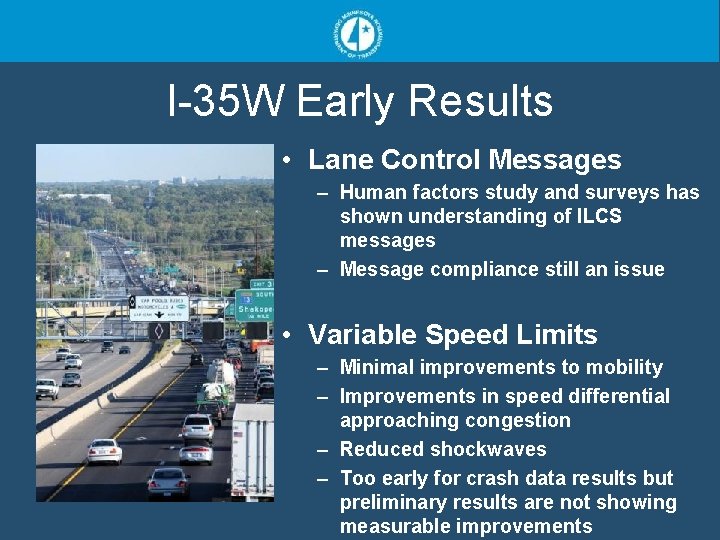
I-35 W Early Results • Lane Control Messages – Human factors study and surveys has shown understanding of ILCS messages – Message compliance still an issue • Variable Speed Limits – Minimal improvements to mobility – Improvements in speed differential approaching congestion – Reduced shockwaves – Too early for crash data results but preliminary results are not showing measurable improvements
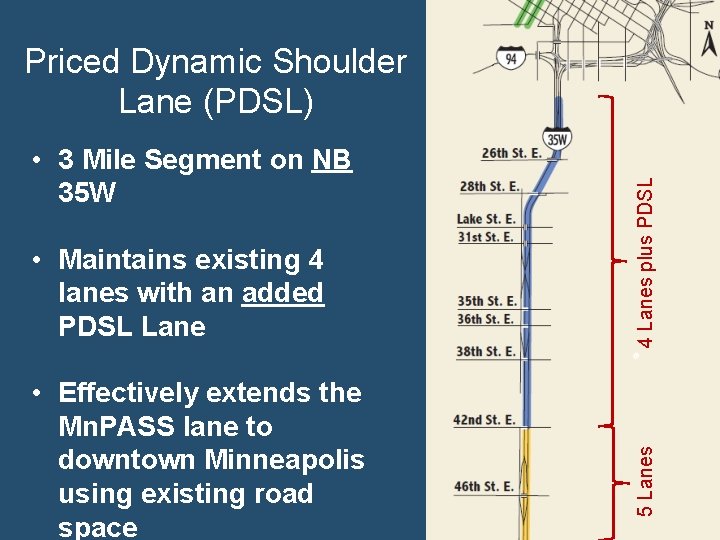
• Maintains existing 4 lanes with an added PDSL Lane • Effectively extends the Mn. PASS lane to downtown Minneapolis using existing road space 5 Lanes • 3 Mile Segment on NB 35 W 4 Lanes plus PDSL Priced Dynamic Shoulder Lane (PDSL)
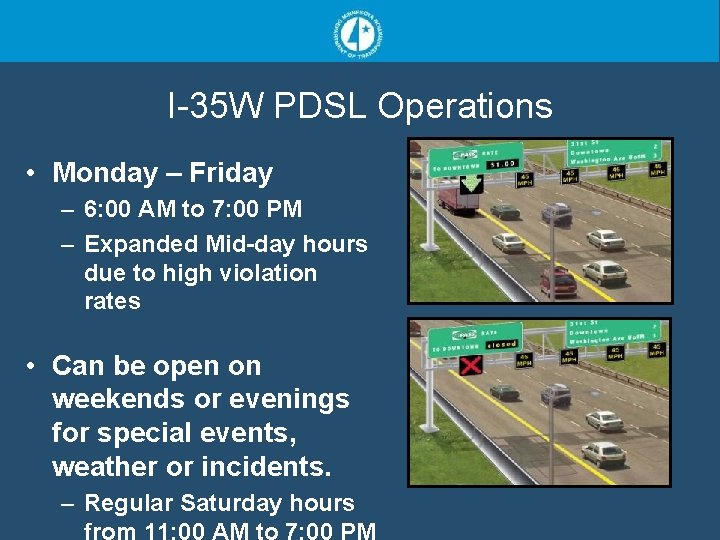
I-35 W PDSL Operations • Monday – Friday – 6: 00 AM to 7: 00 PM – Expanded Mid-day hours due to high violation rates • Can be open on weekends or evenings for special events, weather or incidents. – Regular Saturday hours from 11: 00 AM to 7: 00 PM
Operations Challenges • ILCS requires more precision to deploy than overhead CMS. – – Distance to incident is closer Lane specific Need precise location of incident Requires more operator actions • Multiple ILCS to deploy for a single incident • Every changing incident scene • Requires highly skilled and detail oriented staff
Maintenance Staffing • Mn. PASS Revenues on I-35 W paid for one FTE to maintain ILCS. – No additional funding for I-94 • Maintenance Agreements for ILCS – I-35 W - approximately $280, 000 a year – I-94 - approximately $200, 000 a year • Utilities Costs – I-35 W - approximately $60, 000 a year – I-94 – approximately $40, 000 a year
Future of ATM in Mn. DOT • Dynamic Shoulders – Nothing planned, but still in the toolbox • I-35 W ATM – Some removal as part of future construction projects – Replace with more frequent DMS rather than ILCS – PDSL will be a permanent lane
Questions? Brian Kary Freeway Operations Engineer brian. kary@state. mn. us
- Slides: 16