
Active Tile Self Assembly Simulating Cellular Automata at
Active Tile Self Assembly: Simulating Cellular Automata at Temperature 1 Daria Karpenko Department of Mathematics and Statistics, University of South Florida
Outline • Introduction ▫ Overview of DNA self-assembly ▫ DNA nanotech, DNA computing, and Applications • Active Tile Assembly Model ▫ Basic Tile Structures ▫ Active Tile Assembly & Signaling ▫ Hierarchical Tile Assembly Sets • Simulating a Cellular Automaton ▫ General Tile Set Construction ▫ Example Rule 90 • Summary
Introduction DNA: What can we do with it?
Overview of DNA Self-Assembly • DNA: ▫ A-T and G-C nucleobases • DNA and self-assembly: ▫ Single strands with complementary base pairs will bond together • Nanotechnology and Computing ▫ Nanotechnology: �Ned Seeman: DNA structures, methods �Strand displacement �DNA origami: �DNA does not have to be a double helix – base pairings allow for other structures! �Possible to fold a DNA strand into any shape using “staple” molecules to hold it rigidly in place ▫ Computing �In 1994 Adleman proved experimentally that DNA could be used to solve computational problems

DNA-based 2 D Arrays • “Approximately” two-dimensional DNA structures with single strands of unpaired bases on their sides – “sticky ends” - can act as tiles and form arrays • In nanotechnology, potential for new materials ▫ Tiles can be marked and used to guide nanoscale assembly of other structures ▫ Nanostructures in themselves as periodic and nonperiodic arrays: � Crystallographic � Have been made in the lab using DNA-based tiles � Quasi-crystallographic � Quasi-crystals in general are rare in nature and in the lab • In computation, problems can be encoded in the tiles with different kinds of sticky ends; the solution is then the product of the self-assembly ▫ Moving computation to the nanoscale
Computing with Tiles • Erik Winfree, 1998 Ph. D. Thesis: ▫ Introduced the “abstract tile assembly model” (a. TAM) ▫ Can simulate the dynamics of any 1 D cellular automaton at temperature 2 �Rule 110 is capable of Turing universal computation • Adding signals to tiles allows cellular automaton simulation at temperature 1
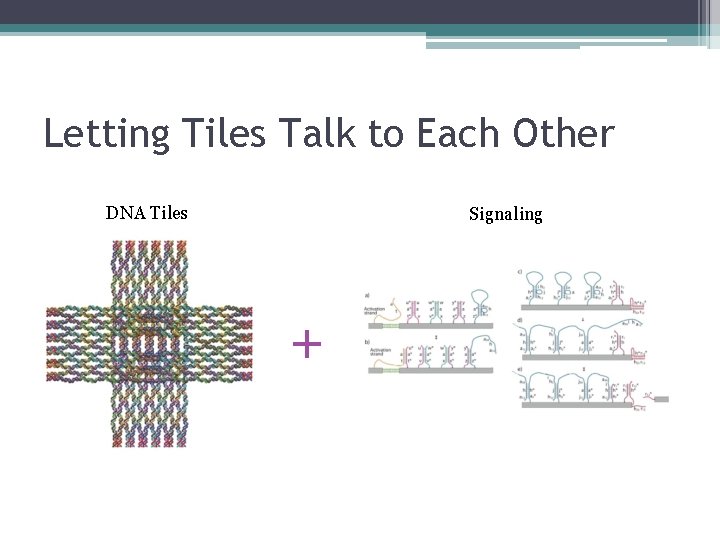
Letting Tiles Talk to Each Other DNA Tiles Signaling +
Active Tile Assembly Model Definitions and Concepts
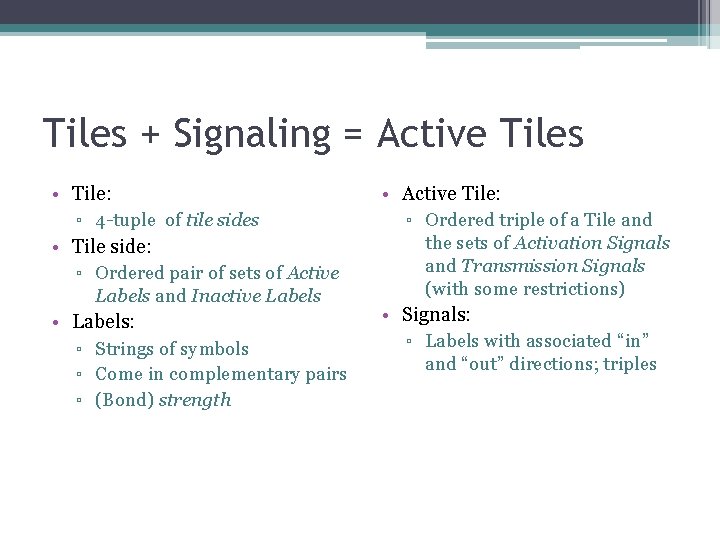
Tiles + Signaling = Active Tiles • Tile: ▫ 4 -tuple of tile sides • Tile side: ▫ Ordered pair of sets of Active Labels and Inactive Labels • Labels: ▫ Strings of symbols ▫ Come in complementary pairs ▫ (Bond) strength • Active Tile: ▫ Ordered triple of a Tile and the sets of Activation Signals and Transmission Signals (with some restrictions) • Signals: ▫ Labels with associated “in” and “out” directions; triples

Tile Assemblies • Tile Assembly Instance ▫ A stable configuration with respect to a set “temperature” ▫ Partial mapping from the integer lattice to the set of all active tiles that �Is connected �The sum of the strengths of the newly formed bonds meets or exceeds the temperature parameter
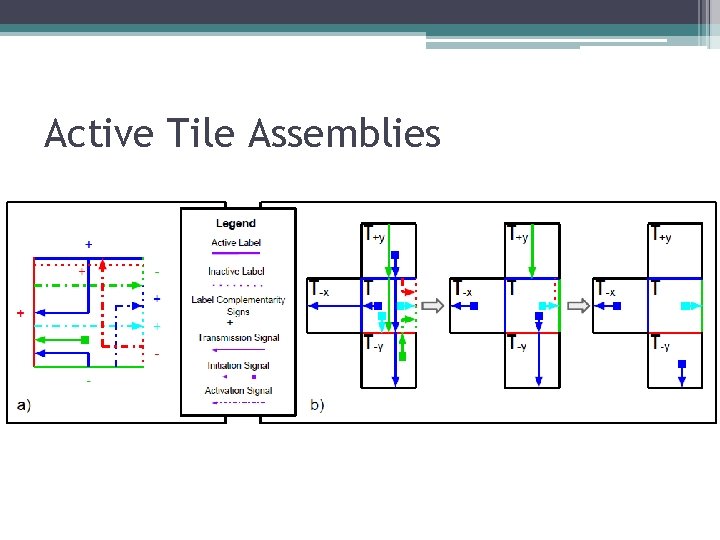
Active Tile Assemblies • What about the signaling? • Tile Modification Function ▫ Allows adjacent tiles to communicate with each other: neighboring tiles can modify themselves as a function of their neighbors ▫ Essentially, a local function for a cellular automaton • What it does: ▫ Activate and remove labels ▫ Modify and remove activation and transmission signals ▫ Can be applied repeatedly to a tile assembly until no more transmissions or activations can be made
Active Tile Assemblies
Hierarchical Tile Assembly • We can define a nested series of active supertile sets: ▫ Begin with a seed set T 0 of unit tiles ▫ Each subsequent set includes �The preceding set �Any tile assembly that can be formed by joining two tile assemblies of the preceding set and repeatedly applying the tile modification function to the result • By specifying the seed set and the temperature, we obtain an Active Tile Assembly System
Simulating Cellular Automata An Active Tile Assembly System Construction
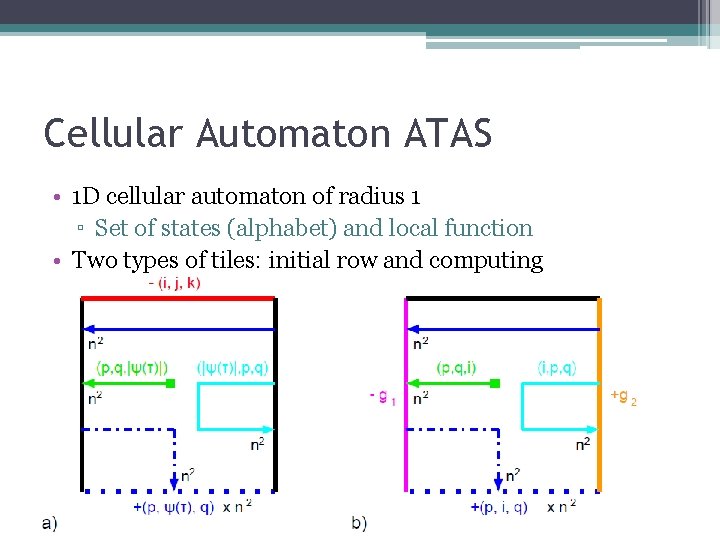
Cellular Automaton ATAS • 1 D cellular automaton of radius 1 ▫ Set of states (alphabet) and local function • Two types of tiles: initial row and computing
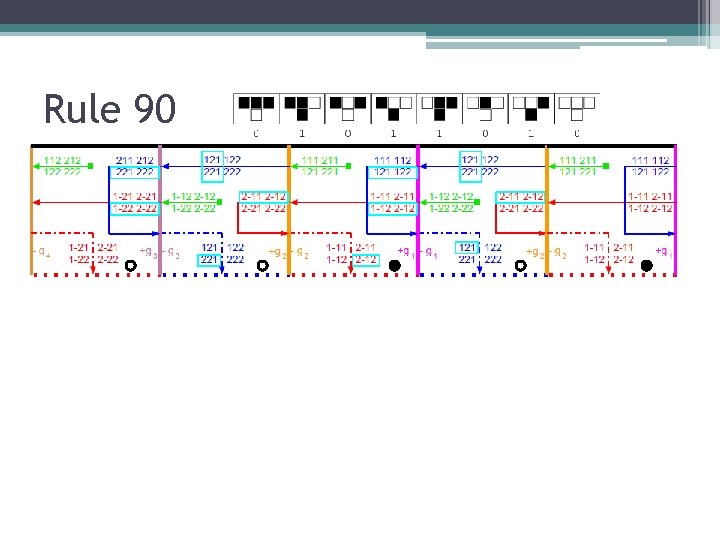
Rule 90
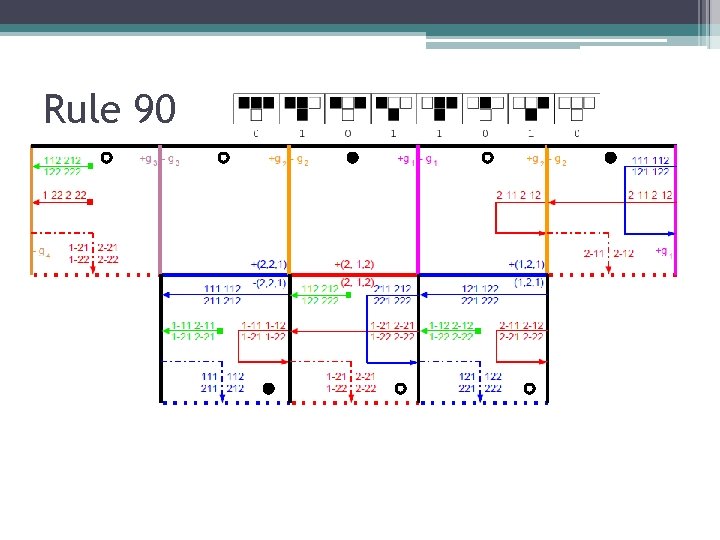
Rule 90
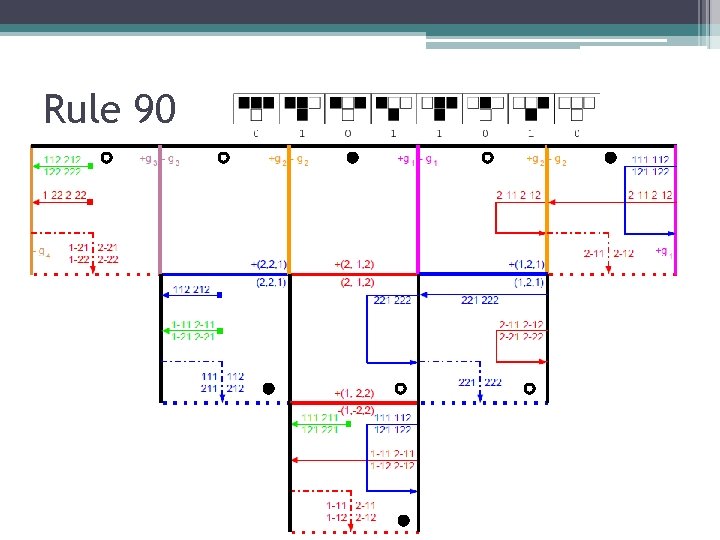
Rule 90
Summary Thank you for your attention!
Summary • We presented a model of active tile assembly ▫ Active Tiles: � Active and Inactive labels � Signals ▫ Tile Modification Function: � Simulates signal transmission and binding site (label) activation ▫ Tile assemblies � “Temperature” parameter determines which configurations are stable ▫ Active Tile Assembly System � Given a seed set and a temperature, obtain a hierarchy of supertile sets • Cellular Automaton Construction ▫ Turing universality at temperature 1 of the Active Tile Assembly Model • Simplifying assumptions with respect to implementation using actual DNA ▫ All signal transmission happens instantaneously ▫ Tile assemblies combine two at a time and they do so if and only if the sum of the strengths of the new bonds formed meets or exceeds the set “temperature” ▫ Tile assemblies do not break apart
Special Thank You To: • Dr. Natasha Jonoska, my wonderful advisor • Jennifer Padilla and her team at NYU, our collaborators

Thank You Everyone! Questions?
References 1. 2. 3. 4. 5. 6. 7. 8. 9. W. B. Sherman and N. C. Seeman. A Precisely Controlled DNA Bipedal Walking Device. Nano. Letters, 4: 1203 -1207, 2004. P. W. K. Rothemund. Folding DNA to Create Nanoscale Shapes and Patterns. Nature, 440(7082): 297 -302, 2006. L. M. Adleman. Molecular Computation of Solutions to Combinatorial Problems. Science, 266(5187): 1021 -1024, 1994. H. Zhong W. Liu, R. Wang, and N. C. Seeman. Crystalline Two-Dimensional DNA Origami Arrays. Angew. Chemie, 50: 264 -267, 2011. E. Winfree. Algorithmic Self-Assembly of DNA. Ph. D. Thesis. California Institute of Technology. 1998. G. Aggarwal, M. H. Goldwasser, M. Y. Kao, and R. T. Schweller. Complexities for Generalized Models of Self-Assembly. Proceedings of the Fifteenth annual ACM-SIAM symposium on Discrete algorithms, p. 889, 2004. U. Majumder, T. H. La. Bean, and J. H. Reif. Activatable Tiles for Compact, Robust Programmable Assembly and other Applications. LNCS 4848: 15 -25, 2008. J. Padilla, W. Liu, N. C. Seeman. Hierarchical Self Assembly of Patterns from the Robinson tilings: DNA Tile Design in an Enhanced Tile Assembly Model. Natural Computing, online first, DOI: 10. 1007/s 11047 -011 -9268 -7, 2011. J. Padilla, M. J. Patitz, R. Pena, R. T. Schweller, N. C. Seeman, R. Sheline, S. M. Summers, and X. Zhong. Asynchronous Signal Passing for Tile Self-Assembly: Fuel Efficient Computation and Efficient Assembly of Shapes. Available on Arxiv: http: //arxiv. org/pdf/1202. 5012 v 1. pdf
- Slides: 23